
Introduction
In February 2025, Örebro Municipality announced that it would discontinue Swedish Sign Language (henceforth STS) as a subject within municipal mother-tongue instruction. The decision concerned instruction intended to support the continued development of STS among students who use it as a first, family, or heritage language. It was particularly striking because Örebro publicly identifies itself as the ‘European Sign Language Capital’ (Örebro Municipality 2016).
The immediate problem was curricular. Sweden has no dedicated national curriculum for STS within mother-tongue instruction. The general curriculum is designed around spoken and written languages and includes content related to pronunciation, stress, intonation, and writing. Teachers have sometimes used the curriculum ‘Sign Language for Hearing,’ but the Swedish National Agency for Education determined that this curriculum could not be used for mother-tongue instruction.
‘Sign Language for Hearing’ is designed for students learning STS as an additional language. Its aims and progression differ from those needed by students who already use STS as a first, family, or heritage language. Additional-language instruction introduces learners to a new language from an existing linguistic base, whereas first- or heritage-language instruction supports increasingly advanced grammatical, narrative, metalinguistic, and academic competence in a language already present in the learner’s repertoire. An additional-language curriculum therefore cannot substitute for mother-tongue instruction in STS. However, the Swedish National Agency for Education cannot develop a dedicated curriculum without an explicit government mandate, which has not been issued despite recent efforts to develop new curricula for Sweden’s national minority languages (Lyxell 2025; SVT 2025).
This curricular gap must also be understood in relation to STS’s legal position. STS is not recognized as one of Sweden’s five national minority languages and is therefore not covered by the rights and protections provided under the Act on National Minorities and Minority Languages (2009:724). The Language Act (2009:600) instead assigns STS a position corresponding to that of the national minority languages. It gives public institutions a special responsibility to protect and promote STS (§9) and states that people who are deaf or hard-of-hearing, or who for other reasons need sign language, should have opportunities to learn, develop, and use it (§14). The absence of an appropriate curriculum illustrates a material consequence of this distinction: formal recognition does not necessarily produce the infrastructure required to develop STS as a first, family, or heritage language.
The Örebro case thus exemplifies a broader contradiction in Swedish language policy. STS is formally recognized, and public institutions are instructed to protect and promote it, yet its legal protection, educational infrastructure, and practical accessibility remain more conditional than those of the national minority languages.
The central argument of this article is that the recurring gap between recognition and provision cannot be explained solely as incomplete implementation of otherwise supportive language policies. It is also shaped by a language-shaming ideology that positions STS as supplementary, disability-related, and dependent on individually assessed need. This positioning allows STS to be acknowledged as a language while remaining less institutionally legitimate than Swedish and less fully protected than the national minority languages.
The aim of this conceptual article is to develop language-shaming ideology as a framework for explaining how this positioning operates across status, acquisition, and attitude planning. The article extends language shaming from a concept primarily associated with practices that devalue languages and their users to a framework for analyzing the ideological organization of institutional practices. It distinguishes language-shaming ideology from overt language-shaming practices, linguistic shame, linguistic discrimination, and the consequences of restricted language access. It also shows how linguistic and ableist assumptions intersect when a natural language is recategorized as a disability-related communication resource.
The discussion draws on Swedish legislation, government inquiries, educational regulations and curricula, public-sector information, and previous research on STS, deaf education, and sign language interpreting. Reagan’s (2010) categories of status, acquisition, and attitude planning organize the institutional domains under consideration. The selected cases illustrate how STS is represented, how its users are positioned, which forms of provision or restriction are made to appear reasonable, and what consequences follow for linguistic access and participation. They are used to develop the explanatory value of language-shaming ideology rather than to provide an exhaustive account of Swedish sign language policy.1
STS as a Natural Language and a Matter of Social Justice
The institutional treatment of STS is shaped by the intersection of linguistic minority rights and disability-related accessibility. Access to the language is therefore not only a matter of communication, but also of language development, participation, and social justice.
Sign languages as natural languages
Sign languages are natural languages that have developed in communities worldwide. They are not universal, and their geographical distributions do not necessarily correspond to national borders (Padden 2024). STS is therefore a distinct language with its own history and linguistic structures, not a manually represented form of spoken Swedish or a generic system of visual communication.
Stokoe’s (1960) analysis of American Sign Language was an important early demonstration that signs consist of smaller linguistic units comparable in structural function, though not in physical form, to those of spoken languages. Subsequent research has established that sign languages have systematic phonological, morphological, syntactic, semantic, and pragmatic organization. They also use modality-specific resources, including space, multiple bodily articulators, simultaneity, and iconicity (Padden 2024; Pfau, Steinbach and Woll 2012).
Natural sign languages must be distinguished from sign-supported systems such as TSS (tecken som stöd, sign-supported speech) and TAKK (tecken som alternativ och kompletterande kommunikation, signs as augmentative and alternative communication). Both use signs, primarily from STS, to support communication organized through spoken Swedish (Roos 2019). They may provide valuable communication support but do not function as independent languages and cannot substitute for sustained access to STS.
Language or communication aid?
In educational, medical, and policy contexts, signed languages have historically been positioned as less legitimate than spoken languages. When deafness is understood primarily as an impairment requiring compensation, STS may be treated as a communication aid introduced when access to speech is insufficient. This perspective has contributed to educational policies that prioritized spoken language and discouraged or prohibited signing, representing signed languages as inferior alternatives to be used only when spoken-language approaches were unsuccessful.
The distinction between language and gesture has not been socially neutral. Forms classified as linguistic have generally been accorded greater legitimacy than those classified as gesture (Kendon 2008). Establishing signed languages as languages was therefore important not only to linguistic classification but also to their recognition as legitimate means of education, knowledge development, and abstract thought.
That STS contributes to accessibility does not make the language an assistive device. Spoken languages likewise provide access to education, employment, public services, and cultural participation without being classified as aids. Sign language interpreting illustrates the distinction: interpreting may constitute an accessibility measure, but the language being interpreted does not. Treating STS as an aid rather than a language narrows the recognition of deaf people’s cultural and collective linguistic rights and supports an individualized, needs-based model in which access depends on assessed need. The distinction therefore affects not only terminology but also institutional responsibility, resource allocation, and opportunities to learn, develop, and use STS.
Deaf people’s dual-category status
Deaf people may be positioned both as members of a linguistic and cultural minority and as people protected by disability-related rights. These categories are not mutually exclusive. Deaf people may hold individual and collective linguistic rights while also requiring accessibility measures in a society organized predominantly around hearing and spoken communication. Alerting systems, visually accessible educational environments, and sign language interpreting do not diminish their linguistic-minority status or transform STS into an assistive device.
De Meulder and Murray (2017) describe this as deaf people’s dual-category status. Although both categories can provide recognition, rights, and resources, they do not necessarily receive equal institutional weight. When the disability category dominates, STS may be understood primarily as a response to impairment rather than as a language with cultural, educational, and societal functions.
This displacement can be reinforced by ableism, which privileges hearing, speech, and auditory participation and may treat learning to speak as preferable to using a signed language (Hehir 2002; O’Connell 2024). Spoken-language use then becomes the expected outcome, while access to STS is justified primarily by demonstrated difficulty with speech. STS consequently appears to result from individual impairment rather than from membership in a linguistic community or the value of multilingualism.
Haualand and Holmström (2019, 112) suggest that dual-category status may help explain why language recognition and language shaming occur together in relation to signed languages. Disability policy can provide essential accessibility measures while reinforcing an understanding of STS as a specialized response to individual need. Conversely, a linguistic-minority framework alone may overlook necessary accessibility measures. A social-justice approach must therefore recognize both dimensions without allowing disability-related categorization to displace linguistic rights.
Early language access and social justice
Early access to a fully accessible language is important for children’s linguistic, cognitive, emotional, and social development. However, approximately 90 to 95% of deaf and hard-of-hearing children are born to hearing parents who do not know the national sign language (Mitchell and Karchmer 2004). Unlike children born into signing families, many deaf children therefore depend on institutional support for access to STS, including opportunities for family members to learn the language, contact with fluent signers, and signing environments in preschool and school (Holmström 2022).
Access to spoken language varies among deaf and hard-of-hearing children and cannot be inferred solely from hearing technologies, medical assessments, or progress in speech. Insufficient access to a fully accessible language during developmentally significant periods may create a risk of language deprivation and associated developmental consequences (Glickman and Hall 2018; Gulati 2018). The concept is used here cautiously, not as an assumed characterization of deaf children, but to highlight the possible consequences of delayed or conditional language access.
Early access to STS is a matter of social justice. It should not depend solely on professional assessments, disability-related categories, family resources, geographical location, or prior difficulty with spoken language. When access is organized through such conditions, opportunities to acquire and develop STS become unequally distributed. The positioning of STS as supplementary or need-dependent consequently affects both how the language is valued and who is given sustained opportunities to learn, develop, and use it.
From Language-Shaming Practices to Language-Shaming Ideology
Language ideology
Language ideologies are socially situated representations and assumptions about language, its users, and its relationship to identity, knowledge, morality, and social order. They may be explicit or implicit and are reproduced not only through individual beliefs but also through institutional classifications, policies, and communicative practices. For example, Silverstein (1979) described them as beliefs expressed by users to justify perceived language structures and uses. Irvine (1989) expanded this view by including cultural, moral, and political aspects, highlighting that language ideologies are connected to social inequality and material conditions. Additionally, Woolard and Schieffelin (1994) noted that language ideologies link linguistic practices to social power and politics. Language hierarchies may consequently reproduce broader social inequalities, with dominant groups shaping linguistic norms and determining which languages and forms of language use are treated as legitimate (e.g., Shohamy 2006; Wodak 2011).
Conceptualizing language-shaming ideology
Piller (2017) uses language shaming to describe media campaigns and face-to-face interactions that deride, disparage, or demean particular ways of using language. She also proposes it as a lens for examining linguistic subordination, domination, and (de)valorization. Such practices may stigmatize languages and their users and contribute to diminished self-worth and social alienation.
Building on Piller, I define language-shaming ideology as a socially and institutionally distributed system of assumptions through which languages, modalities, and users are positioned as deficient, supplementary, or less legitimate. This ideology may question a language’s legitimacy, shift responsibility for language acquisition to individuals, associate language use with competence or normality, or treat formal recognition as sufficient despite inadequate resources for learning, developing, and using the language.
Language-shaming ideology is not inferred from a single expression, classification, or policy outcome. It becomes analytically relevant when recurring representations position a language or modality as deficient, exceptional, or of reduced legitimacy; position its users as individually responsible for overcoming the resulting disadvantage; and make restricted recognition or provision appear appropriate. The concept therefore traces a relationship between representation, institutional arrangement, and consequence. Its explanatory value lies in showing how policies that formally recognize or promote a language may nevertheless reproduce assumptions that limit who is entitled to acquire, develop, and use it.
In relation to STS, language-shaming ideology takes a modality-specific form by recategorizing a visual language as a compensatory resource associated with bodily impairment. Linguistic rights may consequently be reframed as disability accommodations, while language access becomes contingent on disability-related categorization or professionally assessed need. STS can thus be recognized as a language in principle while being institutionally treated as a specialized resource. The ideology may be reproduced not only through overt criticism but also through classifications, eligibility criteria, policy arrangements, and resource allocation.
The conceptual contribution is thus not to redefine all language shaming as ideology. Language-shaming practices remain concrete acts of disparagement, whereas language-shaming ideology identifies the broader assumptions that make such practices and related institutional arrangements intelligible and legitimate. In the case of STS, the framework explains how linguistic subordination can operate without denying that STS is a language: recognition is retained, but the language is recategorized as specialized, compensatory, and conditionally available.
This modality-specific ideology intersects with, but is not synonymous with, ableism. Ableism privileges particular bodily, sensory, and communicative capacities and constructs others as deficient or requiring compensation (Campbell 2009; Goodley et al. 2019). In relation to deaf people, it may privilege hearing and speech over signed language (Hehir 2002; O’Connell 2024). Ableism associates STS with bodily impairment, while language-shaming ideology translates that association into conditional linguistic recognition and provision.
Distinguishing ideology, practice, shame, and discrimination
Language-shaming ideology must be distinguished from language-shaming practices, linguistic shame, and linguistic discrimination. Language-shaming practices are concrete acts that disparage particular ways of using language or the people who use them, while linguistic shame refers to feelings of embarrassment, inferiority, or self-reproach associated with one’s language use (Gallegos 2023). Linguistic discrimination concerns unequal treatment or access to rights, resources, and participation on linguistic grounds and may operate interpersonally or institutionally. Its structural dimension is related to Skutnabb-Kangas and Phillipson’s (1995) concept of linguicism. Whereas linguicism foregrounds the unequal distribution of power and resources between groups defined by language, language-shaming ideology focuses more specifically on the representations through which particular languages, modalities, and users are positioned as less legitimate or less entitled to provision. Ableism and language-shaming ideology may inform or legitimize such discrimination, but these ideological formations should not be equated with discriminatory arrangements or their consequences. A recent critical discourse analysis of Swedish governmental documentation similarly identifies ableism, linguicism, and discursive discrimination in the ambiguous recognition of STS (Larsdotter, Lyngbäck and Johansson 2025). Applied to STS, these distinctions help explain how formal recognition can coexist with conditional provision, restricted opportunities for language development, and unequal participation.
Examining Language-Shaming Ideology across Language-Planning Domains
Reagan’s (2010) framework for sign language planning distinguishes among status, corpus, acquisition, and attitude planning. This article focuses on status, acquisition, and attitude planning because it examines the institutional recognition, provision, and social positioning of STS rather than interventions in its linguistic structure. Reagan’s categories organize the institutional domains under discussion, while language-shaming ideology explains how STS can be formally recognized yet remain conditionally provided and institutionally subordinated.
The analysis uses selected examples from Swedish legislation, government inquiries, educational policy, public-sector information, and previous research to trace connections among representations of STS, the positioning of its users, the institutional arrangements these representations legitimize, and their consequences for language access and participation. The examples do not constitute an exhaustive or systematically sampled account of Swedish sign-language policy, nor does the analysis assume an intention to shame STS users. Overtly demeaning acts are treated as language-shaming practices, whereas policies, classifications, eligibility criteria, and institutional routines are examined in terms of the assumptions and arrangements they reproduce. Following analysis of the three planning domains, a final cross-cutting section examines how the same institutional logic shapes the organization and funding of sign language interpreting.
Status planning
Status planning concerns a language’s social and institutional standing, including its official recognition, use, and perceived legitimacy. For STS, measures that have strengthened the language have coexisted with representations that position it as a disability-related communication resource.
The precise origins of STS remain unclear. However, the establishment of schools for deaf children in Sweden, beginning in 1809, brought deaf children into sustained contact with formal instruction and with each other and contributed to the transmission and development of the language. By the late nineteenth century, educational policy had shifted toward oralism, prioritizing spoken Swedish and restricting STS (Svartholm 1984). Deaf schools thus played a contradictory role: they enabled STS to develop while imposing an educational model that treated signing as an obstacle to participation in hearing society.
Oralism involved explicit linguistic policing. Students nevertheless continued to use STS among themselves when staff members could not see them, enabling its transmission to new generations (Svartholm 1984). This represents a clear language-shaming practice because institutional control restricted where and by whom STS could be used. The students’ continued signing simultaneously demonstrates linguistic agency and resistance.
A government inquiry in the late 1970s recognized ‘sign language,’ although not specifically ‘Swedish Sign Language,’ as the language of the deaf community and advocated bilingual education (SOU 1979:50). In 1981, a brief statement in an appendix to a government budget proposal subsequently approved by Parliament stated that deaf people should master both their visual/manual language and Swedish (Utbildningsdepartementet 1980, Proposition 1980/81:100). Although limited in form, the statement marked an important change from oralism. A curriculum introduced in 1983 subsequently helped establish sign-bilingual education and strengthened the institutional position of STS.
The statement in the 1981 budget appendix later came to be widely interpreted as Sweden’s ‘official recognition’ of STS. However, it did not constitute separate legislation specifically recognizing STS or grant the language a formally defined legal status. A recent critical discourse analysis of the relevant parliamentary documentation reaches a similar conclusion, showing how the later construction of an official recognition rested on indirect references and ambiguous, non-binding formulations (Larsdotter, Lyngbäck and Johansson 2025). This distinction became important when the deaf community subsequently sought recognition of STS as a national minority language.
In the 1990s, a government committee considered which languages should be included when Sweden ratified the European Charter for Regional or Minority Languages (SOU 1997:192). The criteria emphasized traditional use, historical continuity, and geographical concentration, although territorially unbound languages could also qualify.
The territorial criterion is particularly consequential for signed languages. Because most deaf children are born into hearing families, signing communities are not reproduced primarily through territorially concentrated intergenerational transmission. Their continuity has often depended instead on schools, associations, and social networks that bring deaf people together. The Swedish National Association of the Deaf argued that STS should be recognized within this latter category, but the committee rejected the claim and described sign language as a ‘communication tool for the deaf, enabling communication despite their handicap’ (SOU 1997:192, p. 95, my translation).
This formulation represents STS primarily through its compensatory function. It presupposes hearing and spoken communication as norms and positions deaf people as individuals requiring support rather than as members of a linguistic community. The policy issue consequently becomes how to facilitate communication for people categorized through disability, rather than how to protect and promote a collectively held language.
At the same time, the committee treated the 1981 statement as sufficient recognition, asserting that sign language already held ‘a strong position in Swedish society’ and that Sweden had become ‘the first country in the world to officially recognize sign language as the mother tongue of the deaf’ (SOU 1997:192, pp. 94–95, my translation). It therefore concluded that further legislation was unnecessary. STS was thus represented as sufficiently recognized to require no additional legal protection while simultaneously being framed as a disability-related communication tool rather than as a minority language. Symbolic recognition justified institutional inaction, while the compensatory representation made exclusion from the minority-language framework appear reasonable.
This reasoning reproduces a modality-specific language-shaming ideology. Its significance does not depend on an intention to demean STS or its users. By recategorizing a visual language as a compensatory resource, the inquiry positioned deaf people as recipients of support rather than holders of collective linguistic rights. Recognition remained conditional and did not entail the legal classification or rights granted to national minority languages.
A later inquiry noted that STS had not benefited from the enhanced status granted to Sweden’s national minority languages and recommended that it receive a corresponding position (SOU 2006:54). The Language Act adopted in 2009 (SFS 2009:600) subsequently assigned STS a corresponding position but did not recognize it as a national minority language. It required public institutions to protect and promote STS but formulated individual access in relation to people ‘in need of sign language.’ The Act therefore strengthened the formal position of STS while retaining an individually needs-based approach to its acquisition and use.
Status planning for STS cannot be described as either straightforward progress or continuous exclusion. Oralism, bilingual education, the 1981 decision, the minority-language inquiries, and the Language Act represent different approaches, several of which substantially strengthened STS. Yet they repeatedly separated recognition from corresponding rights and institutional provision. Language-shaming ideology helps explain this pattern: explicit restrictions and disability-related classifications have coexisted with measures intended to promote STS.
Acquisition planning
Acquisition planning concerns measures that create opportunities to learn, use, and develop a language. Because most deaf and hard-of-hearing children are born to hearing parents who do not know STS, acquisition must be supported through family learning, contact with fluent signers, and signing environments in preschool and school.
Hearing parents may attend introductory courses through habilitation services and the state-funded Teckenspråksutbildning för föräldrar (Sign Language Training for Parents) (TUFF) program, which provides up to 240 hours of STS instruction. TUFF is intended for parents of children considered to ‘need sign language for communication’ and aims to provide skills for functional communication with their children (SFS 1997:1158, §§1–2; SOU 2006:54). It is an important acquisition-planning measure because parents cannot be expected to provide access to STS without opportunities to learn the language themselves. However, the absence of clear criteria for determining which children need STS makes eligibility dependent on assessments of the individual child.
This organization frames STS as a targeted intervention rather than a general linguistic opportunity. It gives professionals considerable authority to determine the language’s relevance and may make access dependent on predictions about the child’s ability to communicate through spoken Swedish. STS is thereby positioned primarily as a response to communication difficulty rather than as a language that may support bilingual development, family communication, participation in a signing community, and future linguistic choice.
TUFF also illustrates the difference between functional communication and sustained language development. Although 240 hours may provide parents with a valuable introduction to STS, parents are learning an additional language while their children need opportunities to develop increasingly complex narrative, social, emotional, and academic competence. Family training must therefore be complemented by contact with fluent signers and sustained signing environments.
Many parents do not use the full allocation of TUFF hours, with some using only approximately 50 hours. Reported reasons include stronger-than-expected spoken-language development, the child not responding in STS, saving hours for later, illness, competing commitments, and difficulties arranging childcare (Branting 2015; Holmström 2022). This pattern does not demonstrate that STS is unimportant or that further provision is unnecessary. Rather, it illustrates the difference between formal availability and substantive accessibility: course design, timing, practical circumstances, and professional expectations regarding spoken-language development all shape parents’ participation.
Parents’ decisions should therefore not be treated as individual language-shaming practices. They are made in contexts in which progress in spoken Swedish may be presented as reducing the need for STS. When speech is treated as the desired outcome and STS primarily as support when speech is insufficient, discontinuing STS learning may appear reasonable. Ableism privileges spoken-language development, while language-shaming ideology positions STS as supplementary and potentially dispensable.
Because family courses alone cannot provide children with sustained access to fluent STS, preschools have an important complementary role. However, surveys show that relatively few preschools attended by deaf and hard-of-hearing children offer sustained sign-bilingual environments in both STS and Swedish (Lyxell 2014, 2021). The preschool curriculum calls for support for children who are deaf or hard-of-hearing, or who ‘for other reasons are in need of sign language’ (Utbildningsdepartementet 2018). In practice, signs or STS may be used intermittently rather than as a sustained language of interaction, learning, and peer communication. Thus, although both TUFF and the preschool curriculum formally promote STS, children’s opportunities to develop the language remain limited by assessed need, restricted parental instruction, and the uneven availability of signing environments.
The distinction between sustained access to STS and more limited visual communication support is also relevant to the use of Tecken som stöd (Signs as Support) (TSS) and Tecken som Alternativ och Kompletterande Kommunikation (Signs as Alternative and Augmentative Communication) (TAKK) in preschool and family contexts. As discussed earlier, these systems use signs to support communication organized through spoken Swedish and may be valuable for some children. The concern is not their use as such, but their use as substitutes for opportunities to acquire STS. Preschools and parents may prefer TSS or TAKK because adults who already know Swedish can more easily integrate them into communication (Holmström 2022). However, treating sign-supported Swedish as equivalent to STS obscures the difference between visual support for a spoken language and access to an independent natural language. Children may consequently receive visual support without sustained access to the grammatical, discursive, cultural, and social resources of STS.
Beyond preschool, acquisition planning also determines children’s access to STS during the school years. State-funded special schools provide sign-bilingual environments with opportunities for instruction, peer interaction, and language development in both STS and Swedish. Admission is not automatic, however. The Special School Admission Board considers the child’s hearing status and assessments from educational, psychological, medical, and social-work professionals before determining whether the child ‘requires bilingual education in a sign language environment’ (SFS 2010:800; SFS 2011:130).
The admission process places access to an STS-rich educational environment within the same needs-based framework. Eligibility depends on whether professional assessments justify placement outside mainstream education, not on whether a child could benefit from sustained bilingual education. Mainstream schooling organized around spoken Swedish remains the unmarked norm, while sign-bilingual education becomes an exceptional option contingent on documented need. Families therefore cannot freely choose between comparable linguistic environments.
Acquisition planning for STS consequently contains a central paradox. TUFF, preschool provisions, and sign-bilingual special schools constitute significant efforts to support STS, yet children’s access remains dependent on family participation, professional assessments, geographical availability, and admission to specialized environments. The relevant problem is therefore not the absence of acquisition planning but how access is organized.
Language-shaming ideology helps explain how measures intended to promote STS may simultaneously restrict its acquisition. Across these measures, spoken Swedish and mainstream education remain institutionally unmarked, while STS is provided through identified communication needs and disability-related categories. Access may therefore be conditional, time-limited, geographically uneven, or dependent on specialized settings. The consequences concern not only the status of STS but also which children and families receive sustained opportunities to acquire, develop, and use it.
Attitude planning
Attitude planning concerns efforts to influence how a language and its users are perceived and valued through education, public information, professional terminology, and institutional classification. In relation to STS, it must address not only overtly negative beliefs but also routine classifications that reproduce spoken Swedish as the unmarked norm and represent STS as a specialized disability-related resource.
One example is the frequent use of the generic term ‘sign language’ rather than ‘Swedish Sign Language.’ Although appropriate when referring to signed languages collectively, the generic term can obscure STS as a distinct language when used in specifically Swedish contexts. It may also conceal linguistic diversity among deaf migrants who use other signed languages. Such usage is not necessarily a language-shaming practice, but it may reproduce language-shaming ideology by representing signed communication as a uniform accessibility tool rather than recognizing distinct languages.
Institutional websites provide a more explicit example of such classification. In Figure 1, ‘Teckenspråk (“Sign Language”)’ is presented alongside ‘Lyssna (“Listen”)’ and ‘Lättläst (“Easy Read”)’, separately from options such as ‘Engelska (“English”)’ and ‘Språk (“Languages”)’. Easy Read and listening functions are not themselves problematic. The relevant issue is that STS is classified as an accessibility option rather than as one of the languages in which public information is provided. This taxonomy positions STS users primarily as recipients of accommodation rather than as members of a linguistic community. Information in STS may consequently appear to be an exceptional service, dependent on resources and demand, rather than part of an institutional responsibility to communicate in different languages.
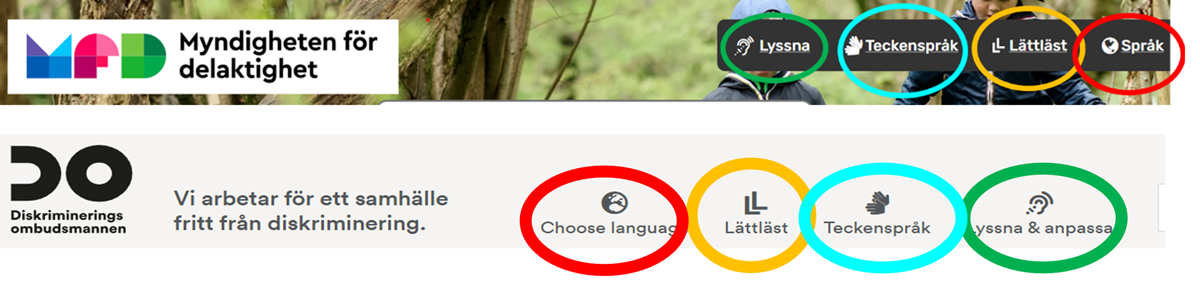
Figure 1
Institutional classification of STS on two Swedish government websites. In both interfaces, ‘Sign Language’ is presented as a separate accessibility option rather than under ‘Languages’. Sources: Swedish Agency for Participation, https://www.mfd.se/; Equality Ombudsman, https://www.do.se/ (accessed September 25, 2025). Swedish labels translated by the author.
The examples are particularly noteworthy because they come from the Swedish Agency for Participation and the Equality Ombudsman, whose responsibilities include participation, accessibility, and equal treatment. They do not demonstrate an intention to diminish STS. Rather, they show how institutional classifications can reproduce its positioning as an accessibility measure while spoken and written languages remain the unmarked members of the category ‘Languages’.
Educational terminology reflects a similar pattern. STS subjects are named ‘Sign Language for Hearing Students,’ ‘Sign Language for Deaf and Hard-of-Hearing Students,’ and ‘Sign Language for Deaf and Hard-of-Hearing Students with Intellectual Disabilities.’ Unlike other language subjects, these titles classify the language through learners’ bodily or sensory characteristics rather than their linguistic backgrounds, proficiency, or educational goals. They therefore associate access to STS with particular groups instead of representing it as a language that can be learned at different levels and for different purposes.
Hearing status alone also fails to distinguish among a hearing child who has acquired STS from deaf parents, a deaf child with delayed access to STS, and a hearing additional-language learner. A language-oriented model would instead consider prior exposure, proficiency, developmental needs, and whether STS is learned as a first, family, heritage, or additional language. The existing titles do not themselves constitute language-shaming practices, but they may reproduce an ideology that treats spoken languages as general educational subjects while connecting STS to specially defined bodily categories.
Professional interpreting terminology provides another example. Institutions may use expressions equivalent to ‘sign interpreter’ or ‘deaf interpreter’ rather than ‘sign language interpreter’ or another contextually appropriate designation. Figure 2 illustrates this through the expression ‘döv tolk bokad,’ literally ‘deaf interpreter booked,’ used in a healthcare setting in Örebro.
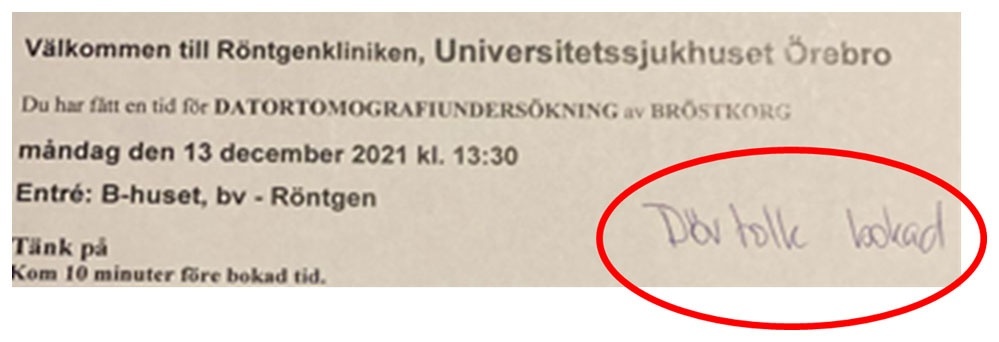
Figure 2
Terminology in a written appointment notice from the radiology clinic at Örebro University Hospital. The circled note reads ‘döv tolk bokad’, literally ‘deaf interpreter booked.’ The example illustrates how the interpreting service is identified through the patient’s deafness rather than through the languages involved or the professional service provided. The notice has been cropped and de-identified by the author.
The recurring phrase ‘in need of sign language’ provides a final link between attitude, status, and acquisition planning. The phrase frames STS primarily as an assessed need rather than as a matter of family affiliation, cultural participation, educational benefit, or multilingualism. It also gives professionals substantial authority to determine who qualifies for access. Needs-based provision is not inherently inappropriate, but problems arise when need becomes the principal basis for understanding the relationship between individuals and STS. The language may then appear unnecessary while spoken communication seems successful and be delayed or treated as a last resort.
A rights- and benefit-oriented approach would complement rather than eliminate consideration of individual needs. It would recognize the value of STS across the life course and not require access to be justified solely through impairment. Attitude planning must therefore address not only general perceptions of STS but also the institutional categories through which it is named, taught, provided, and funded.
Language-shaming ideology explains the common pattern across these examples. STS is represented as generic rather than linguistically distinct, placed outside ordinary language categories, connected to bodily characteristics, and made available through assessed need. These representations position deaf people as recipients of specialized support and can legitimize conditional provision. Attitude planning can challenge this pattern by naming STS consistently as a distinct language, recognizing linguistic diversity, organizing education according to linguistic background and proficiency, and describing interpreting as mediation between languages.
This institutional positioning becomes particularly consequential in the organization and funding of sign language interpreting, which the following section examines.
Sign Language Interpreting, Accessibility, and Social Justice
Recognizing deaf people as members of a linguistic minority does not eliminate the need for disability-related accessibility measures. Swedish society is organized predominantly around spoken Swedish, and many professionals and public officials do not know STS. Sign language interpreting therefore remains essential when participants do not share a language. However, interpreting should not be treated as a ‘quick fix’ that relieves institutions of broader responsibility for linguistic access and inclusion (De Meulder and Haualand 2021).
The distinction between STS and interpreting is fundamental. STS is a natural language, whereas interpreting is a professional service that mediates between users of different languages. The service may constitute a disability-related accessibility measure, but the language being interpreted does not. Nevertheless, because publicly funded interpreting is generally organized within a disability-services framework, access to communication remains dependent on deaf people being classified as requiring disability-related support.
For many deaf STS users, acquiring spoken Swedish cannot eliminate the need for interpreting because spoken communication may remain only partly or inconsistently accessible. Long-term use of interpreting should not be understood as a failure to learn the majority language or as a temporary need that will eventually disappear (cf. Duggan 2024). Rather, it reflects the conditions of participation in a society where institutions and professionals do not widely use STS.
Responsibility for sign language interpreting in Sweden is divided among national, regional, and municipal authorities, which can make access complex and unpredictable (Holmström and Bagga-Gupta 2021). Regions are generally responsible for interpreting in everyday situations, but limited resources may lead them to prioritize certain activities. Healthcare appointments, for example, may receive higher priority than cultural, civic, or leisure activities.
Such prioritization affects self-determination. When authorities determine which situations are sufficiently important to justify interpreting, deaf people have less freedom than hearing people to decide which activities and relationships matter in their lives. Access to healthcare may reasonably be prioritized as urgent, but social justice also concerns opportunities to participate in cultural, social, and political life, form relationships, and exercise personal choice.
The funding of interpreting may also create inequalities in employment. In some circumstances, responsibility for interpreting costs falls on employers or on deaf professionals themselves, particularly those who are self-employed (Holmström and Bagga-Gupta 2021). When these costs are attributed to the deaf employee rather than to the multilingual interaction or the workplace’s reliance on spoken Swedish, the employee may be construed as unusually costly. This can create disadvantages in recruitment, employment, professional development, and entrepreneurship.
This distribution of responsibility illustrates the interaction between ableism and language-shaming ideology. Ableism establishes hearing and spoken communication as the ordinary conditions of participation, while language-shaming ideology positions STS as a specialized resource required by particular individuals. Interpreting costs are consequently associated with the deaf person rather than understood as a shared institutional responsibility for communication between users of different languages. The problem is not interpreting itself, but how the service is classified, funded, prioritized, and provided.
The Swedish Discrimination Act (Arbetsmarknadsdepartementet 2008:567) prohibits direct and indirect discrimination and recognizes inadequate accessibility as a form of discrimination. Inadequate accessibility occurs when reasonable measures have not been taken to place a person with a disability in a situation comparable to that of people without that disability. What is considered reasonable depends on applicable accessibility requirements, financial and practical circumstances, and the nature and duration of the relationship between the individual and the organization.
The Act provides an important framework for challenging exclusion but does not establish an unconditional right to every requested measure. Access to interpreting may consequently depend on its cost and practical feasibility, the activity involved, and the relationship between the parties. Apparently neutral assessments of reasonableness may therefore produce unequal opportunities for STS users. If interpreting is considered disproportionate or unnecessary, deaf people may be excluded from employment, education, services, or public participation despite formal protection against discrimination.
Not every denial of interpreting constitutes language shaming or unlawful discrimination. These concepts concern different analytical levels. A particular decision may constitute discrimination if it results in unequal treatment or inadequate accessibility under the law. Language-shaming ideology is relevant to the broader representation of STS and its associated costs. When interpreting is classified primarily as an individualized disability-related expense rather than as mediation between users of different languages, restricted provision may appear reasonable and institutionally neutral.
Sign language interpreting thus reveals the same contradiction identified throughout this article. STS is recognized as a language, and interpreting services facilitate participation, yet access remains conditional on administrative responsibility, prioritization, funding, and assessments of reasonableness. Interpreting is essential, but it cannot substitute for increased direct provision in STS or for broader institutional responsibility for linguistic access. Social justice requires both adequate interpreting services and a redistribution of responsibility for communication in a society organized predominantly around spoken Swedish.
Final Remarks
This article has developed language-shaming ideology as a framework for explaining how the formal recognition of STS can coexist with its continued institutional subordination. The concept extends the analysis of language shaming beyond overt acts that disparage languages or their users to include the assumptions reproduced through institutional classifications, policies, eligibility criteria, and resource allocation. It should not be equated with language-shaming practices, linguistic shame, ableism, or linguistic discrimination, although these phenomena may intersect.
Across status, acquisition, and attitude planning, the analysis has identified a recurring distinction between recognizing STS as a language and providing the rights, resources, and institutional infrastructure consistent with that recognition. Swedish language-planning measures have substantially strengthened the position of STS through bilingual education, family language courses, legal recognition, sign-bilingual educational environments, and interpreting services. At the same time, access to the language remains frequently organized through disability-related categories, professional assessments, and individually demonstrated need. Spoken Swedish and hearing participation consequently remain institutionally unmarked, while STS is positioned as a specialized resource that becomes relevant when spoken-language access is considered insufficient.
This pattern does not depend on institutional actors consciously intending to demean STS or its users. Language-shaming ideology may be reproduced when classifications and arrangements make conditional provision appear appropriate, proportionate, or neutral. Its consequences concern not only the status of STS but also who receives sustained opportunities to acquire, develop, and use the language and who can participate in education, employment, public services, and social life on equitable terms.
Advancing social justice therefore requires more than formal recognition or positive attitudes toward STS. It requires institutional arrangements that recognize both deaf people’s linguistic rights and their need for disability-related accessibility measures, without allowing the latter to displace the former. This includes sustained opportunities for children and families to learn and develop STS, educational environments that support different linguistic backgrounds and proficiency levels, adequate interpreting services, and a broader distribution of responsibility for linguistic access. STS should not have to be justified primarily through demonstrated failure in spoken communication; it should be supported as a natural language, a collectively held linguistic resource, and a basis for participation in Swedish society.
Note
[1] This article is based on and further developed from the chapter ‘I kläm mellan språkpolitik och språkskamning’ written in Swedish, by Holmström, in the book ‘Sveriges nationella minoritetsspråk—nya språkpolitiska perspektiv’, edited by Tommaso M. Milani and Linus Salö (2023).
Use of AI
AI was used in the initial manuscript to help correct and improve the English language. During revision, Microsoft 365 Copilot, based on the GPT-5 reasoning model (Microsoft, accessed August 2026), was used as an editorial support tool to review author-written sections and suggest clearer organization, shorter formulations, improved transitions, and more precise English expression. The tool was not used to conduct the analysis, select the empirical examples, determine the article’s conclusions, or assume responsibility for source verification. The author assessed and revised all suggestions, verified the manuscript and references, and takes full responsibility for the submitted article.
Author Note
Ingela Holmström is Professor of Sign Language with a focus on bilingualism and deputy head of the Department of Linguistics, Stockholm University, Sweden. Her research is directed toward communication issues in the interaction between deaf, hard-of-hearing, and hearing people both in and outside school contexts. She has a special interest in how language ideologies impact deaf people’s participation in Swedish society.