
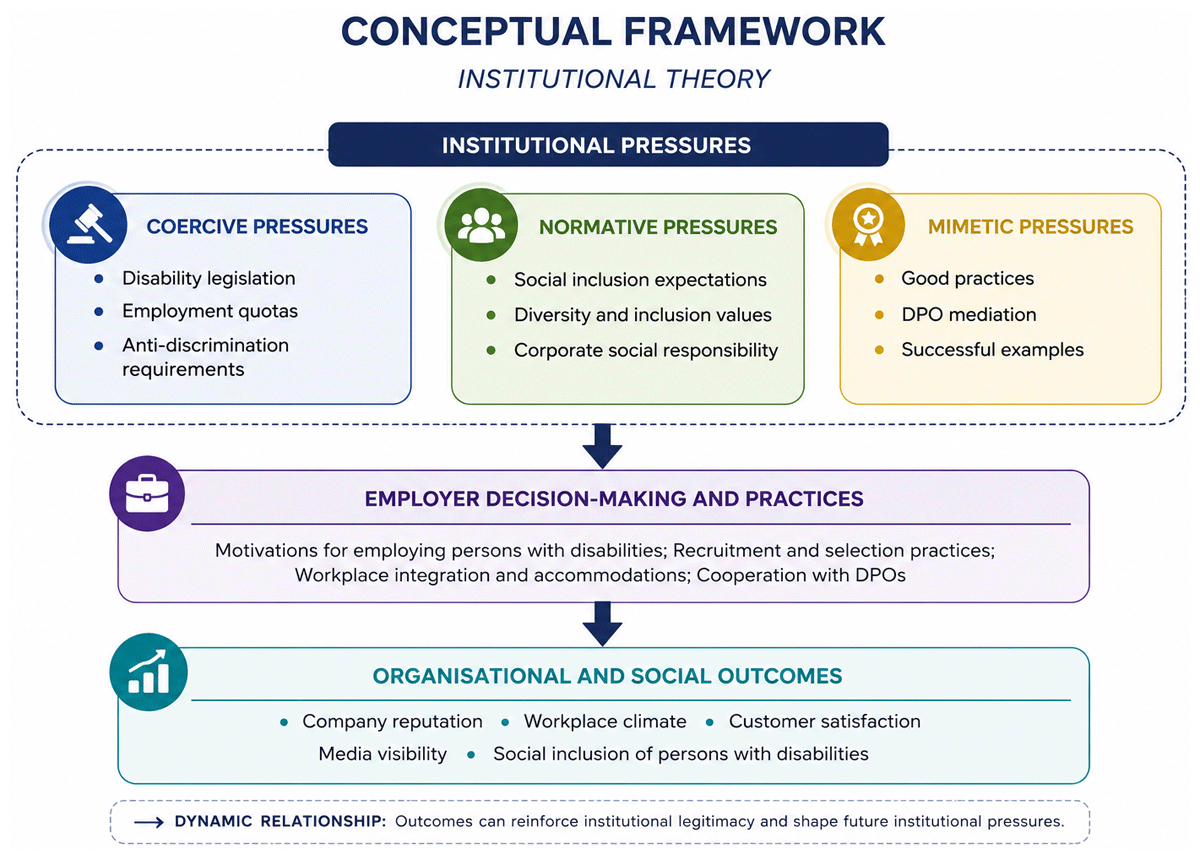
Figure 1
Conceptual framework of disability-inclusive employment from an Institutional Theory perspective.
Table 1
Demographic data of the participants.
| CODE | POSITION | BUSINESS SCOPE | EMPLOYEE’S DISABILITY TYPE |
|---|---|---|---|
| Emp-A | Manager | Gastronomy | Intellectual disability |
| Emp-B | Manager | Gastronomy | Physical disability |
| Emp-C | Manager | Gastronomy | Intellectual disability |
| Emp-D | Manager | Retail | Intellectual disability |
| Emp-E | Manager | Retail | Intellectual disability |
| Emp-F | Sector manager | Retail | Intellectual disability |
| Emp-G | Manager | Pharmacy | Intellectual disability |
| Emp-H | Human resource officer | Retail | Physical disability |
| Emp-I | Manager | Gastronomy | Visual impairment |
| Emp-J | Manager | Retail | Visual impairment |
| Emp-K | Manager | Retail | Blind |
| Emp-L | Supervisor | Retail | Blind |
| Emp-M | Supervisor | Retail | Blind |
| Emp-N | Team leader | Retail | Visual impairment |
| Emp-P | Team leader | Gastronomy | Intellectual disability |
[i] Note: Each code represents one employer.
Table 2
Development of themes, categories and codes.
| THEME | CATEGORY | REPRESENTATIVE CODES |
|---|---|---|
| Theme 1: Inclusion-driven rather than compliance-driven rationales | Promoting social inclusion | Supporting diversity; equal opportunities; social integration; community contribution; setting a positive example |
| Fostering financial independence | Reducing dependence on pensions; economic self-sufficiency; empowerment through employment | |
| Limited influence of legal obligations | Weak enforcement; lack of sanctions; awareness of quota law; compliance not a priority | |
| Theme 2: Negotiating uncertainty in disability-inclusive recruitment | Initial concerns and expectations | Concerns about work performance; concerns about productivity; customer reactions; workplace adaptation |
| Re-evaluating assumptions after employment | Positive work performance; expectations exceeded; adaptation success; reduced concerns | |
| Role of Disabled People’s Organisations (DPOs) | Candidate matching; recruitment mediation; guidance on accommodations; employer support | |
| Limitations of traditional recruitment channels | Lack of applications from persons with disabilities; limited confidence of applicants; need for targeted outreach | |
| Persistent uncertainties and stereotypes | Productivity assumptions; fear of customer reactions; limited prior experience with disability inclusion | |
| Theme 3: Organisational, reputational and social returns of inclusion | Enhanced corporate reputation | Positive public image; social responsibility; community recognition |
| Improved workplace climate | Team solidarity; tolerance; mutual support; positive organisational culture | |
| Increased visibility and media attention | Media coverage; public recognition; showcasing good practices | |
| Customer satisfaction | Positive customer feedback; acceptance of diversity; increased trust and loyalty |