
Introduction
The employment of persons with disabilities is increasingly recognised as a key human rights and social inclusion issue. International frameworks, particularly the United Nations Convention on the Rights of Persons with Disabilities (CRPD), have established employment as a fundamental right and encouraged governments to adopt measures that promote equal labour market participation (United Nations 2006). Nevertheless, significant gaps remain between legal frameworks and their implementation in practice (IDA 2022), suggesting that legal protections alone are insufficient to ensure meaningful labour market inclusion. Employers play a central role in realising these rights, as their attitudes, perceptions and institutional capacities shape employment opportunities for persons with disabilities (Reardon, Unruh & Rowe 2025).
The role of employers is particularly significant because they operate at the intersection of competing expectations and priorities (Jansen et al. 2021). On the one hand, employers are expected to contribute to social inclusion and comply with legal requirements concerning disability rights. On the other hand, they must respond to organisational, financial and operational demands that shape recruitment and workforce management decisions. Consequently, the employment of persons with disabilities may be perceived simultaneously as a legal obligation, a social responsibility and a strategic business decision (Bonaccio et al. 2020). Understanding how employers navigate these potentially competing demands is essential for explaining why disability-inclusive employment practices remain uneven despite increasingly supportive policy environments.
This article examines the perspectives of employers in Kosovo regarding their experiences of hiring persons with disabilities. It focuses on employers’ experiences of workforce diversification and examines the level of preparedness among the business community, co-workers and customers for the integration of persons with disabilities into the labour market. The study explores how employers themselves construct and interpret these experiences within their organisational contexts, rather than assuming that such employment is either inherently beneficial or burdensome.
Literature Review
The foundation for disability rights in employment rests on international human rights law, from the Universal Declaration of Human Rights (United Nations 1948, art. 23) to the CRPD, which provided the first comprehensive framework for protecting persons with disabilities in employment (United Nations 2006). Article 27 of the CRPD recognises ‘the right of persons with disabilities to work, on an equal basis with others’, including the opportunity to gain a living by work freely chosen or accepted in an open, inclusive and accessible labour market (United Nations 2006, art. 27).
Reasonable accommodation is a fundamental component of disability employment rights, referring to necessary and appropriate modifications and adjustments, not imposing a disproportionate or undue burden, that ensure persons with disabilities can exercise their rights on an equal basis with others (United Nations 2006, art. 2). The concept has been incorporated into employment legislation worldwide. In the USA, the Americans with Disabilities Act (ADA) defines discrimination as the failure to make reasonable accommodations for a qualified individual, unless such accommodations would impose undue hardship on the business (Blanck 2022). Similarly, the European Union’s Employment Equality Directive 2000/78/EC qualifies the failure to provide reasonable accommodation that would not impose a disproportionate burden as discriminatory (Ferri and Urzel 2022). The CRPD likewise requires states parties to ensure reasonable accommodation, to treat its denial as discrimination, and to adopt positive measures promoting the employment of persons with disabilities, resting on three core principles: non-discrimination, accessibility of the work environment and the provision of reasonable accommodation (Fasciglione 2015).
The failure to provide reasonable accommodation is qualified as discriminatory because, in addition to enabling persons with disabilities to make a living, equal participation in work is a prerequisite for participation in social life and for leading a dignified life. Although the reasonable accommodation principle has proven effective in facilitating the recruitment, progression and retention of workers with disabilities, in some contexts employers are unwilling to provide these accommodations, resulting in disabled workers facing stigma, discrimination and even job loss when requesting them (Olsen 2024). Recent scholarship continues to emphasise that labour rights remain a central component of disability inclusion, highlighting the importance of institutional accountability and effective protection mechanisms to ensure that formal rights are translated into meaningful employment opportunities (Rym and Simutina 2026; Tsyhanenko 2026).
Disability rights from employers’ perspective
Employers play a critical role in shaping the employment opportunities available to persons with disabilities, as their attitudes and organisational practices directly influence recruitment, workplace inclusion and career development. Research indicates that employers generally express positive attitudes toward hiring persons with disabilities; however, these attitudes do not always translate into actual hiring behaviour. Concerns about workplace accommodations, productivity, supervision requirements and potential legal implications often influence employers’ hiring decisions (Bredgaard and Salado-Rasmussen 2021). In many cases, employers acknowledge the social value of inclusive employment but remain hesitant due to perceived costs or a lack of knowledge about disability inclusion and reasonable accommodations. At the same time, many of these concerns are not supported by empirical evidence, as employees with disabilities often show comparable performance, retention and productivity levels to other employees (Bonaccio et al. 2020). Understanding employers’ perceptions and experiences is therefore essential for identifying barriers and designing policies and interventions that promote equal employment opportunities for persons with disabilities.
Employers’ approaches depend on a complex intertwining of business interests, legal obligations, social responsibility and individual attitudes. Factors identified as influencing hiring decisions include attitudes, job matching, economic incentives, accommodations (Gustafsson, Peralta and Danermark 2014) and prior experience of employing disabled persons (Heera and Devi 2016). Prior experience increases employers’ willingness to hire, yet greater willingness does not necessarily translate into better accessibility and inclusion practices, since employers may rely on assumptions that limit participation in the workplace (Beaton, Kabano and Léger 2012). Organisational characteristics also matter: public and large organisations show the greatest willingness to hire persons with disabilities, as do female employers and employers with a higher level of education (Heera and Devi 2016). Analysing European firms, Jurado-Caraballo and Quintana-García (2026) found that companies with greater female representation on boards of directors and in top management teams were more likely to hire persons with disabilities, highlighting the role of leadership and organisational governance.
Furthermore, employers’ perspectives are influenced by the type of disability and their perceptions of job match, as some employers view certain disabilities or conditions more favourably than others (Zissi et al. 2007). Recent disability scholarship has also emphasised the importance of intersectional perspectives, demonstrating that disability often interacts with other social identities and inequalities, including gender, creating additional barriers to labour market participation and social inclusion (Muchecheti 2026). In terms of business interests, the productivity and economic benefit of the organisation often take priority over human rights (Gustafsson, Peralta and Danermark 2014). Accordingly, the employment of persons with disabilities is positively influenced by financial incentives: many countries apply measures such as tax allowances, competitive funding programmes and subsidies to support companies in providing workplace adaptations and assistive technologies (Nierling et al. 2018). In addition, corporate social responsibility influences the employment practices of persons with disabilities to a considerable extent.
Disability labour rights in Kosovo
According to the Kosovo Agency of Statistics (2024), approximately 337,859 people, or 21.3% of the population, experience long-term difficulties in performing daily activities. Since the end of the 1999 conflict, Kosovo has pursued democratic state-building grounded in principles of equality and social inclusion. Although these efforts have produced an extensive legal framework supporting disability inclusion, the labour market integration of persons with disabilities remains challenging, reflecting gaps between formal rights and actual employment outcomes documented in other contexts (Broskevičová and Gojová 2026; Rym and Simutina 2026).
The efforts to ensure the rights of persons with disabilities in Kosovo are closely intertwined with the CRPD. As a non-UN member, Kosovo is politically ineligible to ratify the CRPD. Article 22 of the Constitution underscores the importance of respecting and protecting human rights in line with international standards; however, the CRPD is not included among the eight international agreements listed in Article 22 as directly applicable in Kosovo (Assembly of the Republic of Kosovo 2008). This omission can be attributed to the chronology of events: the CRPD entered into force in May 2008, coinciding with Kosovo’s declaration of independence and the approval of its Constitution, which was likely formulated before the CRPD’s ratification process was finalised.
However, based on the principles of the CRPD, Kosovo has drafted the National Strategy on the Rights of Persons with Disabilities 2013–2023 (NSRPD) (Government of the Republic of Kosovo 2013). The NSRPD aims to provide a sustainable framework of actions that addresses obstacles and promotes an inclusive society through five strategic objectives: health, employment and social services, education, legal framework and access. The second objective directs institutional efforts toward developing policies that foster the inclusion of persons with disabilities in the labour market, enabling them to pursue careers of their choice and contribute actively to society. However, the NSRPD is reported to be implemented at a very low level, and the status of persons with disabilities in Kosovo remains very adverse (Kosovo Disability Forum 2018).
Reducing the employment gap of persons with disabilities has been a national challenge. In line with the NSRPD, Kosovo’s legislation on the vocational rehabilitation and employment of persons with disabilities requires public and private companies to employ one person with disabilities for every 50 employees and foresees sanctions for non-compliance (Assembly of the Republic of Kosovo 2016). However, monitoring mechanisms are not yet in place, and these sanctions remain barely implemented. In 2021, the Ministry of Finance, Labour and Transfers made non-governmental organisations (NGOs) eligible for financial support for mediation projects connecting persons with disabilities to potential employers (Ministry of Finance, Labour and Transfers 2021), although implementing such policies is often regarded as challenging (HandiKos Prishtina 2018).
Employment rates of persons with disabilities in Kosovo remain critically low (UNDP 2019). As in other contexts, barriers include prejudice about their work potential (Ali, Schur and Blanck 2011), high and burdensome accommodation costs (Houtenville and Kalargyrou 2014) and concerns about customer and co-worker attitudes (Yusoff et al. 2021). Consequently, persons with disabilities in Kosovo depend heavily on the social protection system: Aliu and Bushi (2019) found that Kosovo spent €97,780,000 on disability services in 2018 and argued that gradually redirecting these funds into active labour market measures would improve the employability, social integration and personal fulfilment of persons with disabilities.
Despite substantial progress in disability rights legislation and growing research on disability-inclusive employment, significant gaps remain in understanding how employers interpret and respond to the expectations associated with employing persons with disabilities. Recent studies have increasingly focused on labour rights, organisational accountability, leadership and intersectionality as important dimensions of disability inclusion (Jurado-Caraballo and Quintana-García 2026; Muchecheti 2026; Rym and Simutina 2026); however, limited attention has been devoted to how employers themselves navigate these competing expectations in practice, particularly within transitional labour market contexts. This gap is particularly evident in Kosovo, where legislative commitments promoting disability-inclusive employment coexist with persistently low employment rates. While previous research has documented policy developments and implementation challenges, limited evidence exists regarding employers’ experiences of recruiting, integrating and supporting persons with disabilities in the workplace. Drawing on institutional theory, the present study addresses this gap by examining how employers interpret and respond to the institutional pressures surrounding disability employment in Kosovo.
Theoretical Framework
Institutional theory holds that organisational behaviour is shaped not only by economic considerations but also by legal requirements, social norms and cultural expectations (Roszkowska-Menkes 2022; Scott 2014), and that organisations seek legitimacy by conforming to the rules, norms and shared beliefs regarded as appropriate within their institutional environment (Woodhouse 2024). DiMaggio and Powell (1983) distinguish three forms of institutional pressure: coercive pressures arising from laws and regulations, normative pressures stemming from social values and professional expectations, and mimetic pressures that lead organisations to adopt practices perceived as successful or legitimate elsewhere.
In the context of disability employment, these pressures may influence employers in different ways. Coercive pressures emerge through disability rights legislation and employment quotas that formally encourage or require the inclusion of persons with disabilities in the workforce. Normative pressures arise from increasing societal expectations regarding diversity, inclusion and corporate social responsibility. Mimetic pressures may occur when businesses adopt disability-inclusive practices after observing the positive experiences and reputational benefits achieved by other organisations. The employment of persons with disabilities is therefore a relevant context for applying institutional theory because the implementation of disability employment rights depends not only on legislative frameworks but also on how organisations interpret and respond to institutional expectations. In Kosovo, where legal provisions promoting the employment of persons with disabilities coexist with relatively low levels of labour market participation, the theory provides a valuable lens for examining the relationship between formal policy commitments and workplace practices.
Conceptual framework
The conceptual framework of this study (Figure 1) assumes that coercive, normative and mimetic pressures shape employers’ decisions regarding the recruitment, integration and accommodation of persons with disabilities, and that these practices generate organisational and social outcomes, including an improved workplace climate, organisational reputation and the social inclusion of persons with disabilities. Rather than serving as a causal model, the framework provided an analytical lens that guided the development of the interview protocol and the interpretation of findings.
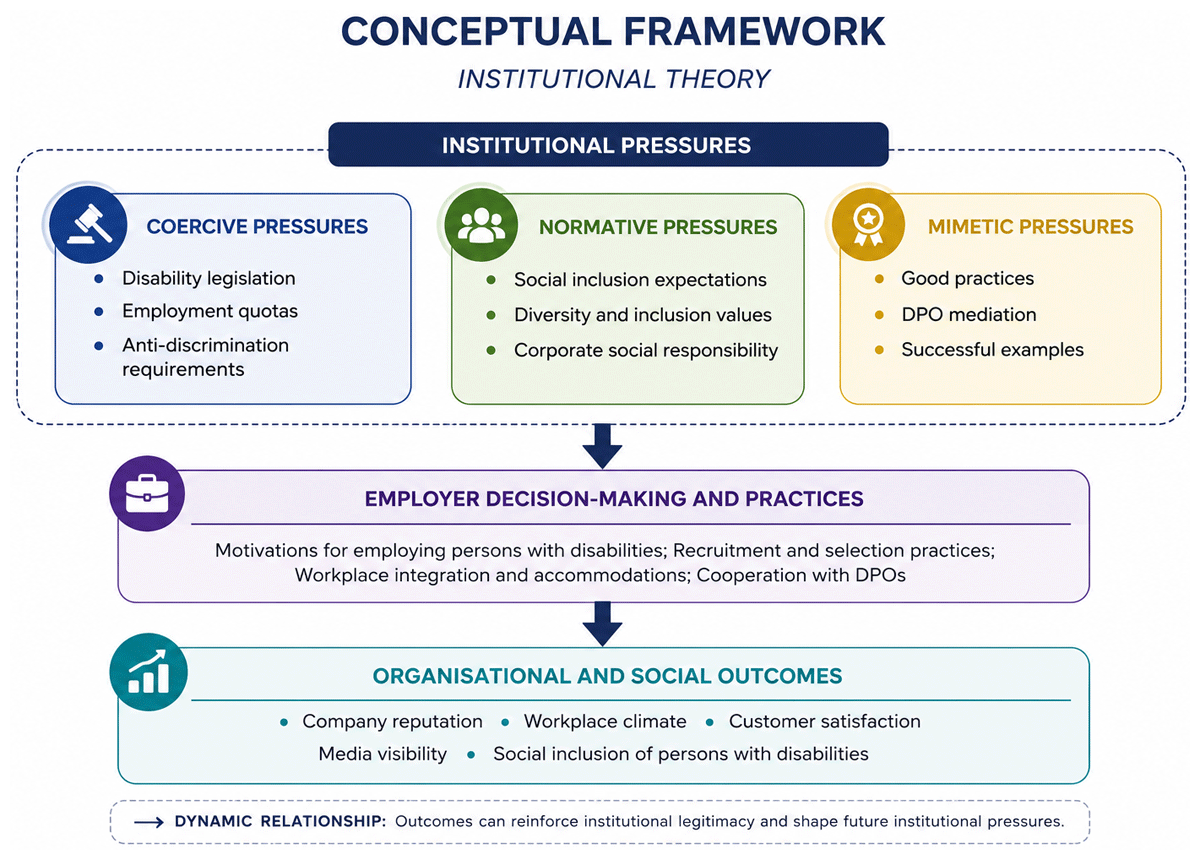
Figure 1
Conceptual framework of disability-inclusive employment from an Institutional Theory perspective.
Research Questions
This study addresses three research questions:
Research Question 1: How do employers in Kosovo justify and rationalise their decisions to employ persons with disabilities?
Research Question 2: What tensions, challenges, and facilitating factors emerge in employers’ experiences of recruiting and integrating persons with disabilities into the workplace?
Research Question 3: How do employers evaluate the impact of employing persons with disabilities on organisational performance, workplace dynamics, and broader social inclusion objectives?
Methods
This study adopts a qualitative approach to explore the perspectives of employers in Kosovo who have decided to hire persons with disabilities. This decision is rooted in the fact that the labour market participation of persons with disabilities is low and the practice of employing persons with disabilities in Kosovo is rare. It was therefore deemed essential to undertake an in-depth exploration of employers’ motivations and experiences of hiring persons with disabilities. By moving beyond reliance on statistical data, the study focuses on understanding and interpreting people’s experiences (Tong et al. 2012), recognising the importance of qualitative insight in shedding light on daily experiences and their complex impact on the dynamics of employing persons with disabilities.
Research design
This study employs a phenomenological research design, which is particularly suitable for capturing the rich and nuanced insights related to knowledge, attitudes, and actions of these employers (Burns and Grove 2009) concerning the implementation of the rights of persons with disabilities in employment.
Participants
Fifteen businesses employing persons with disabilities in Kosovo participated in the study (Table 1). Participants were selected through purposive sampling, which is used to approach individuals with specific characteristics (Howitt and Cramer 2011). To identify businesses that had included persons with disabilities in their workforce, the authors cooperated closely with the Kosovo Disability Forum, the umbrella organisation for persons with disabilities in Kosovo. Of the 15 businesses, only four were medium-sized companies with more than 50 employees and thus legally obliged to hire persons with disabilities. Gastronomy and retail were the predominant sectors, and businesses were represented by managers, supervisors, human resource officers or team leaders.
Table 1
Demographic data of the participants.
| CODE | POSITION | BUSINESS SCOPE | EMPLOYEE’S DISABILITY TYPE |
|---|---|---|---|
| Emp-A | Manager | Gastronomy | Intellectual disability |
| Emp-B | Manager | Gastronomy | Physical disability |
| Emp-C | Manager | Gastronomy | Intellectual disability |
| Emp-D | Manager | Retail | Intellectual disability |
| Emp-E | Manager | Retail | Intellectual disability |
| Emp-F | Sector manager | Retail | Intellectual disability |
| Emp-G | Manager | Pharmacy | Intellectual disability |
| Emp-H | Human resource officer | Retail | Physical disability |
| Emp-I | Manager | Gastronomy | Visual impairment |
| Emp-J | Manager | Retail | Visual impairment |
| Emp-K | Manager | Retail | Blind |
| Emp-L | Supervisor | Retail | Blind |
| Emp-M | Supervisor | Retail | Blind |
| Emp-N | Team leader | Retail | Visual impairment |
| Emp-P | Team leader | Gastronomy | Intellectual disability |
[i] Note: Each code represents one employer.
Instrument
A semi-structured interview protocol was developed for the purpose of data collection. The semi-structured interview consists of 7 main questions and several sub-questions that aim to explore the employer’s perspective in regard to hiring persons with disabilities. Specifically, the interview explored the following dimensions: (1) motivations and rationales for employing persons with disabilities; (2) awareness and perceptions of legal obligations related to disability employment; (3) recruitment and selection practices; (4) workplace integration and accommodation processes; (5) perceptions of co-workers’ and customers’ reactions; (6) perceived challenges and facilitating factors associated with disability-inclusive employment; and (7) employers’ overall experiences and perceived organisational outcomes following the employment of persons with disabilities.
Data collection
Data were obtained through fifteen semi-structured interviews. Interviews were conducted virtually, with each lasting between 47 and 73 minutes, by the first author, in the Albanian language, while ensuring consistency in the data collection process.
Informed consent was obtained verbally from all participants before the interviews commenced. Participants were informed of the voluntary nature of participation and their right to decline answering any question, to withdraw from the interview at any stage without providing a reason, and to request the withdrawal of their data from the study prior to the commencement of data analysis. All information shared during the interviews was treated confidentially and used solely for research purposes. To protect participants’ privacy, no identifying information was included in the transcripts or research reports. All participants were assigned anonymised codes (e.g., Emp-A, Emp-B), and any potentially identifiable details were removed during the transcription process.
Following data collection, the recorded interviews were transcribed verbatim to preserve the accuracy and richness of participants’ accounts. The transcripts were subsequently translated into English for the purposes of analysis and reporting. The audio recordings and transcripts were stored securely and were accessible only to the research team. Data were handled in accordance with established ethical principles relating to confidentiality, anonymity, voluntary participation, and the protection of participants’ rights.
Data analysis
Data were analysed using ATLAS.ti (version 7.5) following the principles of thematic analysis. After repeated reading of the transcripts, an inductive coding process assigned descriptive codes to meaningful text segments. Related codes were grouped into categories and then organised into broader themes reflecting recurring patterns across participants’ accounts, with attention to common experiences, divergent perspectives and tensions in employers’ narratives. The themes were refined iteratively, organised according to the research questions (Table 2) and interpreted through the lens of institutional theory.
Table 2
Development of themes, categories and codes.
| THEME | CATEGORY | REPRESENTATIVE CODES |
|---|---|---|
| Theme 1: Inclusion-driven rather than compliance-driven rationales | Promoting social inclusion | Supporting diversity; equal opportunities; social integration; community contribution; setting a positive example |
| Fostering financial independence | Reducing dependence on pensions; economic self-sufficiency; empowerment through employment | |
| Limited influence of legal obligations | Weak enforcement; lack of sanctions; awareness of quota law; compliance not a priority | |
| Theme 2: Negotiating uncertainty in disability-inclusive recruitment | Initial concerns and expectations | Concerns about work performance; concerns about productivity; customer reactions; workplace adaptation |
| Re-evaluating assumptions after employment | Positive work performance; expectations exceeded; adaptation success; reduced concerns | |
| Role of Disabled People’s Organisations (DPOs) | Candidate matching; recruitment mediation; guidance on accommodations; employer support | |
| Limitations of traditional recruitment channels | Lack of applications from persons with disabilities; limited confidence of applicants; need for targeted outreach | |
| Persistent uncertainties and stereotypes | Productivity assumptions; fear of customer reactions; limited prior experience with disability inclusion | |
| Theme 3: Organisational, reputational and social returns of inclusion | Enhanced corporate reputation | Positive public image; social responsibility; community recognition |
| Improved workplace climate | Team solidarity; tolerance; mutual support; positive organisational culture | |
| Increased visibility and media attention | Media coverage; public recognition; showcasing good practices | |
| Customer satisfaction | Positive customer feedback; acceptance of diversity; increased trust and loyalty |
Results
This section presents the results of the study, which are organised around the themes that emerged during data analysis. This process resulted in the following three themes: 1) Employers’ motivation to hire persons with disabilities, 2) Employers’ experience with employing persons with disabilities and 3) Benefits of employing persons with disabilities in the workforce. The highlighted themes and patterns are supported by relevant quotes from the interviews, providing a rich and nuanced understanding of the subject.
Theme 1: Inclusion-driven rather than compliance-driven rationales
Businesses reported diverse motivations underlying their decision to hire persons with disabilities. The main motivations were promoting diversity and inclusion and fostering the financial independence of persons with disabilities, consequently reducing their reliance on social pension schemes. The findings indicate that businesses do not perceive legal obligations as a significant driving force for employing persons with disabilities, nor do they feel a sense of responsibility to comply with such requirements.
Promoting inclusion was one of the main motivations for hiring persons with disabilities. All 15 businesses viewed the employment of persons with disabilities as an opportunity to promote social integration and set a positive example within the labour market in Kosovo. They underscored the importance of providing persons with disabilities with an opportunity to showcase their potential and become active contributors to society. As Emp-C emphasized, ‘What motivated me is the fact that I wanted to give an example of respecting the rights of communities that are disadvantaged in our society’.
Furthermore, 6 out of 15 businesses reported that an important motivation was reducing the reliance of persons with disabilities on pension schemes provided by the government. These participants acknowledged that the state pension received by persons with disabilities is insufficient for achieving financial independence; by offering employment opportunities, they aimed to foster their self-sufficiency. Emp-A stated, ‘My motive was to give the person a chance to become independent, earn themselves the money that they need, and rely less on the pension’.
Participants reported a diminished sense of responsibility to adhere to the legal obligations mandating quota-based hiring. None of the businesses cited compliance with the quota law as their primary motivation to hire persons with disabilities. They all acknowledged their awareness of the legal obligations deriving from this law; however, they perceived its implementation as ineffective due to the lack of systematic monitoring and enforcement of sanctions in cases of non-compliance. As Emp-G emphasised, ‘I did not hire the person with disabilities because of the law. I have friends in the business community that do not implement this law and who have never experienced any sanctions.’
Theme 2: Negotiating uncertainty in disability-inclusive recruitment
This section presents employers’ experiences of recruiting persons with disabilities, focusing on their concerns prior to hiring, recruitment processes and procedures, workplace adaptation and cooperation with DPOs, which represent and support persons with disabilities in Kosovo. The findings reveal tensions between employers’ initial expectations and their subsequent experiences, as well as structural challenges related to disability-inclusive recruitment practices.
Employers’ initial reservations were mainly related to prejudices about the work capabilities of persons with disabilities. However, for 9 out of 15 businesses, these concerns proved greater than the challenges actually encountered after hiring, which they managed through flexibility, adaptability and openness. As Emp-F expressed:
We were not sure that he would be able to perform correctly in the workplace. We only hired him to set a good example, but we were not convinced that we would benefit anything from this experience. It turned out to be completely the opposite.
Concerns regarding customer reactions similarly proved unfounded. Emp-E recalled:
We actually feared in the beginning for how customers would react towards her [the employee with disabilities]. How will she feel in this job? But then we saw that she has adapted very well and the customers were treating her with respect.
One of the most significant challenges identified by employers was workplace accommodation and adaptation following recruitment. Employers explained that inclusion required adjustments not only from the newly recruited employees but also from co-workers, supervisors and the organisation as a whole. In many cases, existing staff were initially uncertain about how to interact with colleagues with disabilities, how to respond to their specific needs and how to collaborate effectively. As one employer noted, ‘In the beginning they were not so flexible in understanding the specific needs of the employee with disabilities’. Consequently, organisations invested considerable effort in fostering understanding among staff, facilitating communication and creating a supportive workplace climate. Employers also reported that certain work processes, routines and practices had to be modified to ensure the effective participation of employees with disabilities. These findings suggest that disability-inclusive recruitment is not a one-time hiring event but an ongoing organisational process of accommodation, learning and adaptation involving both individual employees and the wider workplace environment.
All interviewed businesses reported that they cooperated with DPOs in the process of recruiting persons with disabilities. They perceived this partnership as instrumental in recruiting the most suitable candidates for the available positions, as well as in accommodating employees in the workplace. Businesses reported that without the support and mediation of DPOs, it would be challenging to navigate the complexities of inclusive hiring and accommodation practices. With their expertise and insight, DPOs supported businesses in aligning job requirements with the specific skills and capabilities of candidates with disabilities. As Emp-I expressed:
We received an email from a Disabled People Organization to initiate a meeting and discuss this opportunity. We were open to learn more and in fact we decided to hire the candidate they suggested us. We explained to them some of the work characteristics and we believe that they have found the most suitable candidate. I think DPOs should do this systematically. It has worked very well with us and it can work with other businesses as well.
Businesses also expressed reservations about open calls and standard recruitment processes, perceiving that persons with disabilities may lack the willingness or confidence to apply through such channels. None had ever received an application from a candidate with disabilities through a standard open call, and only 3 out of 15 had included the statement, ‘persons with disabilities are encouraged to apply’, in their vacancy announcements. These businesses considered partnering with DPOs the only way to identify and recruit suitable candidates with disabilities.
Theme 3: Organisational, reputational and social returns of inclusion
Businesses identified several advantages of employing persons with disabilities: an enhanced company reputation, a positive work climate, increased media presence and visibility, and higher customer satisfaction.
The most prominent advantage, reported by 11 out of 15 companies, was the improvement of the company’s reputation. Companies’ standing as socially responsible organisations resonated positively with customers, resulting in a more favourable public image and stronger customer perceptions. As Emp-G reported, ‘Employing people in need in general shows that, as a company, you care for the community in which you operate. This is directly linked with a better reputation and image of the company’.
According to 9 out of 15 businesses, hiring persons with disabilities fostered a positive workplace atmosphere, increasing solidarity, teamwork and mutual support. Employees with disabilities often showed a heightened appreciation for the opportunity to work, inspiring a greater sense of purpose and commitment among colleagues. As Emp-I expressed, ‘The work climate has been improved with the arrival of the employee with disabilities. All the co-workers are very supportive of him, they have a higher sense of tolerance and are more willing to help each other when needed’.
Increased media presence and visibility were also reported as benefits of hiring persons with disabilities. In total, 8 out of 15 businesses observed that media interest in their activities increased after they recruited persons with disabilities. They were frequently invited to participate in television programmes and interviews to discuss their experiences and strategies for integrating persons with disabilities into their workforce. According to the participants, these opportunities increased their visibility and reinforced their position as leaders in fostering diversity and inclusion in the corporate sector. Emp-F reported:
Marketing was not my motivation to employ a person with disabilities. However, I noticed that it has contributed positively in that regard. I have been invited in different meetings to share my experience, in several TV shows, and I think it is good, because we have been able to set a good example.
Customer satisfaction was also reported as a positive consequence of hiring persons with disabilities. Persons with disabilities held positions with direct customer contact in only 7 out of 15 businesses, and all seven reported that customers were satisfied with the services provided by employees with disabilities. They had experienced firsthand that customers appreciate an inclusive approach and the diversification of the workforce. As Emp-P mentioned, ‘As for the customers, I am surprised how well they accepted him. Customers’ feedback is in 90% of the cases positive. He is the worker who gets the most tips’. Similarly, Emp-P confirmed, ‘We have received positive comments and we have been congratulated for taking this step’.
Discussion
The findings indicate that the experiences of employers who have hired persons with disabilities in Kosovo are predominantly positive and rest largely on intentional decisions rather than legal compliance. However, they also reveal a more complex reality characterised by uncertainty, recruitment barriers and a continuing reliance on intermediary support mechanisms. From the perspective of Institutional Theory (Roszkowska-Menkes 2022; Scott 2014), employers’ decisions and experiences are shaped by the interaction of coercive, normative and mimetic pressures, which influence how disability-inclusive employment is interpreted and implemented in practice.
Regarding the first research question, most participating businesses were small companies not legally obliged to hire persons with disabilities, yet they chose to do so in order to set a positive example, promote social inclusion and enable the financial independence of persons with disabilities. Other studies have identified different motivating factors, such as appropriate matching between work skills and job requirements and previous positive experiences (Gustafsson, Peralta and Danermark 2014), previous contacts (Duvdevany, Or-Chen and Fine 2016), state incentives (Aichner 2021) and type of disability (Mik-Meyer 2016). These findings suggest that normative pressures associated with social inclusion and equal opportunities exerted a stronger influence than coercive pressures arising from legal obligations. Although aware of the legal framework, employers justified their decisions through values of social contribution and inclusion, indicating that disability-inclusive employment may serve as a means of achieving social legitimacy and aligning organisational practices with broader societal expectations.
However, a tension emerges in how employers justified their hiring decisions. While participants frequently referred to social inclusion, financial independence and setting a positive example, they rarely emphasised candidates’ qualifications, skills, work performance or job–person fit. From a disability studies perspective, this pattern may reflect elements of the charity model of disability, whereby employment is framed as an act of assistance rather than as a recognition of persons with disabilities as qualified workers and equal participants in the labour market (Shakespeare 2018). Employers’ narratives thus appear to combine rights-based and charity-oriented understandings of disability-inclusive employment.
Regarding the second research question, the findings indicate that employers’ initial dilemmas and reservations about recruiting persons with disabilities were greater than the challenges actually encountered. The main concerns reported related to the work performance of employees with disabilities, customer satisfaction, co-worker attitudes and the ability of workers to adapt and overcome potential challenges in the workplace. Other studies have also found these concerns to be prevalent among recruiters. Heera and Devi (2016) identified work performance as one of employers’ primary concerns in recruiting persons with disabilities, while Houtenville and Kalargyrou (2014) found that customers’ and co-workers’ attitudes were considered challenges when deciding to hire persons with disabilities.
Nevertheless, these concerns should not be viewed solely as individual employer attitudes but also as reflections of broader societal assumptions about disability and work. Although many employers reported that their initial dilemmas diminished following direct experience with employees with disabilities, uncertainty remained an important element of the recruitment process. This reveals a tension between preconceived assumptions and actual workplace experiences: while disability-inclusive employment often challenged employers’ stereotypes, the persistence of these uncertainties suggests that disability employment continues to be influenced by wider institutional beliefs regarding productivity, capability and organisational risk.
Employers also reported that workplace inclusion required organisational adaptation, including fostering supportive workplace cultures, addressing co-worker reservations and adjusting routines and communication practices to accommodate disability-related needs. These findings align with Yang et al. (2025), who found that employers reporting negative attitudes among co-workers and uncertainty regarding workplace accommodations were less likely to engage in disability-inclusive hiring. Rather than viewing accommodation as a one-time adjustment, the findings of both studies suggest that disability inclusion is an ongoing organisational process involving learning, adaptation and the development of supportive workplace relationships. While the employers in the present study ultimately described these challenges as manageable, their experiences indicate that successful inclusion depends not only on the capabilities of employees with disabilities but also on the willingness of organisations and co-workers to adapt existing workplace practices and cultures.
The reliance on DPOs further suggests that disability-inclusive recruitment has not yet become fully embedded in mainstream organisational recruitment systems. The finding that persons with disabilities rarely apply through standard recruitment channels may reflect a lack of confidence in the inclusiveness of these procedures and indicates that disability-inclusive recruitment remains partially dependent on external support mechanisms. Strengthening the capacity of human resource departments to implement inclusive recruitment policies and practices therefore remains an important priority.
Regarding the third research question, employers perceived that employing persons with disabilities improved company reputation, workplace climate, customer satisfaction and organisational visibility. Other studies similarly report increased profitability (Kalargyrou and Volis 2014), improved company reputation (Rosenbaum, Baniya and Seger-Guttmann 2017), higher employee morale (Ang 2017), loyalty (Kalargyrou 2014) and customer satisfaction. These outcomes can be interpreted through the concept of organisational legitimacy, which is central to Institutional Theory (Roszkowska-Menkes 2022; Scott 2014): by demonstrating alignment with socially valued norms of inclusion and equality, disability-inclusive employment generates both internal organisational benefits and external legitimacy. It may therefore be understood not only as a human rights issue but also as a practice that strengthens the social standing of organisations in their communities.
Overall, the findings suggest that disability-inclusive employment in Kosovo is influenced more strongly by normative institutional pressures related to social inclusion and organisational legitimacy than by coercive pressures arising from legal obligations. At the same time, continuing recruitment barriers, dependence on intermediary support structures and persistent assumptions regarding disability and work highlight the complexity of translating disability employment rights into workplace practices and demonstrate the value of institutional theory for understanding how employers navigate the competing expectations surrounding disability-inclusive employment.
Conclusions
The aim of this study was to examine the perspectives of employers in Kosovo regarding their experiences of hiring persons with disabilities, the impact of workforce diversification and the level of preparedness among the business community, co-workers and customers for integrating persons with disabilities into the labour market. Consistent with the conceptual framework of institutional theory, the main motivations of businesses for hiring persons with disabilities were related to normative and mimetic pressures. More specifically, businesses were strongly motivated by their desire to serve as good examples in society, to provide a source of income for persons with disabilities and to grant them equal opportunities to exercise their right to employment. Coercive pressure was not a factor motivating businesses to hire persons with disabilities, largely due to the perceived ineffective implementation of the legal framework and its sanctioning provisions.
Although companies faced challenges in hiring and accommodating persons with disabilities, their concerns prior to hiring were generally greater than the difficulties experienced afterwards. The main concerns related to work capabilities and customer reactions, while in the initial stages some co-workers were uncertain about how to interact appropriately with colleagues with disabilities. Companies relied on DPOs as key intermediaries in both recruitment and the provision of reasonable accommodation. Hiring persons with disabilities resulted in positive organisational and social outcomes, including a greater sense of solidarity and purpose among employees, higher visibility, an enhanced public image and higher customer satisfaction.
Given the limited research on employers’ experiences of hiring persons with disabilities in Kosovo, this study contributes to the existing evidence base and offers practical implications for policy and practice. The findings may support DPOs, policymakers and other stakeholders in promoting disability-inclusive employment and improving the implementation of labour rights. They may also inform the development of interventions and employer guidance aimed at strengthening inclusive recruitment, workplace accommodation and the labour market participation of persons with disabilities.
Limitations
The main limitation of this study lies in its non-representative sample of only 15 participants, the majority of whom made a deliberate and proactive choice to hire persons with disabilities without feeling pressured to comply with legal obligations. This contextual factor likely influenced participants’ attitudes and perceptions regarding the general experience of hiring persons with disabilities, which were predominantly positive. Expanding the sample to include businesses that have employed persons with disabilities primarily to comply with legal requirements would provide an opportunity to investigate alternative perspectives, including their recruitment processes and the workplace accommodations provided. Future studies are encouraged to investigate the perspectives of persons with disabilities themselves regarding their integration into the labour market, focusing on their perceived work potential, accommodations, work climate, customer satisfaction, media visibility and general work experience. The direct perspectives of co-workers and customers would also be valuable to explore, enabling comparison across stakeholders and a more holistic research approach.
Data Accessibility Statement
The interview data are not publicly available in order to protect the confidentiality of participants and participating businesses.
Ethics and Consent
Approval for the study was obtained from the Kosovo Disability Forum. Informed consent was obtained verbally from all participants prior to the interviews.
Acknowledgements
The authors are grateful for support from the Kosovo Disability Forum.
Author Contributions
Geci, Ilirjana – Conception of the work; the acquisition, analysis, interpretation of data for the work; drafting of the manuscript; Final approval of the version to be published; Agreed to be accountable for all aspects of the work in ensuring that questions related to the accuracy or integrity of any part of the work are appropriately investigated and resolved; agreed to be named on the author list, and approved of the full author list.
Kukaj, Qendresa – The acquisition, analysis, interpretation of data for the work; revising the manuscript critically for important intellectual content; Final approval of the version to be published; Agreed to be accountable for all aspects of the work in ensuring that questions related to the accuracy or integrity of any part of the work are appropriately investigated and resolved; agreed to be named on the author list, and approved of the full author list.