
Table 1
Search strings used across the five selected major electronic databases to identify articles that could be included in the literature review.
| DATABASES | STRINGS |
|---|---|
| PubMed | ((“Autism Spectrum Disorder”[Mesh] OR autis*[tiab] OR asperger*[tiab] OR ASD[tiab] OR “autistic adults”[tiab] OR “autistic employees”[tiab] OR “autistic workers”[tiab]) AND (“Workplace accommodation”[tiab] OR “reasonable adjustment*”[tiab] OR “inclusive employment”[tiab] OR “workplace inclusion”[tiab] OR “job coaching”[tiab] OR “supported employment”[tiab] OR “assistive technolog*”[tiab] OR “sensory-friendly”[tiab] OR “employment policy”[tiab] OR “disability support”[tiab]) AND (“Employment”[Mesh] OR employ*[tiab] OR “employment participation”[tiab] OR “job satisfaction”[tiab] OR “workplace retention”[tiab] OR “employee performance”[tiab] OR “productivity”[tiab] OR “quality of life”[tiab])) |
| Cochrane Library | (((autism) OR (ASD) OR (autistic adults) OR (autistic employees)) AND ((workplace accommodations) OR (job coaching) OR (inclusive employment policies) OR (reasonable adjustments))) AND ((employment outcomes) OR (job satisfaction) OR (retention) OR (performance) OR (workplace inclusion) OR (quality of life))) |
| CINAHL | (MM “Autism Spectrum Disorder” OR MM “Asperger Syndrome” OR autism OR ASD OR “autistic adults” OR “autistic workers”) AND (XB “workplace accommodation” OR XB “job accommodation” OR MJ “reasonable adjustments” OR MJ “inclusive employment” OR MJ “supported employment” OR MJ “assistive technology” OR TI “workplace inclusion” OR TI “employment policy”) AND (MW “employment outcomes” OR MJ “employment” OR MJ “job satisfaction” OR MJ “employee retention” OR MJ “work performance” OR MJ “productivity” OR MJ “quality of life”) |
| Medline | (autis* OR asperger* OR ASD OR “autistic adults” OR “autistic employees” OR “autistic workers”) AND (“workplace accommodations” OR “job coaching” OR “supported employment” OR “inclusive employment” OR “reasonable adjustments” OR “assistive technology” OR “sensory-friendly design” OR “employment policy”) AND (“employment participation” OR “job satisfaction” OR “employee performance” OR “retention” OR “workplace inclusion” OR “quality of life”) |
| PsycINFO | (DE “Autism Spectrum Disorders” OR autis* OR asperger* OR ASD OR “autistic employees” OR “autistic adults” OR “autistic workers”) AND (“workplace accommodations” OR “job coaching” OR “reasonable adjustments” OR “inclusive employment” OR “supported employment” OR “assistive technology” OR “employment policy” OR “workplace inclusion”) AND (“employment participation” OR employ* OR “job satisfaction” OR “employee well-being” OR retention OR performance OR “quality of life” OR “workplace inclusion”) |
Table 2
Final studies included in the review.
| NO. | REFERENCES | STUDY TITLE |
|---|---|---|
| 1 | (Gentry et al. 2015) | Reducing the Need for Personal Supports among Workers with Autism Using an iPod Touch as an Assistive Technology: Delayed Randomized Control Trial |
| 2 | (Ciccarelli and Hodges 2016) | A Personal Digital Assistant Intervention Reduced Job Coaching Support Hours without Reducing Work Performance among Workers with Autism |
| 3 | (Zhou et al. 2025) | Employment-Related Assistive Technologies for Autistic Individuals: A Scoping Review |
| 4 | (Roux et al. 2019) | Employment Policy and Autism: Analysis of State Workforce Innovation and Opportunity Act (WIOA) Implementation Plans |
| 5 | (Lindsay et al. 2021) | Disclosure and Workplace Accommodations for People with Autism: A Systematic Review |
| 6 | (Wehman et al. 2017) | Effects of an Employer-Based Intervention on Employment Outcomes for Youth with Significant Support Needs due to Autism |
| 7 | (Schall et al. 2015) | Employment Interventions for Individuals with ASD: The Relative Efficacy of Supported Employment with or without Prior Project SEARCH Training |
| 8 | (McKnight-Lizotte, 2018) | Work-Related Communication Barriers for Individuals with Autism: A Pilot Qualitative Study |
| 9 | (Wehman et al. 2016) | Employment for Adults with Autism Spectrum Disorders: A Retrospective Review of a customized Employment Approach |
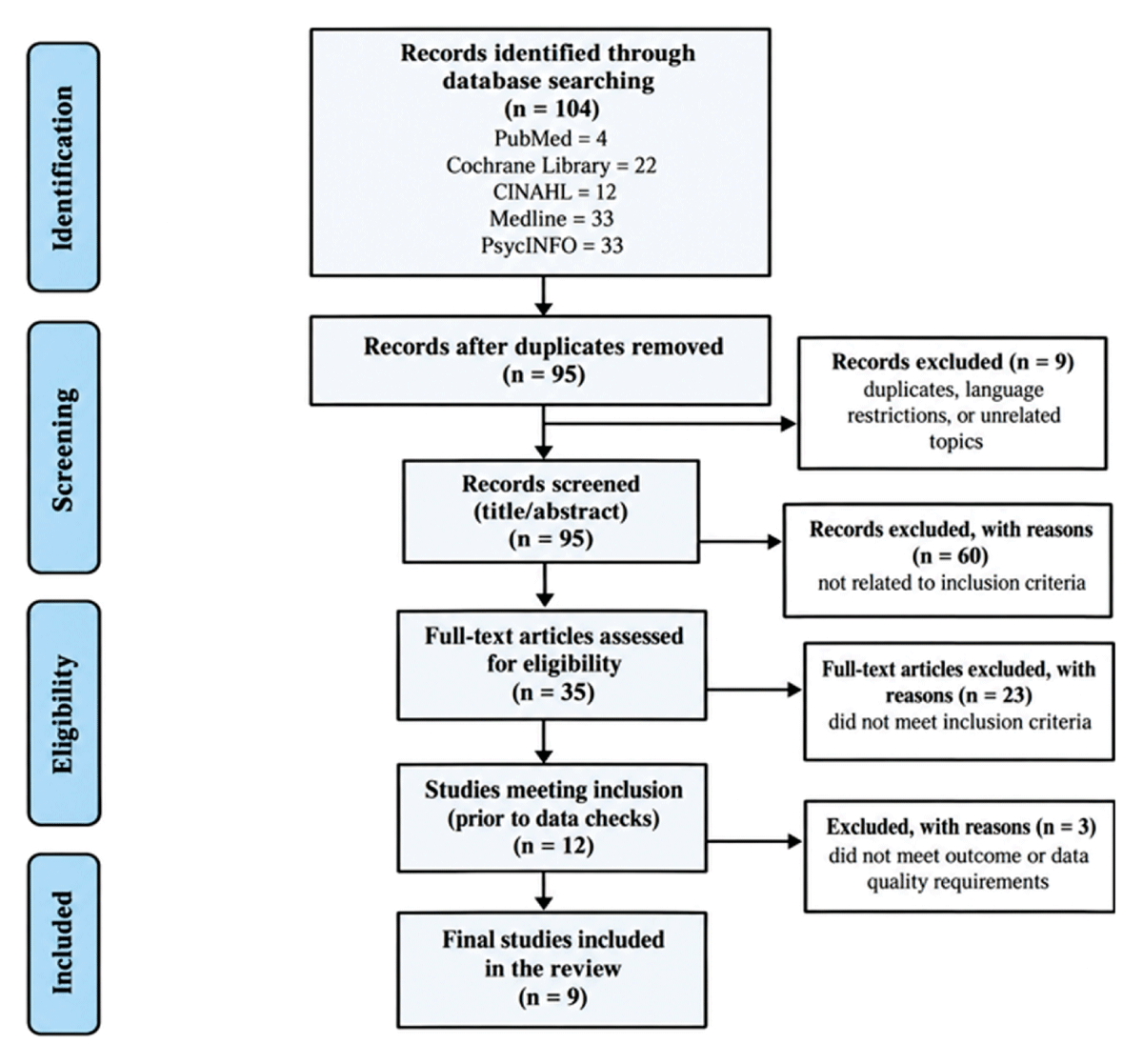
Figure 1
PRISMA flow chart diagram for selection of studies to be included in the review.
Table 3
Quality appraisal of the studies selected for the systematic review.
| SR. NO. | REFERENCE | STUDY TYPE | TOOL USED | BIAS RISK | STRENGTHS | LIMITATIONS | OVERALL QUALITY | TOOL SCORE | REVIEW CRITERIA SCORE (1–3) |
|---|---|---|---|---|---|---|---|---|---|
| 1 | (Gentry et al. 2015) | RCT (Delayed design) | CASP RCT Checklist | Low | Clear randomization; validated measures; strong control design | Small sample size (n = 30); limited generalizability | High Quality | 9 | 3 |
| 2 | (Ciccarelli and Hodges 2016) | Experimental field study | JBI Quasi-Experimental Checklist | Moderate | Real-world intervention; objective outcome data | Lack of randomization; short follow-up | Moderate Quality | 8 | 2 |
| 3 | (Zhou et al. 2025) | Scoping review | JBI Scoping Review Tool | Low | Comprehensive search; transparent synthesis; global scope | Limited appraisal of study bias; heterogeneity in evidence | High Quality | 9 | 3 |
| 4 | (Roux et al. 2019) | Policy analysis | CASP Qualitative/Document Review | Moderate | Systematic policy coding; clear inclusion framework | No empirical outcome measures; U.S.-only scope | Moderate Quality | 7 | 2 |
| 5 | (Lindsay et al. 2021) | Systematic review | PRISMA 2020 + JBI | Low | High transparency; multi-database search; meta-synthesis | Few quantitative studies included | High Quality | 10 | 3 |
| 6 | (Wehman et al. 2017) | Quasi-experimental | JBI Quasi-Experimental Checklist | Moderate | Strong intervention fidelity; measurable workplace outcomes | No blinding; limited control group | Moderate Quality | 8 | 2 |
| 7 | (Schallet al. 2015) | Comparative cohort | CASP Cohort Checklist | Low | Large sample; clear comparative design; objective measures | Non-randomized allocation | High Quality | 9 | 3 |
| 8 | (McKnight-Lizotte 2018) | Qualitative (interview) | CASP Qualitative Checklist | Moderate | Rich participant insight; thematically rigorous | Small sample (n = 10); limited generalization | Moderate Quality | 7 | 2 |
| 9 | (Wehman et al. 2016) | Retrospective cohort | JBI Analytical Cross-sectional Tool | Moderate | Large dataset; long-term outcomes; real-world data | No randomization; retrospective bias | Moderate Quality | 8 | 2 |
[i] Legend: Critical appraisal of study quality using standardized tools (CASP, JBI, PRISMA). Each study is rated for bias risk, strengths, limitations, and overall quality score on a 1–3 scale (1 = Low, 3 = High).
Abbreviations: CASP: Critical Appraisal Skills Programme; JBI: Joanna Briggs Institute; PRISMA: Preferred Reporting Items for Systematic Reviews and Meta-Analyses; RCT: Randomized Controlled Trial; FSIQ: Full-Scale Intelligence Quotient.
Table 4
Characteristics of each study, as well as the rationale for their inclusion and summarized key results.
| SR NO. | REFERENCES | STUDY TYPE | REASON FOR INCLUSION | POPULATION (P) | INTERVENTION (I) | OUTCOME (O) | KEY RESULTS |
|---|---|---|---|---|---|---|---|
| 1 | (Gentry et al. 2015) | RCT (delayed design) | Directly examines assistive-tech workplace adaptation for employed autistic adults | Autistic adults in supported employment | iPod Touch for task sequencing and reminders | Independence, task completion, reduced job-coach time | Significantly reduced external support hours without decline in job performance |
| 2 | (Ciccarelli and Hodges 2016) | Experimental field study | Focuses on workplace technology reducing support dependence | Adult employees with ASD | PDA device to schedule, cue, and structure job tasks | Job performance, independence | Coaching hours reduced >30% while maintaining productivity |
| 3 | (Zhou et al. 2025) | Scoping review | Synthesizes global tech-based accommodations | Autistic adults in employment settings | Digital/ergonomic/organizational assistive tools | Job retention, independence, productivity | Positive effects of digital tools on self-management; identifies access inequity |
| 4 | (Roux et al. 2019) | Policy/document analysis | Evaluates inclusive employment legislation | Adults with ASD under state policy frameworks | Inclusive employment mandates & accommodation provisions | Policy alignment, inclusion metrics | Found wide policy variability; stronger outcomes in states with ASD-specific inclusion plans |
| 5 | (Lindsay et al. 2021) | Systematic review | Core study on disclosure and accommodation practices globally | Autistic adults in employment | Disclosure support, flexible scheduling, sensory-friendly adaptation | Job satisfaction, inclusion, retention | Formal accommodations linked to higher job satisfaction and longer retention |
| 6 | (Wehman et al. 2017) | Quasi-experimental intervention | Employer-driven job training and inclusion | Older adolescents and young adults with ASD | Employer mentoring + on-site supports | Employment retention, satisfaction | Intervention improved job placement & retention by ≈40% vs controls |
| 7 | (Schall et al. 2015) | Comparative cohort study | Tests structured supported-employment programs | Adults with ASD seeking work | Supported employment ± Project SEARCH training | Employment rate and stability | Project SEARCH group 73% employed vs 47% controls; longer retention |
| 8 | (McKnight-Lizotte 2018) | Qualitative (interviews) | Explores lived workplace experiences & barriers | Employed autistic adults | Communication and social-support experiences | Workplace inclusion & satisfaction | Identified stigma, disclosure difficulties, & limited peer understanding |
| 9 | (Wehman et al. 2016) | Retrospective cohort review | Evaluates long-term customized employment model | Adults with ASD in community jobs | Customized job-matching & task redesign | Retention, satisfaction, QOL | 87% retention at 12 months; higher satisfaction vs traditional placement |
[i] Abbreviations: ASD: Autism Spectrum Disorder; QOL: Quality of Life.
Table 5
Intervention type and workplace accommodation strategy.
| NO. | REFERENCE | INTERVENTION/STRATEGY | TYPE OF ACCOMMODATION | IMPLEMENTATION FEATURES | STAKEHOLDER INVOLVEMENT |
|---|---|---|---|---|---|
| 1 | (Gentry et al. 2015) | iPod Touch assistive technology | Technological (digital prompting) | Personalized task sequencing and self-management | Job coaches, tech trainers |
| 2 | (Ciccarelli and Hodges 2016) | Personal digital assistant (PDA) | Technological + behavioral | Task reminders, scheduling, work structure | Supervisors, occupational therapists |
| 3 | (Zhouet al. 2025) | Review of employment-related assistive tech | Mixed interventions | Range: mobile aids, sensory tools, ergonomic design | Review of cross-sector implementations |
| 4 | (Roux et al. 2019) | Policy inclusion under WIOA | Policy-level accommodation | Policy language promoting inclusive hiring | Governmental workforce agencies |
| 5 | (Lindsay et al. 2021) | Review of workplace disclosure and supports | Organizational | Reasonable adjustments, flexible scheduling | Employers, HR departments |
| 6 | (Wehman et al. 2017) | Employer-based training model | Behavioral/organizational | On-site mentoring, structured supervision | Employers, vocational rehab counselors |
| 7 | (Schall et al. 2015) | Supported employment & Project SEARCH | Vocational/training | Job matching, workplace mentors, soft-skills training | Multi-stakeholder collaboration |
| 8 | (McKnight-Lizotte 2018) | Communication support exploration | Social/interpersonal | Analysis of peer and supervisor communication barriers | Employees, managers |
| 9 | (Wehman et al. 2016) | Customized employment approach | Individualized accommodation | Job carving, modified tasks, tailored supervision | Job developers, employers |
[i] Legend: Table 5 summarizes the intervention or accommodation strategy applied in each study, categorized by type (technological, behavioral, organizational, or policy-level) and stakeholder involvement.
Abbreviations: ASD: Autism Spectrum Disorder; HR: Human Resources; WIOA: Workforce Innovation and Opportunity Act.
Table 6
Employment-related outcomes across studies.
| NO. | REFERENCE (IN-TEXT) | INTERVENTION/EXPOSURE | COMPARATOR | SAMPLE (N) | SETTING & DURATION | PRIMARY EMPLOYMENT OUTCOMES (DEFINITION) | QUANTITATIVE RESULTS (AS REPORTED) | STATISTICAL SIGNIFICANCE | SECONDARY/IMPLEMENTATION FINDINGS | NOTES ON BIAS/LIMITATIONS |
|---|---|---|---|---|---|---|---|---|---|---|
| 1 | (Gentry et al. 2015) | iPod Touch digital prompting (task sequencing, reminders) | Delayed-start control (services as usual) | N = 30 autistic workers | USA; supported employment; ~6 months | Support hours (job-coach time); task completion/accuracy; independence | Support hours ↓ ~43%; task accuracy maintained at baseline | p < 0.05 (support hours) | Better punctuality and self-management; high acceptability | Small N; single region; short follow-up |
| 2 | (Ciccarelli and Hodges 2016) | Personal Digital Assistant (PDA) for scheduling and cueing | Pre-post withingroup; usual supervision | N = 20 autistic employees | Australia; workplace field study; 12 weeks | Job-coaching hours; productivity/quality ratings | Coaching hours ↓ ~30%; work quality unchanged | p ≈ 0.02 (coaching hours) | Improved time-management; supervisors accepted tech | Non-randomized; modest N; brief duration |
| 3 | (Zhou et al. 2025) | Employment-related assistive technologies (review of tools) | Varies across 32 included studies | Review (32 studies) | Global; 2010–2025 literature | Retention, independence, usability/adoption of tech | Multiple studies report retention ↑ ~15–25% with digital supports | Narrative (varied significance) | Cost/access barriers; training boosts adoption | Heterogeneity; limited RCTs; variable reporting |
| 4 | (Roux et al. 2019) | WIOA policy language with autism-specific inclusion | States without ASD-specific clauses | 51 state plans | USA; policy cycle 2014–2019 | Inclusion/participation indicators; downstream engagement | ASD-specific states show higher inclusion/engagement signals (descriptive) | Descriptive only | Argues for accountability dashboards and manager training | No human outcomes; ecological inference |
| 5 | (Lindsay et al. 2021) | Formal disclosure + reasonable accommodations | Informal/no disclosure; ad-hoc supports | Systematic review (25 studies) | Global; 2000–2020 | Job satisfaction; retention/tenure; perceived fairness | Retention ↑ ~18% where formal accommodations implemented | Mixed p-values across studies | Psychological safety is critical; HR-led confidential pathways help | Publication bias possible; heterogeneous measures |
| 6 | (Wehman et al. 2017) | Employer-embedded training + on-site mentoring | Business-as-usual placements | N = 49, older adolescents/young adults | USA; employer sites; ~9 months | Retention; job satisfaction; supervision level | Retention ↑ ~40% vs control; satisfaction ↑ ~22% | p < 0.05 (retention) | Mentor fidelity linked to better outcomes | Quasi-experimental; limited blinding |
| 7 | (Schall et al. 2015) | Supported employment ± prior Project SEARCH | Supported employment only | N = 156, adults with ASD | USA; 12-month follow-up | Employment rate; retention duration; wages | 73% employed vs 47% control; longer retention | p < 0.01 (employment rate) | Soft-skills training & employer partnerships are key | Non-randomized allocation |
| 8 | (McKnight-Lizotte 2018) | Workplace communication patterns and barriers (qual.) | N = 10, employed autistic adults | Australia; interviews | Perceived inclusion; communication quality; belonging | Qualitative themes (no numeric change) | Need supervisor/peer training; disclosure safety concerns | Small N; transferability limits | ||
| 9 | (Wehman et al. 2016) | Customized employment (job carving, individualized supports) | Traditional placement models | N = 200 autistic adults | USA; ~3 years program data | 12-month retention; job satisfaction; quality of life | 12-month retention ~87%; satisfaction ↑ ~27% from baseline | p < 0.01 (retention) | Individualized matching scalable with job-developer capacity | Retrospective; potential selection bias |
[i] Legend: Table 6 compares employment outcomes across studies, detailing intervention, comparator, setting, duration, and primary and secondary findings, with reported statistical significance.
Abbreviations: ASD: Autism Spectrum Disorder; N: Sample Size; p: Statistical Significance Value; QOL: Quality of Life; RCT: Randomized Controlled Trial; PDAs: Personal Digital Assistants; USA: United States of America.
Table 7
Thematic and comparative summary across studies.
| THEME/DOMAIN | CONSISTENT FINDINGS (ACROSS STUDIES) | DIVERGENT OR CONTRADICTORY FINDINGS | INTERPRETATION AND IMPLICATIONS | EVIDENCE STRENGTH | REFERENCES |
|---|---|---|---|---|---|
| 1. Effectiveness of Assistive Technology in Workplace Functioning | The use of digital tools, such as iPod Touch and PDAs, significantly enhanced the independence and time management of autistic employees. Both Gentry et al. (2015) and Ciccarelli and Hodges (2016) demonstrated that assistive devices reduced the need for job coaching without compromising task accuracy. Zhou et al. (2025) extended this finding globally, showing consistent gains in autonomy across multiple tech formats. | Some studies have noted limited scalability due to technology access and maintenance costs, especially in small enterprises or low-resource settings. | Assistive technology promotes self-regulation and autonomy, particularly when it is integrated with behavioral or supervisory support. Future interventions should prioritize accessibility, training, and affordability to ensure long-term benefits. | High | (Gentry et al. 2015); (Ciccarelli andHodges 2016); (Zhou et al. 2025) |
| 2. Supported Employment and Job Retention Programs | Structured employment models, such as Project SEARCH and customized job matching, consistently increase employment and retention rates among adults with ASD. Schall et al. (2015) reported 73% retention with structured pre-employment training, while Wehman et al. (2016) and Wehman et al. (2017) confirmed sustained long-term gains under customized and employer-based interventions. | Variability in outcomes was linked to program fidelity and employer involvement in the program. Some cohorts with minimal job-site mentoring showed lower retention rates. | Supported employment models that include tailored supervision and employer mentorship improve workforce stability. These models are adaptable across sectors and should form the foundation of inclusive employment policies. | High | (Schall et al. 2015); (Wehman et al. 2016); (Wehman et al. 2017) |
| 3. Role of Organizational Policies and Systemic Inclusion | Policy analysis by Roux et al. (2019) demonstrated that states integrating autism-specific language under WIOA achieved better employment outcomes. Global reviews (Lindsay et al. 2021) emphasized that formal accommodations within workplace policies positively influence inclusion and satisfaction. | Differences in legal frameworks across countries limit standardization. Some organizations implement policies but lack accountability or enforcement mechanisms. | Policy-level actions remain critical enablers of inclusive employment. Legal mandates are most effective when combined with managerial training, inclusion dashboards, and monitoring systems. | Moderate to High | (Roux et al. 2019); (Lindsayet al. 2021) |
| 4. Disclosure, Stigma, and Workplace Culture | Across studies, formal disclosure and reasonable accommodation were associated with improved job satisfaction and psychological safety (Lindsay et al. 2021). However, qualitative data from McKnight-Lizotte (2018) revealed ongoing stigma and fear of discrimination discouraging self-disclosure. | Some participants perceived disclosure as risky in unsupportive work cultures, particularly when management lacked awareness training. | Disclosure effectiveness depends on workplace culture and leadership. Encouraging voluntary disclosure through confidential HR channels may increase accommodation uptake without incurring social penalties. | Moderate | (Lindsay et al. 2021); (McKnight-Lizotte 2018) |
| 5. Communication and Social Interaction Barriers | Qualitative findings from McKnight-Lizotte (2018) highlighted that poor supervisory feedback, lack of empathy, and social misunderstandings hinder inclusion. Complementary evidence from intervention studies suggests that structured mentoring reduces communication barriers. | Most interventions addressed skill training but not interpersonal workplace culture; thus, communication issues persisted, even with accommodations. | Addressing communication difficulties requires dual training for autistic employees and coworkers/supervisors. Interpersonal awareness programs can bridge understanding and foster psychological safety. | Moderate | (McKnight-Lizotte 2018); (Wehman et al. 2017) |
| 6. Customization and Individualization of Employment Tasks | Customized employment and job carving, as reported by Wehman et al. (2016), significantly improved retention and satisfaction. Such individualized approaches allowed workers to match tasks with strengths rather than limitations. | It requires intensive coordination and is resource-demanding for employers, which may limit scalability. | Individualized job design is one of the most effective, yet underutilized, strategies. Funding incentives and training for job developers could expand their reach. | High | (Wehman et al. 2016); (Schall et al. 2015) |
| 7. Cross-Cultural and Global Trends | Reviews (Zhou et al. 2025; Lindsay et al. 2021) revealed a global shift towards assistive technology, diversity hiring, and inclusion audits. However, disparities exist between high- and low-income regions. | Implementation consistency varies, and few studies from Asia or Africa report structured policies. | Inclusion strategies are emerging globally but require contextual adaptation to respect cultural, economic, and policy environments. | Moderate | (Zhou etal. 2025); (Lindsay et al. 2021); (Roux et al. 2019) |
[i] Legend: Table 7 synthesizes thematic findings across studies, highlighting consistencies and discrepancies in assistive technology effectiveness, disclosure culture, organizational inclusion, and policy frameworks.
Abbreviations: ASD: Autism Spectrum Disorder; WIOA: Workforce Innovation and Opportunity Act; HR: Human Resources; QOL: Quality of Life.