
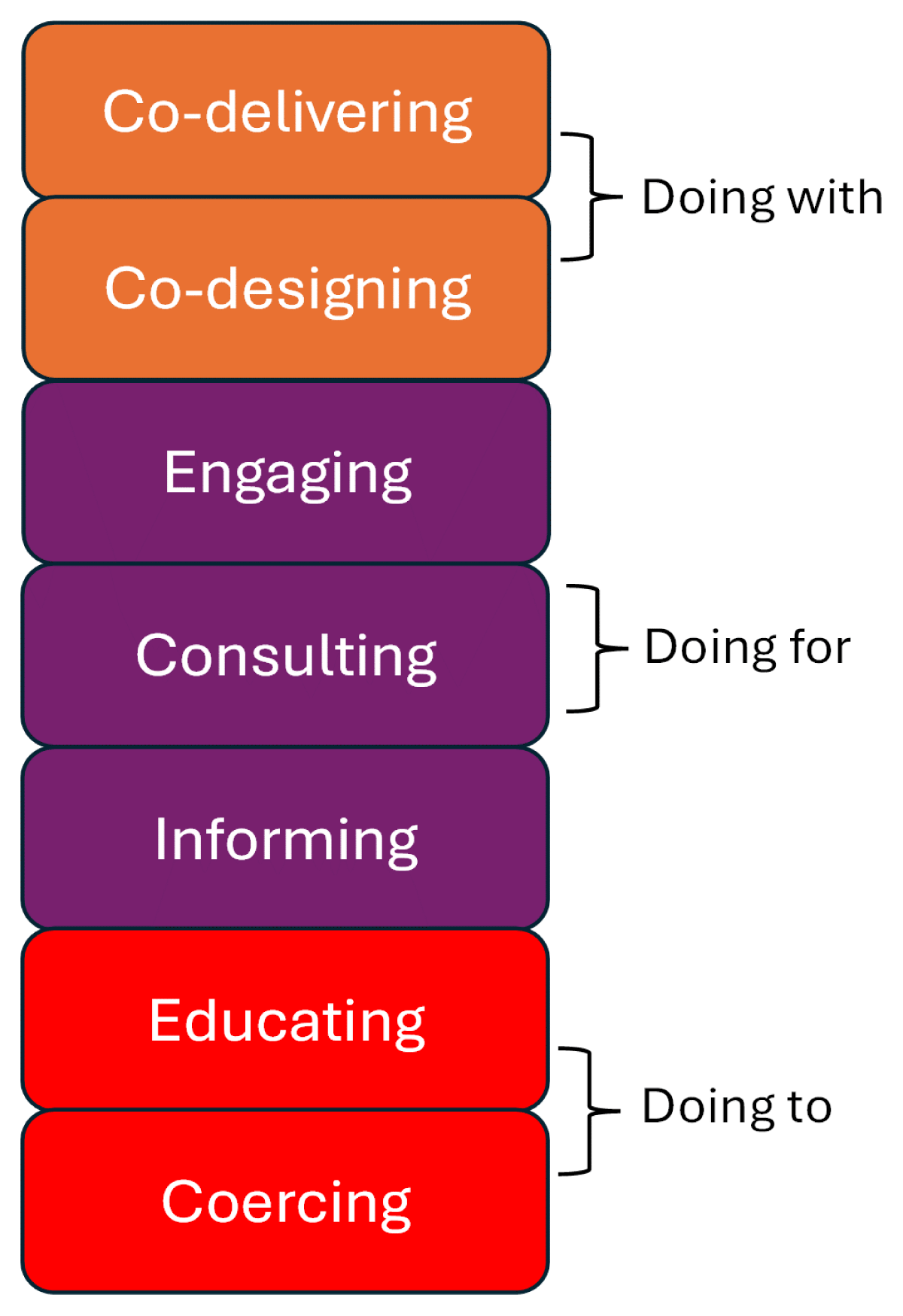
Figure 1
Doing to, doing for and doing with: a model for understanding support in residential services. Merged from Nabatchi et al. (2017) and Norton (2021).
Table 1
Information on residences participating in the SDP.
| PERIOD | RESIDENCE | NUMBER OF PERMANENT STAFF | CHILD CASES |
|---|---|---|---|
| 202001–202006 | A | 5 | 2 |
| 202009–202103 | B | 9 | 2 |
| 202101–202106 | C | 5 | 2 |
| 202109–202203 | D | 9 | 2 |
| 202201–202206 | E | 6 | 2 |
| 202209–202304 | F | 6 | 2 |
Table 2
Examples of configurations of child involvement in support interventions.
| COMMUNICATIONPATTERN | SUPPORT INTERVENTION | CHILD INVOLVEMENT | DESIGN | DELIVERY |
|---|---|---|---|---|
| Verbal communication | The child eats lunch with designated staff in his room to avoid the stress that arose when the child ate with peers in the kitchen. | Before designing the support intervention, staff had a dialogue with the child about how he experienced and wanted to improve the lunch situation. The child suggested eating in the room with the staff. During the intervention, lunchtimes became opportunities for the child and staff to design evening activities and discuss things that were important to him. | Yes | Yes |
| Communicated mostly through body language | A visual aid was implemented for choosing leisure activities. | The design involved staff taking an inventory of the activities the child enjoyed. The visual support enabled the child to choose activities after school. | Partly | Partly |
| Verbal communication | Environmental adaptations and visual aids were designed to reduce a child’s challenging behaviour when getting dressed. | Staff designed and delivered support changes. The staff attempted to involve the child in the changes without success. | No | No |
Table 3
An outline of the categories, sub-categories, and samples of representative quotes.
| CATEGORY | SUB-CATEGORY | QUOTES |
|---|---|---|
| Doing to | Children as passive recipients | ‘I think it was also a lot about us (staff) coming up with a solution.’ |
| Instructions | ‘So, pictures have worked, and clarity has been provided so he/she knows what is going to happen.’ | |
| Doing for | Efforts to involve children | ‘How should we present this to the child? How should we involve the child?’ |
| Promoting choice | ‘We gave the child the opportunity to choose different activities with pictures and so on.’ | |
| Doing with | Recurring child and staff dialogue | ‘We had to sit down with the children and talk several times and try to find out what they think is the problem.’ |