
Introduction
Participation is closely linked to social health (Huber et al. 2011) and plays a central role in disability practice and research (Hedvall 2017). It is a key concept for understanding human functioning (Dean et al. 2016) and encompasses a dimension of self-determination expressed through influence and choice, including control over the support provided (Hammel et al. 2008; Pallisera et al. 2021). Participation, therefore, serves as a foundation for enhancing the involvement of children with intellectual disabilities in life situations and in decision-making about their care.
The right to participation is reflected in the Convention on the Rights of the Child (CRC) and the Convention on the Rights of Persons with Disabilities (CRPD) (United Nations 1989, 2006). Specifically, the conventions (Article 12, CRC; Article 7, CRPD) emphasise the right of children with disabilities to express their views on all matters affecting them. The CRC was made Swedish law on January 1, 2020. In some countries, the CRPD has been elevated to the status of law. Sweden has instead chosen to ensure that legislation (for example, regulation of residential services) is consistent with the convention’s content.
In Sweden, children with intellectual disabilities who live in residential services have varying but extensive support needs to allow them to participate in life situations. In addition, impairments in cognitive and communicative abilities present challenges for these children in expressing themselves and exercising choice and control over their support needs (Wilkinson and McIlvane 2013; Wallin et al. 2021). This study presents findings from a support development programme (SDP) aimed at enhancing staff’s working methods to increase child involvement in daily living situations in residential services in Sweden. The SDP was designed in conjunction with a larger interactive research project in the first author’s workplace.
Residential services for children in Sweden
The Swedish Act (1993:387) concerning support and services for individuals with certain functional impairments (Swedish abbreviation: LSS) is an entitlement law. LSS guarantees good living conditions for people with disabilities, ensuring they receive assistance in their daily lives and can influence the support and services they receive (SFS 1993:387). The right to LSS interventions is conditional on a person having specific diagnoses, such as intellectual disability or autism. LSS provides 10 designated support interventions, including residential services for children and adolescents. The aim is to provide children and adolescents who, due to their disabilities, cannot live in their family homes with a specially adapted residence that meets their individual needs. The National Board of Health and Welfare (NBHW) states that the intervention should strengthen the children’s confidence in their abilities, thus enabling the development of co-influence, self-determination, and participation (NBHW 2020). To qualify for residential services, the child’s parents must apply for support and assistance from the municipality where they are registered. A social service officer investigates the need and grants or denies the right to such support.
Children in residential services can be considered a vulnerable group without daily parental protection and with difficulties in asserting their support needs. They depend on professional staff to help them grow up with good living conditions and support them in making decisions about their life situations. The NBHW (2021) has reported that participation and influence are not self-evident and that measures are required before children with complex support needs can be involved in their own care. The children’s dependency on staff in residential services and their right to participate and influence their daily living situations is further complicated by most staff lacking an educational background in health and welfare (NBHW 2021). In addition, there are limited opportunities for continuous professional development for staff in residential services, and there is a risk of staff using containment and restriction measures when they lack the required competence (ibid.).
Children as actors
There is a lack of high-quality research into residential services for children with intellectual disabilities and how children are involved in their support needs (Alves et al. 2025). Children with communicative disabilities are often excluded as actors in official contexts (Kay and Tisdall 2012), where being an actor refers to formal recognition, inclusion, and participation, for example, in policymaking. This is linked to children’s agency, the intrinsic everyday capacity to act, influence, and make choices in their lives. Children’s agency must be understood in relation to social contexts, as children’s capacity to act is shaped by their interpersonal relationships with other social actors. Children in residential services are thus dependent on staff to enable and support them as actors in their everyday lives (Sorbring and Kuczynski 2018).
There is uncertainty about how service providers and their staff can engage vulnerable children in meaningful participation (Grace et al. 2024). Participation barriers for children with intellectual disabilities derive from impaired physical, cognitive, and social skills and a lack of a supportive environment, including staff attitudes and resources (Bigby et al. 2009; Huus et al. 2021; King et al. 2013).
Swedish research on children with disabilities and LSS has primarily explored children’s participation in meetings with municipal officials (social workers) regarding assessment for and receipt of welfare support (e.g., Engwall and Hultman 2020; Hultman et al. 2019; Nordgren et al. 2022). Among other things, the studies point to a lack of disability knowledge in social workers’ training, limited awareness of processes that hinder children’s involvement, and communication barriers between social workers and children. The latter are reflected in a study exploring staff experiences of the conditions for child involvement in individual support in residential services (Wallin et al. 2021). One conclusion was that when communicative means of expression are lacking, the children depend on the staff’s competence to interpret and act on relational and contextual information. The unequal power relationship creates an inherent risk of the children’s voices not being heard. Improvements in knowledge about how children in residential services can be more involved in their support arrangements are warranted.
Co-production and involvement
Co-production has garnered interest in research and policy, transforming services by giving customers/patients/service users an active role in the service chain (Klev 2024; Masterson et al. 2022). The central tenet underpinning co-production in health and welfare is that service users should not be regarded as passive recipients of welfare services. Instead, they are experts through lived experience and should be involved in improving the policies and services they depend upon (Batalden 2018; Kjellström et al. 2019). The implication is that co-production is beneficial, but there are also challenges with co-production, such as increased responsibility of care for relatives and volunteers (Askheim et al. 2025). Increased focus on co-production in welfare services means that staff must learn to manoeuvre between both a democracy discourse and an efficiency discourse (ibid.).
There is a plethora of definitions and typologies of co-production. These cover who is involved in co-production activities, the nature and level of user involvement, and the point at which co-production occurs in the service chain, such as co-design and co-delivery (Brandsen and Honingh 2016; Masterson et al. 2022; Nabatchi et al. 2017; Park 2020). Nabatchi’s et al. (2017) typology of individual co-design and co-delivery is the starting point for analysing co-production in this study. An example of individual co-design is when a social professional incorporates the experience and preferences of the service user in creating, planning, and arranging services to maximise user benefits (Bovaird and Loeffler 2013; Nabatchi et al. 2017). Individual co-delivery refers to the joint activities between a social worker and a service user that are utilised to provide a service directly or to improve the quality of the service (Alford and O’Flynn 2012; Thomas 2013a, 2013b; Nabatchi et al. 2017).
Children in residential services have diverse needs and rely on staff support to engage at different levels (Wallin et al. 2021), making co-design and co-delivery challenging in this setting. It is therefore crucial to investigate how staff perceive support development linked to levels of child involvement.
Theoretical model of Doing to, Doing for, Doing with
Arnstein’s (1969) ‘A Ladder of Citizen Participation’ can be helpful for staff in residential services in supporting understanding of levels of involvement, as the ladder explains types of involvement and shows a hierarchical system from non-participation to citizen control. Since its original publication in 1969, Arnstein’s ladder has undergone several modifications (Norton 2021). Based on a modified version widely used in the co-production literature on mental health care (Norton, 2021), we developed a model suitable for residential services (Figure 1). In our model, co-production (the highest level according to Norton) is changed to co-delivery in accordance with Nabatchi’s typology. We believe the change provides terminological clarity by offering a vocabulary for describing and defining variations in co-production, enabling staff to identify and select different forms of action to promote co-production, facilitate comparison of cases and experiences, and contribute to improvement in practice (Nabatchi et al. 2017). The change (compared to Norton’s model) focuses on understanding levels of individual co-production and involvement by translating support in residential services into doing to, doing for, and doing with.
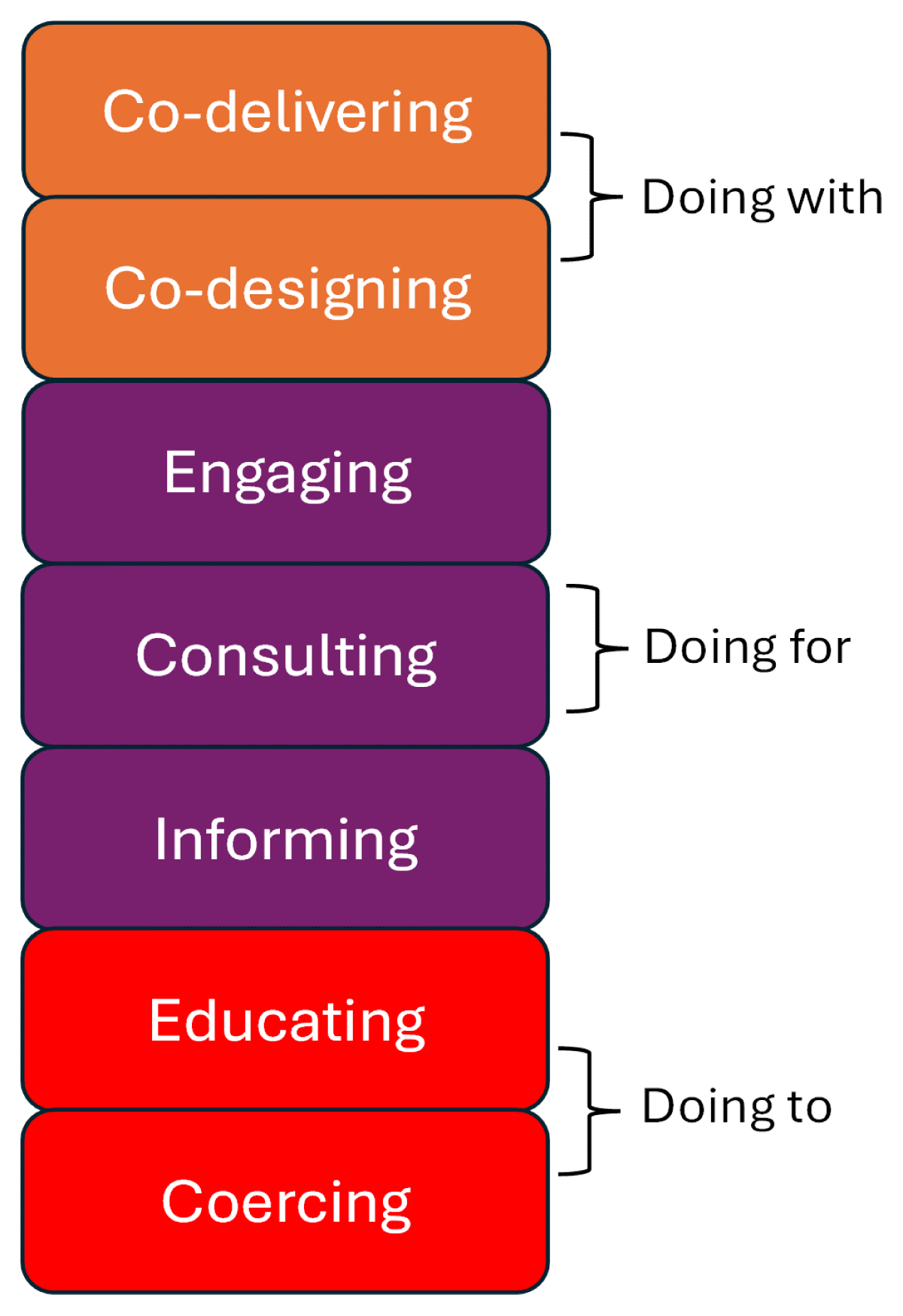
Figure 1
Doing to, doing for and doing with: a model for understanding support in residential services. Merged from Nabatchi et al. (2017) and Norton (2021).
Doing to is represented by the rungs of ‘coercing’ and ‘educating’, which characterise non-involvement in decision-making, where the child is subject to staff members’ control and discretion. Staff in residential services have the practical responsibility for care, protection, and education. Support for children therefore includes staff setting limits and providing guidance (NBHW 2020). Another aspect is that the children must have their basic needs (e.g., dressing, hygiene support, eating, and safeguarding) met by the staff regardless of their capacity to be involved in the activity.
Doing for is illustrated by the rungs ‘informing’, ‘consulting’, and ‘engaging’, reflecting the principles in Swedish legislation and the CRC regarding children’s right to information and to express their opinions (SFS 1993:387; UN 1989). Despite this, the child cannot demand that decisions be made in their best interests or that they be heard or involved (Engwall et al. 2019), implying that the children hold advisory status but without the power to have real influence.
In our model, the rungs for Doing with correspond to Nabatchi’s individual ‘co-delivering’ and ‘co-designing’. Co-design in residential services can then consist of staff and child working together on a plan to meet the child’s support needs in different life areas. Co-delivery can consist of staff and child working together to implement routines and support that strengthen the child’s everyday functioning in different areas of their life.
Objectives
Understanding of how staff can enhance children’s involvement in residential services within their support arrangements remains limited. The aim of the current study was to examine staff actions to involve children in residential services through staff participation in a SDP. The purpose of the SDP was to enhance staff capacity to deliver person-centred support to children with intellectual disabilities living in residential services, as previous research shows that children’s roles as actors should be strengthened.
Method
A secondary analysis was conducted because it is a cost-effective method that uses already collected data to explore aspects that were only partially addressed in the primary study (Heaton 1998; Thorne 1994). Another advantage is that secondary analysis enables maximum data utilisation for vulnerable and hard-to-reach research populations (Fielding 2004; Tate and Happ 2018), such as children with intellectual disabilities (Iacono 2006).
A prerequisite for the reuse of primary data is that the data are suitable for the secondary analysis (Hinds et al. 1997). Investigating children’s involvement in the SDP formed a research theme in the design of the overall research plan for a larger research project exploring co-production and support development. The SDP aimed to enhance child and staff interactions in everyday situations and the child’s level of involvement in those situations.
The SDP was conducted in a non-profit organisation in Sweden from 2020 to 2023, to enhance staff capacity to deliver person-centred support to children with intellectual disabilities living in residential services. The SDP formed part of an interactive research project that utilised experiences from interactions between children and staff. Realist evaluation was employed to identify barriers and enablers (Wallin et al. 2023) and to explore programme theory (Wallin et al. 2025) during the implementation of the SDP.
The organisation offered primary school and residential services to children with intellectual disabilities aged 6–16 years. The level of intellectual disability varied, but the common denominator was that all children had extensive needs for staff support to have a functioning everyday life. Each residence comprised 4–6 children and 5–9 permanent staff, including hourly substitutes. Most staff had disability-related vocational education at high-school level. Staff worked on a rolling 24/7 work-shift schedule. All children had been diagnosed with intellectual disabilities. Most children also had a diagnosis within the autism spectrum and had substantial support needs within the domains of communication and cognition.
The SDP was built on workshop sessions where participating staff teams worked through an improvement methodology, with support from the first author, one child at a time, during the staff’s weekly planning meetings. For each participating child, between 9 and 12 workshop sessions were required to complete all steps in the programme (referred to as a child case study). Between workshop sessions, the staff engaged with the children to enhance their support. In total, six residences participated in the SDP from 2020 to 2023 (Table 1).
Table 1
Information on residences participating in the SDP.
| PERIOD | RESIDENCE | NUMBER OF PERMANENT STAFF | CHILD CASES |
|---|---|---|---|
| 202001–202006 | A | 5 | 2 |
| 202009–202103 | B | 9 | 2 |
| 202101–202106 | C | 5 | 2 |
| 202109–202203 | D | 9 | 2 |
| 202201–202206 | E | 6 | 2 |
| 202209–202304 | F | 6 | 2 |
Data material
Data from the SDP used in this study consisted of nine child case studies and six group interviews.
Child case studies
A de-identified summary of each child’s participation in the SDP was documented, describing what needs a new support intervention was expected to meet and what goals and associated measures were used to assess goal achievement. The summary included information on how the children were involved in various aspects of the support development. The summary of each child case included the outcomes for each child and how the staff had experienced working with the child case. The children’s communication patterns were also noted, to ensure all staff understood how the child communicated, for example, if digital tools were to be used. Informed consent was obtained from 9 of the 12 participating children, and their case studies contributed to the empirical material.
Group interviews
At each residence, after completing their participation in the SDP, the staff’s experiences were collected through group interviews. One theme of the interviews was how the staff collaborated with the children during the SDP. The interviews were semi-structured, featuring open-ended questions supported by an interview guide, and were audio-recorded and transcribed verbatim. The interviews were led by two experienced research team members who had no previous experience with the organisation; they were conducted digitally via Zoom. The group interviews took place between June 2020 and April 2023, lasting approximately 60 minutes each.
Analysis
The design involved analysing qualitative data from two different sources simultaneously to compare the results, gain deeper insights, and provide a comprehensive understanding of the research aim. We used Nabatchi et al.’s (2017) typology of individual co-production focusing on co-design and co-delivery to analyse the child case studies, which represents Doing with in our model, as this was the desirable outcome to increase in the SDP (Framework 1). We used the model of doing to, doing for, and doing with to analyse the group interviews (Framework 2), enabling discussions at all levels of involvement. The results from both frameworks are combined in the subsequent discussion.
Analysis of child case studies: Framework 1
To explore the children’s involvement in the design and delivery of support development, all nine child case studies were summarised using the following steps:
Documenting the communicative patterns of participating children before participation in the SDP;
Identifying the support intervention in the data;
Analysing the aspects of the child’s involvement; and
With a starting point of Nabatchi’s typology of co-design and co-delivery, deductively coding child involvement into Yes, No, or Partly.
Table 2 presents a sample of the analytical process from three child cases.
Table 2
Examples of configurations of child involvement in support interventions.
| COMMUNICATIONPATTERN | SUPPORT INTERVENTION | CHILD INVOLVEMENT | DESIGN | DELIVERY |
|---|---|---|---|---|
| Verbal communication | The child eats lunch with designated staff in his room to avoid the stress that arose when the child ate with peers in the kitchen. | Before designing the support intervention, staff had a dialogue with the child about how he experienced and wanted to improve the lunch situation. The child suggested eating in the room with the staff. During the intervention, lunchtimes became opportunities for the child and staff to design evening activities and discuss things that were important to him. | Yes | Yes |
| Communicated mostly through body language | A visual aid was implemented for choosing leisure activities. | The design involved staff taking an inventory of the activities the child enjoyed. The visual support enabled the child to choose activities after school. | Partly | Partly |
| Verbal communication | Environmental adaptations and visual aids were designed to reduce a child’s challenging behaviour when getting dressed. | Staff designed and delivered support changes. The staff attempted to involve the child in the changes without success. | No | No |
Analysis of group interviews: Framework 2
Qualitative content analysis is considered a suitable method for secondary analysis (Lindahl 2010; Thorne 1994). To examine the staff’s actions regarding support development related to different levels of child involvement, direct content analysis (Hsieh and Shannon 2005) was used to analyse the group interviews. The deductive approach enabled the reinterpretation of existing interviews to identify and categorise key concepts based on staff experiences of children’s involvement. To achieve a mutual understanding of the categorisation process, the first and last authors analysed the data. Deductive coding was performed using the key concepts in the model of Doing to, Doing for, Doing with (Figure 1).
The category Doing to includes the sub-categories Children as passive recipients and Instructions. The category Doing for includes the sub-categories Efforts to involve children and Promoting choice. The category Doing with includes the subcategory Recurring child and staff dialogue. Table 3 presents an outline of how the meaning units were coded into each category. Studying the meaning units allowed us to uncover patterns related to Arnsteinʼs overall categories, which are referred to in the table as sub-categories.
Table 3
An outline of the categories, sub-categories, and samples of representative quotes.
| CATEGORY | SUB-CATEGORY | QUOTES |
|---|---|---|
| Doing to | Children as passive recipients | ‘I think it was also a lot about us (staff) coming up with a solution.’ |
| Instructions | ‘So, pictures have worked, and clarity has been provided so he/she knows what is going to happen.’ | |
| Doing for | Efforts to involve children | ‘How should we present this to the child? How should we involve the child?’ |
| Promoting choice | ‘We gave the child the opportunity to choose different activities with pictures and so on.’ | |
| Doing with | Recurring child and staff dialogue | ‘We had to sit down with the children and talk several times and try to find out what they think is the problem.’ |
Ethical considerations
The study was conducted in accordance with the Declaration of Helsinki. Before data collection, the study was approved by the National Regional Ethics Review Authority (2019–04778). Written informed consent was obtained from all residential staff before data collection. As participating children had impaired decision-making capacity as a result of their cognitive and communicative impairments, decisions regarding participation in the study were handed over to the children’s guardians. The guardians received information letters describing the study purpose and procedure before agreeing to the children’s participation in the research for the SDP. Following Tuffrey-Winje et al. (2008) regarding research involving persons with communication difficulties, ongoing ethical discussions were integrated into the SDP to guarantee that children’s participation occurred under safe and secure conditions. These discussions involved the researcher (first author) and staff, who regularly reflected on the risks and benefits of potential support interventions and considered questions like, what value does this intervention aim to provide from the child’s perspective? How can we detect early indicators that the child is not benefiting from the intervention?
Results
Framework 1 (Child case studies)
The configuration of the nine child case studies reveals differences in children’s involvement in their support arrangements. Not surprisingly, children with limited communicative abilities are underrepresented in co-design and co-delivery. Children with verbal communication skills, along with staff who actively encouraged their input throughout the support development process, form a common denominator of child involvement in co-design and co-delivery support. However, this was not always the case, indicating the importance of other factors in child involvement.
In two cases, staff developed innovative practices to involve children as actors in their daily lives. For example, staff designed a visual aid that increased the children’s ability to choose after-school leisure activities, rather than simply accepting a lack of verbal communication. In one of these cases, the child was partially involved in the design, with staff working with the child to explore preferred activities before the visual aid was developed.
Framework 2 (Group interviews)
The directed content analysis identified key features, starting from the model of Doing to, Doing for, and Doing with, resulting in five sub-categories.
Doing to
Children as passive recipients
A prominent theme from the interviews was that the staff are responsible for developing support that promotes the children’s well-being and everyday functioning.
This responsibility was expressed through the ambition to give the children a meaningful life and to work continuously to improve their situation in the residential environment. The following staff quotes are representative:
‘When you map a child in a problematic situation… which we think is a problem, and then when you are going to make a change, you see that the child reacts in a particular way.’
‘Where do we want to find an improvement in our approach to help the child?’
‘I think it was also a lot about us coming up with a solution.’
There are indications that the staff perceive the children as passive recipients of support, where the staff members’ initiative and competence decide the individual support. This attitude was prominent in residences where staff identified that children could not be involved due to their lack of capacity: ‘A functioning child can be involved. In the residence we work in, we have children who are not at that level.’
Instructions
During the interviews, the staff’s upbringing responsibilities were discussed. Upbringing interventions involve staff exercising control over the children’s everyday activities. For example, some of the staff members’ support interventions aimed to increase the children’s understanding and compliance with everyday events. A staff member recounted how they created a visual aid to direct a child’s behaviour during lunch: ‘So, we put a schedule by his chair at the dining table so he could see what he needed to do right away.’
Some staff highlighted that the work in the residence is challenging. The children often have complex, extensive support needs that must be met while all the tasks associated with a household must be carried out. Predictability is important for creating a manageable everyday life where children follow a planned structure. In this context, developing clarifying visual aids serves to create order in the residential environment. In connection with a description of how the staff worked to introduce a visual aid, the order-creating value of the intervention emerged: ‘The child’s world needs to be reduced and controlled a little because otherwise, he is all over the place.’
Overall, visual support that clarifies instructions fills a need to help children with their everyday functioning and forms part of the staff’s educational responsibility. At the same time, it promotes a manageable environment for the staff.
Doing for
Efforts to involve children
A sincere desire to involve children in their support development emerged as a theme from the interviews. At the same time, challenges arose in creating conditions for involvement, as it required preparations concerning each child’s specific abilities and preferences. Questions were raised about how the children could be engaged in their support arrangements: ‘How should we present this to the child? How should we involve the child?’
In some cases, the preparation included creating opportunities for dialogue based on what the staff had identified as problems in the child’s everyday life. The child’s involvement serves a pedagogical purpose, allowing the child to confirm the staff’s suggestions about what could constitute an improvement. At this level, the problem areas have been predetermined by the staff, meaning that children’s involvement takes on a consultative character: ‘We (the staff) have listed problems about what it (the problem) is about, and we also interviewed the children.’
During the interviews, it emerged that the obstacles to involving children were not solely dependent on the children’s communicative patterns. Finding a common starting point in the dialogue between the staff and the child regarding what needs to be addressed can be challenging, even when the child possesses verbal communication skills. One staff member described the dilemma as follows:
These two children are both verbal. That doesn’t always mean they can say what they want and need help with or even accept that they always need help. But it was still possible to get them involved in shaping what the support looks like or how it is given.
The quote indicates that staff have interpretative precedence over which situations are important to work with to improve the child’s life. The child’s involvement can then be restricted to influencing details within a problem discourse that they did not instigate.
Promoting choice
The interviews revealed that the staff had the ambition to involve children in support delivery. In addition to developing visual instructions for children, they were developing visual aids to give the children a sense of influence over specific situations. Principally, these visual aids were used to promote the children’s choice of leisure activities after the school day or at weekends: ‘We gave the child the opportunity to choose different activities with pictures and so on.’
Since some children have difficulty participating in designing the visual support, staff must engage in detective work to clarify the following: which activities should be included as optional, what type of images suit the child best, and how many activities should be reflected in the visual support. To move forward, staff need to test which activities the child prefers. One staff member explained that they began introducing several different images, and, based on the child’s positive responses, a few were selected to be included in the initial version of the visual support.
Doing with
Recurring staff and child dialogues
Some staff members spoke about an in-depth collaboration with the children. It is understood that in-depth collaboration concerns those children whom the staff assess to have the capacity for dialogue: ‘So with a high-functioning child, you can include the child right from the assessment … because then you can ask questions directly of the child.’
Collaborations involve the child’s early engagement in the support development process. For example, staff can start an unbiased conversation with the child about his or her everyday experiences in the residence. If the child struggles to articulate a perceived problem, the staff adopt a coaching approach to advance the dialogue and identify areas for improvement: ‘We had to sit down with the children and talk several times and try to find out what they think is the problem.’
In this category, staff described how recurring dialogue constituted the hub for identifying, planning, and continuously improving a support intervention based on the child’s input. The following quote is illustrative: ‘… it started with a schedule that the child wanted. Then it didn’t work out exactly, and we changed the schedule until it was completely adapted to what the child wanted to do.’
The staff stated that close collaboration with the children promoted relationships and increased their motivation to contribute to positive development. An important prerequisite is for staff to free up time for planned interaction moments with the children, and the conversations should be adapted based on the children’s communication styles. Another essential prerequisite is to persevere in trying to involve the children, even though it can be difficult initially: ‘Now it’s a bit more about actually taking the time, sitting down, this is a task that needs to be done, now we’re going to sit and talk to this child.’
The quote illustrates how the attitude had changed from seeing children’s involvement as something exclusive, possible when all conditions were met, to becoming a routine feature of the activities.
Discussion
This article examines staff’s actions to involve children in residential services through staff’s participation in a support development programme. The aim of the SDP was to enhance staff capacity to deliver person-centred support to children with intellectual disabilities in residential services, as previous research shows that children’s roles as actors should be strengthened. The main findings of this study indicate that children with intellectual disabilities living in special residences can participate in their support arrangements at various levels if staff employ working methods that encourage involvement. The findings will be discussed in relation to the model of Doing to, Doing for, and Doing with, in the context of residential services for children with intellectual disabilities. To work with the model to increase children’s agency and their role as actors in their daily life, staff need support. As there is a lack of key skills among staff in residential services and a need for initiatives for continuous competence development (NBHW 2021), the SDP can be seen as one way of improving staff competence in daily practice. The child cases are practical examples of a way of working that supports staff’s competence development by working towards identifying capacities for rather than hindrances to child involvement, in situations in everyday life that are stressful or perceived as needing improvement for the child or for staff. The importance of working with small-scale improvement efforts, such as the child cases, should be reflected on in comparison with other studies addressing quality indicators in residential care homes. In a recent study developing quality indicators for residential care for children and young people with disabilities, the microsystem level was not included, as the logic presented concluded that microsystem-level improvement was due to meso- and macro-level improvements (Alves et al. 2025). As individual co-production (Nabatchi et al. 2017) occurs at the microsystem level, we argue that this level should not be excluded or simplified as dependent on actions at other system levels.
Within individual co-production, staff motivation and detective work to promote children’s involvement and communication related to involvement are crucial elements in this endeavour. As child involvement challenges include communication barriers, the staff’s perceptions of the scope for including the children are important.
The findings revealed that children with communication difficulties participated in support development to a lesser extent than children with verbal ability. This is consistent with previous research showing that actual communication barriers between staff and people with disabilities, as well as staff attitudes, can constitute barriers to involvement (Bigby et al. 2009; Talman et al. 2021; Dalton and Sweeney 2013; Hoole and Morgan 2011). Staff’s lack of relevant competencies in residential services in Sweden has been highlighted. The NBHW (2021) has decided to take action to support improved communication skills for staff. Staff training and professional development have been noted as a key to quality in residential care homes for children with intellectual disabilities (Alves et al. 2025).
In the present study, support development for these children focused on improving their involvement in life situations, often resulting in image-based instructions developed by the staff. Although the support seems important for promoting the everyday functioning of these children, they are relegated to passive recipients, uninvited to participate in the design and delivery of that support. Bigby et al. (2009) highlight that the more pronounced the disability of the person receiving support, the greater the challenge for support staff to involve the service user and to believe that it is possible to create participation. Franklin and Goff (2019) conclude that with time, commitment, and positive attitudes and values, children who are often seen as ‘too disabled to express their opinions’ can communicate their needs and preferences. Examples of commitment and positive attitudes in our study were reflected in staff planning, allocating time for child conversations, and taking on the role of detectives to adapt communication to children’s preferences.
Communication can be verbal or more embodied, and staff’s understanding and knowledge of children’s communication patterns and how to support communication is key to ensuring involvement in residential care homes (Franklin and Goff 2019). Although some children were assessed as having communication difficulties too severe to participate at a higher level in our study, supportive interventions aimed at enhancing the children’s communicative autonomy represented a staff focus. People with autism and intellectual disabilities tend to have more developed visual skills than verbal abilities, highlighting the importance of image-based tools for enhancing communication and collaboration (Brill 2011). The development of image-based aids to promote children’s opportunities to make choices represented a goal-setting, guiding support intervention in co-delivery. According to Wehmeyer (2020), professionals should recognise that individuals with intellectual disabilities must have opportunities to make choices. Appropriate information and sources of support can create a context where reliable options and alternatives are available. This type of support has faced criticism because it offers only limited influence; the choices are restricted to a few activities predetermined by the staff (Hollomotz 2014). Furthermore, Norton (2021) refers to this limited impact as a tokenistic practice because it is not based on an egalitarian system where power is equally distributed between service users and professionals. However, given that communication barriers pose real challenges for staff in residential services, image-based activity support can help children gain some control in situations previously solely determined by staff. The image-based aids enabled children to have more choice in co-delivery than they did before they had access to the aids. In isolated cases, image-based aids were also used to foster children’s participation in co-design. Tideman et al. (2025) highlight the need to develop and strengthen the involvement of people with disabilities in the process that precedes the delivery of support in the context of LSS operations: namely, investigation, decision-making, and design of individual support. In our study, the interviews did not reveal why the staff created conditions for children’s involvement in co-delivery to a greater extent than in co-design. Previous and contemporary research has identified a lack of knowledge, resources, and sufficient training for frontline staff as constraining factors (Dalton and Sweeney 2013; Raman and French 2022). It is recommended that service providers create the right conditions for facilitating genuine involvement by establishing a clear commitment (Raman and French 2022). This includes adopting methods and tools that enable individual creativity and conversations: designing time, creating opportunities for mutual learning, and fostering social experiences to build trust and foster equal partnerships.
In the present study, a common denominator in those situations in which the children were involved at a high level was that the staff actively sought and valued the children’s input. The interaction was enabled by staff having freed up time to engage in recurring dialogue with the children at various steps of support development: planning, designing, testing, and follow-up. An example of the procedure is how the staff and children developed a support schedule together. The staff members’ retelling of the working method is reminiscent of a shared learning process where recurring dialogues formed a platform for ongoing individualisation of the children’s schedules. According to co-production literature, establishing a partnership between the professional and the service user is a key factor (Osborne and Strokosch 2013). This indicates that service user involvement is not a one-time activity but serves as the core of the relationship to engage users in every step of the service process (Boyle and Harris 2009). The current study suggests that a relational context defined by ongoing dialogue between staff, the child, and their support arrangements can blur the lines between co-design and co-delivery: the effort to create individualised support benefits from an iterative process where children receiving residential services are involved in designing and redesigning based on the experiences of different phases of support delivery. Data show that the inclusive approach involved children whom the staff considered sufficiently communicatively competent to become co-producers in their support development. However, some findings show that even when the staff assessed the child as being a capable actor, conducting a constructive dialogue based on the child’s preferences was a challenge. An enabling factor could be that the staff member ensures that the communicative interaction suits the child’s communication style, creating a common ground where the child understands and can influence the support development process. This is particularly relevant because overestimating a person’s communication skills often leads staff to underestimate the need to develop individual communication strategies (Bradshaw 2001).
The model of Doing to, Doing for, and Doing with may serve as a tool for discussing how to change the approaches and actions for supporting children with intellectual disabilities to increase their roles as actors in their everyday lives. Further research is needed to deepen understanding and promote the active engagement of children with intellectual disabilities across diverse settings (Hultman et al. 2019; Verdonschot et al. 2009). The relational aspect of children’s agency, as described by Sorbring and Kuczynski (2018), indicates the importance of educating staff on how to promote children’s agency to reach a level of Doing with.
Limitations and strengths
Although this study contributes to a contextual understanding of children’s engagement in support development in special residences, some issues of reliability require further attention. The first author’s dual roles as an improvement coach in the SDP and as the main researcher responsible for collecting and analysing data may have been a potential source of bias. To ensure research integrity, group interviews were conducted by the second and third authors, who had no previous connection to the participating staff teams or their workplace. The data analysis was carried out in collaboration with the last author to minimise possible bias from the first author.
The study design, which utilises two theoretical frameworks and combines case study data with group interview data, promotes the internal and construct validity of the research findings (Baker 2011). However, reliability could have been strengthened by reproducing all child case configurations, allowing stakeholders to assess the coherence between the child case study data and the reported results. Due to concerns about the integrity and traceability of participating children and compliance with ethical review board approval, the authors chose to provide a limited sample (Table 2).
Conclusions
The findings demonstrate that a person-centred support development programme can influence staff’s actions to involve children at different levels within residential services. The level of resources and capacity varies among children, as does the risk of low competence among staff, creating challenges for involvement. The children’s communication difficulties, as well as staff perceptions of the children’s capacities, constitute barriers to involvement in support development. Organisational support to tailor communication support to strengthen children’s voices in co-design and joint implementation, considering the specific situation and children’s abilities and maturity levels, can promote staff working methods. The model of Doing to, Doing for, and Doing with can support development of staff competency in involving children in their own daily living activities. Higher-level involvement requires overcoming communication barriers and engaging in ongoing dialogue with children as a natural part of defining, planning, delivering, and improving individualised support. The lessons learned from this study hold transferable value for organisations and support staff aiming to give children with intellectual disabilities greater control and influence over the support necessary for them to lead more independent lives in their communities.
Data Accessibility Statement
The data generated for this study will not be made publicly available. The ethical approval does not allow the data to be shared outside the research group.