
1. Introduction
In Sweden, children with certain types of disabilities are entitled to personal assistance to support the fulfillment of basic needs and enable participation in society (SSIA 2023). The benefit is granted based on individual need – irrespective of other characteristics – and is intended to ensure that children with disabilities can live in the community with the same choices and opportunities as children without disabilities. Sweden has also ratified the Convention on the Rights of Persons with Disabilities, thereby committing to ensuring that persons with disabilities can achieve full and effective participation in society on equal basis with others (United Nations 2008).
Participation in society for persons with disabilities is influenced not only by the type and severity of disability but also by societal factors, such as environmental barriers and access to societal support (WHO 2001). Consistent with the social model of disability, disability is understood as arising from social conditions that restrict participation, rather than as a property of the individual (Oliver 1990). The independent living philosophy similarly emphasizes that individuals with disabilities should have the same opportunities and autonomy as individuals who do not have disabilities (Morris 2004). In addition, the International Classification of Functioning, Disability and Health (ICF) provides a conceptual framework for understanding disability as the interaction between an individual’s functioning and contextual environmental factors, including social and institutional barriers (WHO 2001). In this context, personal assistance can be understood as a key mechanism for enabling independence and reducing the impact of socially produced barriers to meaningful participation.
Cerebral palsy (CP) is an early-onset, chronic condition affecting movement, posture, and balance (O’Shea 2008). It results from an injury in the developing fetal or infant brain prior to the age of two years and is associated with a number of comorbidities and secondary conditions (O’Shea 2008). Individuals with CP exhibit substantial variation in function, with some functioning independently and others requiring assistance to carry out activities of daily living and participate in society (Rosenbaum et al. 2007). Personal assistance is intended to provide such support and can play a key role in mitigating environmental barriers by promoting and encouraging autonomy and social participation, based on an understanding of the individual’s needs, preferences, and circumstances (Riobóo-Lois et al. 2024). Ensuring equitable access to personal assistance is therefore essential not only for supporting daily life but also for enabling full participation in society in line with both the social model of disability and ICF perspectives.
In Sweden, parents of children with certain disabilities, including CP, can apply for personal assistance compensation for their child at the Swedish Social Insurance Agency (SSIA). The SSIA assesses the application based on medical documentation provided by a physician, potential consultations with the applicant, and, where relevant, supplementary information from settings such as school and other daily activities (SSIA 2023). If the application is approved, personal assistance compensation is granted at a fixed sum per hour. Parents have the option to appeal the decision or apply for more hours of personal assistance at a later point (SSIA 2023). Depending on how many hours of personal assistance are approved, either the national or local authorities are responsible for covering the costs and administration of the benefit. If the number of approved hours exceeds 20 hours per week, the SSIA is the responsible entity, while the municipality (local level) is responsible if the approved hours are 20 hours or less (SSIA 2023).
Concerns have been raised that the application process for personal assistance has become complicated and may disproportionally punish those with lower educational levels. The ability to convincingly justify the need for personal assistance could be influential (Sørensen et al. 2012; Stormacq, Van den Broucke, & Wosinski 2019) in both the initial and subsequent stages of the application process. At the initial stage, parents need to obtain a medical certificate from the child’s physician that describes the child’s disability and its impact on daily life. The parents’ capacity to critically evaluate this certificate and communicate the contents may affect the success of the application. In the later stages of the process, the parents need to outline the child’s activities and provide a persuasive justification for why these activities require personal assistance to caseworkers at the SSIA.
Only a few studies have investigated access to disability benefits among children with disabilities, and with varying results. For example, O’Reilly et al. (2021) noted differences in receipt of disability living allowance in Northern Ireland based on ethnicity, migrant status, religious denomination, parental marital status, housing tenure, household car access, and area of residence. However, the study did not investigate how parental education relates to children’s access to disability benefits. In Norway, Finnvold (2009) noted positive relationships in the likelihood of receiving benefits dependent on educational background of parents, whereas Brekke, Evensen, and Hart (2020) found that children of highly educated mothers were less likely to take up benefits compared to those of less educated mothers. Prior studies concerning disability benefits among children tend to focus on the likelihood of receiving disability benefits with less attention given to the amount of benefit granted. The amount of benefit received is equally important, as it directly influences the child’s opportunities and capacity to participate in society.
The aim of this study was to assess if the likelihood of receiving personal assistance compensation and the number of hours of personal assistance granted varied by parental educational level among children with CP in Sweden between 2006 and 2020.
2. Methods
A central issue when comparing access to disability benefits is measuring differences in needs across individuals. By focusing on one condition (CP), we will be able to approximate needs across individuals through the Gross Motor Function Classification System (GMFCS), a widely used classification system of gross motor function. Although the GMFCS does not capture the full range of contextual factors that shape the experience of disability, it provides a common metric that allows for more consistent comparison than would be possible across heterogeneous impairment categories without a shared scale.
2.1 Study population
The study population included individuals aged 1 to 18 years who were registered with a diagnosis of CP in the CPUP register between 2006 and 2015. The use of a diagnostic category reflects the structure of administrative and clinical data sources, which organize eligibility and follow-up based on medical classifications. Each individual was followed from the year of cohort entry until the earliest of the following: death, emigration, turning 19 years of age, or the end of follow-up in 2020. Hence, the data had a panel structure, indicating the amount of personal assistance benefit received for each year during the study period. The first year of life was excluded, as parents are typically the sole caregivers during this period and few children receive personal assistance benefits.
CPUP is a combined follow-up program and national register for individuals with CP and has been implemented nationwide in Sweden since 2006. The coverage rate of the program has gradually increased over time and by 2015 included approximately 95% of all children with CP born in 2000 or later (Hägglund 2023). See appendix table A5 for annual number and proportion of individuals, total and by educational group. Information of parents was obtained through linkage to the Swedish Multigenerational Register. Demographic and educational data for both parents and children were linked using Statistics Sweden’s Longitudinal Integrated Database for Health Insurance and Labor Market Studies and the Register of the Total Population. Data on personal assistance compensation were obtained from the SSIA and linked to each individual. These data include all individuals granted more than 20 hours of personal assistance per week, reflecting the eligibility threshold for nationally administered benefits. As a result, the analysis pertains specifically to access to personal assistance within this policy framework.
2.2 Variables
The dependent variable was the likelihood of receiving personal assistance and the number of hours of personal assistance compensated per month. The predictor variable was parental educational attainment the year before the birth of the child. Parental educational attainment was coded into four categories: 1) the highest educated parent had nine years or less of compulsory education; 2) the highest educated parent had completed secondary education; 3) the highest educated parent had completed tertiary education at a higher educational institution; and 4) both parents had completed tertiary education at higher educational institutions. We controlled for potential confounding variables, including the child’s biological sex (binary) and age (continuous), parental background (binary: either both parents had non-Swedish birthplace or at least one parent was born in Sweden), and both parents’ ages at the time of the child’s birth (continuous). To address differences in need, we controlled for the level of gross motor function by including the Gross Motor Function Classification System (GMFCS) (categorical). The GMFCS is a widely recognized classification system used to describe functional abilities and constraints in children with CP, and it is closely correlated with other functional measures (Compagnone et al. 2014). The GMFCS focuses on usual performance in the home, school, and community settings, i.e., what the children actually do in their daily lives. The GMFCS comprises five levels where each level represents differences in gross motor function expected to impact daily activities. Level I indicates few limitations (e.g., walks without limitations), whereas level V indicates severe limitations (e.g., child requires transportation in a wheelchair) (Palisano et al. 2008). In this study, the GMFCS assessment closest to the age of 5 years was used, as GMFCS levels generally do not vary by age. The GMFCS level of the child is assessed by a health professional, often in conjunction with the parents, and recorded in the CPUP register.
2.3 Statistical analysis
The statistical analysis was conducted in two steps. First, differences in the likelihood of receiving personal assistance compensation across parental educational groups were assessed using logistic regression on pooled panel data across all years. Standard errors were clustered at the individual level to account for panel data structure. The outcome variable was binary, indicating whether the individual received any hours of personal assistance compensation.
Second, the differences in the number of hours compensated across parental educational groups were estimated on pooled panel data. To address the large proportion of zero observations (78%) and avoid selection bias, we used a two-part model (Belotti, Deb, & Manning 2015; Deb & Norton 2018), which combined a logit model estimating the probability of observing a positive-versus-zero outcome with a regression model conditional on a positive outcome. The second part of the two-part model was estimated using OLS. To address the panel structure and heteroskedasticity in the residuals, standard errors were clustered at the individual level.
Control variables were added stepwise for both the logistic regression and the two-part model. Model 1 included the crude association. Model 2 added demographic variables (sex of the child, age of the child, age of both parents at time of child’s birth, and parents’ birthplaces). Model 3 added GMFCS level of the child and was considered the fully adjusted model.
To examine whether differences by parental education varied over time, the fully adjusted models were estimated for each year in the study period, using robust standard errors.
2.4 Sensitivity analysis
To understand if the results were driven by missing data or added control variables, we re-estimated models 1 and 2 using the sample of the fully adjusted model. We also analyzed if the fully adjusted model yielded different results for individuals without parental education information. Lastly, we tested the robustness of the second part of the two-part model by using alternative specifications, including a generalized linear model with a gamma distribution and a log-transformed OLS model.
All analyses and plots were made using Stata18.
3. Results
Table 1 shows summary statistics of the total sample of eligible individuals, which included 4,881 children with CP, and 50,621 observations from 2006 to 2020. A higher proportion of the compulsory-educated group (26.25%) received personal assistance compensation, compared to those in the secondary-educated group (23.55%), the one-parent tertiary-educated group (21.68%), and the two-parent tertiary-educated group (20.83%). However, children in the one-parent tertiary-educated group (457.02 hours per month) and the two-parent tertiary-educated group (468.41 hours per month) were compensated for more hours of personal assistance than the secondary-educated group (436.50 hours per month) and the compulsory-educated group (435.07 hours per month). This pattern persisted even though children in the tertiary-educated groups generally had lower GMFCS level. The highest proportion of children with parents born outside of Sweden were found in the compulsory-educated group (60.17%) as well as in the group missing information on parental education (98.08%).
Table 1
Summary statistics of outcome and control variables by parental education.
| VARIABLES | TOTAL | COMPULSORY-EDUCATED PARENT | SECONDARY-EDUCATED PARENT | ONE PARENT TERTIARY EDUCATED | BOTH PARENTS TERTIARY EDUCATED | INDIVIDUALS WITH NO EDUCATION INFORMATION |
|---|---|---|---|---|---|---|
| Proportion who received the benefit | 22.16 | 26.25 | 23.55 | 21.68 | 20.83 | 12.25 |
| Hours compensated if any compensateda | 445.58 (207.67) | 435.07 (197.66) | 436.50 (203.07) | 457.02 (212.40) | 466.38 (223.84) | 385.56 (124.01) |
| Proportion of girls | 41.85 | 42.88 | 41.29 | 42.66 | 40.07 | 47.05 |
| Age of child in yearsa | 8.96 (4.80) | 9.65 (4.75) | 9.24 (4.84) | 8.81 (4.80) | 8.25 (4.65) | 8.95 (4.66) |
| Proportion where both parents are born outside Sweden | 27.11 | 60.17 | 18.27 | 23.80 | 16.11 | 98.08 |
| Age of mother at birth in yearsa | 30.26 (5.58) | 26.59 (6.70) | 29.41 (5.47) | 31.40 (5.20) | 32.52 (4.22) | 26.66 (5.77) |
| Age of father at birth in yearsa | 33.33 (6.52) | 31.21 (8.39) | 32.63 (6.54) | 34.19 (6.30) | 34.65 (5.37) | 30.94 (6.78) |
| GMFCS average level of the child | 2.33 | 2.59 | 2.33 | 2.29 | 2.24 | 2.46 |
| Proportions by GMFCS level of the child: | ||||||
| I | 47.23 | 37.33 | 46.46 | 48.94 | 51.39 | 44.96 |
| II | 14.19 | 17.24 | 14.81 | 13.93 | 12.04 | 13.87 |
| III | 10.55 | 12.22 | 10.96 | 9.97 | 10.22 | 8.79 |
| IV | 14.05 | 15.16 | 14.46 | 13.19 | 13.78 | 14.38 |
| V | 13.98 | 18.05 | 13.31 | 13.93 | 12.58 | 18.01 |
| Total number of observations | 50,621 | 4,286 | 20,520 | 13,208 | 9,897 | 2,710 |
| Total number of individuals | 4,881 | 458 | 1,945 | 1,269 | 931 | 278 |
[i] GMFCS = Gross Motor Function Classification System, a = standard deviation indicated in parentheses.
Table 2 shows variations in the likelihood of receiving personal assistance compensation and the number of hours compensated. The sample sizes varied due to missing data on some variables (Appendix, Table A.1). Crude differences in the likelihood and number of hours compensated were largely driven by demographic factors and the GMFCS level of the child. In the fully adjusted model, significant differences were observed both in the likelihood of receiving personal assistance compensation and in the number of hours of personal assistance compensated for the secondary-educated group (OR = 1.43, CI: 1.03, 1.99; Mean difference = 13.09, CI: 1.19, 25.01) and the two-parent tertiary-educated group (OR = 1.49, CI: 1.03, 2.16; Mean difference = 24.62, CI: 10.46, 38.77) compared to the compulsory-educated group. The one-parent tertiary-educated group was compensated for significantly more hours per month (Mean difference = 14.66, CI: 1.79, 27.52), however there was no statistically significant difference in their likelihood of receiving personal assistance compensation compared to the compulsory-educated group.
Table 2
Parental educational level and receipt of personal assistance compensation for their child with cerebral palsy.
| MODEL 1: CRUDE ASSOCIATION | MODEL 2: 1 + ADJUSTED FOR DEMOGRAPHIC VARIABLES | MODEL 3: 2 + ADJUSTED FOR GMFCS LEVEL | ||||
|---|---|---|---|---|---|---|
| OR (CI) | HOURS (CI) | OR (CI) | HOURS (CI) | OR (CI) | HOURS (CI) | |
| Education | ||||||
| Compulsory (reference) | 1.00 | 114.20 | 1.00 | 87.32 | 1.00 | 85.47 |
| Secondary | 0.87 (0.69, 1.08) | –11.39 (–31.82, 9.04) | 1.21 (0.93, 1.57) | 13.60 (–5.26, 32.45) | 1.43 (1.03, 1.99) | 13.09 (1.19, 25.01) |
| One parent tertiary educated | 0.78 (0.61, 0.98) | –15.10 (–36.56, 9.04) | 1.08 (0.82, 1.42) | 11.24 (–8.08, 31.29) | 1.28 (0.90, 1.81) | 14.66 (1.79, 27.52) |
| Both parents tertiary educated | 0.74 (0.58, 0.95) | –17.03 (–39.51, 5.45) | 1.16 (0.87, 1.55) | 19.39 (–2.60, 41.39) | 1.49 (1.03, 2.16) | 24.62 (10.46, 38.77) |
| Observations | 47,911 | 46,452 | 44,681 | |||
| Individuals | 4,603 | 4,428 | 4,265 | |||
[i] OR = Odds ratio, Hours = hours of personal assistance compensated per month. 95% confidence intervals are indicated in parenthesis, and significance results at the 5% level are indicated in bold.
Figure 1 shows the trend of the differences compared to the compulsory-educated group in the likelihoods of receiving personal assistance compensation based on the fully adjusted model. Between 2006 and 2011, significant differences were observed only in 2008 for the secondary-educated group and the two-parent tertiary-educated group. In 2012, the differences increased and reached statistical significance for the secondary-educated group and two-parent tertiary-educated groups. However, in the following years, the differences declined and were not consistently statistically significant from 2015 to 2020. Figure 2 shows the trend in the differences compared to the compulsory-educated group in the number of hours of personal assistance compensated. From 2008 until the end of the study period in 2020, the difference for the two-parent tertiary-educated group was statistically significant and peaked between 2012 and 2015. There was a trend towards increasing differences in the number of hours compensated for the secondary-educated group and the one-parent tertiary-educated group. Starting from 2011 for the one-parent tertiary-educated group, and from 2014 for the secondary-educated group, the differences remained statistically significant or close to significant to the end of the study period.
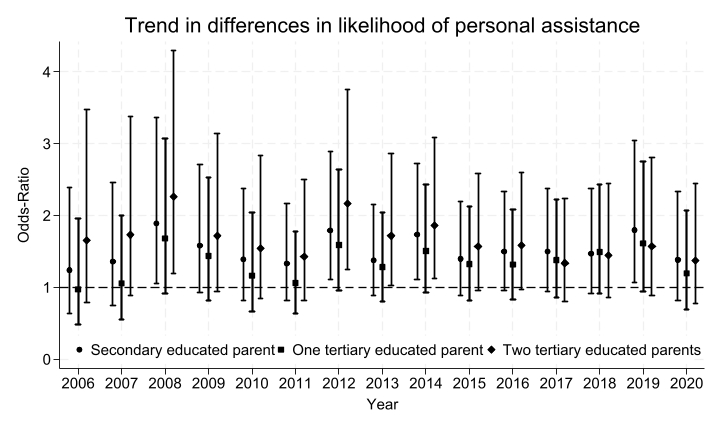
Figure 1
Trend in differences in the likelihood of receiving personal assistance compensation between parental educational levels between 2006 and 2020.
Point estimate and 95% confidence intervals for differences between educational groups in odds of receiving personal assistance compensation compared to the compulsory-educated group in each year. Estimates are derived from the fully adjusted model.
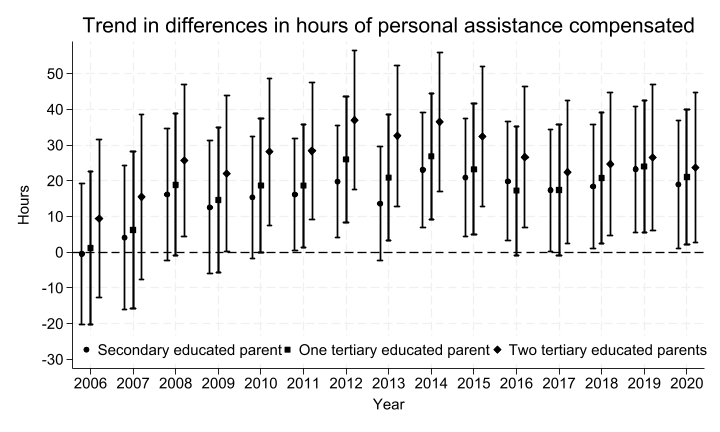
Figure 2
Trend in differences in the number of personal assistance hours compensated between parental educational levels between 2006 and 2020.
Point estimate and 95% confidence intervals for differences between educational groups in hours compensated compared to the compulsory-educated group in each year. Estimates are derived from the fully adjusted model.
Missing data did not appear to bias the results to a degree that caused concern for the validity of the findings. Using the sample of the fully adjusted model in models 1 and 2 only resulted in minor changes in the model outputs (Appendix, Table A.2). Individuals with missing information on parental education received significantly fewer hours of personal assistance than groups with information on parental education (Appendix, Table A.3). Ninety-eight percent of children in this group had parents who were born outside Sweden. Analyses using alternative specifications – including a generalized linear model with a gamma distribution and a log-transformed OLS model – yielded comparable results, suggesting that the findings are robust to the choice of model (Appendix, Table A.4).
4. Discussion
We investigated whether there were differences in the likelihood of access to personal assistance compensation and in the number of hours of personal assistance compensated by the SSIA by parental educational level between the years 2006 and 2020. After adjusting for several variables expected to confound and influence the association, we found that individuals with parents who had only compulsory education had a significantly lower likelihood of receiving personal assistance compensation and were granted significantly fewer hours compared to those with more highly educated parents. These findings might suggest systematic inequalities in access to publicly funded support, indicating that the distribution of personal assistance may be shaped not only by need but also by underlying social and structural factors.
The most noticeable differences were found in the amount of personal assistance compensated. Compared with the compulsory-educated group, the secondary-educated group was compensated for 15% more hours of personal assistance per month for their child with CP, the one-parent tertiary-educated group was compensated for 17% more hours per month, and the two-parent tertiary-educated group was compensated for 29% more hours per month, after adjusting for demographic variables and GMFCS level of the child. There was a trend over the study period of a widening difference between the compulsory-educated group and the higher-educated groups in the number of hours compensated. These patterns run counter to the intended purpose of personal assistance and conflict with the principles of the United Nations Convention on the Rights of Persons with Disabilities, which seeks to ensure that persons with disabilities can participate fully and effectively in society on an equal basis to others. Consequently, these disparities may reflect structural inequities that undermine the rights of persons with disabilities.
Our results are not in alignment with some prior studies on access to disability benefits among children, underlining the importance of the context of the social insurance system and the benefit under investigation. For example, O’Reilly et al. (2021) noted that persons of lower socioeconomic standing were the most likely to receive disability living allowance in Northern Ireland. A study from Norway found no statistically significant difference in the likelihood of receiving a higher amount of disability attendance benefit by parental educational levels (Brekke, Evensen, & Hart 2020). However, they did not control for health status, which might suppress the effect of education. In contrast, our study aligns with the findings of Finnvold (2009), who reported that in Norway, parents with higher education had easier access to income support for children with asthma and faced fewer delays in benefit applications than parents with lower education levels.
The consequence of unequal access to personal assistance could mean that children with CP and their parents are more poorly integrated into society and live more isolated lives. Personal assistants play a crucial role in supporting children’s engagement in activities that promote social development and integration beyond the family environment (Boren et al. 2016). Previous research conducted in Sweden found that children with disabilities more often receive support from personal assistants for studies, schooling, and leisure activities, compared to adults with disabilities (von Granitz et al. 2017). Because access to education and social engagement is fundamental to autonomy, development, and future opportunity (Anaby et al. 2020), restricted access to personal assistance can reinforce marginalization, hinder the formation of social connections, and limit the attainment of well-being. Additionally, when disability intersects with restricted access to personal assistance and low parental education, it could create a ‘triple-burden’ that undermines the child’s social integration and well-being. The lower support for the child with disability can also affect the parents; caregiving demands associated with disability can restrict a parent’s labor market participation (Kleven, Landais, & Søgaard 2019; Asuman et al. 2025) and compromise their mental health (Asuman, Ásgeirsdóttir, & Jarl 2025). For parents with compulsory education, who may already face precarious employment, the necessity of providing additional care due to limited access to personal assistance might worsen economic conditions and reduce labor market participation. Furthermore, the cumulative strain of socioeconomic disadvantage and less support in meeting caregiving demands can compromise parental health further and, by extension, diminish the child’s well-being. These dynamics underscore the importance of ensuring equitable access to personal assistance, not only for the child’s social participation and development but also for the well-being and societal integration of the family as a whole.
Highly educated parents may be better positioned to navigate the claim process and advocate effectively for their child’s support needs. The interpretation of the law has shifted towards a medical understanding of disability that emphasizes deficit rather than participation (Brennan et al. 2016). Consequently, the compulsory-educated group may encounter greater difficulties understanding complex medical terminology and communicating their child’s needs within the system. Furthermore, over the past decades, the Supreme Administrative Court in Sweden has made numerous rulings intended to clarify what constitutes basic needs, reducing the number of recipients of the benefit (SSIA 2020). As such, it is possible that the ability to comprehend the changing legal framework has become increasingly important, disproportionately affecting parents with only compulsory education and potentially contributing to the observed trend of widening inequalities. In line with this, one study showed that fewer personal assistance hours are being granted for activities related to participation in Sweden (von Granitz et al. 2022), which may indicate that effectively advocating for support for leisure and social activities has become even more critical. These developments highlight how procedural complexity and legal interpretation might create structural barriers to equitable access to personal assistance.
Alternatively, it could also be that children of highly educated parents engage in more activities that warrant support. Previous studies have found that children that come from households of low socioeconomic status tend to engage less in physical activities and generally lead a more sedentary lifestyle (Paudel et al. 2023; Lampinen et al. 2017), which may influence the allocation of support. However, it is difficult to establish causality in this context, as children with disabilities may rely on personal assistance to participate in activities in the first place. Additionally, implicit biases among healthcare professionals and caseworkers might also result in differential treatment between social groups, even if such biases contradict personal values (Devine 1989). Class-based stereotypes might influence decisions regarding access to benefits, as claimants from ‘lower’ socioeconomic backgrounds could be judged more harshly than claimants from ‘higher’ socioeconomic groups (de Vries, Reeves, & Geiger 2022). However, the effects of implicit biases are complex, and direct evidence of negative impact in healthcare settings is limited (FitzGerald & Hurst 2017). Nevertheless, such biases could shape claim assessments, particularly given the presence of multiple decision-makers and political pressures to limit the costs of personal assistance benefits.
4.1 Limitations and strengths
We did not have data on receipt of personal assistance at the municipal level, which prevents assessment of whether the observed inequalities extend to claimants compensated for 20 hours or less per week. We were unable to distinguish between unfiled and unsuccessful claims. Understanding whether the results are driven primarily by fewer claims being submitted or by lower success rates among parents with less education would have important implications for policy interventions. We did not explicitly control for comorbidities that can affect needs and thereby access to personal assistance. However, the GMFCS level is strongly correlated with the risk of comorbidities and likely accounts for some of this variation (Shevell et al. 2009). Focusing on CP allows for greater comparability between participants by controlling for GMFCS level; however, we acknowledge that the GMFCS classification is an imperfect proxy for the experience of disability. While it captures functional aspects of CP, it does not account for the social and environmental context that shapes disability. This limitation highlights the importance of considering both individual functioning and structural conditions when assessing access to support. Despite these limitations, the findings point to structural and procedural factors that contribute to inequities in access to personal assistance.
The validity and reliability of the study were reinforced by modeling for the observed zero-values to address potential selection bias. Moreover, focusing on one condition ensures greater reliability of the results through adjustment of gross motor function of the child compared to investigation under multiple conditions where function is more difficult to compare across individuals. Lastly, in 2015 there was a 95% coverage rate in the CPUP register, which underlines the generalizability of the study among children with CP. Missing data are unlikely to have biased the results to a degree that invalidates the results. If anything, missing data likely led to an underestimation of the results, as individuals with missing education information could be more likely to have lower levels of education.
4.2 Future research
Generally, there seems to be a striking paucity of studies investigating access to disability-related benefits among children. Disability-related benefits are a foundational part of many modern welfare states, and most countries have ratified the Convention on the Rights for Persons with Disabilities that underlines the right for persons with disabilities to equally participate in the community (United Nations 2008). Furthermore, persons with disabilities constitute a group that is at risk of marginalization and exclusion from society; thus, ensuring that they receive needed and entitled assistance is essential for the fulfillment of rights and to avoid reinforcement of inequalities.
Future research should investigate the mechanisms behind the observed differences, particularly, if they are driven by the claim process or differential activity levels between the groups. Furthermore, it would be interesting to explore from the perspectives of the caseworkers and claimants (i.e., the parents) to understand what issues they identify in the application process and system.
4.3 Conclusion
The differences observed across parental educational levels are concerning and may reflect structural barriers that undermine the rights of persons with disabilities. Personal assistance is legally intended to be allocated based on need rather than socioeconomic background, yet our findings indicate that children of parents with lower education receive substantially fewer hours of support than those with higher-educated parents. This raises critical questions about the equity and transparency of the claim process and suggests that social and educational resources may influence access to benefits. Over the past decades, policy efforts and legal rulings aimed at limiting the overall cost of personal assistance appear to have coincided with widening inequalities for children of parents with compulsory education. Such patterns point to systemic factors, rather than individual differences in need, that shape who is able to secure support.
From a social model perspective, these findings emphasize that disability is not solely a characteristic of the individual but a product of the interaction between functional limitations and societal structures. Barriers in claim procedures, legal complexity, implicit biases, and socioeconomic disparities might create inequitable access to support and, in turn, possibly constrain the social participation of children with disabilities and their families. Ensuring that personal assistance is equally attainable across educational and socioeconomic levels is therefore not only a matter of administrative fairness but a matter of upholding the human rights of children with disabilities, in line with the United Nations Convention on the Rights of Persons with Disabilities. Addressing these structural inequities is essential to promote full participation, social inclusion, and well-being for both children with disabilities and their families.
Additional File
The additional file for this article can be found as follows:
Data Accessibility Statements
Due to confidentiality and sensitive information, it is not possible to share the data. However, all data is available for research purposes, following normal application process to the register holders.
Ethics and Consent
Ethical approval has been obtained (Dnr: 2018/1000 and 2021–00164).