
Introduction
In the Convention on the Rights of Persons with Disabilities (United Nations 2006), it is stated that People with Disabilities (PwD) have the right to access information that is intended for the general public, which should be provided in an accessible format, including producing said information in such a way that can be accessed through the use of assistive technologies. Another important legal framework for the accessibility of information and communication is the European Accessibility Act. This directive intends to enhance the internal market of products and services by approaching laws and regulations across the Member States through the elimination and prevention of barriers that arise due to different accessibility standards, which will ensure the availability of accessible products and services of the European Union (EU) member states and expand the accessibility of the relevant information (Directive (EU) 2019/882 of the European Parliament and of the Council of 17 April 2019 on the Accessibility Requirements for Products and Services (Text with EEA Relevance) 2019). The European Accessibility Act had to be implemented in all EU member states by June 2025 (Hansen-Schirra et al. 2021).
One strategy to produce information that is understandable and readable by people with communication difficulties is through the concept of Accessible Communication (AC). AC relates to having information/communication available to all regarding understanding and readability, which can include braille, sign language, easy language (text written for people with communication difficulties, where specific guidelines should be followed) and plain language (simplification of expert text, e.g., law, for non-expert audiences). This builds upon universal design fundamentals but applies to communication and information.
There are several groups of people that can be affected by communication difficulties and the lack of information access associated with it, which are non-native speakers, functionally illiterate people and neurodivergent individuals. It is in this last group of people that the focus will be.
As there are competing definitions for what neurodivergent means, we will first set the scope of this study by discussing the difference between neurodivergent and neurodiverse, as sometimes they can be used interchangeably, whilst having different meanings.
Neurodivergent (ND) refers to having a mind that differs from what is considered ‘normal’ by society’s standards (Walker 2021). It is counter to the term ‘neurotypical’, which is used to refer to what is viewed as the norm (Das et al. 2021; Wille and Sajous-Brady 2018). It encompasses autistic, dyslexic, people with intellectual disabilities (e.g., Down Syndrome), epilepsy and aphantasia, among others. Whereas neurodiverse refers to a group of people who have different styles of neurocognitive functioning. For example, a group of friends where some are neurodivergent and others are neurotypical.
A complementing term to neurodivergent is neurodivergence. This relates to the state of being neurodivergent and can occur due to hereditary and intrinsic reasons (e.g., autism), brain-altering experiences (e.g., trauma), or both (Walker 2021). Notwithstanding, and as mentioned here, neurodivergence is also a term applied to those whose model of cognition falls outside the typical, and as such, includes those for whom the atypicality lies simply in the diversity of ways in which they view the world (Walker 2021).
As emphasised by Walker (2021), the definitions explored above avoid the stigmatisation that comes from using incorrect terms. In addition to this author, similar views have been defended by activist movements in the field and by other academics, such as Doyle (2024) and Dwyer (2022). Most specifically, the present study’s framing is strongly informed by Dwyer (2022, 86), by adopting a view of how ‘neurodiversity approach would consider disability as emerging from an interaction of individual and context’, focusing on potential paths to ‘change environments and societies’.
Considering the set-out framing, it is relevant to clarify that this research – and the overreaching potential of AC to this extent – intends to adopt a non-medical and non-pathologizing view of cognitive diversity, as approached above, based on the ND paradigm. Therefore, accessibility is not seen as a reaction to an individual’s medical condition but as a right, operationalised through different potential accommodations in their context, in this sense, in communicational terms. This configures the so-called proactive accessibility – social model of disability path (Sousa et al. 2022).
Additionally to this, it is also important to mention that research about neurodivergence is usually associated with the autistic community due to their role in the neurodiversity movement. As such, when referring to ND-affirmative language, research usually mentions the autistic community. The autistic community has been clear regarding the preference of using identity-first language (autistic person) over person-first language (person with autism) (Geelhand et al. 2023; Keating et al. 2023; Smith et al. 2023), although some research about this community still uses person-first language (Bottini et al. 2024; Flowers et al. 2023; Hutson and Hutson 2022). Notwithstanding, it is also recognised that not all people have the same preferences, and as such, regardless of the neurodivergent group mentioned, it is recommended to ask for their preference (Fecteau et al. 2024; Flowers et al. 2023).
It is unclear what type of information there is in the literature regarding accessible written communication for neurodivergent individuals, the theories and approaches used when doing research in this area, and the type of involvement – if any – neurodivergent individuals have. For this reason, the main aim of this study is to understand the current state-of-the-art of accessible written communication for neurodivergent people, with the main research question (RQ) being ‘What is the state of the art on communication accessibility for neurodivergent people, specifically concerning written text?’ (RQ1).
Moreover, a Scoping Review (ScR) allows for ‘a systematic approach to map evidence on a topic and identify main concepts, theories, sources, and knowledge gaps’ (Tricco et al. 2018, 467), and considering the aims and objectives of this study, a ScR was conducted on accessible written communication for neurodivergent individuals.
Complementing the RQ1, the conducted ScR proposes to answer three more RQs:
RQ2. What topics does accessible communication cover?
RQ3. What are the predominant theories and approaches used in research?
RQ4. What type of involvement do neurodivergent people have in research?
Methods
The following scoping review will be conducted under the PRISMA Extension for Scoping Reviews (PRISMA-ScR; Tricco et al. 2018).
Eligibility criteria
To be included, articles had to be peer-reviewed and published between May 20081 and November 2023 in Portuguese and/or English. Articles should focus on neurodiversity, particularly neurodivergent people and written accessibility. To ensure that it included concepts and theory regarding written accessibility, conceptual studies and empirical studies, either qualitative, quantitative or mixed, were included to limit bias analysis (Sousa and Costa 2022).
Papers were excluded if they were secondary studies, that is, literature reviews, meta-analyses and systematic reviews, to focus on original research. Moreover, non-peer-reviewed articles and unpublished work were also excluded. Studies that solely focused on Deaf and/or blind people, people with motor disabilities and/or animals were also eliminated. Moreover, if the participants were small children (below six years old), they were also not considered due to their differences in developmental markers and expected cognitive functioning related to concrete operations (Piaget 1954). We felt these impacts too intensely on the perception of visual communication and would only confound our exploration. Furthermore, studies that did not focus specifically on written communication were also excluded.
Information sources
To explore the relevant literature, a comprehensive search was conducted across several databases, including Scopus, EBSCO and Web of Science. Moreover, a register, B-on, was used. This platform provides open access to an extensive number of articles from Elsevier, IEEE, Nature, Taylor & Francis, Springer, etc. Grey literature was also searched through the platform ResearchGate to guarantee an exhaustive search, and the inclusion of less visible data.
By also including grey literature, which is papers not published in commercial publications, we tried to reduce publication bias and include papers that are not commercially published.
Regarding the date when the search was conducted, Scopus, EBSCO, Web of Science and B-On were done on December 11, 2023, while the search at ResearchGate was performed on May 3, 2024.
Search
The search was conducted based on a precise Boolean expression to include an extensive range of expressions synonymous with accessible communication, easy-to-read and neurodiversity to ensure that the highest number of research related to this topic was included (Table 1). Furthermore, as the aim is to do an overview of the state-of-art on communication accessibility for neurodivergent people, with a focus on written text, we also wanted to include as many keywords that relate to this. For this, we wrote first the top-of-mind keywords and the identified possible synonymous. This was done to try to reduce the probability of not including specific keywords related to the topic.
Table 1
Boolean expression used for the Scoping Review.
| GROUP | KEYWORDS |
|---|---|
| Communication | ‘accessible communication’ |
| ‘communication accessibility’ | |
| ‘inclusive communication’ | |
| ‘open communication’ | |
| ‘understandable communication’ | |
| ‘clear communication’ | |
| ‘approachable communication’ | |
| ‘user-friendly communication’ | |
| ‘easy-to-follow communication’ ∨ ‘easy to follow communication’ | |
| ‘plain language communication’ | |
| ‘easy to read communication’ ∨ ‘easy-to-read communication’ | |
| ‘plain language’ | |
| AND | |
| Neurodiversity, Neurodivergence and Disabilities | ‘neurodiversity’ |
| ‘neurodiverse’ | |
| ‘neurodivergent’ | |
| ‘cognitive diversity’ | |
| ‘cognitive disabilities’ | |
| ‘cognitive impairments’ | |
| ‘intellectual disabilities’ | |
| ‘intellectual disability’ | |
| ‘intellectual impairments’ | |
| ‘development disabilities’ | |
| ‘learning disabilities’ | |
| ‘communication disabilities’ | |
| ‘communication impairments’ | |
| ‘complex communication needs’ | |
| ‘neurodevelopment disorders’ | |
| ‘autism’ | |
| ‘autistic’ | |
| ‘dyslexia’ | |
| ‘down syndrome’ | |
After this, additional filters were implemented to refine the results, limiting them to peer-reviewed articles published in Portuguese or English and considering only the title and abstract. Although the language criteria were adopted due to the linguistic competencies of the team, it was also seen as relevant to potentially include evidence from more diverse geographies. The publication range was set from May 2008 to November 2023 to encompass the date on which the UNCRPD was effective and the most recent research at the time of the search, but also to include research contemporary to the CRPD, given that the Convention introduced significant changes to the legal framework of accessibility and obligations of signatory states.
Selection of sources of evidence
The selection was done in two phases to assess if the study met the inclusion criteria. First, two independent reviewers selected them based on the title and abstract and exclusion/inclusion criteria with the support of the Rayyan automation tool. After this, the selected studies were retrieved and underwent a second screening, where two independent reviewers read the full text to see if they met the inclusion/exclusion criteria. If disagreements occurred, the reviewers got together and discussed the paper to reach an agreement. Overall, 242 studies were screened in the first phase and in the second phase, 93.
Data charting process
Two reviewers developed a data-charting form in Excel to determine which variables to extract from the sample based on the information needed to answer the research questions. This resulted in the charting form not needing to be iterated.
One reviewer charted the data and discussed the results with another. If any doubts arose during the charting process, the data extracted was confirmed by another review, and the results were compared. If any discrepancies or disagreements occurred, the results were discussed, and different points of view were presented to reach an agreement.
Data items
Data from the eligible studies were extracted based on the article characteristics (author(s), title, year, country of origin, the subject area of the journal); sample (number of participants, population, participant characteristics and type of recruitment); main goal of the paper; aimed outcomes; research design (such as involvement in research, methodological approach and assessment); topics covered; theories used; and effectiveness of the study.
Due to the characteristics of conceptual studies, information about the sample and research design (e.g., involvement in research and assessment) was not extracted.
Synthesis of results
The studies were grouped according to the topics they covered. Additionally, the theories and approaches used, the population included, the participants’ involvement in the study, and the recruitment strategy related to the methodology were identified. The evidence will be presented both in a narrative format and through tables.
Results
Selection of sources of evidence
The selection process was carried out in three phases: identification, screening and eligibility. The first step, done by one reviewer, consisted of searching the various databases and registers to retrieve the data, having identified 474. After the duplicates and the reports marked as ineligible by an automation tool – Rayyan – were deleted and confirmed, 242 proceeded to the next phase.
In the second step, the first screening of the retrieved articles was conducted independently by two reviewers, based on the title and abstract and following the inclusion and exclusion criteria. This resulted in a sample of 93 articles for retrieval and eligibility. While retrieving the reports, seven were not obtained due to access restrictions.
The third step and second screening regarding eligibility were carried out independently by two researchers. Of the 86 eligible articles, 61 were excluded for the following reasons: 41 did not directly mention written communication, four were secondary studies, three did not include the target population of neurodivergent people, the study aim of three studies was not related, two studies were in another language than Portuguese or English, four were not articles, and four were excluded due to the sample they used (i.e., included children). This resulted in a final sample of 25 studies to analyse.
The process is summarised in Figure 1, where the selection process is outlined according to the PRISMA guidelines (Page et al. 2021). The image is divided into two columns: one represents the selection process of the studies retrieved from the databases and registers identified in the information sources section, and the second refers to the grey literature studies identified in ResearchGate, presented in the flowchart as ‘other methods’.
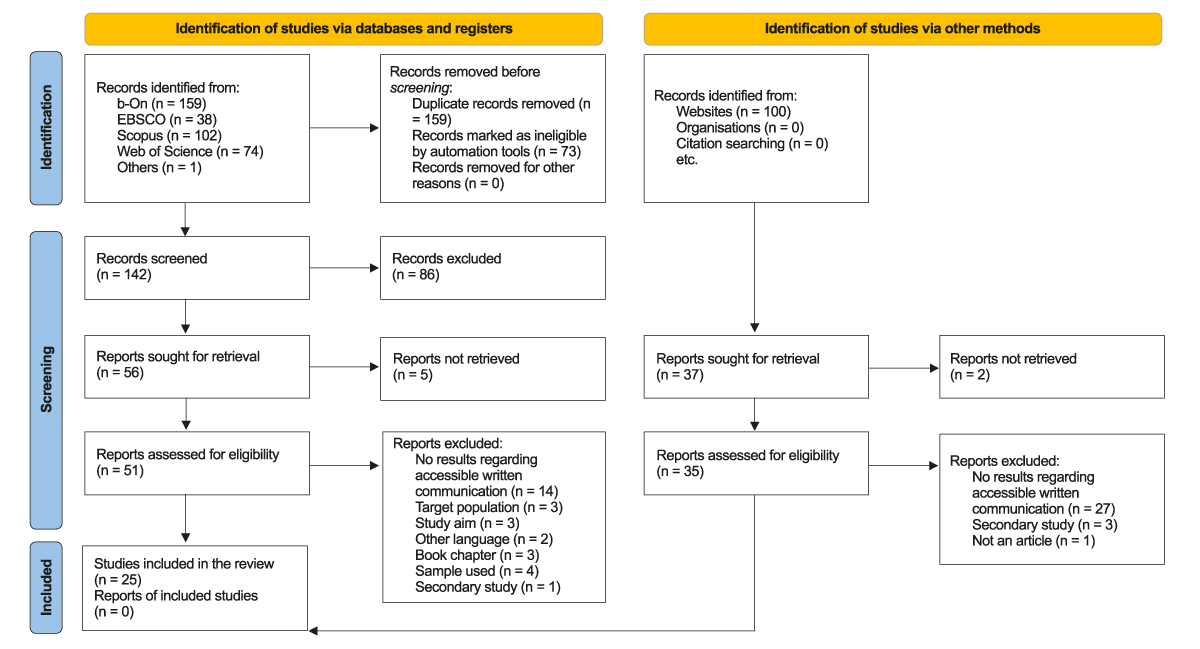
Figure 1
PRISMA Flowchart of the study selection. Source: Adapted from Page et al. (2021).
Moreover, some studies raised doubts about meeting the inclusion criteria but were ultimately excluded after a brief discussion between the reviewers. The studies either related to communication at a macro level or were unrelated to the aim or the target population – neurodivergent people.
Characteristics of sources of evidence
The year, country of origin and publication area were extracted to assess the studies’ general characteristics.
It was noted that in 2016, 2020, 2021, 2022 and 2023, each year had three studies, whereas in 2010, 2018 and 2019 there was only one in each year.
As for the country of origin, most studies came from England and the USA, totalling six studies from each. Four studies came from Spain, but the authors were in some capacity the same. It was also possible to note that two studies included more than one country.
Nine different subject areas were identified in terms of area of publication: multidisciplinary, psychology, medicine, social sciences, computer science, nursing and earth and planetary sciences. The area of publication was identified based on the classification of the Scimago Journal & Country Rank (SJR).
Moreover, eight of the studies were published in journals not included in the SJR, making it impossible to identify their subjects. As we do not know the criteria SJR follows to categorise the publication area and do not have different criteria, we report them as missing values.
In Supplementary File 1, the detailed characterisation is shown.
Concerning the sample characteristics of the selected studies, most included neurodiverse (neurotypical and neurodivergent) or neurodivergent individuals. Notwithstanding, a few studies included news articles or words in their samples. Although some studies did not identify any specification regarding the characteristics of the neurodivergent participants, some did. As such, some included people with intellectual disabilities (PwID), mild cognitive impairment (MCI), learning disabilities, and dislexic and autistic people.
Similarly to the participants’ characteristics, some authors did not disclose the recruitment strategy used, but those who did opted to recruit through non-profits, internal networks, social media, a snowball approach, or purposive sampling. Some chose to apply several strategies during the recruitment phase.
The data mentioned here can be consulted in Supplementary File 2 in more detail.
Results of Individual Sources of Evidence
The relevant data of the individual studies were charted and are presented in Supplementary File 3.
Synthesis of results
The included studies tended to focus on six main themes: understandability and readability, communication strategies, accessible information, digital accessibility, employment and guidelines, with them intersecting with each other.
Understandability and readability
Eight topics emerged when discussing the understandability and readability of texts or information: lexical simplification system, complex word identification, natural language processing, medical information, defining complex words, literacy and ruling passions and tone indicators.
The works of Alarcon et al. (2023, 2021, 2020a) and Moreno et al. (2019) focus primarily on a lexical simplification system that uses complex word identification and natural language processing to identify and predict complex words to have the texts on webpages in compliance with several guidelines (Easy to Read, Plain Language and Web Content Accessibility Guidelines (WCAG)) to increase their readability and understandability. Overall, the results of these studies showed that machine learning approaches and linguistic databases can be helpful in developing a lexical simplification system that identifies complex words and proposes synonyms and definitions of those words that were identified by following accessibility guidelines.
In line with this, the study of Alarcon et al. (2020b) presents a WordSense Disambiguation system that provides a definition of a word, taking its context into consideration. Results show that the system performed positively in giving correct definitions of complex words to improve the cognitive accessibility of texts. However, coverage was low, and there were missing coincidences, as some definitions were in a different grammatical form than the words the system gave.
Another topic that emerged when understandability was mentioned was regarding the understanding of medical information. Here, studies were about the understanding that People with Intellectual Disabilities (PwID) had about their diagnosis and prognosis of cancer and how much they were told (Tuffrey-Wijne et al. 2010), and understanding medical information (Baumbusch et al. 2014; Mander 2016).
Regarding the understanding of the diagnosis and prognosis of cancer, although most of them were told they had cancer, they did not receive any help to understand the implications of the diagnosis or prognosis. Several other aspects were noted, such as: people with severe or profound ID were more likely to be protected from the truth; understanding was linked to the person’s cognitive ability, life experience and truth-telling. Furthermore, the authors state that the models used to give bad news are not suited for PwID (Tuffrey-Wijne et al. 2010). As for understanding medical information, results show that, sometimes, it was difficult for the participants to understand the information. In the study of Baumbusch et al. (2014), some participants indicated that one of the strategies the doctor used to explain to them was through plain language, while others said that they used alternative methods, such as asking the receptionist for more information or bringing someone else to accompany them. Complementary to this, the results from Mander (2016) imply that simple questions may lead to a lenient answer or misinterpretation, which will require the reformulation of the question and that the comprehension of the message will be influenced by the quality and accuracy of the accessible information resources, while also recognising that said resources might focus on what is easier to understand rather than on the topic/issue that is more challenging.
Regarding the autistic community, one strategy to understand texts is through tone indicators. According to the participants of the study, tone indicators are tools for (1) clarify the tone/context of the message, (2) emphasise the expression in the text to help express emotions and feelings clearly, as confusion regarding certain icons can appear (here they appear as a complement, e.g., the use of ‘/s’ to signify writing something sarcastic); and (3) minimise misinterpretation of messages, as when reading written messages there is always the risk of misinterpretation of the tone used (Christanti et al. 2022).
Communication strategies
Communication strategies were mostly identified when referring to accessible remote work, interviews and achieving effective communication.
In the study conducted by Das et al. (2021), when referring to collaboration and communication working remotely, neurodivergent professionals indicated having to adapt to the complexities of multimodal communication to ensure effective communication and understanding; for instance, typing a message instead of speaking, others use closed captions and lip reading to help with processing information via video/audio channels. Contrary to these strategies, those who have dyslexia prefer to communicate through speech rather than by writing, which proves a challenge when, in an online meeting, there is no dedicated time for questions and most of the communication is written. To help them with these, participants refer to using dictation tools to write, screen readers, or read-aloud features. Having access to meeting material before and afterwards was also mentioned as being helpful.
In interviews with PwID, Hollomotz (2018) identified that some of the communication strategies could be: asking questions in plain language accompanied by reference tools, such as picture cards and photo-story vignettes; and adapting the depth of the questions according to each participant’s willingness or capabilities.
Likewise, the strategies used to help contextualise the question asked should vary according to each person’s characteristics. For instance, in the study, the use of vignettes was helpful for some participants but not others. In these cases, a triangulation technique (i.e., what the participant was saying, a secondary confirmatory source, and participant observation) was adopted. In all, it is necessary to adapt the questions to the person, as keeping it too simple may interfere with the answers of those who have more to say and feel patronised. At the same time, if questions are too complex, it could generate interview errors.
Related to this, one of the communication strategies can be relating the written content to the ruling passions of neurodivergent people. According to Bailey (2023), if neurodivergent people have access from a young age to quality fiction that relates to their passionate interests, it could help them comprehend different personalities, motivations and relationships. To this end, the author recommends that they have access, contact and create multimodal texts to help increase their knowledge of their ruling passions. This way, the content is interesting for them, which in turn can also mean being more accessible to them, as it is about a topic of interest.
Accessible information
Accessible information is not only important for people with disabilities, in general, but also for people with different languages or educational backgrounds or in any other situation where oral and written communication are hindered. When mentioning accessible information, studies focused on the context of visual information and the specific needs of people with complex communication needs.
The studies of Niediek (2016) and Cameron and Matthews (2017) focused on visual information to complement written text. Niediek (2016) argues that illustrations and symbols have an important contribution to accessible information, mostly because through more concrete or detailed illustrations, it is possible to transmit more information. However, this can also represent a barrier for early-stage readers and be a bad facilitator option as they need to be familiar with the communication method. The same was maintained in the use of pictures and graphic signs, as they relate to a determined cultural knowledge acquired in childhood and interaction processes. As such, their use can also be limited if they follow the principle of ‘single-meaning picture’, as it cannot represent every concept or idea and can lead to misunderstandings. For this reason, it should be used in conjunction with plain or easy-to-read text.
From another perspective, Cameron and Matthews (2017) presented the process of developing an accessible communication resource, ‘Keeping Safe’, where the communication framework ‘Talking Mat’ was applied and found that it helped people with learning disabilities (PwLD) to reflect and express what was important to them at that moment.
In relation to text and print-based communications, Collier et al. (2012) denote that people with complex communication needs prefer to receive documents in plain language and have alternative formats available (e.g., with large fonts, without staplers, or send it to them in a format compatible with screen readers). Although service providers said that people with complex communication needs needed someone to help with reading and understanding documents, respondents with complex communication needs said to prefer accommodations that assist them to be more independent.
Digital accessibility
In the studies selected, those who mentioned digital accessibility were usually in the context of a voting interface (Harley et al. 2016; Summers et al. 2014), a web-based decision aid (Bogza et al. 2020), and the specific needs of individuals with CCN (Collier et al. 2012).
In all, the studies show similar results when it comes to digital accessibility. To ensure that the interface was accessible, participants with low literacy and mild ID mentioned that it was necessary to put instructions in fewer and simpler words, avoid the use of the word ‘choices’, increase the font size and spacing between lines, use a vertical layout, have additional information available if needed, and the possibility to deselect their vote (Summers et al. 2014). These results are similar to those obtained by Harley et al. (2016), as participants with language difficulties preferred the version in plain language and recommended the reduction of instructional text. Notwithstanding, participants also added that the text should be accompanied by illustrations to help explain the visual aspects of the ballot. Other interesting results obtained from Harley et al. (2016) were that dyslexic participants preferred text written in Helvetica font over the two fonts specifically designed for dyslexic people (Lexia Readable and Open Dyslexic).
These results are also consistent with those obtained by Bogza et al. (2020) in relation to simplifying the content. Concretely, the content should be simple but not simplistic, which means that the content should be simplified to a level that still retains enough detail to support informed and shared decision-making. It also means that the text should use clear and comprehensive words to include only the meaningful content, remove the unnecessary details and make the content easy to remember. For this, the results show that pictograms are a helpful strategy to assist in remembering the options available and to resume the information.
The same results were also obtained regarding digital accessibility for people with complex communication needs. According to Collier et al. (2012), this means having the option to: change font sizes and colour contrast, read out loud what is on the screen and access online plain versions of the documents. Moreover, other identified recommendations included having the option to change columns to a single one to facilitate navigation, a version with graphics to help with readability, and a graphic-free version to facilitate navigation and use of screen readers.
Employment
Regarding employment, communication accessibility was mentioned in terms of experiences in the workplace regarding the recruitment process, internships and in an image and data annotation platform.
Starting with the results of the identified needs of the communication process during the employment process to meet the needs of autistic individuals, Tomczak et al. (2021) found that in the recruitment phase, job advertisements should be modified, and job interviews should be less structured, as autistic people tend to find it difficult to brag about previous job experiences. During the onboarding stage, the results show that having a mentor, buddy or job trainer accompanying them would be beneficial to give confidence and reassurance during stressful situations. Lastly, to support job retention, employers should use clear messages, direct and sensitive feedback and limit emotions during the communication process. These last findings go in line with what Shute et al. (2012) found is necessary to have in an effective and inclusive communication. Adding that, to help have a stress-free communication process, organisations should use written and non-direct electronic mediated communication forms.
Still, regarding the communication preferences of autistic individuals and workplace experiences, the results from Remington et al. (2022) suggest that although autistic and non-autistic interns go through the same difficulties, some were specific to the autistic interns, such as: the report of prior negative workplace experiences – which has implications for their performance and self-confidence, mental health and well-being; and communication challenges that happen due to preferences in communication styles, such as preferring written communication via email instead of verbal communication, which helps reduce difficulties that can emerge in interpreting implicit social cues. Autistic participants also highlighted the necessity of having a tailored recruitment process and raising awareness with managers about their (individual) needs.
To understand the experiences that neurodivergent crowd workers had in an image and data annotation platform, Garrison et al. (2023) focussed on five topics: (1) responses regarding the receipt transcription, movie review and picture description; (2) work completion; (3) time per question; (4) effective hourly pay; and (5) participant experience where it was considered the participants’ task preferences, challenges faced with the tasks, and suggestions to have an inclusive and accessible digital work in data annotation for neurodivergent peers.
In brief, results showed that participants justified their answers in movie reviews and described pictures based on personal feelings and experiences; work completion was associated with how long the text was – if it was long, the participants skipped it or gave incomplete answers -, this also correlates with the time spent per question, the longer the text, the more time was needed; some of the participants would earn less than the minimum hourly wage due to incomplete and skipped tasks, and the time spent on the tasks; participants enjoyed all tasks because they were clear and straightforward, but they found challenging deciding annotations for subjective tasks, the long texts, reading the receipts and handling missing information.
Regarding the suggestions made, participants mentioned that clear instructions with visual examples should be provided in the request, as well as visual and auditory stimuli, accessible keyboard functions, word counters and screen readers.
Finally, the authors noted that participants had difficulties with vocal communication and that some preferred to write down their answers instead of saying them.
Guidelines
The guidelines identified across the studies pertained to the identification of complex words, interaction in plain language, alternative text and image descriptions, and communication of probabilistic information.
In essence, Alarcon et al. (2023) found that what constitutes complex words was:
Words that are used in verbal communication but that can be unknown to PwID and/or older people;
Long words that are difficult to read and pronounce;
Technical jargon;
Abbreviations or acronyms used without any explanation;
Words in a different language than the one mainly used in the document;
Roman numerals;
Idioms with double meanings that are difficult to understand;
Use of metaphorical expressions;
Use of abstract terms that don’t have a physical form, which can be difficult to perceive or imagine;
Multi-word terms (expressions with complex words, expressions with simple words whose more familiar meaning is different, and complex expressions with complex and simple words whose meaning has changed);
Words with different meanings according to the context;
Percentages and mathematical expressions;
Adverbs ending in ‘-mente’ (-ly);
Collective nouns;
Obsolete words or in disuse.
For using plain language to interact with someone, Vermeiren (2018) established some considerations, of which:
Preference for face-to-face interaction;
Usage of words like ‘you’ and ‘me’ and well-structured words;
Give information in small parts with the most important part coming first;
Use a normal tone of voice;
Speak clearly and briefly, with pauses from time to time, and be prepared to repeat and rephrase the sentences;
The pitch should vary according to what is being said;
The sentences should be in active voice, with strong verbs, and in the present tense, as well as in the positive form;
It should be avoided the use of long strings of nouns and fillers (e.g., um, ah, okay, etc.);
Words that may be new to the audience should be explained, as well as abbreviations or acronyms, the first time used;
Use everyday words and avoid jargon, technical terms and foreign expressions;
Reuse the same words instead of synonyms;
Instead of using figures and percentages, it should use expressions such as ‘a few’ and ‘a lot’;
Be concise and cut out unnecessary words;
Feelings should be expressed to enhance speech acts and through emotion-expressing paralinguistic means.
Complementing this, Monroe and Morrison (2022) found that the best way to edit the alternative text to reduce the description’s cognitive load is to:
Use clear and concise syntax, where the text should be edited for clarity;
Organise the information in a predictable manner, starting from a general topic to a specific one, grouping and describing them by similarity and then differences.
Describe the content in relation to each other and any trends or visually emphasised information;
Give information in multiple modalities. For example, when using images, image descriptions and alternative texts are recommended, graphics should be transformed into tables and flow charts into lists;
Avoid redundancies by ensuring that what is in the caption or surrounding text is not repeated.
While creating templates to be used to communicate probabilistic information, Heggli et al. (2023), incorporated guided principles of graphic design and social science in an attempt to produce effective and accessible probabilistic information visualisations in the templates.
In this sense, the authors developed guidelines for effective visual communication of probabilistic weather information that were grouped into six topics: accessibility, layout, content, colour, font and embellishments.
Discussion
The ScR aimed to understand the state-of-the-art of accessible written communication for neurodivergent individuals. As for answering RQ1, it is needed first to answer the RQs that follow it, the response to this question will be given last.
Starting with RQ2, what is studied regarding accessible written communication for neurodivergent people, the evidence seems to suggest that studies tend to focus on guidelines, communication strategies, accessible information, digital accessibility, employment and guidelines. Moreover, the studies included in the sample were primarily published in journals in the field of medicine and social sciences. As such, it appears that when studying written accessibility, studies tend to focus on themes related to medicine and/or health. This shows the complexity as well as the need for more accessible communication in the medical field. Likewise, it also shows that there is a need to expand research to other fields that affect the neurodivergent people quality of life and participation in society.
As for the more prominent theories, RQ3, seven different themes were identified: text simplification, referring to natural language processing and WordSense Disambiguation; communication and interaction, mentioning the theory of communicative actions and multi-modality; visual and graphic communication, related to semiotics and cognitive load; inclusion and accessibility, focusing on accessibility guidelines and universal design theory; information processing, related to computer-mediated communication; medical and health communication, mainly concerning the disclosure of diagnosis and prognosis, as well as, physician-patient communication; and lastly employment and work environment, which focused on remote work and employment of autistic people. Overall, it appears that the most predominant theories in the sample relate to accessibility, machine learning, communication and technology that can facilitate access to written communication.
Furthermore, there seems to be a convergence among the various theories. When discussing accessibility theories, studies often highlight the importance of making information accessible through techniques such as text simplification, plain language, visual aids and universal design. To this extent, it is relevant to clarify that plain language is clear, concise, but still maintains more complex written information than easy language (Maaß, 2020). This concept has also been explored in studies conducted by Boldyreff et al. (2001), Hong (2012) and Alarcon et al. (2021). In studies concerning effective communication, it is made obvious that the importance of clear, compassionate, accessible and inclusive interactions. These are especially important when concerning medical settings, health/medical communication, research with PwID and interpreter-mediated encounters. This is also supported by Ratna (2019), Strickler and Havercamp (2023), Carlson (2013) and Foster and MacLeod (2003). Similarly, when mentioning natural language processing and computer-mediated communication, the discussion is usually about the integration of technology to facilitate communication, access information and employment opportunities, not only for neurodivergent individuals but also for those who have disabilities. As for visual communication, the concepts mentioned – visual information, semiotics and graphic design – were used to indicate how visual elements can be used to better the understanding and accessibility, mostly, of PwID or for those with low literacy skills. Likewise, the studies concerning employment and considerations for remote work for neurodivergent individuals reflect the importance of having inclusive practices implemented in the workplace, as pointed out by Khan et al. (2023) and Szulc (2022). Finally, theories about learning from images and cognitive load suggest that there is a need to consider cognitive aspects while designing information and tools, as presented by Sweller (2011) and Van Merriënboer and Ayres (2005).
Concerning RQ4, more than half of the studies included participants without having any decision-making power towards the research, while only three had neurodivergent individuals as advisors. Of these three, two did recruitment through social media (Hollomotz 2018; Remington et al. 2022), while in the other, it was not mentioned. This appears to indicate that, although the studies focus on accessible communication for neurodivergent individuals, they are rarely involved as active contributors, such as co-researchers or advisors. This goes against the mantra ‘Nothing About Us, Without Us’, which is prominent within the social movements around disability. There are several reasons this might happen. Some of them, according to St. John et al. (2022), Tilley et al. (2021) and Strickler and Havercamp (2023), are: the obstacles put by the ethics committees; the need to have more time to do research, which means more financing; the existing gap between researchers’ knowledge or skills; inaccessible language and documents; and the perceived lack of ability to consent or assent.
Lastly, giving an answer to the main research question regarding the state-of-the-art, RQ1, it was possible to assess that most studies focused on understandability and readability, digital accessibility and guidelines, where plain language and inclusive design had a focal point.
With the EAA’s effectiveness last year, research in this area is expected to increase in other fields outside of medicine and health.
Limitations and Future Research
An attempt was made to utilise various terms that could serve as synonyms for our desired criteria. However, some terms can no longer be accepted by the community (e.g., intellectual impairments), and there may be others that designate specific accessibility needs that were not contained in the search expression. Moreover, in this ScR, books and secondary studies were not included; as such, it is possible that some important literature was not collected.
The results indicate a lack of research in several fields, including culture, socialisation and recreation, which focuses primarily on the pragmatics of day-to-day life, highlighting a research gap in quality of life. For this gap to be met, it is necessary to start to actively include people who are affected by these problems in research, which can be done by having them in advisor or co-researcher roles. Nevertheless, researchers must take several considerations into account, which they usually do not know (Bigby et al. 2014; St. John et al. 2022). It is also equally important that ND and PwD understand their role and rights when participating in research, either as an advisor/co-researcher or as a regular participant.
Based on this, it is recommended that future research on accessible written information be broadened to areas that consider people as an integral part of society, and as members with cultural and leisure needs. While discussing the various definitions (e.g., neurodiversity, neurodivergence, neurodiverse, etc.), we found it necessary to also address their cultural conceptions, which would require a separate conceptual article accompanied by a theoretical framework. This will be approached next in our research.
Finally, researchers should be trained in inclusive research practices to promote meaningful participation of neurodivergent individuals, including co-research and advisory roles.
Additional Files
The additional files for this article can be found as follows:
Supplementary File 1
Articles’ characteristics (author(s), year, title, country, and area of the journal). DOI: https://doi.org/10.16993/sjdr.1297.s1
Supplementary File 2
Sample characteristics (number of participants, population, participants’ characteristics, and recruitment strategy). DOI: https://doi.org/10.16993/sjdr.1297.s2
Supplementary File 3
Aricles’ characterisation (topics covered, theoretical framework, methodological approach, involvement in research). DOI: https://doi.org/10.16993/sjdr.1297.s3
Competing Interests
The authors have no competing interests to declare.
Author Contributions
C.C. and C.S. conceived the presented idea. C.C. carried out the scoping review with support from C.S. C.C. analysed and interpreted the data and wrote the original draft. C.S. and M.J.H. revised the draft and provided critical feedback that helped shape the manuscript.