
Introduction
The United Nations Convention on the Rights of Persons with Disabilities (UNCRPD) emphasizes equal access to work as a fundamental right and a state’s obligation (United Nations 2006, art. 27). Despite ratifying the UNCRPD, Norway’s labor policies fall short of full inclusion. In 2021, only 38 percent of individuals aged 15–66 who reported long-term health problems that limited their daily functioning and self-identified as having a disability were employed, compared to 78.4 percent of the general population (Statistics Norway 2022a; Statistics Norway 2022b). This covers all defined by Statistics Norway (SSB)’s criteria, not only those assessed as employable. Among the Article 27 focuses, we also emphasize the role of trade unions and the right of persons with disabilities to bolster their agenda (Degener and Begg 2017; Liisberg 2017).
Like other Organisation for Economic Co-operation and Development (OECD) countries, Norway struggles to create an inclusive labor market despite its welfare model and long-standing policies (OECD 2022; OECD 2010). Introduced in 2001, the Inclusive Work Life Agreement (IA Agreement) aimed to promote labor market inclusion and reduce sick leave, thereby lowering public expenditures (Ministry of Government Administration and Labour 2001). The Norwegian government has cited the IA agreement as evidence of compliance with Article 27 of the UNCRPD, despite the lack of representation from Disabled People’s Organizations (DPOs) (Ministry of Children, Equality and Social Inclusion 2015, 72). While the role of DPOs is not analyzed in this article, their absence from the IA Agreement process is noted as a structural feature of the policy context. The agreement, rooted in the Nordic tripartite model of cooperation between government, employers, and trade unions (Dølvik 2022), has been renegotiated six times.
This article uses the IA Agreement as a case study to explore how inclusion policies are translated into practice in a highly developed welfare state. Despite praise for its welfare model, Norway struggles to achieve meaningful work inclusion for persons with disabilities (OECD 2010; OECD 2022). The IA Agreement offers a unique opportunity to critically assess whether structural and operational mechanisms align with rhetorical commitments to equality and human rights. As one of the earliest national frameworks to explicitly address work inclusion through tripartite collaboration, its evolution reveals how inclusion can be framed, reframed, and at times deprioritized. This trajectory also reflects broader international dynamics, showing how global commitments, such as those in the UNCRPD, may be selectively interpreted, implemented, or diluted in national employment policies (Degener and Begg 2017).
To investigate this, the article analyzes how the concept of inclusion is constructed in IA policy documents. The central research question is: How is the inclusion of people with disabilities conceptualized in these policy documents?
This study does not aim to redefine inclusion but to describe how it is understood, explicitly and implicitly, in context.
Methodologically, the study follows an abductive approach. It begins with a descriptive document analysis (Asdal and Reinertsen 2022), followed by thematic analysis (Braun and Clarke 2006), which informs the use of a specific theoretical register: Luc Boltanski and Laurent Thévenot`s theories of justification and ‘moral economy’ (2006). Due to this abductive structure, the article first presents its methodology, then introduces theoretical mobilization and more interpretative or theory-informed findings.
The IA Agreements in context
Norway ratified the UNCRPD in 2013, committing to promote inclusive employment and prevent discrimination. Article 27 affirms the right to work on an equal basis with others, and General Comment No. 8 (2022) emphasizes the need for ‘effective and sustained inclusion in the open labor market’, explicitly rejecting segregated or symbolic employment (2022, sec. 12).
Although Norway joined the UNCRPD negotiations (2002 and 2006) (Maker et al. 2018), the IA Agreement was developed nationally. Slotsvik et al. (2025) argue that the agreement stems from 1990s domestic concerns, especially welfare sustainability and tripartite traditions, rather than from human rights commitments.
Nonetheless, the IA agreements have addressed disability inclusion. Until 2018, they included a specific sub-goal 2, aimed at increasing employment opportunities for persons with disabilities. However, this goal was removed from the later versions. As a recent literature review notes, the focus of both the agreements and related research has shifted toward sick leave and workforce withdrawal among those already employed (Holte et al. 2024, 9). It is therefore unsurprising that the 2022 and 2025 agreements did not reinstate disability-specific goals.
Responsibility for disability inclusion was instead transferred to a separate initiative: the Inclusion Dugnad (Inkluderingsdugnaden), launched in 2018. ‘Dugnad’ refers to Norway’s tradition of voluntary collective effort, often linked to community work. Here, it signals shared responsibility for inclusion but may obscure structural change by framing it as goodwill rather than enforceable rights. This inclusion campaign aimed to improve employment outcomes for marginalized groups, particularly in the state sector, by introducing a 5 percent soft quota for new hires from underrepresented groups (Østerud 2021). Only 3.1 percent of government agencies met this target; most lacked proactive recruitment, indicating limited impact (Østerud, Vedeler and Fremstad 2023). Following the 2021 election, the incoming center-left coalition led by Prime Minister Støre (Labor Party) chose not to renew the initiative.
Disability inclusion is now largely absent from labor policy, especially in terms of targets or evaluation. Both policy documents and research suggest that this shift is linked to delays, stalled negotiations, and a difficult policy process leading up to the 2025 agreement.
How to understand the persistence of non-inclusion?
Although the IA Agreements may appear stable, the goal of including persons with disabilities has been repeatedly reframed and ultimately removed as an explicit objective. In contrast to Slotsvik, Holte, and Øyeflaten (2025), who emphasize continuity in the IA process, this article highlights the weakening of the inclusion agenda over time.
Some scholars, for instance, Østerud, Vedeler, and Fremstad (2023), interpreted this shift as a retreat from earlier commitments to equality and labor participation, raising concerns about whether the IA Agreement still upholds its original ambitions. Others have argued that the goal of inclusion has been decoupled from rights and justice-oriented frameworks and reframed as a managerial concern (Berre 2023; Berre 2025). Moreover, inclusion efforts are often inconsistently applied or disconnected from concrete measures (Østerud, Vedeler and Fremstad 2023).
Several studies point to structural and institutional barriers. Andreassen and Fossestøl (2014) argue, in an early evaluation of the IA agreements, that Norway’s inclusion policy challenges the institutional logics of key implementing actors such as employers, the Norwegian Labour and Welfare Administration (NAV), and the health services. They show how integrating people with disabilities into the workforce requires a shift from traditional bureaucratic models to more collaborative, responsibility-sharing approaches. Yet, this transition has faced significant resistance, raising questions about the coherence and effectiveness of the inclusion agenda.
Halvorsen and Hvinden (2014) similarly emphasize that effective inclusion must address not only structural barriers but also the cultural legitimacy of marginalized groups, particularly youth with disabilities. Misrecognition and lack of accommodation remain persistent challenges, even in Nordic welfare states.
More recent empirical studies emphasize employer attitudes. Chhabra (2021) shows that young adults with visual impairments face enduring attitudinal barriers in Norway’s labor market, with ableist assumptions often overriding their qualifications. Kuznetsova (2016) found that while companies publicly embraced disability inclusion, actual measures are often limited to short-term training programs, suggesting symbolic rather than substantive inclusion. In a comparative study, Kuznetsova and Yalcin (2017) argue that meaningful inclusion depends on committed leadership at both personal and institutional levels.
More recently, scholars have questioned the very framing of inclusion. Grue and Alnes (2023), for example, analyze the Ministry of Labour’s social media campaign linked to the Inclusion Dugnad, describing its rhetoric as promoting ‘neoliberal inclusionism’, where inclusion is conditional on alignment with ideals of productivity and normalcy.
Building on these insights, this article explores how the concept of inclusion is constructed in the IA Agreements over time. Two exploratory questions guide it:
How is the social process of inclusion described in these documents over time?
Under which terminologies or definitions are inclusion—or, possibly, its opposites, such as exclusion and discrimination—present over time?
Methodology
When disability studies scholars analyze documents, they often rubricate this work as critical discourse analysis (Grue 2009; Van Aswegen 2020). Since this tradition often emphasizes broader sets of textual data, and this article deals solely with policy documents, we utilize the notion of practical-analytical document analysis developed by Asdal and Reinertsen (2022).
The Corpus – the IA documents
The document chosen for this study’s corpus defines the inclusive work-life policy and measures agreed upon by negotiation parties, sourced from the Ministry of Labour and Social Inclusion website (2018). They include negotiated signed agreements, a prolonged protocol, and a government circular. These documents are chosen because they serve as ruling documents and are firsthand accounts written by the negotiation parties. The parties use them as a governing map, a budget document, and an action document. These agreement documents focus on reducing sick leave, inclusion, and early retirement. The award letter details government inclusion initiatives after removing explicit inclusion aims in the fifth agreement. The Inclusion Dugnad campaign aimed to include people with disabilities in the workforce alongside the IA Agreement. The case documents informing the negotiating parties, ordered reports, and peer-reviewed research on the effects of the different aims in the agreements have not been included in the corpus due to the size of the documents and our interest in the negotiated result.
The IA Agreement began with a Letter of Intent on October 3, 2001, and has been renegotiated in 2005, 2010, 2014, 2018, and 2025. The analyzed corpus includes eight documents. This illustrates the evolution of inclusion as a policy goal within the IA framework. These documents are detailed in Table 1.
Table 1
List of analyzed policy documents.
| NR. | DATE, NUMBER OF WORDS | DOCUMENT | TYPE OF DOCUMENT |
|---|---|---|---|
| 1. | 3rd of October 2001, 1,549 words | White Paper No. 1 Supplement No. 1 (2001–2002): Intentional Agreement on an Inclusive Working Life – Budgetary Consequences, etc. | A web article (HTML) presenting a Norwegian parliamentary budget attachment. |
| 2. | 14th of December 2005 (attachment 6th of June 2006, 6th of November 2006, 15th of May 2007), 4,147 words | Letter of Intent regarding a more inclusive working life 2006- | The second agreement and the first renegotiated version. One primary document (available on regjeringen.no, in a picture-scanned version) and several attachments (in a readable PDF format). |
| 3. | 24th of February 2010, 1,806 words | Letter of Intent regarding a more inclusive working life, 1st of March 2010–31st of December 2013 (The IA Agreement) | The third IA agreement and second negotiated version (readable PDF regjeringen.no). |
| 4. | 4th of March 2014, 2,951 words | Letter of Intent regarding a more inclusive working life 4 March 2014–31 December 2018 (the IA Agreement) | The fourth signed agreement (A picture-scanned version, regjeringen.no) |
| 5. | 18th of December 2018, 2,706 words | Letter of Intent regarding a more inclusive working life: A working life with room for everyone, 1 January 2019–31 December 2022 | The fifth signed agreement (PDF at regjeringen.no) |
| 6. | 20th of June 2018, 2,199 words | Circular – Text to be included in supplementary Allocation letter for 2018– the inclusion effort and the 5% target. | Circular. Not a signed agreement. |
| 7. | 2nd of November 2022, 219 words | Protocol Extension of IA Agreement, 2 November 2022 | A short protocol prolonging the existing Agreement until 2024. |
| 8. | 12th of February 2024, 1,875 words | Agreement on Reduced Sickness Absence and Workforce Dropout (IA Agreement) 2025–2028 | The sixth signed agreement (PDF at regjeringen.no). |
Data analysis: Inductive and abductive processes
To address the research question, we employed a systematic coding process, categorizing terms expressed in the texts through multiple cycles. Using NVivo (2023), the initial phase involved inductive mapping (Saldaña 2009) to identify expressions related to inclusion or inclusive actions. This yielded eleven initial codes, which were continuously documented and refined in NVivo.
Next, we conducted an automatic text search and manually reviewed all documents to verify and expand the codes. Co-occurring text led to the development of additional and child codes (LeCompte and Schensul 2012). To ensure consistency, we developed a codebook with definitions and inclusion/exclusion criteria (MacQueen et al. 1998). An external coder tested the codebook using ten percent of the data, yielding consistent outcomes with only minor revisions.
Following this, we conducted more detailed thematic analyses (Braun and Clarke 2006), reducing the number of codes and themes and performing an in-depth analysis of selected excerpts. While the first phase focuses on occurrence and prevalence, this phase adopted a more hermeneutical approach. These analyses highlighted the dual importance of morality and sector-specific concerns, prompting us to draw on the work of Boltanski and Thévenot (2006).
Guided by their theories, we engaged in abductive interpretations. By ‘abductive’, we mean that theories were chosen and utilized based on inductive findings, rather than being positioned as a data-independent ‘framework’ (Tjora 2018). The research process is illustrated in Figure 1.
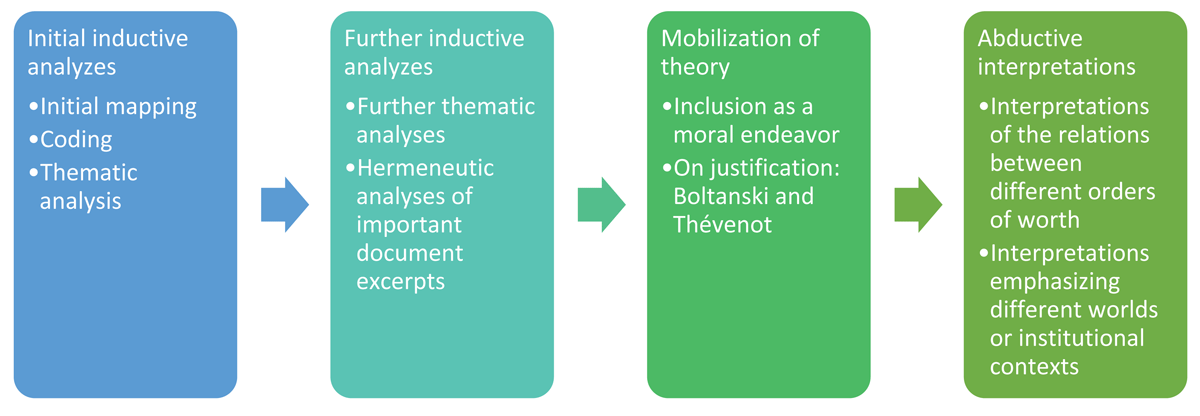
Figure 1
Visualization of the analytical process.
This research process can be described as a mixed method, involving both quantitative and qualitative techniques. While the selection of search terms was interpretive and thus aligned with qualitative reasoning, the first three stages were primarily quantitative. The abductive phase reflected a blend of sensitivity to quantitative patterns and a fundamentally qualitative integration.
Findings: How Inclusion is Conceptualized in IA Documents
This section presents the inductive findings, those based on coding without reference to Boltanski and Thévenot, whose influence is discussed in the ‘Interpretations’ section.
Before presenting the findings, a brief note on the analytic strategy is warranted. The corpus comprises eight documents (N = 8). The thematic codes were developed through multiple coding cycles (Saldaña 2009) and were not mutually exclusive, allowing segments to be double-coded. We quantified both the frequency of theme mentions and their percentage coverage in each document. These codes were then grouped into five overarching themes, which include (1) Inclusive Working Life, (2) Inclusive Working Life Agreement (IA Agreement), (3) Inclusion and Persons with Disabilities, (4) Non-Inclusion, and (5) Sick Leave.
While frequency patterns provided an initial entry point, we acknowledge that frequency does not equate to analytical importance (Bazeley 2013). Instead, these counts guided a deeper exploration of how inclusion, non-inclusion, and sick leave were discussed across the documents.
All files were systematically coded and analyzed using NVivo, combining automatic text queries with iterative manual coding (Saldaña 2009). The analysis focused on how these themes were framed, both explicitly and through underlying assumptions. Below, Figure 2 illustrates the distribution of these five themes across the eight IA Agreement documents, offering a visual overview of how frequently they appear and the variation across the corpus.
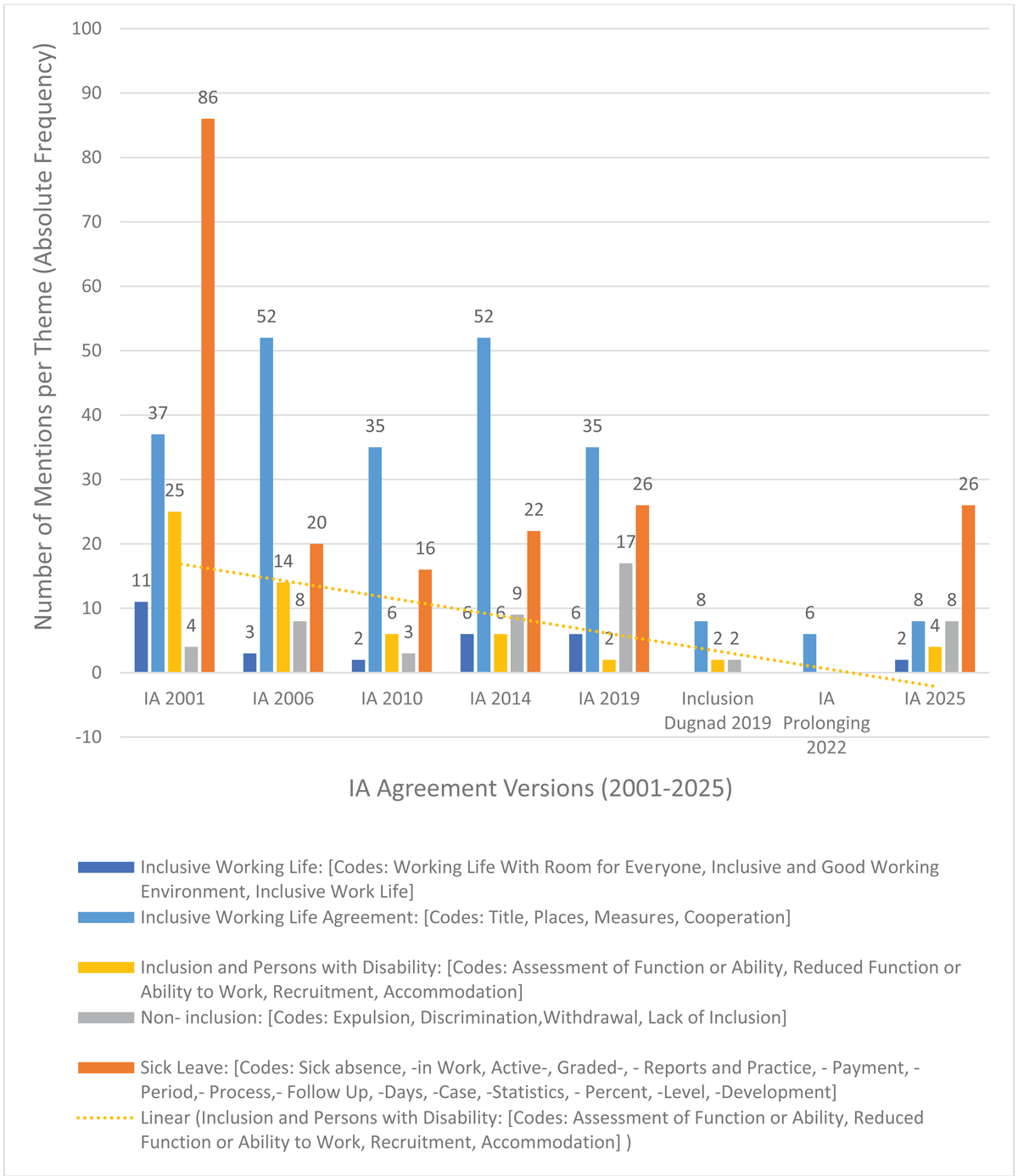
Figure 2
Frequency of five key themes across eight IA Agreement Documents (2001–2025). The figure shows absolute counts of coded mentions per theme: Inclusive Working Life, IA Agreement, Inclusion of Persons with disabilities, Non-inclusion, and Sick Leave.
How is the social process of inclusion described over time?
The IA Agreements describe inclusion mainly in aspirational and procedural terms, not as a clearly defined or measurable process. Early versions frame ‘inclusive working life’ as a collective goal, emphasizing cooperation between government, employers, and trade unions. This language promotes values like collaboration, responsibility, and participation, aligning inclusion with a vision of a working life ‘with room for all’.
In later agreements, inclusion is reframed as internal workforce management, focusing on reducing sick leave and early labor market exit. This shift is reflected in both language and thematic emphasis.
Figure 2 shows that the IA Agreement is most often referenced as an institutional structure, with fewer mentions of disability or inclusion as societal values. References to disability inclusion peak in the earliest agreement, decline over time, and by 2014, they are nearly equal to general inclusion. In 2019 and 2022, procedural language remained stable.
Inclusion is increasingly tied to employment maintenance, rather than expanding access for excluded groups, by retaining those at risk of exiting the workforce. This marks a shift from proactive social justice to reactive workforce management.
Sick leave and disability inclusion are conceptually linked in the IA documents. Inclusion is framed as a societal challenge, while sick leave is treated as a measurable issue with cost implications and policy targets. For example, the 2005 Agreement sets clear goals to reduce transitions from employment to health-related benefits:
“The parties have agreed to adopt the following measuring indicators and target figures as a basis:
a) Reduce the number of persons going from employment to passive benefits
…The target figure must reflect whether the enterprise, in cooperation with the authorities, succeeds in preventing the employees from leaving employment and going over to health-related benefits. The goal formulation is very similar to sub-goal 1 in the agreement.” (Ministry of Labour and Social Affairs 2005a, 22).
The imbalance, where sick leave receives more concrete attention than inclusion, highlights a key finding: policy focuses more on those already employed than on those excluded. Employer and employee representatives also raise concerns about reduced sick leave rights, using inclusion as justification rather than as a goal (Ministry of Government Administration and Labour 2001, chap. 1, para. 7).
Inclusion is often discussed without clear benchmarks or outcome measures. Though its importance is emphasized, the documents rarely specify how it should be pursued or evaluated. Instead, a managerial framing dominates, equating inclusion with reduced sick leave, higher attendance, or staff retention, rather than addressing marginalization or barriers to labor market entry.
Under which terminologies or definitions are inclusion and opposites present?
Although the IA Agreements emphasize inclusion, they offer no formal definition. The first agreement frames it as increasing employment for people with reduced abilities through active measures, with further aims to be specified later (Ministry of Government Administration and Labour 2001, chap. 2, para. 2).
The term ‘exclusion’ (ekskludering) is absent from the documents. Instead, exclusion is implied through evolving terms: Expulsion, Discrimination, Withdrawal, and Lack of Inclusion, shown in Figure 3. As exclusion is not explicitly used, the theme of Non-Inclusion was adopted.
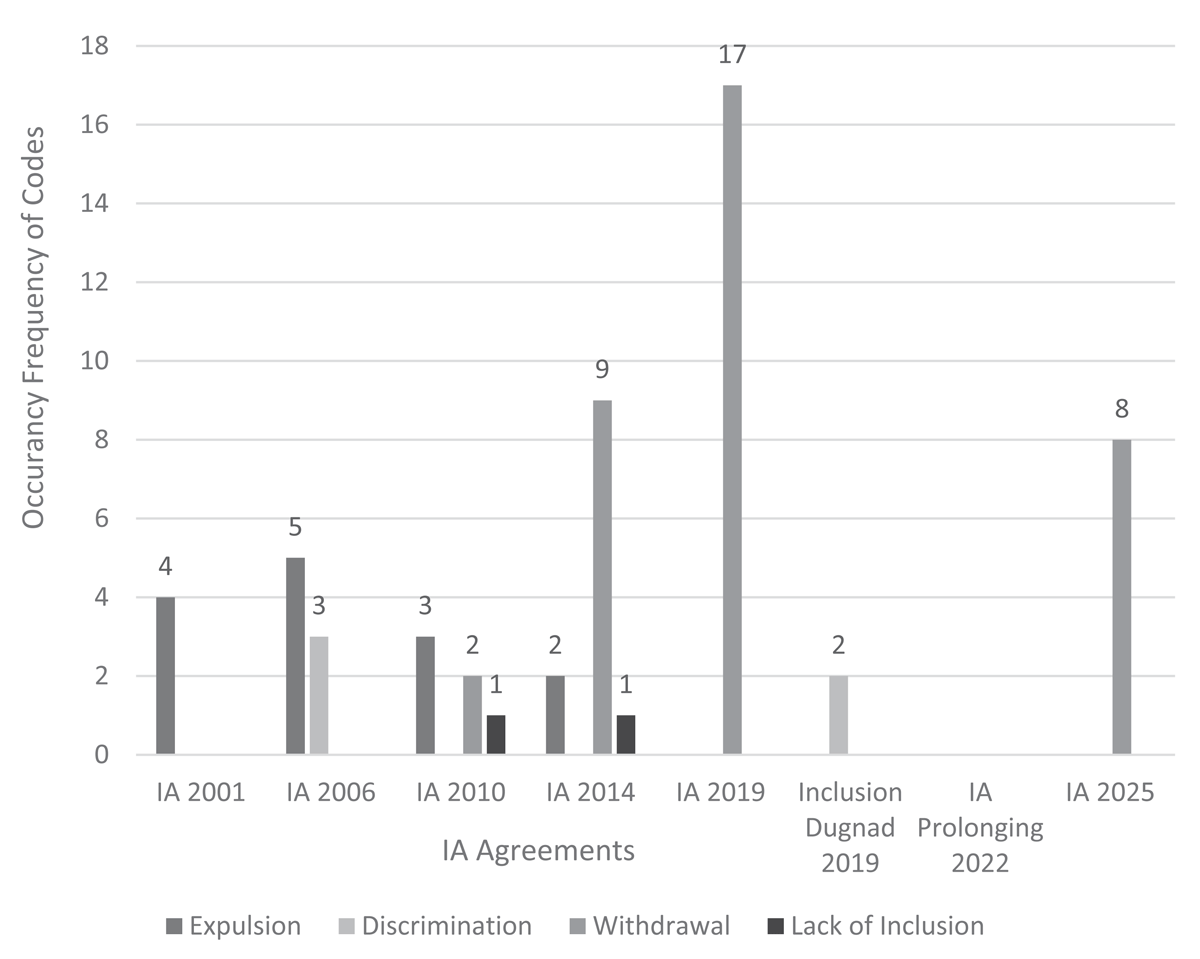
Figure 3
Closer look at occurrence of non-inclusion codes over time.
The theme arose from the assumption that exclusion would be discussed alongside inclusion. Discrimination, although present, is primarily addressed as a legislative or symbolic issue, rather than as an operational focus in the IA Agreements.
In the first agreement, expulsion (utstøting) is framed as the opposite of inclusion, initially in quotation marks to signal its contested status. The third and fourth agreements address challenges in defining exclusive practices, including sick leave and work participation. Withdrawal lacks clear agency, implying coincidence, like the lack of inclusion.
Expulsion and discrimination differ conceptually; discrimination implies active wrongdoing and affects both employed and unemployed, while expulsion suggests systemic or indirect exclusion. In Norwegian, discrimination carries normative weight, denoting a breach of social values. The legal term ‘unfair differential treatment’ (usaklig forskjellsbehandling), used in the Constitution (2024, sec. 98), is a synonym but is absent from the IA documents.
One relevant reference states:
“The parties agree that the IA agreement can be a policy instrument in countering discrimination in working life in general…. Only when we succeed in this will we have succeeded in achieving a more inclusive working life” (Ministry of Labour and Social Affairs 2005b, 4).
The words can suggest a conditional role for the IA Agreement in addressing discrimination without clear systemic anti-discrimination efforts (Ministry of Labour and Social Affairs 2005b, 3, 6).
Later documents distinguish between the IA Agreement and employers’ legal obligations. The duty to accommodate is not a substitute for compliance with anti-discrimination laws (Ministry of Labour and Social Affairs 2014, 2). The Inclusion Dugnad reiterates this, emphasizing public institutions’ responsibility to promote equality and counter discrimination (Ministry of Local Government and Modernisation 2018, chap. 3, para. 9).
Withdrawal and expulsion reflect different views of exclusion. Withdrawal applies to those already employed and implies a self-initiated process, often linked to social or medical issues, framed as addressable through motivation or reintegration. Expulsion, by contrast, is a transitive action, caused by external actors.
The documents also frame exclusion in terms of early retirement or outdated skills: ‘To achieve better results with regard to increased employment of people with reduced functional ability, the efforts will target young people’ (Ministry of Government Administration and Labour 2001, chap. 3.1, para. 1; Ministry of Labour and Social Affairs 2014, 2).
Lack of inclusion introduces a passive framing. Though external, it lacks the systemic weight of expulsion, suggesting mere absence. Still, it carries a negative connotation, equating absence from work with exclusion.
These terminological shifts, from ‘expulsion’ to ‘withdrawal’ and from ‘discrimination’ to ‘lack of inclusion’, are not merely descriptive. They reflect a broader linguistic and conceptual reframing of inclusion in the IA Agreements. Over time, the language moves from systemic critique to individualized narratives, suggesting a shift in how responsibility for exclusion is understood: from structural injustice to personal or medical withdrawal. This linguistic evolution parallels a broader shift in how inclusion is framed: from a shared social responsibility rooted in justice and equality to a more administrative, instrumental logic. Early agreements emphasize inclusion as a societal value, while later ones focus on workforce participation, absence management, and productivity. Inclusion becomes a tool for reducing absenteeism rather than a goal in itself.
Mobilizing theory: Orders of worth
The inductive analyses revealed extensive normative terminology. This is expected, as scholars analyzing Nordic employment policies in the light of the UNCRPD often rely on normative thinkers, such as Martha Nussbaum (Jónasdóttir and Horghagen 2024), John Rawls (Karjalainen and Ylhäinen 2021), or Nancy Fraser (Halvorsen et al. 2017). Theresia Degener’s development of a human rights model of disability (2017), for instance, builds upon Axel Honneth’s work. These perspectives frame inclusion policies, such as the IA Agreement, as moral endeavors (Sen 2009; Nussbaum 2011).
Much of the disability studies literature that engages with morality emphasizes the structural ordering. This is especially in work drawing on Fraser or Honneth, which often treats policy frameworks as stable (Halvorsen et al. 2017). In contrast, the IA Agreement’s history is marked by shifts and a collapse of its original ambitions. Given competing stakeholder interests, we need a framework that accounts for both unpredictability and agency. Therefore, we turn to Boltanski and Thévenot.
Boltanski and Thévenot identify the concept of ‘value orders’, with six coexisting orders in any social or historical situation, each with an overarching principle and a mode of evaluation. Later, Thévenot added a ‘green order’ on environmental and ecological concerns (2002).
The seven orders of worth are:
Market: Competition as the superior principle. Ideal subjects are sellers, consumers, or merchants.
Industrial: Productivity and efficiency are the superior values. The ideal agent is a professional or expert.
Civic: Common good in a political and legal sense. The ideal subjects are citizens upholding legal or political regulations.
Domestic: Family, care, and tradition. The ideal agent includes parents and caregivers.
Inspirational: Centers on ‘ascribing worth to truly inspired beings – the creative, artistic beings who are independent of recognition from others’ (Herup Nielsen 2018, 50). The ideal agents are artists or heroes.
Fame: Popularity and celebrity. The ideal subjects are public figures.
Green: Ecological concerns rather than limiting the moral scope to social or intersubjective relations. Various ideal agents but most often activists or technologists.
While the domestic, fame, and green orders are less central to this analysis, they are not irrelevant. For example, the domestic order may support inclusion through care ethics (Hanisch and Solvang 2019), and the green order may inform broader sustainability goals.
The market order is implicit in labor policies, where non-discrimination reflects fair competition. The inspirational order underpins ‘overcoming’ and ‘success stories’ narratives (Lundberg 2024), imagining a more inclusive future: “The government places great emphasis on a working life that includes everyone” (Ministry of Government Administration and Labour 2001, 1). These orders shape the broader social context, though they are less central to the documents’ core arguments.
Our focus is on the civic and industrial orders. The civic order, rooted in collective welfare, is expressed through the language of cohesion and inclusion, central to the Scandinavian model (Frederiksen 2018; Herup Nielsen 2018). The concept of the civic order is mainly used to analyze obligations within states. Given the introduction of extended equality- and anti-discrimination legislation in 2009 and ratification of the UNCRPD, it is also worth noting that recent research argues that this order underpins human rights claims (Hanrieder 2016).
The industrial order values productivity and efficiency, framing dignity as ‘the potential for activity that nourishes the human machine in its work’ (Boltanski and Thévenot 2006, 13, emphasis in original). This normativity is explicit: the fifth IA agreement combines inclusion with productivity: “to create a working life with room for everyone through preventing sick leave and withdrawal, thus increasing general employment” (Ministry of Labour and Social Affairs 2019, 2).
Boltanski and Thévenot’s work is part of the ‘pragmatic turn’ in social sciences (Bernstein 2010), focusing on how actors navigate and negotiate the normative framework. We utilize two pragmatic insights from On Justification. First, while each value order reflects a community’s shared understanding of humanity (2006, 74), it shapes how people and actions are evaluated. However, not everyone is evaluated in every order of worth. For example, a small child’s actions are not judged by the standards of the industrial order of worth. Each order also assumes a specific group of “qualified human beings” or “qualified subjects” (Schneijderberg 2022), who are often evaluated as ideal examples of those roles.
Second, we focus on compromises between orders of worth. The orders coexist, often in tension. They are also somewhat flexible and take on different functions in different social situations. This is why other researchers describe them as “repertoires of evaluation” (Hanrieder 2016). Under the market order, companies may highlight inclusive hiring to appeal to socially conscious consumers.
This pragmatic lens introduces the concept of worlds—institutional settings in which specific orders of worth are enacted. While some define a world as a value system (Söderbaum 2019, 379), Thévenot later emphasized engagement: “The formation of value in organizations, markets, and standards is related to a plurality of valuable engagements with the world” (Thévenot 2015, 197). Here, ‘world’ refers to the institutional context that sustains a given order.
Using Boltanski and Thévenot’s framework does not exclude other perspectives. Instead, it reflects our effort to align theory with inductive findings, especially the role of moral reasoning. To avoid over-reliance, we incorporate additional theoretical traditions in the discussion section.
Interpretations
Interacting orders of worth
The inductive findings present a somewhat conflicting pattern. On one hand, the industrial order of worth clearly dominates the IA documents; inclusion is primarily framed to enhance productivity, whether at the individual or societal level.
On the other hand, a closer reading reveals the civic order’s relevance in several ways. First, inclusion is linked to the value of a cohesive society, captured in the phrase ‘A Working Life with Room for Everyone’. Second, the IA Agreement connects inclusion to the political realm, hinting, albeit vaguely, at rights-based reasoning. Third, the very concept of inclusion implies a response to its opposite; without exclusion, inclusion would be meaningless.
Figure 4 illustrates how inclusion is conceptualized in the IA Agreements through three overlapping orders of worth: civic, industrial, and inspirational. These orders can be seen as distinct but also as interacting in ways that produce mixed justifications, where inclusion emerges as a compromise.
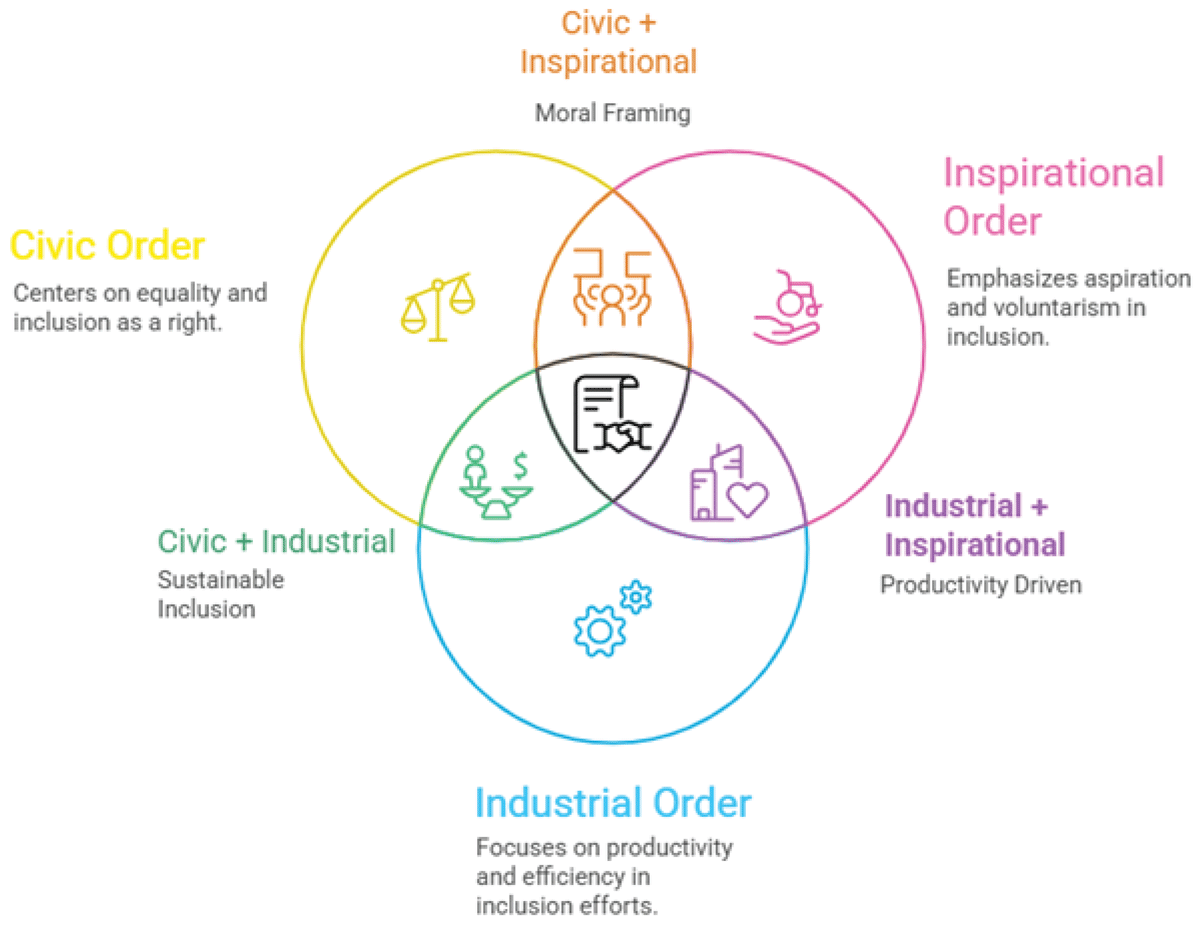
Figure 4
Understanding inclusion through orders of worth.
Drawing on Boltanski and Thévenot’s concepts of compromise and clash between orders of worth, we suggest that the civic order has repeatedly entered into compromises where other orders, especially the industrial, are dominant. This does not mean the civic order is irrelevant; the documents contain genuine commitments to social inclusion. However, the way inclusion is translated into policy often results in asymmetrical compromises. In practice, the concept of inclusion has had fewer implications than the agreements initially suggested.
This interpretation aligns with previous research. For example, Slotsvik, Holter, and Øyeflaten (2025) describe concerns about sick leave as ‘the glue’ holding the agreements together, without mentioning sub-goal 2 or disability-related issues in their conclusion. Our analysis aims to go further by highlighting the moral logic underlying these developments.
Harmony and the veiling of injustice
Many instances where the civic order is weakened, particularly in the Inclusion Dugnad, are shaped by the inspirational order. This appears to be the second most significant compromise. Through this lens, inclusion is framed as a virtuous act rather than as a response to politically unacceptable exclusion.
In our view, this framing is closely tied to how the agreements handle regulation. Civic-order mechanisms, such as legal enforcement, labor inspections, and monitoring by the Norwegian Labor Inspection Authority, are largely absent. While the civic order introduces political dimensions, its inclusion often comes at the cost of omitting discussions of injustice.
This results in a narrative where inclusion is seen as inherently good, but its absence is not framed as particularly harmful. This contributes to a broader trend of voluntarism in the agreements; there is a desire to reduce sick leave and promote inclusion, but little attention is paid to the consequences if these goals are not met.
We argue that this absence of a clearly defined problem reinforces the dominance of the industrial order of worth. A moral endeavor needs both a goal and a counterpart to give it direction and urgency. The industrial order presents a clear and pressing concern: declining productivity and the financial sustainability of the welfare state. In contrast, the vaguely defined issue of non-inclusion lacks the same weight without a clearly articulated opposite; inclusion risks becoming a hollow ideal rather than a compelling policy imperative.
Orders are important, worlds are decisive
A final perspective emphasizes the importance of worlds, the social contexts in which orders of worth are embedded. The main parties to the IA Agreements, trade unions and employer associations, are not only moral agents but also representatives of specific social fields. They are obligated to consider the interests of those they represent.
More specifically, these organizations reflect existing labor relations. Trade unions, for example, primarily represent current employees rather than potential ones. They emerged from and operate within the structures of industrial relations as is. In this sense, they represent those already included in the workforce. When viewed through this lens, the development of a shared ‘moral grammar’ within the agreements becomes less surprising.
This also points to a distinction between stable and unstable commitments. The recent delay in presenting a new negotiated agreement suggests that specific commitments, such as employer associations’ alignment with their members’ broader political interests, are more stable than their commitment to inclusion. These interests are rooted in specific social contexts, not in abstract orders of worth. As such, there is a risk that the institutional structures of this world could bring an end to two decades of mutual commitment to inclusion.
This interpretation aligns with earlier research on the IA Agreement, which often draws on concepts like institutional logics (Andreassen and Fossestøl 2014) or aligned interests (Slotsvik et al. 2025, 13). However, while these frameworks are frequently referenced, they are often taken for granted rather than critically examined.
Normative potentialities
The weakening of the civic order, first through the Inclusion Dugnad, then through the removal of disability-related goals, might be seen as a form of absence. However, as previously discussed, Boltanski and Thévenot remind us that orders of worth remain present, even when peripheral to a particular compromise.
This is significant because it highlights the potential of these orders. The normative foundation for disability inclusion remains in the documents, albeit in the IA Agreement’s title and in general references to non-discrimination. Moreover, such potentialities predate the IA Agreements. The policy slogan ‘employment for everyone’ has been a part of Norwegian discourse since at least the 1930s (The Norwegian Labour Party 2025).
We argue that the turbulent history of the IA Agreements, including the ability of different worlds to reshape policies in disruptive ways, also points to the possibility of stronger inclusion policies in the future. This is not to suggest an optimistic outlook, but rather to emphasize that a sound social analysis must account for both potentiality and actuality. This perspective is largely absent from existing research. Due to the predominantly descriptive nature of prior studies, the concept of social potentiality often falls outside their analytical scope.
Discussion
Historically, our findings reveal a tension: while inclusion became more prominent, it remained vague and gradually moved to the periphery. This mirrors broader European labor market trends, where employer attitudes have become more inclusive, yet employment disparities for people with disabilities persist in Norway and other high-income countries (Ballo and Alecu 2023). To move beyond description, we propose five analytical suggestions.
First, this disconnect may stem from a limited understanding of disability. Although Norwegian policy endorses a relational model, the IA Agreements focus on individual accommodations and overlook structural barriers. A recent global literature review (Mitra and Gao 2023) shows how limited conceptions of disability can constrain policy scope and inadvertently reinforce marginalization.
Second, the paradox may reflect failed mediation. The IA agreement attempts to reconcile normative commitments, including those of the UNCRPD, through Norway’s tripartite cooperation model. In this system employment-issues, like workers’ rights and wage development, are addressed through collaboration between the state, employer organizations, and trade unions (Dølvik 2022). However, as Roulstone and Prideaux (2012, 31) warn, ‘reasonable compromises can have devastating effects for disabled people’.
Third, disability policy research shows that policies lacking concrete targets and strategies tend to be ineffective. The IA Agreements include clear measures to reduce sick leave and retain older workers but lack explicit strategies to include people with disabilities. This gap suggests a form of insincerity, not in intent, but in execution.
Fourth, it is possible to see this as a sign of unconscious ableism. The prioritization of productivity in the IA Agreements reflects ableist assumptions that position disabled workers as burdens rather than contributors (Goodley 2017). Importantly, we do not interpret this as an intentional act but rather as a form of unconscious ableism. As Campbell (2009) argues, ableism operates through a network of beliefs, processes, and practices that produce a particular kind of self and body, the corporeal standard, projected as fully human. Disability is thereby cast as a diminished state of being human.
Finally, this can be seen as a matter of representation. Although orders of worth may extend to those not yet included, the IA Agreement is shaped within a specific world of existing employment. It therefore prioritizes those already in the workforce, especially individuals at risk of sick leave, while people with disabilities outside the labor market remain a secondary concern. This internal focus reflects the legitimacy structures of the employment world, where inclusion is framed more as retention than expansion.
Implications for policy
The five analytical conclusions above have distinct policy implications. While outlined cautiously due to the reliance on document analysis, they remain important.
Policies could more directly reflect relational understandings of disability. Pieces of research, for instance, document that ‘awareness of structural discrimination’ can lead to more effective policies (Dirth and Branscombe 2017).
Failed mediation does not preclude better outcomes. A stronger legal framework, through bodies such as the UNCRPD and the Equality and Anti-Discrimination Act (2018), could improve policies if integrated more rigorously into tripartite cooperation.
The lack of actionable strategies could be addressed through existing initiatives in Norway, such as HelseiArbeid, which combine health- and work-related measures. To make such cooperation more effective, traditional approaches should be supplemented by stronger disability rights.
Unconscious ableism may be better addressed through awareness than policy alone. Still, actions like removing disability-related goals in the fifth agreement likely reinforced ableist assumptions. Reinstating these goals could be effective—both directly through tripartite cooperation and indirectly via increased disability awareness.
Representation could be improved through stronger involvement of Disabled People’s Organizations (DPOs). As this challenge is difficult to resolve within Norway’s tripartite model, expanding the framework may be necessary.
This conclusion is not straightforward. Suppose we interpret the IA Agreement’s primary goal as reducing sick leave, with disability inclusion as a secondary goal. It may be unfair to critique it as a failed vehicle for disability rights. Still, tripartite cooperation could advance inclusion if disability issues and representation are explicitly prioritized.
Since the Norwegian government cites the IA Agreement as evidence of compliance with UNCRPD Article 27 (Ministry of Children, Equality and Social Inclusion 2015, 72), this study offers a cautionary insight: states may use policy instruments rhetorically while falling short in practice. It thus contributes to understanding the global gap between disability rights frameworks and labor market policies.
Strengths and limitations
As with any study, methodological and theoretical choices offer both interpretive strengths and limitations. Document analysis, combining descriptive statistics and thematic analysis, ensures transparency but may prioritize precise analyses of singular documents over broader discursive dynamics and contextual sensitivity.
Unlike disability policy studies that triangulate document analysis with interviews (Widadsyah 2023) or ethnography (Pozzoli 2022), our analyses may underrepresent the deeper power structures and social and institutional conditions embedded in the texts.
A strict research design reveals patterns of meaning and justification that can inform further triangulatory research. We believe that the utilization of Boltanski and Thévenot’s work could pave the way for both applied policy analyses and research on public discourse.
Acknowledgements
We are very grateful to the head supervisor, Luca Tateo, the midway reader, Arnfinn Vonen, the research assistant, Helene Hodneland Sæle, and the anonymous reviewers for their helpful comments.
Competing Interests
The authors have no competing interests to declare.
Author contributions
While the first author performed the quantitative data analysis, both authors are responsible for interpretative processes and writing. ChatGPT has been used to improve language clarity.