
Introduction
In many European countries, persons with disabilities are among those most at risk of income poverty, even after accounting for social transfers. These individuals frequently reside in households characterised by lower levels of education and employment, and they encounter additional disability-related expenses and material deprivation (Frączek 2022; Grammenos 2023). Existing research predominantly examines poverty risk at the individual level, often overlooking household-level dynamics, which are critical for effective policy development (Altman and Blackwell 2014, 20–21). Persons with disabilities reside in varied household arrangements, including those with relatives, as well as those living alone or with non-related individuals. The extent to which the socio-demographic composition of these household structures contributes to the elevated risk of income poverty among persons with disabilities in Austria remains unclear.
Addressing this gap is crucial for understanding how household structure influences poverty risks among people with disabilities. Prior studies have established that household structure affects poverty risk (Cancian and Reed 2009; Heitzmann and Pennerstorfer 2021; Heitzmann and Pennerstorfer 2024). This analysis focuses specifically on income poverty, rather than material deprivation or subjective poverty. Prior research also showed that poverty risks are shaped by the intersection of disability with other socio-economic characteristics (Palmer 2011; Pinilla-Roncancio 2015). Therefore, this study assesses whether income poverty in households with disabled members is affected by different socio-economic factors, thereby clarifying the cumulative effects of disadvantage in these households.
Austria is an interesting case. It was among the first countries to sign and ratify the United Nations Convention on the Rights of Persons with Disabilities (UN CRPD) in 2008, reflecting the belief that its constitutional and social protection systems already met the Convention’s standards and that little action would be required (Naue 2009). Austrian data indicate that the country performs in the lower half of the EU-27 rankings in terms of post-transfer poverty risk, including for persons with disabilities (Grammenos 2023, 90–103). Nevertheless, Austria has one of the highest youth disability poverty gaps in the EU (11.1 percentage points) (Grammenos 2023, 65). This contradiction, in conjunction with the lack of household-level research, underscores the need for a more comprehensive examination.
The research design was guided by the following research question: What explains the disproportionate risk that Austrian households with disabled members face in experiencing income poverty? We argue that understanding household structures and socio-economic factors is vital for informed policy design. Previous research has found that large families are at a higher risk of experiencing income poverty. However, Heitzmann and Pennerstorfer (2024) also found that the socio-economic characteristics of households, including work intensity, education, and migration background, can explain the elevated risk of income poverty for families with three or more children. Based on this finding, we expect that the disproportionate risk of families with disabled members to experience income poverty can be explained by the socio-economic composition of these households.
The 2022 European Union Statistics on Income and Living Conditions (EU-SILC) household dataset is utilised, and logistic regression is used to analyse the data. The dependent variable is the risk of poverty, as defined by Eurostat, while the primary independent variable differentiates between households with and without a disabled member according to the EU-SILC definition. Additional variables include household composition, location, work intensity, education, and migration background. Several supplementary models are estimated to test the robustness of the findings. A Blinder–Oaxaca decomposition is also conducted to quantify the extent to which the disability–poverty association is explained by the control variables. In contrast to findings for large-family households, the elevated poverty risk for households with disabled members is not explained by the household characteristics. It is posited that structural ableism and ableist welfare policies contribute to this outcome. Ableism is grounded in normative assumptions regarding normality, productivity, and autonomy, leading to the devaluation of people with disabilities. Even when households with disabled members possess comparable educational or employment status, an unexplained income gap persists. These results suggest that discriminatory structures, public policies, and societal attitudes are primarily driven by insufficient economic redistribution, cultural recognition, and political representation.
The structure of this paper is as follows. The initial section summarises the debate on the interrelationship between poverty and disability, followed by an overview of the theoretical perspective of ableism. Subsequently, the Austrian welfare state and disability policy context are described. The data and methods are then outlined, and the analysis results are presented. The final section discusses the findings, derives policy implications, and concludes with recommendations for future research.
Poverty and Disability (Policy) Relationship
The mutual relationship between poverty and disability is a central concern for both policy and research. Poverty and disability are interrelated. Disability can lead to poverty, and poverty increases the risk of acquiring a permanent impairment. Living with disabilities increases the likelihood of falling into poverty or exacerbating existing poverty (Pinilla-Roncancio 2015). This makes individuals even more vulnerable. Vulnerability is characterised by factors specific to disability or impairment. These factors, either alone or in combination with socio-demographic and environmental factors, create conditions of socio-economic vulnerability that increase the risk of poverty (Traustadóttir and Rice 2012). Research often focuses on lower-income countries or those without a functioning social security system. In such countries, individuals with disabilities and their families can face existentially threatening economic situations (Groce et al. 2011; Pinilla-Roncancio 2015; Mitra, Posarac and Vick 2013). However, even in high-income countries and those with generous welfare states, disability often leads to inequality and socio-economic distance. It can also result in precarious economic situations (Gugushvili et al. 2023). Jajtner et al. (2020) found that income inequality in US households with disabled members and work limitations was consistently 30% higher than in other households. Disability-related expenditures are frequently underinsured or not covered by public policy measures. This places further strain on household incomes (Morris et al. 2022; WHO and World Bank 2011, 43–44). Poverty has been identified as a significant issue affecting individuals with disabilities. A recent scoping review showed that, despite growing recognition of the issue, research on the topic remains limited (Berie, Kidd and Wolbring 2024).
For most individuals, participation in capitalist production and subsequent gainful employment constitutes the primary source of income. It is also meant as a key to social inclusion. For a considerable number of persons with disabilities, getting a higher level of education and vocational training, as well as finding or staying in gainful employment, is challenging and not a matter of course. In addition, household members frequently assume responsibilities related to assistance and care (Palmer 2011, 213–15), which can also significantly diminish the employment intensity. A lack of accessibility, support services, and devices can limit the education and employment possibilities of persons with disabilities and also their household members. Persons with disabilities are often situated in the outer circles of the labour market, and their employment rates, working hours, and/or wages have historically been low (Gugushvili et al. 2023; Lindblad et al. 2024; Wegscheider and Schaur 2019). Russell (1998, 119) argues that persons with disabilities are kept ‘on the bottom socio-economic rungs of the capitalist pyramid’ because, according to the logic of capitalism, the labour market systematically excludes them and values their labour less productively than that of non-disabled individuals (Russell 1998, 137).
The prevalence of disability may influence household structure. Changes in family living conditions and household structures have reduced both intra- and intergenerational support. Notably, the increase in single-parent families is particularly striking (Altman and Blackwell 2014). These households, along with large families (three or more children) with specific socio-economic characteristics, are at higher risk of poverty (Heitzmann and Pennerstorfer 2021; Heitzmann and Pennerstorfer 2024). Households that were not poor before the onset of disability are at significantly higher risk of falling into poverty; conversely, households already in poverty are at increased risk of deepening their deprivation when disability occurs—even in high-income countries (Morris et al. 2022; Palmer 2011). The identification of the influencing factors on the poverty of households with disabled members has hardly been a topic in poverty research, especially in Austria.
The type and extent of disability and social policy shape the socio-economic participation and the quality of life for persons with disabilities (Palmer 2011). The kind of rights and entitlements for social services and benefits granted by welfare and disability policies, in turn, depends on the underlying interpretation of or assumptions about disability (Waddington and Diller 2002). An affirmative assumption is that wealthy welfare states provide better outcomes to their populations in terms of indicators of well-being and lessening disability-based inequalities. The concept of welfare states emerged as a reaction to the struggles of the labour movement (Obinger and Tálos 2010, 101). These policies are primarily focused on employment and autonomy and often relate to the conventional male life course. Welfare state regimes have long ignored differences between people based on gender, race, sexuality, class, and/or disability. This is evidenced by a lack of redistribution and a failure to recognise different identities and life situations, which are then affected by a lack of appreciation, economic disadvantage, and systematic exclusion (Fraser and Honneth 2003; Wegscheider 2024, 123–27). In addressing the broader issue of social justice, Russell (1998) criticises the dominant focus on civil rights. Nancy Fraser expanded the concept of social justice to include participation, which can be achieved through three key strategies: economic redistribution, cultural recognition, and political representation (Fraser 1996). Social justice can therefore only be achieved if the needs of persons with disabilities are taken into account in all central areas of society, such as the economy, culture, and politics, particularly concerning improving their economic support, anti-discrimination rights, and participation. Mladenov (2016) points out that the recent years’ dominant emphasis on symbolic recognition and a lack of social compensation can hardly prevent poverty, and that the entire system must be transformed to effect deep improvements.
Public policy that favours productive, non-disabled citizens is often influenced by ableist assumptions. Campbell (2021, 23) defines ableism as a belief system that portrays disability as a deviation from able-bodiedness, thereby justifying discrimination. Ableism promotes the ideal of a self-sufficient, economically productive citizen. The needs of persons with disabilities are constructed as exceptional and non-obligatory, leading to the denial of accessibility, support, and equal participation in education, work, and housing (Campbell 2009; Campbell 2021; Maskos 2015). Structural ableism, as defined by Lundberg and Chen (2024), refers to long-standing policies and cultural systems that favour those perceived as able-bodied. The valorisation of productivity has been used to justify the marginalisation of those deemed to lack ‘superior’ abilities (More 2024). Welfare regimes that dominantly promote neoliberal ‘active citizenship’ often exclude persons with disabilities, as can be seen in strict conditionality regimes for unemployment support (Waldschmidt and Sépulchre 2019).
The perception of disability has policy implications. Disability must be understood not as an individual tragedy, but as a consequence of systemic exclusion and devaluation, combined with insufficient support structures and policies (Goodley 2016; Hirschberg 2022). The outline of disability-specific rights, benefits, and services can influence the opportunities available to persons with disabilities and how living with disabilities is perceived and experienced. While welfare benefits can expand opportunities, they may also reinforce dependence and restrict autonomy. For instance, they can discourage marriage or cohabitation to avoid losing entitlements. However, connected to income limits and/or stereotypical prejudices, they can also prevent people from living and working independently. Restricting social and disability policies are often based on presumed or real inabilities, familial responsibility, and controlling mechanisms, reinforcing dependency structures and restricting autonomy. It entails an assumption of responsibility towards disabled individuals by their families or partners, thereby creating an additional state of dependency. Access to disability-specific rights, benefits, and services is often met with suspicion of misuse, which is why the state believes it must exercise strict control (Wegscheider and Forstner 2024, 16–19). All this can be shaped by disability-related stereotypes, which frequently portray persons with disabilities as inert, passive, and incapable of making decisions about what is good for them (Longmore 2003).
The Austrian Case
Austria is classified as having a conservative welfare state, characterised by moderate benefits, restrictive eligibility, and strong family orientation (Österle and Heitzmann 2020; Obinger and Tálos 2010; Wiß 2022). Key features include status preservation, family-based integration into the social insurance system, obligations of family and household members, and the reliance on charitable organisations, resulting in medium de-commodification and low de-stratification (Esping-Andersen 1990). This model entails income-based social insurance payments in the event of old age, incapacity to work due to an accident at work, childbirth, illness, and, for a specified period, also for unemployment. It provides a limited supply of social benefits and public services, in return for which it has a strong family orientation in social care tasks (Wiß 2022). These characteristics reinforce stratification between employed and non-employed individuals. Although the state respects family autonomy, it influences household organisation by linking access to social benefits and public services to employment status and household income (Obinger and Tálos 2010; Österle and Heitzmann 2020). These welfare state characteristics have a particular impact on the lives and needs of people with disabilities.
Despite its small population (9 million), Austria is a federal republic with nine federal states (Länder). Federalism, combined with the classical cross-sectional nature of disability, renders disability policy complex and fragmented across levels and sectors (Naue 2009, 277). The Austrian Federal Constitution lacks clear provisions for disability. Consequently, the central government has permitted the co-administration of disability in various policy domains on an ad hoc basis, with the authority to establish regulations for persons with disabilities when deemed appropriate or necessary (e.g., in social law, family law, labour law, and building law). A lack of clear responsibilities and poor coordination between the state and federal governments can easily lead to gaps and referrals, as well as a general lack of accountability.
In the 1960s, at the federal state level, social assistance and disability assistance laws evolved from poor relief, acquiring their own legal basis in the process, albeit with certain path dependency. Disability assistance benefits are primarily means-tested, case-based, and subsidiary, providing minimal support when higher-level systems fall short. Benefits may include cash benefits as well as supplements or maximum benefits, benefits in kind, and services for special or additional needs. At this level, there are hardly any legal entitlements to cash benefits or benefits in kind. The Länder are reluctant, cautious, and controlling when it comes to providing social and disability assistance benefits and are quick to suspect those affected of misuse. Therefore, they are often subject to conditions that can promote dependency and vulnerability. The Länder have broad autonomy in financing and delivering housing, social assistance, care, and other disability services. However, aside from the presence of specific central framework rules, they tend to adopt similar, but not equal, approaches in practice (Schaur and Wegscheider 2024; Wegscheider and Schaur 2019). Only the long-term care allowances, a cash-for-care benefit based on medically evaluated individual care needs, are uniformly regulated at the federal level. The benefit is detached from the system of in-kind services and is available without any constraint on its utilisation (Gori and Luppi 2019).
In 2022, social spending comprised 30.4% of GDP (EUR 136 billion). Two-thirds (EUR 87 billion) were cash benefits, primarily pensions, family allowances and unemployment benefits, and care allowances. 34% of the budget is allocated to care services for children, persons with disabilities, and the elderly. Within disability-related expenditure, the largest share was pensions for individuals under retirement age (34%, EUR 2.4 billion), followed by Länder/municipal disability benefits (31%, EUR 2.2 billion). 310 million euros are spent on measures supporting the integration of persons with disabilities into the labour market, and 10 million euros on measures supporting their integration into society (Pratscher, Huber and Demirol 2023). Social services have become increasingly important in Austria over the last four decades, driven not only by the structural demographic, familial, and labour market changes, but also by the increasing public financial burden for their provision. The federal states’ social administrations mainly commission welfare organisations from the private market sector—mostly non-profit, but some are for-profit—to provide social services for persons with disabilities (Dimmel and Schmid 2013, 13–14). At the time of publication, there were still no nationwide quality guidelines for social services for people with disabilities that could curb the strong tendency towards fragmentation at the federal and state levels (Flieger and Naue 2024, 6).
More comprehensive anti-discrimination legislation has developed since Austria joined the EU in 1995. Although there is awareness of anti-discrimination in the area of disability in Austria, practical implementation and the complete elimination of discrimination and barriers still pose challenges (Flieger and Schönwiese 2021). Since ratifying the UN CRPD in 2008, Austria has made little structural progress in disability policy. In several areas—accessibility, equality law, social and labour policy, and education—conditions have worsened (Schönwiese 2022). Policies continue to favour segregation, exclusion, family care, and economic dependency. In many ways, access to support requires complex, often stigmatising, and means-tested procedures. Persons with disabilities remain marginalised in social policy, impairing their right to a good and self-determined life equal to persons without disabilities (Naue 2023, 150). One reason is their limited participation in developing and implementing laws and standards, resulting in weak representation of their interests (Österreichischer Behindertenrat 2018, 25).
Data and Methods
We analyse the poverty risk of households with disabled members using the 2022 data from the European Union Statistics on Income and Living Conditions (EU-SILC 2022). The survey comprises annual information on income, poverty, social exclusion, and living conditions at both the individual and household levels.
Similar to Heitzmann and Pennerstorfer (2024), we do not focus on individual poverty risk, but rather on the poverty risk of households with disabled members. The EU-SILC 2022 dataset contains information about poverty risk and disability for 5,938 households in Austria. 2,501 households, or 42%, include at least one member with a disability. For individual distinction between disabled and not disabled, we stick to the EU-SILC definition, which defines disability as a ‘limitation in activities people usually do because of health problems for at least the past six months’. On the individual level, this definition applies to 2,986 persons, representing 41% of the total.
We use logistic regression to analyse which factors contribute to explaining the income poverty risk of Austrian households. Our dependent variable is being at risk of poverty, as defined by Eurostat, which is set at 60% of the national median equivalized disposable income after social transfers. The at-risk-of-poverty rate is 17% for households with at least one disabled member, whereas it is only 12% for households without disabled members (see Table 1).
Table 1
Basic information for Austrian households without a disabled member (N = 3,437) and households with at least one disabled member (N = 2,501).
| NOT DISABLED | DISABLED | DIFF. | SIG. | |
|---|---|---|---|---|
| Share of households | 57.88% | 42.12% | 15.76 p.p. | |
| At-risk-of-poverty rate | 11.65% | 16.81% | –5.16 p.p. | Chi-squared p-value < 0.001 |
| Average number of HHMs | 2.08 | 1.98 | 0.09 | t-test p-value < 0.01 |
| Average number of children (age 0 to 15) in HH | 0.41 | 0.20 | 0.21 | t-test p-value < 0.01 |
| Average age of HHMs | 46.75 | 57.90 | –11.15 | t-test p-value < 0.01 |
| Number of observations | 3,434 | 2,499 | 935 |
[i] Note: Figures based on EU-SILC 2022 data for Austria; unit of analysis: household.
We planned to include seven control variables in our analysis. These variables measure the household’s work intensity, household size, average age of household members, number of children (0 to 15 years old) in the household, educational and migration composition of the household, and the urban–rural location of the household. The control variables measuring household size (mean = 2.04 members), the average age of household members (mean = 51.45 years), and the number of children (0 to 15 years old) in the household (mean = 0.32 children) are included in the EU-SILC household level dataset and measured using numeric variables. Due to a problematic amount of collinearity (Variance Inflation Factor (VIF) value > 10), we had to remove the variable measuring household size and calculated our main model using only six control variables.
Similar to Heitzmann and Pennerstorfer (2024), household work intensity, educational composition, and migration patterns are based on the EU-SILC individual-level dataset. Based on individual information, households have been categorised in several groups for each of these three variables (see Table 2).
Table 2
Descriptive statistics of the categorical variables to explain the poverty risk of Austrian households without a disabled member (N = 3,437) and households with at least one disabled member (N = 2,501).
| NOT DISABLED | DISABLED | DIFF. | SIG. | |
|---|---|---|---|---|
| Work intensity of HH | ||||
| Full-time/full-time (ref.) | 15.22% | 10.52% | 4.71 p.p. | Chi-squared p-value < 0.01 |
| Full-time/part-time | 15.28% | 10.00% | 5.28 p.p. | |
| Part-time/inactive | 13.85% | 30.03% | –16.17 p.p. | |
| Part-time/part-time | 11.50% | 10.28% | 1.22 p.p. | |
| Single full-time | 18.83% | 6.08% | 12.75 p.p. | |
| Single part-time | 5.47% | 2.32 % | 3.15 p.p. | |
| Single inactive | 19.85% | 30.79% | –10.94 p.p. | |
| Education of HH | ||||
| Primary education (ref.) | 29.84% | 47.74% | –17.9 p.p. | Chi-squared p-value < 0.01 |
| Secondary | 22.94% | 17.33% | 5.61 p.p. | |
| Secondary, primary | 15.66% | 19.05% | –3.39 p.p. | |
| Tertiary | 20.09% | 7.04% | 13.04 p.p. | |
| Tertiary, secondary, and/or primary | 11.47% | 8.84% | 2.63 p.p. | |
| Migration background of HH | ||||
| AUT (ref.) | 83.85 % | 81.69 % | –1.12 p.p. | Chi-squared p-value < 0.01 |
| AUT and EU/ROW | 6.98 % | 7.96 % | –0.97 p.p. | |
| EU | 6.75 % | 4.64 % | 2.11 p.p. | |
| ROW (and EU) | 5.70 % | 5.72 % | –0.02 p.p. | |
| Urban–rural | ||||
| 1 = Vienna | 23.22 % | 21.15 % | 2.07 p.p. | Chi-squared p-value < 0.01 |
| 2 = more than 100,000 inhabitants | 9.98 % | 7.88 % | 2.1 p.p. | |
| 3 = more than 10,000 inhabitants | 15.19 % | 15.67 % | –0.49 p.p. | |
| 4 = less than 10,000 inhabitants | 51.62% | 55.30% | –3.68 p.p. | |
[i] Note: Figures based on EU-SILC 2022 data for Austria; units of analysis: household.
The household level work intensity variable comprises seven distinct groups: (1) ‘full-time/full-time’, at least two household members are working full-time (used as reference category in Table 2. Model 2 and 3); (2) ‘full-time/part-time’, one household member is working full-time, at least one part-time; (3) ‘part-time/inactive’, one household member is working part-time, at least one is inactive (corresponds: pension, education, unemployment); (4) ‘part-time/part-time’, at least two household members are working part-time; (5) ‘single full-time’, single household, working full-time; (6) ‘single part-time’ single household working part-time; and (7) ‘single inactive’, single household, not working. The educational composition variable comprises five distinct groups: (1) ‘primary education’, all household members only compulsory school (used as reference category in Table 2. Model 2 and 3); (2) ‘secondary education’, all household members high school degree; (3) ‘secondary, primary’ some household members compulsory, some high school degree; (4) ‘tertiary’, all household members university degree; and (5) ‘tertiary, secondary and/or primary’, some members university degree, some high school or compulsory. The migration composition comprises four distinct groups: (1) ‘AUT’, all household members are born in Austria (used as reference category in Table 2. Model 2 and 3); (2) ‘AUT and EU/ROW’, household members born in Austria and other countries; (3) ‘EU’, all household members born in the European Union; and (4) ‘ROW (and EU)’, household members born in the European Union and non-EU countries. Finally, the urban–rural location variable comprises four distinct groups: (1) Vienna, households located in the capital; (2) households located in cities with more than 100,000 inhabitants (Graz, Linz, Salzburg, Innsbruck, Klagenfurt); (3) households located in smaller cities, but more than 10,000 inhabitants; and (4) households located in municipalities with less than 10,000 inhabitants. Descriptive statistics are summarised in Table 1.
Results
The results of our logistic regression analysis surprisingly show that the higher poverty risk of families with disabled members cannot be explained by other variables. As can be derived from the results of the empty model in Figure 1 (for more detailed coefficients see Table A.1 in the Appendix), the odds of being at risk of poverty are 53.7% higher (odds ratio/exponential function of coefficient 0.430 is 1.5372) for families with one or more disabled members. Including all control variables, the odds of being at risk of poverty are still 38.8% higher (odds ratio/exponential function of coefficient 0.328 is 1.388) than for families without disabled members. In other words, we still see a highly significant effect, which can only be explained to a very limited extent by the control variables.
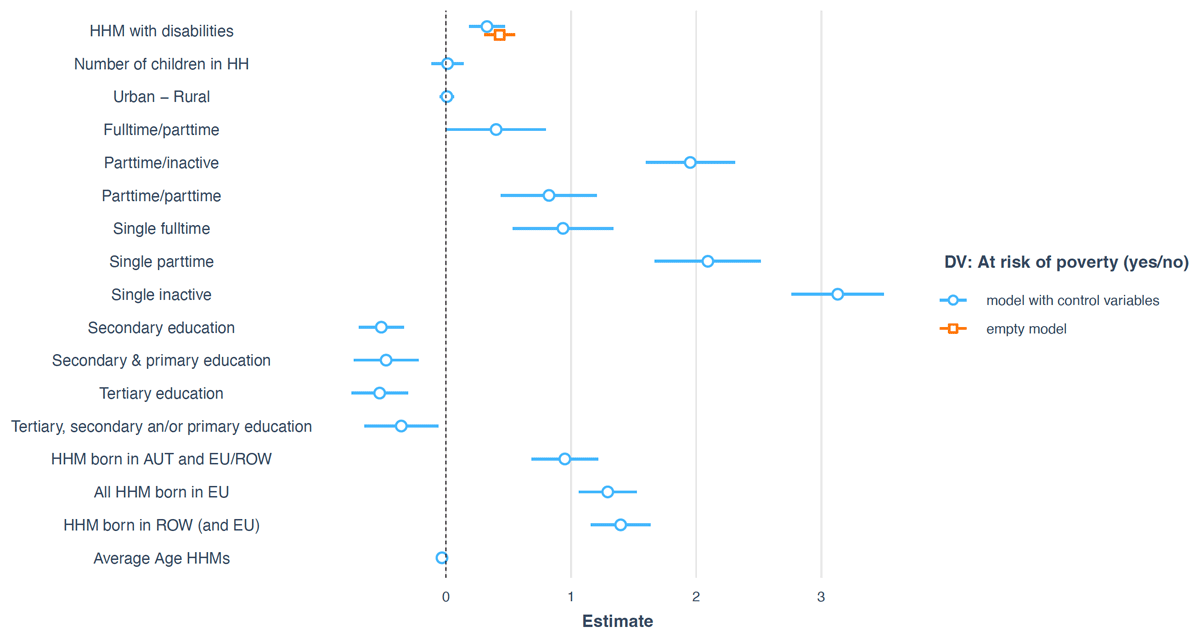
Figure 1
Visualisation of logistic regression analysis of poverty risk for Austrian households based on EU-SILC sample 2022 (for detailed coefficients see Table A.1 in the Appendix).
Nevertheless, the results demonstrate that factors possibly associated with disability, like lower work intensity or educational attainment, do have a large impact on the risk of living in poverty. Looking at the households work intensity, for example, households with lower work intensity have much higher odds of being at risk of poverty; compared to households with at least two members working full-time the odds of being at risk of poverty increases by 49.3% for full-time/part-time households, by 128% for part-time/part-time households, and by 605% for part-time/inactive households.
Single households generally must face a much higher risk of living in poverty. Compared to full-time/full-time households, the odds of being at risk of poverty increase by 155% for single full-time households, by 711.7% for single part-time households, and by 2,291% for single inactive households.
As expected, higher formal education decreases the probability of being at risk of poverty. Compared to all primary education households, the odds of being at risk of poverty decrease by 67.7% in all secondary education households. In primary/secondary households, the decrease is 61.3%, and in all tertiary households, it is 69.9%. In households comprising all different levels, from primary to tertiary education, the odds of being at risk of poverty decrease by only 42.9%. Summarised, we observe that education is a significant predictor of a household’s risk of living in poverty; however, substantial differences can only be noted between primary and secondary/tertiary education, not between secondary and tertiary education.
The migration composition of the household likewise influences the risk of living in poverty, as expected. Austrian households have the lowest risk, followed by mixed households, which have a 158.8% higher risk, and all EU citizens’ households, which have a 264.4% higher risk. All non-EU citizens’ households must face a 304.3% higher risk.
A higher average age of the household members decreases the odds of being at risk of poverty. In other words, the odds of being at risk of poverty increase by 3.3% if the average age of the household decreases by one year. This indicates that households with children and young adults are disproportionately affected by poverty.
Surprisingly, neither the number of children nor the urban–rural location of the household has a significant impact on being at risk of poverty. The effect sizes and directions stay the same for the six control variables if we exclude our main explanatory variable (household with/without a disabled member) from the model (see Appendix Table A.1, model 3).
We calculated several additional models to test the robustness of our results. These models account for the severity of disability (Table A.3 in the appendix), limiting our subgroup of families with disabled members to those who suffer severe restrictions in everyday activities due to health problems for at least six months. This reduces the subgroup of families with a disabled member from 2,501 to 808 observations. As the results in Table A.3 in the appendix show, this variation does not change the direction of significance of the effects. What can be noted, though, by looking at the results of the empty model is an even higher risk of income poverty for families with severely disabled members. The odds of being at risk of poverty are 81.5% higher (compared to 53.7% in our main model) for families with at least one severely disabled member. We further assumed that there might be subnational policy differences between the nine Austrian federal states. Surprisingly, the results did not show a significant effect (see Table A.4 in the appendix). We also tested whether the effect of disability interacts with other variables in the model and found no significant interaction effect (see Table A.2 in the appendix).
In addition to that, we estimate a Blinder–Oaxaca decomposition to quantify how much of the disability–poverty link is (un)explained by the controls. The results are presented in Table A.5, as well as in Figures A.1 and A.2 in the appendix. As reported already in the descriptive statistics of Table 1, results show that in 2,499 households at least one member has a disability according to the EU-SILC definition, while in 3,434, this is not the case. Overall, the dataset comprises 5,933 cases. The y component of the Oaxaca-class-object indicates that 16.81% of households with disabled member(s) are affected by income poverty. This is true only for 11.65% of households without a disabled member. The resulting difference between the two groups, which should be explained by the decomposition, is –5.158 percentage points. The result of the threefold decomposition suggests that –1.73 percentage points can be attributed to the group difference of household composition, location, work intensity, education, and migration background. –4.06 percentage points can be attributed to differences in coefficients, and 0.77 percentage points is accounted for by the interaction of group and coefficient differences. Figure A.1 shows the results and confidence intervals for each variable. The results of the twofold decomposition are consistent with the results of the threefold decomposition described above. Assuming a group weight of 0.5, we see that only –1.415 percentage points can be explained by the independent variables, while –3.744 percentage points remain unexplained. Figure A.2 visualises this result, showing the explained and unexplained components of the poverty gap between Austrian households with and without disabled member(s). Summarising the results of the Blinder–Oaxaca decomposition confirms the findings from our logistic regression analysis, and the hypothesis formulated earlier in this contribution must be rejected. Even when households with disabled members have the same household composition, location, work intensity, education and migration background, our results show that an income gap remains that cannot be fully explained.
Discussion
The most salient finding of this study is that a significant part of the disability-related poverty gap in Austria remains unexplained by conventional socio-economic indicators. The ‘unexplained’ part of the poverty risk gap refers to the income difference between low-income households with and without disabled members that remains after controlling for factors such as household composition, work intensity, or education. Logistic regression results demonstrate that, even after adjusting for household composition, location, work intensity, education, and migration background, households with disabled members face a 38.8% higher risk of being at risk of income poverty. The Blinder–Oaxaca decomposition confirms this: less than one-third of the observed gap can be attributed to differences in measurable characteristics (endowments), while 73% of the gap remains unexplained.
These results align with the findings in gender pay gap research, where the unexplained component is widely interpreted as a manifestation of systemic discrimination, as well as risk aversion, negotiation outcomes, stereotype threat, or career choices (Sielska 2023, 80–97). In the disability context, such an unexplained component strongly suggests the operation of systemic ableism—structural, institutional, and cultural barriers (Campbell 2009; Campbell 2021; Lundberg and Chen 2024; Wolbring 2024) that devalue not only persons with disabilities but also their household members, regardless of their measured socio-economic profile. In reference to the explanations provided for the gender pay gap and a systemic ableism approach, the unexplained portion of the disability poverty gap can be attributed to factors such as discrimination (stereotypical devaluation and prejudices that lead to income disparities) and unrecorded variables such as barriers in the education and labour sectors (inadequate accommodation and support structures). In the future, there is a need for further empirical research and cross-national comparisons to be conducted to verify and diversify these findings.
In general, our results align with earlier household-level poverty research, which shows that disability remains a significant predictor of poverty risk even after controlling for standard socio-economic factors (Gugushvili et al. 2023; Palmer 2011; Pinilla-Roncancio 2015). Heitzmann and Pennerstorfer’s (2024) findings for large families suggest that compositional effects can explain part of their higher poverty risk; however, in the case of disability, these compositional factors are insufficient, indicating a deeper, structural cause.
Despite receiving forms of public and familial support in Austria, persons with disabilities were always disproportionately exposed to extreme poverty, social exclusion, and segregation (Flieger and Naue 2023). They have a higher risk of experiencing poverty, especially when they are deprived of sufficient, adequate, and self-determining social support and services, which prevent them from obtaining education, employment, and recognition as a vulnerable person with rights (Flieger and Naue 2024). The Austrian conservative-corporatist welfare state (Obinger and Tálos 2010; Wiß 2022) influences this dynamic through its strong link between social protection and labour market participation, its reliance on family-based care, and its fragmented, means-tested disability benefits, which are administered at the Länder level (Naue 2023). This institutional architecture prioritises the ‘normative’ life course of continuous full-time employment, framing needs arising from disability as exceptional, conditional, and dependent on familial provision (Wegscheider and Forstner 2024; Wegscheider 2024). Persons with disabilities are frequently excluded from gainful employment due to legal provisions and a lack of support. Monika Rauchberger (2020a; 2020b) from a regional People First Group in Austria noted that she was discouraged from pursuing vocational training and an opportunity in the open job market. Instead, she should continue working in a workshop for pocket money and continue receiving social assistance, which is below the poverty line.
Empirically, our descriptive results reveal a markedly higher prevalence of part-time/inactive work arrangements in households with disabled members (30.03% vs. 13.85% in non-disabled households). This supports earlier observations that both disabled individuals and their co-residents face significant barriers to labour market participation due to accessibility deficits, discrimination, and unpaid care responsibilities (Altman and Blackwell 2014; Lindblad et al. 2024). These patterns reflect not merely individual circumstances but structural exclusion from stable, well-paid employment. Relatives who provide care describe difficulties in balancing caregiving with employment, which has resulted in a reduction of their working hours. Furthermore, they have been compelled to relinquish paid work to care for their relatives (Staflinger, Kadi and Pot 2024).
Moreover, the EU-SILC data do not account for disability-related extra costs, which evidence from high-income countries shows can significantly erode disposable income (Morris et al. 2022). Such costs interact with already limited incomes to deepen deprivation—a mechanism recognised in both the World Report on Disability (WHO and World Bank 2011) and recent European analyses (Grammenos 2023). Disability-related benefits are granted without conditions, such as co-pays, to households with low incomes. This income is usually below the poverty line. Since this can result in the loss of benefits or a higher financial burden through co-pays for disability support, it is perceived that a higher income can therefore reduce access to benefits that support a livelihood, including housing, mobility, transport, and devices. Co-payments demotivate and may also disincentivise necessary use (Wegscheider and Forstner 2024, 22–23).
The persistence of the unexplained gap even in a high-income welfare state underscores Russell’s (1998) and Mladenov’s (2016) argument that symbolic recognition without economic redistribution cannot eradicate poverty. Despite the existence of an advanced welfare state that could provide persons with disabilities with assistive technology and personal assistance services, public policy still seems to equate disability with poverty. This suggests that disability is also equated with passivity, inertia (Longmore 2003, 9), reduced productivity, and reduced economic exploitability in the labour market, resulting in a life of financial hardship (Russell 1998). Applying Fraser’s (1996) terms, an effective disability policy must integrate economic redistribution, cultural recognition, and political representation; Austria currently falls short on all three dimensions. Given that the unexplained component constitutes the larger part of the disability-related poverty gap, policy must go beyond improving measurable socio-economic ‘endowments’ and address the structural discrimination embedded in welfare, labour market, and care regimes (Mladenov 2016). We propose six interlinked measures, which may also be relevant for disability policy reforms in other countries.
Economic redistribution through compensatory social benefits for people with disabilities: This serves to correct market inequalities and ensure equal opportunities by compensating for income losses and disability-related additional costs. It should be based on principles of a social contract, such as solidarity, social justice, and collective protection against life risks. The equal opportunity approach is insufficient here when there are deeper structural, institutional, and cultural factors that cause the increased poverty rate among households with disabled members (Russell 1998).
Structural Anti-Ableism Mainstreaming: Adopt a binding federal strategy to identify and dismantle ableism across all policy domains, analogous to gender equality mainstreaming (cf. Waldschmidt and Sépulchre 2019). This should include annual reporting on the disability poverty gap, disaggregating its explained and unexplained components, and setting reduction targets.
Comprehensive Disability Cost Compensation: Establish a federal, non-means-tested disability cost allowance that covers both direct and indirect disability-related expenses, as recommended under Article 28 of the UN CRPD. This would address income erosion due to extra costs, a key but unmeasured driver of poverty (Morris et al. 2022).
Inclusive Labour Market Reform: Replace activation regimes premised on narrow productivity norms with inclusive employment strategies: long-term wage subsidies, enforceable reasonable accommodation, and targeted creation of full-time positions for disabled workers and carers (Wegscheider and Forstner 2024; Wegscheider and Schaur 2019).
De-familialisation of Care: Expand rights-based, publicly funded personal assistance and community-based services nationwide (Buchner 2009; Flieger and Naue 2024) to reduce unpaid care burdens and decrease household work intensity.
Centralised Coordination with DPO Leadership: Create a federal disability policy coordination body with binding authority, standardised service quality guidelines, and strong representation from Disabled People’s Organisations (Österreichischer Behindertenrat 2018; Naue 2023), to overcome the fragmentation and paternalism of the current system.
By prioritising the reduction of the explained and unexplained parts in the poverty gap, Austria could shift from incremental welfare adjustments to structural transformation. This requires a fundamental revaluation of the place given to persons with disabilities in society—acknowledging them as full economic, cultural, and political citizens (Fraser and Honneth 2003; Flieger and Schönwiese 2021).
Additional File
The additional file for this article can be found as follows:
Competing Interests
The authors have no competing interests to declare.