
Introduction
Children with disabilities were flagged as a particularly vulnerable group in relation to the consequences of the COVID-19 pandemic, in the sense that they are often more dependent on adult support both at school and home (e.g., Asbury et al. 2021). This implies that the pandemic presented additional challenges (e.g., cooperation between home and school) regarding schooling and everyday life for this vulnerable group of children and their families (e.g., Mann et al. 2023). Part of understanding how the situation changed for this group during the pandemic is to study parenting practices. In this study, we look at the experiences of parenting a child with a disability, specifically in relation to schooling during the pandemic. Although it is difficult to delineate which aspects of family life and parenting are ‘school-related’, the starting point in this study has been to examine the aspects of parenting that relate to the child’s school and what happens there. According to Bouakaz (2007), school-related parenting activities can either be home-focused, comprising things done at home to support the child’s schooling (e.g., getting the child off to school or helping with homework), or school-focused, involving parental activities at school (e.g., participating in the classroom or attending meetings).
Parental participation in a child’s education is assumed to be an important part of family life and a prerequisite for children’s education. This study posits that the changes observed during the pandemic can reflect broader societal conditions. Therefore, understanding how parenting was affected during the COVID-19 pandemic provides crucial insights into the lives of children and families both during the pandemic and outside the pandemic.
Aim and Research Questions
Drawing on interviews with Swedish parents of children with intellectual disability, autism spectrum disorder (ASD), and/or attention deficit hyperactivity disorder (ADHD), the study aims to contribute knowledge about changes in parenting practices during the COVID-19 pandemic for this group of parents. It also discusses the insights these changes provide about the conditions of parenting for this group in non-pandemic times. To achieve this, the questions asked are: (a) how do parents describe the way changes in school and society influenced their parenting in relation to their child’s schooling? and (b) how do parents describe how home-focused changes relating to school influenced their parenting?
The Swedish Context: Disability, School, and Pandemic Measures
This study concerns the parenting of children with intellectual disability, ASD, and/or ADHD. We use the term ‘children with disabilities’, as this is in line with recommendations to use language rooted in the participants’ context(s) (e.g., Morgan, Cheatham and Park 2022). In Sweden, this terminology is used both within the disability movement and by the relevant authorities (e.g., Autism Sverige n.d.; National Agency for Special Needs Education and Schools 2024; Tiefenbacher 2023).
This study concerns the parenting of children attending primary or middle school during the COVID-19 pandemic, that is, Swedish preschool class and grades one to six. Children attend these grades from the year they turn six to the year they turn 13. Children with intellectual disabilities can either attend compulsory school or compulsory school for pupils with intellectual disabilities, while children with ADHD or ASD are taught within compulsory school (SFS 2010:800). Within compulsory school, teaching for children with special educational needs is sometimes offered partially or completely in special teaching groups. Regardless of the school type, the aim is to provide equal quality education as much as possible (cf. Malmqvist 2025).
To understand the findings of this study, it is important to understand the Swedish context. The COVID-19 pandemic had a significant impact all over the world, but different countries took different approaches (Organisation for Economic Co-operation and Development 2021). The Swedish approach to the pandemic is often viewed as a relatively open policy compared to other countries that implemented strict lockdowns. One consequence of the open policy was that schools for young children stayed open during the pandemic, and there were no national school closures for this age group. But even though there were no national closures of primary or middle schools, local school closures were implemented for limited periods. In relation to children with disabilities, the message from the authorities was that this group needed to remain in school even more than other children. For example, keeping special schools open was a priority, and children in need of special support were singled out as a group that should be allowed to come to school even during local school closures (Swedish National Agency of Education 2022), which meant that extended periods of home schooling were very unusual. If this occurred, it was usually because the child belonged to a risk group. Still, everyday life was also disrupted in other ways. Schools enforced new routines such as preventing parents or other non-essential staff from entering school premises. This was a significant change, as it is generally common for Swedish parents to visit school, especially in the early years of schooling. In Swedish society, strict recommendations were implemented to prevent people from leaving home when they had symptoms of illness, and people were urged to maintain social distancing (Ludvigsson 2023).
Theoretical Perspectives
As the present study focuses on parenting of children with disabilities, the perspective of disabled children’s childhood studies (Curran and Runswick-Cole 2014) is used as it brings age and functionality together to understand and problematise the conditions for children, childhood, and disability. The practices and perspectives of parents are one aspect used to create this understanding. In this study, the focus is on the intersection between school-age parenting, parenting a child with a disability, and pandemic parenting and how change makes practices and norms visible in this context.
The present study takes a view of parenting as a social practice in which the doing of parenting is in focus (Ostner, Betz and Honig 2017). We also assume that parenting practices are related to other social practices (Juhl, Westerling and Dannesboe 2023; Lind et al. 2016). Parenting is dependent on conditions, as well as the norms and expectations that parents have about their role. The focus here is on how parenting is constructed in relation to the child’s schooling and thus on parents’ talk about the child’s school situation and how this affects and creates different parental actions and practices.
As this study concerns changing parenting practices in relation to school, the social and institutional boundaries between family and school are important (Juhl, Westerling and Dannesboe 2023). For this reason, the concept of boundary work is used to understand how pandemic parenting is done. Boundaries are understood as intersections or overlaps between different institutional and private domains, typically home and school (Edwards 2011; Rantavuori 2018). These zones between domains are open to negotiation and need to be understood, maintained, and/or changed through boundary work. Boundaries are thus seen as something that needs to be understood, re-negotiated, and re-understood in relation to specific conditions, such as the pandemic.
Previous Research on Parenting, Disability, and the COVID-19 Pandemic
What part(s) of being a parent to a child with a disability are related to the child’s disability, and what part(s) are related to parenting in general? This is a recurring question in relation to parenting children with disabilities. Ryan and Runswick-Cole (2008) discuss parenting a child with disabilities in relation to parenting (more specifically, mothering) in general. They argue that even if there are connections between parenting in general and the parenting of children with disabilities, specific knowledge and competencies related to the experience of disability must be made visible to fully understand and situate these experiences. Runswick-Cole and Goodley (2018, 238) argue that being a parent to a child with disabilities includes ‘difference and sameness at the same time’. This means that when this kind of parenting is studied, it inevitably includes experiences related to parenting in general, experiences related to parenting a child with a disability, and experiences that are unique to the individual. However, a recurring theme in research on parenting children with disabilities is the complexity of the child-parent relationship, which relates to the fact that this group of parents needs (and is expected) to be more involved in different aspects of their children’s lives than other parents (e.g., Billen, Sams and Nordquist 2023; Lindgren and Zetterqvist-Nelson 2024; Runswick-Cole 2013).
Describing and comparing the impact of the COVID-19 pandemic on families and parents in different contexts is no simple task, as countries took very different approaches in response to the pandemic. Internationally, major lockdowns and their impact on family life are therefore often in focus, which is not entirely transferable to the Swedish context, where such lockdowns were not implemented. For example, studies show that family routines and relationships were affected as families were required to spend extended periods of time together (Tokatly Latzer, Leitner and Karnieli-Miller 2021), and families were also affected by the need for home schooling (Schmidt, Šilc and Brown 2023), which was commonplace in many countries. This meant increased parental involvement for parents in general, not just for parents of children with disabilities (Carpenter and Dunn 2020), and parents were required to allocate more time to educating their children (Milovanska-Farrington 2022).
Studies on parenting children with disabilities during the COVID-19 pandemic have mainly focused on homeschooling. These studies indicate that it was more challenging for this group of parents to support their children and to create functioning routines (Chatlos et al. 2022; Dobosz, Gierczyk and Hornby 2023; Karnas, Alpaydın and Eker 2023), for example, due to increased school absenteeism (Shaw and Shaw 2021) and learning difficulties (Couper-Kenney and Riddell 2021). For parents of children with disabilities, homeschooling also presented challenges regarding communication with the school and building and maintaining relationships with individual school staff (Lipkin and Crepeau-Hobson 2023). Canning and Robinson (2021, 76) discuss ‘blurred boundaries’ in relation to this as the home space was ‘invaded’ and children did not ‘understand why they are being asked to do activities at home which are usually done at school’. Overall, previous research shows that parenting children with disabilities is a complex task in which the situation of the child and the family is at the centre. The experiences of these families are simultaneously linked to the child’s disability, family life in general, and the context. In this study, the COVID-19 pandemic created unique conditions. However, as Lindgren and Zetterqvist-Nelson (2024) argue, the specific circumstances of the pandemic also revealed important aspects about parenting in general. This study thus contributes further knowledge about the conditions affecting the parenting practices of this specific group and, more specifically, how the pandemic affected these practices. This knowledge is central to developing support structures for children and parents in relation to schooling.
Materials and Method
Based on qualitative interviews with parents, this study focuses on the experiences of parenting a school-age child before, during, and after the COVID-19 pandemic; how situations are defined; and the main concerns that emerge in parents’ responses in the interviews. Twenty-one interviews were conducted during 2022 and 2023 with 23 parents of a total of 26 children (Table 1). Notably, 20 mothers and three fathers volunteered for interviews. The parents come from various parts of Sweden and had different socioeconomic backgrounds. However, there is a predominance of highly educated parents in the sample, and the sample lacks parents with an immigrant background. The children were between six and 14, which means that they attended primary or middle school during the pandemic. In total, the parents of 19 boys and seven girls participated. All children had been identified as having ADHD, intellectual disability, and/or ASD, as reported by the parents. Most children were reported to have more than one disability (a combination of the above and/or other disabilities/impairments). Parents are referred to by interview numbers (P1, P2, etc.). Names are pseudonyms.
Table 1
Participating parents and their children.
| P1 | Mother of 3 boys with intellectual disabilities and ADHD (6, 8, and 11 years old) |
| P2 | Mother of 10-year-old girl with ADHD and ASD and 11-year-old girl with ADHD |
| P3 | Mother of 12-year-old boy with ADHD |
| P4 | Mother of 13-year-old boy with intellectual disability and ADHD |
| P5 | Mother and father of 12-year-old girl with intellectual disability and ASD |
| P6 | Mother of 8-year-old boy with ASD and ADHD |
| P7 | Mother of 10-year-old boy with ADHD and ASD |
| P8 | Mother of 12-year-old boy with ASD and ADHD |
| P9 | Mother of 11-year-old girl with ADHD |
| P10 | Mother of 12-year-old girl with ASD and ADHD |
| P11 | Mother of 9-year-old boy with ASD and ADHD |
| P12 | Mother of 11-year-old boy with intellectual disability and ASD |
| P13 | Mother and father of 12-year-old boy with intellectual disability |
| P14 | Mother of 12-year-old boy with intellectual disability and ASD |
| P15 | Mother of 12-year-old boy with ADHD and 11-year-old girl with ADHD and ASD |
| P16 | Mother of 11-year-old boy with ADHD |
| P17 | Mother of 12-year-old boy with intellectual disability |
| P18 | Mother of 10-year-old boy with ADHD |
| P19 | Mother of 12-year-old boy with ASD |
| P20 | Mother of 14-year-old boy with intellectual disability and ADHD |
| P21 | Father of 12-year-old boy with ADHD |
The interviews lasted between 31 and 66 minutes, with an average length of 43 minutes. In the interview, we first asked questions about the child’s schooling (e.g., ‘What does a typical school week look like for your child?’; ‘Does your child’s disability affect the school situation?’; ‘How?’). This was followed by questions about schooling during the pandemic (e.g., ‘Was your child’s school situation affected by the COVID-19 pandemic?’; ‘Was any aspect of school particularly challenging or better during the pandemic?’). All interviews were documented using audio recording equipment. The parents were mainly recruited through social media, where information about the project was shared in groups or communities of parents of children with disabilities. In some cases, parents were recruited through snowball sampling (i.e., participating parents forwarded information to acquaintances) or personal contacts. The informants self-identified as a parent of a child with intellectual disability, ASD, and/or ADHD. Another selection criterion was that the child attended primary or middle school (preschool class and grades one to six in the Swedish school system) during the pandemic.
Analysis
The interviews were transcribed verbatim, with some adjustments to written language. The transcripts were analysed using the core principles and methods of constructivist grounded theory (Charmaz 2014). First, the transcripts were coded according to the principles of open coding. Codes related to parenting were then singled out for this study, both in general and in relation to the pandemic. At this stage, the recurring issue of the pandemic’s impact on the child’s school situation and parenting was noted. In the next step, parenting of schoolchildren was coded more systematically. This involved coding and labelling different statements in an organised manner. Following this, categories were created based on the various codes and labels, which were then compared for similarities and differences. Additionally, an analysis was conducted to identify the participants’ main concern (Glaser 2007). In this case, the central issue was the tension between ordinary parenting practices and pandemic parenting practices, highlighting the contrast between non-change and change. To understand these tensions and their significance in relation to parents’ experiences during the pandemic, this is linked to boundary work. This approach, combined with the theoretical framework of disabled children’s childhood, is used to interpret the parents’ statement. This means that although the text presents theoretical starting points before the findings, these were chosen based on the results of the analysis, not the other way around. We have aimed to stay close to the participants’ statements and highlight various possible interpretations. The identified categories then formed the basis for writing and structuring the text. During the writing process, revisions were made to the transcripts (e.g., removing repeated words and hesitation markers) to improve readability, as the selected quotes were translated from Swedish to English.
Ethical reflections
The study follows Swedish regulations for research (Swedish Research Council 2024), which means that the participants were informed of the purpose of the study and gave their consent to participate. Since the data contains what is considered in Swedish law (SFS 2003:460) to be sensitive personal data about children’s health, it has been handled in a particularly secure way to protect that data. All names have been changed to protect the privacy of the informants and their children. We have also considered whether personal data should be presented in cases where it could lead to the identification of an individual. We would also like to emphasize the importance of ethics in practice. Ethical issues and considerations have been present at all stages of the research process, taking into account the research participants and their children. The project has been assessed and approved by the Swedish Ethical Review Authority (registration number 2022-02130-01).
Findings: Pandemic Parenting, Stories of (Non-)Change
In the parents’ descriptions, the tension between ‘pandemic parenting’ and ‘ordinary parenting’ (i.e., parenting of school-age children before and after the pandemic) is central. This was highlighted, for example, in the initial response given by several parents to the question of what the COVID-19 pandemic had meant for them and their children. Parents then shared stories about ‘non-change’, for example, ‘our life didn’t change that much’ (P17) or ‘in my experience, they [school] tried to do things as normal as possible’ (P8). In relation to ordinary parenting, we identify stories of change in parallel with stories of non-change, where parents encountered new challenges but were also relieved in certain respects. These are presented in four categories: a) shifted responsibilities, b) communication and information challenges, c) understanding and adapted routines, and d) additional resources for children in parent-child negotiations relating to school.
Shifted responsibilities
A recurrent theme in the parents’ stories is that the pandemic meant a shift in the balance of responsibilities between the school and the parents. Under ordinary circumstances, the boundary between school and home is something that moves back and forth. Parents describe that they often need to be on call, ready to step in if the school or their child needs them to act (Lago et al. manuscript). This need could arise due to conflicts (e.g., P17), to ensure the child’s well-being (e.g., P9, P18), or due to tensions between the child’s needs and the organisation of school (e.g., P10).
Often, the pandemic shifted the balance of responsibilities towards the home, where parents took on more responsibilities usually handled by the school. Several parents talk about how the pandemic made it ‘harder to draw a line’ (P20) between home and school. In cases where there was a high staff absence or the school situation was strained due to concerns about the spread of the virus, the children and their needs were construed as a problem. In such cases, the parents were expected to take on greater responsibility by, for example, keeping the children at home and taking more responsibility for their education. Jeanette (P1) describes such a situation:
When she [the principal] called the first time, it was a Sunday evening. She said ‘we have no resources; we have no staff for your children tomorrow’ […] And then I asked her straight out, ‘What will you do if my children come tomorrow?’ And then she said that ‘if they come tomorrow, they will be unsupervised with an iPad all day’. And what do you do as a parent in that situation? Well, I don’t want to send my children to school under those circumstances. So, I chose to keep them at home that day. But I was upset. I was really angry.
In this example, we see that due to the staffing shortage caused by the pandemic, the school is described as relinquishing its responsibility to educate the children. Jeanette described a situation where the school declared that they could do no more than offer her children supervision. What underlies Janette’s narrative can be understood as a shift in the responsibility for providing support and enriching activities for the children from the school to her. In that situation, Jeanette explains that she perceived that her only choice was to keep her children home so that they could be provided with more enriching activities. This story stands out, but there are other stories of children being sent home due to staff shortages (P14) or cases where the children were ‘sniffling’ (P5) or ‘feeling off’ (P11). The pandemic can thus be said to have added additional strain and pressure to the parents’ baseline responsibilities, where parents were already highly active and involved in their children’s schooling.
Jeanette’s statement also illustrates an aspect that recurs in the parents’ stories: having to set aside their own activities (e.g., studies or work) to help their children complete their schoolwork. The shift in responsibility is identified as a major contributing factor to this recurring theme. In cases such as Jeanette’s, where the school is not perceived to be taking on its share of responsibility, parents also experienced frustration and anger.
The reported shift in responsibility was not always about the school explicitly abandoning its educational responsibilities, such as in the example of Jeanette above. It was more common that responsibility was transferred to the parents when the children were forced to stay home for longer or shorter periods of time due to school closures, illness, or the risk of infection. Several parents report that their child’s disability led to increased school absence during the pandemic, particularly among children who were in a risk group (e.g., P4, P13, P17). In that situation, the parents describe more of a consensus and cooperation between home and school, where both sides attempted to manage the situation as best they could; for example, the children were assigned tasks and received online support from the school. However, parents reported that the effectiveness of this approach varied significantly, and depending on whether the teachers’ support was ‘structured’ (P9) or ‘inadequate’ (P21), the parents had to provide additional support to varying degrees.
Overall, these periods of homeschooling meant that the school-home boundary shifted, as it required parents to step in and provide more support to help their child complete their schoolwork. Johanna (P4) talks about this:
Both of us [parents] can work from home and easily take time off when he [the child] is sick. We don’t have any important. Well, they are important jobs, but we’re not irreplaceable in our jobs. So, there will be quite a lot of time off work since it’s difficult to work from home when he’s [the child] also there, as he requires so much. He needs us with him.
Like Johanna, other parents stated that their children’s disabilities made it difficult for them to plan and manage their children’s schoolwork to the extent needed to make homeschooling work, regardless of the support provided by school. This meant that parents, in many cases, had to set aside their own work and help their children with their schoolwork. Some parents found it easier to do this if their ‘current work tasks allowed for’ the kind of flexibility that was needed (P17), while others could not work from home at all as they ‘were needed’ (P16) at their physical workplace. This can partly be linked to the nature of the parents’ work, that is, whether it was essential to society, but also to the flexibility they had in their work (e.g., being able to work at other times) or the family’s financial situation. Even parents who had flexible jobs sometimes described the situation as ‘not ideal for us’ (P10), as they had to focus on their child’s schoolwork rather than their own work. Overall, the pandemic created a situation where, for various reasons, even more educational responsibility was transferred to the parents, thus requiring them to dedicate more of their time to parenting. Therefore, the space for adjusting boundaries was varied in different parents’ boundary work.
Communication and information challenges
Most parents report that effective communication and information exchange between the home and school is crucial for both parenting and the child’s school situation. Close communication with the school is part of ordinary parenting, and the parents mention such things as ‘regular weekly meetings’ (P15) and ‘diary entries’ (P13), but above all, communication at drop-off and pick-up from school. Paula (P20) describes that she usually ‘followed him in until he [her son] was settled and picked up by his teacher assistant’.
However, the pandemic presented challenges to the exchange of information, where transparency and communication between parents and the school were hindered because of pandemic restrictions. Paula (P20) also states that ‘contact with guardians got much more limited during that period [the pandemic]’, leaving her feeling less ‘involved’ in her son’s schooling. Many parents report that pandemic restrictions made it more difficult for them to support their children. Felicia (P18) talks about an issue that several parents raised:
Yes, what was COVID really like? Hmm, it was a bit, well, the biggest difference was that you weren’t allowed to go in [the school]. So, sometimes I had to ask permission to run in and take all the hundred million jackets and stuff he never took home.
Most schools set up rules that prevented parents from entering the school building (e.g., P7, P9, P20). Given some of the other difficulties the parents described in relation to their child’s disability, for example, limited ability to communicate (P20) or struggles with order and structure (P6, P21), this became a major challenge. When communication and transparency changed, it created additional problems for parents, as they often became responsible for maintaining structure and order. When they were not allowed to go into the school, the child’s personal items would often be left at school, unless they were allowed ‘to run in and take all the hundred million jackets’ from the cloakroom.
The interviews also include recurrent descriptions of how this spatial exclusion from school meant that parents lacked the information they needed to support their child. This exclusion could be a matter of minor everyday things (e.g., how the child’s day had been) (P4), where parents would normally receive information during everyday conversations during drop-off and pick-up. To some extent, this information was communicated during the pandemic via SMS, phone calls, or email (e.g., P9, P18), but many parents stated that it was not quite the same. Some parents also reflected that the COVID-19 pandemic meant that transparency (i.e., their knowledge of what was going on in school) was lost during this period. Anna (P7) describes that, after the pandemic, they learned that her son had ASD in addition to ADHD, something she believed could have been identified earlier if they, as parents, had been able to observe him in the school setting.
We know what he’s like at home and what kind of challenges we have, and we can, of course, sort of understand what it’s like in school. But we couldn’t see exactly how our son was behaving or what was happening [in school] when he had to sit still and concentrate and stuff. It’s just, he doesn’t do that at home, sit and concentrate in that kind of environment. And we can’t see that if we’re not there. […] And it was such an awakening [to be able to see him in school], that he’s having such a hard time.
The pandemic made it more difficult to create the conditions needed for the kind of active parenting described as the baseline because transparency was lost due to pandemic restrictions. The lack of knowledge described by Anna meant that she was limited in her ability to practice supportive parenting, which led to a delay in her ability to advocate for her child’s right to support in school. In line with the stories of ordinary parenting, Anna conveys an image where a child does not necessarily get support unless the parents actively advocate for the child’s rights. However, during the pandemic, there were conditions that drew stricter boundaries between parents and schools, making active parenting more difficult.
Understanding and adapted routines
Something that repeatedly appears in the parents’ descriptions is the importance that the school staff understands the child’s needs and adapts their routines accordingly. In the descriptions of ordinary parenting practices, several parents mention that the school/school staff do not always have this understanding. For example, Peter (P21) says:
It’s about them [the school] not striving to address his difficulties. That they don’t listen to what might be difficult for him, and then Kalle is a child who very, very easily can put his problems into words.
In relation to the school not being ‘active enough’ (P2) in providing support for the needs of the child, the parents feel they need to act, but also that they themselves are ‘questioned’ (P16) as they try to advocate for their children’s needs. Similarly, it is described that a functioning school situation largely depends on the staff being ‘empathetic’ (P19) or ‘nice’ (P18) to the child. The school staff’s understanding of the child’s situation is important for the ordinary parenting of school-age children.
One of the changes brought by the pandemic that the parents describe in positive terms is that others suddenly showed increasing acceptance of the child’s behaviours or way of being. In these cases, it is not about the child changing their behaviour. Instead, it is about others, such as school staff, beginning to see these behaviours as acceptable. This shift is due to societal and behavioural changes during the pandemic, where more people behaved in a comparable way. For example, Josefine (P14) said that ‘It was almost nice in a way’, referring to a new kind of ‘calmness’ in society. There are also examples of the schools showing an understanding for the parents and their concerns, for instance, if they wanted their children to work from home ‘if they felt worried’ (P4). Two examples of this were the acceptance of school absences (e.g., P4, P21) and acceptance of social distancing (P12). In some ways, the ‘forced’ new routines of school and schooling helped the parents cope with certain behavioural repertoires in their children. Thus, the space for negotiating parental responsibilities at the home/school interface was softened. Inez (P9) reports how this change affected her daughter:
She panics when she falls behind, but during the pandemic, it was good that we could just go into this programme and see what they were doing [in school] that day and catch up at home. If we were at home and she was well enough to work, you could always stay on top of things. You knew what they had done [in school].
The stress and anxiety otherwise associated with missing schoolwork became something that Inez could help her daughter manage because the school was more diligent about posting information and materials that they (Inez emphasises ‘we’) could work with. In this way, the pandemic created new conditions that helped parents manage their child’s schooling and relieve them from the difficulties of ordinary parenting. In some cases, parents reported that such routines remained fully or partially in place after the pandemic.
Additional resources for children in parent-child negotiations relating to school
The pandemic also had an impact on certain home-focused aspects (cf. Bouakaz 2007) of parenting, as it provided some children with additional resources they could use in parent-child negotiations relating to school. Several parents describe such negotiations as part of ordinary parenting practices, specifically that it is ‘difficult to get them going’ (e.g., P16, P19) to school in the morning. During the pandemic, the children were in a new or stronger position to present arguments as homeschooling was more common (‘but X has homeschool then I can also have that’ [P4]). Some parents also describe how it was difficult to get their child back to school after a closure, as the child argued that things had worked well when the school was closed (e.g., P9). Another aspect the parents described is that children would exploit the general restrictions on the spread of infection in Sweden, which meant that the child was required to stay home if they had any symptoms. It was reported that some children practised excessive self-checking due to these restrictions, searching for the ‘slightest’ (P15) indication of illness, in which case the parents found it difficult to send them to school even if they suspected that the child was not ill. Therese (P11) describes how her daughter even evoked symptoms:
She worries about that [diseases]. So that’s why. Now she denies it, but she loved to wear gloves, masks [laughter] and so on. And, she like coughed until she ‘got’ corona, and just, ‘well, you’re not allowed to go to school’.
The pandemic provided children who did not feel comfortable in school with a legitimate reason to stay at home. As Rebecka [P10] says, ‘She [her daughter] loved corona that way’. For parents, however, this posed additional challenges, as they are responsible for ensuring that their child attends school. In this way, the pandemic restrictions can be said to have provided children with tools in their boundary work and thus challenged parents’ responsibilities in the zone between home and school, thus affecting school child parenting comprised at home to support the child’s schooling.
Although parents frequently described that children used these new resources in negotiations about school and that there were shifted boundaries between school and home (into the home), there were also stories of reduced areas of conflict. This is because certain boundaries dissolved, as previously non-negotiable demands imposed by the school were relaxed due to pandemic restrictions. Prior to the pandemic, such demands and activities were the cause of significant anxiety for many of the children, which often required special preparation at home or additional support from the parents. One example was changing for gym and showering. Fia (P15) felt it was stressful that her children disliked changing before gym class:
And that’s actually a great positive thing, like at my son’s school. They discovered during the pandemic that no pupils changed, and showered, and so on, at gym class. And then they discovered that the pupils felt better when they did not have to change, when they weren’t forced to.
The relaxation of these requirements meant that some of the struggles parents and children faced regarding school were disarmed. Fia’s account is one example of this, as the gym class became an issue that she no longer had to deal with at home, making parenting easier.
Concluding Discussion
The parents’ stories in the present study show that a situation that was already strained, what we may call ‘ordinary life’, became even more strained in some ways during the pandemic. The parents reported that the pandemic presented new or increased challenges in terms of shifted responsibilities, reduced transparency and communication, and lost arguments. Even though descriptions of strain and pressure related to parenting school-age children during and after the pandemic dominate the parents’ stories, they also report some positive changes. The pandemic and its effects on school and society brought new opportunities in the conditions and practices of parenting a school-age child with a disability. These changes include increased understanding, more suitable routines, and reduced requirements. Additionally, the stories also contain descriptions of non-change, which can be linked to the ordinary struggle of parenting a schoolchild with disabilities, regardless of a pandemic. This makes visible the tensions between ordinary parenting and pandemic parenting, as well as between change and non-change (Figure 1).
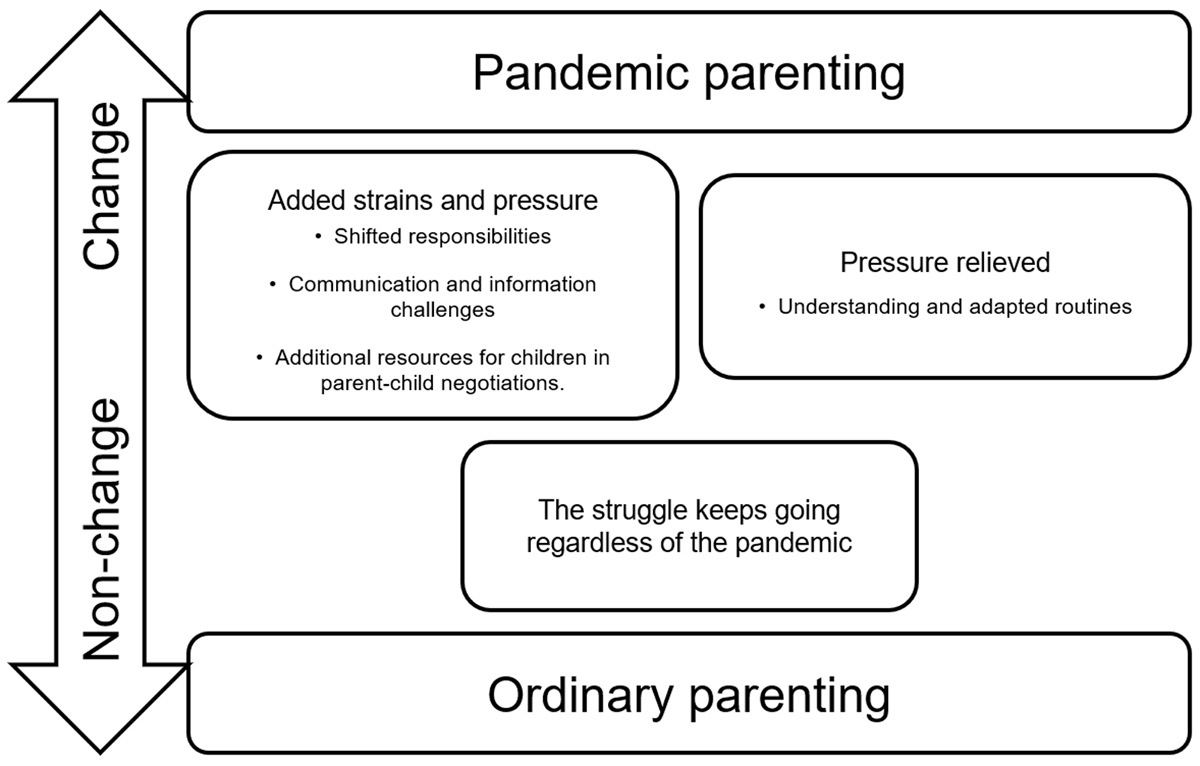
Figure 1
Identified tensions between pandemic parenting/ordinary parenting and change/non-change.
In line with previous research, the findings show that societal change and altered schooling during the COVID-19 pandemic affected the lives of families (e.g., Tokatly Latzer, Leitner and Karnieli-Miller 2021; Schmidt, Šilc and Brown 2023) and thus modified the conditions and practices of parenting schoolchildren with disabilities. An important insight that the study provides is that these conditions and practices of parenting must be understood as diverse and that parents perceived that parenting during the pandemic became more strained in some ways and easier in others. In this way, the effects of the pandemic on parenting seem to be about shifted, increasing, or decreasing levels of strain and pressure in a parenting practice that is already under strain (cf. Lindgren and Zetterqvist-Nelson 2024), making it evident that pandemic parenting needs to be considered in relation to parenting outside pandemic conditions. The descriptions of the need for parental support (also Lipkin and Crepeau-Hobson 2023) or shifted responsibilities are closely linked to ordinary parenting, where such practices are already in place to some extent. Based on these findings, there is reason to reconsider the structures and conditions in place at school for children with disabilities, as well as the approach used for the school’s collaboration with families. The aspects that were eased during the pandemic show that there is room to change the way schools operate that can help both parents and children.
The findings indicate that parenting is very much related to what happens at school, and this study contributes to an understanding of how different social practices (here school) seep into family life and parenting practices (Juhl, Westerling and Dannesboe 2023; Lind et al. 2016). The findings also show that the pandemic led to intensified boundary work in parenting related to changed practices. The blurred boundaries described by Canning and Robinson (2021) in relation to pandemic parenting are partly present in the everyday lives of these families. Additionally, the pandemic further contributed to these blurred boundaries through factors such as school closures, increased sickness absence among children, and a strained staff situation in schools. Similarly, parenting under pressure affects the conditions for children.
In this study, we have sought the perspectives of parents of children with intellectual disability, ASD, and/or ADHD. However, it is important to reflect on whether the pandemic parenting practices described are related to parenting schoolchildren with disabilities or to parenting any schoolchild. In describing pandemic parenting, the child’s disability is not always present, and there are aspects of the parenting practices described that could be related to general parenting rather than parenting a schoolchild with disabilities. One such aspect is shifted responsibilities. The experiences described are consistent with studies of parents’ experiences during the COVID-19 pandemic when schools were closed, and homeschooling became a new, or at least more common, practice (e.g., Khalid and Singal 2023). On the one hand, it is possible that some of the parental challenges are simply about parenting in general; on the other hand, we would argue that it is important to highlight that some of the challenges described are specifically related to parenting school-age children with disabilities. Otherwise, there is a risk that the specific experiences of this group will be made invisible (cf. Runswick-Cole and Goodley 2018; Ryan and Runswick-Cole 2008). Even though parents in general may have similar experiences, the findings show that parents in this group make connections to the child’s disability and/or special needs. This makes it important to, at least in part, understand this as parenting a child with disabilities. Some parenting experiences, such as lifted requirements, are often directly related to the child’s special needs. In line with previous studies (e.g., Billen, Sams and Nordquist 2023; Runswick-Cole 2013) showing that parents in this group experience strain, the parents in the present study reported improved understanding and better routines. This needs to be understood in the context of the parents’ usual sentiment that the school was not adequately adapted to their child’s disability. This shows that the parents’ experiences during the pandemic were about parenting a child with a disability.
Contribution and limitations
The qualitative nature of the study means the findings are not generalisable but provide a deeper understanding of specific cases. It offers insights into parenting a schoolchild with a disability during the COVID-19 pandemic. Given the complexity and diversity of these experiences, studies highlighting various aspects are valuable. Qualitatively studying a parent’s experiences allows us to highlight processes and everyday routines, contributing to a deeper understanding of the phenomenon. This study contributes to the cumulative knowledge of families of children with disabilities. While acknowledging the diversity of experiences and conditions, there are limitations in selection and representation, particularly regarding ethnicity and gender. The selection issue is relevant to the study’s findings, as economic, cultural, and social capital can significantly impact parents’ conditions during the pandemic, such as their ability to support children in their schoolwork or work from home.
Competing Interests
The authors have no competing interests to declare.
Authors Contributions
All authors collected data. The first author analysed the data and drafted the manuscript with support from the second author. All authors reviewed and approved the final manuscript.