
Introduction
Hearing loss (HL) limits social participation in a variety of everyday situations and places. Public spaces with traffic noise or speech echo in suboptimal acoustic environments entail common obstacles to communicative participation and are particularly a barrier for persons with HL (Pelegrin-Garcia et al. 2011). Furthermore, small-scale group interactions with multiple speakers are a frequently noted but underexplored barrier to interaction, generating auditory engulfment and resulting micro-exclusion (Jepsen and Liebst 2021). We develop a micro-sociological theory of participation in communicative rituals, including small-scale groups, to explore such issues further with a focus on how the interactional acquisition of a socially recognised role occurs for youth with HL in school life. Drawing on Randall Collins’ interactional ritual theory (2005), we understand communicative ritual as a focussed encounter in which a participant is emotionally in sync with the other participants and develops mutual understanding and solidarity (Collins 2005: 41). The definition encompasses a range of communicative encounters, but in this article, we focus on small-scale, every day, informal face-to-face communication, whether spontaneous or planned, experienced by young students with HL.
Utilising theories of ritual communication in everyday life (Collins 2005; Goffman 1967; Scheff 1977), different roles are not freely acquired because they depend on the micro-structuring force of rituals. We distinguish positive from negative rituals in their consequences for developing autonomous or constrained roles. The latter entails systematic constraints on self-representation, normatively perceived as a disabling deficit when mirrored in meaningful communication with the hearing of ritual activities. The constrained role of negative rituals contrasts with voluntary self-presentations of exhibiting abilities to control, adjust, and fit into the normative expectations that others have of what proper participants should do. The ability to hear and recognise others in communicative participation is exchanged for a normative recognition validating the person as an insider of the ritual. This secures a deep acceptance where the person feels bonded and in tune with the social surroundings (Jepsen and Liebst 2021).
We utilise the above framework to explore and explain the importance of following along in communication and being on equal footing, focussing on how 15 adolescents with HL experienced school life in a Danish context. We investigate how they experienced ritual participation focussing on play and informal group conversation in youth within mainstream schools. We compare the findings to communicative participation in group life at a secondary boarding school (henceforth: boarding school) specialised in HL. The inability to recognise the meaning of conversations and gain peer access was detected for 5 out of 15 adolescents. This was related to difficulties in perceiving words and following along in the pace of communicative rituals, which informed a process of uniform role-taking, excluding active role-making. The process for the 10 other interviewees was similar but less severe as they acquired a socially accepted role while still experiencing difficulties in communicative participation.
Opposite to mainstream school, the boarding school offered opportunities for socialisation activities and distinct communication forms that collectively support liberating roles one can assume and be accepted in. We discuss why the boarding school succeeds in inclusion despite many students’ previous vulnerability in mainstream school.
The Social Role: Missing an Explanation in Previous Research?
There is a wealth of medical knowledge about HL and how advanced technology and structured language training support a well-functioning sense of hearing (e.g., Percy-Smith et al. 2021). In Denmark, the context of this article, and in most European countries such results support a general trend towards individual inclusion in school life (Alasim 2023). It is now standard for children and youth with HL to be included in mainstream classes with typically hearing peers instead of special education classrooms made for students with similar disabilities. However, some social scientific research suggests that social barriers to access and partake as equals among peers are likely to arise (Bengtsson, Larsen and Lindsay 2014; Jepsen and Liebst 2021). In line with the social model of disability (Shakespeare 2006), which determines disability as an outcome of social barriers rather than essential deficits of a person’s body, we examine how interactional barriers might be generating hearing disabilities despite technology improvements.
A Danish study (Bengtsson, Larsen and Lindsay 2014) of 269 children, 86% of whom had cochlear implants (CI), found that over 30% were socially isolated after school hours. For ordinary hearing students it was 5%. The HL group exhibited up to three times higher psychological symptoms such as insecurity and depression compared to the standard for children up to 15 years old. Such difficulties have also been found in other studies (Roland et al. 2016).
It is a fact that some children with (CI) or digital hearing aids (HA) can achieve language skills and social well-being comparable to children without HL (Stevenson et al. 2017). However, HL differs as a social phenomenon depending on severity, age group, technology, and treatment solution, along with the understudied question of how many encounters in everyday life affect the experience of being able to follow along with others in informal relations or not (Jepsen 2021). In quantitative studies, it is a common finding that people with HL report two to four times higher psychosocial difficulties than hearing individuals, and that there is a significant correlation between mastery of speech-language skills and psychosocial well-being (Dammeyer 2016). Those who master speech-language skills at a typical hearing level tend to avoid difficulties (Stevenson et al. 2017). However, some studies show that social communication problems appear generally more widespread. Actual communicative skills in real life have different meanings than laboratory tests, and barriers to following along and understanding the context of participation have been pronounced for some children (Crowe and Dammeyer 2021; Haukedal et al. 2022).
A Danish study (Hansen 2009) of 16- to 35-year-olds with HL showed that more than 50% had been bullied in school, and around 25% often felt ashamed. Approximately 50% sometimes felt ashamed of their HL, and more than 50% did not disclose their HL in social contexts when they felt excluded (Hansen 2009: 304, 328). The same study disclosed that over 61% felt physically exhausted after a day, which has also been highlighted in studies of young CI users aged 11–15 years (Dammeyer, Chapman and Marschark 2018) and in international studies of young people with HL in general (Adams et al. 2023). Such findings reflect that social relationships only sometimes support participation in environments and that inquiries into the social conditions of communicative participation in real life are needed.
Advanced hearing technology treatment can undoubtedly support efficient hearing and language skills acquisition, but some social scientific research documents barriers to communicative relations. There is a good reason to investigate how psychosocial difficulties play out and their significance for participation in important speech environments such as schools. We propose a systematic exploration of the importance of the social role because the role is a fundamental condition of human interaction in everyday life interaction rituals (Collins 2005; Turner 2002). The social role refers normatively to capacities for proper self-presentation to partake in successful collaboration to attain collective goals, gain recognition, and develop emotionally rewarding relationships (Goffman 1959; Tomasello 2014).
Theoretical Framework: The Ritual Importance of Social Roles
Micro-sociological theory of ritual face-to-face interaction (Collins 2005; Goffman 1967; Scheff 1977; Summers-Efflers 2004) has advanced a focus on how inclusion in everyday encounters depends on access to participate in and acquire an accepted role in face-to-face interactional rituals. Interactional rituals are forms of repeated communicative exchange and association revolving around the fundamental value of gaining role recognition. (Goffman 1967; Collins 2005: 79). A positive ritual refers to how participants gain recognition from having a certain degree of control over the information they convey so others accept them, they follow along with ease, feel at ease with their self-presentation which other confirm and verify (Goffman 1959: 15; Goffman 1967: 7–9; Scheff 1977).
Thus, through an unconstrained interactional exchange that flows easily and allows for spontaneous self-expression, an unconstrained and voluntary social role can be acquired. As reviewed, research shows that HL involves misunderstandings, barriers to participating like others, and the risk of severe psychosocial difficulties. We propose that individuals with HL may face limitations in communicative relations in the form of an imbalance, where they are trapped in a negative ritual of role-taking and unable to assert themselves as they aspire to participate freely. A social role can have indefinite qualities depending on what occurs in a ritual. However, it is possible analytically to distinguish between formal mechanisms that explain the hearing difficulties that can be faced.
Analytically, the acquisition of a socially accepted role depends on two related social mechanisms in the forms of role-taking (self-presentation based on passive adjustment) and role-making (self-presentation based on active appearance, where one has control over how one communicates to others) (Turner 2002: 80–85). The successful and emotionally rewarding acquisition of a social role rests on recognising both forms of self-representation. A lack of ability to comprehend verbal communication leads to failed identification with others in the ritual (Scheff 1977), which equals entrapment referred to as role-takers. Role-taking is less challenging as it depends on recognising others’ speech acts and mirroring oneself in ritual activities, which might involve concealed misunderstanding. In any case, it can be done from a socially withdrawn place in interactional encounters. Someone does not need to speak up to be a good listener. In contrast, role-making requires communicative skills to present oneself in a desired way actively and to assert oneself through words and deeds that involve a turn from passive to active participation.
Hearing loss: an analytical model of recognition/misrecognition
Based on our micro-sociological approach to how role acquisition is the elementary value at stake in ritual communication, we propose that the relationship between HL and psychosocial difficulties revolves around recognition/misrecognition, affecting how identification is possible and how one acquires an accepted social role among others over time. We analyse how adolescents with HL invest and develop emotions when recognising, monitoring, and seeking to present a social role in ritual activities. This can be formulated in the following flow chart as a processual model (Figure 1).
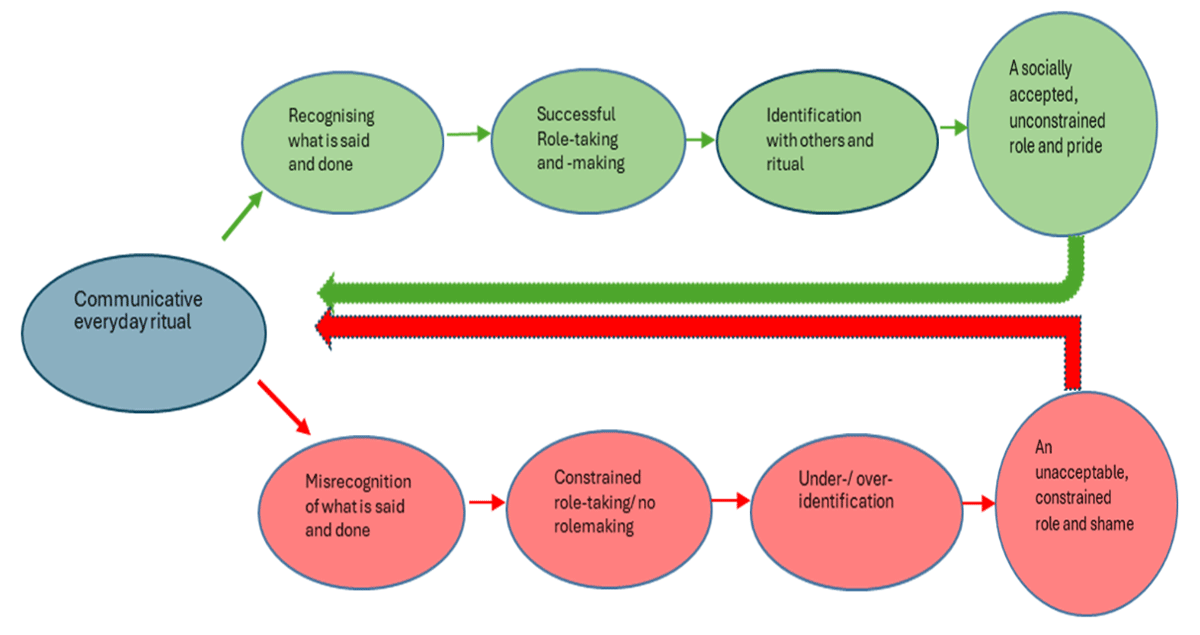
Figure 1
Flow chart of communicative ritual participations.
All positive rituals (green chain) are based on successful recognition of hearing, speaking, and understanding others and one’s behaviour among them. A positive ritual depends on the ability to take and create a role in a balanced manner. Role-taking and role-making correspond to the ability to follow symbolically meaningful behaviour: to hear, and switch communicatively between hearing-speaking without interruption, speaking in the right place, and acting in ways others understand. The result is the acquisition of an accepted social role where one can participate and be with others and, therefore, appear visible. This generates pride, contributing to a positive commitment to ritual engagement, that is, staying in the green loop.
The failed ritual (red) is based on failed communicative recognition and unsuccessful role exchange, manifested at the experiential level as either over-identification (total emotional absorption in the ritual) or under-identification (perceiving others and the ritual from a distance) (Scheff 1977). Under-/over-identification involves a shared behavioural role where the person is compelled to conform to others. Such identification is visible as behavioural signals to avoid falling outside of what others expect, for example, pretending to listen. This generates a feeling of shame from failing to live up to ordinary standards for communication (Scheff 1977).
Concerning our theoretical determination, research on HL and social communication qualifies our proposition that communicative dynamics behaviourally construct the social role as interactional barriers are reported in artificial test settings (Crowe and Dammeyer 2021). We explore such findings further in terms of the fundamental necessity of involvement in rituals through role acquisition, focussing on two communication rituals, childhood play and youth peer conversation, respectively.
Childhood play: Research in developmental psychology and educational sociology highlights the importance of children achieving peer acceptance through play in childhood. Peer group relations are essential for the development of language and social skills, which occurs in the bounded school environment through play sessions in peer groups (Ladd 1989: 2). Schools serve as both educational and social environments, where academic success may not necessarily harmonise with popularity, as seen in research showing that informal peer relationships are not necessarily dependent on educational skills (Ladd 1989; Wentzel 2014). This is evident in early childhood, where play in the informal peer group is a central space for attachment and, in our terminology, for the accepted role.
Youth peer conversation: The informal peer group of conversation typically gains autonomy during secondary school, that is, in adolescence. Informal groups play a crucial role in fostering positive solidarity and acquiring conflict resolution skills, learning the codes for participation in the group’s customs (Wentzel 2014). Youth research shows involvement in self-disclosure and attention skills to understand mixed feelings, as well as more intense interaction to gain acceptance (Wentzel 2014). The ability to create a role for oneself among others depends on claiming how others should perceive and behave towards one, which is based on the ability to hear, understand, and speak in interaction with others.
Our empirically informed theory posits that recognition/misrecognition is fundamental to individuals’ participation in ritual life and the necessary identification with others. Disabilities result from interactional barriers (Lid 2014), which we explore as negative or positive rituals experienced by young people over time in Danish school life.
Methods
Our model’s focus on the basic mechanisms in communication rituals suggests that earlier studies into psychosocial difficulties might involve a constrained role. However, what is the meaning and importance of the socially recognised role of young people with HL?
Building upon our theoretical framework we investigate the question through a comparative case study including 15 young people with HL, who had participated in two distinct school environments in Denmark. We focus on different childhood and adolescent communication rituals in mainstream schools compared to an independent lower secondary boarding school specialised in HL for students aged 14–16 years. In Denmark, the model of boarding schools goes back to the 19th century, when it was originally a common school for the cultural education of poor and illiterate people. Currently, there are around 250 schools with many different profiles such as arts, sports, music, etc., whereas 15 schools remain common schools focussed on cultural education. We carried out our research in the early 2020s at a common boarding school specialising in handling HL and social life problems.
A comparative method is used to reveal similarities or differences across different cases (Ragin 2014). Our case consists of the experience of participation in communication rituals for young people with HL in mainstream and boarding schools, respectively. Two different school environments are compared by the students themselves. The first author has conducted qualitative in-depth interviews with the 15 students with HL and the second author has generated a questionnaire for all boarding school students (N = 98). Similarities and differences in social role acquisition as role-taking and role-making in communicative rituals are analysed in the material. The comparison unfolds in distinct domains for ritualised participation in childhood play and informal group conversations in mainstream schools compared to boarding schools. Based on our model, the case study thus compares different school environments and empirical material, where our unit of analysis is participation in different communication rituals.
In addition to qualitative in-depth interviews and the questionnaire, results from the Danish national survey, SHILD (Survey of Health, Impairment and Living Conditions in Denmark), were used to discover the significance of disability for the Danish population aged 16–64 years. The survey is conducted by VIVE (The Danish Center for Social Science Research) every 4 years in Denmark and covers both disabilities and political, economic, and social conditions. To generate the questionnaire for all boarding school students, we used a particular module of 10 questions, which were included in the regular SHILD survey in 2020. The boarding school questionnaire was created to illuminate how the respondents functioned in informal groups in the environment outside the family where they exert most energy. The questions revolved around keeping up with conversations in small groups, feeling equal to others, and having a friend. Moreover, we included general SHILD survey questions that address several aspects of social participation, such as experience of loneliness, support needed, coping with problems, humiliation, and bullying. In this paper’s analysis, we compare the general population results from SHILD 2020 about keeping up with communication and feeling excluded and other relevant issues with our findings from the boarding school questionnaire.
The interviews were part of more considerable fieldwork at the boarding school including two rounds of interviews four and 11 months into the stay. The interview questions were focussed on feeling part of informal communication rituals, included domain-specific questions, which are known to be problematic for persons with HL, and related to the issues of the survey. Drawing inspiration from Stern’s ‘microanalytical interview’ (Stern 1998), the semi-structured interview guide was designed to gain in-depth knowledge of miscommunication, focussing on the difficulties and benefits of using HA or CI in specific situations.
An interview question about difficulties in following along in communication was repeated in varied forms within areas such as group relations, in class, during informal breaks, in spare time, and related feelings. This generated a detailed and comparative perspective on how communication matters for the students with HL and allowed for analysis of shared experiences of recognition and role acquisition necessary for achieving acceptance among others in an environment. The interviews lasted up to an hour and a half.
Table 1 provides an overview of the 15 anonymised students (fictive names) with HL who were interviewed and asked whether they experienced difficulties participating in play and conversation with peers in youth.
Table 1
Data of participants with HL and their experienced difficulties.
| PARTICIPANT | DIFFICULTIES: PLAY | DIFFICULTIES: PEER CONVERSATION | DIFFICULTIES: PARTICIPATION IN A PEER GROUP |
|---|---|---|---|
| Lise | + | + | |
| Sara-Sofie | |||
| Line | + | + | + |
| Theis | |||
| Clara | + | + | + |
| Søren | + | + | |
| Leif | |||
| Maria | + | + | + |
| Erik | |||
| Josefine | |||
| Solvej | + | + | |
| Susanne | |||
| Louise | |||
| Jane | |||
| Johanne |
Our micro-sociological framework has formulated how role-taking and role-making are fundamental building blocks in ritualised communication. We first examine this phenomenon quantitatively and then qualitatively regarding the target group to demonstrate the extensiveness and qualitative meanings of role acquisition. A key finding in our data is that the interviewees faced various difficulties, especially related to how 5 students did not belong to a peer group and 10 did. In our qualitative analysis, we differentiate between less severe (10 students) and severe (5 students) challenges of partaking communicative rituals to explain the different meanings of the related social role.
Quantitative Findings: Problems with Following Along
The questionnaire conducted among the boarding school students indicates that approximately 70% of the students who did not report HL had equally lower levels of social participation than those with HL (Figure 2).
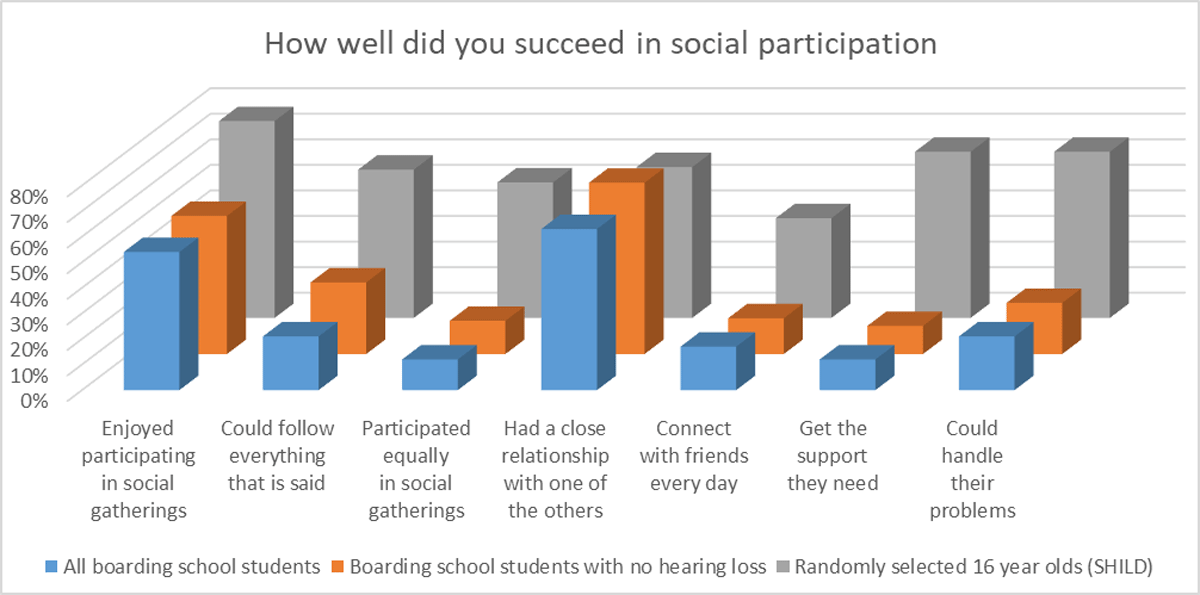
Figure 2
Social participation among boarding school students and general population.
The students at the boarding school without HL saw their friends in mainstream school just as rarely as those with HL and much less frequently than the 16-year-olds in the SHILD sample. The same applies when asked about receiving support and whether they could cope with their problems. The students without HL also preferred to avoid participating in social gatherings similar to those with HL. The only point where boarding school students were in line with the 16-year-olds in the population survey was that a large portion of them had a friend. Regarding questions about keeping up with everything said in informal groups and participating equally in social interaction, all boarding school students scored much lower than the 16-year-olds in the population survey. Still, there was a significant difference depending on their hearing ability so that those with HL reported more difficulties than students with complete hearing.
The boarding school attracted many students with earlier social difficulties even though they were without HL. Using factor analysis of the responses to problems with social participation for the 16-years-olds in the population and for the students at the boarding school, we identified the variables on social participation where the boarding school particularly attracted students and had overrepresentation compared to the population. From these variables, we constructed an index for problems with social participation. With that index, we can illuminate how problems with social participation are related to HL for young people aged 16. The figure also shows that the difference that exists for the youngest remains more or less unchanged throughout life (Figure 3).
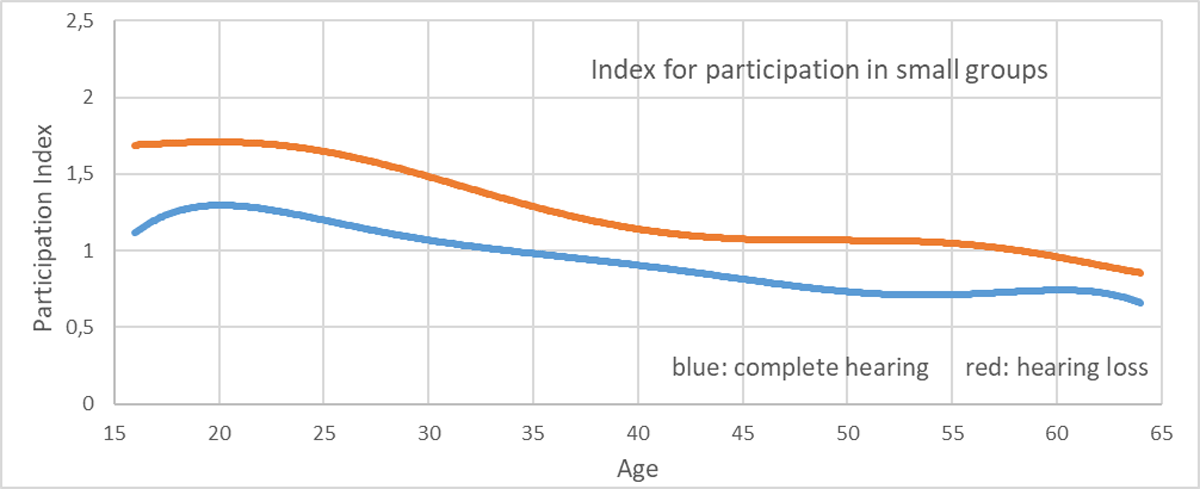
Figure 3
Participation in small groups among the Danish population (SHILD 2020).
The index values show that the problems with participating in small groups are most significant for individuals aged 16–25, with index values ranging from 1 to 2, and they decrease with age so that those with HL aged 45 and older have values below 1. For all age groups, the index indicates that the problems to ‘participate in small groups’ are more significant for those with HL than those with full hearing. However, only a minority of the SHILD respondents has reported HL: around 15% up to age 40, after which the proportion steadily increases, surpassing 30% by age 55. This means that although HL poses a significant risk for participation problems, only a portion of those with these problems have reported HL. Let us take a look at the proportion of each age group that receives the highest index values (Figure 4).
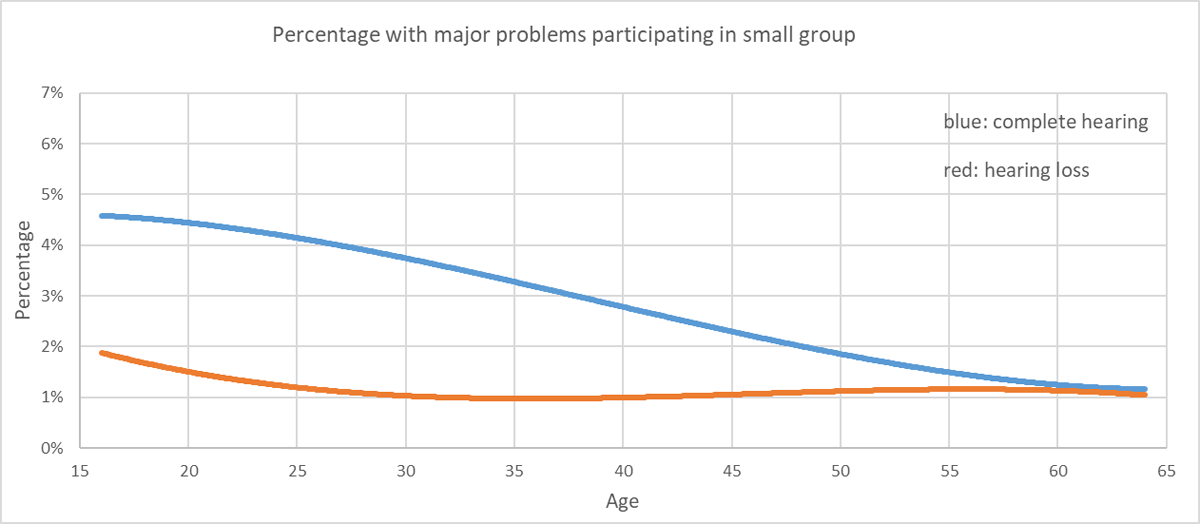
Figure 4
Major problems in partaking in small groups.
Please note that the proportions are taken from the entire age group of the SHILD respondents. Therefore, the figure should be interpreted as follows: 2% of the 16-year-olds have reported HL and problems with participation, and 4.5% have not reported HL, but still have problems with participation, resulting in 6.5% of 16-year-olds experiencing participation problems. Up to age 40, only about one-fifth of the group experiencing significant participation problems also reported HL. From age 60 onwards, it is half of the group. So, HL is not the only reason for participation problems.
In line with our theoretical model (Figure 1), our quantitative analysis suggests a greater likelihood for those with HL to become trapped in constrained role-taking with few opportunities for active role-making. However, it is important to note that HL is not decisive when it comes to the experience of not participating equally, as a large proportion of the population experiences this. This aspect was particularly evident at the boarding school as most students without HL encountered participatory barriers in mainstream school. Therefore, the boarding school is faced with the challenge of addressing a general social problem also found in the population, and the question is whether students achieve role recognition and inclusion. We explore this further in a comparative analysis of the students with HL and their experience in mainstream and boarding school, respectively.
Qualitative Findings: Barriers to Follow Along and the Constrained Role
Out of the 15 interviewed adolescents, 10 had a solid group of peers to be with. Five adolescents experienced being without a group of friends in their childhood at school, and for all – including the 10 students who had relationships – there was a strongly focussed concern about not standing out because of HL. Specifically, it manifests as a tendency to pretend keep up with others in play and conversations.
The social role in play
The following quotes are significant examples of those students who experienced access to partake in communitive rituals of play, and who differed markedly from those who did not have access to them. In the following, we highlight this as a difference between ‘less severe’ constraints and ‘severe’ constraints on role-taking in communicative rituals. The following accounts illustrate less severe limitations in role-taking:
Less severe constraints:
Lise:: I remember in mainstream school, when we were about to play, I thought, ‘Okay, you need to look at me in the eyes so I can read you.’ What are we going to do? What is going to happen? We were in groups, and I did not understand anything, but then I thought…then I have to look at what the others are doing, and then I do the same.
Leif:: The breaks in my class were nice. We spent much time outside playing football or something similar. We were mostly 4–5 in the classroom [during breaks], so it was not noisy, and friendships worked fine.
Sara-Sophie:: When we were little, we played outside, which was sometimes difficult for me. I hated hide-and-seek because when we shouted, “Free, come out,” I stayed in my hiding spot; I could not hear it.
The quotes illustrate different experiences in their perception of ease in following along in play. Leif did not experience difficulties, but HL presents clear constraints in play situations for Lise and Sara-Sophie. Although ten interviewees had friends in their early school years, they experienced varying limitations. Our model (Figure 1) suggests that the cause is based on repetitive barriers to recognising, understanding, and following along to make a role. A failed hearing could make them lonely: ‘I stayed in my hiding spot’ (Lise). The result is that they do not feel on equal footing with peers and feel different, which other research finds common among adolescents with HL (Dammeyer, Chapman and Marschark 2018; Freeman et al. 2017).
At the level of role-making, childhood has several constraints on free play and activities, even for those with peer group relations. HL likely increases the risk of passive role-taking by referring the child to an act of imitating others or needing peer assistance in one-on-one relationships: ‘You need to look me in the eyes’ (Lise). In such situations, role-taking involves a distance or under-identification between oneself and others, where what should be fun play turns into a reflexive activity focussed on hiding or just doing what others do, even if not following along. More severe constraints on role-taking became particularly evident with those who did not have access to engage in play with peers. The following accounts illustrate such challenges:
Severe constraints:
Linda:: They teased me. It got really bad; I was frustrated because I could not hear, and I got into fights, got angry, and wanted to hit… The teachers did not understand me or care, and it only got better when I switched to a special school in 5th grade.
Clara:: And all the students, they did not care… There were some I hung out with during breaks, but I was never really friends with them. Mostly, when I was little, I was stupid, as you always are when you are little, so I did not think it was bullying; I only found out it was bullying when I got older because I thought: ‘You do not treat other people like that’.
Regarding the negative ritual of misrecognition and under-identification, some interviewees, like Linda and Clara, attended school without stable relationships with peers. They experienced inadequacy in entering and following along with their peers’ conversation circles, making it impossible to pursue recognition as a communicative basis for ritual participation. The result was severe under-identification with their schoolmates’ actions, as they perceived peers as being distant and excluded in close relationships.
Our theoretical framework has proposed that feelings of shame are related to the exclusion that HL entails. In the above quotes, Lise’s anger is a more expressive and direct form of confrontation than the way Clara talks about victimisation. However, our theoretical approach has specified that shame is the underlying emotional engine that evokes other emotions and behaviours. The experience of inadequacy and lack of acceptance, which cannot be changed, is the source of shame and generates different emotional expressions, such as anger or sadness (Scheff 1998). This relationship becomes clearer with the importance of more reflexively intentional conversations within the peer group. Deviating from the norm of proper communicative behaviour is a strong pressure to conform in childhood, but it gains momentum in adolescence.
Adolescents’ peer group talk in mainstream school
Difficulties in gaining access to the ritual of successful role acquisition take on a different meaning in adolescence. Verbalised relationships rather than play become important for achieving an accepted social role in school life (Wentzel 2014). HL research supports that adolescence is a time of more intense emotional investment in creating intense relationships and more uncertainty about fitting in, that is, uncertainty about social identity (Freeman et al. 2017). All interviewees expressed that verbalised relationships in the peer group are constrained by HL, but for those outside group access the constraint was most repetitive and severe. As Line puts it:
Severe constraints:
I remember a bad situation in group work just before I stopped school. We were a big group of eight, and I had done the assignment for us because either I did the whole assignment for them or nothing. We should divide into two groups, and four say: “Well, we are together, so you should be with her.” The others said: “No, we do not want that,” they just stood there and threw me back and forth between the groups, saying it was petty for them to be with me. I did not go to school for the next two days, and we met with the principal and the teacher.
Line experienced the other classmates’ behaviour as a barrier to following along. Line’s experience is not an isolated incident but a serious example of a general trend. Similar experiences were also narrated by others, like Maria, who explained the emotional consequences of her classmates’ behaviour:
Severe constraints:
But there was, there was, it was better, but yeah, I do not know, if, I – I, I do not want to blame the hearing loss, but they said I could have had depression from the end of sixth grade. And then I only got out of it in eighth grade when I moved here [to the boarding school] (…) I don’t want to blame the hearing loss, but I think it has something to do with it because it has meant that I couldn’t be with others and couldn’t feel understood (…). That I couldn’t be with people like everyone else.
For Line and Maria, conversation in informal communication with other students was a strongly disruptive force turned against them, involving social distance and demeaning feelings, which for Maria and later Line (7th grade) resulted in depression. We have suggested that this can be explained by shame related to misrecognition and loss of acceptance in others and one’s own eyes. Depression is a serious condition related to incessant negative self-feelings and bodily passivity (Collins 2005: 118–120, 156), which, within our framework, can be explained as a negative ritual cycle of uniform role-taking. The role as an object of others’ negative view (real or imagined) locks one in a role, and one becomes a symbol of what needs to be excluded. The person is elevated to a symbol of the extraordinarily deviant and thus an emblem of the negative ritual per excellence.
Three of the interviewees shared distant relationships with peer groups, meaning that the conversation was more about them and turned against them instead of being directed to them. They were more on the outside than the inside of the conversation circles. For two of the three, the relationship was more akin to tension than a direct exclusion from the comforting belonging to peer groups:
Less severe constraints:
Soeren:: Sometimes I would ask about it (what they were saying), and then they wouldn’t answer or give a quick response and return to the conversation…and I was like, ‘what’s happening?’… It was often okay if you were inside the conversation circle, but if you stood outside, it was difficult to get in… If they were talking about something or making an inside joke or something, I could not be a part of it. I got confused.
For Soeren, the conversational peer group circle is a place of over-identification as outlined in Figure 1. Over-identification is an attempt to recognise and follow along with others and to be on equal footing with them. Soeren is pushed into a state of self-conscious efforts to follow along but with misrecognition. In the interview, he explained that this led to a withdrawal from social relationships at school.
As outlined in the theory section, problems of role-taking include predominantly one-sided and passively constraining dynamics based on lack of abilities for bodily sensory recognition of what others say and do. Misrecognition contributes to trapping the youth in a passive role. This can result in a social role characterised by a reflexive gaze on one’s lack of abilities and a perceived state of inferiority or at least negative self-feelings, which are likely shame-generating. Withdrawal seems to be the only option, which has a strong time dimension, because entrapment in an unwanted role accelerates psychosocial difficulties over time.
Five out of the six interviewees who experienced difficulties in childhood also reported ongoing difficulties in adolescence. Therefore, there is likely an accumulative effect of social distancing from peer groups that may be difficult to reverse. Our explanation is also grounded in the fact that the nine other interviewees who avoided difficulties in childhood experienced a different pattern, where they either succeeded in positive ritual identification or at least alternated between negative and positive ritual participation as the following illustrates.
Less severe constraints:
Louise:: It was mostly during breaks that it was difficult because there was much conversation, and it was hard to keep up with the conversation because everyone was talking at once… I did not ask for repetition; I did my best to keep up.
Erik:: It is difficult because the voices are present simultaneously. You miss part of the sentence and don’t get the context. Then, the question arises of whether you can ask for repetition. If it’s a joke, it’s not fun to repeat.
The quotes illustrate the experience of the 9 adolescents who in their childhood did not experience a serious form of exclusion and distancing from the ritualising conversation circles. This does not mean that failed recognition of what is said and done in group conversations as a ritual unit for acceptance was completely avoided. However, the inability to follow along involves an occasional misrecognition and related misidentification of what the conversation ritual means. The person is not necessarily trapped in a constrained role.
The quotes also illustrate our model’s explanation of the need for a mixture of positive and negative patterns in the ritual cycle to avoid negative role entrapment. This is also related to how young people with few difficulties keeping up in conversation circles experienced fewer serious problems in childhood. They talked about being able to play and participate. So, even though adolescence could sometimes make it difficult to participate in group conversations, there needs to be a consistent pattern of barriers to participation before role entrapment is ensured.
An important finding is that all interviewees worried about deviating from basic etiquette in ritual conversations, namely, showing the ability to spontaneously and effortlessly follow along. For the youth, the concern about standing out is potentially a difficult situation of interpersonal conflict, where difficulties keeping up are assumed to lead to an unwanted social role as the passive recipient of others’ help and consideration. However, the nine interviewees generally said they worked on the right timing to ask for repetition or that peer support made their concerns about deviation less pressing. A clear example is Josefine:
Interviewer:: You said you had become better at accepting your hearing loss at school?
Josefine:: Yes, I think I have become better at putting it into words instead of just doing it for myself…I have always just automatically placed myself where I could naturally hear better. However, I have become better at following along than just doing it. My head and body have gotten used to it [hearing loss and sounds for conversations]… The others [peers] were good at showing consideration.
Josefine’s experience is a clear example of how self-presentation, limited in front of peers, can be seen as a processual cycle over time. It demonstrates how role formation involves demands to be seen in a particular way, as the immediate visibility in communication is a strong indicator of being able to keep up like others. When communicative behaviour can be repeated, a ritual acquisition of a role involves building mutual understanding among peers. For Josefine, it strengthened her conviction that she could control and handle her situation.
The liberating role at the boarding school
We have illustrated how young people with hearing impairments worry about presenting themselves due to a limiting and fixed role where they appear to need special consideration. This changes radically at the boarding school:
Maria:: Here, it becomes natural, so it is not like, ‘Oh okay, should I sit like this?’ or like this. You know it here because you have been taught a little, and you only come to this boarding school knowing that there are people who hear poorly, so if you did not accept it, you would have chosen another boarding school. So people talk about it, and the teachers also talk about it, so it becomes normal.
There is a naturalness about HL at the boarding school. This is partially due to information, as everyone knows about it, and everyone has been informed of its importance for hearing and communicating at school, for example, speaking calmly, paying focussed attention, and not standing against the light to enable lip reading for the person with HL. Thus, there must be specialised knowledge about the importance of hearing impairment in practice, where the school’s pedagogy involves building a common understanding among students. As Maria saw it, the common knowledge at the boarding school is a significant factor in creating open social interactions and special friendships that confirm the young person’s ability to step into a liberating role with a high degree of self-determination. Theis and Erik articulate it as follows:
Theis:: Well, of course, friend groups have formed, but you don’t have to be in that friend group all the time. You can be everywhere, so you’re not tied to one group.
Erik:: Well, what is different is that you are with people 24/7 here, and you can quickly connect with people. If I return to my room to relax, I must take a few steps out and find someone to talk to, unlike in mainstream school.
Theis, Erik, and Maria’s experiences resemble those of the other interviewees. It’s not just about experiencing a strong sense of community based on common understanding but also about ways of accessing and recognising each other as roommates who understand each other and belong together. The essential question is what promotes mutual understanding as achieved by the school’s pedagogy?
Specifically, two important social mechanisms are at play: the school’s diverse activity opportunities and the institutionalisation of a sensitive approach to being focussed and present in communication with each other.
The pedagogy of the boarding school is manifested in daily routines involving teaching and various duties such as cleaning, cooking, homework, and a wide range of optional activities. All students have a designated break time, allowing everyone time to recharge their energy, which research shows can be important for individuals with HL who tire more quickly (Adams 2023; Jepsen and Liebst 2021). The young people with HL appreciated this ritualized hour of immersion and emphasised the importance of engaging in appropriate social activities with others in various ways. The school’s diverse activities in distinct spaces, from common rooms, the dining hall, and the organised residential pillars in different colours to more specific spaces like the sports hall, fitness centre, art room, and lounge, offer a high degree of flexibility regarding the role one wants to step into and engage others with. The natural understanding of each other, as Maria aptly told about at the beginning of this section, can be partially understood as a result of diverse activity spaces. Susanne clarifies such spaces:
I like that when you sit in the dining hall and have to eat, you talk and are together. I also like being in the classrooms, having lessons, and such. I also like being in my room because I know there is peace and I can relax. There are many places…
The second important factor revolves around communication, where mutual understanding is directly derived from students being able to and willing to understand each other, thus giving each other space to keep up. In micro-sociology, it has been explained how successful communication occurs through mutual understandings and adaptations of body language (Goffman 1967), including the gaze’s ability to quickly read others’ intentions and moods (Kendon 1990: 30–50). This requires observing each other, not relying solely on hearing’s usually finely tuned abilities to discriminate, filter, and identify understandable speech even in noisy environments (Sørensen et al. 2019).
For the interviewees, the ability to lip-read others was particularly conducive to understanding. As Maria puts it, lip-reading worked because everyone at the school had the experience to support mutual focus, such as sitting correctly: ‘Here, it becomes natural, so it is not like, “okay, should I sit like this or like this”’. However, the adolescents’ reliance on lip-reading indicates that interaction dynamics likely occur qualitatively differently from the ordinary hearing person’s ability to listen without visual attention. The students at the boarding school rely more fully on visual skills, which have shown importance for mutual consideration and coordinating good communication:
Maria:: “Well, I lip-read a lot. So people… They should look at me and preferably not from the side.”
Erik:: “Yes, eye contact when I talk one-on-one. Moreover, of course, I can also lip-read a bit. I do that a lot.”
Susanne:: “I do not think about it [lip-reading] much when I have my cochlear implants on. However, when I do not have them on, I only lip-read because I cannot…Well, people have to say it correctly; they cannot just make the gestures for it. They have to say it correctly. Moreover, I think my parents also often talk correctly, or more clearly than usual.”
Leif:: “It is not like the [body language] doesn’t matter much to me. The most important thing is to see the whole face to see lip-reading and stuff like that.”
The unique aspect of the young people’s opportunities to engage in positive ritual communication and develop close bonds at the boarding school is that others immediately show consideration by maintaining close-focussed communication. This close communication is part of the pedagogy of proper communication and, in any case, of the physical proximity of living together. Consequently, HL loses its negative connotation as disability and instead becomes part of a positive way of being together through the dominance of close communication forms, as opposed to the distant forms experienced in mainstream school. The result of the boarding school’s environment and social interactions is a positive ritualisation, which also leads young people with HL to develop a new perspective on their role as adolescents. This perspective entails a focus on acquiring a socially acknowledged role that is not constrained by HL.
Conclusion
This article’s analysis of adolescents’ school life experiences suggests that social inclusion depends on ritualised role acquisition, which cannot be taken for granted during everyday communications involving adolescents with hearing loss. Drawing on our micro-sociological framework and analytical model of recognition/misrecognition, we have demonstrated how the negative ritual’s constrained role arises to varying degrees in mainstream schools. In contrast, participation in everyday conversation rituals and activities at the boarding school involved mutual understanding based on diverse activity possibilities and closely focussed communication forms that enable proper recognition of each other. Specifically, the boarding school facilitates common understanding across social and disability differences because the ritual communication patterns consist of fixed routines for equal participation (duties), a large degree of flexibility in activity possibilities, and closely focussed face-to-face communications thus making communicative dynamics flow with ease.
Our combination of quantitative and qualitative methods has made it clear that several adolescents at the boarding school, including those without hearing loss, faced earlier difficulties in mainstream school. They had experienced barriers to following along and being on an equal footing with peers in mainstream school to an extent that is ten times greater than that seen in the general population. Despite such psychosocial difficulties, the boarding school managed to build an environment around positive rituals facilitating accepted role acquisition and inclusive group dynamics among students.
Overall, this paper has explicated that although HL is a barrier to partake and follow along in informal groups, then barriers were also pronounced for those without hearing loss. Hearing loss is an additional risk factor in creating obstacles to inclusion into everyday communicative rituals, but a socially supportive environment can do much to solve social problems also for those without hearing loss. Hence, the interviewees saw the boarding school as inclusive for all, which also calls for future studies into how hearing peers might experience everyday participation in comparison.
Finally, hearing loss and the entrenched role of interactional constraints experienced in mainstream school were not explicated by the students with hearing loss as a challenge during their stay at the boarding school. The positive communicative rituals at the boarding school facilitated an open environment of liberating role acquisitions wedded to the new school environment, which broke with past constraints and difficulties of living with hearing loss in school life.
Funding Information
This work was supported by the VELUX FONDEN, grant number 35585.
Competing Interests
The authors have no competing interests to declare.