
Introduction
Individuals with disabilities, particularly those with severe disabilities, may face marginalization, as well as social, economic, and civic disparities (Ciciurkaite et al. 2022; Mitra & Turk 2022; Sabariego et al. 2015). Therefore, this minority group may have fewer resources to cope with adverse COVID-19 stressors (Ciciurkaite et al. 2022; Mitra & Turk 2022). Although systematic reviews and meta-analyses have indicated that young people in particular, have been vulnerable to mental health problems during the pandemic in Europe, East Asia, the Middle East, and America (Racine et al. 2021; Xiong et al. 2020), there is little research on this issue among young people with disabilities. Studies from Finland, the United Kingdom, and the United States have found that adults with disabilities reported mental health problems more often during the pandemic than those without disabilities (Holm et al. 2023; Holm et al. 2022b; Kavanagh et al. 2022; Okoro et al. 2021), suggesting that it is essential to study the situation in young people with disabilities. However, only a few studies—one from Finland and two from Africa—have addressed this issue and have found that young people with disabilities reported more frequent anxiety and decreased well-being than those without disabilities during the pandemic (Holm et al. 2024a; Sharpe et al. 2021). In addition, studies focusing on students with disabilities in higher education are limited.
Previous theories indicate that loneliness, financial situation, and study workload are important constructs for understanding psychological distress (Frankham et al. 2020; Keller et al. 2023; Lazarus & Folkman 1984). The theory of loneliness suggests that unfulfilled social connection needs lead to feelings of loneliness, which can impact mental health, such as psychological distress, over time (Keller et al., 2023). Particularly, lonely individuals often cope with stress through withdrawal and maladaptive emotion regulation strategies, such as rumination and negative thinking. They are less likely to seek help from others and may lack supportive social relationships, which can contribute to mental health issues (Cacioppo et al. 2000; Heinrich & Gullone 2006; Keller et al. 2023). Theoretical evidence also indicates that financial problems create insecurity, foster hopelessness, instill a sense of powerlessness, lower self-esteem, and increase worry and financial strain, ultimately leading to mental health problems (Frankham et al. 2020; Ryu & Fan 2023). Additionally, a higher academic workload may lead to failures in academic tasks and demands that exceed personal resources, which in turn triggers stress and mental health problems (Barker et al. 2018; Lazarus & Folkman 1984). Even before the pandemic, individuals with disabilities faced loneliness, financial problems, and challenges in school, leading to higher study workloads (Coster et al. 2013; Lombardi et al. 2023; MacDonald et al. 2018). According to the stress process theory, these vulnerabilities may increase their risk of mental health challenges during the pandemic (Ciciurkaite et al. 2022).
Studies concerning young people and students from the United States and European countries have shown that the impact of COVID-19-related social restrictions was possibly more significant among those who had to cope with an altered academic landscape, weakened employment prospects, school closures, social isolation, and possible financial consequences (Horigian et al. 2021; Tancredi et al. 2022). Social exclusion during the pandemic increased the loneliness of young people, resulting in vulnerability to mental health problems (Horigian et al. 2021; Loades et al. 2020). However, empirical evidence on these issues among young people with disabilities is limited. Studies from Finland and the United Kingdom have indicated that disabled adults experienced loneliness more often than those without disabilities (Holm et al. 2022a; Kavanagh et al. 2022), suggesting that young people from this minority group may also be at risk. Morrison et al. (2023) found that, during the pandemic, young people with disabilities felt socially isolated. However, this study did not include a comparison with those without disabilities and it focused only on rural areas in low-income Nepal (Morrison et al. 2023). Disabled people—especially those with severe disabilities—may be at a greater risk of morbidity and mortality if they contract the virus due to their underlying health conditions (Dixon-Ibarra & Horner-Johnson 2014), leading them to avoid social contact.
Unemployment among young people resulting in financial difficulties increased during the pandemic in each member country of the European Union (Lambovska et al. 2021). Students who worked part-time may have lost their jobs, and their parents’ incomes may have decreased, thus reducing their ability to support their children financially. Moreover, students with disabilities may have had fewer opportunities to work part-time due to the risk of infection (Dixon-Ibarra & Horner-Johnson, 2014). Loss of financial resources was associated with mental health problems during the pandemic among young people and students in Israel and European countries (Achdut & Refaeli 2020; Tancredi et al. 2022). Regarding the financial situation of persons with disabilities, studies have focused on adults from the United Kingdom and Canada (Emerson et al. 2021; Gignac et al. 2021), while the situation of young people has remained unaddressed.
COVID-19 forced higher education institutions worldwide to switch to new distance learning methods to protect students from the pandemic. Despite some potential advantages (e.g., the flexibility of distance learning) this transition had negative impacts on students, such as in decreased teacher support and increased study workload, which may have led to higher levels of mental health problems (AlAzzam et al. 2021; Aristeidou & Cross 2021; Kiviruusu et al. 2023; Lemay et al. 2021). Students with disabilities from the different countries—Finland, the United States, Austria, and the United Kingdom—have been at increased risk during distance learning due to inequities in resources and support, lack of accommodations, and a reduced ability to cope with the demands of distance learning (Bakaniene et al. 2023; Holm et al. 2024b; Supratiwi et al. 2021). Thus, their workload may increase more in distance learning, resulting in a higher level of mental symptoms compared to students without disabilities.
In summary, considerable research has been conducted on mental health among young people during the pandemic in various countries. However, there is less population-level research focusing on mental health problems among young people with disabilities during this period (Holm et al. 2024a; Sharpe et al. 2021) and this research was often limited to specific regions—Finland and African countries—focusing on anxiety or positive mental well-being rather than psychological distress. Additionally, there is limited empirical, population-based evidence on whether increased loneliness, a weakened financial situation, and an increased study workload mediate differences in distress between students with and without disabilities. In Finland in 2021 various measures were implemented to protect citizens from COVID-19 and to control the pandemic. These measures included school closures, some workplace closures, the cancelation of public events and gatherings, the implementation of social distancing measures, the enforcement of assembly restrictions, and the mandating of quarantine in the case of infection. Similar restrictions were observed worldwide during the COVID-19 pandemic (Mathieu et al. 2020). However, like other Nordic countries, Finland did not impose stay-at-home orders in 2021 (Mathieu et al. 2020). Instead, the government only recommended these measures, while such orders were mandated in many countries, including the United States, Germany, France, Spain, and the United Kingdom at the beginning of 2021 (Mathieu et al. 2020).
We investigated psychological distress during the pandemic in Finland among students with severe and moderate disabilities compared to those without disabilities and whether increased loneliness, weakened financial situations, and increased study workloads mediated the association between disability and psychological distress. We hypothesize that these three factors partly mediate the association between disability and psychological distress. Our results may provide information that could help to decrease mental health inequalities among vulnerable groups.
Methods
Data and design
We analyzed the cross-sectional data of higher education students aged 18–34 at universities or universities of applied sciences in Finland from the Finnish Student Health and Wellbeing Survey (KOTT) (THL 2024). Data from KOTT 2021 were collected during the third wave of the COVID-19 pandemic, between February 2021 and March 2021, by the Finnish Institute for Health and Welfare (THL). At that time, several COVID-19-related restrictions were implemented, such as using distance education for students, closing public places, implementing social distancing measures, enforcing assembly restrictions, and mandating quarantine in the case of infection. However, no stay-at-home orders were implemented. The KOTT produces comprehensive data on higher education students’ health, well-being, study abilities, and health services. The KOTT is the only population-based survey in Finland that provides comprehensive and up-to-date information on higher education students. It offers an opportunity to compare the situation of higher education students with disabilities to the broader higher education population, allowing for a better understanding of the inequalities faced by these vulnerable students.
The survey was based on a sample of the student population (n = 11, 912) enrolled in higher education institutions in Finland in spring 2021. The sampling method used was random sampling stratified by higher education institutions. The stratification of the higher education institutions was defined such that each sample included 140–400 students from universities of applied sciences and 150–800 students from universities, with about 6,000 students in total from both types of institutions. The sample size was larger for those institutions with a greater number of students. Students from the institutions were selected through random sampling. The web questionnaire (available in Finnish, Swedish, and English) was sent to selected higher education students. Of the invitees, 6,258 (53%) participated. The THL Ethics Committee approved the survey protocol (THL/2129/6.02.01/2019).
Measures
Disability
Disability was assessed using the Global Activity Limitation Indicator (GALI; Robine & Jagger 2003), previously validated against other disability measures in several European countries (Van Oyen et al. 2018). This indicator is used as a proxy for identifying persons with disabilities and those who are limited or severely limited in their activity (Eurostat 2021). The GALI consists of two questions: (a) ‘Are you limited because of a health problem in activities that people usually do?’ [with response options: severely limited (1), limited but not severely (2), and not limited at all (3)]; and (b) ‘Have you been limited for at least the past six months?’ [with response options: yes and no]. Those who responded that they had been severely limited for at least the previous six months were categorized as having severe disabilities. Those who responded that they had been limited but not severely for at least the previous six months were categorized as having moderate disabilities. Those who responded that they had not been limited at all or had been limited for less than six months were categorized as having no disabilities.
Outcome variable
Psychological distress was assessed using the 12-item version of the General Health Questionnaire (GHQ-12; Goldberg 1972). It is a widely used measure to assess different aspects of psychological difficulties and performance, such as symptoms of anxiety and depression, problem-solving, and self-confidence. Items are rated on a four-point scale and, using the most common bi-modal GHQ scoring (0-0-1-1), the score range is 0–12 (Goldberg 1972). The GHQ-12 has shown good reliability and validity (Gelaye et al. 2015) and has been used in Finnish epidemiological studies (Holi, Marttunen & Aalberg 2003). In the present sample, the internal consistency of the GHQ-12 was excellent (Cronbach’s alpha 0.90). In the analyses, the GHQ-12 was used both as a continuous and dichotomous variable. For the dichotomy, we used the cut-off point of four or more points to indicate those with psychological distress (Holi, Marttunen & Aalberg 2003).
Potential mediators
The questions used to measure the potential mediators were developed by a group of expert researchers and subject matter specialists, and their comprehensibility was tested with higher education students. A weakened financial situation during the pandemic was identified based on the question: Has the coronavirus pandemic negatively affected your financial situation? The response options were listed as: very much (1), quite a lot (2), to some extent (3), a little (4), and not at all (5). We report here the proportion of those who responded that the coronavirus pandemic had, at least to some extent, negatively affected their financial situation: yes (answer options (1), (2), and (3)|) vs. no (options (4) and (5)).
Increased loneliness and workload required for studies during the pandemic were identified based on the question: Have the coronavirus pandemic or the subsequent restrictive measures affected your daily life? A list of several life situations followed, including feeling lonely and the workload required for studies. The response options were listed as: no influence; yes, decreased; yes, increased; and not applicable. Here, we report the negative effects: a perceived increase in the feeling of loneliness and a perceived increase in the workload required for studies. The ‘not applicable’ option was excluded (responses revealed loneliness: 2.6% and workload required for studies: 2.1%).
Sociodemographic covariates
We used the following sociodemographic covariates: age group (18–22, 23–26, and 27–34 years), sex (female/male), living alone (yes/no), and higher education sector (university/university of applied sciences). These covariates were selected based on studies indicating that they are associated with psychological distress (Muñoz & Santos-Lozada 2021; Myklestad et al. 2012; Rega et al. 2022; Van Droogenbroeck, Spruyt & Keppens 2018). In our study these sociodemographic covariates were significantly associated with psychological distress.
Data analysis
Weights were used in the analyses to restore the representativeness of the data (Härkänen et al. 2014). The weights were calculated using the inverse probability weighing method. The weights were calculated using register-based information for the entire sample concerning age group, sex, native language, higher education sector (university/university of applied sciences), and the number of credits earned in the previous semester.
We used Stata’s survey analysis procedures to analyze survey data by considering the sample design (Stata Version 16). First, frequency analyses were conducted to examine the prevalence of the sociodemographic characteristics of the study groups. Second, adjusted regression analyses were conducted to investigate the mean and prevalence of psychological distress and the prevalence of the potential mediators, i.e., weakened financial situation, increased loneliness, and increased workload required for studies. These analyses were conducted stratified by disability. In the adjusted model, we controlled for sociodemographic characteristics: sex, living alone, age group, and higher education sector. The adjusted mean and prevalence were estimated using the margins command (William 2012). We reported the unstandardized coefficients (B, linear regression) or the odds ratio (OR, logistic regression) as measures of comparison between students with disabilities (i.e., severe or moderate) and those without disabilities.
If disability (severe/moderate) was significantly associated with psychological distress, mediation analyses were performed to identify the direct and indirect pathways (through the three mediators) between disability and the continuous psychological distress variable (see Figure 1). These analyses were adjusted for sociodemographic covariates. Structural equation modeling (SEM) was used for mediation within the lavaan survey package in R (Version 4.3.1) software concerning complex survey design (Oberski 2014). SEM allowed us to specify direct, indirect (mediation), and total (direct + indirect) pathways for psychological distress. We used unstandardized coefficients (B) to determine the pathway effect. We also estimated the percentage that the mediators accounted for the association between disability and psychological distress (mediating percentage) by dividing the indirect mediation effects by the total effect.
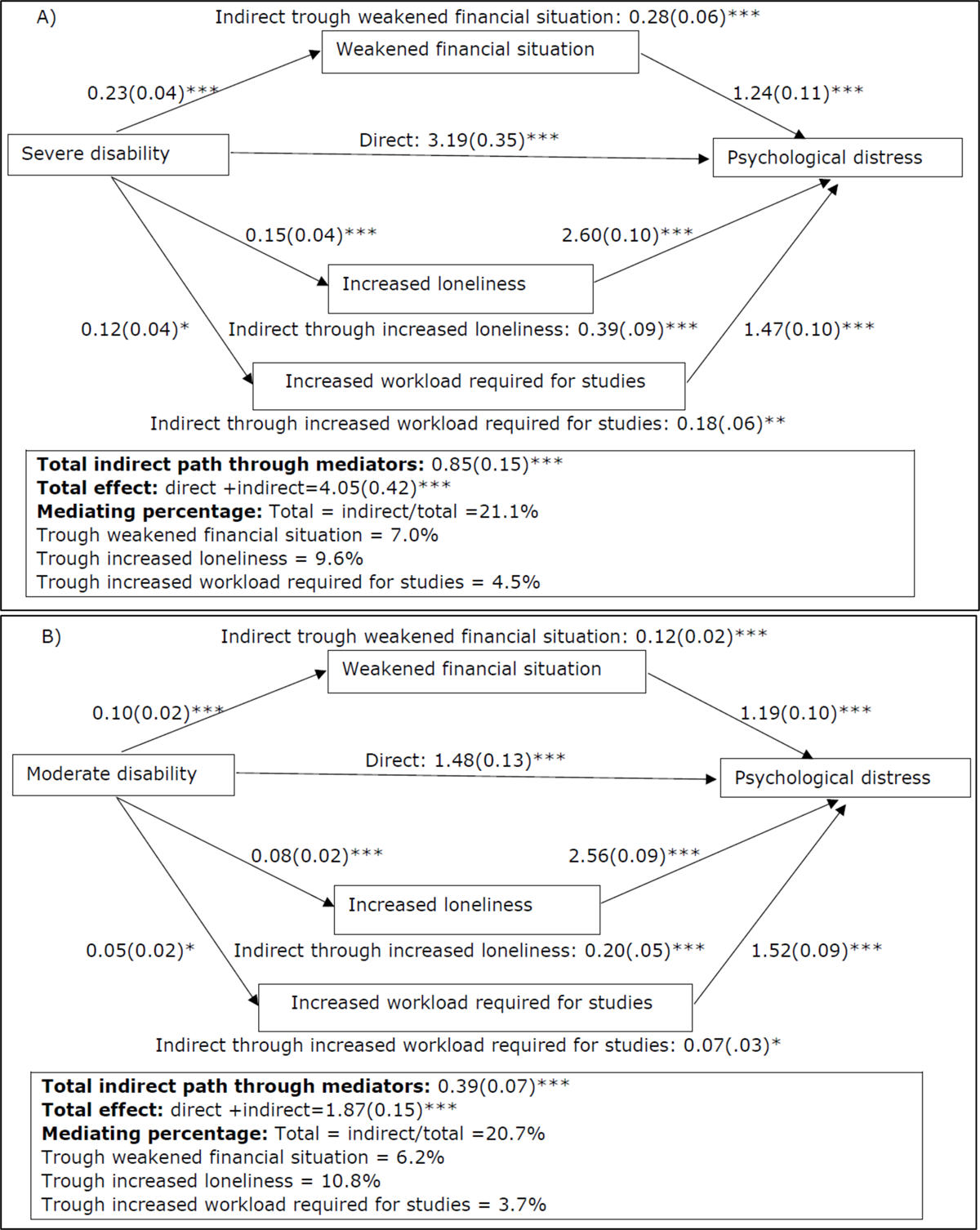
Figure 1
The analyzed mediation model, separately for severe (A) and moderate (B) disability.
Indirect pathway = association between disability and psychological distress through the mediation of weakened financial situation, increased loneliness, or increased workload required for studies. Direct pathway = association between disability and psychological distress while controlling for the mediators. Adjusted for sociodemographic covariates (sex, living alone, age group, and education sector). Unstandardized effects and standard errors (in brackets) are presented. *p < 0.05; **p < 0.01; ***p < 0.001. Meditating percentage = the proportion in which a mediator accounted for the associations between disabilities and psychological distresss.
Results
Sociodemographic background
About 3.9% of the student population reported severe disability, while about 17% reported moderate disability, as shown in Table 1. Females were more likely than males to report moderate disability, while there was no gender gap with regards severe disability.
Table 1
Sociodemographic characteristics of the study population.
| SEVERE DISABILITY n = 225 | MODERATE DISABILITY n = 1057 | WITHOUT DISABILITY n = 4896 | |
|---|---|---|---|
| Total, % [95% CI] | 3.9 [3.4, 4.5] | 17.0 [16.0, 18.0] | 79.1 [78.0, 80.1] |
| Age group, % [95% CI] | |||
| 18–22 | 25.1 [19.7, 31.4] | 26.5 [24.0, 29.3] | 34.9 [33.5, 36.3] |
| 23–26 | 40.6 [34.0, 47.5] | 38.9 [35.8, 42.1] | 40.4 [38.9, 41.8] |
| 27–34 | 34.3 [28.0, 41.2] | 34.6 [31.5, 37.8] | 24.8 [23.4, 26.1] |
| Higher education sector, % [95% CI] | |||
| University | 55.7 [48.7, 62.4] | 51.1 [47.8, 54.3] | 50.7 [49.2, 52.2] |
| University of applied sciences | 44.3 [37.6, 51.3] | 49.0 [45.8, 52.2] | 49.3 [47.8, 50.8] |
| Sex, % [95% CI] | |||
| Male | 47.5 [40.6, 54.5] | 33.5 [30.3, 36.8] | 48.7 [47.2, 50.2] |
| Female | 52.5 [45.5, 59.4] | 66.5 [63.3, 69.7] | 51.3 [49.8, 52.8] |
| Living alone, % [95% CI] | |||
| No | 46.9 [39.9, 54.1] | 55.2 [51.9, 58.4] | 58.8 [57.3, 60.3] |
| Yes | 53.1 [45.9, 60.1] | 44.8 [41.6, 48.1] | 41.2 [39.7, 42.7] |
| aPsychological distress (dichotomized) | |||
| % [95% CI] | 79.8 [74.1, 85.4] | 64.3 [61.1, 67.5] | 43.2 [41.7, 44.7] |
| OR [95% CI] | 5.36 [3.73, 7.70]*** | 2.41 [2.06, 2.81]*** | ref. |
| aPsychological distress (continuous) | |||
| M(SE) | 8.35(.28) | 6.35(.13) | 4.44(.06) |
| B(SE) | 3.90(.29)*** | 1.91(.14)*** | ref. |
| aWeakened financial situation | |||
| % [95% CI] | 57.2 [50.2, 64.3] | 45.7 [42.5, 49.0] | 36.2 [34.7, 37.6] |
| OR [95% CI] | 2.39 [1.77, 3.21]*** | 1.49 [1.29, 1.73]*** | ref. |
| aIncreased loneliness during | |||
| % [95% CI] | 73.6 [67.1, 80.0] | 68.4 [65.3, 71.6] | 61.8 [60.3, 63.3] |
| OR [95% CI] | 1.76 [1.24, 2.49]*** | 1.36 [1.15, 1.60]*** | ref. |
| aIncreased workload required for studies | |||
| % [95% CI] | 59.5 [52.4, 66.5] | 50.5 [47.2, 53.8] | 46.0 [44.5, 47.5] |
| OR [95% CI] | 1.75 [1.29, 2.38]*** | 1.20[1.04, 1.40]* | ref. |
[i] Note. aAdjusted for sociodemographic covariates (sex, living alone, age group, and education sector). OR = odds ratio; CI = confidence interval; SE = standard error.
*p < 0.05; ***p < 0.001.
Table 1 also presents differences in psychological distress and mediators between students with and without disabilities. Students with severe and moderate disabilities reported higher psychological distress levels (severe: M = 8.35 and moderate: M = 6.35) and prevalence (severe: 79.8% and moderate: 64.3%) than students without disabilities (M = 4.44 and 43.2%) when controlling for sociodemographic covariates. A higher share of students with disabilities (severe or moderate) than those without disabilities reported a weakened financial situation, increased loneliness, and an increased workload for studies. In all cases, students with severe disabilities had the highest odds.
Results of mediation analyses
Figure 1 presents the results of the mediation models separately for those with severe (A, upper part) or moderate (B, lower part) disability. As shown in Figure 1 and already noted, disability (severe or moderate) was associated with the three mediators. Additionally, the three mediators were significantly associated with psychological distress.
Regarding mediation, severe disability had an indirect association with psychological distress via a weakened financial situation (B = 0.28), increased loneliness (B = 0.39), and increased workload required for studies (B = 0.18). However, the direct pathway also remained significant (B = 3.19). These mediators accounted for 21.1% of the association between severe disability and psychological distress, and increased loneliness accounted for the largest part of this association at 9.6%. Similarly, moderate disability had an indirect association with psychological distress via a weakened financial situation (B = 0.12), increased loneliness (B = 0.20), and increased study workload (B = 0.07), while the direct pathway remained significant (B = 1.48). The three mediators accounted for 20.7% of the association between moderate disability and psychological distress, and increased loneliness accounted for the largest part of this association at 10.8%.
Discussion
Psychological distress was found to be more prevalent and of a higher level among higher education students with disabilities (severe or moderate) than among those without disabilities. An interesting, new finding observed in this study was that a weakened financial situation, increased loneliness, and increased study workload among students with disabilities partly mediated their higher psychological distress levels compared to those without disabilities.
We found that those who had severe disabilities were the most vulnerable to psychological distress—about 80% of them reported psychological distress at the clinical level. While previous research suggests that increased loneliness, financial loss, and increased study workload in distance learning during the pandemic are linked to mental health among young people (Achdut & Refaeli 2020; AlAzzam et al. 2021; Horigian et al. 2021; Kiviruusu et al. 2023; Lemay et al. 2021; Tancredi et al. 2022), our research shows that these adverse experiences account, significantly so, for the higher levels of psychological distress among students with disabilities compared to those without disabilities. These mediation associations were very similar regardless of the severity of the disabilities. Our findings support the earlier theory that loneliness, financial situation, and study workload are important contributors to psychological stress (Frankham et al. 2020; Keller et al. 2023; Lazarus & Folkman 1984). Our results also support the stress process theory, which suggests that the vulnerability of disabled people to the abovementioned unfavorable factors before the pandemic might have made them more susceptible to these adversities and the resulting mental health problems during the pandemic (Ciciurkaite et al. 2022).
Notably, given that the data represents experiences during a specific time, it is not possible to determine whether the level of psychological distress among disabled and non-disabled students persisted during the pandemic compared to the time before and after the pandemic, or whether psychological distress increased more among disabled students than among their non-disabled peers during the pandemic. However, previous studies have indicated that mental health problems increased during the pandemic among young people without disabilities in several countries (Kiviruusu et al. 2024; Xiong et al. 2020). This increase was even more pronounced among students with cognitive and mobility disabilities than among those without disabilities in Finland (Holm et al. 2024a). Our study also found that the greater psychological distress among students with disabilities, compared to those without disabilities, was partly due to the former having more frequent experiences of negative changes in loneliness, financial situation, and study workload during the pandemic compared to their non-disabled peers. Consequently, these pandemic-related factors may have exacerbated mental health inequalities between students with disabilities and their peers without disabilities.
We found that increased loneliness during the pandemic accounted for most of the association between disability and psychological distress. We also found that adolescents with severe or moderate disabilities reported increased loneliness more often than those without disabilities. Because people with disabilities may be at particular risk of COVID-19 infection, they were probably isolated in their homes during the pandemic and many of their group activities were canceled (Dixon-Ibarra & Horner-Johnson 2014; United Nations 2020), therefore potentially leading to an increase in their loneliness during the pandemic. Additionally, young people with disabilities who experience loneliness may not necessarily receive the social support they need during such events, which in turn reflects on their mental health (Honey et al. 2011).
We found that students with disabilities reported a weakened financial situation more often than those without disabilities, which, in turn, accounted significantly for their greater psychological distress. The economic uncertainty caused by the pandemic may have affected young people who were even before the pandemic in a weaker position economically, particularly those with severe disabilities (Ciciurkaite et al. 2022; Honey et al. 2011; Sabariego et al. 2015). This disadvantaged group may have lost their jobs during the pandemic. Additionally, young people with disabilities—particularly those with severe disabilities—might not have worked due to the risk of COVID-19 infection (Dixon-Ibarra & Horner-Johnson 2014; United Nations 2020) and this may have further weakened their financial situation. This significant financial impact may have influenced their mental health. Weakened financial situations can prevent disabled people from receiving paid services and care that are important to them, of which can lead to an increase in their mental health problems (Ciciurkaite et al. 2022; United Nations 2020).
Our study indicated that students with severe or moderate disabilities reported an increased study workload during the pandemic more often than those without disabilities, and this workload accounted significantly for their increased psychological distress. The entire education sector quickly moved to distance learning when the pandemic started. Previous findings indicated that those with disabilities reported unmet needs in distance learning (Holm et al. 2024b). This minority group does not necessarily receive sufficient support from teachers or parents despite the challenges they face regarding distance education: in resource inequality, access to technology, insufficient abilities in relation to distance learning, and a lack of accommodations (Bakaniene et al. 2023; Supratiwi et al. 2021), thus, they may experience increased study workload during distance learning. These circumstances may contribute to them experiencing greater psychological distress than those without disabilities.
We found that these COVID-19-related adverse factors—loneliness, study workload, and financial situation—accounted for 21% of the association between disability and psychological distress. Other factors may have led to disabled people experiencing greater psychological distress, such as limited knowledge regarding COVID-19, family conflict, worry about the long-term impact of COVID-19, and loss of access to therapy and disability services (Holm et al. 2024b; Masi et al. 2021; Sharpe et al. 2021). Additionally, factors independent of the pandemic may have had an effect. Young people with disabilities—particularly severe disabilities—may experience mental health problems because they feel that they are not socially accepted (Hofmann 2023), perceive themselves as less capable than others (Clapton et al. 2018), experience overall social exclusion, and experience material hardship (Emerson et al. 2009).
Limitations and Strengths
The large dataset representing the Finnish higher education population is a major strength of the present study. The response rate was relatively good (53%) and higher than that of population surveys (Guo et al. 2016). Additionally, weights were used to correct for the bias caused by nonparticipation through the register data available for the entire sample, improving the generalizability of the results. However, due to the cross-sectional survey design, we cannot address cause-and-effect relationships regarding disability, mediator variables, and psychological distress.
The disability metric was based on the internationally recognized method called the GALI tool, to identify individuals with disabilities (Robine & Jagger 2003; Van Oyen et al. 2018). We found however, that using GALI, which refers to moderate or severe limitations in activities people usually do, we could not analyze whether psychological distress varies by disability type (e.g., sensory, cognitive, or mobility disabilities). Although this measure does not provide details about specific disabilities or the context of disabilities, the aformentioned study indicated that GALI effectively captures disabilities as measured by both self-reported and objective measures of physical limitations among the adult population (Van Oyen et al., 2018). Additionally, a moderate association was found between GALI and specific disabilities (e.g., with seeing, hearing, walking, remembering, concentrating, communicating, and dressing) among adults, with the highest correlations observed with items related to more physical activities. In the future we should also investigate the associations between different disability measures in the populations of young people (Coste et al. 2023). To measure psychological distress we used a validated instrument, GHQ-12 (Gelaye et al. 2015; Goldberg 1972). For the mediators we used individual questions to determine increased loneliness, increased workload, and weakened financial situation during the pandemic. These questions were developed in cooperation with researchers and subject experts, with their comprehensibility tested in a pilot study with higher education students, thus showing good face validity.
We focused on loneliness, financial situation, and study workload—the factors that showed significant associations with psychological distress among young people during the pandemic (Horigian et al. 2021; Lemay et al. 2021; Tancredi et al. 2022). However, other factors may also be associated with psychological distress, such as social support and bullying (Landstedt & Persson 2014; Li et al. 2021). Future research could investigate these other additional factors that may mediate the relationship between disability and psychological distress during and after the COVID-19 pandemic.
Conclusions
Our study highlighted the fact that higher education students with severe (80%) or moderate disabilities (64%) reported greater psychological distress than those without disabilities (43%). Additionally, they were more vulnerable to increased loneliness, weakened financial situation, and increased study workload than those without disabilities during the pandemic, and these vulnerabilities were associated with higher levels of psychological distress. As loneliness, study workload, and economic inequality increased during the pandemic, particularly for students with disabilities, the decision threshold for switching to distance education and implementing restriction measures must be higher in crises than previously adopted. If distance education and restriction measures are unavoidable in crises, social policy measures are needed to support the finances of students with disabilities, particularly those with severe disabilities. Decision-makers and educators should provide sufficient resources for young people with disabilities to prevent them from being overwhelmed by their study workload and ensure that they are not left alone. Such efforts are significant because the adverse factors experienced during the crisis could exacerbate the increased psychological distress of young people with disabilities and thus increase health inequality. Because the economic depression and uncertain situation in society (threat of war and increased unrest) continue in Nordic and European countries, the vulnerability of students with disabilities during the crisis should also be considered during the post-pandemic period.
Data accessibility statement
The data used in this study are not publicly available. The data from which personal information has been removed may be retrieved for research purposes from the Social and Health Data Permit Authority (Findata) upon submission of a research proposal and an approved user authorization application.
Ethics and consent
The Finnish Institute for Health and Welfare (THL) Ethics Committee approved the survey protocol (THL/2129/6.02.01/2019).
Competing interests
The authors have no competing interests to declare.
Author contributions
The first author conceptualized the study, analyzed the data, and wrote the original draft. All authors revised the original draft, contributed to the methodological design and interpretation of the results. All authors have read and agreed to the published version of the manuscript.