
Imagine two people with differing views on assisted dying for disabled people who are terminally ill. The first, Person A, supports assisted dying because they believe that terminally ill people should possess autonomy and the ability to choose the time and manner of their own death. The second, Person B, supports assisted dying because they believe that the lives of terminally ill people, like disabled people more broadly, do not hold much value. We may label Person A as open-minded and tolerant and Person B as prejudiced and intolerant. Now imagine two other individuals, C and D. Person C actively opposes assisted dying for the terminally ill on the basis that they hold religious beliefs that forbid all forms of assisted dying and euthanasia. We cannot say they are prejudiced toward disabled people, yet we may describe this person as intolerant in the sense that they are not willing to accept these practices in their society. On the other hand, imagine that Person D is opposed to assisted dying for the terminally ill because of the same beliefs yet undertakes not to interfere with the wishes of terminally ill people (or their supporters) because of the value they place on individual autonomy. This person can be labelled as tolerant despite behaving very differently to Person A.
We open with this example to highlight a serious gap in scholarship on disability issues to date: study of (in)tolerance. Our first pair of individuals, A and B, hold dispositions based on the modern meanings of tolerance and intolerance. This understanding equates tolerance with the state of being genuinely accepting of the practices of others and intolerance with the state of being prejudiced. However, in recent years there has been increased attention to exploring alternative conceptualisations of (in)tolerance within social psychology, notably an impressive body of recent scholarship by Verkuyten, Yogeeswaran, Adelman and colleagues exploring the classical view of tolerance as forbearance (Verkuyten 2022; Verkuyten and Yogeeswaren 2017; Verkuyten, Yogeeswaran and Adelman 2020; Verkuyten, Yogeeswaran and Adelman 2023). Notably, this view defines tolerant individuals as those who disapprove of specific beliefs or practices held by others yet undertake not to interfere with them because of non-prejudicial values. Intolerant individuals are those who disapprove of these beliefs or practices for similar, non-prejudicial reasons but who then undertake to interfere with them instead. As these definitions suggest, one of the key contributions of this scholarship has been to conceptually distinguish intolerance from prejudice. Yet, this important body of social psychological work has largely neglected disability in favour of discussing (in)tolerance within other social contexts.
In this theoretical article we address this gap joining up advances in the study of (in)tolerance from social psychology with current disability research. We highlight the importance for disability researchers of studying (in)tolerance, particularly the value of distinguishing disability-related intolerance from disability stigma/prejudice. Although those researching disability issues are our primary audience, insights from our work are also relevant for social psychologists studying (in)tolerance. For conceptual clarity within this article we use the terms ‘tolerance’ and ‘intolerance’ to refer to the distinct state of being tolerant/intolerant and (in)tolerance to refer to the study of tolerance and intolerance as a whole.
Defining Tolerance and Intolerance
Verkuyten and colleagues have drawn attention to two key understandings of (in)tolerance. Verkuyten (2022) notes that tolerance as appreciation is the modern understanding and the one generally employed in tolerance promotion initiatives by policymakers. The cornerstone example of appreciation tolerance in policy given by Verkuyten (2022) is UNESCO’s (1995) declaration of principles on tolerance which defines tolerance as “respect, acceptance and appreciation of the rich diversity of our world’s cultures, our forms of expression and our ways of being human” (9). According to Verkuyten, Yogeeswaran, and Adelman (2020), from this viewpoint, tolerance is equated to being non-judgemental, open-minded to differences and free from prejudice. Conversely, intolerance is equated with holding prejudice toward a group or an individual member of that group (Duckitt 1992). Tolerance as appreciation therefore encompasses a genuinely positive response to multiculturalism, diversity and the practices of others.
The second understanding of (in)tolerance conceptualises tolerance as forbearance, which Verkuyten, Yogeeswaran, and Adelman (2020) note corresponds to its classical definition in philosophy and political science, in that for individuals to tolerate something they must also disapprove of it. Hence, tolerance is defined as “put[ting] up with differences one disapproves of, such as religious and ideological beliefs, cultural practices, sexual orientations, and modes of behaviour differing from one’s own” (Verkuyten, Yogeeswaran, and Adelman 2020, 240). Conversely, intolerance comprises rejection or interference with the beliefs or practices that one disapproves of. From this perspective, the process of toleration starts with an explicit disapproval or negative judgement about another person’s or group’s beliefs or practices (Verkuyten et al. 2023). Second, there follows a psychological process of reasoning as an individual assesses whether to accept what they disapprove of (tolerance) or reject it (intolerance). When an individual decides either to accept or reject the practices that offend them, this comprises a principled judgement to endure or not to endure that has been weighed against the perceived cost of putting up with the disliked behaviour (Verkuyten 2022). For an individual to be tolerant, the content of this reasoning must be produced by value-based judgements rather than heralded by extrinsic pressures. Therefore, a non-Muslim who accepts a proposal to build a mosque in their community is tolerant if they accept because they value the right of all persons to religious expression; another non-Muslim who accepts this proposal because they feel powerless to change the course of the decision is not.
Distinguishing between Tolerance, Intolerance, Stigma and Prejudice
A crucial distinction between the appreciation and forbearance perspective of (in)tolerance is the role accorded to prejudice. From the appreciation perspective, prejudice is the same as intolerance. Conversely, from the forbearance perspective, the initial disapproval of another’s beliefs or practices that starts the process of toleration is conceived as separate from the psychological factors that underlie stigmatising and prejudicial judgements because it is grounded in value-driven considerations (Verkuyten, Yogeeswaran and Adelman 2020). Thus, people who decide to put up with the practices they disapprove of (i.e. tolerance) are different from prejudiced individuals who hide or suppress their antipathy, for example due to the possibility of attracting societal sanctions (Plant and Devine 1998). The separation between the processes involved in toleration and prejudice also leads to the possibility that individuals can undertake to interfere with the practices of others (i.e. intolerance) without necessarily being prejudiced toward them. As an example, Verkuyten et al. (2023) highlight that individuals can object to Muslim civil servants wearing headscarves because they hold generalised antipathy toward Muslims or because they believe in secular public institutions. The former is an example of prejudice but the latter is intolerance because it is done for value-driven reasons. Distinguishing between tolerance and intolerance and concepts like stigma/prejudice has important implications for promoting the inclusion of disabled people in society, as we discuss later in this article. We first briefly summarise the extant social psychological evidence for (in)tolerance as distinct from prejudice.
Verkuyten and colleagues have used a range of strategies to interrogate the demarcation between (in)tolerance and prejudice including quantitative and experimental approaches (see Verkuyten et al. 2023). For instance, Sleijpen, Verkuyten and Adelman (2020) asked native Dutch participants to judge how tolerable a series of practices performed by a religious outgroup were (e.g., the wearing of religious icons at work). Experimental conditions varied whether this outgroup were Turkish Christians or Turkish Muslims, with the latter religious group (Muslims) encountering high levels of prejudice in many European countries. On average, the presented practices were all judged negatively by participants. However, there was no significant difference in tolerance judgements when the outgroup were Turkish Christians compared to Turkish Muslims, suggesting this negativity was unrelated to group-based antipathy (i.e. prejudice). Another study (Dangubić et al. 2023) used nationally representative survey samples obtained from majority group members in two Western European countries to examine tolerance judgements of practices carried out by three different religious groups (Christians, Jews and Muslims). Latent profile analysis identified a fifth of respondents who applied a double standard by rejecting practices more strongly when the Muslim outgroup was involved, suggesting anti-Muslim prejudice. However, another clear subgroup accepted some religious practices and rejected others, equally for all three religious groups. This profile incorporates practice-based acceptance and rejection that cannot easily be explained by prejudice toward a particular group and thus is more consistent with definitions of tolerance and intolerance from the forbearance perspective. As these indicative examples show, the social psychological scholarship on (in)tolerance thus offers good evidence that tolerance and intolerance are conceptually distinct from prejudice.
Like tolerance and intolerance, stigma and prejudice are complex concepts which benefit from definitional clarity. Study of both stigma and prejudice has generated two large evidence bases, each with a range of different theories and conceptualisations (e.g., Allport 1954; Duckitt 1992; Goffman 1963; Link and Phelan 2001). Moreover, these literatures are largely separate; for instance, social psychology has studied prejudice particularly in connection with race while research on antipathy toward disability and mental illness has usually been grounded in the study of stigma (Phelan, Link and Dovidio 2008). A review of conceptual models of prejudice and stigma finds that the constructs are essentially similar, overlapping phenomena (Phelan, Link and Dovidio 2008) with a defining feature of comprising negativity expressed toward a target because of attributes or characteristics they possess (Kende and McGarty 2019). Accordingly, social psychological research on (in)tolerance has itself emphasised negativity as a core feature of prejudice (e.g., Verkuyten et al. 2023). While this literature tends to discuss differences between (in)tolerance and prejudice specifically, we argue the same distinctions can be drawn between (in)tolerance and stigma expression because of the conceptual overlaps identified between prejudice and stigma (Phelan, Link and Dovidio 2008). We highlight this point because disability stigma is frequently discussed in place of prejudice within disability research. We summarise the distinctions between tolerance and intolerance and stigma/prejudice in Figure 1.
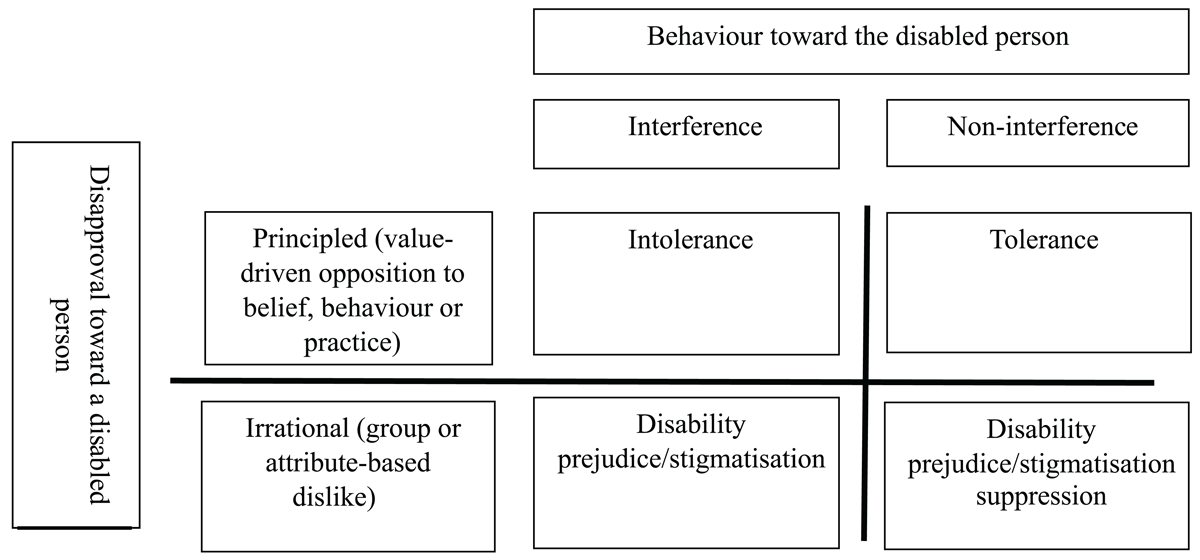
Figure 1
Distinction between tolerance and intolerance and stigma/prejudice.
Current Understandings of Tolerance and Intolerance in Disability Policy and Research
We now consider how tolerance and intolerance has been discussed in disability policy and research to date. In the last two decades there has been markedly increased international policy attention to disability issues, particularly since the adoption of the Convention on the Rights of Persons with Disabilities (United Nations 2007) and many national governments and multilateral organisations have domestic and/or globally-focused strategies designed to advance the rights of persons with disabilities (e.g., Foreign, Commonwealth, & Development Office 2022). Like the UNESCO (1995) declaration, these initiatives generally take an appreciation type perspective on (in)tolerance. For instance, they emphasise promoting tolerance in the context of fostering dignity and respect toward disabled people (Foreign, Commonwealth, & Development Office 2022) and combating discrimination arising from group-based antipathy like hate crime (e.g., Council of Europe 2017).
Yet, this policy impetus is not supported by a robust evidence base on (in)tolerance in the disability context. Examination of the disability literature shows definitions consistent with both appreciation tolerance and forbearance tolerance in parallel usage. For instance, Ndlovu (2023) equates tolerance with acceptance and positivity toward disability and uses this basis to explore how the African belief system of Ubuntu, through integrating proverbs about tolerance into the education curriculum (e.g., “Akusilima sindlebende kwaso” – a disabled [person] is not despised by his own people), can be used to foster true inclusion and acceptance of people with disabilities. Similarly, Imafidon (2021) discusses the extent to which African Communitarian Philosophy contributes to a sense of community that is “less hostile to, more tolerant of, and more open to, differences in general” (47). Elsewhere, writing about ableism in academia from the UK, tolerance for Finesilver, Leign and Brown (2020, 147) represents an ideal to move towards as something akin to empathy and mutual kindness. These perspectives all take an appreciation type perspective to tolerance, equating it with the absence of negativity, hostility and closed-mindedness.
Other disability scholars have been more consistent with the forbearance perspective. For example, Ferguson and Nussbaum (2012) suggest that the academic study of disability issues, particularly the lived experience of disability, allows for a greater understanding of the disability experience that goes way beyond tolerance. For Mitchell and Snyder (2015), increased emphasis on disability as part of diversity initiatives in education, which promote the value of tolerance as acceptance, are only a sign of inclusionism, a tokenistic form of inclusion “which requires that disability be tolerated as long as it does not require an excessive degree of change from relatively inflexible institutions, environments and norms of belonging” (13). Similarly, Houston (2020) uses Mitchell and Snyder’s (2015) concept of inclusionism to examine how tolerance as set out as a core British value in domestic UK policy documentation falls short of promoting true inclusion for disabled people and other marginalised groups, serving to sustain unequal power dynamics. These discussions all recall the forbearance perspective where tolerance is not conceptualised as true acceptance or openness to differences but instead as putting up with those differences that an individual disapproves of (Verkuyten, Yogeeswaran, and Adelman 2020).
Turning to social psychology, within their recent and extensive scholarship Verkuyten and colleagues have mainly investigated (in)tolerance from the perspective of cultural and religious identity. The absence of discussion about disability in favour of other groups is an important gap, particularly given that disabled people, comprising 16% of the global population (World Health Organisation 2022), are a large minority group who are present across every society. Bagci et al. (2020) provide an exception to this lack of focus through research investigating associations between experiences of being tolerated and of being discriminated against (i.e. being excluded or treated unfairly) with psychological well-being among a sample of Turkish people with disabilities. In this study being tolerated is measured in a manner consistent with the forbearance perspective, namely the degree that participants experienced being endured or put up with because of their disability. Findings indicate that both the experience of being tolerated and the experience of being discriminated against independently predicted negative psychological wellbeing. The implication of these findings is that the state of being tolerated may be psychologically harmful for disabled people.
In sum, there is a large disability gap within (in)tolerance research. First, definitions of tolerance and intolerance used in disability research are inconsistent. Second, there is not very much research on (in)tolerance conducted in the disability context within either the disability or social psychological literature. Third, as a consequence of the first two reasons, while there is an impetus to promote tolerance toward disabled people among policymakers (e.g., Foreign, Commonwealth, & Development Office 2022) this is not informed by a clear and consistent evidence-base.
Better Understandings of Disability Discrimination and How to Address It
We now turn to discuss the value of studying tolerance and intolerance in the disability context, particularly as distinct from disability stigma/prejudice. First, studying (in)tolerance will allow for a more comprehensive and nuanced understanding of disability discrimination and its causes. This is important since disabled people are among the social groups most affected by discrimination. Globally, disabled people are frequently excluded from education (Mizunoya, Mitra and Yamasaki 2018), employment (Mizunoya and Mitra 2013), accessing health services (Carew et al. 2024) and many other areas of social participation. As such, the goal of addressing disability discrimination is quite rightly an international policy priority, appearing in key disability rights treaties like the Convention on the Rights of Persons with Disabilities (United Nations 2007) and strategies (e.g., European Commission 2021; Foreign, Commonwealth, & Development Office 2022). Disability stigma is recognised as a key driver of disability discrimination among both researchers and organisations who work directly with disabled people (Rohwerder 2018). We think focusing on disability stigma/prejudice as a cause of disability discrimination is critical but that there is another important driver of disability discrimination that has been neglected in disability research thus far: disability-related intolerance.
To interrogate this argument properly, a working definition of discrimination is helpful. Al-Ramiah et al. (2010, 85) define discrimination as an “unjustifiable negative behaviour towards a group or its members… that is directed towards them not because of any particular deservingness or reciprocity, but simply because they happen to be members of that category.” This definition is aligned with definitions present in key disability rights legislation such as the UK’s Equality Act (UK Government 2010). Here, discrimination is defined as treatment of someone ‘less favourably’ than others because of certain characteristics they possess, including disability. Hence, a discriminatory behaviour toward a disabled person is that which is negative in the sense it results in less favourable treatment of them and unjustified when it is done so without good reason because they are disabled. To pose the question of when disability-related intolerance leads to disability discrimination is essentially to ask: under what circumstances can individuals who hold value-driven, non-prejudicial reasons to interfere with disability issues act to treat disabled people unfavourably?
As signified by the Al Ramiah et al. (2010) definition of discrimination, the crux of this question has to do with the justifiability or deservingness of treating a disabled person unfavourably. Al Ramiah et al. (2010) note that deservingness is not an objective criteria but influenced by contextual factors such as social norms. A similar point about justifiability been recognised within the social psychological scholarship on (in)tolerance. Verkuyten (2022) states that what comprises good reasons to interfere with others can differ between groups, cultures and historical periods. Verkuyten (2022) further notes that individuals are intolerant when they undertake to interfere with the practices of others for both justifiable and unjustifiable reasons. The former is differential treatment (treating disabled people differently for relevant reasons) and the latter is discrimination (treating disabled people differently for irrelevant reasons). Thus, to properly understand the causes of disability discrimination and how to address it, a comprehensive grasp of the value-driven reasons individuals use to treat disabled people unfavourably is needed. This understanding is largely absent in disability research. This is because the field has focused on disability stigma/prejudice (e.g., Rohwerder 2018) which, as arbitrary and irrational beliefs, are always unjustifiable reasons to treat disabled people unfavourably. Yet, corresponding focus has not been given to disability-related intolerance as value-driven and rational reasoning to treat disabled people unfavourably that can nevertheless be unjustifiable. This neglect of disability-related intolerance is thus an important gap in understanding disability discrimination and its causes, which should be addressed by disability researchers.
This gap is particularly evident when considering that there are circumstances in which non-disabled people express intolerance to disability issues based on reasoning that has very little to do with disabled people. Stigmatisation and prejudice are rooted in categorical “us” and “them” distinctions and so have difficulty fully accounting for situations in which individuals discriminate against disabled people based on reasons unrelated to disability. Conversely, what matters to (in)tolerance is not social identities per se but how specific dissenting practices or beliefs are interpreted (Verkuyten 2022). This better reflects the reasons why some individuals undertake to interfere with disability issues. For some religious people who are intolerant of assisted dying for example, an individual’s disability status is often not relevant. Frequently, the target of intolerance is in fact the assister (e.g., a medical professional) because what is proscribed by many religions is human interference toward hastening the end of life (Grove, Lovell and Best 2022). Investigation of another current UK policy priority, tackling assistance dog refusals (UK Government 2024), presents another example of a social issue that predominantly affects disabled people but in which they are not the primary target of intolerance. Despite being illegal under UK law, business owners and taxi drivers frequently deny entry and carriage to disabled people accompanied by an assistance dog. Research by a UK disability charity (Smith 2015) has highlighted that the top three reasons for refusals by taxi drivers are all dog rather than disability-related, spanning religious/cultural objections1, concern about damage to vehicles and possession of dog allergies. Legally in the UK, assistance dog refusals constitute disability discrimination. However, if these reasons are taken at face value, psychologically, the causes of this discrimination have very little to do with stigmatising and prejudicial views of disability or disabled people. This distinguishes assistance dog refusals from situations where group-based prejudice often is a key cause of disability discrimination. Examples of the latter include disability discrimination in work-related contexts where disabled people are often treated unfavourably because of the widespread stereotype that they are incompetent (Rohmer and Louvet 2018). Clearly, where the reasons why individuals engage in disability discrimination are different, distinct solutions are needed.
Thus, a second connected key reason to study (in)tolerance in the disability context, particularly as distinct from disability stigma/prejudice, is that it will allow for the design of more appropriate intervention strategies to address the factors that underpin disability discrimination. Verkuyten, Yogeeswaran and Adelman (2020) highlight that prejudice reduction and tolerance promotion are two complementary yet distinct strategies to combat discrimination and promote societal harmony. Both prejudice and intolerance involve a type of negative judgement but a key distinction is the reasonableness of this judgement. The viewpoint of a prejudiced individual or stigmatiser is grounded in an irrational negative judgement derived from the social category or attributes of the target (Kende and McGarty 2019). Conversely, the intolerant individual is making a reasoned judgement based on principled considerations. These situations call for different approaches. As Verkuyten (2022) says, a bigot should not learn to be tolerant but should be trained to let go of their prejudice. By the same token, intolerant individuals should not be treated like bigots but instead be encouraged to reassess their values and redraw the line of what they decide to tolerate.
What Makes Intolerance Toward Disabled People Unjustified?
The preceding discussion naturally raises the question of what type of values and reasons comprise unjustifiable and justifiable disability-related intolerance and how individuals distinguish between the two when deciding to interfere with disability issues. We think it is fair to say that among policymakers and disability advocates there is some level of agreement about how disabled people should be treated. The CRPD has been ratified by 191 countries2 and is extremely broad, setting out a multitude of rights disabled people have on the same basis as other persons such as the right to education and the right to the highest attainable standard of health (United Nations 2007). In other words, these rights are the values to which the global community view interference, whether derived from irrational (prejudicial) or value-driven (intolerant) reasoning, as unjustifiable.
However, to assume that unjustifiably intolerant individuals are those who, for value-driven reasons, act to interfere with the disability rights set out in the CRPD is not analytically useful for understanding intolerance and its relationship to disability discrimination at the societal level. To make this assumption would neglect the fact that assessments of the reasonableness of (in)tolerance judgements are generally far more complex for individuals to make when they confront actual disability issues in their day to day lives. This is because, in deciding whether or not to tolerate a dissenting belief or practice, individuals must weigh up not only their values in relation to disabled people but also the corresponding implications of these values for themselves and the other individuals and groups they live alongside. On the other hand, the CRPD is an asymmetrical piece of legislation. Its function is to set out the rights disabled people possess and not, for example, to demarcate how these affect or are affected by corresponding rights for non-disabled people or other groups, like religious groups. This means it is of interest for disability researchers to explore, across a range of social contexts, how individuals determine whether their intolerance (and therefore, interference) with disability issues is unjust or just. Incorporating a study of (in)tolerance alongside disability stigma/prejudice will allow for this exploration.
Grasping the value-driven reasons that individuals use as a basis for interfering with disability issues and how individuals engage in justification of their intolerance will also allow for contextually richer understandings of complex, contemporary disability issues. Consider again our opening example of the fraught debate within the UK around assisted dying for the terminally ill. This is, at the time of writing, still illegal, although public support for legalisation is high (Booth 2023). However, critics have argued that legalisation will lead to harm and discrimination (i.e. unfavourable treatment) of disabled people, for example, fears that introducing assisted dying is a slippery slope toward disabled people being pressured into non-voluntary euthanasia (Colburn 2022). At the same time, supporters have argued that the current ban on assisted dying is itself discriminatory toward disabled people. In the UK, one individual with a severe physical impairment brought a legal challenge of discrimination on the basis that people without disabilities can choose to end their lives but he is unable to without physical assistance (McDonald 2019).
Although individuals on each side of the assisted dying debate conceptualise the opposing view as discriminatory, in most cases it makes little sense to say that the individuals involved are prejudiced or hold stigma against disabled people. In particular, disability prejudice (e.g., the belief that living with disability is worse than death) has been suggested as something that would drive misapplication of assisted dying decisions if legalised (Colburn 2022; Golden and Zoanni 2010). However, many disabled people and their supporters are in favour of legalising assisted dying for the terminally ill for decidedly non-prejudiced reasons, for instance because they hold that it supports the autonomy of affected individuals and the right to make choices at the end of life (Shakespeare 2006). Thus, a narrow focus on disability stigma/prejudice is of limited utility to help understand different perspectives on assisted dying. A broader view which incorporates disability-related intolerance is needed. In the case of assisted dying both opponents and supporters are intolerant – of the practice and of the ban, respectively. The ultimate task for UK policymakers is to determine whose intolerance is unjustified and therefore discriminatory with respect to the context and values of British society. As such, these policy decisions should be informed by a comprehensive empirical understanding of the types of values and justifications that intolerant individuals in the British population employ in relation to the issue of assisted dying.
What Makes Intolerance Toward Disabled People Justified?
Understanding when disability-related intolerance is unjustified and therefore leads to disability discrimination also implies consideration of when disability-related intolerance is justified and therefore leads to differential treatment instead. That is, what are justifiable, value-driven, non-prejudicial reasons for individuals to interfere with the beliefs and practices of disabled people? This question may seem alarming to some readers, particularly disabled people and their allies, since disabled people are already among the social groups most affected by discrimination and exclusion from society (Branco, Ramos and Hewstone 2019). However, consideration of this issue is inherent to the forbearance perspective of (in)tolerance. People cannot tolerate everything; this is one of the central aspects of toleration (Verkuyten 2022). The state of tolerance is also not permissive relativism (Verkuyten 2022); we cannot say “anything goes” for disabled people.
One key example of justified intolerance that the (in)tolerance literature gives is that societies justifiably proscribe practices that cause harm like violence, polygamy or honour killings (Verkuyten 2022). Some of these practices may be disproportionally carried out by certain groups but the group-related characteristics or attributes of the individuals involved are ultimately irrelevant. What is intolerable about honour killings is the practice and the harm it causes, not who perpetrates it. It is interesting to extend this discussion on harm prevention and justified intolerance to the disability context. This is because disabled people can be subjected to justified intolerance based on values to do with harm prevention when they engage in conduct that is permissible for the vast majority of other individuals. These situations arise in contexts where the conduct, if performed by someone with an impairment of a certain type and severity, is likely to cause harm or danger because of the interaction between the disabled person’s bodily impairment(s) and the inaccessible environment around them. One clear example is medical restrictions for certain jobs, activities and professions. For instance, in the UK there are legal, sight-related restrictions on who can obtain a driving licence for the purposes of road safety (Driving and Vehicle Licensing Agency 2021). These restrictions have the effect of treating some individuals who have severe visual impairments that cannot be redressed by assistive technology unfavourably. This constitutes differential treatment, not disability discrimination. Moreover, exceptions to discrimination in relation to occupational requirements are also often explicitly provided for in equalities legislation. For instance, the European Union Equality Directive allows Member States to treat disabled people unfavourably in relation to work when there is a genuine occupational requirement that cannot be met due to an individual’s impairment (Waddington 2015). Thus, beliefs that disabled people with certain severe impairments should not work in occupations that directly rely on individuals using those bodily functions to prevent harm is an example of justified intolerance that is already reflected within areas of legislation.
Even with an exciting raft of technology on the horizon such as self-driving cars it is difficult to imagine no areas of justified disability-related intolerance in the foreseeable future. As Shakespeare (2016) notes, “while environments and services can and should be adapted wherever possible, there remains disadvantage associated with having many impairments which no amount of environmental change could entirely eliminate” (202). For instance, we think a great many individuals would still be intolerant to the prospect of a blind surgeon operating on hospital patients, as happened in New York in 1984 (The New York Times 1984). In raising these examples, we do not at all intend to suggest that there are occupations or activities that people with certain impairments should as the norm be excluded from. The vast majority of disability-related issues can be solved with reasonable accommodations and other accessibility considerations. But the fact remains that individuals must draw a line somewhere in regard to what they think it is tolerable for disabled people to do. Our point is that disability researchers must consider how individuals draw this line and explore circumstances of both unjustifiable and justifiable disability-related intolerance. By no means is all disability-related intolerance justifiable, but by the same token an individual’s unfavourable treatment of disabled people will not be prejudicial or discriminatory in every single possible circumstance. Sometimes it will be rooted in justifiable value-driven intolerance. Equipped with a proper understanding of how individuals come to these decisions, disability researchers can better inform policymakers seeking to roll out tolerance promotion interventions.
Can Disabled People Express Disability-Related Intolerance and is Tolerating Disability Issues Even Acceptable?
Verkuyten (2022) notes that tolerance judgements are directed against specific beliefs and practices and do not address biases or categorical distinctions that arise between social groups such as disabled and non-disabled people. This contrasts the psychological processes inherent in stigmatisation and prejudice which involve social categorisation and the labelling of individuals based on characteristics or attributes that they possess that are viewed negatively and discredited (Kende and McGarty 2019). Thus, one advantage of (in)tolerance is that it helps understanding of disability issues go beyond narrow conceptualisations that see them as playing out solely between disabled people and non-disabled society. (In)tolerance is especially valuable in understanding issues like assisted dying precisely because disabled people hold a mixed pattern of views on it, with both supporters and opponents (Shakespeare 2006). In contrast to explanations of social relations grounded in stigma/prejudice theory, in most cases disabled people are not opposing other disabled people on assisted dying for the terminally ill because of categorical “us” and “them” distinctions but because they are taking principled, value-driven stances on the issue. This example is indicative of the fact that it is possible for both disabled and non-disabled people to express the same types of intolerance toward a disability issue.
While it is possible for disabled people to express disability-related intolerance, they are likely to most frequently encounter toleration via the experience of being tolerated by others. In the majority of cases these others will most likely be non-disabled people. Being tolerated by someone means that disapproval has been elicited from them which they have decided to put up with (i.e. tolerate). Tolerance is not respect or acceptance of differences but endurance. It is thus intuitive to see why the experience of being tolerated may be negative for disabled people. As discussed earlier, a study by Bagci et al. (2020) does provide some evidence that being tolerated is psychologically harmful for disabled people in a similar fashion to the negative psychological consequences of experiencing discrimination. Disability researchers should seek to build on the findings of Bagci et al. (2020) and gain a fuller understanding of the implications and consequences of being tolerated for disabled people. Learning about disabled people’s experiences of being tolerated is also crucial for informing the appropriateness of tolerance promotion interventions for specific contexts.
Setting out when (In)tolerance Matters in the Disability Context
We now set out some examples of disability issues for which we think gaining an understanding of (in)tolerance is important. This list is by no means intended to be exhaustive but offered as food for thought to encourage disability researchers to investigate and measure (in)tolerance alongside disability stigma/prejudice.
The first category of disability issues for which we think (in)tolerance matters is those where people generally have no objection related to the beliefs or practices of the disabled person but may disapprove of the consequences of permitting this conduct for themselves personally. Taxi drivers refusing assistance dog owners due to dog allergies or a parent raising objections with school leaders about the inclusion of a child with disruptive behavioural issues in their offspring’s class are examples where intolerance is based on non-prejudiced objections related to infringement on the self or close others that goes beyond mere inconvenience. Elsewhere, intolerance may arise through a concomitant deliberation of whether a “good” outcome for the disabled person will in fact be achieved by the accommodation. For instance, concerns about resources for inclusive education in school systems (e.g., accessible infrastructure, adapted materials) are a particular issue for school systems in low- and middle-income countries (Kuyini, Desai and Sharma 2020). A teacher can be intolerant to the inclusion of a disabled child in their mainstream classroom on the grounds they believe it is not well adapted, equipped or resourced to foster their learning compared to a special education classroom. They may be concerned both about their own increased workload necessary to cope with these shortcomings and whether the child will ultimately be able to do well in this environment. It is reductionist to say that this teacher holds similar views compared to one who believes (for example) that disabled children should be excluded from mainstream classrooms because they should not mix with non-disabled children. We present examples of this type of intolerant belief, as distinct from prejudiced beliefs, in Table 1.
Table 1
Examples of prejudiced beliefs and intolerant beliefs toward disability issues related to anticipated personal consequences of enabling the conduct.
| PERPETRATOR | PREJUDICED BELIEF | INTOLERANT BELIEF | SHARED BEHAVIOUR |
|---|---|---|---|
| Taxi driver | Disabled people are slow and troublesome passengers | Desire to avoid an allergic reaction from contact with a dog | Refusal to take passengers with assistance dogs |
| Parent | Disabled children disrupt the learning of their peers | Desire to avoid exposing one’s own child to violence or harm from a specific child with disruptive behavioural issues | Opposition to the inclusion of a disabled child in a mainstream classroom |
| Teacher | Disabled children should not mix with non-disabled children | Mainstream classrooms lack resources to facilitate disabled children’s learning and will increase workload | Opposition to the inclusion of a disabled child in a mainstream classroom |
The second category of disability issue for which we think (in)tolerance matters is that which does not affect other individuals personally but which nonetheless may spark intolerance because observers deem the practice itself morally wrong in some fashion. There are many socially contested issues in which disabled people stand to be the main group who is harmed by intolerance (or who benefit depending on the justifiability of the intolerance). The example of assisted dying fits under this category. Other relevant examples include medically-assisted sex/sexual surrogacy for disabled people who cannot independently fulfil their sexual needs3, the use of illegal drugs in the treatment of mental illnesses and bodily modifications aimed at increasing a disabled person’s capabilities (e.g., brainchips to help individuals who are paralysed interact with the world). Individuals may be intolerant of these practices because of concerns that the perceived harm to the disabled person outweighs the benefits (e.g., illegal drugs and risk of addiction). Elsewhere, individuals may be concerned about the perceived harm to others involved in facilitating the conduct (e.g., sexual surrogates) or because of a violation of a perceived universal moral standard (e.g., a person’s body is sacred and its fundamental parts like the brain should not been altered). We present examples of this type of intolerant belief, as distinct from prejudiced beliefs, in Table 2.
Table 2
Examples of prejudiced beliefs and intolerant beliefs toward disability issues related to moral concerns about the conduct.
| PERPETRATOR | PREJUDICED BELIEF | INTOLERANT BELIEF | SHARED BEHAVIOUR |
|---|---|---|---|
| Religious person | Disabled people are morally responsible for the illness they experience | Life is inalienable -people must not interfere to hasten end of life | Opposition to assisted dying for the terminally ill |
| General public | Disabled people have no sexual needs | Sexual surrogates are vulnerable to exploitation and violence | Opposition to disabled people using sexual surrogates |
| General public | People who are mentally ill can get better if they try harder | People who use psychedelic drugs for therapy may become addicted | Opposition to the use of psychedelic drugs as therapy for mentally ill people |
| Religious person | Disabled people are morally responsible for the illness they experience | The body is sacred and should not be augmented | Opposition to brain implants for paralysed individuals |
Limitations and Future Directions
While we think (in)tolerance is highly relevant for understanding disability issues it is not a magic bullet, as highlighted by Verkuyten (2022). Some issues that individuals express intolerance to (e.g., objecting to reasonable accommodations, access refusals of individuals with assistance dogs) are illegal in many countries, including the UK. Thus, tolerance promotion is not a substitute for laws that effectively enforce disability inclusion. It makes little sense to promote tolerance of disabled people in the workplace if they cannot get into the workforce in the first place. At the same time, the current situation for disabled people in the UK, as well as internationally, shows why toleration promotion may be helpful. Despite a raft of laws and policies prohibiting disability discrimination many areas have poor compliance (e.g., assistance dog refusals) which are challenging to legislate away. Tolerance promotion, alongside stigma reduction and awareness raising of laws, may be an additional helpful strategy to combat disability discrimination. However, the fact that tolerance is not an ultimate good means disability researchers must take an evidence-informed view of when to deploy tolerance promotion interventions. In particular, research is needed to further explore the impacts of being “merely tolerated” for disabled people. Lastly, in drawing a conceptual distinction between disability stigma/prejudice and disability-related intolerance we are not suggesting that all individuals fall neatly into either group. We anticipate many people will be both intolerant to disability issues and prejudiced toward disabled people.
Despite recent advances within social psychology regarding the study of (in)tolerance, the disability context has largely been neglected. In this paper we have argued that studying disability-related tolerance and intolerance is crucial to gain a comprehensive understanding of disability issues and inform the design of interventions that seek to target disability discrimination and its causes. We hope our work constitutes a call to action for disability researchers to study (in)tolerance alongside disability stigma/prejudice and ignites greater interest among social psychologists to examine (in)tolerance within the disability context.
Notes
Acknowledgements
We thank the four anonymous reviewers for their extremely helpful feedback on an earlier draft of this manuscript.
Funding Information
This research received funding support from the United Kingdom Foreign, Commonwealth and Development Office (FCDO) through the project Programme for Evidence to Inform Disability Action (PENDA) (Code: PO8073).
Competing Interests
The authors have no competing interests to declare.