
Table 1
Phases, development, and bodies of data collected from the project.
| PHASE | CONTENT AND DEVELOPMENT |
|---|---|
| Phase 1: defining the challenge and actors involved | Objective: To identify the needs, delimit the problem and identify the actors concerned. |
| Description: The analysis of needs and the identification of the concerned agents were carried out through a documentary search in the existing bibliography on social and labor insertion of people with autism. Activities: 2 workshops | |
| Participants: Social researchers’ team, Specialisterne team and CSMC. | |
| Phase 2: needs identification | Objective: To determine the needs, objectives, values, priorities, etc. of the various actors involved in the challenge. |
| Description: Face-to-face session where the objectives and interests of the participants were raised and agreed upon. After an exercise to identify objectives and needs within the group, all participants shared their concerns in a workshop. Activities: 1 workshop | |
| Participants: Social researchers’ team, Specialisterne team and CSMC. | |
| Phase 3: Ideation | Objective: To develop tools to enhance creativity, discover valuable knowledge and imagine innovative solutions to the challenges at hand. |
| Description: The needs of phase 2 were collected. A joint activity was carried out to generate creative ideas, imagine futures and scenarios. Activities: 1 workshop | |
| Participants: Social researchers’ team, Specialisterne team and CSMC. | |
| Phase 4: strategy and prototyping | Objectives: To develop action plans to achieve the objectives and concretize the methodology for the construction of the ideas identified in Phase 3. |
| Description: In this phase the tool was prototyped and lasted four months. All participants met monthly to assess progress and possible updates. The coding of the tool was carried out by a technician from the job placement company. Activities: 2 workshops | |
| Participants: Social researchers’ team, Specialisterne team and CSMC. | |
| Phase 5: experimentación | Objective: To validate the solutions developed, from various perspectives and the needs of the various actors. |
| Description: The prototype was tested by two groups, one composed of neurodiverse people and the other of neurotypical people. Subsequently, a group discussion session was held with all the testers. Activities: 2 focus groups and 1 workshop | |
| Participants: 10 user-testers with autism (8 male, 2 female), social researchers’ team, Specialisterne team and CSMC. |
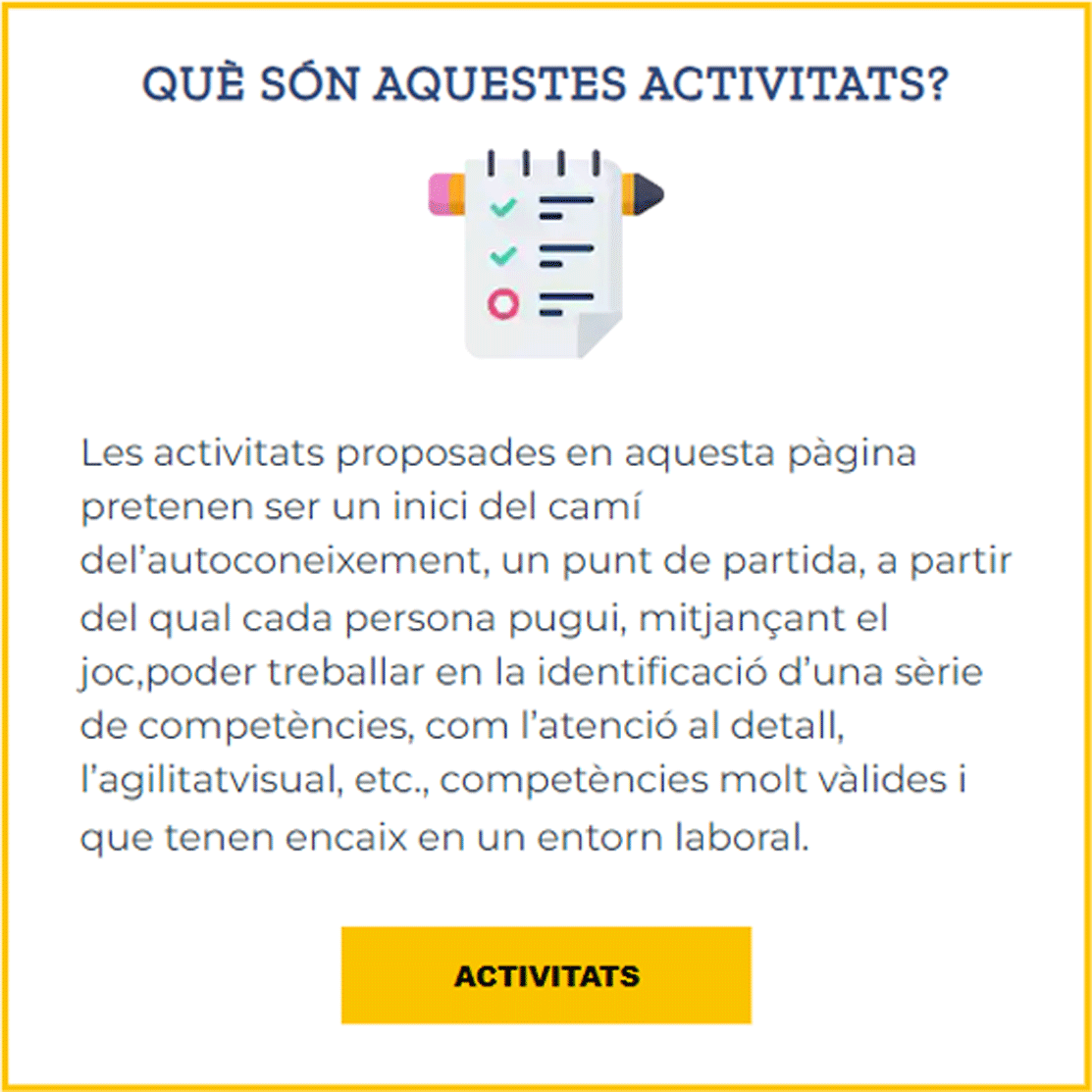
Image 1
Image and text for the presentation of the tool. The text’s translation is the following: The activities proposed on this page are intended to be a start on the road to self-knowledge, a starting point, from which each person can, through play, work on identifying a series of skills such as attention to detail, visual agility, etc. very valid competences that fit in a work environment.
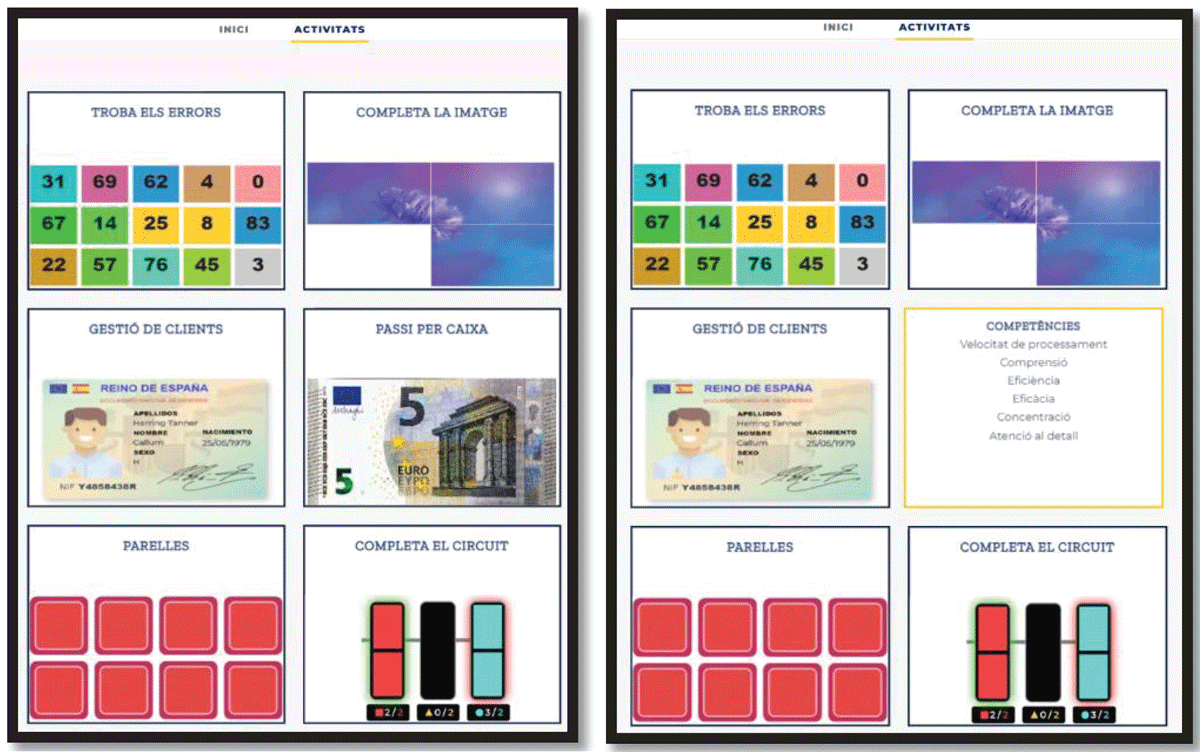
Image 2
The activities, from top to bottom and from left to right, consist of finding errors, completing the image, transferring data from a card to a form, returning change from a payment, finding pairs and a game of logical-mathematical skills. In the figure on the right, we can see the skills associated with the activity of returning: Speed, efficacy, efficiency, comprehension, attention to detail.
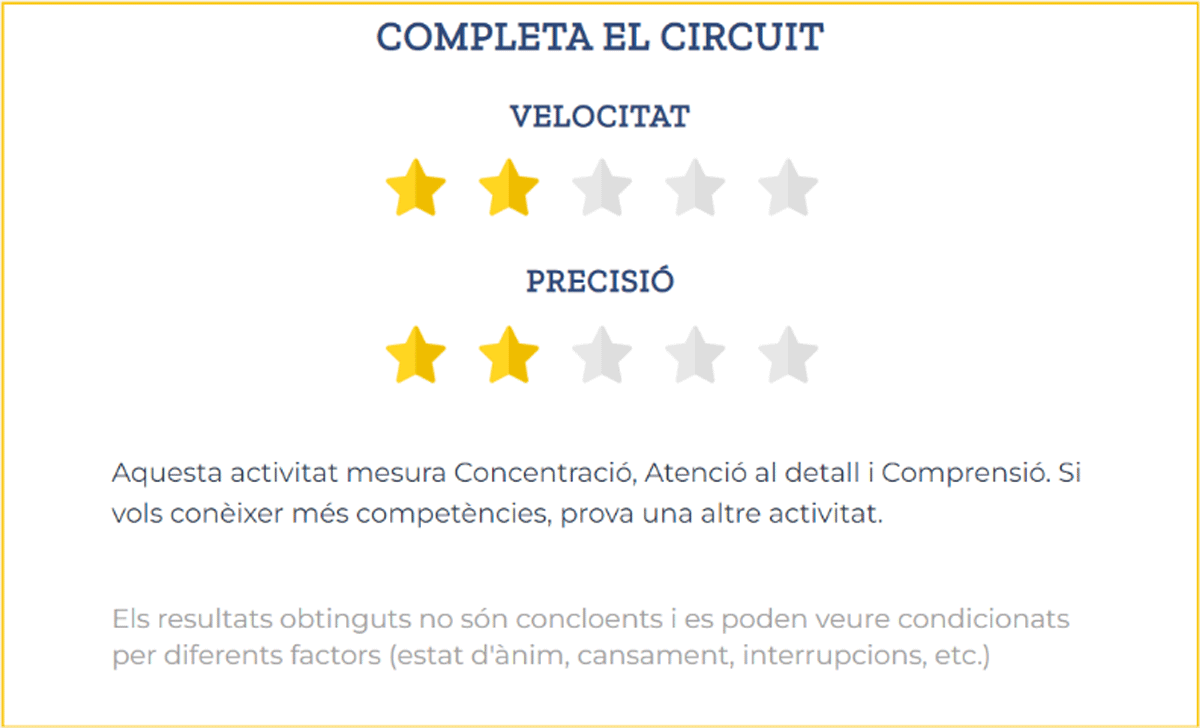
Image 3
Capture of the return of results of one of the activities. The activity called ‘COMPLETE THE CIRCUIT’ is rated by speed and precision. The feedback is: ‘This activity measures concentration, attention to detail and comprehension. If you want to know more skills, try another activity. The results obtained are not conclusive and can be conditioned by different factors (mood, tiredness, interruptions, etc.).’
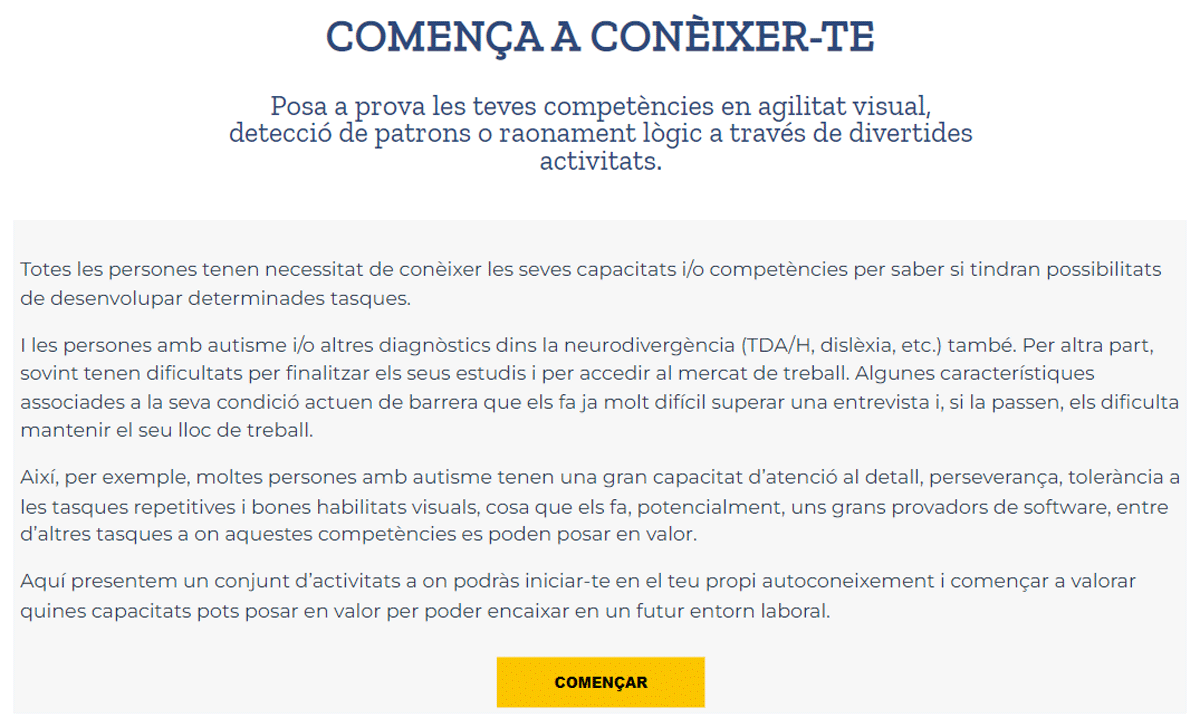
Image 4
Tool’s presentation tex. From Catalan to English: START TO KNOW YOURSELF. Test your skills in visual affability, pattern detection or logical reasoning through fun activities. All people have a need to know their capabilities and/or competences to know whether they will be able to perform certain tasks. And people with autism and/or other diagnoses within neurodiversity (ADHD, dyslexia, etc.) as well. On the other hand, they often have difficulties to finish their studies and to access the labour market. Some characteristics associated with their condition act as a barrier, as it is very difficult for them to pass an interview and if they pass it, it makes it difficult for them to keep their job. Many people with autism have a great capacity of attention to detail, perseverance, tolerance to repetitive tasks and good visual skills, which makes them potentially great software testers, among other tasks. Here we present a set of activities where you can initiate yourself in your own knowledge and start assessing what abilities you can put in value for a future work environment.