
Introduction
A quarter century ago there was no language for autistic experience, emotions, and intentions. Many people with autism have a great deal of difficulty in understanding what other people are doing, feeling, or thinking. The intentions of others are opaque. The situation is symmetric. Neurotypicals like me have a lot of problems understanding autistic individuals, even if they become quite articulate. (Hacking 2009)
This is how Hacking articulates one of the most significant issues about our current perceptions and conceptualizations of autism. A shared, common understanding is absent; autism has been objectified as a distinct reality, isolated and marginalized. From the mid-20th century, discussions surrounding autism have predominantly been influenced by biomedical viewpoints (Kapp 2020; Woods et al. 2018). Several authors highlight the consequences of diagnoses, their role in stigmatizing and subjectivity-shaping (Corrigan 2007; Farrugia 2009), building homogenizing standardizations (Hull et al. 2017), and an incommensurable sense of otherness (Pinchevski 2005). Ways of thinking and acting autism that traversed practices and discourses in the field, yielding direct repercussions such as pharmacological interventions (Nadesan 2009), coerced institutionalization—particularly prevalent until the 1990s (Nadesan 2013)—re-education processes and therapies to redirect behavior (Bumiller 2008). These endeavors have collectively shaped the reality for many individuals with autism, perpetuating a pervasive logic of violence that portrays autism as a pathological threat (McGuire 2016). The research presented in this paper is precisely situated within the context of involving individuals with autism in a technological design process, specifically within a co-design project focused on developing an AI application for people with autism.
Facing the need to open spaces of symmetry between autistic and neurotypical experiences, emotions, and intentions, this field has experienced a growing need for self-definition of its existence (Ne’eman and Bascom 2020). This has been especially important for a relatively new space lacking its narrative (Hacking 2009).
Since the ʼ90s, there have been approaches to the autistic community from social movements mainly composed of people with autism and their families (Thibault 2014). The emergence of the conceptual framework introduced by the idea of neurodiversity is a good example, offering counter-narratives to biomedical models based on the experience of autism spectrum disorder (ASD) and other neurological or developmental conditions such as dyslexia or attention deficit hyperactivity disorder (ADHD), presenting them as variations of human brain functioning (Broderick and Ne’eman 2008). A change that would help to stop conceiving this reality as a disease is to define it as a human specificity that would be no more than any other human difference (Jaarsma and Welin 2012). This movement led to changes in the political redefinition of their condition (see Chamak 2008), displacing the idea of suffering as an element resulting from an internal malfunctioning, to become an element determined by society that, due to its lack of adaptability to human variability, discriminates and belittles the autistic difference (Kapp 2020). An activist effort that has impacted diagnostic practices by broadening the autistic spectrum to encompass various forms and manifestations, consolidating the three preceding diagnoses—Autistic Disorder, Asperger’s Syndrome, and PDD-NOS (Pervasive Developmental Disorder-Not Otherwise Specified)—into one ‘Autism spectrum disorder’ in the DSM-5. This was promoted from within activism as a commitment to ‘cross-spectrum solidarity’ aimed at erasing arbitrary distinctions imposed by biomedical perspectives (Kapp and Ne’eman 2020).
Numerous instances of academic work have approached such redefinition through direct, bottom-up engagement and collective activism (e.g., Bertilsdotter Rosqvist et al. 2019; O’Dell et al. 2016) and have shown the important role that technology can play in sharing and redefining neurodiversity (Korhonen, Räty, and Kärnä 2017; Meinen 2023). However, less attention has been given to formal and top-down participation as a way of redefinition and social transformation. Although there is some research involving children or young individuals that aims to foster equitable processes aligned with their needs and potential inclusion via direct engagement (Bayor et al. 2021; Bray et al. 2022; Hodson, Svanda, and Dadashi 2023; Raman and French 2021), limited attention has been directed towards adult populations. Although several studies demonstrate that direct participation generates better and more responsive outcomes (Moyà-Köhler and Domènech 2023; Palà, Moyà-Köhler, and Domènech 2018; Steen, Manschot, and Koning 2011; Jasanoff 2003), and that collaborative development of technologies or services enables better conditions to articulate features such as autonomy and quality of life (Gaudion et al. 2015). This scarcity of experiences might stem from the challenge of reconciling the distinctive attributes of individuals with autism with the capacitist modes of expression, action, or intervention by which ‘participation’ is thought (Gaudion et al. 2015; Simplican 2015).
The present work departs from this little-explored space of co-production in the field of adults on the ASD to investigate the potential and effects of direct participation through co-design.
To this end, we present a Participatory Action Research process. This research approach involves collaborative research to generate knowledge and provoke social change, by actively involving the concerned individuals (Bradbury, 2015). In this process, a digital tool, that is, an app, has been co-designed. This research has been conducted by a group of researchers from the field of Science and Technology Studies (STS) [authors of the text]. These same researchers have spearheaded the co-design of the app, alongside three other actors: a cluster of innovation in mental health founded by the public administration called Catalonia Mental Health Cluster (CSMC), a company dedicated to the insertion of people on the ASD into the labor market called Specialisterne, and a group of people on the ASD. The project was financed by the Generalitat de Catalunya government.
This paper shows the changes that the app’s design has undergone from its inception to its outcome. Initially, this device was intended to be an efficient and reliable tool for evaluating the skills of people with autism. However, with the emergence of certain concerns throughout the co-design process, this initial idea shifted to end up being a device committed to depathologizing imaginaries. Using the theoretical and conceptual tools provided by STS we show how the participation of concerned groups during the technological design allows a shared configuration of experiences and imaginaries (Vallès-Peris and Domènech 2020). This process allows us to analyze how an idea of public is materialized through three displacements in the development of this app’s co-design, ending up in a process of what Le Dantec and DiSalvo define as public infrastructuring (2013), built here as the sociotechnical generation of those imaginaries with which people with neurodiversity, and their allies, build horizons of possibility that point towards the construction of more sensitive futures with the reality of people in the ASD.
Co-design process description
Between March and December 2022, Specialisterne, a social organization focused on ‘offering people with autism and other neurodivergent training and job opportunities’ (Specialisterne n.d.), promoted a co-design project called ‘Getting to know yourself.’ Before Covid19, Specialisterne used face-to-face techniques to assess competencies in autistic people. However, the pandemic, along with the search for territorial growth, and the desire to be able to assess more potential employees, prompted the company to consider digitalizing the assessment tests.
The project was conceived as a participatory experience, understood at the beginning in a very open and unspecified way, around the development of a device designed to evaluate the abilities of people with autism through a set of tests.
The project was financed with public funds and was conceived as a multi-stakeholder project (university, company, and public-private consortium), in which the roles of the participants were the following: Specialisterne and its employers promoted, guided and decided the ideas, directions, and uses of the developed app; the university researchers [authors] designed the work methodology and dynamized the participatory spaces; and the CSMC oversaw the founding management and the coordination of the project.
The co-design process was organized into five distinct phases, with an adaptation of the design thinking methodology (Brown 2009). This approach is characterized by a predetermined sequence of interconnected steps forming a seamless path of innovation. However, a distinguishing feature is the recurring and iterative nature of these phases, revisiting them multiple times as concepts evolve, and new trajectories emerge. Table 1 outlines the various phases alongside their respective objectives:
Table 1
Phases, development, and bodies of data collected from the project.
| PHASE | CONTENT AND DEVELOPMENT |
|---|---|
| Phase 1: defining the challenge and actors involved | Objective: To identify the needs, delimit the problem and identify the actors concerned. |
| Description: The analysis of needs and the identification of the concerned agents were carried out through a documentary search in the existing bibliography on social and labor insertion of people with autism. Activities: 2 workshops | |
| Participants: Social researchers’ team, Specialisterne team and CSMC. | |
| Phase 2: needs identification | Objective: To determine the needs, objectives, values, priorities, etc. of the various actors involved in the challenge. |
| Description: Face-to-face session where the objectives and interests of the participants were raised and agreed upon. After an exercise to identify objectives and needs within the group, all participants shared their concerns in a workshop. Activities: 1 workshop | |
| Participants: Social researchers’ team, Specialisterne team and CSMC. | |
| Phase 3: Ideation | Objective: To develop tools to enhance creativity, discover valuable knowledge and imagine innovative solutions to the challenges at hand. |
| Description: The needs of phase 2 were collected. A joint activity was carried out to generate creative ideas, imagine futures and scenarios. Activities: 1 workshop | |
| Participants: Social researchers’ team, Specialisterne team and CSMC. | |
| Phase 4: strategy and prototyping | Objectives: To develop action plans to achieve the objectives and concretize the methodology for the construction of the ideas identified in Phase 3. |
| Description: In this phase the tool was prototyped and lasted four months. All participants met monthly to assess progress and possible updates. The coding of the tool was carried out by a technician from the job placement company. Activities: 2 workshops | |
| Participants: Social researchers’ team, Specialisterne team and CSMC. | |
| Phase 5: experimentación | Objective: To validate the solutions developed, from various perspectives and the needs of the various actors. |
| Description: The prototype was tested by two groups, one composed of neurodiverse people and the other of neurotypical people. Subsequently, a group discussion session was held with all the testers. Activities: 2 focus groups and 1 workshop | |
| Participants: 10 user-testers with autism (8 male, 2 female), social researchers’ team, Specialisterne team and CSMC. |
Methods
Data collection
The work we present is based on Participatory Action Research (PAR) for the co-design of an app, a research methodology focused on active collaboration between researchers and participants to address specific problems and generate practical knowledge (Bradbury 2015). This approach is particularly useful in developing solutions that directly impact involved communities. During the process, the team of social researchers facilitated various spaces and working sessions while conducting focal ethnography (Knoblauch 2005) to gather relevant information. Throughout this work, meticulous ethnographic notes were taken to capture the details, interactions, and dynamics observed in each of the spaces and meetings. The data corpus consisted of ethnographic notes (field diary) about all activities carried out during the five phases of the participatory process (Table 1), which include: informal conversations with the designers, seven collaborative works sessions with app developers, and two group discussion sessions with people with autism who tested the app (recorded and transcribed).
An iterative co-design process was followed: After the last phase of the project, the adjustments, changes, and suggestions made by the participants were subsequently adapted and incorporated into the application by the designers.
Analysis
The data analysis employed an inductive approach, centering on relevant information extracted from the field. To this end a thematic analysis was carried out, examining the collected minutes, the ethnographic notes, the interview notes, and the transcription of the group discussion session. This involved identifying and organizing key themes and patterns within the data, following the guidelines outlined by Clarke and Braun (2013).
First, the collected minutes and the ethnographic notes were transcribed and unified in a single document. A first thematic analysis of this collected data was carried out, which resulted in three major categories that reflected the emerging tensions: the first major category reflected the tension between diagnosis and the need to show high competencies, the second category reflected the tension between the ability to evaluate and the need to emphasize value, and the third category reflected the tension between internal use and the need to generate public discourse.
The group discussion session was initially reviewed twice to gain a general understanding of their content and structure the themes accordingly. Subsequently, it was partially transcribed, focusing on elements relevant to the previous analysis.
The information from the two sources was cross-referenced, allowing for a comprehensive analysis and a more detailed understanding of the co-creation process. To this end, the collected material has been analyzed by examining related codes and themes, enabling the creation of an interpretive and situated narrative. This process went beyond a purely descriptive approach and focused on reflecting on the interactions and emerging meanings (Geertz 2008). Through this analysis, connections were established between the elements observed in the field and theoretical concepts, offering a comprehensive account that spans the temporal continuum where different concerns and changes occurred.
The current study received approval from the ethics committee at the Universitat Autònoma de Barcelona (UAB). Throughout the research, information was provided to the participants, with adaptations made for the users when needed. All participants signed an adapted informed consent. The anonymity of all participants has been always maintained.
Results: The App Transformation Through Three Concern-Driven Displacements
The initial purpose of the project was defined as follows:
The aim is to have a technology that helps to carry out the evaluation of competencies […] in such a way that it can be done in a very complete and objective way and at a much lower cost. (Extract from the project technical report).
The aim was to design a competencies evaluation technology in a participatory way. This process, described in Table 1, led to the need to adjust some of the forms the app would take. The process began to gain complexity as stakeholders’ concerns were recognized and addressed.
These concerns engendered a palpable tension between a profoundly technical approach rooted in digitization and categorization and a more open-ended and uncertain method that closely aligned with the various concerns of the involved groups. A process that led to three major displacements that transformed the previous idea on the app, to its final version.
First displacement: From diagnosis to competences
The tool was originally designed to assess individuals on the ASD, with the goal of identifying potential matches for specific job roles. Consequently, positioning the diagnosis as the gateway to the assessment process was paramount from the outset.
At that moment, this initial planning without any prototype was quickly problematized by some participants. On the one hand, on a technical level, the collection of this information presents a complex challenge, particularly due to data protection concerns. On the other hand, the complexity of controlling the variables within the diagnosis itself also raised doubts about using the clinical dimension as foundational, as indicated by Specialisternes’ psychologist:
This way of collecting and classifying data is problematic because we have no control over the way they have been generated and acquired. (Field notes, psychologist of Specialisterne)
The central focus of the debate was primarily on the problematic dimension of the diagnosis. On the one hand, because ‘the diagnosis has also been changing over the years and it is not always well done,’ as the same psychologist commented, and because autism diagnoses are often made at very advanced ages (Huang et al. 2020), or with important gender (Gesi et al. 2021; Gould and Ashton-Smith 2011; Hus and Segal 2021), socio-economic, and cultural (Hus and Segal 2021) biases. On the other hand, centering the construction of the user’s identity under a diagnostic label was also problematized during the process because of the stigmatizing effects it could entail (see Farrugia 2009).
Considering these doubts regarding the diagnosis, the participatory process shifted towards different ways of explaining neurodiversity, detaching itself from the diagnosis, and starting from the condition that identifies differential abilities:
It is not as important to know the diagnosis as to know what the person can do. The diagnosis gives us a label, a category, but explaining that you have skills beyond a diagnosis is a way of making the person feel useful. (Field notes session 3, Specialisterne executive 1)
Consequently, the focus shifted from the diagnosis towards the valorization of skills, with efforts aimed at addressing the need to incorporate discourses on the value and uniqueness of neurodiverse people. This transformation materialized within the app through brief but concise explanations of neurodiversity and the distinctive skills of neurodiverse individuals. The text depicted in Image 1—in Catalan, the language employed throughout the tool—conveys: ‘The activities suggested on this page serve as an initial step towards self-discovery […], highlighting the highly valuable skills inherent to individuals with neurodiversity, which enable them to seamlessly integrate into the workforce.’
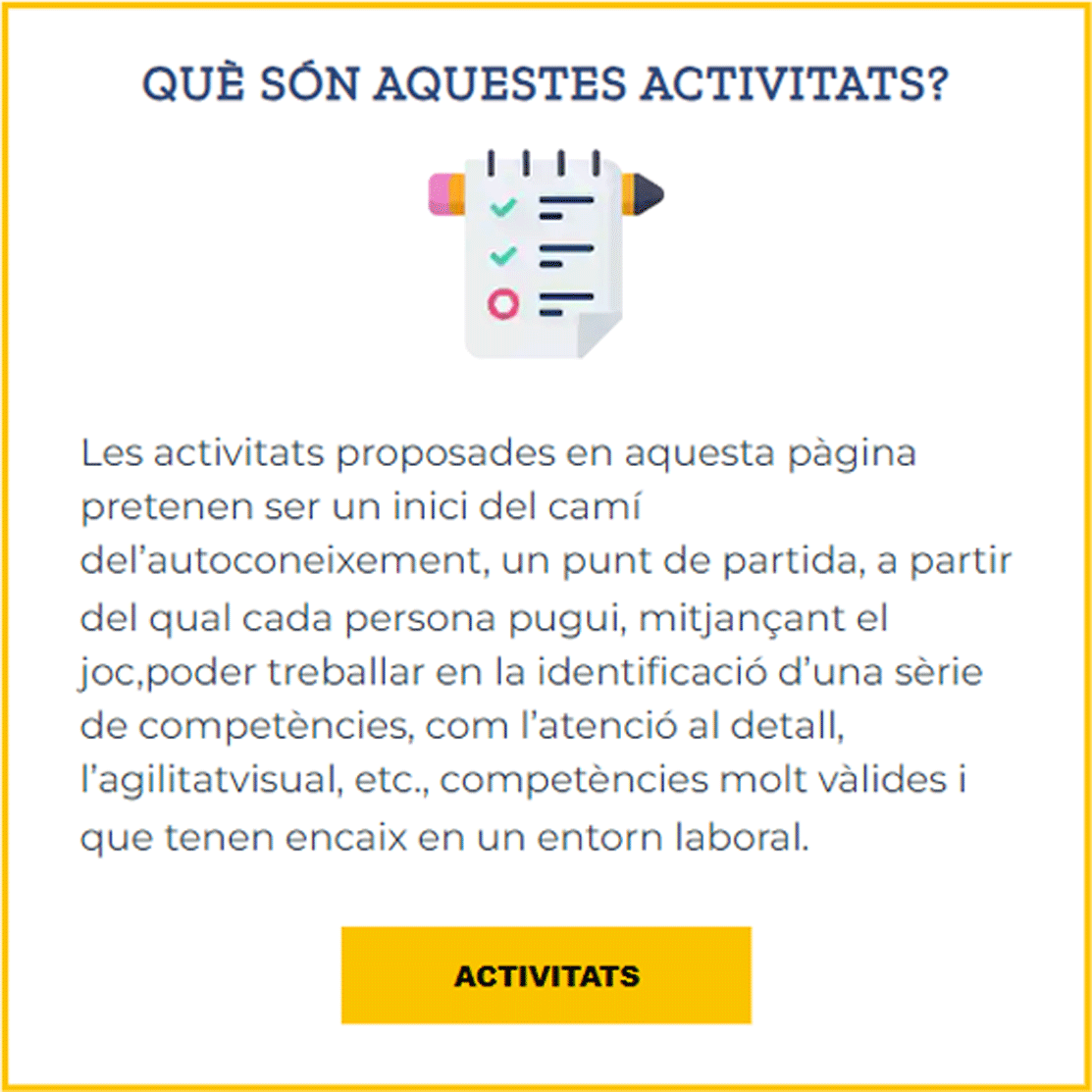
Image 1
Image and text for the presentation of the tool. The text’s translation is the following: The activities proposed on this page are intended to be a start on the road to self-knowledge, a starting point, from which each person can, through play, work on identifying a series of skills such as attention to detail, visual agility, etc. very valid competences that fit in a work environment.
Prioritizing competencies over diagnostic assessments catalyzed a shift. Parameters such as validity or internal coherence ceased to hold significance in the evaluation process. Instead, the focus pivoted toward crafting dynamic and engaging activities, affording connections with diverse abilities. Consequently, the activities adopted a framework centered around gamification. This shift led to the creation of six recreational activities (Image 2) that visually represented all the specific competencies delineated by the company. However, it’s important to note that these activities were not designed for evaluative purposes. In the revised format, hovering the mouse over an activity reveals the specialist competencies or skills associated with each activity.
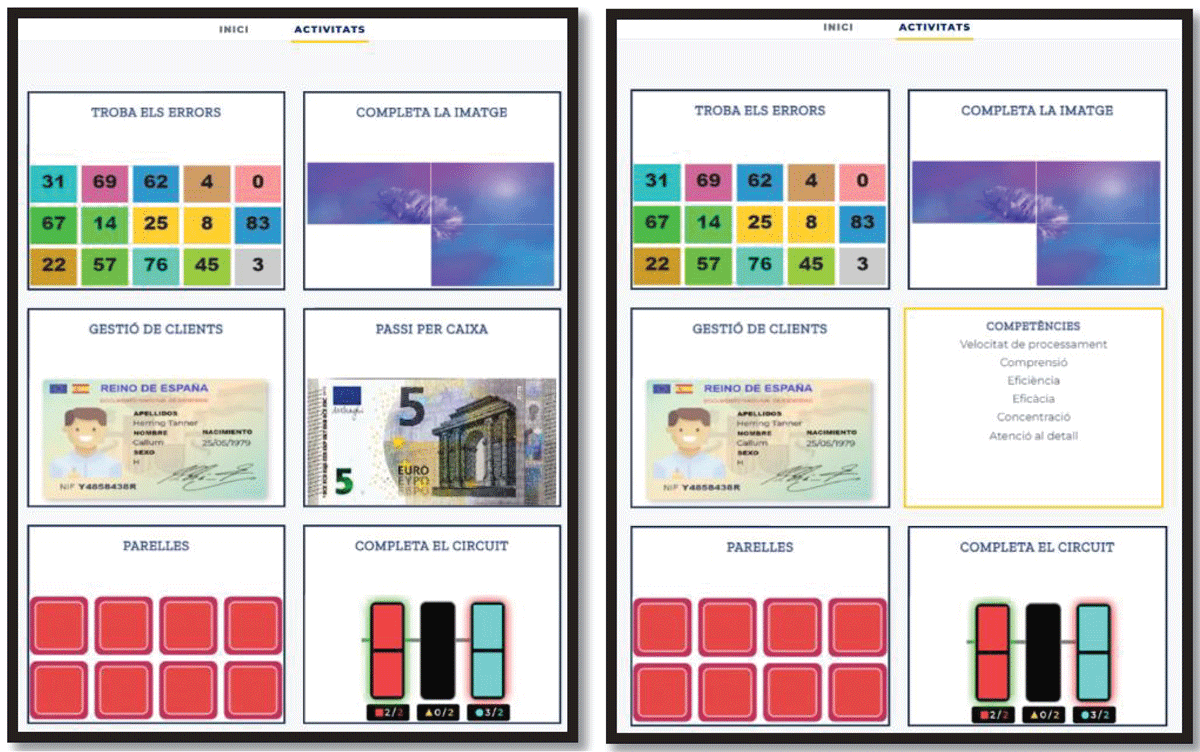
Image 2
The activities, from top to bottom and from left to right, consist of finding errors, completing the image, transferring data from a card to a form, returning change from a payment, finding pairs and a game of logical-mathematical skills. In the figure on the right, we can see the skills associated with the activity of returning: Speed, efficacy, efficiency, comprehension, attention to detail.
The incorporation of the notion of neurodiversity and skills as a relevant dimension for people on the autistic spectrum led to the removal of any elements related to diagnosis and led to a focus on playability. With this, the tool managed to avoid a definition based on deficits and the associated stigma (Grinker 2020) and focused on skills to broaden the perspective on the abilities of people with neurodiversity.
Second displacement: From evaluation to valuation
The second displacement we identified was on how to present results. At first, the idea of offering user feedback after each activity was not considered, as the results were reserved exclusively for Specialisterne’s access. However, there was no specific proposal as to how the company’s managers raised the need to give feedback to users. During this process of thinking and developing a feedback form, a concern emerged regarding the importance of avoiding messages of ‘inability’ associated with bad/low scores, as this could affect the users who perform the exercises of the app:
It is important to do it [the return of the results] in such a way that the people who take the tests do not feel undervalued, because it may be the case that someone does not score high in any activity. We cannot send the message to someone that they are worthless. (Field notes session 1, Specialisterne executive 2)
To achieve this, different proposals appeared from both the group of users with autism, and the company managers and social researchers. All proposals focused on two different dimensions. The first one referred to the reference group on which the results of each user would be compared. The second one made direct reference to the format in which the results would be returned.
In the discussion on the first dimension, three possible paths were identified: making a reference database with results from people in the ASD, establishing database made with results from people without autism, or taking only the own results as a reference once the test has been carried out, to see if there is an improvement in the performance of the results as the activities are repeated.
The first option was discarded due to the high skill performance of the people in the ASD available to generate a database. They were Specialisterne workers, already selected using similar activities. This reference group would lead to outstanding results, which would result in low scores for future app users, affecting their self-concept and self-esteem, especially sensitive dimensions for people within the autistic aspect (Nguyen et al. 2020):
We can ask our workers [people with autism with very high abilities] to carry out the tests, but they are very specific profiles that will score very high and leave a very demanding base result. (Field notes session 2, Specialisterne psychologist)
Finally, baseline results were created from a group of people without autism who tested the app’s activities. The resulting database was used as a baseline result for future users, but measuring only two categories: speed and accuracy, which are common dimensions across all activities. In this way, two relevant dimensions were achieved. First, the benchmark database is based on lower performance results, which would allow users to get better scores. Second, if the activities were repeated, it was possible to see whether one could improve its performance.
To articulate feedback, a star-based scheme was created to evaluate the results of the tasks, guaranteeing at least a star just for completing the activity. In Image 3, the results panel of a test is shown together with the concrete competencies that the test addresses, without detailing specific scores.
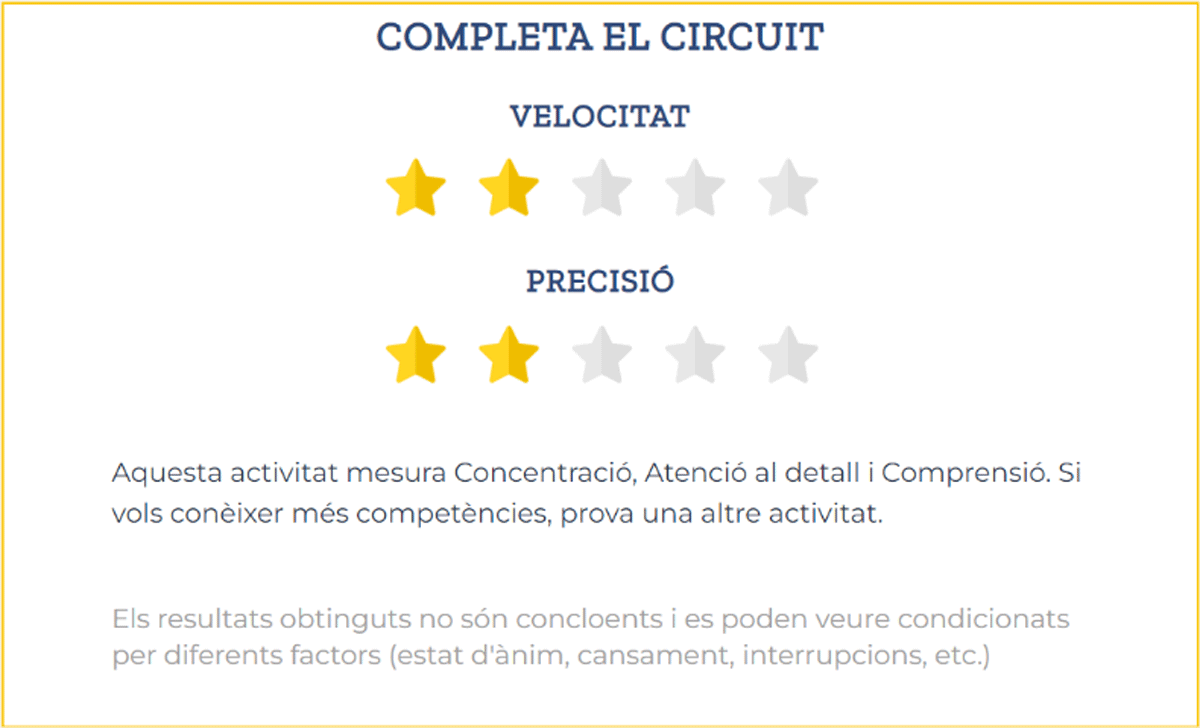
Image 3
Capture of the return of results of one of the activities. The activity called ‘COMPLETE THE CIRCUIT’ is rated by speed and precision. The feedback is: ‘This activity measures concentration, attention to detail and comprehension. If you want to know more skills, try another activity. The results obtained are not conclusive and can be conditioned by different factors (mood, tiredness, interruptions, etc.).’
As observed, the only reference to concrete competencies appears in the description of the activities, where we can find out which competencies are related to each one, but without mentioning any result in this regard. The process revealed the need for finding ways to make feel valuable people with autism. It was no longer a question of evaluating, but of valuing or assessing, overcoming the constant biomedical narratives based on deficit (Fisher 2008) using positive feedback, both in form and content, of the execution of the tests:
The ultimate purpose of the tool is to give information to neurodiverse people, to offer them a tool so that they can know that they are good, that they know how to do things. (Field notes session 3, Specialisterne executive 1)
Third displacement: From internal use to public impact
Finally, the participatory design process produced a third and last movement. We have commented on the emergence of these different concerns, and over the course of the discussions, the people in charge of articulating the app wanted to use it as a device to explain the reality of neurodiversity publicly. The aim extended beyond mere assessment or rectification of the repercussions of diagnostic categorizations. Instead, it delved into a more profound political and activist exposition of the neurodiversity reality.
In this way, this app was understood as an opportunity also to focus on the environment and its lack of adaptation to meet the needs of all people beyond their characteristics (Oliver and Barnes 2012). To this end, during the process, Specialisterne made the decision to discontinue developing an app for internal use and instead offer a tool accessible to everyone online, whether they are on the autism spectrum or not. It was a tool attractive enough to be played by anyone wanting to test their skills. The fact that the application was now intended for open use meant that the designers not only considered the presentation of the notion of neurodiversity in the initial presentation of the tool but also chose to explicitly contextualize neurodiversity in all the functionalities present throughout the entire interaction with the app.
The application evolved from an internal tool used within the organization to a publicly accessible resource available on the company’s website and promoted across various networks. This shift involved conveying the conceptual framework supporting the idea of neurodiversity (Broderick and Ne’eman 2008). This alteration aimed to facilitate universal access to this mode of contemplating and articulating neurodiversity. To complement this shift, a corresponding introductory text was incorporated. This text not only introduced the concept of neurodiversity but also shed light on the challenges that neurodiverse individuals encounter when attempting to access the job market (Image 4). This text started from their analysis on the labor market reality, in which ‘[people in the spectrum] often have difficulties in finishing their studies and accessing the labor market because it is very difficult for them to pass an interview and, if they pass, it makes it difficult for them to keep their job.’
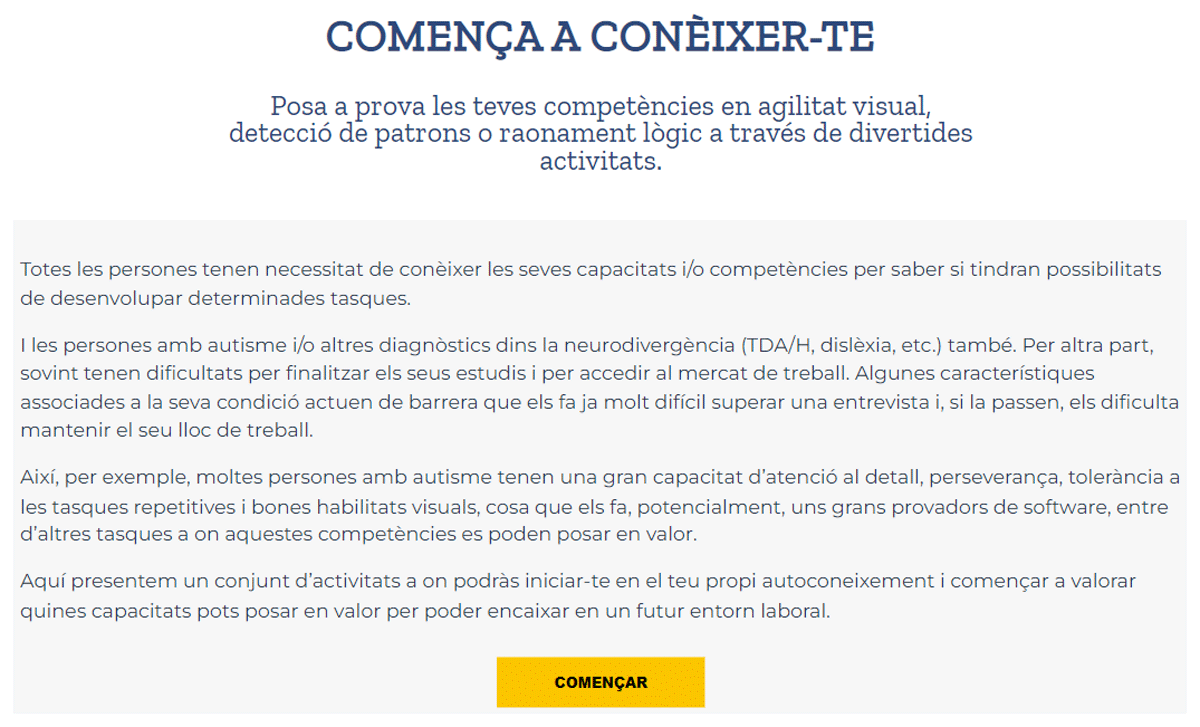
Image 4
Tool’s presentation tex. From Catalan to English: START TO KNOW YOURSELF. Test your skills in visual affability, pattern detection or logical reasoning through fun activities. All people have a need to know their capabilities and/or competences to know whether they will be able to perform certain tasks. And people with autism and/or other diagnoses within neurodiversity (ADHD, dyslexia, etc.) as well. On the other hand, they often have difficulties to finish their studies and to access the labour market. Some characteristics associated with their condition act as a barrier, as it is very difficult for them to pass an interview and if they pass it, it makes it difficult for them to keep their job. Many people with autism have a great capacity of attention to detail, perseverance, tolerance to repetitive tasks and good visual skills, which makes them potentially great software testers, among other tasks. Here we present a set of activities where you can initiate yourself in your own knowledge and start assessing what abilities you can put in value for a future work environment.
The tool highlights the fact that the traditional pathways to employment are not suitable for people within the autistic spectrum. In this way, exclusion from the labor market, together with the lack of spaces for public participation, allowed a public conception as people without skills or meaningful knowledge (Bölte 2023; Pellicano et al. 2022).
Through this third displacement, the application took on a pivotal role in elucidating and projecting a political narrative that could amplify the voices advocating for demands aligned with the unique circumstances and experiences of the neurodivergent community. It is no longer just a matter of highlighting certain abilities, as we saw in the first movement, but it spotlighted a dimension imbued with political activism (McGuire 2016). This endeavor pursued two parallel objectives. Firstly, it aimed to inform individuals who are not on the ASD about the manifold, dynamic, and diverse reality that exists beyond rigid and unchanging categorizations. Under the notion of neurodiversity, a multitude of ways of understanding reality come together, each with its specificities, needs, limitations, and virtues (Ne’eman and Bascom 2020). Secondly, this public discourse proved invaluable for individuals within the spectrum who were unfamiliar with the concept of neurodiversity. It rendered accessible a political narrative from where to talk and claim themselves as diverse subjects.
Discussion: Infrastructuring a “Neurodiversity Publics”
The results presented here show how the emergence of certain tensions during the process of co-designing a technological device changed the course of its development. What initially started as an internal business app became a public tool with a political vocation.
We have shown how participants’ concerns challenged the initial perspective. This perspective was technically oriented and perceived autism out of context, as a stable condition, measurable, and classifiable. These concerns allowed a transformative process in the development of the device. An evolution involving three shifts from rigid constructs toward more open and less essentialist approaches.
To expound on the process, it’s insightful to draw from the distinction made by Di Salvo and Le Dantec (2013) between ‘design for use’ and ‘design for future use.’ These authors explain how in participatory spaces there are two different ways to articulate participation. On one hand ‘design for use’ refers to the development of a functional system tailored for a specific purpose. In our context, this was the initial conception of an app designed to evaluate skills, facilitating users’ integration into the labor market. On the other hand, Di Salvo and Le Dantec also elucidate the notion of ‘design for future use,’ the shaping of a tool aimed at cultivating an audience—a device strategically ‘structured to create fertile ground to sustain a community of participants’ (2013, 247). Similarly, our project exhibits a parallel trajectory; as we embraced participant concerns, the application’s design assimilated elements aligning with goals of societal transformation (Lanng, Laursen, and Borg 2022). This endeavor seeks to establish a future-engaged public. Within this project, a discernible shift from ‘design for use’ to ‘design for future use’ becomes evident, catalyzed by the concerns of those directly impacted in the process.
This ‘design for future use’ trajectory emerged from a backdrop of questions, concerns, and uncertainties that necessitated a comprehensive re-evaluation of the tool’s conceptual underpinnings. These inquiries led to a process of integrating components designed to resonate with future users—whether they are or not within the ASD community—enabling them to connect and engage with a specific issue (Marres 2007). Here, participation made it possible to articulate a device-discourse based on neurodiversity. A device-discourse acting as a conduit, forging continuity between two incongruous realms—the neurotypical and the neurodiverse. For the promoters, the objective extended beyond merely identifying technical remedies for the emergent challenges. It transformed into a pursuit to bring these concerns into the public sphere, counteracting prevalent narratives and creating a new understanding for and by people on the spectrum disorder. A process of public infrastructuring that, as we have seen, operates along two distinct dimensions: at a subjective level for people on the ASD on the one hand, and at a general level on the other.
On a subjective level, the app started engaging potential users on the autism spectrum, who had traditionally been categorized according to deficits outlined in official diagnostic criteria. This endeavor involved reframing, shifting the focus towards capacities that could be embraced in affirmative terms. The potentially problematic diagnostic label, notorious for its looping effect—altering and shaping the very collective it categorizes (Hacking 1995)—was sidelined. Instead, autism was reconceptualized in the context of valuable social and cognitive distinctions (Turowetz, Wiscons, and Maynard 2023). This approach facilitated a process of self-recognition and empowerment among individuals with autism, while simultaneously constructing a political subjectivity capable of positive self-reference.
We have seen how the developed technology aspires to extend its reach beyond ASD, inviting neurotypical individuals to engage with discourses and practices attuned to the intricacies of neurodivergence. The app was ultimately designed as an ally trigger to foster counter-hegemonic and alternative narratives around autism (O’Dell et al. 2016).
Broderick, in collaboration with Ne’eman, has advocated for a double-layered process like this one, as they envision the influence of their work on both neurodiverse and neurotypical individuals, whom they target as potential allies:
I (second author) would like to encourage my own community to think strategically about how to approach the divide between the autism and the autistic community. Accordingly, I (first author) would like to encourage the non-autistic community of family members, researchers, educators, and fellow citizens to act as allies to the community of autistic citizens in these endeavors. To drain the swamp of toxic rhetoric from the cure-oriented autism community, we must pursue two distinct but equally important tracks” (Broderick and Ne’eman 2008: 472)
We have observed how a project that initially focused on expanding the capabilities of an application has shifted towards activism, aiming to project desirable futures. This involves not only shaping how the device is used but also shaping an emerging public that did not exist prior to the application itself. This endeavor doesn’t merely strive to mobilize individuals within the autism spectrum who already self-identify positively or try to sensitize those attuned to neurodiversity discourses to foster careful dialogues with this group. Instead, it goes beyond, redefining reality and incorporating novel forms of engagement. Like what Ginsburg and Rapp conceptualize as ‘disability publics,’ as a space allowing
new social imaginaries in which people with disabilities have horizons of possibility (…). This provides a refiguring of notions of typicality that we think of as a ‘new normal,’ in which the inclusion of disability is no longer considered exceptional but, is simply taken for granted. (2015, 5)
In our case, the infrastructuring of a public is more specific, leading us to propose the concept of ‘neurodiversity publics.’ This approach underscores how the co-design process has enabled the envisioning of desirable futures and the definition of a concrete public. This public is sensitive and emergent, characterized by a desire for counter-narrative, criticality, and resistance to the hegemony of biomedical ideology (Broderick and Ne’eman 2008). The co-design process evolved into a semiotic-material configuration of a realm for action, fostering a gateway to sensibilities that encourage genuine connections to non-standardized modes of situating individuals within ASD.
From this point, the work we have presented, which aimed to explore the potential and effects of direct participation through co-design, unveils a crucial insight: delving into participatory dynamics isn’t solely advantageous for refining or tailoring devices through co-design, it is equally crucial in acknowledging how participation, in addition to enhancing technological quality, becomes intertwined with the ethical and political facets inherent to user involvement (Barnes and Cotterell 2011).
Through this paper, we underscore the remarkable potential of participatory processes to transcend the mere shaping of spaces for co-generating specific technologies. We discern the broader horizons that participation unveils, infrastructuring new publics by enabling new connections and, thus, positioning itself as a platform for opening desirable and shared futures. Such processes hold heightened significance for groups that, as evidenced at the outset of this text, have historically and consistently remained invisible and undesirable (Kafer 2013) and for which there has been a lack of ‘making up language to give a voice to the people and thereby help determine who, or how, they shall be’ (Hacking 2009, 264). Our work here adds a new dimension by emphasizing the significance of materiality. Materiality has been a key element studied in various fields (Vincent 2020), but in this context, we present the sociomaterial configuration of a public, a ‘neurodiversity public,’ which aligns intriguingly with the concepts proposed by Marres (2007) and Latour (2004). Our work extends beyond merely representing a group of individuals keen to express their views and opinions—it’s not just a platform for giving ‘voice.’ What we precisely uncover is that ‘a public’ is defined by the creation and maintenance of bonds, connections, and interdependencies centered around a specific subject of interest. This subject does not pre-exist; instead, it is materially infrastructured, in our case, through the development of the App. The possibility of building common worlds is not only about discourses; it is sustained in a heterogeneous web of interdependent people, technologies, discourses, and materiality (see Callon and Law 1997).
Final Remarks
While this co-design space holds significant potential, it is important to acknowledge its complexities. Our approach, embedded in a specific narrative about autism, risks perpetuating stereotypes and presenting a uniform portrayal of (Hull et al. 2017). This is exacerbated by the app’s development within an employment-focused company, potentially narrowing the representation of autistic experiences. Moreover, the reliance on Anglo-Saxon references in understanding neurodivergence could undermine local concepts like ‘functional diversity’ in the Spanish context (Romañach and Lobato 2005). Furthermore, the binary framing of neurotypical/neurodivergent categories may reify the difference and mystify it (see Hacking 2009), thus complicating the commensurability of different worlds.
Nevertheless, our work offers significant contributions in two distinct areas. Firstly, it enhances neurodiversity studies and activism by emphasizing the importance of participatory action and the integration of studies on connections, attachments, and material-semiotic configurations. This approach extends beyond the prevalent cultural narrative frameworks in autism discourse, focusing on designing tools for social change. Second, this work provides an interesting study to the field of participation and co-design in STS. This is due to its novel nature, as it introduces a case involving a group that is not very present in the literature on formal participation with an adult population. Furthermore, the case exemplifies the importance of finding hybrid forms of participation, that combine activism and its disruptive modes of approaching reality with more formal spaces of participation that may have broader outreach.
The final version of the app can be found here: https://specialisternespain.com/ca/comenca-a-coneixer-te/.
Acknowledgements
We sincerely thank Specialisterne Spain for their invaluable insights and feedback on our article.
Funding Information
This work was supported by Acció (Generalitat de Catalunya), in the context of the Reinforcement of Competitiveness Initiatives.
Competing Interests
The authors have no competing interests to declare.
Author Contributions
Joan Moyà-Köhler spearheaded the concept, initial drafting, and analysis. Oriol Barat-Auleda data curation, initial writing and analysis. Núria Vallès-Peris methodology and conducted the final review. Miquel Domènech managed project and resources and final review.