
Table 1
Search strategy.
| DATABASE | SEARCH STRATEGY |
|---|---|
| Scopus | TITLE ((“Cerebral Palsy” OR “CP”) AND “employment*” AND NOT “children”) |
| PubMed | (“Cerebral Palsy”[Title/Abstract] OR “CP”[Title/Abstract]) AND “employment*” |
| ProQuest | abstract((Cerebral Palsy) AND (employment) NOT children) |
| Google Scholar | allintitle: Cerebral Palsy OR CP AND “employment” -Children |
| AUB Primo | All fields is (exactly) “Cerebral Palsy” AND All fields is (exactly) “employment*” NOT “children” |
Table 2
Inclusion and exclusions criteria.
| INCLUSION CRITERIA | EXCLUSION CRITERIA |
|---|---|
|
|
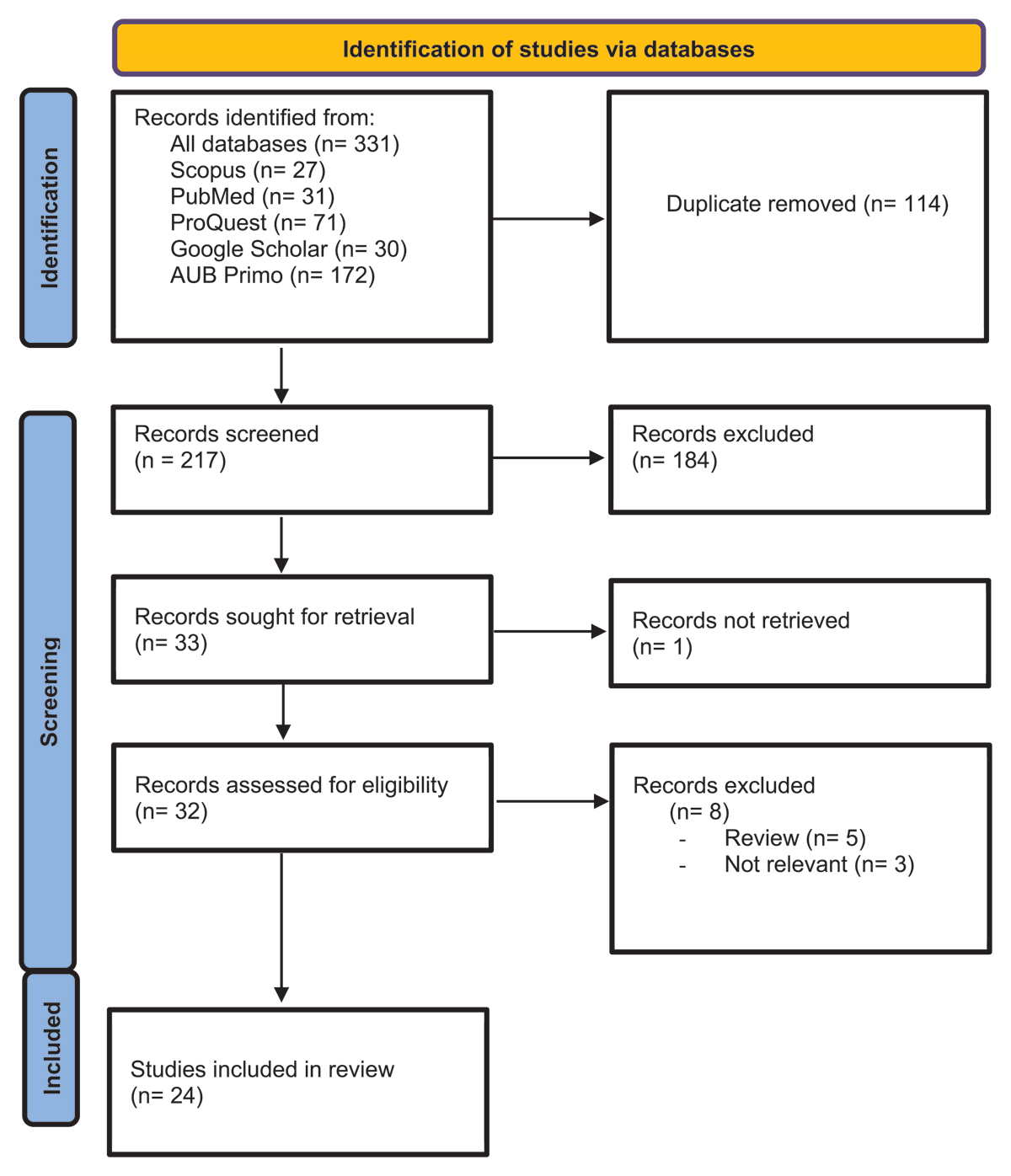
Figure 1
PRISMA Flow diagram.
Table 3
PPC model.
| POPULATION | CONCEPT | CONTEXT | TYPES OF EVIDENCE |
|---|---|---|---|
| Individuals with CP (age 16+). | Factors influencing on labour market participation (employment). | International (Literature in English). | Research studies in English, published after the year 2000. |
Table 4
Study Overview.
| AUTHOR(S), YEAR | STUDY POPULATION | STUDY AIM | METHODOLOGY | KEY FINDINGS |
|---|---|---|---|---|
| Andersson, C., and Mattsson, E., 2001 | 363 adults with CP. 125 males, 96 females (20–58 years) | To describe problems and resources, including employment aspects | A questionnaire (survey) | 24% are employed full-time, while 18% receive a disability pension. Most live independently, with or without home services. |
| Asuman, D., Gerdtham, U-G., Alriksson-Schmidt, A.I., Nordin, M., and Jarl, J., 2023 | 77.971 individuals made up of all 13,000 persons with CP in Sweden and 64,971 persons in a comparison group | To explore the labour market consequences of CP and the pathways through which it affects labour outcomes | Data from multiple Swedish National Population Registers from 1990 to 2015 | Having cerebral palsy reduces labour market participation, education rates, and income levels. |
| Benner, J., Hilberink, S., Veenis, T., VanDer Slot, W., and Roebroeck, M., 2017 | 65 adults with CP. 33 males, 32 females | To explore employment over a 14-year period | Prospective cohort study with self-reported employment data (survey) | Long-term labour market participation is influenced by education, intellectual impairment, and motor function. |
| Bertels, N., Molenaers, G., Van Campenhout, A., Craenen, K., and Franki, I., 2023 | 80 adults with CP. Median age: 31. 39 males, 41 females | To explore the impact of contributing factors on employment | Standardised tests and questionnaires | Labour market participation is correlated with cognitive abilities, mobility, social participation, daily activities, and fatigue. |
| Bottos, M., Feliciangeli, A., Sciuto, L., Gericke, C., and Vianello, A., 2001 | 72 adults with CP born between 1934–1980. Median age: 33. 43 males, 29 females | To examine the evolution from childhood to adulthood, including employment aspects | Data collected using case notes and through direct assessments (survey, health data) | Higher education increases labour market participation. |
| Huang, I., Holzbauer, J., Chronister, J., Fong, C., and O’Neil, J., 2013 | 3162 individuals with CP. 1.820 males, 1.342 females, age range 16–54 | To examine the relationship between vocational rehabilitation services and employment outcomes | Data from the US Department of Education Rehabilitation Service Administration Case Service Report database (registry) | Vocational rehabilitation, such as on-the-job training, job search assistance, on-the-job support, job coaching, support services and job accommodations, improves labour market participation. |
| Lowman, D.K., West, S.L., andMcMahon, B.T., 2005 | 1.392 complaints filled between 1992–2003 | To examine employment discrimination experiences | Analysis of the American database EEOC (registry) | Hiring discrimination accounts for 15.4%, a significantly higher proportion compared to the 5.3% observed among complaints from individuals with other types of disabilities. |
| Magill-Evans, J., Galambos, N., Darrah, J., and Nickerson, C., 2008 | 76 persons between the ages of 20–30 with CP or spina bifida (SB). 35 males, 41 females | To identify personal, family, and community factors that facilitate or hinder employment | Mixed method. Participants completed survey and semi structured interviews | Nearly half of the participants are unemployed. Gender (with females being less likely to be employed), IQ, and reliance on transportation collectively explain 42% of the variance in labour market participation. |
| McNaughton, D., Light, J., and Arnold, K., 2009 | 8 males with CP who use augmentative and alternative communication | To explore successful full-time employment experiences | Online focus group interview | Internships, social networks, and coworker support facilitate labour market participation, while transport and stigma are barriers. |
| Törnbom, K., Törnbom, M., and Sunnerhagen, S., 2017 | 20 individuals with CP or SB. age 35–55. 9 females, 11 males | To explore experiences of participation in employment and social life | Semi structured interviews | Several participants have experienced dismissal due to disability discrimination. |
| Mesterman, R., Leitner, Y., Yifat, R., Gilutz, G., Levi-Hakeini, O., Bitchonsky, O., Rosenbaum, P., and Harel, S., 2010 | 203 people with CP followed between 1975–1994. 61% males | To describe the long-term psychosocial outcomes of CP, including education and employment outcomes | Cross-sectional telephone survey | Education is crucial for labour market participation. |
| Michelsen, S. I., Uldall, P., Kejs, A. M. T., and Madsen, M., 2005 | 819. 471 males, 348 females with CP born between 1965–1978, and 4406 controls born between 1965–1978 | To find predictors in childhood of subsequent education and employment | Data obtained from several Danish registries | Higher cognitive abilities, education, and mobility significantly improve labour market participation. |
| Michelsen, S. I., Uldall, P., Hansen, T., and Madsen, M., 2006 | 416 participants with CP born between 1965–1970. 243 males, 173 females; mean age 32, compared to 2247 age-matched individuals | To explore and compare adults with and without CP, regarding different social related factors including employment | Data obtained from several Danish registries | Individuals with cerebral palsy have significantly lower labour market participation rates than people without disabilities. |
| Mik-Meyer, N., 2016 | 19 employers and 43 colleagues who worked closely with an employee with CP in 13 different work organizations | To explore how able-bodied co-workers engage in the ‘othering’ of colleagues with CP | Interviews | Employers’ and educational institutions’ attitudes affect the labour market participation of individuals with cerebral palsy. |
| Murphy, K., Molnar, G., and Lankasky, K., 2000 | 101 participants with CP, age 27–74 years. 48 females, 53 males | To assess the social and employment status of adults with CP | Data form PULTIBEC (registry), and a standardized questionnaire | 53% are competitively employed. Education beyond high school is the most significant factor for achieving labour market participation, especially for individuals with severe CP. |
| Opheim, A., Jahnsen, R., Olsson, E., and Stanghelle, J. K., 2009 | 149 participants, mean age 40.5, with CP. 76 male, 73 females | To compare walking function, pain, fatigue and employment rates, 7 years after an initial survey | A multidimensional questionnaire | Pain and fatigue reduce work capacity and labour market participation. |
| Pagliano, E., Casalino, T., Mazzanti. S., Bianchi, E., Fazzi, E., Picciolini, O., Frigerio. A., Rossi, A., et al., 2021 | 109 individuals with CP followed from infancy and recalled for assessment at ages between 18–50. 53 females, 56 males | To assess quality of life and participation including employment rates | Mixed methods. Involving semi-structured interviews, observation, and surveys | Quality of life and labour market participation are interlinked. |
| Pettersson, K., and Rodby-Bousquet, E., 2021 | 1.888 adults with CP. 1.030 males, 858 females enrolled in the Swedish CP follow-up program, median age 25 | To analyse living conditions and social outcomes, including employment | Cross-sectional registry-based study | Only one in six has competitive employment. Women with CP are half as likely to be employed as men. |
| Rasalingam, A., Brekke, I., and Dahl, E. Helseth S., 2021 | Young adults with different somatic long-term health challenges born between 1990–1996 (421.110 in total) | To examine the consequences of somatic long-term health challenges including consequences in education and income | Data obtained from the Norwegian Patient Registry, which is linked to other registries | CP reduce education and income levels, and possibly more than individuals with other lifelong disabilities. |
| Reddihough, D. S., Jiang, B., Lanigan, A., Reid, S. M., Walstab, J. E., and Davis, E., 2013 | 334 individuals with CP (age 20–30). 171 males, 164 females, compared to a population-based control group (2.152) | To investigate functional abilities and social outcomes, including employment | Telephone survey, public access electoral roll (registry) | Functional abilities correlate with labour market participation |
| Shrader, M., Wade, C., Lennon, N., Shields, T., Salazar-Torres, J., Howard, J., andMiller, F., 2021 | 126 adults with CP (mean age 29,7). 70 males, 56 females | To describe well-being by assessing education, employment, physical function, walking activity, and healthcare | Patient-reported outcomes (survey), and pedometer data (health data) | Physical function affects both education and labour market participation. |
| Törnbom, M., Jonsson, U., and Sunnerhagen, K. S., 2014 | 72 individuals. 40 males, 32 females, with CP or spina bifida (SB) | To compare work participation in 2009 with 1997 | Survey by telephone | Labour market participation and work hours decreases with age. |
| Van Der Slot, W. M., Nieuwenhuijsen, C., Van Den Berg-Emons, R. J., Wensink-Boonstra, A. E., Stam, H. J., and Roebroeck, M. E., 2010 | 56 adults with CP (mean age 36.4). 62% males | To assess participation including in employment and health-related quality of life | Survey | Almost half of individuals with CP experience employment difficulties and have lower health-related quality of life. |
| Verhoef, J. A. C., Bramsen, I., Miedema, H. S., Stam, H. J., and Roebroeck, M. E., 2014 | 74 adults with CP (age 16–20). 45 males, 29 females | To document the development of work participation over a 4-year period | Observational longitudinal cohort study, surveys | Employment and labour market participation increases with age. |
Table 5
Key Factors Affecting Labour Market Participation.
| Individual factors |
| Andersson and Mattsson (2001), Asuman et al. (2023), Benner et al. (2017), Bertels et al. (2023), Bottos et al. (2001), Mesterman et al. (2010), Michelsen et al. (2005), Michelsen et al. (2006), Murphy et al. (2000), Opheim et al. (2009), Pagliano et al. (2021), Pettersson and Rodby-Bousquet (2021), Rasalingam et al. (2021), Reddihough et al. (2013), Törnbom et al. (2014), Van Der Slot et al. (2010), Verhoef et al. (2014) |
| Contextual factors |
| Mik-Meyer (2016), Lowman, West, and McMahon (2005), Törnbom et al. (2017), Shrader et al. (2021), Magill-Evans et al. (2008), McNaughton et al. (2009), Huang et al. (2013) |