
Introduction
Limited knowledge exists regarding the factors affecting labour market participation for individuals with cerebral palsy (CP). No prior review has specifically addressed this topic, making this review valuable, particularly considering the group’s low employment rate (Andersson and Mattsson 2001; Benner et al. 2017; Michelsen et al. 2006; Pettersson and Rodby-Bousquet 2021). The purpose of this scoping review is to identify the factors influencing this group’s labour market participation. Subsequently, these factors will be linked to a comprehensive labour market model (Bredgaard et al. 2020) to identify the gaps within existing research and propose suggestions for future research.
Cerebral palsy (CP) is a brain injury that occurs during the foetal or infant stages of development. CP is characterised by physical and cognitive impairments, presenting with varying degrees of severity (Asuman et al. 2023). CP accompanies secondary complications such as sensory disturbances, intellectual impairments, speech difficulties, fatigue, and pain. These challenges affect individuals with CP differently across their lifespans, resulting in a heterogeneous group (Rosenbaum and Stewart 2004). Unlike the brain injury itself, some of the secondary conditions may worsen over time (Törnbom et al. 2014). Approximately two to three out of every 1,000 children are born with CP, and it is estimated that 17 million people are living with CP worldwide (Graham et al. 2016). The severity of the physical impairment is typically categorised using the ‘GMFCS system’ (gross motor function classification system). This is a scale ranging from one to five. Level one signifies the highest level of physical function (independence in walking), while level five signifies the lowest level of physical function (full-time wheelchair use) (Rosenbaum and Stewart 2004).
Employment plays an important role in today’s modern society. Existing literature highlights the significant contribution of employment to individuals with disabilities’ overall well-being, social participation, and quality of life (Bishop and Feist-Price 2002; Chapin and Holbert 2010; Fleming et al. 2013; Kober and Eggleton 2005). Existing studies show significantly lower employment rates for individuals with CP compared to the general working population. Moreover, the research highlights variations in employment rates within the CP population, emphasising the heterogeneity within the group, whereas individuals with severe CP tend to have lower employment rates (e.g., Andersson and Mattsson 2001; Benner et al. 2017; Michelsen et al. 2006; Pettersson and Rodby-Bousquet 2021; Reddihough et al. 2013).
Numerous studies have reported a wide range of employment rates, ranging from 17.5% to 68% (Andersson and Mattsson 2001; Benner et al. 2017; Bottos et al. 2001; Frish and Mshall 2013; Huang et al. 2013; Mesterman 2010; Michelsen et al. 2005; Michelsen et al. 2006; Murphy et al. 2000; Opheim et al. 2009; Pettersson and Rodby-Bousquet 2021; Reddihough et al. 2013; Van Der Slot et al. 2010; Young et al. 2006). These variations may be attributed to differences in the definitions of employment, such as the inclusion of part-time, sheltered, or accommodated employment. Additionally, there is significant heterogeneity within the CP population across studies, including variations in age and the severity of CP (GMFCS and IQ levels). Furthermore, the studies span different decades and have differences in sample size.
Existing literature finds that individuals with CP tend to have a lower income compared to the general working population, and that those with severe CP tend to rely on disability pensions as their primary source of income (Andersson and Mattsson 2001; Huang et al. 2013; Mesterman 2010; Michelsen et al. 2006; Michelsen et al. 2005; Opheim et al. 2009; Rasalingam et al. 2021; Reddihough et al. 2013). These studies also present varying findings, which may be attributed to differences in disability support systems across countries, variations in the severity of CP within the study populations, disparities in eligibility criteria for disability pensions, and differences in study methodologies, sample sizes, and the time periods during which the studies were conducted.
These findings across multiple studies, indicating both low employment rates and income levels among individuals with CP, underscore the need to investigate the factors affecting their labour market participation. Notably, only a limited number of studies have delved into this, as this review will highlight.
When examining labour market participation, three primary stakeholders play a crucial role: 1) individuals with CP, 2) employers responsible for hiring, and 3) the employment system, which assists unemployed individuals in finding jobs and facilitates the matching of unemployed individuals with employers and companies (Bredgaard et al. 2020). This is called ‘the comprehensive labour market’ model. This model is grounded in the concept that the labour market comprises a supply-side (job seekers), a demand-side (employers), and various institutions and processes that facilitate or hinder the matching of the supply-side and demand-side (Bredgaard et al. 2020).
The comprehensive labour market model is based on a relative understanding of disability (Bredgaard et al. 2020). The relative model is positioned between the medical and social model and seeks to integrate elements from both perspectives. The medical model conceptualises disability as an individual trait. According to this model, disability stems from an impairment, and the focus is on ‘fixing the problem’ through medical intervention to minimise or eliminate the impairment. Critics of this model argue that it fails to consider the social and environmental factors that contribute to disability (Shakespeare 2013). In contrast, the social model emerged as a reaction to the medical model. It understands disability as a result of societal barriers, asserting that it is not the impairment itself that creates disability, but rather society’s failure to accommodate and include individuals with impairments (Oliver 1990). Critics of this model argue that it can overlook the individual’s challenges and potential need for medical intervention (Gustavsson 2004).
The relative model acknowledges that disability is shaped by the interplay between the individual and their context (Grue 2016; Gustavsson 2004; Söder 1987). Thus, factors influencing labour market participation should not be attributed solely to the individual with an impairment; contextual factors, including the role of other labour market stakeholders, must also be considered (Bredgaard et al. 2020). Therefore, this review will assess the literature based on whether it examines: 1) factors pertaining to the individual, or 2) factors associated with the individual’s context.
Method – Scoping Review
Given the limited attention in existing research to individuals with CP and the factors influencing their labour market participation, it is essential to develop a deeper understanding of the existing knowledge. To achieve this, a scoping study method is used. Scoping reviews are characterised by their exploratory nature. This methodology is intended to map and assess the available literature on a topic. It provides a comprehensive overview of existing research while identifying areas where research is limited, and further investigation is needed (Arksey and O’Malley 2005). In contrast to systematic reviews, scoping reviews aim to identify diverse literature across various study designs and are particularly well-suited when research is limited. Scoping reviews are not intended for conducting a critical analysis or literature evaluation across studies; their purpose is to provide a broader presentation of existing knowledge (Arksey and O’Malley 2005).
This scoping review follows the framework by Arksey and O’Malley (2005), which outlines five stages. According to Arksey and O’Malley (2005), scoping reviews benefit from collaborative efforts to ensure comprehensive coverage and reduce potential biases. Although this review was conducted by a single researcher, colleagues provided feedback and were involved throughout the process, thereby strengthening the review. This collaboration is part of a national research project on labour market participation for individuals with CP (Bredgaard et al. 2023).
Stage 1: Identifying the research question
The aim of this scoping review is to investigate existing literature on the factors influencing labour market participation among individuals with CP and to address the potential gaps in this literature. The following research questions were formulated:
Which factors have been identified in existing literature as affecting the labour market participation of individuals with CP?
What limitations and gaps can be identified in existing literature regarding factors influencing labour market participation of individuals with CP, and how can these findings provide implications for future research?
The results section will investigate the factors that influence the labour market participation of individuals with CP (research question 1). The discussion will examine these findings further to highlight literature gaps and provide implications for future research (research question 2).
Stage 2: Identifying relevant studies
Literature searches were conducted in September–October 2023. Relevant databases, including Scopus, PubMed, ProQuest, Google Scholar, and AUB Primo (Aalborg University Database), were utilised. Keywords were constrained and simplified to maintain a broad approach, as recommended in the scoping study method (Peters et al. 2015). The primary keyword was ‘Cerebral Palsy’, supplemented by the secondary keyword as presented in Table 1. In some databases, ‘OR CP’ was added; however, this was not applicable to all databases, such as PubMed and ProQuest, where it resulted in many imprecise search results due to ‘CP’ being an abbreviation for terms other than Cerebral Palsy. To refine the search, the keyword ‘NOT children’ was added to focus on adults. If an advanced search feature was available, a search criterion was set to ensure that ‘cerebral palsy’ and ‘employment’ were referenced in the abstract, title, or keywords. In Google Scholar, the specification required both keywords to be present in the title, as the alternative allowed for either keyword to appear anywhere in the text, resulting in 17,800 imprecise search results. This approach was adopted to narrow down the search to relevant peer-reviewed studies where individuals with CP and employment play a key role. In some initial searches without employing this advanced search feature, several irrelevant results emerged.
Table 1
Search strategy.
| DATABASE | SEARCH STRATEGY |
|---|---|
| Scopus | TITLE ((“Cerebral Palsy” OR “CP”) AND “employment*” AND NOT “children”) |
| PubMed | (“Cerebral Palsy”[Title/Abstract] OR “CP”[Title/Abstract]) AND “employment*” |
| ProQuest | abstract((Cerebral Palsy) AND (employment) NOT children) |
| Google Scholar | allintitle: Cerebral Palsy OR CP AND “employment” -Children |
| AUB Primo | All fields is (exactly) “Cerebral Palsy” AND All fields is (exactly) “employment*” NOT “children” |
Stage 3: Study selection
Studies published before the year 2000 were excluded. It was assessed that research prior to this year had limited relevance due to being several decades old, with significant developments having occurred in the fields of employment, disability and cerebral palsy in general. Furthermore, literature considered non-research, such as non-academic book chapters or grey literature like conference papers, was excluded due to relevance. Studies solely focusing on children were also excluded. Five literature reviews were examined to identify relevant references; however, these were not included in the final selection of studies.
Due to limited time and resources, the literature search was restricted to studies published in English as seen in Table 2. Conducting a multilingual search and translating non-English articles was considered too time-consuming. Moreover, English functions as the dominant language in international academic publishing (Hyland 2016) and was therefore considered appropriate for capturing a broad body of literature. However, it is acknowledged that this decision may have excluded valuable insights from non-English literature.
Table 2
Inclusion and exclusions criteria.
| INCLUSION CRITERIA | EXCLUSION CRITERIA |
|---|---|
|
|
The process of study selection was carried out in three steps by the author. In the first step, a preliminary screening was conducted in each of the databases, involving the review of titles and abstracts to identify relevant publications. Promising and relevant articles were saved for further examination. In the second step, the studies considered relevant were set aside for detailed full-text reading. Lastly, a citation chaining method was employed to review the selected literature for references. However, this did not result in any additional references. This process resulted in the final selection of 24 studies. The process of study selection is presented in Figure 1, and the final studies are summarised in Table 4.
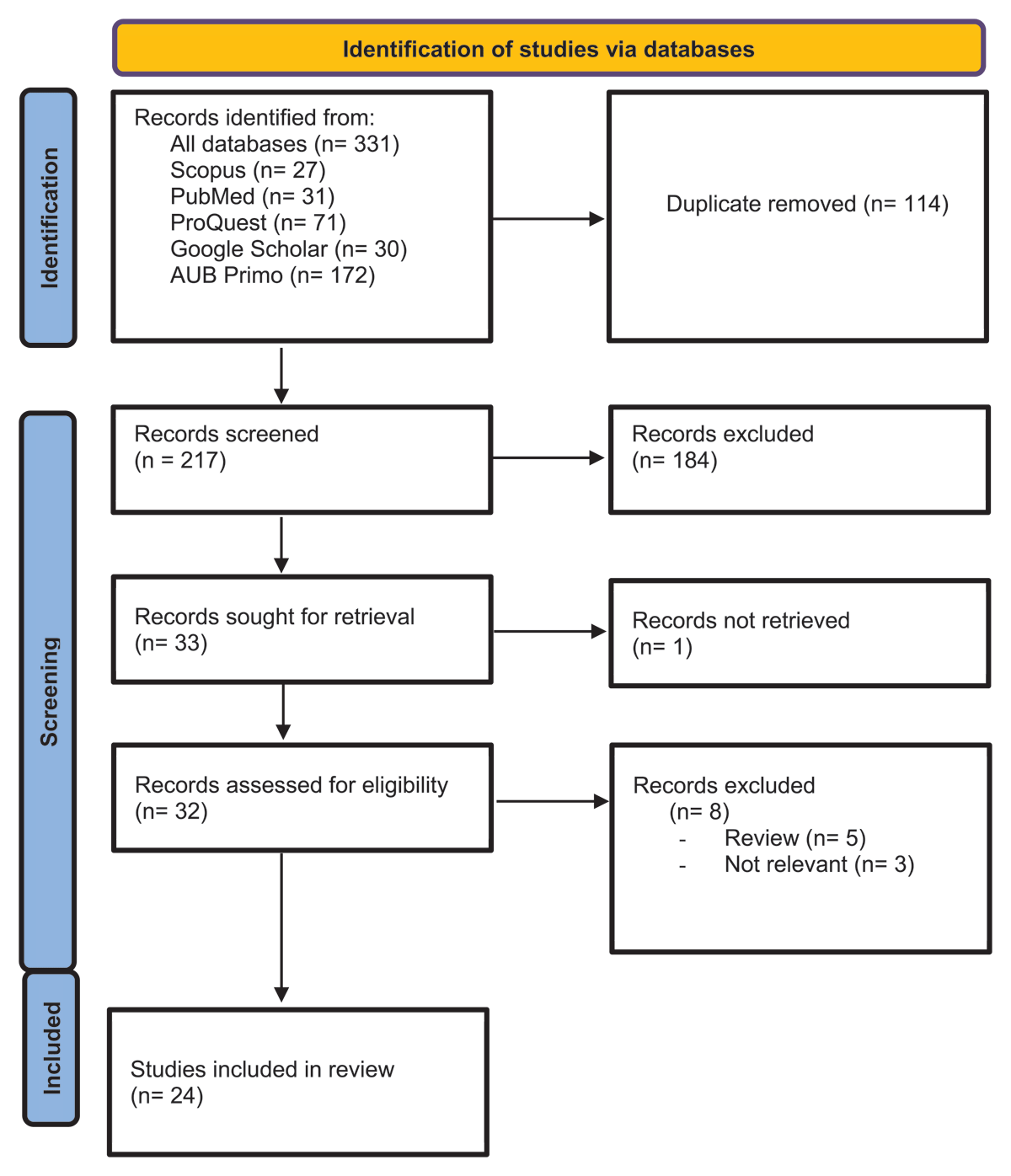
Figure 1
PRISMA Flow diagram.
The PCC model is a framework utilised in scoping reviews to delineate the primary elements of the research by defining the specific group of individuals under study (Population), the main focus of the research (Concept), and the relevant setting (Context) (JBI 2024; Peters et al. 2015). In this review, the PCC model was used to guide the formulation of the research question and inclusion criteria, as outlined in Table 3.
Stage 4: Charting the data
Data from the selected studies were mapped using Excel, as presented in Table 4. The data-mapping process revealed various characteristics. In terms of the studies’ methodologies, quantitative methods, including surveys and questionnaires, together with national registries, are most often used. Only six out of the 24 studies employ qualitative methods, such as interviews. Regarding study populations, the studies encompass a wide diversity, ranging from young adults (aged 16–20) to middle-aged (aged 20–45) and older adults. Gender distribution in the studies varies with a gender imbalance. Eighteen of the 24 studies have more males than females. Only one study has more females, while the others lack information regarding gender. However, it should be noted that this could be due to a higher prevalence of males with CP (Jarvis et al. 2005). All studies primarily focus on individuals with CP. However, a few studies also included individuals with spina bifida (SB). Sample sizes are quite diverse, ranging from small groups of a few individuals to large populations exceeding 13,000 individuals.
Table 4
Study Overview.
| AUTHOR(S), YEAR | STUDY POPULATION | STUDY AIM | METHODOLOGY | KEY FINDINGS |
|---|---|---|---|---|
| Andersson, C., and Mattsson, E., 2001 | 363 adults with CP. 125 males, 96 females (20–58 years) | To describe problems and resources, including employment aspects | A questionnaire (survey) | 24% are employed full-time, while 18% receive a disability pension. Most live independently, with or without home services. |
| Asuman, D., Gerdtham, U-G., Alriksson-Schmidt, A.I., Nordin, M., and Jarl, J., 2023 | 77.971 individuals made up of all 13,000 persons with CP in Sweden and 64,971 persons in a comparison group | To explore the labour market consequences of CP and the pathways through which it affects labour outcomes | Data from multiple Swedish National Population Registers from 1990 to 2015 | Having cerebral palsy reduces labour market participation, education rates, and income levels. |
| Benner, J., Hilberink, S., Veenis, T., VanDer Slot, W., and Roebroeck, M., 2017 | 65 adults with CP. 33 males, 32 females | To explore employment over a 14-year period | Prospective cohort study with self-reported employment data (survey) | Long-term labour market participation is influenced by education, intellectual impairment, and motor function. |
| Bertels, N., Molenaers, G., Van Campenhout, A., Craenen, K., and Franki, I., 2023 | 80 adults with CP. Median age: 31. 39 males, 41 females | To explore the impact of contributing factors on employment | Standardised tests and questionnaires | Labour market participation is correlated with cognitive abilities, mobility, social participation, daily activities, and fatigue. |
| Bottos, M., Feliciangeli, A., Sciuto, L., Gericke, C., and Vianello, A., 2001 | 72 adults with CP born between 1934–1980. Median age: 33. 43 males, 29 females | To examine the evolution from childhood to adulthood, including employment aspects | Data collected using case notes and through direct assessments (survey, health data) | Higher education increases labour market participation. |
| Huang, I., Holzbauer, J., Chronister, J., Fong, C., and O’Neil, J., 2013 | 3162 individuals with CP. 1.820 males, 1.342 females, age range 16–54 | To examine the relationship between vocational rehabilitation services and employment outcomes | Data from the US Department of Education Rehabilitation Service Administration Case Service Report database (registry) | Vocational rehabilitation, such as on-the-job training, job search assistance, on-the-job support, job coaching, support services and job accommodations, improves labour market participation. |
| Lowman, D.K., West, S.L., andMcMahon, B.T., 2005 | 1.392 complaints filled between 1992–2003 | To examine employment discrimination experiences | Analysis of the American database EEOC (registry) | Hiring discrimination accounts for 15.4%, a significantly higher proportion compared to the 5.3% observed among complaints from individuals with other types of disabilities. |
| Magill-Evans, J., Galambos, N., Darrah, J., and Nickerson, C., 2008 | 76 persons between the ages of 20–30 with CP or spina bifida (SB). 35 males, 41 females | To identify personal, family, and community factors that facilitate or hinder employment | Mixed method. Participants completed survey and semi structured interviews | Nearly half of the participants are unemployed. Gender (with females being less likely to be employed), IQ, and reliance on transportation collectively explain 42% of the variance in labour market participation. |
| McNaughton, D., Light, J., and Arnold, K., 2009 | 8 males with CP who use augmentative and alternative communication | To explore successful full-time employment experiences | Online focus group interview | Internships, social networks, and coworker support facilitate labour market participation, while transport and stigma are barriers. |
| Törnbom, K., Törnbom, M., and Sunnerhagen, S., 2017 | 20 individuals with CP or SB. age 35–55. 9 females, 11 males | To explore experiences of participation in employment and social life | Semi structured interviews | Several participants have experienced dismissal due to disability discrimination. |
| Mesterman, R., Leitner, Y., Yifat, R., Gilutz, G., Levi-Hakeini, O., Bitchonsky, O., Rosenbaum, P., and Harel, S., 2010 | 203 people with CP followed between 1975–1994. 61% males | To describe the long-term psychosocial outcomes of CP, including education and employment outcomes | Cross-sectional telephone survey | Education is crucial for labour market participation. |
| Michelsen, S. I., Uldall, P., Kejs, A. M. T., and Madsen, M., 2005 | 819. 471 males, 348 females with CP born between 1965–1978, and 4406 controls born between 1965–1978 | To find predictors in childhood of subsequent education and employment | Data obtained from several Danish registries | Higher cognitive abilities, education, and mobility significantly improve labour market participation. |
| Michelsen, S. I., Uldall, P., Hansen, T., and Madsen, M., 2006 | 416 participants with CP born between 1965–1970. 243 males, 173 females; mean age 32, compared to 2247 age-matched individuals | To explore and compare adults with and without CP, regarding different social related factors including employment | Data obtained from several Danish registries | Individuals with cerebral palsy have significantly lower labour market participation rates than people without disabilities. |
| Mik-Meyer, N., 2016 | 19 employers and 43 colleagues who worked closely with an employee with CP in 13 different work organizations | To explore how able-bodied co-workers engage in the ‘othering’ of colleagues with CP | Interviews | Employers’ and educational institutions’ attitudes affect the labour market participation of individuals with cerebral palsy. |
| Murphy, K., Molnar, G., and Lankasky, K., 2000 | 101 participants with CP, age 27–74 years. 48 females, 53 males | To assess the social and employment status of adults with CP | Data form PULTIBEC (registry), and a standardized questionnaire | 53% are competitively employed. Education beyond high school is the most significant factor for achieving labour market participation, especially for individuals with severe CP. |
| Opheim, A., Jahnsen, R., Olsson, E., and Stanghelle, J. K., 2009 | 149 participants, mean age 40.5, with CP. 76 male, 73 females | To compare walking function, pain, fatigue and employment rates, 7 years after an initial survey | A multidimensional questionnaire | Pain and fatigue reduce work capacity and labour market participation. |
| Pagliano, E., Casalino, T., Mazzanti. S., Bianchi, E., Fazzi, E., Picciolini, O., Frigerio. A., Rossi, A., et al., 2021 | 109 individuals with CP followed from infancy and recalled for assessment at ages between 18–50. 53 females, 56 males | To assess quality of life and participation including employment rates | Mixed methods. Involving semi-structured interviews, observation, and surveys | Quality of life and labour market participation are interlinked. |
| Pettersson, K., and Rodby-Bousquet, E., 2021 | 1.888 adults with CP. 1.030 males, 858 females enrolled in the Swedish CP follow-up program, median age 25 | To analyse living conditions and social outcomes, including employment | Cross-sectional registry-based study | Only one in six has competitive employment. Women with CP are half as likely to be employed as men. |
| Rasalingam, A., Brekke, I., and Dahl, E. Helseth S., 2021 | Young adults with different somatic long-term health challenges born between 1990–1996 (421.110 in total) | To examine the consequences of somatic long-term health challenges including consequences in education and income | Data obtained from the Norwegian Patient Registry, which is linked to other registries | CP reduce education and income levels, and possibly more than individuals with other lifelong disabilities. |
| Reddihough, D. S., Jiang, B., Lanigan, A., Reid, S. M., Walstab, J. E., and Davis, E., 2013 | 334 individuals with CP (age 20–30). 171 males, 164 females, compared to a population-based control group (2.152) | To investigate functional abilities and social outcomes, including employment | Telephone survey, public access electoral roll (registry) | Functional abilities correlate with labour market participation |
| Shrader, M., Wade, C., Lennon, N., Shields, T., Salazar-Torres, J., Howard, J., andMiller, F., 2021 | 126 adults with CP (mean age 29,7). 70 males, 56 females | To describe well-being by assessing education, employment, physical function, walking activity, and healthcare | Patient-reported outcomes (survey), and pedometer data (health data) | Physical function affects both education and labour market participation. |
| Törnbom, M., Jonsson, U., and Sunnerhagen, K. S., 2014 | 72 individuals. 40 males, 32 females, with CP or spina bifida (SB) | To compare work participation in 2009 with 1997 | Survey by telephone | Labour market participation and work hours decreases with age. |
| Van Der Slot, W. M., Nieuwenhuijsen, C., Van Den Berg-Emons, R. J., Wensink-Boonstra, A. E., Stam, H. J., and Roebroeck, M. E., 2010 | 56 adults with CP (mean age 36.4). 62% males | To assess participation including in employment and health-related quality of life | Survey | Almost half of individuals with CP experience employment difficulties and have lower health-related quality of life. |
| Verhoef, J. A. C., Bramsen, I., Miedema, H. S., Stam, H. J., and Roebroeck, M. E., 2014 | 74 adults with CP (age 16–20). 45 males, 29 females | To document the development of work participation over a 4-year period | Observational longitudinal cohort study, surveys | Employment and labour market participation increases with age. |
Following the data-mapping, articles were coded using NVivo. In line with scoping study guidelines, the coding process was conducted broadly, with a relatively limited number of codes (JBI 2024; Peters et al. 2015). These included: 1) factors related to the individual with CP and 2) factors related to the individual’s context.
Stage 5: Collating, summarising, and reporting the results
This stage is represented in the rest of the review.
Results
Firstly, the analysis presents the individual factors influencing the labour market participation of individuals with CP. Secondly, it explores the contextual factors affecting their labour market participation. Each section includes findings from different studies, focusing on the specific factors and their impact on labour market participation among individuals with CP. As seen in Table 5, 17 of the 24 studies address factors related to individuals with CP, while only seven studies discuss factors related to the context of individuals with CP.
Table 5
Key Factors Affecting Labour Market Participation.
| Individual factors |
| Andersson and Mattsson (2001), Asuman et al. (2023), Benner et al. (2017), Bertels et al. (2023), Bottos et al. (2001), Mesterman et al. (2010), Michelsen et al. (2005), Michelsen et al. (2006), Murphy et al. (2000), Opheim et al. (2009), Pagliano et al. (2021), Pettersson and Rodby-Bousquet (2021), Rasalingam et al. (2021), Reddihough et al. (2013), Törnbom et al. (2014), Van Der Slot et al. (2010), Verhoef et al. (2014) |
| Contextual factors |
| Mik-Meyer (2016), Lowman, West, and McMahon (2005), Törnbom et al. (2017), Shrader et al. (2021), Magill-Evans et al. (2008), McNaughton et al. (2009), Huang et al. (2013) |
Factors Related to Individuals with CP
The most prevalent factors in the existing literature that affect labour market participation among individuals with CP are: severity of CP, gender, education, and age.
Severity of CP, which includes having a high level of physical functioning (low GMFCS level) and the absence of intellectual impairment, is the most prevalent factor in existing literature. Individuals with high-functioning CP are more likely to be employed (e.g., Bertels et al. 2023; Magill-Evans et al. 2008; Pagliano et al. 2021; Pettersson and Rodby-Bousquet 2021; Verhoef et al. 2014). Building on this, the visibility of the disability may also intertwine with the severity. Individuals with severe CP may exhibit a more visible disability, which seems to have a negative effect on employment.
Bertels et al. (2023) evaluated factors influencing employment in a study of 80 adults (aged 21–65, without intellectual impairment). They divided individuals with CP into three groups: 1) employed, 2) in sheltered or voluntary employment, and 3) unemployed. The study identified that the group of individuals with CP in employment consisted of significantly more males compared to the unemployed group. Furthermore, the functional and educational level in the employed group was higher, with 60.5% having a GMFCS score of one (highest level), and 53.5% having more advanced educational levels compared to the two other groups. Finally, the study found that 38% of the variability in weekly working hours could be explained by factors such as gender, educational level, and GMFCS level. This indicates that high-functioning adults, particularly males, who have a higher education, are more likely to be employed.
Several studies (e.g. Andersson and Mattsson 2001; Benner et al. 2017; Bertels et al. 2023; Pagliano et al. 2021) support that high-functioning males are more likely to be employed, making gender a recurrent factor in the existing literature. Pagliano et al. (2021) followed 109 individuals from childhood to adulthood and determined that males with high-functioning CP are more frequently employed compared to females and individuals with more severe CP. Pettersson and Rodby-Bousquet (2021) conducted a registry study of 1,888 people and found that women were half as likely to be employed as their male counterparts.
Education is another factor often found in the existing literature that affects labour market participation among individuals with CP. Individuals with CP who have higher levels of education are more likely to be employed. This may correlate with the ‘severity of CP factor’, as individuals with higher-functioning CP are more inclined to pursue higher education (e.g., Asuman et al. 2023; Bottos et al. 2001; Michelsen et al. 2005; Michelsen et al. 2006; Murphy et al. 2000; Reddihough et al. 2013). In general, studies find that individuals with CP tend to have lower educational attainment levels compared to those without CP (Asuman et al. 2023; Mesterman 2010; Michelsen et al. 2006; Michelsen et al. 2005; Reddihough et al. 2013). Additionally, studies also find that individuals with high-functioning CP are more likely to achieve higher levels of education and experience higher employment rates than those with severe CP (Asuman et al. 2023; Michelsen et al. 2005; Michelsen et al. 2006; Murphy et al. 2000; Opheim et al. 2009; Reddihough et al. 2013; Van Der Slot et al. 2010).
Age also plays a role in labour market participation. The youngest adults (aged 16–20) are more frequently unemployed compared to middle-aged individuals (Verhoef et al. 2014). This may relate to younger individuals being in school rather than in the workforce. Furthermore, studies also find that as individuals with CP get older (after age 45), they often work fewer hours, and a greater number retire from employment (Asuman et al. 2023; Törnbom et al. 2014). This indicates that middle-aged individuals (aged 20–45) are the ones most likely to be in employment.
Verhoef et al. (2014) examined the work participation development of 74 young individuals (aged 16–20 at the beginning) over a four-year period. They found a strong significant correlation between age (with the youngest adults experiencing higher unemployment rates), educational level, and GMFCS level.
In a study by Benner et al. (2017), 65 adults were followed over a 14-year period to investigate the development of employment throughout their lifespan. The study found that as adults with CP reach the age of 45, employment stability increases, while weekly working hours decrease, particularly for women.
The decrease in work hours with the ageing of individuals with CP is supported by additional studies. Törnbom et al. (2014) followed 85 adults (without intellectual impairment) from 1997–2009 and found that overall employment decreases with ageing. This decline manifested not only in reduced working hours but also in a higher number of individuals retiring from the labour market. They suggested that this decrease in both work hours and employability might be attributed to the secondary conditions accompanying CP, which tend to worsen with age.
This is also observed in a recent registry study by Asuman et al. (2023) that examined employment over a 25-year period for individuals with CP residing in Sweden between 1990–2015 (13,000 individuals). Age and possible worsening of secondary conditions may therefore create a barrier to maintaining consistent employment throughout the lifespan of adults with CP.
Factors Related to the Context of Individuals with CP
Only seven studies were found to investigate how the context of individuals with CP affects their labour market participation, which provides insufficient evidence to fully understand these factors impact. However, three key factors affecting the labour market participation of individuals with CP can be identified: discrimination and stigmatisation in employment and education, transportation difficulties, and supportive networks and accommodations.
Mik-Meyer (2016) investigated how individuals with CP were perceived by colleagues and leaders within their workplace. The study was based on interviews conducted with 76 individuals from 13 different companies, including 14 individuals with CP. The findings showed that individuals with CP are viewed as ‘different’ due to their visible disabilities. This perception significantly impacted their professional standing within the workplace. Additionally, the study highlighted how this visible distinctiveness often led to doubts about intelligence, professional competence, and the ability to perform job tasks. This indicates that employer and colleague attitudes, including discrimination and stigmatisation, affect the labour market participation of individuals with CP.
Other studies also found that people with CP experience discrimination and stigmatisation. Lowman, West, and McMahon (2005) analysed the Equal Employment Opportunity Commission (EEOC) database, examining employment discrimination complaints filed by individuals with CP in the United States between 1992 and 2003. Of the 1,392 complaints included in the dataset, hiring discrimination accounted for 15.4%, a significantly higher proportion compared to the 5.3% observed among complaints from individuals with other types of disabilities. The study highlighted the role of employer assumptions about incapacity as a key barrier to employment.
In a study by Törnbom et al. (2017) individuals with CP reflected upon their experiences of participation in relation to employment. Several participants reported being fired from a job due to disability discrimination by employers.
Shrader et al. (2021) found that, despite a high level of education, unemployment for individuals with CP is still much higher than for individuals without CP with similar educational backgrounds. They divided 126 adults into two groups: those who used an assistant to answer the survey (41 participants) and those who self-reported (85 participants). Participants in the self-reported group had education levels that were similar or even higher than the national average. Shrader et al. (2021) suggested that this indicates discrimination in employment opportunities for adults with CP who have advanced education and are high functioning, but despite this, still have a high unemployment rate. Several other studies found that high-functioning individuals with CP tend to have significantly lower educational levels compared to individuals without CP, and possibly even lower than individuals with other lifelong disabilities (Michelsen et al. 2006; Michelsen et al. 2005; Rasalingam et al. 2021). This may indicate discrimination in education affecting the group’s labour market participation despite having high physical function and no intellectual impairment.
Magill-Evans et al. (2008) investigated the factors that promote or hinder employment prospects for 76 young adults with CP or SB. The study used a mixed-method design. A hierarchical regression analysis found that gender, with females being less likely to be employed, having an intellectual impairment, and transportation dependence, collectively explained 42% of the variance in employment outcomes. The study interviews highlighted two key findings on employment barriers. The first one being transportation. Participants revealed the challenges they faced in commuting to work, including the time and number of buses required, and difficulties in aligning bus schedules with work schedules. Many participants lacked a driver’s licence, which limited their employment opportunities. Social reactions to disabilities were also found to be a barrier. Several individuals reported experiences with employers hesitant to hire due to lacking knowledge and fears. The study also highlighted the challenge of securing a job when disclosing a disability on resumes and employers’ tendency to focus on the disability rather than considering possible accommodations.
McNaughton et al. (2009) also found that transportation difficulties are a key barrier to labour market participation. They explored the employment experiences of eight full-time employees with CP in a focus group interview. In this study, transportation difficulties were frequently mentioned. Participants also highlighted the value of internships or volunteering when obtaining employment, which contributed to gaining practical skills, work experience, and networking with potential employers. Support from social networks within the community were also found to play a positive role when job seeking. Lastly, the workplaces’ ability to offer support from coworkers such as mentors was highlighted as a positive factor for labour market participation.
Huang et al. (2013) identified similar types of support and accommodations. The study identified five types of vocational rehabilitation that significantly increased employment for adults with CP: 1) on-the-job training, 2) job search assistance, 3) on-the-job support and job coaching, 4) support services such as maintenance and follow-up services, and 5) job accommodations (adjusting job tasks, working hours, and work pace).
Discussion
The aim of this discussion is to identify and discuss gaps and limitations in the existing literature. These gaps will be examined in relation to the comprehensive labour market model (Bredgaard et al. 2020) to propose suggestions for future research.
As mentioned in the introduction, the comprehensive labour market model highlights the roles of three labour market stakeholders: unemployed individuals (with CP), employers, and the employment system. This model is based on a relative understanding of disability, considering the interplay between individual and contextual factors (Bredgaard et al. 2020). As shown in this review, existing literature primarily focuses on investigating factors regarding individuals with CP. Hence, there is a notable lack of research concerning contextual factors, such as the roles of the demand-side (employers) and the matching system (public employment services). This may indicate a medical disability understanding in a majority of the existing literature, where the emphasis is on the individual’s barriers to employment. This imbalance highlights the need for future research that adopt a more relative and comprehensive understanding. Such studies could examine employers’ attitudes, knowledge, and perceptions, and whether these factors hinder or promote the hiring of individuals with CP. Similarly, research could explore the effectiveness of public employment services in facilitating job matches for individuals with CP.
While this review categorises factors influencing labour market participation into individual and contextual categories, it is important to recognise that these interact in complex ways (Bredgaard et al. 2020). For instance, educational opportunities are often shaped by broader societal frameworks that either facilitate or hinder access to inclusive education. Gender can also be considered a socially constructed category rather than a solely individual characteristic. The higher employment rates observed among males may reflect underlying societal norms and expectations about gender roles and capabilities. However, the 24 studies reviewed do not extensively explore these interconnections, highlighting a gap in the literature. Future research should aim to investigate how these factors interact and influence each other, providing a more nuanced understanding of the barriers and facilitators to labour market participation for individuals with CP.
This gap may result from the predominance of quantitative studies. Out of the 24 studies, 19 are quantitative, with twelve relying on surveys, seven on registry data, and one combining survey and registry. Only three studies are qualitative, and two employ mixed methods. Since most of the research in this field utilises registry and survey data, the available data may also be expected to focus on factors related to individuals with CP, as this is the data available in registries. There are both advantages and disadvantages associated with quantitative methods. While quantitative methods excel at revealing the overall landscape and identifying broader trends, such as the observation that more males with CP are employed, qualitative interviews can be particularly valuable when seeking to understand the ‘why’ behind a specific phenomenon. For example, this can help investigate if individuals with CP might have experiences with employers that prefer to hire men (Creswell and Clark 2017).
Hence, future research should shift its focus from primarily identifying broader employment trends in a quantitative framework to also attempting to comprehend these trends. Achieving this not only requires the use of both qualitative and quantitative methods but also involves incorporating multiple perspectives from the three labour market stakeholders to achieve the most comprehensive investigation.
This integration may be accomplished through a mixed-method design that explores the complex interplay among the three labour market stakeholders, which may illuminate ‘why’ and ‘how’ these factors affect employment. However, such a comprehensive approach, incorporating both qualitative and quantitative methods while simultaneously considering perspectives from three different stakeholders, is relatively extensive. It requires time and resources with the risk of not delving deep enough into each aspect.
Conclusion
This scoping review provides insights into the factors affecting labour market participation for adults with cerebral palsy (CP). The review identifies several factors in existing literature, including the severity and visibility of CP, educational attainment, gender, and age. Middle-aged individuals with high-functioning CP, higher education, and males are often more likely to be employed. However, these factors mainly revolve around individuals with CP themselves. There is a significant dearth of research that investigates how the context of individuals with CP affects their labour market participation. Only seven studies were found to investigate contextual factors; these highlighted that discrimination and stigmatisation in employment and education, transportation difficulties, and supportive networks and accommodations are key factors. Considering these findings, this review suggests that future research should adopt a more comprehensive labour market approach (Bredgaard et al. 2020) aligning with the relative disability model, considering both the supply-side (individuals with CP), the demand-side (employers), and the matching system (public employment services). The research should also aim to further explain why the identified factors affect employment. By addressing these research gaps, a step toward increasing labour market participation for individuals with CP may be taken.
Acknowledgements
I would like to thank my colleagues Thomas Bredgaard, Gija Rackauskaite, and Frederik Thuesen for their feedback on this review.
Competing Interests
The author has no competing interests to declare.