
Introduction
Employment serves as a critical determinant of life quality and societal integration for people with disabilities. However, these people often grapple with an uneven playing field in the labor market, a situation possibly exacerbated by factors such as reduced educational achievement, disability-related constraints, or bias during the hiring process. While correspondence testing field experiments have proven invaluable in revealing employment discrimination across various sectors worldwide, most research has predominantly focused on biases related to ethnicity, race, and gender (Bertrand and Duflo 2017). The use of correspondence testing to detect discrimination due to disability remains relatively limited, with a few exceptions (Ameri et al. 2018; Baldwin and Johnson 2006; Bellemare et al. 2023; Bjørnshagen and Ugreninov 2021; Hipes et al. 2016; Krogh and Bredgaard 2022; Ravaud, Madiot and Ville 1992; Stone and Wright 2013). What characterizes earlier field experiments on disability discrimination is that they typically have investigated discrimination against people with explicit disabilities, such as wheelchair use, disfigurement, blindness, and spinal cord injuries.
Studying disability discrimination in the labor market is inherently challenging, primarily because signaling disability without suggesting potential productivity differences is difficult (Baldwin and Johnson 2006). Contrary to attributes like gender or race, signaling disability demands more overt signals, which could inadvertently indicate a reduced work capacity, stemming from societal misconceptions equating disability with lower productivity. Furthermore, disabilities greatly vary in type, severity, and impact on work capabilities, making it challenging to design a uniform, consistent disability signal that does not influence perceived job qualifications. As a result, fewer field experiments address disability discrimination in the job market since the practical implementation of these tests requires careful consideration of such complexities.
Furthermore, research on the long-term outcomes of labor market integration and training programs for disabled people is significantly lacking. Current studies largely overlook how these initiatives affect employability, career progression, job stability, and income for disabled workers. This knowledge is critical for crafting effective policies to integrate disabled people into the workforce. Furthermore, examining these programs’ real-world effects is essential to determine if they lead to meaningful, sustainable employment or merely serve as stopgap solutions. With the increasing focus on workplace inclusivity and diversity, understanding and improving these strategies is vital to ensure employment and long-term labor market fulfillment for disabled people. The question is whether people with disabilities, after completing labor market programs and gaining significant experience, truly integrate into the labor market or if they continue to face discrimination despite these achievements.
Discrimination in the labor market can be understood through the lenses of taste-based and statistical discrimination theories. Taste-based discrimination, as proposed by Becker (1957), suggests that employers may have a prejudice or ‘taste’ against hiring certain groups, leading to discriminatory behavior regardless of the individual’s actual productivity. On the other hand, the statistical theory of discrimination, developed by Arrow (1973) and Phelps (1972), posits that employers make hiring decisions based on statistical averages of groups, using observable characteristics like disability as proxies for unobservable qualities such as productivity. These theories provide a framework for understanding the persistent barriers faced by disabled individuals in the labor market. Despite programs like Samhall in Sweden, designed to improve the employability of disabled workers through training and experience, discrimination may still occur if employers harbor prejudices (taste-based discrimination) or if they perceive the productivity of disabled individuals as lower based on group statistics (statistical discrimination). Our study aims to investigate whether signaling disability through work experience at Samhall affects employability in Sweden’s cleaning sector. Specifically, we ask: Do individuals implied to have a disability receive fewer positive responses from employers for cleaner roles compared to their non-disabled counterparts despite possessing equivalent training and identical work experience? This question is essential to uncover the nuanced dynamics of labor market discrimination and to assess the long-term impact of integration programs like Samhall.
We employed correspondence testing by sending fictitious job applications to 768 employers offering cleaner positions in Sweden. Each employer received an application where the disability status of the applicants was assigned randomly, either included or not. Given existing research indicating gender bias in female-dominated roles (Ahmed, Granberg and Khanna 2021), we also randomized the gender of our applicants. All applicants had experience from a labor market program and an additional three years of regular work experience following the program. Disabled applicants had completed a program at Samhall, while non-disabled ones had completed a program at Lernia. Both programs share the same purpose: training, preparing, and providing individuals with experience. The distinguishing factor is that Samhall is well known in Sweden to be specifically for people with disabilities. Samhall also focuses on jobs in the manufacturing and janitorial/cleaning sectors, meaning that the connection between Samhall and disability will be most apparent to people in these sectors, which is why we limited our study to cleaner positions (standardized application materials fit better in this sector than they do in manufacturing where job tasks are more diverse). Furthermore, all applicants indicated on their résumés that they had successfully worked as a cleaner in a private company for three years after participating in the (Lernia/Samhall) program, equalizing their perceived potential productivity. We then examined the employer responses to address our research question.
Our study minimized perceived productivity differences between our fictitious disabled and non-disabled applicants, allowing for a refined and subtle assessment of discrimination. Our research offers a dual contribution: First, it examined disability discrimination by delicately indicating disability status through employment history at Samhall while controlling for productivity differences. Second, it assessed the program’s long-term impact on participants’ employability and experiences of discrimination.
Method
We conducted an unmatched randomized correspondence test field experiment where we sent fictitious applications to 768 employers with job advertisements for cleaner positions posted on the website of the Swedish Public Employment Service, the largest online job board in Sweden. The experiment was preregistered at AsPredicted (https://aspredicted.org/y7829.pdf). We applied to job postings listed between February 1st and April 13th, 2022, in accordance with our preregistered data collection period and budget constraint. We applied to all cleaning jobs across Sweden that could be applied for via email. All applicants reported work experience from some labor market program. Disability status and gender were randomly assigned. Thus, the sample size was determined entirely by the preregistered data collection period, as we applied for all cleaning jobs posted during that time.
We signaled the applicants’ gender using typical Swedish male and female first names (Marcus and Sara, respectively) and a common Swedish surname (Larsson). Our approach used prevalent Swedish-sounding names, avoiding any connotations related to social status, socio-economic background, or foreign origins. The names were chosen based on name statistics from Statistics Sweden (https://www.scb.se/be0001).
We indicated that our applicant had a disability by including work experience at the state-owned company Samhall in the résumé. As one of Sweden’s largest companies, government-owned Samhall aims to create meaningful and developmental jobs for people with disabilities (Samhall 2024; Swedish Public Employment Service 2024). Its goal is to provide people with disabilities with work experience and training, enabling their employability in the general labor market. The company operates in various occupations, with cleaning roles being among the most prevalent. Including Samhall in our candidate’s work history was beneficial for two primary reasons. First, it allowed us to denote a disability without specifically disclosing its type or severity. Second, it facilitated the reduction of perceived productivity disparities between our applicants since the program’s purpose is to equip disabled workers with the necessary skills.
To create a comparably positioned applicant without a disability, we included experience from a labor market program offered by the staffing agency Lernia. This program aims to provide individuals with experience and training, followed by assistance transitioning to the regular labor market (Lernia 2024). It caters to unemployed people or those at risk of unemployment who are registered job seekers with the Swedish Public Employment Service. Notably, work experience at Lernia does not carry the disability-associated signals that Samhall does.
Importantly, all applicants, disabled and non-disabled, demonstrated successful integration into the labor market, indicating equivalent post-program employment as a hotel cleaner during the past three years. This strategy minimized potential productivity concerns for disabled and non-disabled applicants, as evidenced by a relatively high average employer response rate of 31%.
While our study aimed to minimize perceived productivity differences between disabled and non-disabled applicants by indicating successful post-program employment as hotel cleaners, we recognize that the perception of disabilities among employers can significantly vary. The challenge of signaling disability without implying productivity differences is inherently complex due to the vast diversity in types, severity, and impacts of disabilities on work capabilities. Employers’ past experiences with individuals with disabilities that may have affected work performance could influence their expectations and biases. Consequently, despite our efforts to present all applicants as having seamlessly integrated into the labor market, these nuances could still lead to varying employer responses. Our approach, which utilized work experience at Samhall to signal disability, may not fully capture these subtleties. Future research should consider incorporating more detailed characterizations of disabilities and their potential impact on job performance to better understand and address the breadth of employer biases. This could involve varying the type and severity of disabilities signaled in applications or including qualitative assessments of employer perceptions, providing a more comprehensive picture of discrimination dynamics in the labor market.
The outcome variable in our study was binary, indicating whether the fictitious applications we submitted received a non-automated positive response from employers. This included an invitation for further communication, a job interview invitation, or, in rare cases, an immediate job offer. We use this broad definition because there is little reason to believe that discrimination should be limited to just the act of inviting applicants to an interview; it is more likely that it is pervasive throughout recruitment interactions. As an example, a discriminating employer would be more likely to ask the non-disabled applicant to provide a reference than they would be to ask the same of a disabled person. Our primary explanatory variables were disability status and gender, which were also binary.
To minimize the ethical issues associated with taking up employers’ time, any positive responses were immediately declined. The use of deception and the lack of informed consent in these field experiments are typically argued to be justified ethically if the societal benefit from the generated knowledge can outweigh the costs (Riach and Rich, 2004). Since discrimination against disabled people is a pressing societal issue and since we implicitly evaluate a long-running Swedish labor market institution with the purpose of facilitating the employment of people with disabilities, we would argue that this research succeeds in reaching this standard.
We analyzed the data by comparing the rate of positive employer responses, utilizing the chi-squared test to evaluate the null hypothesis of independence. This statistical test is appropriate for our study as it evaluates whether there is a significant association between categorical variables—in this case, disability status and the receipt of a positive response from employers. The chi-square test is particularly suited for binary outcomes, providing a straightforward method to assess differences in response rates between our job applicants. We also used the Linear Probability Model (LPM) to analyze the data further while controlling for confounding variables such as job location, job type, and employer characteristics. The LPM is beneficial in our context because it allows us to estimate the probability of receiving a positive response as a linear function of the predictors. This approach is straightforward to interpret and facilitates the inclusion of multiple control variables, thereby addressing potential confounders and providing a more nuanced understanding of the factors influencing employer responses.
In developing the methodology for this study, we consulted with the Swedish Public Employment Service, Samhall, and several HR personnel to ensure that our approach was informed by practical insights and current practices in the field of employment for individuals with disabilities. While our research team did not include direct representation of individuals with disabilities, these consultations provided valuable perspectives that helped shape our study design. We acknowledge the importance of inclusive methods and the direct involvement of people with disabilities in research. However, given our project’s scope and resources, we could not include such representation in the research team. We believe our external consultations helped mitigate this limitation, but we recognize that future studies would benefit from a more inclusive research process.
Results
A non-disabled applicant received a positive employer response 34% (135/393) of the time, while the disabled applicant received a positive response 28% (105/375) of the time. The difference in employer response rates between the non-disabled and disabled applicants was statistically significant, χ2(1, N = 768) = 3.60, p = .058. This suggests that the non-disabled applicant had a six percentage points (or 21%) higher likelihood of receiving a positive employer response than the disabled applicant. This is shown graphically in Figure 1.
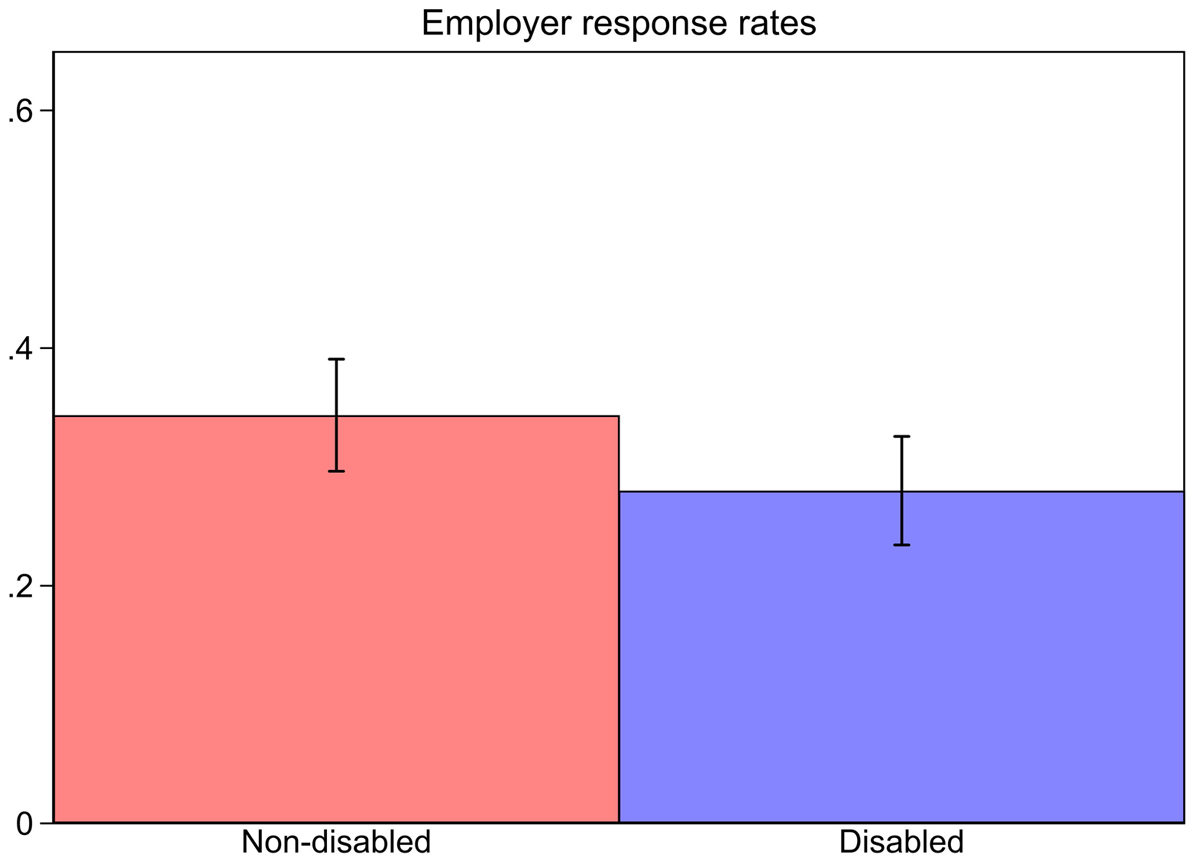
Figure 1
Positive employer response rates, two categories.
Note: Black bars represent 95% confidence intervals.
Given the known discrimination against males in this sector (Ahmed, Granberg and Khanna 2021), it is essential to incorporate gender into our analysis. The probability of a non-disabled female applicant receiving a positive employer response was 42% (85/202), while for disabled female applicants, this probability was 37% (72/197). The marginal difference between non-disabled and disabled female applicants was not statistically significant, χ2(1, N = 399) = 1.28, p = .258.
Among male applicants, the non-disabled applicant received a positive employer response 26% (50/191) of the time, while the disabled applicant received a positive response 19% (33/178) of the time. Thus, the non-disabled male applicant was seven percentage points (or 37%) more likely to receive a positive response than the disabled male applicant, a statistically significant difference, χ2(1, N = 369) = 3.08, p = .079. The differences by gender are shown graphically in Figure 2.
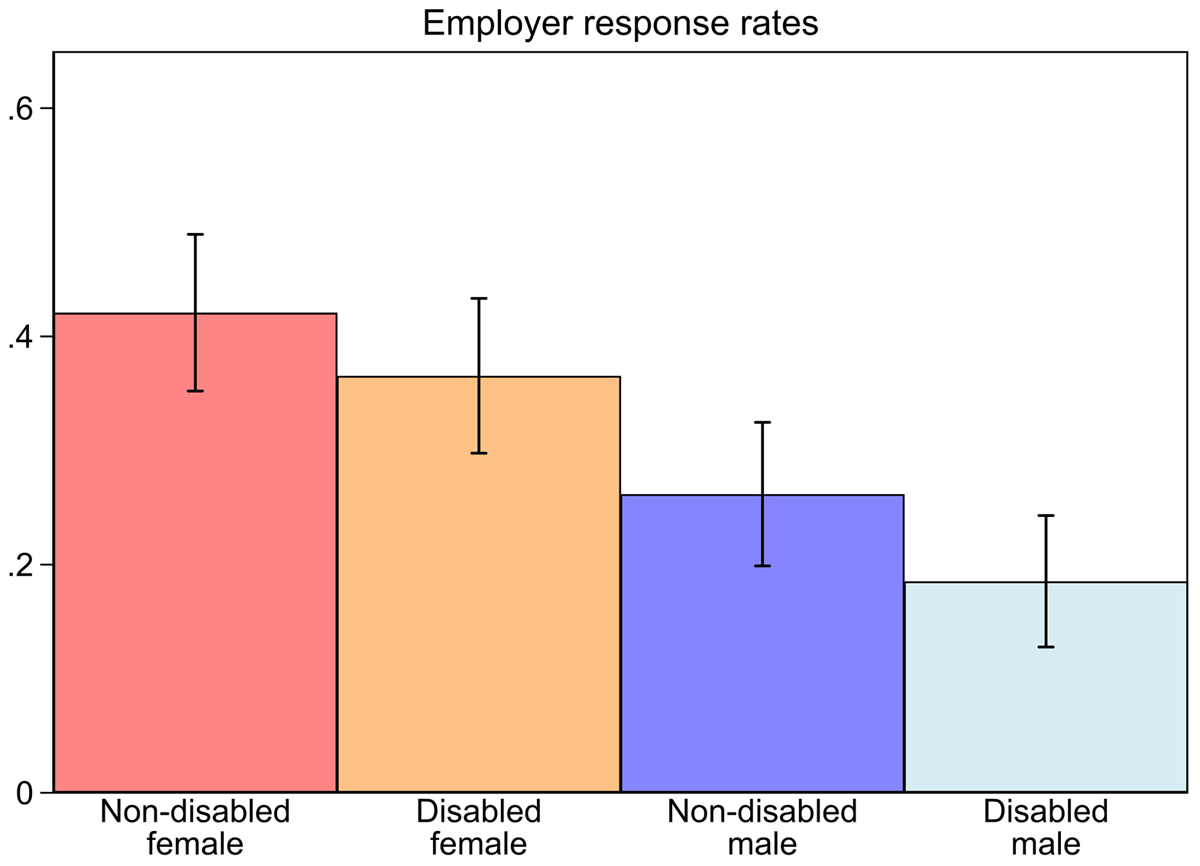
Figure 2
Positive employer response rates, four categories.
Note: Black bars represent 95 percent confidence intervals.
Another way to show these results is through regression. We use the LPM, controlling for gender, whether the job was in a major metropolitan area, i.e., in Stockholm, Göteborg, or Malmö (urban), whether it was a full-time position, an indefinite contract duration, the natural logarithm of number of employees at the company (ln(employees)), and the natural logarithm of company revenue in Swedish kronor (ln(revenue)). The variables ln(employees) and ln(revenue) have some missing data since they are not available for all observations, somewhat limiting the number of observations for the regression with full controls. Results are shown in Table 1.
Table 1
LPM estimates of marginal positive employer response probabilities.
| (1) | (2) | (3) | (4) | |
|---|---|---|---|---|
| Disability | –0.064* | –0.065** | –0.065** | –0.075** |
| (0.033) | (0.033) | (0.032) | (0.036) | |
| Male | –0.169*** | –0.183*** | –0.180*** | |
| (0.033) | (0.032) | (0.036) | ||
| Urban | –0.186*** | –0.201*** | ||
| (0.033) | (0.038) | |||
| Full time | –0.087*** | –0.047 | ||
| (0.033) | (0.039) | |||
| Indefinite contract | 0.011 | 0.033 | ||
| (0.051) | (0.058) | |||
| ln(Employees) | 0.026 | |||
| (0.029) | ||||
| ln(Revenue) | –0.008 | |||
| (0.028) | ||||
| Constant | 0.344*** | 0.426*** | 0.531*** | 0.596 |
| (0.024) | (0.030) | (0.035) | (0.375) | |
| Observations | 768 | 768 | 768 | 608 |
[i] Note: Standard errors in parentheses. *, **, and ***, indicate statistical significance at the .1, .05, and .01 levels respectively.
The LPM estimate a 7.5 percentage points penalty in positive employer response probability for disabled applicants compared to non-disabled applicants when controlling for applicant gender, job characteristics, and firm characteristics. This difference is significant at the 5% level. Expressed as a risk ratio, common in correspondence studies, non-disabled applicants are 1.278 times, or 27.8 percent, more likely to receive a positive response to their applications.
Discussion
The results of our study shed light on the complexities of disability discrimination within the Swedish labor market, mainly focusing on entry-level positions such as those in cleaning. We employed a nuanced method, subtly indicating disability via employment history at Samhall, which allowed us to assess ableist biases more accurately by minimizing the impact of perceived productivity differences. Our findings reveal a discrepancy in response rates between disabled and non-disabled job applicants. This difference hints at ingrained biases in employer hiring practices. Notably, non-disabled applicants, particularly among male applicants, were more likely to receive favorable responses than disabled applicants. This trend highlights the ongoing difficulties that people with disabilities face in securing employment – a crucial factor for their societal integration and personal growth.
Our research suggests potential challenges in the effectiveness of labor market integration programs such as Samhall. While these programs are crucial and aim to improve the employability of individuals with disabilities, our findings imply that prevailing biases in the labor market could potentially undermine their success. Even after participants have integrated into the common labor market post-program participation, biases may still exist. However, given the scope and design of our study, these conclusions are tentative and highlight the need for further, more detailed research to fully understand the long-term impacts of these programs.
It is of utmost importance to implement policy measures that enforce existing laws against disability discrimination (Swedish Code of Statutes 2008, 567) in tandem with labor market programs. The Equality Ombudsman also plays a crucial role in ensuring that the law is followed and that people are not discriminated against. Such policies are essential to ensure that the skills training provided by these programs effectively leads to fair employment opportunities. While enforcing anti-discrimination laws is crucial, research suggests that it is not sufficient on its own to change employer attitudes (Fisher and Purcal 2017). Successful policies have included a combination of direct contact with people with disabilities, diversity training programs, awareness campaigns, education about disabilities, and the implementation of anti-discrimination strategies (Fisher and Purcal 2017). For example, studies have shown that employer education and training programs can significantly reduce biases and improve attitudes toward hiring individuals with disabilities (Ruggs and McGonagle 2023).
Furthermore, our results highlight the potential problem of segregating labor market programs based on legally protected characteristics. Since Samhall focuses on people with disabilities, including work experience from Samhall in one’s application may signal this to employers and potentially serve as a basis for discrimination. The possible problematic consequences of segregated training programs underscore the need for integrated training environments that do not inadvertently signal lower productivity or reinforce stereotypes. Addressing these issues requires a multifaceted approach that combines legal enforcement with proactive measures to educate and engage employers, fostering a more inclusive and equitable labor market.
Our study has limitations. Focusing solely on one industry and entry-level jobs may limit the generalizability of our findings to other sectors and job levels. This narrow focus was necessary due to our concentration on Samhall’s primary domain. Additionally, while our method of subtly indicating disability is innovative, it does not capture the full range of biases against more noticeable or severe disabilities that have been documented in the previous literature (Ameri et al. 2018; Baldwin and Johnson 2006; Bellemare et al. 2023; Bjørnshagen and Ugreninov 2021; Hipes et al. 2016; Krogh and Bredgaard 2022; Ravaud, Madiot and Ville 1992; Stone and Wright 2013). Furthermore, although ethically justified, our use of fictitious applications may not fully capture the complex realities of real-world hiring practices. The binary outcome variable and the handling of ambiguous responses might oversimplify the nuanced nature of employer decisions. Moreover, while our randomization was designed to ensure the orthogonality of treatment to omitted variables, there may still be unobserved factors influencing employer responses. Future research should address these limitations by exploring a broader range of industries, job levels, and more detailed characterizations of disabilities. This would also include evaluating other labor market integration programs for a more comprehensive understanding. Finally, our research team did not include a direct representation of individuals with disabilities, which is a limitation that future studies should aim to address.
Data accessibility statement
The data that support the findings of this study are available at the Open Science Framework (https://doi.org/10.17605/OSF.IO/BV7G6).
Ethics and consent
Ethical approval was not required for this study under §§3-4 of the Ethical Review Act (Lag om etikprövning av forskning som avser människor) in Sweden (Swedish Code of Statutes, 2003:460) since no personally identifiable information of any human being was collected in the field experiment.
Acknowledgements
We thank seminar participants at Linköping University and the Ratio Institute for their valuable input.
Funding information
A.A. received financial support from The Swedish Research Council (grant number 2018-03487). M.G. received financial support from the Torsten Söderberg Foundation (grant number E46/21) and the Crafoord Foundation (grant number 20220590).
Competing Interests
The authors have no competing interests to declare.
Author Contributions
A.A. and M.G. conceptualized the study. G.A.K. and A.Å. designed the experiment, prepared the materials, programmed and executed the experiment, and collected and coded the data. M.G., G.A.K., and A.Å. conducted the analysis. A.A. and M.G. wrote the article and made the revisions.