
Introduction
People with disabilities include those who have ‘long-term physical, mental, intellectual or sensory impairments which in interaction with various barriers may hinder their full and effective participation in society on an equal basis with others’ (United Nations General Assembly 2007: 4). Approximately 16 percent of the world’s population lives with a disability; an estimated one billion people (World Health Organization 2022). Disability prevalence increases with age and estimates indicate that 80 percent of people with disabilities live in low- and middle-income countries (LMICs) (World Health Organization & The World Bank 2011).
The global policy of equity and disability inclusion is enshrined in several treaties and legislative mandates. The United Nations Convention on the Rights of Persons with Disabilities (UNCRPD) was launched in 2006 to ‘promote, protect and ensure the full and equal enjoyment of all human rights and fundamental freedoms by all persons with disabilities, and to promote respect for their inherent dignity’ (United Nations General Assembly 2007: 4). The 2030 Agenda for Sustainable Development and the Sustainable Development Goals emphasise that action should leave no-one behind, with explicit mention of people with disabilities across key goals (United Nations General Assembly 2015). However, people with disabilities in LMICs are often excluded from community life, education, employment, and healthcare services, negatively impacting their health and quality of life (Bright & Kuper 2018; Egan et al. 2022; Hashemi et al. 2022; Prynn et al. 2021; Tripney et al. 2017). Disability is further associated with poverty and people with disabilities are at risk of stigma, discrimination, and violence (Banks, Kuper, & Polack 2017; Fang et al. 2022).
People with disabilities face continued exclusion from health, education, support, and employment systems, arising from inadequate, inappropriate, or inaccessible services, and there is a need to strengthen systems to overcome these challenges (Bright, Wallace, & Kuper 2018; Hunt et al. 2022; Mendoza & Heymann 2022). As noted in Article 31 of the UNCRPD, understanding the experiences and needs of people with disabilities is necessary to inform policy and programming (United Nations General Assembly 2007). Moreover, evidence is necessary to motivate stakeholders towards the equitable allocation of limited resources to optimise quality of life and well-being for people with disabilities, and to achieve the obligations outlined in the UNCRPD. It is essential that local evidence is used to develop relevant and practical disability-inclusive policies and programmes. Although there are positive actions being taken, strategies in LMICs often rely on evidence from high-income settings, leading to policies, programmes and interventions that may not be feasible or appropriate to local contexts and needs (Kwete et al. 2022). Even within studies from LMICs, there is an uneven geographic distribution of evidence. A recent evidence and gap map of studies on interventions for people with disabilities found very few studies from low-income settings and a dearth of evidence from sub-Saharan Africa (Saran, White, & Kuper 2020). There is need for further evidence from LMICs to inform contextually relevant disability-inclusive strategies.
This review therefore aims to synthesise evidence on the lived experience of people with disabilities in Zambia to support national disability policy and practice. Whilst serving as a comprehensive source for existing disability research, this review also aims to identify gaps in the available literature to inform future research.
Zambia, a landlocked country in South-Central Africa, was recently reclassified by the World Bank as a lower-middle-income country (World Bank 2023). Primary and secondary education is free in Zambia, although only 63 percent of children transition from primary to secondary school and learning outcomes are generally poor (Zambia Ministry of Education 2022), as a result of limited space in schools, low teacher preparedness, and insufficient funding (United Nations Children’s Fund 2023b). The health system is comprised of primary health services at community level (e.g., health centres), first and second level hospitals at district and provincial levels, and tertiary and specialised hospitals at the national level. There have been efforts to promote Universal Health Coverage, supported by the National Health Insurance Scheme, and although there has been progress in health service delivery, the Ministry of Health recognises challenges in healthcare access and status among women, children, and vulnerable groups (Zambia Ministry of Health 2023).
A 2015 national survey estimated that approximately 7.7 percent of people in the country had a disability (Central Statistical Office of Zambia 2018). For adults aged 18 and over, the prevalence of disability was estimated at 10.9 percent, and at 4.4 percent for children aged 2–17 years. The all-age prevalence in Zambia is higher than some comparable countries in East and Southern Africa, such as Kenya (2.2%) (Kenya National Bureau of Statistics 2019), Tanzania (3.2%) (Kuper et al. 2016), and Botswana (4.2%) (Central Statistics Office of Botswana 2017), whilst it is slightly lower than others, such as Malawi (11.6%) (National Statistical Office of Malawi 2018) and Uganda (12.4%) (Uganda Bureau of Statistics 2018). Stigma and discrimination towards persons with disabilities is evident in Zambia. Findings from an assessment of disability stigma in sub-Saharan Africa show that there are examples of negative cultural and religious beliefs about the causes of disability in Zambia (Rohwerder 2018). These include ancestral curses, the sins of parents, and demonic possession. These are similar to beliefs held in other countries included in the assessment, such as Cameroon, Ethiopia, Senegal, and Uganda.
The Government of the Republic of Zambia has made efforts to progress disability-inclusive policies, ratifying the United Nations Convention on the Rights of Persons with Disabilities (UNCRPD) in 2010, whilst enacting the Persons with Disabilities Act No.6 in 2012 and the National Policy on Disability in 2013. The Zambia Agency for Persons with Disabilities (ZAPD), a quasi-governmental institution, was established under the Persons with Disabilities Act 2012, with the aim of promoting the rights of people with disabilities in the country and to uphold the Articles of the UNCRPD. Further, households with people who are chronically ill or who have a severe disability, and are in the poorest socioeconomic bracket, are eligible to qualify for the Government Social Cash Transfer scheme, to support their participation. Eligible households receive 400 Kwacha (~$18) per month (Martin et al. 2022). The Persons with Disabilities Act 2012 requires that the Ministry of Health provide free general and specialised health care to people with disabilities. However, limited resources and services hinder implementation (Zambia Agency for Persons with Disabilities 2017).
In their latest Strategic Plan, ZAPD state, ‘One of the critical issues being faced by the country is the absence of data on people with disabilities in relation to social issues, such as gender, HIV and AIDS, access to justice, access to health and education among others’ (Zambia Agency for Persons with Disabilities 2017: 7). However, to date, there is no synthesis of disability evidence in Zambia to comprehensively understand the lived experience of people with disabilities, and to support advocacy, policies, and programmes. This review aims to establish the breadth and diversity of the literature on disability in Zambia, to synthesise the evidence on the lived experience of people with disabilities across key life areas, such as education, employment, and health, and to identify evidence gaps for future research attention.
Method
The protocol for this review was registered on the Open Science Framework on February 16, 2022 (https://osf.io/akx3j).
The scoping review was conducted and reported in accordance with the PRISMA Extension for Scoping Reviews (PRISMA-ScR) guideline and Arksey and O’Malley’s framework for scoping reviews (Arksey & O’Malley 2005). In line with this framework, we conducted the review over five stages: (1) identifying the research question; (2) identifying relevant studies; (3) study selection; (4) charting the data; (5) collating and summarising the results.
Research question
What is the lived experience of people with disabilities in Zambia?
Eligibility criteria
Criteria for the review was developed using the SPIDER framework, appropriate for reviews of mixed-methods research (Cooke, Smith, & Booth 2012).
S = Sample
People with disabilities of any age, with any impairment type
Parents, caregivers, or family members of people with disabilities
People without a disability, reflecting on support or interaction with people with disabilities (for example, healthcare professionals, teachers, or community members)
Studies describing findings of relevance to people with and without disabilities were included if data relevant to people with disabilities was clearly disaggregated
Participants or the population of interest must be based in Zambia. Studies conducted across multiple countries, including Zambia, were included if data from Zambia was clearly disaggregated
PI = Phenomenon of interest
Research related to disability, including policy analysis, lived experience, community knowledge, and programme evaluation
Prevalence studies were excluded in order to focus on lived experience
Treatment studies and evaluations of interventions to alleviate a health condition were excluded (e.g., surgical procedures and interventions for mental health conditions)
D = Design
Any recognised research methodology, including questionnaire, survey, in-depth interview, case study, focus group discussion, and policy analysis
E = Evaluation
Studies with no applied research methodology were excluded, including general literature reviews, commentaries, opinion pieces, and programme descriptions
R = Research type
Any study design including quantitative, qualitative, and mixed-method
Policy analysis was included
Situational analyses were scanned for relevant individual studies
Systematic review/scoping review/meta-analyses were excluded, but were scanned for primary research
PhD theses were included only if they presented one primary study; if they presented multiple primary studies, we considered each study individually
All studies must be published in English
Both peer-reviewed and grey literature were included
Search strategy
Articles were retrieved through a systematic literature search of MEDLINE, Web of Science, CINAHL, PsycInfo, Global Health, Africa-Wide Information, and Embase. These databases were searched from their inception date. Subject headings and Boolean operators were used. Reference lists of included studies were searched for additional articles for inclusion.
The search was conducted on 12 June 2023. As an example, the MEDLINE search strategy is available in Appendix A.
Search for grey literature was conducted through online search engines Google, Google Scholar, OpenGrey, and Greylit using the terms ‘Disability’ and ‘Zambia’. The first 50 results of each search were included in the screening by title and abstract. In addition, we searched the graduate dissertation database of the University of Zambia for relevant theses using the search term ‘Disability’. The first 50 results were included in the screening by title and abstract. Further, we manually searched the websites of organisations that may be working with people with disabilities in Zambia. Relevant research was filtered into the screening by title and abstract. The list of organisations searched is included in Appendix B.
Study selection
Study selection was conducted with use of Covidence software. Authors NS, MBC, TCK, KN, QS, and TS first screened all titles and abstracts against the eligibility criteria. Each record was independently screened by two reviewers. With a large number of results proceeding to the full-text screening, consensus was made to exclude all articles published before the UNCRPD was adopted in December 2006, thus including only articles from 2007 onwards. Further, consensus was made to exclude prevalence studies and treatment studies, in order to maintain relevance and focus the review to lived experience. Subsequently, full-text articles were independently reviewed by two reviewers. Discrepancies throughout were discussed between the two reviewers and with the wider team, if needed.
Data extraction and charting
Authors NS, MBC, TCK, KN, and QS extracted equal portions of the final included articles. The extraction form was first piloted by each team member, with amendments made as necessary. TS reviewed the extraction of NS. Author NS reviewed the extraction of MBC, TCK, KN, and QS. Data extracted included:
Publication details: author, year of publication, title, country, aims/objectives, and study design
Intervention characteristics and key findings: intervention setting and delivery agent, intervention components, outcome measurement tools, data collection timepoints, and result summary
Quality assessment
Given that scoping reviews seek to understand the breadth and scope of evidence available, rather than exclude those deemed low quality, we did not complete an assessment of risk of bias (Peters et al. 2015).
Synthesis of results
Available studies have been grouped under headings of key topic areas in line with the UNCRPD, including education, health, and employment. Evidence from the included studies have been narratively synthesised. When qualitative data are available, we have extracted and included quotes from the included articles.
When providing an overview of the studies (Table 1), we have classified studies against the most relevant disability type and/or impairment. The category defined as ‘neurological’ was used to define neurological disorders for which various impairments can result. This category includes autism, cerebral palsy, neural tube defects, epilepsy, stroke, and disorders associated with communication impairment. Studies listed under HIV include those that focus on people with disabilities and comorbid HIV, as well as studies that look at people with HIV through a lens of impairment and disability. Where studies list a sample of people with disabilities as a broad group, we have included the disability type as ‘all disability’.
Table 1
Summary of study characteristics.
| Total | 122 (100%) | |
|---|---|---|
| Year of publication | 2007–2010 | 19 (16%) |
| 2011–2014 | 40 (33%) | |
| 2015–2018 | 30 (25%) | |
| 2019–2023 | 33 (27%) | |
| Peer-reviewed | Yes | 71 (58%) |
| No | 51 (42%) | |
| Topic area | Education | 41 (34%) |
| Health | 20 (16%) | |
| Impact of disability | 14 (11%) | |
| Disability awareness | 13 (11%) | |
| Family | 12 (10%) | |
| Accessibility | 8 (7%) | |
| Policy | 7 (6%) | |
| Work | 6 (5%) | |
| Justice | 1 (1%) | |
| Disability type | All disability | 57 (47%) |
| Neurological | 22 (18%) | |
| Visual | 14 (11%) | |
| Psychosocial | 13 (11%) | |
| Intellectual | 12 (10%) | |
| Physical | 9 (7%) | |
| Hearing | 8 (7%) | |
| Study design | Qualitative | 55 (45%) |
| Mixed-methods | 35 (29%) | |
| Quantitative | 31 (25%) | |
| Policy analysis | 3 (2%) | |
| Province | Lusaka | 73 (60%) |
| National | 23 (19%) | |
| Southern | 15 (12%) | |
| Copperbelt | 14 (11%) | |
| Central | 11 (9%) | |
| Western | 5 (4%) | |
| Eastern | 4 (3%) | |
| North-Western | 2 (2%) | |
| Luapula | 2 (2%) | |
| Northern | 1 (1%) | |
| Unclear | 1 (1%) |
[i] NB: Studies may be attributed to more than one category (e.g., studies conducted in multiple locations) and the total of some variables is therefore greater than the total of included studies (n = 122).
Results
The database search generated 10,327 results, from which 4,841 duplicates were removed (Figure 1). In total, 5,486 records were screened by title and abstract, with 725 full-text articles reviewed. Of these, 122 have been included in the final synthesis (Appendix C).
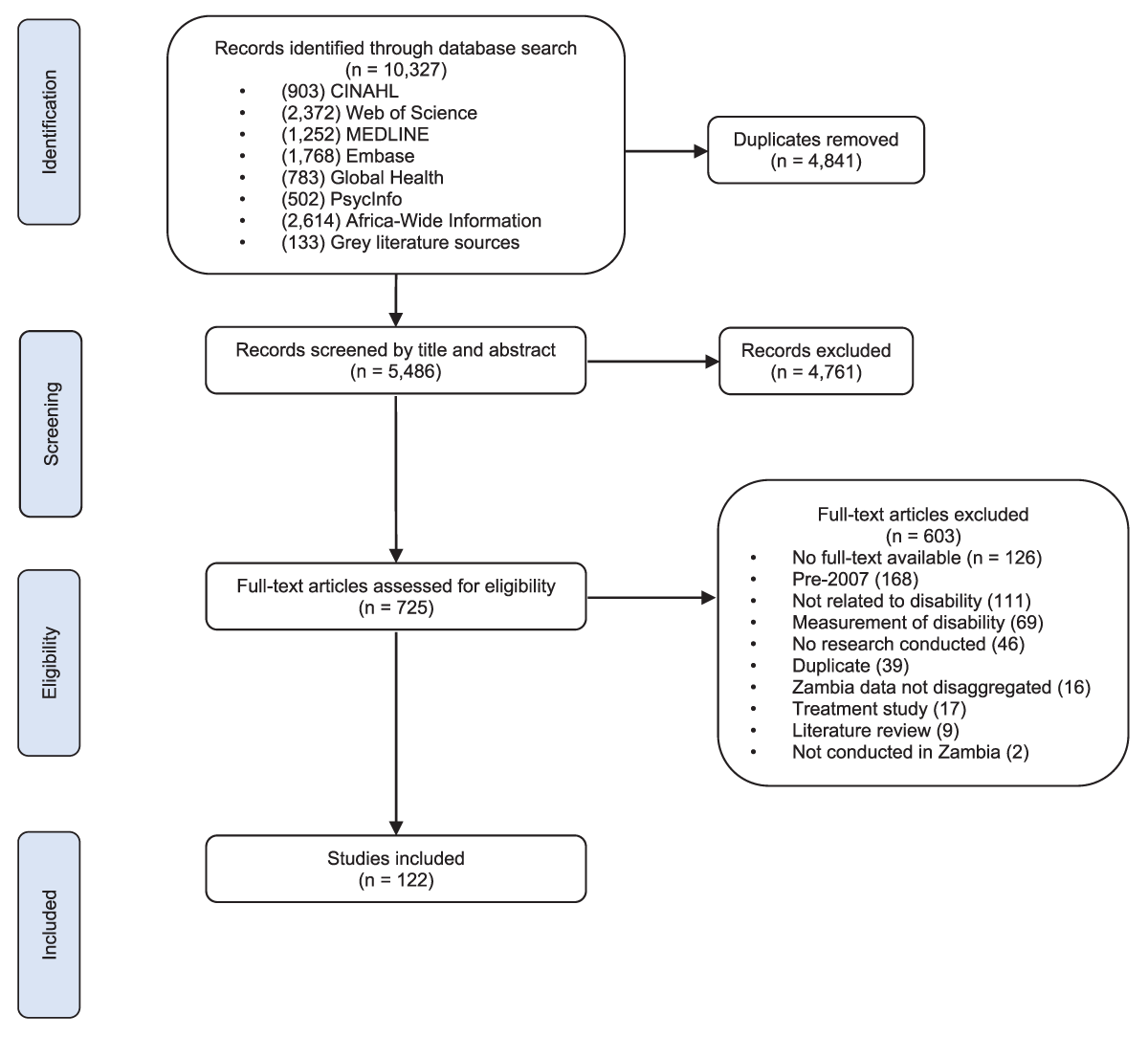
Figure 1
PRISMA flow diagram.
Study characteristics
Of the 122 studies included, 16 percent (n = 19) were published between 2007–2010, 33 percent (n = 40) between 2011–2014, 25 percent (n = 30) between 2015–2018, and 27 percent (n = 33) between 2019–2023. Of those included, 58 percent (n = 71) were peer-reviewed articles; the remaining 42 percent (n = 51) being student theses, conference presentations, and other grey literature. The majority of studies included focus on people with disabilities broadly (47%, n = 57), with the remainder focused on specific impairments and health conditions. Most studies adopted qualitative research methods (45%, n = 55). When considering mixed-methods studies, (29%, n = 35), nearly three-quarters of the included articles utilised qualitative methods (74%, n = 90). Finally, the majority of studies were conducted in Lusaka Province (60%, n = 73), followed by national representation (19%, n = 23), Southern Province (12%, n = 15), and Copperbelt Province (11%, n = 14).
Policy development and implementation
Seven (6%) studies focused on national policies and laws, although only two were published in the past five years (Birtha 2013; Bwalya et al. 2017b; Cleaver et al. 2020a, b; Faydi et al. 2011; Mwanza et al. 2008; Omar et al. 2010).
One notable study completed an analysis on the extent to which Zambian policies addressed the needs of people with disabilities (Bwalya et al. 2017b). Policies were scored and analysed against six criteria: Rights of People with Disabilities, Accessibility, Inclusivity, National Implementation Plan, Enforcement Mechanism, Budgetary Concerns, and Information Management Systems. Further, strengths and weaknesses across the policies were summarised under different domains. Disability-specific policies complied with the UNCRPD, except the Mental Health Act, which predates the Convention. Policies in education, health and employment received a score of ‘questionable’ to ‘medium’ inclusion of disability rights. In education policies, for example, disability inclusion in primary education was well noted, but this was not the case for tertiary or vocational education. Across the policies authors identified a need for strengthening the implementation and budgetary allocations for policies, as well as clearly defined monitoring plans with key indicators. Many of the policies were outdated against the principles of the UNCRPD and needed updating.
In the other studies, implementation of disability policies was reported to be low, and there is need to better mainstream disability across government, sensitising government workers on disability rights and those enshrined in Zambia’s laws and policies.
Impact of disability
Fourteen (11%) studies focused on the impact of disability on the lives of people with disabilities and their families, with relation to social and economic life, well-being and quality of life (Birbeck et al. 2007; Chomba et al. 2008; Cleaver et al. 2018; Hearst et al. 2023; Karr 2011; Kuper et al. 2014; Mapulanga, Nzala, & Mweemba 2014; Mulenga 2010, Mulima 2012; Nixon et al. 2011; Simpamba 2020; Trani & Loeb 2012; Wickenden, Nixon, & Yoshida 2013; Yoshida et al. 2014). Just two of these studies had been conducted in the past five years (Hearst et al. 2023; Simpamba 2020).
These studies underscore the challenges faced by people with disabilities, from the socio-economic impact of disability to quality of life. Evidence showed that people with disabilities were less likely to have access to running water or electricity, were less likely to be employed, were less likely to marry, were less likely to be in school, and were more likely to experience physical abuse. Two recent studies demonstrated the higher likelihood of food insecurity and malnutrition among children with disabilities (Hearst et al. 2023; Simpamba 2020). Another found that poverty was a major concern for people with disabilities, underpinning many of the challenges in their lives (Cleaver et al. 2018).
Findings indicate the substantial impact of disability on people’s lives. Recent findings related to increased risk and impact of poverty, food insecurity, and malnutrition highlight the need for policies and intervention programmes that address these concerns.
Disability awareness
Thirteen (11%) studies examined disability awareness and attitudes (Atadzhanov et al. 2010; Birbeck et al. 2008; Chansa-Kabali, Nyoni, & Mwanza 2019; Elafros et al. 2018; Elafros et al. 2013a; Elafros et al. 2013b; Hearst et al. 2022; Hepperlen et al. 2021a; Jacobs 2011; Kapungwe et al. 2010; Mbewe et al. 2007; Pupillo et al. 2014; Sichimba, Janlöv, & Khalaf 2022). Seven (54%) studies focused on epilepsy stigma (Atadzhanov et al. 2010; Birbeck et al. 2008; Elafros et al. 2018; Elafros et al. 2013a; Elafros et al. 2013b; Mbewe et al. 2007; Pupillo et al. 2014), although none have been published in the past five years.
Studies on epilepsy stigma found that people with epilepsy in Zambia were socially excluded and isolated. This leads to difficulties in finding a partner and accessing employment opportunities. Studies found similar findings with regards to stigma and discrimination towards all disability. In some of the studies, such as Chansa-Kabali et al. (2019), there was limited awareness and understanding of disability and associated conditions, which resulted in increased stigma (Chansa-Kabali, Nyoni, & Mwanza 2019). Furthermore, the pervasive stigma and discrimination faced by people with disabilities extends to their families as well.
So, I came in contact with stigma and discrimination and that introduced me to life of misery, you know you can’t get a job… you can’t be accepted. I couldn’t see hope and my future was chopped off. I live a life of loneliness. (Individual with a mental health condition) (Kapungwe et al. 2010: 195)
Of note, people with comorbid conditions can experience increased vulnerability to stigma; in assessing layered stigma, Elafros et al. (2018) found that people with epilepsy and HIV were more likely than people with HIV only to report feeling like they were ‘no longer a person’ because of their HIV status, and they were more likely to associate epilepsy with prejudice than people with HIV or epilepsy only (Elafros et al. 2018: 58).
To combat stigma towards disability, studies by Hearst et al. (2022) and Hepperlen et al. (2021a) piloted Kusamala +, an intervention that aimed to reduce stigma towards children with disabilities (Hearst et al. 2022; Hepperlen et al. 2021a). Held in maternal and child health clinics, churches, and community spaces, the programme included assessment and play therapy for children with disabilities and encouraged families to access social welfare and to register with the Zambia Agency for Persons with Disabilities. Community education covered disability types and causes, prevention, and disability rights. The intervention reached 23,000 community members. Parents reported that fewer children with disabilities faced rejection by peers after the intervention (baseline = 74%; follow-up = 56%; p = 0.004). However, parent and community stigma measures did not significantly improve, and 44 percent of children with disabilities remained rejected in the community. Authors called on government support to refine the programme and promote scale-up.
The included studies indicate that stigma towards disability remains prevalent in Zambia, with a need for education and awareness raising programmes on a national scale. While there are indications that these programmes may have some impact on reducing stigma, there is a crucial need for government support and funding to achieve the intended impact.
Accessibility and participation
Eight (7%) studies considered accessibility and the participation of people with disabilities in public, political and cultural life (Banda-Chalwe, Nitz, & de Jonge 2014; Chiluba 2019; Gize 2016; Hansen, Siame, & van der Veen 2014; Kalomba 2018; Mwape 2019; Phiri 2007; Pilke & Waliyua 2022).
Physical inaccessibility remains a major barrier to participation in everyday life. For example, Banda-Chalwe (2014) found that people with mobility impairments perceived the built environment of Zambia to be inaccessible, limiting their opportunities in education, employment, and community life (Banda-Chalwe, Nitz, & de Jonge 2014). Limited accessibility was also viewed as infringing on their sense of dignity.
I crawl up and down stairs of buildings when I want to buy school requirements for my children and the shop where I can find what my children need is upstairs at a shopping complex. I feel embarrassed crawling and my children also feel embarrassed […] Sometimes I am forced to crawl up stairs when I want to interview for a job […] Asking me how I would be managing going to the 4th floor crawling if I am offered the job is an insult to my integrity, dignity and respect! (Female with a mobility impairment, aged 42) (Banda-Chalwe, Nitz, & de Jonge 2014: 8)
The studies reveal a lack of effective implementation of disability policies and standards to promote disability rights and accessibility. Chiluba (2019) found that policies and legislation to promote accessibility were poorly implemented because of limited enforcement penalties, lack of auditors and inspectors, limited coordination mechanisms, limited resources, poor knowledge on disability rights and policy, and limited representation of people with disabilities in decision-making procedures (Chiluba 2019). In particular, ZAPD was said to have limited resources to deliver their mandate to promote accessibility. Further, Pilke and Waliyua (2022) found substantial barriers for people with disabilities looking to be involved in politics and public decision-making (Pilke & Waliyua 2022). They called for improved understanding of these barriers within the political system and more effective implementation of legal frameworks to ensure equal rights.
Overall, the included studies highlight inaccessible environments and information for people with disabilities in Zambia. Despite existing frameworks to promote accessibility, there is pressing need for improved implementation to foster inclusivity.
Health
In total, 20 (16%) studies investigated health and healthcare for people with disabilities (Chintende et al. 2017; Chipanta et al. 2021; Chomba et al. 2007; Hachipola, Mweemba, & Sitali 2017; Hearst et al. 2021; Kapungwe et al. 2011; Karban 2013; Katuta 2011; Magnussen 2011; Munakampe 2020; Mwale & Chita 2016; Mwansa 2010; Mwanza et al. 2011; Mwape et al. 2010; Nixon et al. 2014; Parsons, Bond, & Nixon 2015; Schenk et al. 2020; Sikwese et al. 2010; Simbyakula 2009; Simpamba, Struthers, & Mweshi 2016). However, just four of these were published in the past five years (Chipanta et al. 2021; Hearst et al. 2021; Munakampe 2020; Schenk et al. 2020).
Seven of the studies focused on experiences of healthcare and healthcare access (Hachipola, Mweemba, & Sitali 2017; Magnussen 2011; Mwansa 2010; Nixon et al. 2014; Parsons, Bond, & Nixon 2015; Schenk et al. 2020; Simpamba, Struthers, & Mweshi 2016), although just two looked at access to general healthcare for people with disabilities broadly, and these were over 10 years old (Magnussen 2011; Mwansa 2010). The remaining five looked at specific scenarios, such as access to HIV services or cervical cancer screening, or they looked at the experiences of a specific group of people with disabilities, such as children with neural tube defects (Hachipola, Mweemba, & Sitali 2017; Nixon et al. 2014; Parsons, Bond, & Nixon 2015; Schenk et al. 2020; Simpamba, Struthers, & Mweshi 2016). Barriers to access were consistently identified, including inaccessible buildings, inappropriate equipment and difficulties accessing health information, when no accessible formats were provided.
At least every disabled person should have access to the building, like even the toilet, they are not all that good. They are not friendly for a person who is disabled… who cannot use the type of toilets that are there. It all contributes to people with disabilities not going to the clinic also. (Key informant) (Hachipola, Mweemba, & Sitali 2017: 12)
Many participants across the studies noted the challenges of transport to health facilities, especially noting the need to pay for an accessible option. Stigma and discrimination from the community and health staff also stopped many from seeking care. There were calls from these studies for widespread accessibility audits and training on disability for staff members.
Seven studies investigated access to HIV services for people with disabilities, or the health and healthcare experience of people with disabilities and HIV (Chintende et al. 2017; Chipanta et al. 2021; Katuta 2011; Nixon et al. 2014; Parsons, Bond, & Nixon 2015; Schenk et al. 2020; Simbyakula 2009). Studies found that many people still view people with disabilities as a group that do not engage in sexual activity and thus are not at risk of HIV. In studies such as Chintende et al. (2017) and Schenk et al. (2020), participants reported having limited knowledge of HIV and sexual health because of inaccessible HIV-information (Chintende et al. 2017; Schenk et al. 2020). There were calls for improved awareness on HIV and sexual health for people with disabilities, as well as accessible forms of information, through Braille, large print, and sign language interpretation.
Health education was a primary concern across the included studies, yielding several recommendations. Alongside the aforementioned accessible information, studies recommended workshops and formal training, utilising people with disabilities and lived experience as peer educators. As well as health education for people with disabilities, studies called for training of health staff, to improve knowledge and attitudes, and ultimately to increase accessibility. Parents also wished for more information and training on how to access health services.
The evidence available indicates barriers to healthcare access and recommendations for improvement. Recommendations were made for extensive accessibility audits, health education for both individuals with disabilities and healthcare staff, and improved awareness on HIV and sexual health, emphasising the need for inclusivity and knowledge dissemination to create a more equitable healthcare environment.
Education
Education was the most common topic amongst the included studies (Akakandelwa & Munsanje 2012; Azalde et al. 2018; Banja & Mandyata 2019; Bwalya 2014; Chinombwe 2011; Chirwa 2011; Chisembe 2017; Fulawulu 2014; Hamusonde 2014; Jere 2020; Kaindu 2021; Kasongole & Muzata 2020; Kauka 2010; Leonard Cheshire & UNESCO 2011; Maiba 2012; Malata & Muzata 2022; Malungo et al. 2018; Manda 2013; Mando 2011; Mandumbwa 2020; Mandyata 2015; Mandyata et al. 2017; Mtonga 2013; Mushole 2012; Mwamba 2016; Mwanza 2010; Nalungwe 2014; Ndawa 2021; Ndesaula et al. 2022; Ndhlovu-Choola 2007; Ndonyo 2007; Ndume 2021; Njelesani et al. 2021; Njelesani, Si, & Swarm 2022; Nkolola-Wakumelo & Manyando 2013; Samanenga 2015; Sibanda 2016; Simui et al. 2019; Sinyinza 2017; Zemba & Chipindi 2020). In total, 41 (34%) studies investigated the education of children with disabilities. The majority (68%, n = 28) of these publications were not peer-reviewed, with many from University of Zambia students pursuing a Masters in Special Education. Nearly one-third (29%, n = 12) were published in the past five years.
The studies consistently revealed evidence of exclusion of children with disabilities from education. Special schools were found to be scarce, and exclusion from mainstream education was attributed to inaccessible teaching materials, the cost of school and transport, and inaccessible buildings. This exclusion persisted from older to more recent studies.
Stigma from community members, teachers, parents, and other students was also a major barrier to education. Some schools were reported to have rejected applications from children with disabilities and children in schools have been victims of bullying and violence. Notably, Njelesani et al. (2022) found that teachers often blamed students with disabilities for the violence occurring and did not often address violence when reported (Njelesani, Si, & Swarm 2022). Teachers reported inadequate child protection policies and little training for teachers on supporting children with disabilities.
One day when I was playing a boy hit me with a stick. When I complained to the teacher, the teacher said I could not play football anymore. He said I am the one who disturbs the team. (Male with a disability, aged 17) (Njelesani, Si, & Swarm 2022: 4)
Many of the barriers to education stem from limited funding and resources to implement inclusive education policies. Mandumbwa (2020) demonstrated that donor funding can improve access to education for youth with disabilities. However, there is an overreliance on donor funding to support inclusive education and many studies called for greater government commitment to implement national policies (Mandumbwa 2020). Additionally, studies reported that the Ministry of Education’s insufficient support of head teachers has hindered implementation of these policies.
We don’t have enough teachers to support learners with disabilities. But we need more [teachers] so that every child [with a disability] is reasonably supported. At the moment, our teachers are a bit overstretched in terms of teaching workload. Our school requires a multi-disciplinary team. We need more trained in inclusive education with a background in disability screening and assessment. Such a team is needed in this school. (Head teacher) (Zemba & Chipindi 2020: 122)
Overall, the evidence indicates the severe challenges faced by children with disabilities in accessing education, with greater support needed for inclusive education, including funding and resources.
Work and employment
Six (5%) studies reported on work and employment for people with disabilities (Bwalya et al. 2017a; Chilambwe 2013; Kachaka & Imasiku 2012; Mulenga 2007; Mwondela 2014; Njelesani et al. 2015). However, none of the studies were published in the past five years.
In a large quantitative study (n = 32,272), Bwalya et al. (2017a) found that people with disabilities were less likely to be in permanent employment, more likely to be informally employed and more likely to be self-employed than people without disabilities (Bwalya et al. 2017a). Of people with disabilities not working in the past 30 days, 42 percent reported the reason to be disability or injury/illness. When interviewing people with disabilities and HIV, Njelesani et al. (2015) found similar results, with participants reporting stigma and discrimination when seeking work (Njelesani et al. 2015). Participants said that employers often believed that people with disabilities could not perform well at work. HIV diagnosis compounded this discrimination, and many said that they lost their job once their HIV status was revealed.
[…] before, my eyes got worse, and the I was HIV-positive, there was, in a certain community, where there was some jobs… upon realising that we’re positive, we were told, ‘We cannot employ you.’ (Male with a visual impairment and HIV, aged 52) (Njelesani et al. 2015: 53)
These studies indicate barriers to employment for people with disabilities, but it is difficult to make firm conclusions of the present situation, with no studies completed in recent years.
Access to justice
Just one study looked at access to justice (Jacobson, Sabuni, & Talbot 2017). Many of the people with intellectual and psychosocial disabilities interviewed reported negative experiences at police stations, including not understanding what was happening and physical abuse (Jacobson, Sabuni, & Talbot 2017).
Statements from participants included: ‘I was brutally beaten by the police officers before they could even get a statement from me,’ ‘I was beaten, slapped and taken in to police cells,’ ‘When I reached the police station people were talking but I didn’t understand what they were trying to say’ (Jacobson, Sabuni, & Talbot 2017: 63).
Similarly, many had negative experiences in court, including fear, delays, and lack of comprehension about the proceedings. Additionally, experiences of prison were mostly negative and included poor physical conditions, limited food, physical abuse, and mistreatment by staff. The study revealed that many participants were unable to exercise their legal rights. Poor treatment throughout the justice system was said to reflect poor societal attitudes to disability. Respondents said that people with intellectual and psychosocial disabilities were at risk of interaction with the justice system because of limited health and social care support.
Family experience and support
Twelve (10%) of the included studies examined the experience of caregivers and families (Chiluba & Phiri 2019; Chiluba & Moyo 2017; Chirwa 2017; Hansangu 2015; Hepperlen et al. 2021b; Musuka 2017; Muzata 2020; Nsama 2013; Pierucci et al. 2023; Rabaey et al. 2021; Singogo, Mweshi, & Rhoda 2015; Washington-Nortey & Serpell 2021).
The majority of these studies uncovered challenges that caregivers and families of people with disabilities experience in Zambia. Families reported being blamed for their child’s disability, experiences of social exclusion and strain on family relationships. This can result from stigma and limited understanding of disability among community.
Taking a child with intellectual challenges out in public places, for instance shopping malls, can be a source of a big challenge to parents. People may stare, make comments or fail to understand any mishaps of behaviours that may occur […] As a result of these potential experiences, I often feel uncomfortable taking my child to the homes of friends or relatives […] As such, I experience a sense of isolation from friends, relatives and community. (Mother, aged 31, of a child with an intellectual disability, aged 9) (Hansangu 2015: 38)
Family members also reported having to stop work so that they could care for the person with a disability, and many faced financial difficulties, especially when having to pay for additional disability-related costs, such as travel to healthcare facilities and assistive technology. Some studies highlighted the impact of these stressors on caregiver and family mental health, with participants reporting feelings of depression, hopelessness, frustration, and emotional distress.
It has been hard financially since my husband became sick… sometimes we go hungry at home just to reserve some money for bringing the patient to the hospital. (Caregiver of an individual with speech impairments as a result of stroke) (Chiluba & Phiri 2019: 217).
Parents in the studies of Hepperlen et al. (2021b) and Rabaey et al. (2021) told researchers how they wanted the community to learn about disability and understand that children with disabilities need love, care and dignity, the same as all others (Hepperlen et al. 2021b; Rabaey et al. 2021). Parents said that they kept their child indoors and away from others, as they were ashamed. These studies and others highlighted the need for community sensitisation on disability to reduce stigma and discrimination, as well as training and information on parents, so that they did not keep their child away from community life.
I want to teach that children with disability need to be loved and taken good care of. Some disabled children are not loved; they are treated as if they are outcasts or like workers. Only the able-bodied children are loved. Some parents do not wat to tell people that they have a disabled child; they do not acknowledge that the disabled child is theirs. (Caregiver of a child with a disability) (Rabaey et al. 2021: 4).
Caregivers said that children with disabilities are excluded from opportunities for play with other children. Very few caregivers across the studies reported any formal support. They relied on informal support from families and friends. Caregivers called for greater community support, including visits from community volunteers. They also suggested organised groups of caregivers, to reduce social isolation and teach them about disability. Pierucci et al. (2023) investigated one such caregiver-training intervention, Project ImPACT, finding it to be feasible, acceptable and to have a positive impact on child development (Pierucci et al. 2023). However, the sample size was small and there is need for larger-scale evaluations of parent interventions.
In summary, caregivers of children with disabilities in Zambia experience blame, social exclusion, strain on family relationships, financial difficulties, and negative impacts on mental health, highlighting the urgent need for community sensitisation, support, and interventions to reduce stigma and discrimination, and to provide adequate care and inclusion for children with disabilities and their families.
Discussion
This is the first scoping review to synthesise evidence on disability and the lived experience of people with disabilities in Zambia. This comprehensive scoping review of 122 studies revealed a number of ongoing challenges for people with disabilities, impinging on their rights and the rights enshrined in the UNCRPD. It highlights the need for improved implementation of disability-inclusive systems, policy updates and awareness-raising initiatives to address barriers to education, work, healthcare, justice, and social inclusion. Additionally, the review emphasises the importance of providing support and resources to caregivers and families of people with disabilities to improve their well-being and quality of life. Importantly, the review demonstrates the need to empower people with disabilities and their families in Zambia, so that they can have a voice in determining how and what policy is implemented.
Although the majority of the literature demonstrated challenges, there are a few examples of positive action in Zambia. Pierucci et al. (2023) demonstrated the feasibility, acceptability, and benefit of caregiver training (Pierucci et al. 2023). Such training programmes have been demonstrated globally to improve child development, parenting skills, caregiver well-being, and family relations (Reichow et al. 2023). Although the study from Pierucci et al. (2023) had a small sample size, results were positive, and the Government and service providers should consider implementing caregiver-training interventions in Zambia, ideally conducting large-scale evaluations. Further, Hearst et al. (2022) and Hepperlen et al. (2021) found the stigma-reduction intervention Kusamala + to be feasible, to be acceptable, and to have a positive impact on rejection of children with disabilities (Hearst et al. 2022; Hepperlen et al. 2021a). Although a little more dated, Elafros et al. (2013a) found that peer-support groups reduced internal stigma amongst youth with disabilities (Elafros et al. 2013a). There is a lack of quality evidence on stigma-reduction strategies for children with disabilities in low- and middle-income countries (Smythe, Adelson, & Polack 2020), but this research provides evidence on suitable approaches in Zambia. As noted by the authors, there is need for Government support to promote scale-up of such programmes across the country. Evidence on positive initiatives such as these was limited in this scoping review, as is the case for disability interventions across LMICs (Saran, White, & Kuper 2020). Moving forward, research in Zambia should focus on high-quality impact evaluations of interventions to support people with disabilities, in order to support advocacy, policymaking and service provision. Impact evaluations are needed across key life areas, and they should include target interventions for people with all types of impairment (Saran, White, & Kuper 2020).
Whilst there have been efforts to promote disability in policy and law, this scoping review provides evidence on the need for action by the Government of the Republic of Zambia to secure the rights of people with disabilities outlined in the UNCRPD. Evidence of this review highlights the limited knowledge of disability rights across Government Ministries and limited implementation of disability-related policy actions. Moving forward, it is crucial for policy makers to address these shortcomings and ensure the comprehensive inclusion of people with disabilities in all spheres of life. For example, ZAPD and other organisations are working to progress disability rights, however such initiatives require government funding, resources, and capacity with which to achieve the actions set out in the UNCRPD. This evidence synthesis complements and supports the findings of two 2020 reports on the lived experience of persons with disabilities in Zambia submitted to the United Nations Committee on the Rights of Persons with Disabilities. The first, authored by the Zambia Federation of Disability Organisations (ZAFOD) and Disability Rights Watch, provides coordinated reports from disability organisations in Zambia, highlighting gaps in the implementation of the UNCRPD and priority actions needed to achieve the targets of the Convention (Zambia Federation of Disability Organisations & Disability Rights Watch 2020). Similarly, the second report, independently authored by the Human Rights Commission, outlines the challenges faced by people with disabilities in Zambia across key areas such as education and healthcare (Human Rights Commission of Zambia 2020). The report calls on the Government of the Republic of Zambia to reform policies and laws, and to enhance the capacity of ZAPD to effectively implement its mandate. This current review has provided synthesised evidence, gathered using rigorous and comprehensive methods, to support the calls for action in these reports.
In addition to the locally contextual evidence of this review and the two 2020 reports aforementioned, the Government should consider leveraging additional resources from international actors to facilitate the implementation of the UNCRPD. For example, guidance documents provided by the United Nations Partnership on the Rights of Persons with Disabilities (UNPRPD) provide national actors with support on realising national disability-inclusion. Guidance and training from the UNPRPD include an intersectionality resource toolkit, guidance on enhancing the political participation of people with intellectual and psychosocial disabilities, and guidance on how to conduct a situational analysis of disability-inclusion across the country. Specific to the right to health and SDG 3, the Missing Billion Initiative has developed a toolkit with which national stakeholders can identify progress towards disability-inclusive health across the country. The toolkit asks national actors to assess disability-inclusive health across key areas, including governance, health financing, human resources and health facilities. As recommended in the included literature in this review (Hachipola, Mweemba, & Sitali 2017; Nixon et al. 2014), we encourage the Zambian Ministry of Health to utilise this toolkit in assessment of the health system in Zambia, in order to develop a disability-inclusive health strategy. Key in the Missing Billion toolkit is the request for up-to-date data and evidence with which to inform policy and practice. As is evident from this review, there is need in Zambia for more recent data on healthcare for people with disabilities to inform inclusive-health practices. In general, international guidance and toolkits such as these provide Zambia with a valuable resource with which to foster disability-inclusive development, but as with any international resource, it is important to adapt the given recommendations to the local context, in partnership with key disability stakeholders. Under their given mandate, ZAPD are conducting assessments on disability-inclusion and promoting disability research, although recent research demonstrates that they need additional resources to support disability inclusion in Zambia (Chiluba 2019).
When building strategic direction in disability-inclusion, it is important to engage Organisations of Persons with Disabilities (OPDs), including the Zambia Federation of Disability Organisations (ZAFOD). The UNPRPD guidance on situational analyses highlights the importance of these engagements, to first help assess the disability context and to subsequently develop strategies for inclusion. OPDs are generally underfunded and understaffed, and the Government of the Republic of Zambia (as well as external funders) should continue to support OPD development in the country. The Bridge CRPD-SDGs training initiative from the International Disability Alliance and the International Disability and Development Consortium has aimed to develop the skills and capacity of OPDs globally, and such may be beneficial to OPDs in Zambia. Continued capacity development and increased funding will help OPDs in Zambia be involved in Government action and promote disability inclusion across the country. Developing on this principle, ZAPD and the Government of the Republic of Zambia should continue to develop community-based rehabilitation (CBR) and community-based inclusive development (CBID) programmes with people with disabilities, local communities and other partners, fostering strategic alliances.
Further to the recommendations here and included in the primary studies of this scoping review, the report from the Human Rights Commission highlights a number of strong recommendations to promote disability rights in Zambia (Human Rights Commission of Zambia 2020). Many of these are supported by the evidence in this review. Examples include strengthening Disability Focal Point Persons in Government, developing nationally consistent measures for disability data collection, critical review of laws and policies, adaptation to health facilities, and mass sensitisation efforts to address attitudes to disability. The recommendations outlined are numerous and ambitious. To achieve these, there must be improved knowledge of disability rights across all national and local Government agencies, as highlighted in the included literature. Further, financial, human, and technological resources must be made available if Zambia is to achieve disability inclusion. A lack of disability funding and resources within government systems (such as health and education) and for actors such as ZAPD were listed throughout the literature as a major barrier to national disability inclusion. A recent Disability Budget Brief from UNICEF highlighted that Government spending on disability-inclusion programmes in Zambia has accounted for less than 0.03 percent of the total national budget (United Nations Children’s Fund 2023a). The allocation to disability programmes as a proportion of the Ministry of Community Development and Social Services budget has been reducing since 2019, from 3.05 percent to 0.54 percent. As the report notes, funding for disability inclusion is low and is reducing. The report calls for the Government to supplement funds for disability programmes with support from major on-budget financiers, such as the International Labour Organization and the United Nations Development Programme. The report notes that the Government has made notable progress in providing social protection programmes, including the monthly cash-transfer, but only 0.82 percent of Government funds for disability programmes are financially supported by development partners. The report recommends that the Government take action to increase funding from external partners for disability-inclusion, in order to improve the welfare of people with disabilities.
Strengths and limitations
This review has a number of strengths. Adhering to PRISMA-ScR guidelines and the SPIDER framework provided methodological rigour. The search was broad and comprehensive, including a number of databases and grey literature. The dual review process at each stage of screening provided consistency and reduced bias.
There are limitations in this review to consider. First, we excluded studies prior to 2007 and we therefore cannot provide information on longitudinal trends prior to this date, which may help understand the evolution of disability policy and practice in Zambia. Second, the grey literature search strategy was limited, using just the word ‘disability’ as the primary search term. This search may therefore have excluded grey literature on specific groups, such as those with visual impairment. Third, we could not source 126 full texts, which may have been relevant. We contacted authors directly and made use of numerous institutional access agreements but still did not find these for assessment.
Implications for future research
Implementation of the UNCRPD in Zambia would be aided with the availability of current evidence, and although there has been consistent research on disability in Zambia since 2007, there is need to generate up-to-date evidence with which to inform policy and programming in a number of key areas, particularly healthcare and employment. Further, the vast majority of data has been collected in Lusaka Province, which holds the nation’s capital. This skew in data presents a challenge when aiming to develop contextually relevant programmes in more remote areas of the country. Funders and researchers should prioritise research in other Provinces to correct this issue. The majority of data is qualitative, and this is perhaps unsurprising, given the exclusion of prevalence studies and focus on investigation of lived experience. Large-scale surveys of lived experience, including employment status, education, etc. would be valuable. As argued by Abualghaid et al. (2019), ‘Disability-disaggregated data is vital to “leave no-one behind”’ (Abualghaib et al. 2019: 1).
Conclusion
This scoping review examined the literature on the lived experience of people with disabilities in Zambia, identifying challenges, disadvantages and inequalities experienced by people with disabilities, as well as gaps in the literature. There is need for a national response and priority actions in line with the UNCRPD, supported with adequate resources and informed by best practice guidance.
Data Accessibility Statement
This scoping review includes secondary data from the included studies. Supplementary file 1: Appendix C provides a summary of each included study, including findings and recommendations. Further details can be found in the manuscripts of the included studies.
Additional Files
The additional files for this article can be found as follows:
Appendix B
List of organisations searched for grey literature. DOI: https://doi.org/10.16993/sjdr.1095.s2
Acknowledgements
Thank you to Russell Burke in the LSHTM Library & Archives Service for his training and support on literature searching.
Funding Information
Nathaniel Scherer’s salary for this work was funded under a grant from CBM Christoffel-Blindenmission Christian Blind Mission e.V. (Grant Ref: MYP-4002).
Competing Interests
The authors have no competing interests to declare.
Author contributions
All authors made substantial contributions to the design of the work, as well as the acquisition, analysis, and interpretation of the data for the work. All authors contributed to the drafting and critical review of the manuscript.