
Introduction
The devolved Government of Wales, in contrast to that of the UK, acknowledged the disproportionately negative impact COVID-19 was having on disabled people during the pandemic, and responded by establishing an investigation into the causes. The outcome published in 2021, was a report co-produced exclusively by disabled people with support from Welsh Government researchers, entitled ‘Locked-out: Liberating Disabled People’s Lives and Rights in Wales Beyond COVID-19’ (Welsh Government 2021a), from here on referred to as the ‘Locked-out’ Report. This highlighted significant correlations between pre pandemic social and health inequalities and high COVID mortalities among disabled people, as well as potential breaches in their human rights. Reacting to criticisms in the report of past social policy, the Welsh Government issued a formal written response (Welsh Government 2021b). Significantly, this included a commitment to establishing a Disability Rights Taskforce (DRT) consisting of disabled people, their organisations, and Welsh Government policy leads. The Taskforce, whose work is still ongoing, is engaged in scrutinising key areas of policy with the purpose of co-producing recommendations that will form the basis of a new 10-year Disability Rights Action Plan for Wales.
This is a reflective essay rather than a conventional academic article. It presents and discusses a co-production experience involving a disabled academic (the author of this article, co-chair of the Taskforce and co-author of The Locked-out Report), disabled people and organisations representing them, and a regional government. It is an example of disability human rights in practice, particularly the right of disabled people to participate in decision-making during the process of policy formulation. The paper will begin by describing how the Welsh DRT came about, and the important role that the pandemic played in influencing political opinion in Wales. It will also detail how a series of agreed principles influenced by the values of the Disability Rights Movement, shaped the way the Taskforce operates. Finally, consideration will be given to how this example of co-production can be understood in the context of pre-existing academic literature. This Special Issue provides an important opportunity to reflect on the work of the Welsh DRT to date and consider what might be learnt from this novel initiative. In so doing, particular attention will be paid to the objectives of Article 4.3 of the United Nations Convention on the Rights of Disabled People (UNCRDP),2 which ‘embodies a mandate for disabled people and their representative organisations as full and active participants in the development of law and policy on matters that affect their lives’ (Löve et al. 2019: 1).
It has been important to reflect on the different metaphorical ‘hats’ that I have worn as an academic working with disabled people to facilitate their voices and rights in a political context. As someone with lived experience in my area of research, I have argued elsewhere that the personal is political (Foster 2022), which as others have noted (Baird 2020), can influence how one views the policy context. At the end of this article, therefore, attention is paid to my standpoint (Harding 2004) or positionality (Massoud 2022) when participating in activities and writing.
Taskforce composition and activities
The work of the Welsh DRT began in 2022 and is expected to continue until 2025, which represents a significant commitment of time and resources by the Welsh Government. Once a draft Disability Rights Action Plan for Wales has been coproduced and approved by Cabinet, a statutory period of consultation should follow. It is envisioned, however, that disabled people will continue to play a central role in any implementation and evaluation of a Disability Rights Action Plan. A dedicated team of civil servants have supported Taskforce activities. Political representation has, moreover, been provided by a Minister, who has been a Taskforce co-chair. I am the other chair, nominated by the Disability Equality Forum (DEF) of Welsh Government, which consists of disabled people, and representatives from third sector and Disabled People’s Organisations (DPOs).
The position of co-chair has entailed playing various roles, none of which, apart from chairing Taskforce meetings with a Minister, were pre-determined. Taskforce membership includes DPOs, Welsh Government policy leads, relevant external stakeholders (including some academics), and individual disabled people. The detailed work it has undertaken, however, has taken place in eight (later to became nine) working groups. After some discussion it was agreed that these would, among other things, address key areas of policy identified by the ‘Locked-out’ Report. Working groups examine existing evidence, including the way policy is currently experienced by disabled people. Recommendations they draw up are then presented to a full Taskforce meeting, at which the relevant Minister holding that policy portfolio, is invited. In my role as co-chair, I have attended as many working group meetings as possible and have been responsible for chairing one on ‘Employment and Income’: my area of expertise. I am also a conduit between disabled people, DPOs, and the Welsh Government, which has entailed being an advocate, advisor, facilitator, mediator, and negotiator, as well as an academic. No remuneration is attached to the co-chair position to avoid potential conflicts of interest. It has, nonetheless, been necessary for my time to be made available by my university, which has been willing to facilitate this. My participation has been necessary to build relationships of trust between all stakeholders. As a nominee of the DEF of Welsh Government, I am also well placed to raise issues on behalf of disabled people where concerns have arisen.
At the time of writing, the Taskforce has completed two-thirds of its work. No predetermined ‘map’ specified the composition or operation of the Taskforce, rather this was an organic process that emerged from an ongoing dialogue between disabled people and the Welsh Government. As an organisational form the Taskforce is best described as having evolved, with some constraints placed on it by established practices of government and civil service. There has been a genuine willingness among senior politicians and civil servants to be open to new ways of working, and learning. A form of co-production that is more inclusive than is often understood in public policymaking (closer to that used by DPOs), has therefore emerged, which has challenged the boundaries of participatory decision-making. It is important to recognise, however, that the concept of co-production can means different things to different people in different contexts and in this respect should not be regarded as static (Liddiard et al. 2019). Taking a step backwards at this juncture to articulate the development and objectives of the Taskforce to a broader audience is, therefore, a useful exercise.
Background
The Welsh DRT is part of the official Programme for Government of Wales, and it was established because of a policy commitment made by the majority Labour Party, which was also supported by the Welsh nationalist party, Plaid Cymru. Thus, while an academic article typically begins with a literature review, description of methods, findings, and analysis; debate here will begin by exploring how the pandemic became the stimulus for political change in the policy process in Wales. The pandemic represented a watershed moment that exposed the consequences of systemic social and health inequalities, prompting some politicians to argue that unless groups that bore the brunt of deaths were part of the re-building process, lessons would not be learnt. The demand of the Disability Rights Movement – ‘Nothing About Us Without Us’ – began to gain traction. This was reflected in the principles that became incorporated into the terms of reference of the Taskforce, which were: adherence to a social model of disability; respect for human rights detailed in the UNCRDP (UN 2017); the value of lived experience; and co-production as a way of working.
The way the Taskforce has operated will be outlined before consideration is given to how this policymaking experiment might influence ongoing debates in the academic literature. Three areas of literature are identified as pertinent, which in common with the CRDP, share a concern with the way historically, disabled people have had limited access to power and decision-making. The first is literature in Disability Studies, which since the 1980s has challenged the status of disabled people in research as passive recipients of knowledge and ‘welfare’ or objects of study (Quinn & Flynn 2012). Instead, emancipatory research methodologies have emphasised the active agency and involvement of disabled people in decisions affecting their lives (see Oliver 1992; Stone & Priestley 1996). The second is UK public management, where there has been an increased interest in bringing previously marginalised groups into the policy-making process using co-productive methods (Joshi & Moore 2004), a practice with a longer tradition in the US (Ostrom cited in Alford 2014). Finally, contemporary debates in socio-legal studies continue to be concerned with how human rights legislation might influence the way disabled people are regarded as active decision-makers in law: an interest that has extended to include inclusive research methodologies (Arstein-Kerslake et al. 2019, 2020; Löve, Traustadóttir & Rice 2019).
Discussion
The ‘Locked-out Report’: the significance of the pandemic and co-production
The current COVID-19 Public Inquiry in the UK3 has highlighted how the pandemic laid bare the fragility of the nation’s depleted public infrastructure following a decade of neo-liberal austerity policies. Cut-backs and under-investment in public services that preceded the arrival of the pandemic, laid the foundations for a national disaster. A series of critical reports published by the Health Foundation in England since 2020 have argued that it would be a ‘tragic mistake’ to continue with the status quo. It called on the Government to rebuild ‘a society based on the principles of social justice; to reduce inequalities of income and wealth; to build a wellbeing economy that puts achievement of health and wellbeing, rather than narrow economic goals, at the heart of government strategy’ (Marmot et al. 2020: 4). The disproportionately negative impact of austerity on disabled people in the UK had already been highlighted by the United Nations before the pandemic, when it took the decision to launch its formal investigation in 2016 under Article 6 of its Optional Protocol. Drawing attention to ‘the cumulative impact of the legislation, policies and measures adopted by the State party relating to social security schemes and to work and employment’ (UN 2017: 3), the UN feared the basic right of disabled people to live independently, was under threat. For the benefit of an international readership, it is important to note that the Welsh Government operates within budgetary constraints set by the UK Government and has limited independent tax raising powers. Furthermore, while responsible for decision-making in areas such as education and healthcare, other areas of social policy including social security, employment, and key aspects of justice, remain the responsibility of central government. In terms of the UNs reporting procedure, moreover, this requires that devolved Governments of the UK and their populations be consulted separately, as part of its investigation.
At the beginning of the pandemic, it was perhaps inevitable that the dominant public discourse about COVID-19 would be shaped by a medical narrative. Little was known about the virus and its potential threat to public health. However, a continued emphasis on the ‘vulnerability’ of people with pre-existing health conditions, arguably had the effect of normalising deaths among disabled populations in the public imagination. It also served to divert attention away from inadequate political decision-making. When statistics about mortalities from COVID-19 began to suggest that deaths among Black, Asian, and Minority Ethnic people were disproportionately high, the role played by social factors began to receive attention. The reluctance of UK politicians to acknowledge this contrasted with the response in Wales, where the opposition Labour Party held power and had established an Advisory Group, which with the aid of two sub-groups, produced a workplace risk assessment tool in May 2020. This was initially for use by the health and social care workforce, which had a high representation of these groups among it. An investigation was also launched into the contribution of socio-economic variables responsible for the uneven impact of COVID on different communities in Wales.4 This published its findings in June 2020 (Welsh Government 2020).
In England, ‘six out of ten people who died with COVID-19 between January and November 2020 were disabled’ with those who were learning disabled and in institutional settings at greatest risk (Marmot et al 2020: 49). In Wales, the official statistic that 68% of all deaths from COVID were among disabled people (ONS 2020a; 2020b; 2020c) was equally shocking, however, given the level of relative historical regional socio-economic deprivation, not entirely surprising. Significantly, neither statistic was widely reported in the media. This only began to happen when celebrities spotlighted the plight of a disabled relative or sibling. In terms of access to political decision-makers, in Wales disabled people in contrast to England had access to a Minister, through the Welsh Government’s DEF. In the summer of 2020, in response to ongoing concerns being raised by DPOs, the Minister for Social Justice who was then chairing the forum proposed to establish an evidence-based enquiry into the impact of COVID-19 on disabled people in Wales. In contrast to the Black, Asian and Minority Ethnic inquiry that had preceded it, fewer resources were allocated to this task, however, the forum were able to nominate disabled people to represent them in a steering group to lead the investigation. The steering group operated with little formal oversight from Welsh Government and enjoyed a high degree of autonomy. Two civil servants were allocated to the group to help with the collection of documentary evidence and statistical data.
Originally asked to chair the steering group and author the report, it seemed a better use of my academic skills for me to evaluate data being collected by officials and write up subsequent steering group discussions, while someone else chaired. This also had the effect of re-distributing power and the chief executive of Disability Wales, the umbrella DPO in the region, was chosen by members to chair meetings. The Welsh Government had appointed an ethnic minority professor to author the socio-economic report for the COVID Black Asian and Minority Ethnic group and the logic of DPOs in approaching me was that they needed someone of equivalent status and lived experience, to head their enquiry. By using co-production, we were able to take collective responsibility for the contents of the report, even though I undertook its writing. This had the advantage of enabling members of DPOs and third sector organisations, heavily reliant upon government funding, to adopt a critical stance, using me as a conduit.
Steering group meetings took place on-line between October 2020 and February 2021 using Zoom as the preferred interface for reasons of accessibility. Invitations were generated through the university rather than Welsh Government who, for security reasons, like other government agencies, used Microsoft Teams. I sifted and analysed over 300 items of documentary evidence provided by Welsh Government researchers, summarising them for further discussion by the steering group. During meetings I took notes, anonymising debates where they drew on personal lived experiences during COVID, or on the experiences of members of organisations that contributors were part of. A bibliography of sources used in the report and considered by the group was compiled into an accompanying bibliography and Statistical Article ‘Coronavirus (COVID-19) and the impact on disabled people in Wales’.5
Before each meeting I prepared and distributed a summary of evidence for steering group members to consider compiled from government statistical data, reports by statutory agencies, academic publications, briefings from DPOs, trade unions, third sector organisations, and from national and international bodies. The group decided to organise this evidence around five themes, or chapters, which were:
The social versus the medical model of disability
Human rights
Health and well-being
Socio-economic disadvantages
Exclusion, accessibility and citizenship.
As well as organising and summarising evidence, I drafted a preamble to each chapter based on steering group discussions, the tone of which was often critical, to reflect the sombre tone of debates. As an academic I drew on qualitative research skills to anonymously convey the voices of disabled participants. I was, therefore, aware that in a government context it would be necessary to combine lived experiences with conventional evidence-based arguments and that recommendations needed to be practical and achievable. The strength of the steering group was that it consisted of people with diverse impairment experiences: important because of the different effects of the pandemic on people and groups. Drafts of everything were debated and additional comments welcomed before being finalised and agreed. I also pulled together drafts of recommendations from discussions within the group often across different meetings. Recommendations in the report were categorised into short, medium, and long-term objectives we wanted Welsh Government to consider.
A central argument of the report was that decades of disability rights campaigning and legislation had been simply cast aside during the pandemic, largely because disabled people were not present as decision-makers around the table. It was, therefore, an important undertaking and responsibility to produce a report that we agreed upon. This exemplifies the potential importance and public value of academic impact, where academics and universities are willing to work collaboratively with under-represented groups, policymakers, and politicians.
The key principles that shaped the work of the disability rights Taskforce
The ‘Locked-out Report’ helped to identify four key principles that were to underpin the Welsh DRT. Most significantly, disabled people pinpointed the abandonment of human rights and a social model of disability as reasons why so much had gone wrong during the pandemic, which provided a logical starting point. Arguing that past failures in social policy could not be solved through traditional political and policy approaches, the report proposed that disabled people needed to be an integral part of decision-making to reform public services. The first principle discussed and agreed was that the Taskforce needed to work within a UK social model of disability and that this had to be embedded into everything that the government did. The Welsh Government had committed to incorporate the model into its work as far back as 2002, but it was difficult to see how this had translated into policymaking. Academics and disabled people argued that legislation developed in Wales since adopting the social model had continued to be framed using medical model language and paid insufficient attention to the right to independent living. The ‘Locked-out Report’ and DPOs therefore proposed that social model training delivered by Disability Wales would be available to all Taskforce participants. The second agreed principle was that disabled people’s lived experiences would take precedence in all discussions. Significantly, the Taskforce also acknowledged that lived experience should be regarded as evidence of equivalent status to all other types of evidence. The third principle committed Taskforce participants to working co-productively. While the fourth acknowledged the importance of disabled people’s human rights contained in the CRDP. This last principle was particularly important to DPOs, who wanted to ensure that the ruling Labour Party in the Welsh Government prioritised an election manifesto pledge to incorporate the CRDP into Welsh law.
It would be misleading to say that the importance of these principles to disabled people were immediately or wholly grasped by all Welsh Government officials and discussions did, and continue to, ensue about what they mean in practice. Agreeing to work using a social model of disability was the least contentious of the four, given the pre-existing commitment of Welsh Government to do this. Many officials also appreciated the value of disabled people’s lived experiences, because there had been tangible benefits from previous diversity initiatives, most notably work with Black, Asian, and Minority Ethnic communities and with women who had experienced domestic violence. Agreeing how to operationalise the principle of working co-productively, nonetheless, proved more challenging.
Co-production has become an increasingly trendy term in UK public policymaking circles as will be discussed further below. However, it became apparent that the way it is understood by policy officials and DPOs, many of whom have been influenced by an emancipatory research paradigm developed by disability studies (Oliver 1992; Stone & Priestley 1996), differed. At a minimum, co-production implies working collaboratively and sharing power. It is the extent of that collaboration and power sharing that is, nevertheless, often contested. In a governmental body, which is characteristically rule bound and hierarchical, co-production has the potential to disrupt long established norms, roles, and decision-making processes (Weber 1954). The additional layer of politics, influenced by a particular world view, adds yet further complexity and a dimension of power (Lukes 2005).
Civil servants have played a central, positive role, in organising the DRT. Co-production and power sharing introduces uncertainty, especially where disabled people demand a degree of control over shaping agendas and recommendations that usually only policy-leads and politicians hold. Having a team of civil servants willing to have debates with colleagues about the controversies and conflicts that co-production can throw up has, therefore, been invaluable. In effect, the Welsh Government has had to create a new space at a strategic level for disabled people to be active participants in. This contrasts sharply with past paternalistic, patronising, and segregated approaches. Within this space disabled people are recast as key stakeholders, knowledge brokers and active citizens: roles that non-disabled people and existing power holders can find threatening.
The establishment and operation of a disability rights Taskforce
Differing visions of the Taskforce and the need to appoint a secretariat to support the DRTs functions meant it took some time to initiate its work. Originally, it was suggested that the five chapters of the ‘Locked-out Report’ should shape the Taskforce agenda. However, by this time most COVID restrictions had been lifted and the emphasis had shifted to building back better. Welsh Government wanted to organise the work around its existing policy areas and those of the UK Equality and Human Rights Commission. DPOs were resistant to this, arguing that it replicated past approaches where policy was developed in silos, which had contributed to current problems. After debate, it was agreed that consideration would be given to eight (later to become nine) themes, detailed in Figure 1 many of which had featured in ‘Locked-out’. Significantly, Welsh Government agreed to a proposal put forward that each working group be chaired and led by a disabled person with lived experience in that policy area. As the co-chair representing the DEF I was asked to suggest appropriate working group chairs.
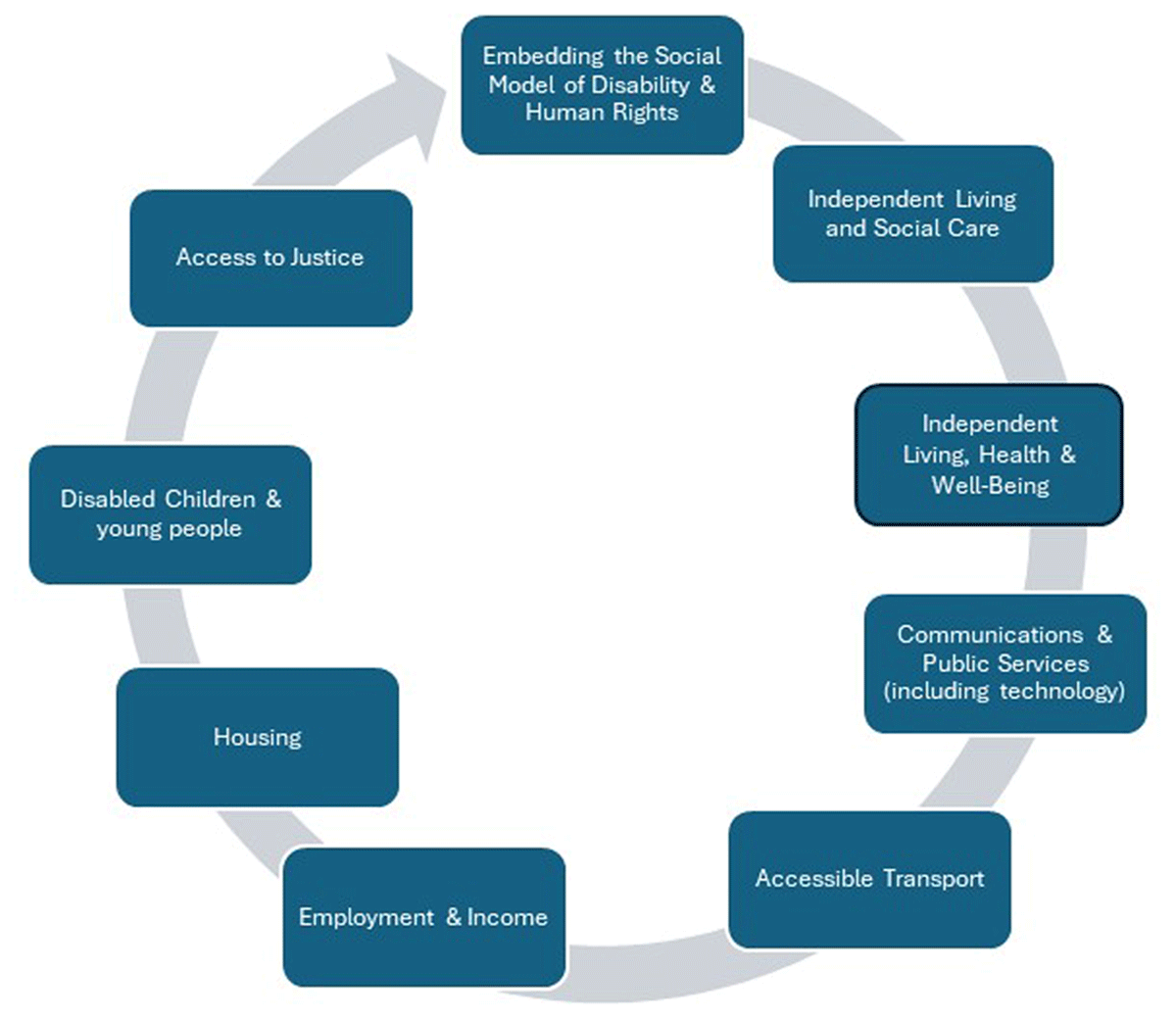
Figure 1
Working Groups of the Welsh DRT.
The first working group began with a discussion of the social model of disability and the need to embed it into Welsh Government – in terms of awareness, culture, language, policy, and practice. After agreeing to the provision of social model training by a DPO, it was also suggested training in co-production should be offered. There was little recognition at this stage that co-production had a specific meaning to some disabled people and, therefore, a DPO was not approached to provide this. Social model training has since been provided for other public agencies including regulatory bodies in health, education, and social care. The expectation is that it will be extended more widely. The manifesto commitment in 2021 of the majority Welsh Labour Party towards incorporating the UNCRDP into Welsh law, helped to stimulate discussions of its importance, as well as potential inconsistencies and conflicts incorporation might create with existing UK disability law, given its reliance on a medical model of disability.
An additional group entitled ‘Access to Justice’ was added to the eight existing working groups. It was felt that this group needed to explore problems encountered by disabled people in the justice system as well as disability hate crime. To maximise participation and promote accessibility, all meetings have been held on-line using Zoom. The Welsh Government have employed external providers who offer British Sign Language, easy read, live captioning, and two contractors who run a business providing accessible solutions for meetings. The latter have also supported chairs of working groups by answering questions during meetings from participants and reading out messages in the chat. Each meeting opens by reaffirming a commitment to working within a social model of disability, co-productively, and by emphasising the value of the lived experiences of disabled people.
A lesson from the pandemic identified early in the life of the DRT, was that the way that government data is gathered does not always reflect the experiences of disabled people. It was agreed that not only was there insufficient data but that of the data available, this failed to provide enough nuance to reflect the complexities of disabled people’s lives. Reliance on statistics by policymakers it was argued, provided little insight into diverse lived experiences, and was viewed as a major limitation. The questions being asked of disabled people and by whom, were also critically evaluated. This followed criticisms by DPOs that the UK Government had failed to properly consult with disabled people when proposing its National Disability Strategy, which had ended in court action. Few examples of Government statisticians consulting with DPOs when formulating questions using official data collection tools could be found and it was unclear whether data gathered through supplementary qualitative sources (e.g. telephone interviews and home visits), were capturing the experiences of disabled people, rather than guardians or carers. Doubts about the efficacy of data sources and gathering, led the Welsh Government to establish a new Disability Evidence Unit. As part of a wider Equalities Evidence Unit this is also commissioning work to look at incorporating the social model of disability and co-productive methods into official data collection to improve its quality.
The academic literature and contribution of the Welsh example
There has been recent interest in socio-legal studies in how the CRDP and UN guidance to States about its implementation, might be strategically employed by disabled people and DPOs, to shift the balance of power in policy and law making in their favour. Löve, Traustadóttir and Rice (2019) provide an account of how the CRDP helped DPOs secure a seat at the decision-making table in the latter stages of a consultation process on proposed law affecting long term support for disabled people in Iceland. Further examples can be found in the work of Arstein-Kerslake et al. (2019, 2020), which has begun to develop a ‘roadmap’ towards a participatory human rights-based research methodology. Among other things it is envisaged this could be used to include groups of disabled people in the legal process usually regarded as ‘unfit to plead’ when they may have committed a crime. Although awareness of these debates was limited during events in Wales and did not directly influence them, it is still useful to identify interrelated themes. The Welsh COVID-19 ‘Locked-out Report’ had referenced obligations in the CRDP, including expectations that disabled people would be involved in decision-making during times of crisis and emergency: mechanisms that neither the UK nor Welsh Government had established before the pandemic. Furthermore, unlike Wales, England and the UK did not have an equivalent body that could provide a route for disabled people and DPOs to periodically raise concerns with a Minister. Exclusion of disabled people, especially from early pandemic decision-making, had profound consequences. Examples included the omission of visually impaired people from priority on-line supermarket food shopping that had been established for ‘vulnerable’ groups in the first few weeks (RNIB 2020). The placing of ‘do not resuscitate’ notices on the medical files of disabled people without their prior knowledge or consent (EHRC 2020a, 2020b). The limited availability of Personal Protective Equipment in social rather than health care settings. The withdrawal of statutory rights that had ensured disabled people had access to essential social care (ONS 2020b) and, the removal of basic human rights to independent living from disabled people living in institutional settings. Government in England, unlike its Welsh and Scottish counterparts, also failed to provide essential public guidance about COVID in accessible formats, until later in the pandemic.
In Wales, it was significant that an established political process – the DEF – rather than rights in the CRDP, led to disabled people being consulted during the pandemic and to an enquiry into COVID-19, which became the catalyst for the establishment of a Taskforce. The facilitation by the Welsh Government of an evidence-based report and recommendations, authored and coproduced by disabled people and an academic, was politically powerful. It is, however, difficult to know if the level of autonomy disabled people enjoyed producing the report occurred by accident or design. DPOs initially feared the Welsh Government would not publish its findings. The decision to do so ultimately appears to have been a political one, taken by senior politicians, including several with a developed understanding of the UK social model of disability. The influence of this unique coalition of circumstances on what followed should, therefore, not be under-estimated. A Taskforce set-up by the First Minister, with the Minister for Social Justice as its co-chair, solidified political commitment, which is not always guaranteed when legal provisions alone are relied upon (Lukes 2005).
The importance of political contingencies in public policy making is acknowledged and it is interesting to contrast events in Wales and Iceland through this prism. Recent UK political history has been marked by an obsession with marketisation, and a form of austerity driven New Public Management, interpreted as a neo-liberal reaction to the perceived dominance of producer interests in public services (Hood 1991; Pollitt 1990). In the early 2000s an interest in what has been referred to as ‘institutionalized co-production’ (Joshi & Moore 2004) emerged, in part as a reaction to excessive managerialism and a means of incorporating service user perspectives into public service delivery. Co-production stressed the need for long-standing relationships between citizens groups and state agencies (Bovaird et al. 2015), a model that had previously been popular in overseas development projects, where local citizen involvement was viewed as critical in understanding cultural and social norms (Cepiku & Giordano 2014). It does not take a huge leap in imagination to see how co-production could be adapted to involve marginalised groups in society in the design of public services to achieve a similar purpose. In health, local government, and devolved administrations, co-production is a common term. However, while it had a presence in the UK public sector and Welsh Government before COVID-19, the ‘Locked-out Report’ and the establishment of the DRT, the way co-production has been understood and implemented differs in important respects from how it is perceived in DPOs.
My understanding of co-production originated from so-called emancipatory research approaches in disability studies (Oliver 1992) and working co-productively with DPOs on research projects (DRILL 2015–2020; Foster & Hirst 2020, 2022). As far back as the 1980s, debates among disability studies scholars had discussed problems associated with working co-productively with disabled people: facilitating time for reflection. For example, Disability Studies has argued that because emancipatory forms of research are overtly political and focus on the democratisation of the research process (Swain, Heyman & Gillman 1998; Zarb 1992), studies must be about ‘the demystification of the structures and processes which create disability’ (Barnes, 1992: 122). There is also a recognition of the potential for academics to be parasitic on disabled people in the production of knowledge, which may lead to disabled people being exploited in this process (Swain, Heyman & Gillman 1998; Oliver & Barton 2000: 8). In the context of Welsh Government, DPOs and I instigated conversations about the ethics of remunerating disabled participants in the Taskforce and working groups, an issue yet to be resolved. Public procurement rules and the potential impact of payments on welfare benefit claimants have proved major obstacles, although there has been agreement (belatedly) that disabled people chairing working groups who are not being remunerated by a DPO (e.g. those who are self-employed), should be. Originally, the Taskforce had intended to appoint disabled people to ‘community mentor’ roles. Based on a model originally developed by the Black, Asian, and Minority Ethnic group, this would have provided mentoring based on lived experience to Welsh policy leads. To date, the problem of paying disabled people in receipt of benefits without affecting their entitlements has proved an obstacle, although discussions continue. An interim solution proposed by Welsh Government has been to incorporate mentoring of policy leads into the job descriptions of newly advertised Disabled People’s Employment Champion roles. These roles had existed temporarily when the work of the Taskforce began but have recently been advertised as permanent jobs.
The influence of political traditions and culture were also discussed by Löve, Traustadóttir and Rice (2019) in their account of policy processes in Iceland. Drawing comparisons with Nordic countries, they highlight how historically, paternalistic welfare traditions have provided support to disabled citizens, based on a ‘compensation’ (Quinn & Flynn 2012) rather than the rights-based model of the CRDP. The mobilisation of academics and DPOs into important new alliances with the purpose of operationalising these rights, has therefore, been significant. Events in Iceland can, however, be distinguished from Wales by reference to the stage at which participation was achieved. In Wales, disabled people have been involved in agenda-setting and decision-making from the outset, whereas in Iceland, involvement was achieved in the latter stages of the process. There are additional problems when comparing experiences in the two countries, most notably because the work of the Taskforce is not yet complete and as such, outcomes cannot be evaluated. Furthermore, while earlier it was noted that in some circumstances political power can be more effective than legislative processes, the disadvantage is that politicians can change, and elections can be won and lost. This highlights a matter of further concern: the under-representation of disabled people as political representatives.
Interim Conclusions
The lessons brought about by the pandemic have provided a potentially positive force for change for disabled people in Wales. Exposing the shortcomings of previous decision-making, they precipitated conversations that have led to genuine attempts to do policy differently and more inclusively, going forward. The impact of national lockdowns on methods of communication and the democratisation of participation in decision-making should also be acknowledged. In Wales, populations are widely distributed, and some rural areas have poor transport links, which has always hindered the physical participation of disabled people in political forums. The increased use of virtual spaces as some researchers noted even before the pandemic (Liddiard et al. 2019), facilitated new forms of citizenship and activism. In Wales, no longer is it viewed as sufficient to consult disabled people about policy. Instead, by enabling them into positions of leadership in a co-productive process where they help shape future policy at a strategic level, disabled people’s lived experiences have become integral to the process, consistent with the objectives of Article 4.3 of the UNCRDP. It could be argued that the facilitation of leadership roles for disabled people by Welsh Government has not only represented a shift in power but has opened- up a new space to allow historic systemic political and social problems to be scrutinised.
The ultimate test will be measured by outcomes and whether long lasting cultural change in the policy process has been achieved. It has been a recurrent criticism of disabled people and their organisations during the Taskforce that while the Welsh Government have been more receptive than local or national governments, there has in the past been a persistent gap between rhetoric and reality. Conceptualised as an ‘implementation gap,’ this criticism is accepted by current senior politicians in Wales. The concern is that if a change in political leadership occurs, which is expected soon, the absence of key politicians who have made this journey possible, by demonstrating an understanding of the social model of disability as well as the importance of the CRDP, may mean gains will be short-lived. This is a script yet to be written and as an actor in this ‘drama’ I hope to be able to report further on future developments.
Positionality and reflexivity
Given my multiple roles as author of this paper, co-producer of the original COVID-19 report and co-chair of the Welsh DRT, it is important that I reflect on my position. In academia, Massoud (2022: 64) defines positionality as: ‘the disclosure of how an author’s racial, gender, class, or other self-identifications, experiences, and privileges, influence research methods.’ While not a piece of academic research, my academic reputation and prior research with DPOs has undoubtedly been influential, suggesting it should be categorised as academic impact. I am open about self-identifying as a disabled person and have worked with DPOs not just concerned with academic outputs but also the empowerment of disabled participants. I have been a mentor for disability rights organisations and a representative on committees set up by Disability Wales, including one charged with evaluating grant applications to a fund established by a consortium of DPOs from England, Scotland, and Northern Ireland called Disability Research on Independent Living and Learning (DRILL). This funded co-produced projects between academics and DPOs and I was also successful in bidding for funds with an independent disabled researcher, which was partnered by disabled people’s organisations in the legal profession in England and Wales and has had significant impact (Foster & Hirst 2020).
Being cast in the unusual and unprecedented position of representative of other disabled people in a government policy-process has been challenging. The trust and responsibility placed in me by disabled people has been a huge responsibility, but also a privilege. As academics it is important that we acknowledge the privileges afforded by our status, which has also been significant in instilling confidence among Welsh Government officials and politicians. Recognising what decisions are operational rather than substantive has been important in my role. For this reason, I established a reference group made up of the working group chairs to provide a wider steer on substantive decisions and we meet on an ad hoc basis when required. Civil servants meet separately with chairs of working groups to support them, but I have felt chairs should remain in full control of their agendas and, while I endeavour to attend as many working group meetings as possible, my role is supportive and I keep my participation to a minimum, often via the chat facility. The extent to which disabled people feel a genuine ownership of the outputs of co-production has always been my barometer to measure how successful it has been, and my role should be to facilitate this.
It should be acknowledged that while there are advantages to being open about your standpoint in both academic research and policy-processes, there can be disadvantages. As Massoud (2022: 66) notes, while one of the key benefits is that contributions from others are often more authentic because of the potential for a shared lived experience, disadvantages include criticisms of bias or lack of ‘objectivity’ (Baird 2020; Harding 2004; Massoud 2022). Furthermore, in the policy making context where anonymity and confidentiality are not always guaranteed, it is necessary to be mindful that asking disabled people to share personal lived experiences can expose them and you to psychological trauma, or re-traumatization. Reflecting on my own experiences with the Welsh Government, on balance, I have found my own lived experiences helpful in making connections with disabled participants, but I have also found the emotional labour sometimes involved in discussions exhausting, if ultimately, rewarding.
I view myself as an academic and a disability rights activist. For some, most notably of a positivist inclination, this is a contradictory position. However, for others it is a natural progression when you have spent your career attempting to further knowledge in an under-researched area. Baird (2020) for example, when reflecting on her contribution to Australia’s policy debates about paid maternity and parental leave, found herself embroiled in a highly political process. However, the positive relationship she describes between academia and activism is one I can relate to, and this includes personal and professional pride in having contributed to some greater good. In my case, I have interpreted my role as primarily one of facilitator and mediator, although I am pleased to say I have to date found myself engaged in more of the former. Activist academics can experience personal and professional attacks from peers, the academy and wider society. The demand that academics adopt some sort of ‘neutrality’ is so well engrained that using your knowledge to help bring about change, tends not to be valued. Moreover, involvement in policy does not always translate easily into academic publications, a conventional currency of academic success. Finally, as Baird (2020: 616) observes, engaging in impact is not always compatible with the conventional academic labour process and, leading as opposed to informing or critiquing social processes, does not always fit neatly into what other academics think you should be doing.
Notes
[1] The UK delegation to the UN argued successfully for the right to retain the terminology ‘disabled people’ and this is respected in this article by referring to the Convention as the CRDP.
[2] The Social Model of Disability supported by the UK Disability Rights Movement rejects people first language. It argues that people are disabled by barriers in society not necessarily by their impairment or medical condition.
[3] The author provided evidence to the Welsh part of the UK COVID-19 Public Inquiry, which is cited in the references (Foster, 2024) because some of the content of the witness statement overlaps here with the description of the Disability Rights Taskforce.
Acknowledgements
I wish to acknowledge the participants in the Welsh Government’s Disability Rights Taskforce. This includes disabled people, organisations that represent them, impairment groups, civil servants, Ministers, and the range of stakeholder groups and academics that shared their expertise.
Competing Interests
The author has no competing interests to declare.