
Table 1
Changes in the work of the NDC (participants’ mentions).
| NDC (1999 TO 2011–2012) | NDC TODAY |
|---|---|
| Regular meetings (several times a year) | Less frequent meetings. For long periods (even for over a year) the NDC did not convene at all. |
| Ministries sent representatives to meet DPOs, enabling discussions between ministries and DPOs | Ministry representatives were excluded from the NDC in 2012. Only the social ministry participates. |
| NDC opinions were ‘taken more seriously’. | NDC opinions are not taken seriously. |
| NDC decrees had some weight in policy-making | If NDC disagrees with a government proposal, ‘nothing happens’. |
| NDC opinions & proposals were sent to government meetings or other ministries, with follow-up | DPOs receive no or very little feedback about their proposals |
| Agenda for meetings were developed jointly by DPOs and the ministry. | Agenda of meetings are set by the ministry. Proposals for the agenda by DPOs may be refused. |
| NDC rules, membership, summary of meetings and decrees were more transparent | Lack of transparency: decrees, membership, summaries are not available publicly |
| More meaningful debates | Debates have deteriorated to the level of quarrels |
| NDC was chaired jointly by DPO and state-representatives, decisions were made jointly | The chair of NDC is a state official, decisions are made by him |
| Subcommittees (sometimes) worked | Work in subcommittees has ceased |
| Sometimes incorrect minutes (i.e. with misinterpretations) |
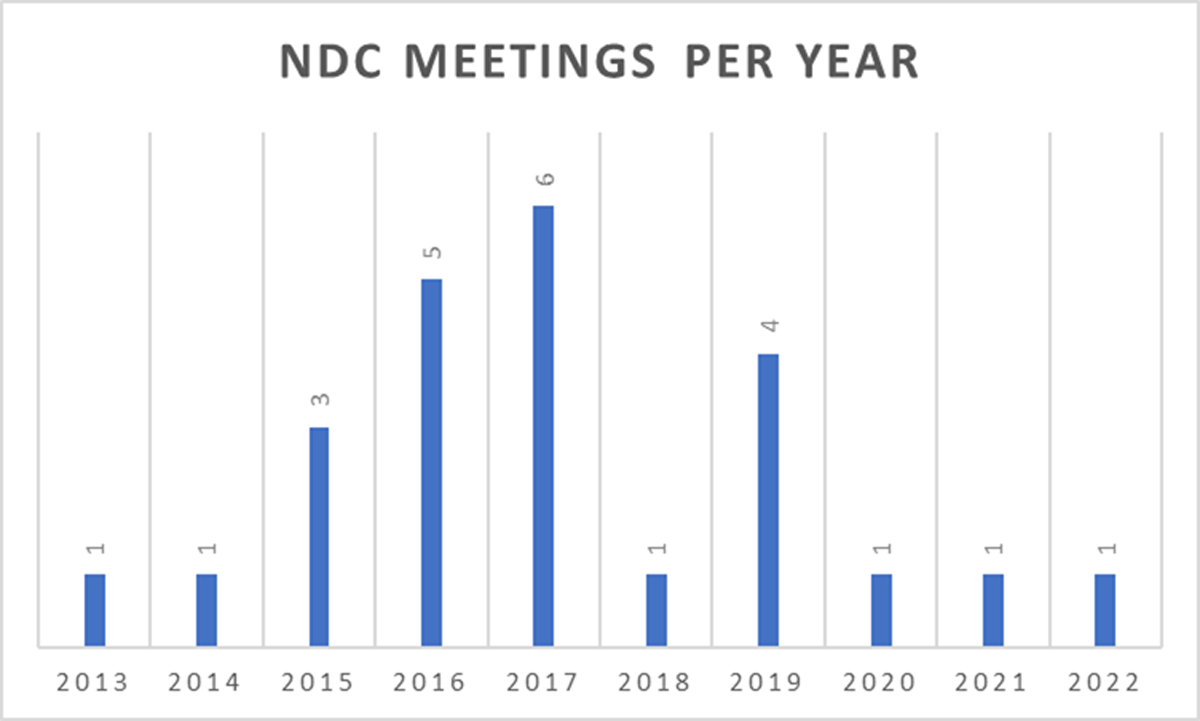
Graph 1
Number of meetings of the National Disability Committee. (Source: Ministry of Interior, 2023).
Table 2
Level of participation.
| PARTICIPATION SCALE |
|---|
| 4. Partnership/co-governance (participation in agenda setting; monitoring or the implementation of policies; stable working relations between authorities & civil society; shared responsibilities). |
| 3. Consultation/deliberation (DPOs provide expertise; structured dialogue exists with tangible influence). |
| 2. Tokenistic inclusion (inclusion in meetings or consultative bodies; information sharing but no impact on agenda or outcomes). |
| 1. Information sharing (DPOs receive information but have no influence on them) |
| 0. No consultation (exclusion from platforms, services). |
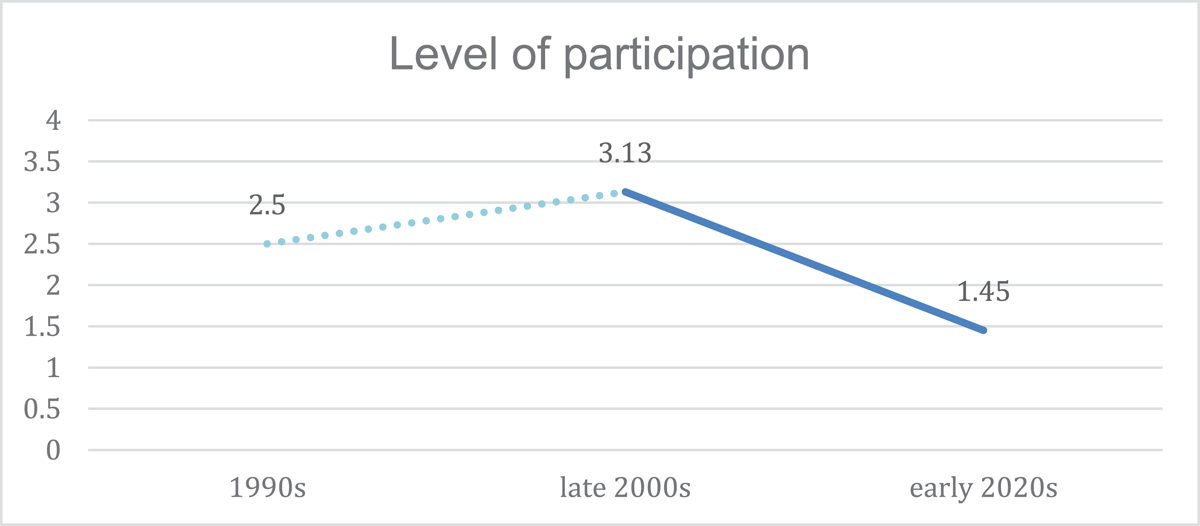
Graph 2
Level of participation, mean scores (late 2000s: N = 11; early 2020s: N = 15).
Table 3
Advocacy space scale.
| ADVOCACY SPACE |
|---|
| 3. Full freedom/rights (DPOs are free to choose their strategies, unlimited freedom of association, freedom of critical speech and protest). |
| 2. Restricted opinions (self-censorship when voicing concerns, avoiding certain issues in public statements, fear of losing space due to critical statements) |
| 1. Vilification/stigmatization (DPOs or activist groups may be stigmatized due to their criticism or authorities or because of their funding background) |
| 0. Persecution/harassment (legal actions or physical violence against NGOs) |
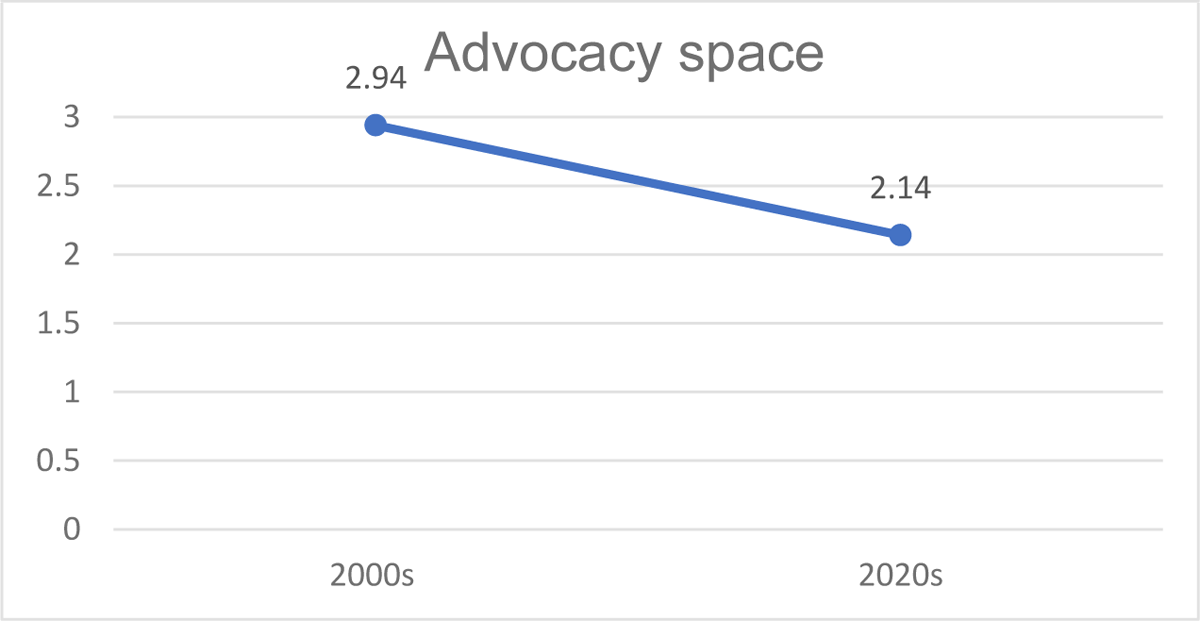
Graph 3
Advocacy space, mean scores. (2000s: N = 9; 2020s: N = 15).
Table 4
Levels of funding.
| FUNDING SCALE |
|---|
| 4. Structural government funding (multi-annual funding schemes, organisational funding enshrined in law). |
| 3. Ad hoc government funding (occasional grants, annual grants). |
| 2. Only foreign funding available (or no domestic funding schemes are used). |
| 1. Foreign funding obstructed. |
| 0. No funding available. |
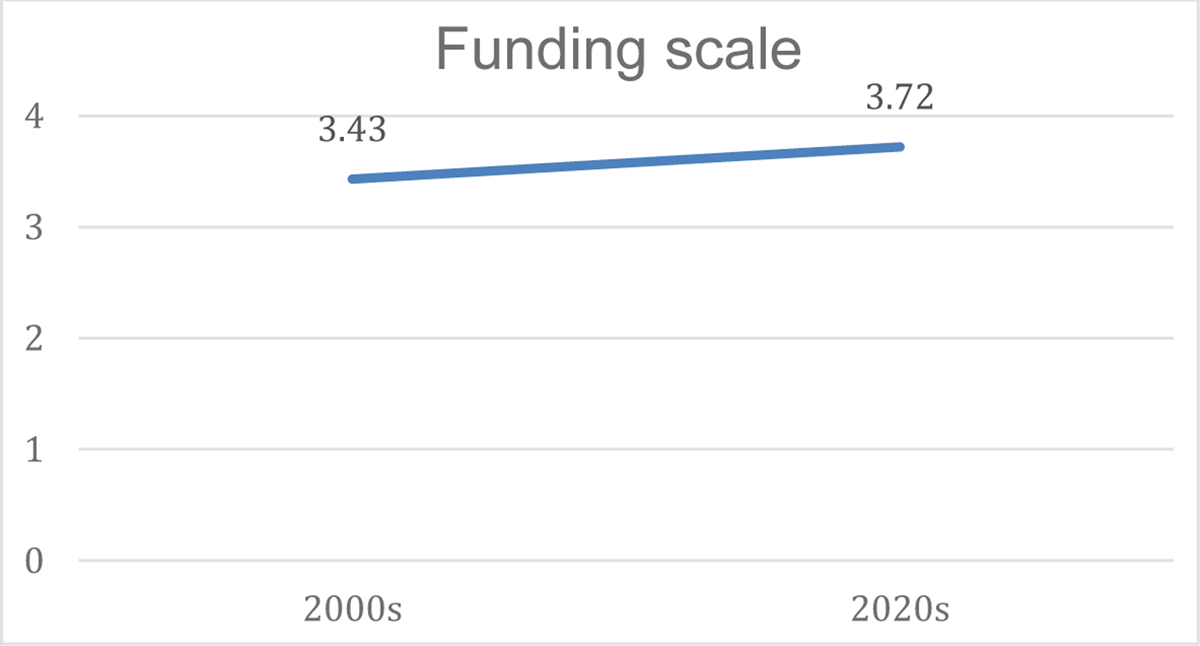
Graph 4
Levels of funding, mean scores (2000s: N = 8; 2020s N = 15).