
1. Introduction
The disabled people’s social movement (DPM) has made a significant impact on how today’s liberal democracies have developed. Political rights; laws prohibiting discrimination on the basis of disability; accessibility requirements for the built environment and services; community-based services for disabled people; progressive legal capacity laws etc. – these are just some of the achievements of decades of persistent disability advocacy.
Disability is intertwined with economic, societal, political, and cultural processes (Barnes & Mercer 2010), making it difficult to trace how policy changes happen. Historical accounts (e.g. Pettinicchio 2019) show that progressive disability policies have developed through negotiations between public officials and politicians on the one hand, and the DPM on the other. The DPM (organisations representing or speaking for disabled people, activist collectives, and individuals) have always been central to policy change. However, social movement studies mostly ignore the DPM. For decades, disability studies focused on the British or American DPMs (Oliver 1997; Shakespeare 2013; Trevisan 2016), and only recently started to cover DPMs in peripheral or semi-peripheral countries of the world (Berghs et al. 2019).
In this context, there has been a shift in academic inquiries, also called a paradigm-shift (e.g. Harpur 2012): the rise of human rights research where disabled people’s problems and demands are framed as legal rights issues. Today’s academic research about the DPM is often contextualised by the UN Convention on the Rights of Persons with Disabilities (CRPD), how the CRPD should be ‘implemented’ by states, and how DPMs participate in implementation. This ‘human rights model’ (Degener 2016) is closely related to the older ‘social model’ (Oliver 1990) however, the two models offer somewhat different approaches to the ‘disability problem’. British social model pioneers vehemently criticised the human rights approach (e.g. Oliver & Barnes 2012; Oliver 2016), mostly on Marxism-inspired grounds. The DPM itself has diverse views on human rights. Many movement actors, especially in the national and local levels seem far from convinced about the human rights model: activists claim to have minimal knowledge about human rights laws and think such laws remain ineffective in practice (Petri et al. 2017). International, CRPD-driven advocacy may have aims and strategies different from local, grassroots-level activism that creates hierarchic relationships between international and local levels (Meyers 2014; Meyers 2019).
We cannot reconcile this debate (Lawson & Beckett 2021), yet it is crucial to see the DPM operating in a policy field where human rights laws co-exist with political and other structures. Instead of a paradigm shift where one model is changed for another, this system is a mixed one where contending models coexist (Bickenbach et al. 1999; Goodley 2012) amid historical and political structures, where movement actors themselves have mixed views on what works best for their advocacy.
Our paper explores disability policy-making in the context of this complex landscape – we analyse how eroding democratic structures affect the DPM and its advocacy for disability human rights. Democratic backsliding (Gora & de Wilde 2022) and attacks on civil society are reported across Central and Eastern Europe (CEE; Cianetti 2019). But democratic erosion is not specific to the post-socialist region: concerns have also been raised about countries from all continents, including Brazil, Chile, Ghana, Greece, India, Italy, Israel, the Philippines, Turkey, the USA, and the UK, among others (see Butler 2017; Papada et al. 2023). The erosion of democratic structures is accompanied by the oppression of critical voices of civil society organisations (Labanino & Dobbins 2023; Butler 2017). Our case study is one post-socialist country, Hungary, the ‘poster child’ of backsliding democracy, illiberalism and populism (Greskovits 2015; Szelényi 2022).
In this paper, we aspire to inform researchers about how democratic backsliding affects the DPM and the movement’s historical struggle for progressive, human rights compliant changes in policies. We build on a case study and explore how the position of the DPM has changed over the last 25 years in the eroding Hungarian democracy. First, we give historical and policy context, then, after presenting our research approach, we report on findings of our study. We conclude this paper with a discussion about how de-democratisation may impact disability rights advocacy globally.
2. Historical Background and Current Trends
Hungary is a post-socialist country in CEE, member of the EU since 2004. State-socialist regimes between the late-1940s and 1990 claimed to have solved the ‘disability problem’ by maintaining cultural, political, and economic policies that made disabled citizens invisible to most of society. Communist ideology put an emphasis on productivism (Mladenov 2018): full employment and hard work by all citizens was encouraged and regulated by law. Medical assessments served these productivist ends. The ‘lack of ability’ to work was the ideological basis for admission to special services like segregated schools and residential institutions (Zaviršek 2014). Consequently, those unable to work were hidden from society. Residential institutions became dominant in social services in many countries in the Soviet-influenced region of Europe and segregated forms of education and employment were widespread.
Soviet-style policies oppressed disability organisations and advocacy initiatives. Disabled people’s organisations (DPOs) were often banned in the region, and where they existed, they had to employ strategies particular to single-party regimes where social organisation was perceived hostile by governments. Thus, DPOs’ influence on policies was minimal before 1990. This left many countries in the region with a heavy heritage in policy in the public discourse (Rasell & Iarskaia-Smirnova 2011), and affected how DPMs advocate for progressive policies today. Today’s post-socialist trends in redistribution, cultural recognition and political representation are central to this context, theorised convincingly by Mladenov (2017: 113): both ‘state socialist legacy’ and ‘post-socialist neoliberalisation’ have shaped disability policies in the region.
Current trends are key here. Although most CEE countries have ratified the CRPD and adopted other relevant disability rights laws since the 1990s (Vanhala 2010), there are concerns that progress in disability rights policies have stalled in the region. For example, despite substantial financial expenditure provided by the EU, and legal obligations under the CRPD, deinstitutionalisation policies are following alarming trends across CEE (Mladenov & Petri 2020; Šiška & Beadle-Brown 2020): re-institutionalisation is becoming a problem. Hungarian disability policies have also been stagnant: only a fraction of disabled people has been accessing community-based services and their number remains virtually unchanged since 2010 (Kozma et al. 2020). The lack of progress is also reflected in life-course interviews: a recent study found that two decades of human rights-inspired legal changes and large-scale financial transfers by the EU have made little impact on disabled people’s lives who feel permanently excluded from society (Petri et al. 2023).
This policy context may not be unrelated to concerns about de-democratisation in the region. Studies show that advocacy organisations in backsliding democracies face reduced opportunities: there is a ‘closing space’ (Carothers 2016) or ‘shrinking space’ (Muiznieks 2017) for civil society actors to influence policies. Government strategies that curb critical NGOs’ activities (Butler 2017) include smear campaigns in media, administrative harassment, funding cuts, over-regulation, and shrinking opportunities for consultations. Democratic erosion has impacted Hungarian civil society, too. Human rights organisations (Gerő et al. 2020), organisations fighting for women’s rights (Roggeband & Krizsán 2021), and environmental activists (Buzogány et al. 2022) have all faced adverse government actions.
This paper focuses on the DPM’s participation in policy-making in Hungary since from the late-1990s to 2022. We chose this time-frame because a pivotal law, campaigned for by the DPM, the Hungarian ‘Disability Rights Act’ (26/1998) entered into force in 1998 – it is a useful cutting-off point for our analysis in a period where legal recognition of disability rights was already in force. Our analysis is interested in how Hungarian DPM-actors perceive the ‘closing space’ concept, and how various factors influence the DPM’s fight for disability human rights under eroding democratic structures today.
3. Research Methods
This paper is part of a wider study exploring the situation of the DPM in CEE, designed and led by the first author, with the support of the Open Society University Network. The project ran in four countries (Bulgaria, Hungary, Romania, Serbia), with similar questions. This paper reports only on the situation in Hungary. We employed the following research questions: What is the position of DPMs in policy-making in Hungary? How have political and advocacy opportunities changed for the DPM since 1998? To answer these questions, we appraised the following aspects:
The policy context for NGO-involvement: does the government provide sufficient opportunities to the DPM to influence policy-making?
DPM experiences about both formal consultations, and ‘informal avenues’ (Hallstrom 2004)
Advocacy repertoires used by disability organisations
DPM perception of the ‘shrinking space’ for disability advocacy.
The disability movement is usually understood to include various civil society organisations and non-formal collectives of disability advocates, as well as individual activists. In the scope of this study, we focused on national-level disability organisations, including disabled people’s organisations (DPOs) and organisations for disabled people. While recognising the importance of direct representation, in the context of policy-making we maintain an inclusive approach that is interested in all civil society organisations that influence policies and lobby governments.
We analysed interviews and data available in academic papers and grey literature including civil society reports, media, and government websites. For the analysis of interviews, we used thematic analysis (Braun & Clarke 2012).
This was a participatory study carried out by a non-disabled researcher with over 20 years of experience in disability advocacy and a disabled activist with experience in participatory studies and over 25 years of experience in disability advocacy. The two co-researchers worked together from the conceptualisation of the study, through data collection, analysis, and reporting.
In our analysis, we built primarily on the accounts of disability advocates who lived through the last 25 years of political changes in Hungary. We put individual accounts in the centre because these give a long-view on policy changes, including its more factual (‘what happened and when?’), and informal aspects (‘how did they perceive these changes?’). This mixed perspective, expressed in interviews were rich in references to policy changes that can be traced through other sources, but they were also invaluable because of their layered character and subjectivity. Advocates are always also people who bring their own aspirations, values, resources, networks, and knowledge to the job they are doing – and all these factors shape their work. Thus, our paper also testifies of the ‘acquired virtuosity’ (Hartblay 2020: 34) of disability advocates.
Recruitment happened through personal networks, organisations’ websites, and snowball sampling. To protect the identity of participants, we only give general descriptions about our sample. We used purposive sampling: we recruited those with many years of experience in disability advocacy and/or policy-making in Hungary. We interviewed 15 participants whose mean years worked in disability advocacy and disability policy-making was 19.7 years. Most participants had experience spanning back to the pre-CRPD period of the 1990s and early 2000s. Several participants were disabled people and the majority of participants worked at DPOs at the time of data collection. Most interviewees had worked for two or more advocacy organisations over their careers, including national DPOs and local or even informal collectives. Some interviewees had also experience in policy-making within government bodies.
Interviews were conducted in October and November 2022. Participation was voluntary and anonymous. Interviews were audio-recorded, summary transcripts were made by researchers. Data analysis was done by both researchers, using MS Word and NVIVO software. Ethical approval of the study was given by the Central European University Ethical Research Committee in July 2022.
4. Analysis
Respondents confirmed that Hungarian disability organisations, including DPOs and other disability rights collectives perceive a closing space of opportunities to influence public policies. One long-time disability advocate added: ‘…the participation of civil society organisations in policy-making has been reduced to a minimum level, and this trend has been very, very noticeable over the last 10–12 years’.
Others added that their space to advocate was ‘absolutely shrinking’, and ‘it’s suffocating what we experience’. One participant claimed their opportunities were ‘not merely shrinking, but quickly and visibly disappearing’.
The dominance of this narrative was strongly present in all but one interview. One participant said the space to advocate for rights has not shrunk for their organisation and their particular disability group has seen positive policy-changes. However, they added that although their space did not shrink, ‘it did not grow either’ and this was a ‘stagnation’ in rights, and ‘this (stagnation) in itself is unsatisfactory, because when we started in 1998 we hoped to see progress’ and ‘the lack of progress is itself a shrinkage in a way’.
Four themes emerged from interviews – factors that mark the closing space.
Changing formal consultative bodies: The National Disability Council
The work of the ‘National Disability Council’ (NDC, or ‘Országos Fogyatékosügyi Tanács – OFT’ in Hungarian) was central in participants’ framing their opportunities to influence policies (12 out of 15 participants had many years of first-hand experience in this body). The NDC, established by the 1998 Disability Act, is an advisory body to the government, composed of DPOs, NGOs, and state representatives. The NDC has been a core platform for tabling proposals, influencing legal and policy-changes, working directly with government officials and various state bodies, and monitoring rights. Notably, the NDC in Hungary was also assigned the role of the ‘independent mechanism’ under the CRPD that Hungary ratified in 2008.1 Thus, problems with the NDC affected directly the monitoring of the Convention from 2008 until 2022.
The dominant view was that the NDC lost its significance over the last decade – consequently, the DPM as a whole has lost much of its influence over policy-making. Problems with the NDC are illustrated in the following account:
It is typical that the NDC rarely meets anymore, and when it does, it is more about just giving us information than about us making proposals. (…) When we propose something then we just do not know what is implemented (of them). (…) they don’t send us documents that are hugely relevant for disability policies. We don’t receive these, or if we do, they are sent at very short notice, but it’s common that we don’t get them at all.
Participants stated that the NDC used to enjoy a period of relative significance, marked by several factors (see Table 1.), and the body was at its peak in the 2000s. They did not frame this period as an ideal one, but ‘something much better’ than today. Some noted that the NDC lost significance gradually in the 2010s, but the strongest decline happened since 2018 – it has become ‘empty’, ‘meaningless’, ‘hollow’, with one advocate stating: ‘if it the NDC ceased existing no one would notice the difference’.
Table 1
Changes in the work of the NDC (participants’ mentions).
| NDC (1999 TO 2011–2012) | NDC TODAY |
|---|---|
| Regular meetings (several times a year) | Less frequent meetings. For long periods (even for over a year) the NDC did not convene at all. |
| Ministries sent representatives to meet DPOs, enabling discussions between ministries and DPOs | Ministry representatives were excluded from the NDC in 2012. Only the social ministry participates. |
| NDC opinions were ‘taken more seriously’. | NDC opinions are not taken seriously. |
| NDC decrees had some weight in policy-making | If NDC disagrees with a government proposal, ‘nothing happens’. |
| NDC opinions & proposals were sent to government meetings or other ministries, with follow-up | DPOs receive no or very little feedback about their proposals |
| Agenda for meetings were developed jointly by DPOs and the ministry. | Agenda of meetings are set by the ministry. Proposals for the agenda by DPOs may be refused. |
| NDC rules, membership, summary of meetings and decrees were more transparent | Lack of transparency: decrees, membership, summaries are not available publicly |
| More meaningful debates | Debates have deteriorated to the level of quarrels |
| NDC was chaired jointly by DPO and state-representatives, decisions were made jointly | The chair of NDC is a state official, decisions are made by him |
| Subcommittees (sometimes) worked | Work in subcommittees has ceased |
| Sometimes incorrect minutes (i.e. with misinterpretations) |
The NDC is regulated by a government decree (No. 1330/2013). According to Para 15 of the Decree, the NDC shall meet minimum four times per year. Participants noted that the decline is illustrated by the fact that it rarely convenes anymore, whereas meetings were more frequent in the 2000s. We requested information from the Ministry of Interior about NDC meetings – information received verifies participants’ claims (Graph 1.). (The Ministry declined to share information about NDC-meetings before 2012.) The Decree also makes it mandatory (Para 18) that meeting agendas, invitations, decrees of the NDC etc. should be featured online on the Ministry website. At the time of our study, such information was unavailable on the ministry website – representing a lack of transparency about this central consultative platform for the movement. Answering our formal request for information, the Ministry refused to send us minutes, participants’ list or even decrees made at meetings, illustrating points made by participants.
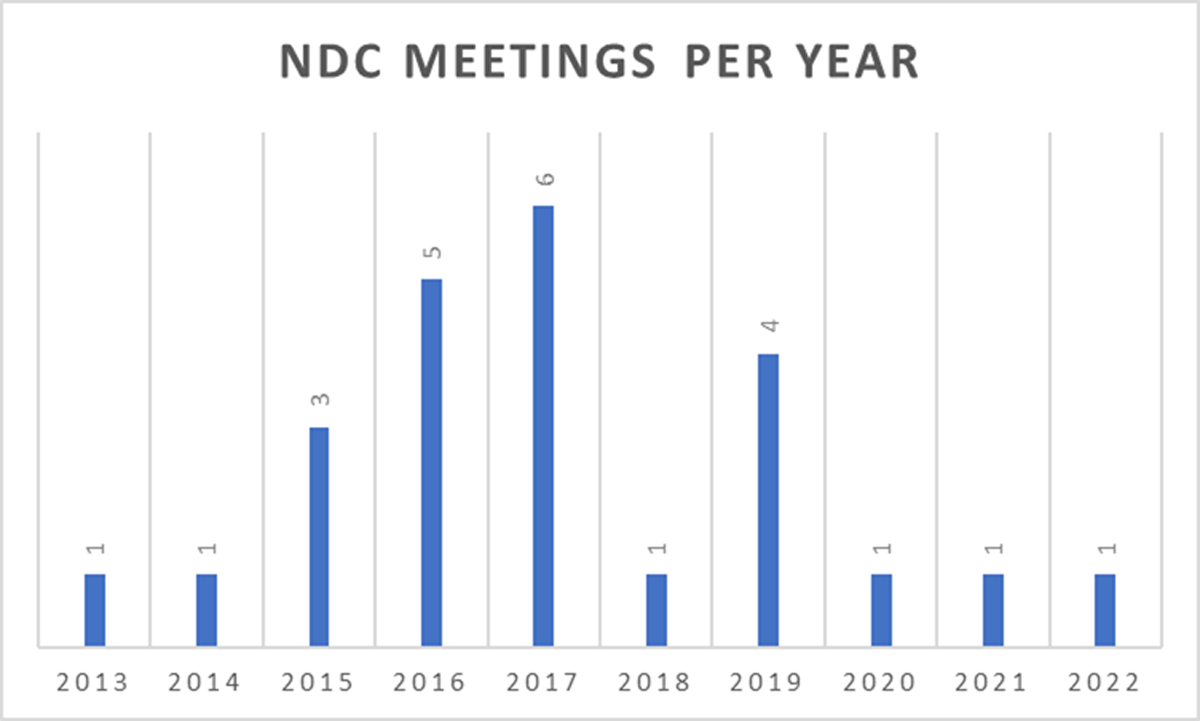
Graph 1
Number of meetings of the National Disability Committee. (Source: Ministry of Interior, 2023).
The DPM uses other consultative platforms, too: for example, online consultations about the planning and implementation of EU Structural Funds. Structural Funds play a crucial role in funding and influencing national-level social policies such as deinstitutionalisation (Mladenov & Petri 2020; ENIL 2023) or the building of more accessible public services (MEOSZ 2023). All participants who mentioned EU Funds-related consultations said that they found these hollow, because proposals by the DPM have almost never influenced policies in a meaningful way. Some said that they did not even get follow-up reports about their submitted proposals. One participant, with experience about EU Funds-consultations said:
When, on behalf of the ministry, we respond to online inputs (by the DPM), we basically reply that we (the government) agree with them even if this is not the case. Really, we have mastered this! In a(n online) consultation period, we write as much bullshit as we can. Essentially, we have communication panels so that we write the same thing back to everyone.
Two more consultative platforms were mentioned. First, the Advisory Body on Deinstitutionalisation (in Hungarian: ‘IFKKOT’), formed in 2011, overseeing the government’s large-scale deinstitutionalisation programme: all mentions of this body were decisively negative, with one person (with membership experience) calling it a ‘phantom thing’.
The other platform, the Human Rights Roundtable (‘Emberi Jogi Kerekasztal’), an advisory body to the government managed by the Ministry of Justice since 2012, is not disability-specific but convenes different human rights and minority groups. This body was also seen as lacking impact in policy-making, and most participants decided to not participate in it. The conscious decision to abstain from this body was explained by one participant who recalled that at a meeting, when the Ombudsperson’s report on disability rights was to be discussed, ‘(the item) was simply taken off the agenda in no time at all, right there on the spot. (…) All I could do was that, as a sign of protest, I stood up and left the room.’
Bilateral consultations between DPOs and the government were also discussed. These happen in various ways: personal, formal, or informal meetings between DPO-leaders and government officials, phone calls and email exchanges etc. Some noted that bilateral consultations carry a risk of dividing the movement whereby complex policy matters are negotiated without involving coalitions of DPOs – and may result in competition between organisations and their interests. Despite the use of these often ‘informal avenues’, examples were told when DPOs only learnt about relevant legislative changes not from their government contacts but from the media.
The following opinion about emptied-out consultations is illustrative of dominant views in interviews:
There is no formal platform or anything that matters anymore (to influence policies). For example, any draft legislation is supposed to be put on the website for us to comment, but… I don’t know, at 11:00 PM they publish the proposal on the Parliament website, to be voted on by the Parliament the following day, so technically you could have your say, yes, but, it’s not a real thing… Because you cannot send proposals and write things up in an hour, when in the next hour or day the vote on it will have taken place already.
The role of democratic institutions
Participants framed three institutions, core bodies of liberal democracies, that the DPM has used for many years for disability advocacy: the Ombudsperson (Commissioner for Fundamental Rights); the Parliament; and the Constitutional Court. Nearly all participants mentioned at least one of these bodies as pivotal to advocacy, and, according to the dominant view, all of these have lost significance for the DPM in the last decade.
The most frequently mentioned body was the Ombudsperson. None of the participants who discussed this body framed it as a meaningful platform to advocate for disability rights in Hungary. There was a strong sense of disappointment in interviews about the Ombudsperson’s work, with one participant noting that its role in protecting fundamental rights ‘has gradually weakened’. Several people questioned the present (elected in 2019) Ombudsperson’s independence from the government, with one advocate adding sardonically: ‘he should be really independent and not just a decorated parrot like today’. Another participant, a legal expert, went as far as making a symbolic claim: ‘the Ombudsperson has ceased to exist’. One advocate voiced doubt about the Ombudsperson’s work because in their experience submissions were not always followed by due reporting or even timely response.
The Hungarian Parliament was also framed as a platform to advocate for disability human rights: DPM actors may join committee meetings or work through Members of Parliament to raise concerns and table amendments in plenary sessions. According to our data, today’s DPM rarely attends parliamentary meetings or when they do, they do not speak up. One participant said that due to the two-third majority of government parties, since 2010, the Parliament has ceased to be a place where DPOs can lobby for issues important to them: the two-third majority of the government holds strong against any criticism or proposals by opposition MPs. This is in contrast with the period before 2010, when none of the political alliances had a two-third majority, and lobbying through MPs was a more regular pathway for DPOs to influence policies. One participant said that ‘governing by decree’ (Bayer 2020; Szelényi 2022) has been practiced by the Government since 2020, making it difficult for civil society to use the Parliament as a platform to influence policies and fight for human rights.
The role of the Constitutional Court was also mentioned. One senior participant noted that they used to send submissions directly to the Court as a way to intervene in the legislative process and call the Court’s attention to human rights issues in laws. However, the Constitutional Court has ceased being a body through which the DPM can influence law-making: in the early-2010s, the Parliament changed the Fundamental Law that previously allowed civil society actors to directly put inquiries before the Court (Fundamental Law Para. 24 (2)1; see also Chronowski 2014). This change diminished the DPM’s chance to raise concerns before the Court.
Shrinking visibility of human rights issues in the media
All participants who discussed the media, saw diminishing opportunities to use it as a tool for disability advocacy. Whereas DPOs used to campaign for policy-change by using the press, today this does not seem a real option – during the 2010s DPO-access to media has shrunk markedly. For instance, DPOs may be denied of the opportunity to speak openly in the media, as this example by a senior advocate illustrates:
So, the X. (names channel) is coming to X. (names city), to shoot a report about our new service. We’ve been filming at our premises, when I tell the editor that it’s nice that you’re featuring what we’ve built, but there’s a huge problem here with (lack of) funding, rising energy prices we cannot cover! (…) This editor then said that the editor-in-chief would cut this out, if we covered that, and they already discussed this in the editorial team and (…) they’re going to cut it out because this (issue) cannot be published. So basically, I was told that problems like ours will not be broadcast on the national, publicly-funded TV channel.
Limited access to media hinders the DPM from making disabled people’s struggles and injustices seen, and have their voices heard before the public. Media campaigns have been powerful tools for disability activism (Ellis & Goggin 2018); therefore it would be difficult to overstate the importance of the statement of a participant: ‘the disability movement has practically lost its access to media’. Notably, there are examples when disability activists and DPOs took action and used the media and the public to push lobby the Orbán-government of Hungary. For example, in 2017–2018, widespread media reporting of the statements of one DPO, the National Association of Organisations of Persons with Physical Disabilities – MEOSZ (Pivarnyik 2017) and demonstrations by grassroots groups prompted the Government and the Mayor of Budapest to change plans and make a newly refurbished Metro Line 3 fully accessible (Hruskó 2018).
The term ‘human rights’ has also changed its meaning in public discourse, making it difficult to report about rights violations in the media. Many participants said that human rights have been antagonised by the Orbán-government that perceive human rights reports with hostility. One advocate said, ‘human rights have been a pain in the government’s rear since 2010.’
Another participant stated that human rights have almost completely disappeared from the public discourse whereas they used to be a regular point of reference in the context of disability policy-making. Although all participants said they believed in human rights principles, many of them claimed that the movement, as a whole, may think ‘human rights don’t work’. One participant observed that the illiberal Orbán-government’s approach to disability is a charity-based ‘top-down’ model that increasingly avoids references to disabled people as rights-holders. Many participants held the view expressed in the following quote: ‘This is a symbolic, political battle that the Hungarian government fights against liberalism.’
One participant mentioned recent examples when the CRPD was used in litigation successfully – this shows that independent courts can uphold human rights laws even in oppressive political environments.
Intimidation
Although we did not ask participants to discuss their emotions in the context of policy-making, a theme emerged that was present in many interviews: intimidation. Mentions varied from open to more subtle ones. The latter is illustrated in the account of a legal advocate who felt the term ‘civil society’ acquired a suspicious meaning in the last decade, due to the government’s smear campaigns against some civil society organisations: ‘the term ‘civil’ has got an acquired meaning now (…) people look at me suspiciously when I mention I do human rights protection at a civil society organisation’.
Others told us that over the years they received the label ‘agent of (George) Soros’ (an American philanthrope) that they found threatening. One advocate said that fear was present in their work, and they found this unfair:
We did not start advocating (for human rights) to yell at the government but to bring results to disabled Hungarian citizens. But if we do our work then we get a knock on the head, and they can easily just swipe us away.
One participant made references to other minority groups and stated that government campaigns against LGBT+ people were relevant to disability activists as well:
This world has many different people, everyone is who they are, and everyone should have a place in this world. And no one has the right to decide who has a place in it and who has not… and especially not to label people who are different. This (labelling) is sickening!
One advocate told us an anecdote about one DPO leader who was threatened by a government official to lose their job at a state-run body in case they join a joint DPO-statement criticising the government. Another participant recalled an occasion when he was told by a high-level ministry official: ‘if you keep criticising us, you can say goodbye to state funding’.
Shift in advocacy strategies
We also asked participants about advocacy strategies – interviewees mentioned of formal meetings; informal talks with officials; consultative platforms; petitions and open letters; public statements; submissions to authorities or independent bodies; direct action such as demonstrations; legal action litigation; international advocacy (e.g. with the UN, the Council of Europe, or the EU); media campaigns etc. The first alternative report for the CRPD-review of Hungary in 2010, prepared by an alliance of organisations, the Hungarian ‘disability caucus’ (SINOSZ-MDAC-FESZT 2010), was mentioned as a good practice here – in contrast with the later CRPD-review of Hungary in 2017/2020, when only some individual DPOs submitted separate shadow reports to the CRPD Committee.
Based on interviews, the DPM still uses many, or all, of the above strategies, but DPOs are aware of risks certain actions may carry. For example, criticism of the government becomes risky when made openly – although this does not mean that they do not voice (some) criticism directly by letter or at private meetings with officials. Open letters, public statements, petitions, and street demonstrations may bring adverse government reactions in this political environment, rendering much of disability advocacy almost invisible to the public.
Three factors: Participation opportunities, advocacy space, and funding
To draw up trendlines about the changing position of the DPM, we also employed three scales that measure factors that are central to DPO-opportunities to influence public policies. For these scales, we took inspiration from recent literature (Roggeband & Krizsán 2021; Zentai 2020) that used similar scales to measure issues around the involvement of women’s organisation in policy-making in CEE. The following three scales are adapted, altered versions of the ones used by Roggeband and Krizsán (2021).
Level of participation
The first scale (Table 2.) refers to opportunities civil society organisations get to participate in public policy-making – it relates to Arnstein’s Ladder of participation (1969) but is more specific to civil society involvement. This scale asks how DPOs perceive their inclusion in consultations and government advisory bodies.
Table 2
Level of participation.
| PARTICIPATION SCALE |
|---|
| 4. Partnership/co-governance (participation in agenda setting; monitoring or the implementation of policies; stable working relations between authorities & civil society; shared responsibilities). |
| 3. Consultation/deliberation (DPOs provide expertise; structured dialogue exists with tangible influence). |
| 2. Tokenistic inclusion (inclusion in meetings or consultative bodies; information sharing but no impact on agenda or outcomes). |
| 1. Information sharing (DPOs receive information but have no influence on them) |
| 0. No consultation (exclusion from platforms, services). |
We asked participants to focus on their own organisations’ experiences: mark their level of participation today, and then give a score to ‘past experiences’. In this question about the past, we allowed them to reflect on any periods of their choice that they had first-hand experience about. Given the seniority of many advocates, we received narratives about the 1990s and the 2000s, but nearly all participants mentioned one period: the late-2000s. Thus, we present scores (Graph 2.) about two periods: the early-2020s and the late-2000s, but we also indicate one period that some participants talked about: the 1990s, predating the milestone legislation of the Disability Rights Act (1998).
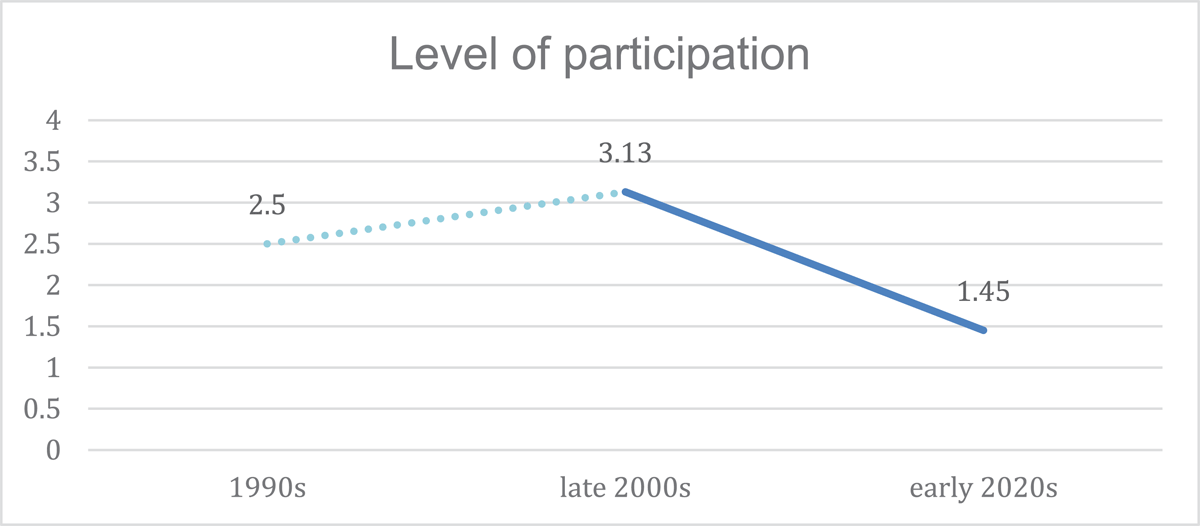
Graph 2
Level of participation, mean scores (late 2000s: N = 11; early 2020s: N = 15).
Results show a visible drop in the level of participation in policy-making: from a mean score of 3.13 (late-2000s) to 1.45 (early-2020s): whereas in the late-2000s the DPM enjoyed more meaningful consultations, today it is mostly tokenised, often only receiving information without opportunities to enter into meaningful dialogue or to influence agendas of consultative bodies.
The graph includes a 2.5 score for the period before the Disability Rights Act of 1998. This should be understood with a limitation, because only three advocates, who were actively involved in that period, gave scores. One of them said that the Disability Rights Act of 1998 strongly improved the DPM’s inclusion in policy-making, hence a higher score in the late 2000s – this trend illustrates how human rights laws can advance practice and strengthen the position of the DPM vis-à-vis governments.
The ratification of the CRPD (2007) was framed as an initial boost for DPOs’ participation in policy-making – thus, the ratification itself and ‘our enthusiasm about the Convention’ also contributed to the higher scores of the late-2000s. Participants felt government bodies ‘took them more seriously’ before 2010: organisations were consulted on a more regular basis, the NDC was ‘stronger’, and state bodies more often entered into meaningful dialogue with DPOs about issues important to disabled people. This is illustrated in the following quote:
…when we discussed what the actual Hungarian translation (in the late 2000s), what the official translation of the UN Convention should be, and what specific terms should be included in the Hungarian text, so when this was debated (in the Ministry) with DPOs… I remember we had comprehensive, very long negotiations with the participation of advocacy organisations, and even passionate debates. I find this unthinkable today.
The drop in participation-level did not start immediately after the election of the Orbán-government in 2010, but – several participants claimed – ‘around 2012’. According to opinions, the downward trend was not linear: stagnation or even ‘visible efforts for improvement’ (in 2014–2018) in consultations were experienced.
Space for advocacy
This scale (Table 3.) measures a second aspect of disability advocacy: how organisations develop and execute advocacy strategies, and how they occupy a position in the public domain amid potential external oppression. It asks a question relevant to NGOs working in feminist (Roggeband & Krizsán 2020) or LGBT+ movements and here its role was to tease out DPM actors’ views on similar tendencies.
Table 3
Advocacy space scale.
| ADVOCACY SPACE |
|---|
| 3. Full freedom/rights (DPOs are free to choose their strategies, unlimited freedom of association, freedom of critical speech and protest). |
| 2. Restricted opinions (self-censorship when voicing concerns, avoiding certain issues in public statements, fear of losing space due to critical statements) |
| 1. Vilification/stigmatization (DPOs or activist groups may be stigmatized due to their criticism or authorities or because of their funding background) |
| 0. Persecution/harassment (legal actions or physical violence against NGOs) |
Most advocates said that it has become common practice that organisations do not publish openly their advocacy statements – in other words they hide their opinions from the public. Thus, criticism of present-day Hungarian disability politics and government policies often remain unvoiced due to fear of repercussions. This self-censorship is illustrated in the opinion of a disabled advocate:
We do not tell fully our opinion. Yes, we know that we should not say this or that about a given issue, because it will blow the Minister’s fuse and then we will be deprived of our funding. And I think this is a fear of voicing criticism (of the government).
Scores (Graph 3.) shows a clear drop, from 2.94 (2000s) to 2.14 (today): while the 2000s were marked by an almost full freedom of choosing advocacy strategies and publishing critical statements, in the 2020s this has changed to a level to ‘restricted opinions’.
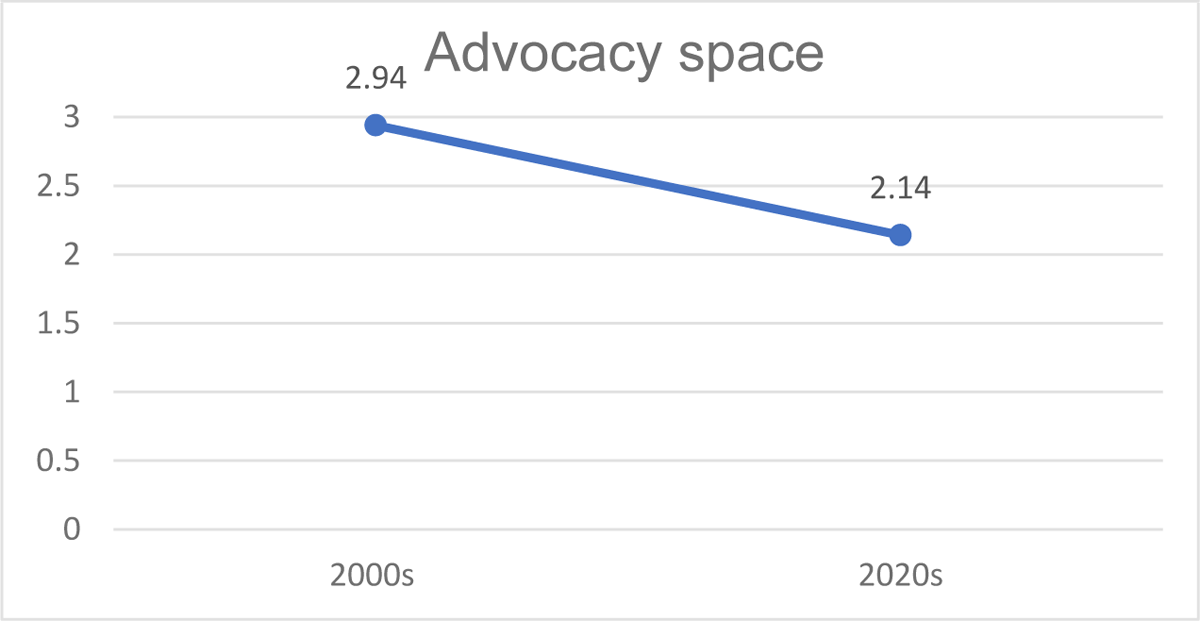
Graph 3
Advocacy space, mean scores. (2000s: N = 9; 2020s: N = 15).
According to participants who had experience from that period – that included several Hungarian governments, including the first Orbán-government (1998–2002), and subsequent socialist-liberal governments (2002–2010) – the 2000s was relatively stable for the DPM on the advocacy scale. One advocate said that DPOs under the first Orbán-government enjoyed high level of autonomy when choosing their strategies, and this freedom continued throughout the 2000s. Several advocates mentioned not 2010 (the start of the second Orbán-government), but the mid-2010s as a turning point. For example, one of them said: ‘…under Fidesz, it was not from the beginning but from 2014–15 when the time came, when there were potential consequences, that we knew we can get smacked (if we speak up)’.
In narratives about possible repercussions, one theme came up in several interviews: the harassment and media campaign against civil society organisations that has been known as the ‘Norwegian Fund scandal’, starting in 2014 (Dunai & Balazs 2014). It appears that after the Norwegian-case, disability advocates became very aware of the risks government-led harassment and negative media campaign may bring to any organisations, including DPOs and their leaders personally.
Importantly, fear of repercussions did not start in the 2010s, with the second Orbán-government. One participant, with over 20 years of experience said, ‘it was the same in the 2000s.’ Another advocate agreed and recalled that they were present at an event around 2006 when a senior socialist-liberal government politician verbally threatened a DPO-leader with withdrawal of funding should they continue their protest.
It seems that, since the 1990s, the DPM has never operated in a fully free environment. Only two participants gave the top score of three to the 2000s, and many more marked this era with various other scores (between 2 to 2.8). However, what participants contextualised was a clearly shrinking political space in the 2010s where DPOs must be increasingly cautious when speaking up. Several advocates said that they have come to avoid certain topics altogether (such as showing solidarity with LGBT+ people attacked by the government), and ‘must’ choose to focus only on issues that are absolutely crucial to their disability groups. Some stated that today they avoid public criticism of the government even in issues most crucial to their constituency.
Based on interviews, this fear of repercussions is largely a fear of losing funding by state bodies. Several advocates claimed that any funding provided by public bodies must result in restricted independence of DPOs – this view is illustrated by the opinion of an advocate of a state-funded organisation:
What a paradox to be funded from a state budget! A civil society organization is either independent or not, so you can explain this away, but nowadays it is more and more often that I keep my mouth shut. (…) as a private person and as representative I can afford less and less to express my opinion.
State funding holds a strong explanatory power when advocates contextualise the closing advocacy space. However, our exploration of funding issues showed a somewhat paradoxical picture.
Access to financial resources
Funding allows organisations to allocate resources to advocacy work, to pay staff and experts, organise events and campaigns, publish reports etc. This third scale refers to types of funding schemes that influence how DPOs can allocate resources to work on public policy-making (Table 4.). Funding independent NGOs in backsliding democracies is well-discussed in literature – funding cuts are government measures against organisations. Studies showed that changing advocacy opportunities have prompted civil society organisations to change funding strategies (Gerő et al. 2023). The role of funding in disability advocacy is largely under-researched (e.g. Petri et al. 2021).
Table 4
Levels of funding.
| FUNDING SCALE |
|---|
| 4. Structural government funding (multi-annual funding schemes, organisational funding enshrined in law). |
| 3. Ad hoc government funding (occasional grants, annual grants). |
| 2. Only foreign funding available (or no domestic funding schemes are used). |
| 1. Foreign funding obstructed. |
| 0. No funding available. |
Results (Graph 4.) show that several national-level organisations in the Hungarian DPM have not experienced difficulties to secure funding in an increasingly repressive political environment. It is almost puzzling to see that so many individual narratives about oppression and fear of losing funding can exist alongside statements where advocates talk about a relatively stable and predictable funding environment – for many but not all organisations.
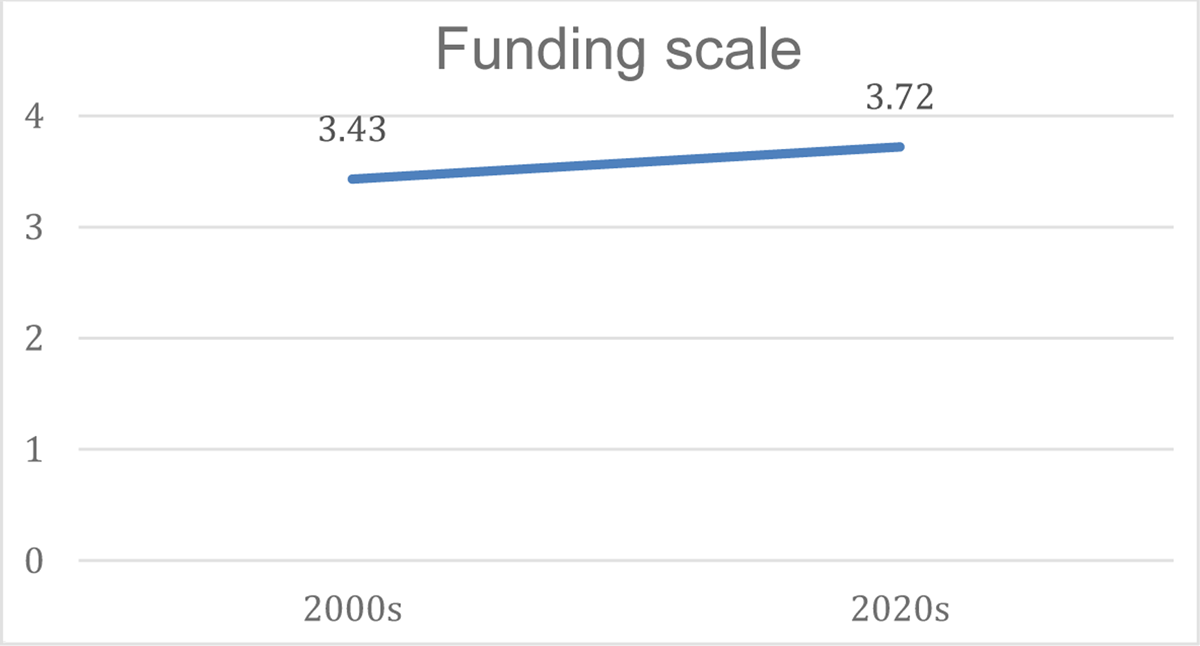
Graph 4
Levels of funding, mean scores (2000s: N = 8; 2020s N = 15).
Participants noted differences between organisations within the movement, pointing at the financial security of ‘big organisations’ in contrast with the rest of the movement that gets funding from occasional grants or other sources. In this context once again, a circle of DPOs is visible: a circle that overlaps with members of the consultative body NDC. Consequently, the above high scores must be interpreted with caution: national, ‘big’ umbrella organisations rely on secure annual funding by the state, but the rest of the DPM would score lower, probably at the level of ad hoc funding.
The list of organisations receiving direct funding through Hungary’s annual Act on the National Budget (‘Költségvetési törvény’) has been extended, and new organisations (e.g. an association for persons with psychosocial disabilities) have been included in the list. Human rights organisations active in disability like the Validity Foundation and the Hungarian Civil Liberties Union are financially independent from the government – public data shows that their funding remains secure, or even improved, due to successful fund-raising from global funders. Launching new disability advocacy organisations is extremely hard. For example, members of the disabled-controlled, Budapest-based collective ‘Living Independently, Living in the Community’ (‘Önállóan lakni, Közösségben élni’) reported that they have struggled to get secure funding since their launch in 2016.
The paradox between secure funding and fear of losing it was explained by one participant:
Well, yes, disabled people’s organisations are listed in the annual Act on the National Budget, so they get funding, but (…) this should be understood together with the two previous scales, that they are still intimidated, that losing funding is a possibility.
This opinion is validated by the government’s step to remove the list of disability organisations in the Act on the Annual Budget in 2021: instead of a list of DPOs’ names, the Act included only a compound budget line for ‘disability advocacy organisations’ – national-level DPOs had to apply for their annual funding from this budget line. This change sent a signal to DPO leaders that their privileged and secure financial status may be fragile and subject to loyalty-checks – less loyal DPOs may receive less funding when their applications are evaluated by the ministry.
5. Discussion
Our case study showed that democratic backsliding has strongly affected the Hungarian DPM. Cautiously extrapolating from our data, we contend that DPM-opportunities to influence policies and fight for human rights are likely to shrink in all eroding democracies, including in countries with formally functioning democratic institutions such as Ombudsperson, Constitutional Court, Human Rights Roundtables and similar bodies – like the Hungarian democratic system that features all these institutions. The existence of human rights-framed or other consultative platforms does not necessarily mean that DPMs have an opportunity to influence policies let alone speak up when they feel important. Crucially, even consultations about European Union policies can hollow out in backsliding EU Member States, making it difficult to uphold human rights principles of the EU’s ‘acquis communautaire’. Amid de-democratisation, we can hardly talk about ‘meaningful engagement’ (CRPD Article 4(3)) in policy-making: consultations become limited or may disappear altogether – and when they exist, they may be reduced to tokenism.
In backsliding democracies, what DPOs say publicly may not be their true opinion. Self-censorship can be systemic, silencing or altering disabled people’s collective voice. Public criticism of governments is avoided (with few exceptions, see MEOSZ 2022), with the probable exception of organisations that are independent from state funding. Interestingly, in the Hungarian case, these are human rights organisations not controlled by disabled people – these are also the organisations that are targeted openly by the government, calling them ‘foreign agents’ (Gerő et al. 2020).
Advocacy strategies shift in eroding democracies: DPOs avoid confrontation with state bodies and while not stopping advocacy altogether, they often rely on ‘informal avenues’ (Hallstrom 2004) such as private contacts and informal bargaining with officials. This means that much of what DPOs and governments negotiate happens ‘behind closed doors’, without the watchful eye of the public, including disabled people, the press, and the international community. Restricted access to free media reinforces this lack of transparency, resulting in a situation where neither human rights violations nor the DPM’s responses are reported publicly.
Fear and intimidation play an important role in movement actors’ behaviour and influence their strategic decisions. Funding issues are crucial in how movements react to a shrinking space of advocacy. Funding has not shrunk for national-level organisations in Hungary, but worrying trends make future funding possibilities uncertain for most of them – thereby reinforcing their intimidation.
In the light of our study a core question appears: amid de-democratisation, can progress in disability rights be made at all? The human rights approach to disability is based on the active participation of people with disabilities in shaping policies that affect their lives. However, this is only possible if political actors and democratic institutions give space to them. Human rights laws are not enough to ensure this space is available – legal obligations in national or international law (such as the CRPD) to consult with DPOs are overwritten by the absence of strong democratic institutions.
Based on the Hungarian example, two additional factors arise. First, coalitions of DPOs are weakened under de-democratisation: individual, bilateral negotiations between DPOs and government cannot replace broader coalitions and run against the ethos of the disability movement that builds strongly on cross-disability solidarity, shared advocacy targets and joint strategies. Second, when the DPM relies mostly on unpublished opinions and non-public advocacy actions, it reduces their chances to hold politicians accountable to their promises but also reduces the control of disabled people over the movement that represents them. These factors – a fractured DPM and ‘silent’ forms of advocacy – add to measures by autocratic governments to curb civil society advocacy and have a compound effect that seriously hinder efforts to influence policy-making and further human rights for all disabled people.
What should the DPM do? In their study about feminist organisations’ responses to democratic backsliding in CEE, Krizsán and Roggeband (2018: 182) assert that cooperative activism only works amid ‘more open and progressive periods’ – a period that has clearly passed the Hungarian DPM by the 2020s. Building on examples, they also suggest that in backsliding democracies more confrontative actions such as mass protests may work, especially if women’s rights are related to broader pro-democracy political movements. This suggestion is applicable to disability issues. Confrontative actions, including street demonstrations were successfully used by the Hungarian DPM: the Metro Line 3 in Budapest was only made accessible after an open campaign, including demonstrations by alliances of DPOs in 2018 – a year when the advocacy space for the DPM was already closing. Connecting disability rights to broader political and pro-democratic demonstrations seems necessary amid de-democratisation. Agreeing with Krizsán and Roggeband (2018), we contend that the politicization of disability rights is unavoidable to defend results of hard-fought battles of the DPM, and issues of disability human rights must be clearly visible on the agenda of any political movement defending democracy.
Our findings bear relevance beyond the CEE region. By 2022, the global shift to populism was reported from with 42 autocratising countries (Papada et al. 2023). The share of people living in autocracies grew from 46% (2012) to 72% (2022) of the world population (Papada et al. 2023: 7). Crucially, democratic institutions are weaking also in Western Europe and North America, for example, key democracy indicators have been dropping all old and new Member States of the EU (Gora & de Wilde 2020: 352). Thus, there is a great risk that the exclusion, tokenisation, intimidation and silencing of the DPM presented in our study, will be, or is already experienced in similar or indeed in various other configurations by DPMs around the world.
We hope this paper will inform researchers in countries with concerns about eroding democratic institutions. Broader and open discussions about issues internal to the DPM and more studies on how DPMs work are needed to help us to face a period when more and more countries are experiencing de-democratisation. DPMs must prepare for strategies to counter the effects of a shrinking space for disability human rights advocacy – and disability studies researchers must support this fight by honest and critical research about the disability movement.
Notes
Acknowledgement
The authors wish to thank Melinda Faragó, Dorottya Fekete, Andrea Krizsán, and Viola Zentai, for their kind support and guidance throughout this project.
Funding Information
The first author was recipient of the Open Society University Network scholarship during this study.
Competing Interests
During this study, Gabor Petri worked as international coordinator at the National Federation of Associations of People with Physical Disabilities (MEOSZ) and Erika Hruskó was volunteering at Önállóan élni - Közösségben lakni (‘Living independently - Living in the community’), a disability rights grassroots organisation in Budapest.
The authors have no competing interests to declare.