
Table 1
Inclusion and exclusion criteria.
| Include | Peer-reviewed, original empirical studies published between March 2020 and October 2022 that address:
English language publications. |
| Exclude | Research studies that focus on children. Research studies that focus on education and learning. Research studies that focus on healthcare, carers and service provision. Literature review articles. Non-research papers including discussion, opinion and correspondence papers, editorials. Non-English publications. Grey literature not listed in databases. |
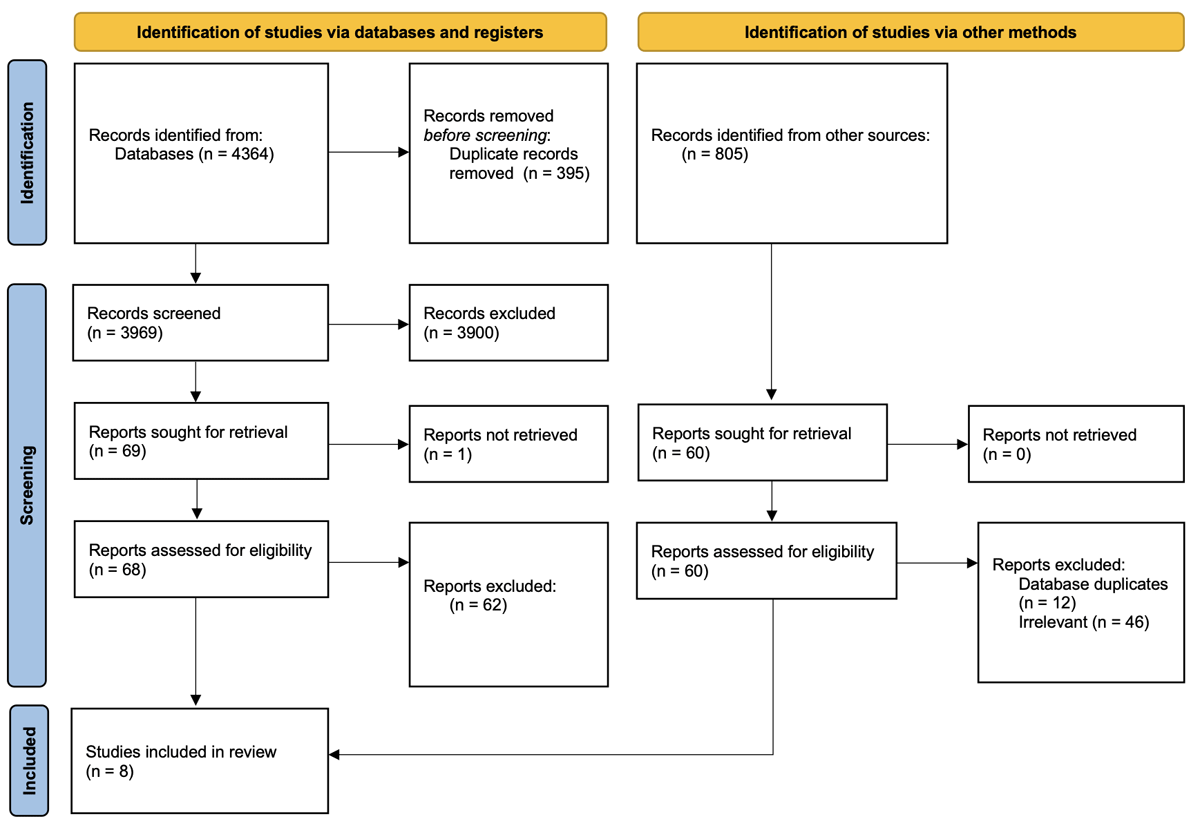
Figure 1
Visual overview of the search and selection process (inspired by Page et al. 2020).
Table 2
Descriptions of the eight publications included in the scoping review.
| AUTHOR(S) | AIM(S) | KEYWORDS | METHODS | PARTICIPANTS | INTERSECTIONALITY | WORK | COUNTRY |
|---|---|---|---|---|---|---|---|
| Adams et al. (2021) | To understand how isolation related to Covid-19 has affected the employment experiences of persons living with spinal cord injury. | Covid-19, spinal cord injury, employment, isolation | Online focus group interviews | N = 14 10 female 4 male Motor disabilities | None | Remote work in all work sectors | USA |
| Chan et al. (2021) | To investigate company characteristics and effective disability inclusion practices that are related to the employment of people with disabilities. | Diversity, inclusion, disability, employment, vocational rehabilitation | Cross-section survey design The Disability Inclusion Profile (DIP) to assess disability inclusion practices | N = 466 Human resources managers and professionals who made hiring decisions | None | A variation of work sectors, from technical services, Information technology to health care and education | USA |
| Das et al. (2021) | To analyse how neurodivergent professionals engage in remote work from their homes and what access means in this context. | Neurodivergent, autism, ADHD, dyslexia, psychosocial disability, accessibility, work from home, remote work, Covid-19, pandemic | Online semi-structured interviews | N = 36 14 female 22 male Cognitive or intellectual disabilities | None | Remote work from home High-skilled work in software and engineering-re lated fields | USA |
| Epstein et al. (2021) | To identify how COVID-19 has uniquely impacted the lives of people with disabilities. | Covid-19, disability health, disability equality, qualitative, emergency response | Semi-structured online focus group interviews | N = 38 22 female 13 male 3 gender not specified Motor, hearing, visual, cognitive or intellectual disabilities, chronic illness | None | Unspecified | USA |
| Gullekson et al. (2022) | To shed light on the experiences and perceptions of persons with disabilities working in a university setting during the COVID-19 pandemic. | Covid-19, employees with disabilities, diversity and inclusion, organisational action | Online survey | N = 485 University employees whereof N = 43 indicated at least one disability | None | Higher education work | USA |
| Oviedo-Cáceres et al. (2021) | To understand changes in daily life emerging from the Covid-19 pandemic for people with visual impairment | Pandemics, Coronavirus infections, disabled persons, visually impaired persons, internet | Telephone interviews | N = 26 12 female 14 male Visual disabilities | None | Unspecified | |
| Szulc et al. (2021) | To understand how neuro minorities experience remote working in times of crisis and what the implications are for human resource (HR) professionals. | Qualitative, human resource, work-life balance (WLB), neurodiversity, remote work, Covid-19 crisis | Online semi-structured interviews | N = 9 Cognitive or intellectual disabilities N = 2 Business professionals supportive of neurodiversity | None | Remote work | UK |
| Tang (2021) | To understand the lived experience of how people with disabilities telework | Telework, computer-mediate d communication, collaboration technology, video calling, people with disabilities | Telephone interviews | N = 25 Motor disabilities, hearing disabilities, visual disabilities, and cognitive or intellectual disabilities | None | Collaborative remote work | USA |