
Introduction
The outbreak of the COVID-19 pandemic in 2020 resulted in instant life-changing events for all people and had medical, mental and social consequences depending on the individual but also societal conditions (Ahmad 2023; Su et al. 2022). The state of health and mortality were affected as were the economy and the labour market on a global scale (Smite et al. 2023; Wilson et al. 2021; Wong et al. 2022), including the working lives of people with disabilities (de Sousa 2021; Holland 2021; Hoque and Bacon 2022; Houtenville et al. 2021; Lindsay and Ahmed 2021; Okyere et al. 2021; Su et al. 2022). People with disabilities were disproportionately impacted by unemployment during COVID-19 due to significant employment in the occupations most affected by the pandemic, but also due to increased discrimination by employers (Schur et al. 2021).
Working life underwent a transition towards increased remote working arrangements, alternatively termed ‘telework’; that is, different ways of working outside the traditional office, at home or in other locations, using telecommunication technologies (Martel et al. 2021; Teklè 2022). New forms of communication and collaboration that evolved during the pandemic have become a ‘digital normality’ for people with and without disabilities (Jochmaring and York 2023). The technological advances applied to work from home hold the potential to be implemented post-pandemic as a strategy to increase accessibility for a range of disabilities (McNamara and Mason Stanch 2021; Schur et al. 2020; Tang 2021). It may appear advantageous for people with disabilities to work from home and use assistive technologies, but they face many challenges to accessing and using technological resources (Jashinsky et al. 2021). In addition, fewer people with disabilities report being users of digital technologies in comparison to people without disabilities, which results in a digital divide (Anderson and Perrin 2017).
Less research has been published reporting on how people with disabilities adapted their working lives to the conditions caused by the pandemic and what working practices and strategies they applied to cope with the situations that arose (Gullekson et al. 2022). What digital technologies and tools did they use to partake in working life during the pandemic, and what challenges and opportunities emerged in connection to that? What learning experiences can we bring with us to future working life to meet the needs of disabled workers? To shed light on the overall state of the research addressing these issues, a scoping review was conducted to map existing research literature and findings and identify where further research is needed.
The aims
The aims of the scoping review are, firstly, to map relevant research literature and examine the extent, range and characteristics of research conducted in 2020–2022 exploring how people with disabilities cope with the pandemic situation in relation to their working lives and what working practices, digital technologies, and strategies they applied; secondly, to summarise and disseminate research findings presented in the research literature included in the scoping review.
Background
Accessibility and participation in society, including working life, is a human right for all people in society (United Nations General Assembly 2006; United Nations General Assembly 2015; World Health Organization and The World Bank 2011). Disability research has, in recent years, focused on barriers in working life, since participation is proven to be lower for people with disabilities compared to other groups, despite their being well-educated (Östlund and Johansson 2018). People with disabilities express difficulties to be included in the private labour market due to environmental, attitudinal and organisational barriers (Gustafsson et al. 2018; Martel et al. 2021). Further on, people with disabilities are less likely to be in paid employment and more likely to be on temporary or part-time contracts, and even more so in the cases of people with intellectual disabilities (Hall 2020; Kock et al. 2021). Working life-related issues and education for people with disabilities have been driven by the disability movement, which has historically been described as a powerful actor in society to influence and improve living conditions for marginalised communities (Bahner 2022; Charlton 1997; Priestley et al. 2010).
The COVID-19 pandemic indeed shook up traditional workplace structures and made employers and employees rethink how and where working tasks can be performed. Teleworking from home or other locations has gained greater acceptance, which has made working life for people with disabilities easier and more accessible (Schur et al. 2020). Flexible working arrangements and work locations are claimed as being important factors to reduce barriers to employment for people with disabilities (Hoque and Bacon 2022). The idea that telework is an opportunity for people with disabilities was launched long before the outbreak of the COVID-19 pandemic (Das et al. 2021). Already, in the digitally immature 1990s, telework was explored as an alternative employment arrangement for people with disabilities and framed as a potential form of ‘reasonable accommodation’ (Americans with Disabilities Act 1999). These earlier studies of telework did not necessarily involve digital collaborative work but could also be paper-based work at home. Telework for people with disabilities was found to be a viable alternative, given the right conditions and training (Murray and Kenny 1990). It was claimed to ‘level the playing field’ for people with disabilities when office-based work became too difficult (Hesse 1996; Partanen 1999).
Since then, further research has been conducted exploring teleworking conditions, consequences for career opportunities (Bosua and Gloet 2017), socialisation at work (Ruiller et al. 2018) and work/life balance (Linden and Milchus 2014; Nishina 2010). The COVID-19 pandemic brought a large cultural and organisational shift in relation to telework as well as accelerated the technological maturity for remote work and collaboration. This rapid shift in work practices has strengthened the possibility of teleworking, fusing the discussion about how we wish our future (post-pandemic) working life to look. However, in discussions about the future of working life, people with disabilities are rarely mentioned (Martel et al. 2021). Also, they are overrepresented in jobs that are not conducive to teleworking, so despite these new openings to participate in working life, the position of many people with disabilities remains a challenge (Holland 2021).
Methodology
A scoping review approach was applied to identify research studies and to synthesise evidence. The general purpose of scoping reviews is to map existing literature in a field in terms of the extent, range and characteristics of the research and to provide a descriptive overview of the reviewed material (Arksey and O’Malley 2005). The approach allows for examining a phenomenon from different perspectives while at the same time facilitating the identification of various knowledge gaps within a research area (Ståhl et al. 2022).
The framework adopted for conducting the review builds on five key stages (Arksey and O’Malley 2005). Stage 1: identify the research questions that will be addressed. Stage 2: identify relevant research studies by developing a search strategy and searching in databases and other sources. Stage 3: select research studies based on specific inclusion and exclusion criteria. Stage 4: map the data presented in the research studies according to key issues and themes. Stage 5: compile, summarise and report the results.
Stage 1: Research questions
The scoping review was conducted as part of the project ‘Working life during the COVID-19 pandemic: social participation, learning experiences, design opportunities and future work life for people with disabilities’ (University of Gothenburg, RISE, and Malmö university, 2021). The aim is to explore how the experiences gained from the transition towards remote work during the pandemic can contribute to improving the conditions for people with disabilities to participate in and contribute to working life. ‘Working life’ is here referred to as any form of employment (part/full time, volunteer assignments, temporary or subsidised employment etc.) at a workplace within the public, private or idea-based sector (civil society).
In line with the project aims, the scoping review was guided by the research questions:
According to existing research:
• How has the working life of people with disabilities been adapted to the new conditions caused by the pandemic?
• What strategies did people with disabilities use to manage their working life during the pandemic situation?
• What kinds of digital technologies and tools did people with disabilities use to partake in working life during the pandemic?
Stage 2: Identify research studies
A search strategy and specific inclusion and exclusion criteria (Table 1) were developed. Two university librarians and experts in database searches formulated a search query (Appendix 1). The reliability of the study was strengthened by having the university librarians and three researchers (the authors of this article, from now on referred to as the reviewers) decide upon the search query and selection of keywords.
Table 1
Inclusion and exclusion criteria.
| Include | Peer-reviewed, original empirical studies published between March 2020 and October 2022 that address:
English language publications. |
| Exclude | Research studies that focus on children. Research studies that focus on education and learning. Research studies that focus on healthcare, carers and service provision. Literature review articles. Non-research papers including discussion, opinion and correspondence papers, editorials. Non-English publications. Grey literature not listed in databases. |
The search was implemented in August 2022 and finalised on October 31, 2022, in the bibliographic databases: Scopus, Cinahl, IEEE Xplore, ACM Digital library, Psycinfo, education database, sociological abstracts, social services abstracts, ASSIA (Applied Social Sciences and Abstracts) and sociology database. The ‘snowball’ technique (Bryman et al. 2022) was also applied to identify relevant publications to include.
Stage 3: Select research studies
The database search generated a large number (n = 4 364) of research studies (Figure 1). In addition, research studies (n = 805) were identified via other search methods (snowball technique, Google scholar etc). A two-step screening process was conducted to assess the relevance of the research studies. The first step consisted of importing the citations into the online review system Rayyan (2023) for a collaborative screening of titles and abstracts. All citations were individually screened by three reviewers applying the same inclusion and exclusion criteria (Table 1).
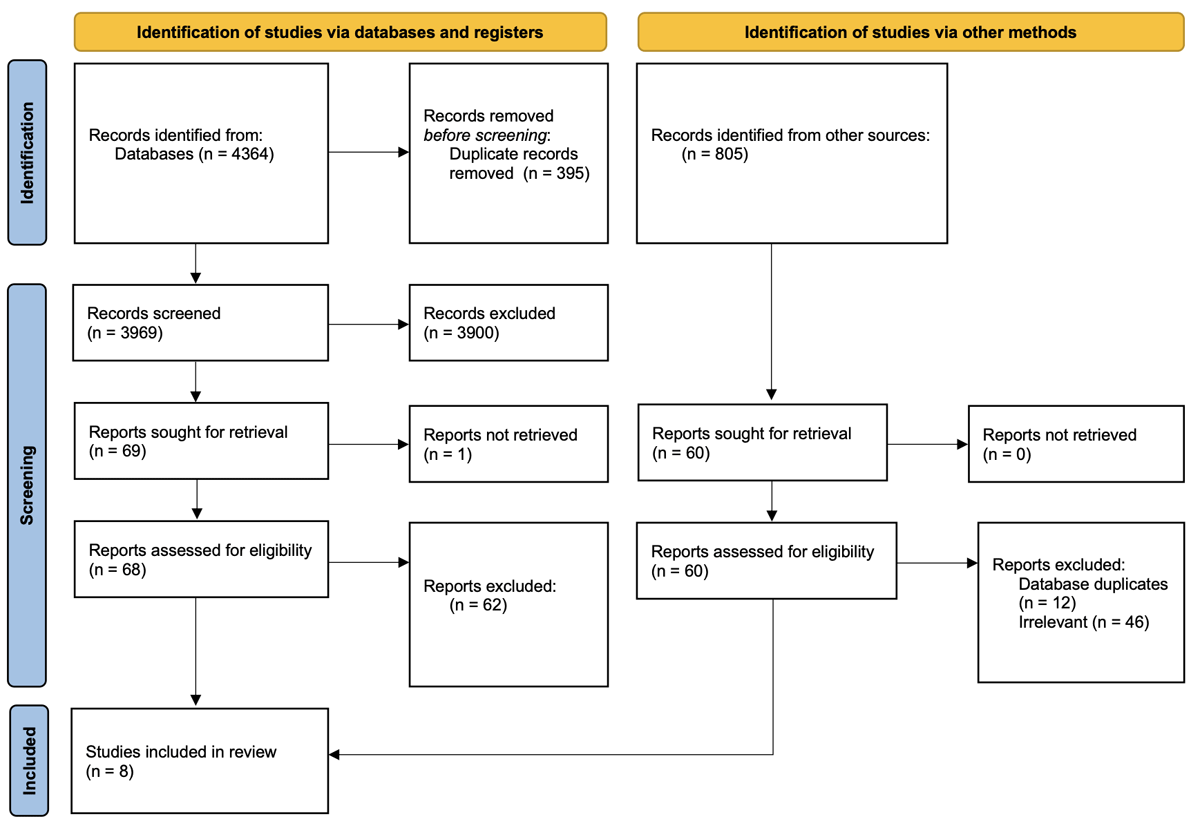
Figure 1
Visual overview of the search and selection process (inspired by Page et al. 2020).
The citations were marked with ‘Include’, ‘Exclude’ and ‘Maybe’. The citations that were marked differently by the reviewers or with a ‘Maybe’ were screened again and then jointly marked. Duplicate articles were removed. The process resulted in a large part of the research studies being eliminated since they were found irrelevant.
In the second step, the remaining research studies (n = 68), and research studies (n = 60) identified via other search methods were imported to the online bibliographic manager Zotero (Zotero 2023). The research studies were divided between three reviewers for a new round of screening process. Having read the publications in detail, eight research studies were selected to be included in the scoping review.
Stage 4: Map and analyse the data
The next stage consisted of mapping the data presented in the publications. Information related to aims, research methods, approaches, population, type of disability and work, and geographical location was collected. The types of disabilities were divided into five overarching groups: motor disabilities, hearing disabilities, visual disabilities, cognitive or intellectual disabilities, and chronic illness (World Health Organization and The World Bank 2011). Previous research emphasises the importance of understanding the intersectionality of the different dimensions of how the COVID-19 pandemic affected people’s participation in society and working life (Thomas et al. 2023). To develop a deeper understanding of how the COVID-19 pandemic affected people with disabilities, we ought to look at further dimensions beyond disabilities that may marginalise people, e.g., gender, ethnicity, class and geography (Cameron and Curran 2022). Thus, whether the research studies assumed intersectional approaches or not was also registered.
A form was developed to chart the data (Table 2). The reviewers strived to follow a uniform approach; however, as also noted by others (Badger et al. 2000), this is not always possible since research publications sometimes fail to present data in the most accessible formats. Together, the data chart formed the basis of the descriptive analysis of the research studies.
Table 2
Descriptions of the eight publications included in the scoping review.
| AUTHOR(S) | AIM(S) | KEYWORDS | METHODS | PARTICIPANTS | INTERSECTIONALITY | WORK | COUNTRY |
|---|---|---|---|---|---|---|---|
| Adams et al. (2021) | To understand how isolation related to Covid-19 has affected the employment experiences of persons living with spinal cord injury. | Covid-19, spinal cord injury, employment, isolation | Online focus group interviews | N = 14 10 female 4 male Motor disabilities | None | Remote work in all work sectors | USA |
| Chan et al. (2021) | To investigate company characteristics and effective disability inclusion practices that are related to the employment of people with disabilities. | Diversity, inclusion, disability, employment, vocational rehabilitation | Cross-section survey design The Disability Inclusion Profile (DIP) to assess disability inclusion practices | N = 466 Human resources managers and professionals who made hiring decisions | None | A variation of work sectors, from technical services, Information technology to health care and education | USA |
| Das et al. (2021) | To analyse how neurodivergent professionals engage in remote work from their homes and what access means in this context. | Neurodivergent, autism, ADHD, dyslexia, psychosocial disability, accessibility, work from home, remote work, Covid-19, pandemic | Online semi-structured interviews | N = 36 14 female 22 male Cognitive or intellectual disabilities | None | Remote work from home High-skilled work in software and engineering-re lated fields | USA |
| Epstein et al. (2021) | To identify how COVID-19 has uniquely impacted the lives of people with disabilities. | Covid-19, disability health, disability equality, qualitative, emergency response | Semi-structured online focus group interviews | N = 38 22 female 13 male 3 gender not specified Motor, hearing, visual, cognitive or intellectual disabilities, chronic illness | None | Unspecified | USA |
| Gullekson et al. (2022) | To shed light on the experiences and perceptions of persons with disabilities working in a university setting during the COVID-19 pandemic. | Covid-19, employees with disabilities, diversity and inclusion, organisational action | Online survey | N = 485 University employees whereof N = 43 indicated at least one disability | None | Higher education work | USA |
| Oviedo-Cáceres et al. (2021) | To understand changes in daily life emerging from the Covid-19 pandemic for people with visual impairment | Pandemics, Coronavirus infections, disabled persons, visually impaired persons, internet | Telephone interviews | N = 26 12 female 14 male Visual disabilities | None | Unspecified | |
| Szulc et al. (2021) | To understand how neuro minorities experience remote working in times of crisis and what the implications are for human resource (HR) professionals. | Qualitative, human resource, work-life balance (WLB), neurodiversity, remote work, Covid-19 crisis | Online semi-structured interviews | N = 9 Cognitive or intellectual disabilities N = 2 Business professionals supportive of neurodiversity | None | Remote work | UK |
| Tang (2021) | To understand the lived experience of how people with disabilities telework | Telework, computer-mediate d communication, collaboration technology, video calling, people with disabilities | Telephone interviews | N = 25 Motor disabilities, hearing disabilities, visual disabilities, and cognitive or intellectual disabilities | None | Collaborative remote work | USA |
Data on the results of the research studies reported upon in the publications was also collected. A thematic analysis and an inductive approach were assumed to analyse the data and identify patterns of meaning (themes) (Braun and Clarke 2023). The approach allowed for the data to determine the themes, that is, the themes originated from the data materials themselves (bottom-up) and not from predetermined categories. The themes were used as analytical tools to structure, interpret and describe the research results and formed the basis of thematic analysis.
Stage 5: Compile, summarise and report the results of the descriptive and thematic analysis
The descriptive and thematic analyses of the data charted from the publications resulted in two types of narrative accounts of existing research. Firstly, the descriptive analysis of the extent, range and characteristics of the research studies shed light on the dominant areas of research in this field. This contributed to fulfilling the first aim of this scoping review, that is, to map and describe research studies exploring how people with disabilities cope with the pandemic situation in relation to their working lives.
Secondly, the thematic analysis and summary of the research results presented in the publications provide a state-of-the-art of the field, reveal knowledge gaps and point out potential directions for future research. The thematic analysis resulted in four themes used to describe the results in a narrative format. This contributed to fulfilling the second aim of this scoping review, that is, to summarise and disseminate research findings presented in the existing research literature.
Results
Description of the research studies
Descriptive data of the eight publications is charted in Table 2. The column ‘Author(s)’ lists the author(s) and year of publication (full references can be found in the reference list). ‘Aims’ presents the aim(s) of the study. ‘Study design’ is the approach and methods applied. ‘Participants’ presents the number of participants and the type of disability. The column ‘Intersectionality’ indicates whether an intersectional approach was assumed. Work’ presents the work area addressed in the publication. ‘Country’ is the country where the study was conducted.
Seven articles were published in 2021 and one in 2022. Two of the articles are published in the field of human-computer interaction, two articles in rehabilitation studies, two articles in nursing studies, one in disability studies, one in sociology, one in work sciences, and finally, one article in the field of security studies. Six of the studies were conducted in the USA, one in the UK and one in Colombia.
The aims of the eight research studies varied. One study investigated company characteristics and disability inclusion practices related to the employment of people with disabilities during the COVID-19 pandemic. The other seven studies aimed at exploring working life during the pandemic from the perspective of disabled workers. Two of these studies specifically explored the topic of telework, and what access means in this context. Two studies aimed at understanding changes in daily life, including working life, during the pandemic and how this impacted the lives of people with disabilities. One study aimed at shedding light on the experiences of people with disabilities working in higher education.
Six of the studies assumed a qualitative approach and two a quantitative approach using online surveys. The six qualitative studies were all based on interviews, whereof two were focus group interviews conducted online via video conferencing platforms and four individual interviews whereof two were conducted via video conferencing platforms and two via telephone.
The two studies assuming a quantitative approach involved 466 and 485 participants. The participants in the first study represented the human resources departments, also including managers and professionals who made hiring decisions. The latter study involved university employees whereof 43 indicated at least one disability. The kinds of disability were not specified.
The six qualitative studies involved from 9 to 38 participants, on average 25 participants. Two of the studies specifically involved participants with cognitive or intellectual disabilities, 36 and 9 participants partook, as did 2 business professionals supportive of neurodiversity. One study with 26 participants specifically addressed visual disabilities; one study with 14 participants specifically addressed mobility disabilities. Two of the studies addressed all types of disabilities and involved 38 and 25 participants.
Seven of the studies gathered demographic data on the participants, such as gender, ethnicity, race, age and geography. These dimensions were, however, not addressed when analysing the data, which means that none of the eight research studies assumed an intersectional approach.
Two studies did not specify the type of work or employment of their participants. The rest of the studies dealt with remote working settings, often in hybrid settings. One study dealt with higher education work and one study with high-skilled work in software and engineering-related fields. One study dealt with remote work in all sectors. Another study involved participants from a wide range of work sectors, from information technology to retail trade. One study specifically addressed collaborative remote work.
To summarise, seven of the eight research studies took a point of departure in the lived experiences of people with disabilities and their working practices and strategies applied during the pandemic. One study indirectly addressed the working lives of disabled workers by exploring the characteristics of companies and their inclusion practices related to employees with disabilities. Six out of eight studies assumed a qualitative approach and were based on interview data. None of the interviews were conducted face-to-face, but in remote settings since keeping distance from others was recommended during the pandemic. The two quantitative studies used online surveys. The working life settings explored were primarily the kind of work that could be conducted in remote settings, that is, office-based work. All of the studies can be sorted into the fields of disability research and social sciences, also including the field of human-computer interaction. None of the studies assumed an intersectional perspective. The majority of the studies were conducted in a Western context.
Four themes addressing working life
The thematic analysis resulted in four themes addressing the working life of people with disabilities during the pandemic.
Theme 1: The (home) office environment
The first theme addresses the benefits and drawbacks of the home office environment compared to the office environment at a workplace. A home office can be tailored to individual needs in ways that are often not made possible in an office environment, especially in open-plan offices where the employee does not have a fixed workspace. Thus, the home office holds the potential to become a better-suited work environment where the individual may, for example, regulate sensory stimulation of light, reduce noise and distractions, and decorate the work environment solely based on their preferences and needs, something that can be helpful for neurodivergent people (Szulc et al. 2021). An important challenge to highlight is that working from home offices may make it more difficult to provide and receive clear feedback on work performance and expectations, which emphasises the need to make feedback more explicit for remote workers to not risk a drop in productivity or over-work and burn-out (Szulc et al. 2021).
The home office also allows for a variation of work postures, such as working while laying down, which may be considered too informal at a workplace, but can be helpful for people with limited mobility and/or who need pain relief (Tang 2021). To others, working from the home office has led to a more sedentary lifestyle and less movement during the workday (Adams et al. 2021). Based on living conditions and arrangements, some employees cannot separate the home office workplace from the rest of the home due to, for example, lack of space. They thus have to work and relax in the same space, which may make it difficult to let go of work and find time to rest. Individuals that are cohabiting with others who are also working or studying at home may find themselves in an even more distracting work environment than open-plan office spaces (Das et al. 2021).
Theme: 2 Digital tools and meetings
The second theme addresses the accessibility of digital tools and remote meetings via video conferencing platforms. While the distractions in the home office can be controlled by the individual, the virtual work environment comes with its own set of challenges for managing attention and distractions for example during remote meetings, which can be especially aggravating for neurodivergent people (Das et al. 2021). Remote meetings come with many quirks such as a screen full of people and their facial expressions and body language, noise from participants not having their microphone muted, and video and audio glitches (Das et al. 2021).
The question of keeping the video camera on or off during remote meetings can be controversial. Some individuals prefer to keep their videos off because they become too self-conscious about their appearance, especially if it risks disclosing a disability such as tics and other impression management (Tang 2021). Others are afraid that activities not directly related to the meeting would become obvious and that this would make them appear unfocused (Szulc et al. 2021). Some individuals prefer to keep the video on to enable reading social cues, to see everyone’s faces or for lip reading (Szulc et al. 2021). Virtual backgrounds or video blur can be a compromise and a way of preventing the disclosure of disability—for example, concealing medical equipment in the background (Tang 2021).
Remote meeting practices and behaviour
Remote meeting software based on screening a video of the person currently speaking may lead to practical obstacles when using a sign language interpreter (Tang, 2021). Since the interpreter is not speaking, their video may not show up properly and when someone speaks through their interpreter, the window of the interpreter is shown, not the person speaking using sign language.
Upcoming technical solutions such as closed caption, auto-transcribing and other tools that can assist and enhance audio and video can become an important addition (Das et al. 2021), especially making video and audio not reliant on real-time attention and comprehension but possible to review afterwards. Screen reading technologies or voice command software are relied upon by many, but they can run into issues when used with the combined audio streams of the remote meeting (Tang 2021). Moreover, remote meetings can place high requirements of digital skills and access to assistive technologies as well as internet connectivity that may not be available to everyone (Oviedo-Cáceres et al. 2021). They are also not suited for activities that involve the room and other artefacts, such as teaching painting, music or dance (Epstein et al. 2021).
It is not only the features of the digital tools themselves but also the behaviour in remote meetings that can determine whether they are accessible to people with disabilities (Das et al. 2021). The question of turn-taking is important both to make sure that everyone can get attention, but also to make it easier to follow a meeting and what is said. Interruptions are common in remote meetings due to, for example, time latency. It is thus important to keep meetings more organised than physical meetings due to the risk of miscommunication and lack of social cues, including assigning different roles for participants to keep track of time and speaking turns. Hand raising and using the chat to communicate can be alternatives, as well as making sure that speaking time is fairly distributed.
Communication, information and visual materials
Sharing material such as slide presentations and agenda beforehand can help with preparation and comprehension during remote meetings. Sharing material afterwards such as presentations, transcriptions and recordings allows for the processing of the information at an individual pace, which may be of special importance for neurodivergent persons (Das et al. 2021).
Outside of the meetings, collaboration in remote work uses different modes of communication, such as e-mails, chat messages, comments in documents, video calls, phone calls etc. The initiator can often choose the mode of communication they are most comfortable with, such as writing over speaking, but must also in some cases adapt to the mode of communication chosen by colleagues (Das et al. 2021). Using different modes of communication can also help combat so-called ‘Zoom fatigue’ coming from endless remote meetings (Adams et al., 2021).
Theme: 3 The relationship with employers and work colleagues
The third theme addresses the relationships between people with disabilities and their employers and colleagues. In these relationships, support and empathy are central elements.
People with disabilities often rely on support from colleagues to manage the remote working situation. In remote meetings, this may involve asking someone to repeat things that were not heard clearly due to sound or hearing issues, or asking the presenter to explain what is shown on screen if visually impaired (Tang 2021). For neurodivergent persons with concentration challenges, it may involve reaching out to colleagues to recall meetings when they were not able to pay attention the whole time (Das et al. 2021). To be the one who often interrupts meetings with such requests can cause a nuisance, as in the case of colleagues that do not understand the situations of people with disabilities. Working remotely from home makes it more difficult to spontaneously reach out to a colleague for quick assistance (Epstein et al. 2021).
The ability of the management and the human resources department to support remote work is proven to be crucial to ensure an inclusive working environment (Chan et al. 2021). The circumstances caused by the pandemic resulted in a growing acceptance of mental health support for employees (Das et al. 2021). This also extends to the general accommodation of the work situation to individual employees, although there can still be uncertainties about how stigmatised it is to talk about and acknowledge mental health problems.
To create conditions for an inclusive workplace, management and human resources departments must be trained in how various disabilities can affect the work situation and well-being (Chan et al. 2021). If managers take the initiative to show commitment to accommodating disabilities in the workplace, a culture of acceptance and accommodation can spread throughout the organisation. Support from management and colleagues in terms of being able to adapt the work situation to individual needs, or offer flexible schedules and remote work, is helpful for all employees and not just to those with disabilities. To assume an inclusive approach enables organisations to take certain measures that benefit all, and without singling out employees with disabilities (Gullekson et al. 2022). The remote working situation can make the work more similar for all employees with and without disabilities. The experiences gained from the COVID-19 situation have made remote work more accepted and less judged (Tang 2021).
Theme: 4 The structure of the workday
The fourth theme addresses the structure of the workday. Working from home allows for a more flexible workday adapted to individual needs (Das et al. 2021). To individuals that have the capacity and the self-discipline to structure their working hours, this is perceived as one of the positive sides of remote work. To others, to self-organise working life is perceived as a burden. To achieve a sustainable remote working life, employers and human resources departments must provide proper support and resources to employees (Adams et al. 2021; Szulc et al. 2021).
There is also a risk that remote workdays are filled with consecutive meetings and few breaks. The transition between these meetings may be challenging, especially for neurodivergent people (Das et al. 2021). Individuals report having experienced ‘Zoom fatigue’, which is a feeling of exhaustion caused by too long a time in front of the computer screen (Adams et al. 2021; Das et al. 2021). Thus, taking breaks during meetings or moving to asynchronous communication is important (Das et al. 2021). In addition, flexible work hours can cause difficulties for employees who have to plan for assistance or have to reschedule interpreters on short notice (Tang 2021).
Not having to deal with the time and hassle of commuting to and from the workplace is perceived as a great benefit (Epstein et al. 2021; Das et al. 2021). Physical exercise and movement must instead actively be planned for during the workday, which otherwise would have come naturally by going to work or moving through the office space during the workday (Adams et al. 2021). As put forward, most people preferred a hybrid work environment working both from home and the office (Das et al. 2021).
Discussion
This scoping review aimed to present and map empirical research exploring the working life practices of people with disabilities during the pandemic (2020–2022). The review includes research studies focusing on how people with disabilities adapted their working lives to the conditions caused by the COVID-19 pandemic and what working practices, digital technologies, and strategies they applied to adapt to the pandemic.
The transition towards a post-pandemic working life
The situation that the outbreak of the pandemic put us in, forcing us to rethink how and where work can be performed, has certainly sped up the transition towards more flexible and inclusive working arrangements (Martel et al. 2021; Teklè 2022). Yet, there is little evidence describing what this means in practice and what this implies, both to people with and without disabilities (Jochmaring and York 2023).
The result of the scoping review reveals that there are still few research studies published (from the pandemic outbreak until October 31, 2022) specifically exploring how disabled workers coped with the pandemic situation in relation to their working lives. In the initial database search conducted as part of the scoping review, several thousands of articles appeared. In the end, only eight publications met the inclusion criteria (Table 1) and qualified to be part of the review. The majority of the many studies identified in the initial database search (and then sorted out due to irrelevance, see Figure 1) stated that teleworking settings and more flexible work arrangements could potentially open up the labour market to people with special needs (McNamara and Mason Stanch 2021; Schur et al. 2020). As evident from the review results, very few studies addressed how these potentials could be realised and implemented post-pandemic and the challenges that may emerge in connection to that, both in terms of working practices and strategies, but also in public health decision-making and policy development (Epstein et al. 2021).
Knowledge resources to learn from
Further on, some of the studies referred to in this scoping review present visionary future scenarios and speculate about future working life, but rarely directly engage with and invite people with disabilities to be part of the discussions (Martel et al. 2021). None of the research studies reviewed assumed a participatory research approach and involved their participants in research interventions beyond interviews and surveys. This may be a result of the fact that the researchers followed the recommendations communicated by the authorities saying that distance must be kept to avoid spreading the infection. The knowledge and experiences of people with disabilities are resources for the non-disabled world to learn from (Epstein et al. 2021). Lockdown is normal life for many people with disabilities (Martel et al. 2021). They are used to coping with physical and social isolation, routine disruption, and anxiety, which are experiences that also people without disabilities faced and struggled with during the pandemic.
Disability and intersectionality
Another important insight to highlight is the fact that none of the eight research studies assumed an intersectional approach. This is despite the fact that the disability research community argue for the importance of understanding the intersectionality of the different dimensions of how the COVID-19 pandemic affected people’s participation in society and working life (Cameron and Curran 2022; Thomas et al. 2023). Hall (2020) states that ‘the pandemic is a timely reminder of the (commonly neglected) complex intersectionality of people with disabilities’ (Hall 2020: 350) and that we ought to consider other things that may marginalise people beyond the disability, such as gender, ethnicity, class and geography. Further on, an intersectional perspective is also needed to understand more about the digital inequalities that arose during the pandemic since digital technologies can be ‘wielded as oppressive tools at the same time they provide benefit, or at least, functional or practical returns, and often produce and reproduce social orders that harm some while privileging others’ (Curran 2022: 95). Digital inequalities can either be made visible, be avoided or be improved (Curran 2022).
Themes of accessibility
The thematic analysis of the research studies shows that making remote working life accessible to people with disabilities is not simply a matter of the accessibility functions of the digital tools in use, although that is a requirement. A transition to remote work affects all aspects of life both during and after the normal workday and can be a life-changing experience. Relationships at work, both between colleagues and with managers, and how flexible the pace and structure of the work environment can be, are equally important issues to consider.
Limitations of the study
English was used for the database searches, which means scientific articles published in other languages were not reviewed. Research studies carried out during the period 2020–2022, but yet not published, were not included in the review. ‘Grey literature’, not published in the databases, but relevant, such as knowledge documents, articles and reports published by the national and international disability movement, were also not included.
An important limitation to address concerns the representation in the group of researchers that reviewed the publications that do not include researchers with disabilities, which is a weakness (Burke and Byrne 2020). However, the research project that this scoping review is part of has a reference group consisting of representatives from various disability rights organisations that contribute to strengthening the disability perspective.
Conclusions
The results of the scoping review reveal both challenges and new openings for the future work life of people with disabilities. The transition to remote work initiated during the pandemic is an ongoing negotiation with the conditions of a new work life and how to make it functional at the same time as work-life balances are rethought. This scoping review shows that neither practices nor digital infrastructures have yet stabilised, and should be a call to include the perspectives of people with disabilities in the ongoing re-shaping of work life going forward post-pandemic.
The research studies included in this scoping review identified a series of implications for future research addressing topics such as the post-pandemic hybrid working life and digital gaps both in terms of digital literacies but also access to tools and materials. Also addressed was the lack of intersectional perspectives in previous research and the need for increased involvement and participation of people with disabilities in research. The disability movement has a long history of working with issues related to people with disabilities’ rights to participate in and contribute to society, including working life and research conducted in this field (Charlton 1997; Priestley et al. 2010; Bahner 2022). ‘Nothing about us without us’ (Charlton 1997) is a motto pointing out that no policy or decision-making should be done without the direct participation of the people affected by the policy. This motto must be followed in future research and development aiming to build on the experiences gained from the COVID-19 pandemic to improve the conditions for people with various forms of disabilities to participate in and contribute to working life.
Additional File
The additional file for this article can be found as follows:
Ethics and Consent
The research work conducted for this paper received ethical approval from the Swedish Ethical Review Authority (Dnr 2022-02306-01).
Acknowledgements
We direct our gratitude to David Kjellin and Sofia Gullstrand, librarians at the University of Gothenburg library, for excellent help with the database searches.
Funding Information
The Swedish Research Council for Health, Working Life and Welfare (FORTE Project Dnr 2021-01878).
Competing Interests
The authors have no competing interests to declare.
Author Contributions
All authors have been equally involved in the scoping review and in writing the manuscript.