
Table 1
Sample Characteristics.
| NO. | PERCENTAGE | ||
|---|---|---|---|
| Disability Type | Physical | 7 | 46.7 |
| Visual impairment | 5 | 33.3 | |
| Mental | 3 | 20 | |
| Gender | Men | 6 | 40 |
| Women | 9 | 60 | |
| Marital Status | Single | 11 | 73.3 |
| Married | 4 | 26.7 | |
| Volunteering | Yes | 13 | 86.7 |
| No | 2 | 13.3 | |
| Work in the Disability Field | Yes | 9 | 60 |
| No | 6 | 40 | |
| Education | High school (HS) | 3 | 20 |
| B.A. | 5 | 33.3 | |
| M.A. | 7 | 46.7 | |
| Religion | Muslim | 12 | 80.0 |
| Christian | 2 | 13.3 | |
| Druze | 1 | 6.7 | |
| Geographic Regions | North | 7 | 46.7 |
| Center | 4 | 26.7 | |
| Jerusalem | 1 | 20 | |
| South | 3 | 6.7 | |
| Age: 40 ± 9.7 | |||
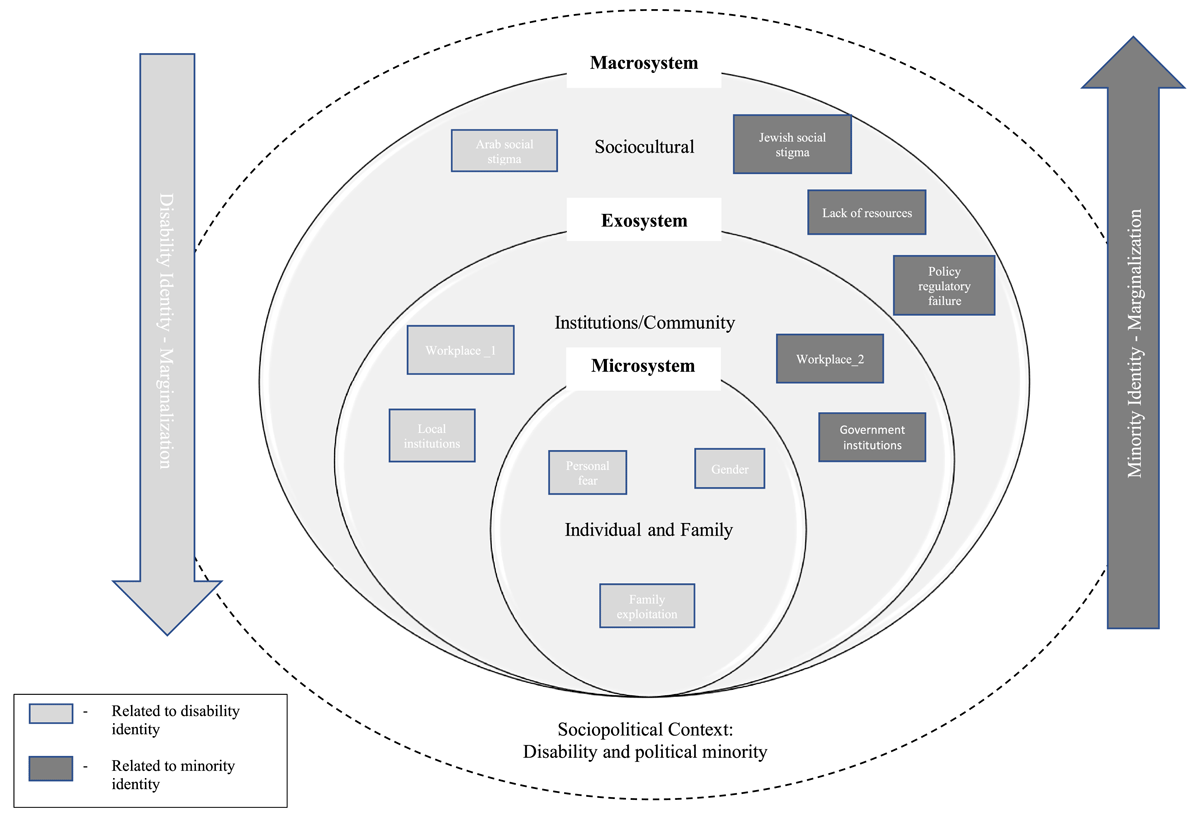
Figure 1
The Intersectional-Ecological Model.
Table 2
Summary of the themes and sub-themes.
| MAJOR THEMES | SUB-THEMES | EXAMPLES OF THE SUB-THEMES |
|---|---|---|
| Microsystem | Individual level | - Personal fear - Language - Gender |
| Family level | - Financial exploitation | |
| Exosystem | Governmental institutions | - National Insurance Institute - Checkpoints/airports - Healthcare - Colleges/Universities |
| Local institutions | - Schools | |
| Workplace | - Employers’ prejudices | |
| Macrosystem | Lack of Resources | - Lack of funds, services, and accommodation |
| Policy and Regulatory Failure | - Law enforcement and equity | |
| Jewish Social Stigma | - Stereotypes | |
| Arab Social Stigma | - Negative attitudes |