
Introduction
The United Nations Convention on the Rights of Persons with Disabilities (UN General Assembly 2006) encourages states’ parties to guarantee the rights of their citizens with disabilities and ensure their equal opportunity for personal development and societal integration. The State of Israel ratified the Convention in 2012 (Ministry of Justice 2021). However, despite this formal commitment, multiple forms of discrimination continue to impact Arabs with disabilities living in Israel for two main reasons.
First, the Arab population is both an ethnic and a political minority group. The 1948 war that resulted in Israel’s establishment is commonly referred to by Palestinian Arabs (hereafter and above, Arabs) as the Nakba, which means “catastrophe,” and represents the loss of their homeland, frustration of their national aspirations, and the origin of their refugee status. Arabs constituted a majority in Palestine prior to the 1948 war. Consequently, Palestinians who lived in the land were divided into three groups: The first group became refugees who moved to neighboring Arab countries such as Jordan and Lebanon; the second group are Palestinians who remained in the West Bank and Gaza Strip, also known as Occupied Palestine; the third group are Palestinians who remained in the geographic area that became the State of Israel and gained Israeli citizenship (Al-Krenawi and Graham 2011; Badran et al. 2023). The third group is the focus of our research. In the years following 1948, through to this day, Arabs in Israel have been discriminated against in many aspects of their existence.
Second, people with disabilities face a wide range of obstacles to their daily functioning that prevent their integration into society, both globally and within Israel. Due to their intersecting identity statuses, Arabs with disabilities living in Israel find it especially difficult to exercise their rights. According to Sandler-Loeff and Shahak (2006), these individuals face many forms of discrimination, some shared with other disabled people in Israel and elsewhere, and others more severe and unique to Arab society in Israel. In their opinion, one of the prominent reasons for this circumstance is an internalized low self-image that incorporates negative societal prejudices. Caught in a vicious cycle, Arabs with disabilities are seen by society as weak and of lower value, and as a result perceive themselves as such.
Despite the growing literature on intersectional identities, little has been written on the nexus between the ethnic political minority and disability identity statuses of Arabs with disabilities in Israel. The current study focuses on Arabs in Israel with physical, sensory, or mental disabilities. Participants’ disabilities were congenital or caused by an accident, but not produced as a result of state violence. Notably, this paper is the first to present the subjective experience of Arabs with disabilities in Israel and their worldview. By giving voice to a group that faces both the barriers of being an Arab and having a disability, we render visible a group that is considered ‘the invisible of the invisible ethnical political minority.’ To do so, we developed and utilized a novel intersectional-ecological model and applied it to this otherwise overlooked population. Our model was developed based on our findings in accordance with a grounded theory approach.
Arabs with Disabilities in Israel
Arab individuals constitute 21% of Israel’s population, and consist of Muslims (85.1%), Druze (7.6%), and Christians (7.3%) (Central Bureau of Statistics 2020a, Central Bureau of Statistics 2020b). Considered a politically, socially, and economically weakened ethnic minority, Arabs in Israel face barriers such as insufficient health and education services, unemployment, and poverty. These factors in turn impair or heighten existing impairments to physical and mental health (Azaiza 2013). Arab communities are mostly located in Israel’s geosocial periphery, and are characterized by low access to public transportation, poor housing conditions, lack of employment opportunities, and high crime rates. Accordingly, the socioeconomic status of the Arab population is significantly disadvantaged relative to that of the Jewish population (Al-Krenawi and Graham 2011). On average, Arabs also have a higher prevalence of several chronic diseases, higher incidence of disability and functional impairments, and higher mortality rates relative to the Jewish majority (Knesset Research and Information Center 2017). These discrepancies may be explained due to a combination of medical specialists and access to medical services being lower among Arab communities, and a greater prevalence among Arab individuals of occupational accidents, a reduced awareness of maintaining a healthy lifestyle, and a higher incidence of consanguineous marriages. Because the participants in our study live within the Israeli territory, they experience fewer attacks by the IDF than Palestinian peers living in Occupied Palestine (Mazawi-Marjyyah 2001).
Arabs with disabilities in Israel are exposed to different levels of exclusion and stigma. The intersection of the two identities—being a person with a disability and belonging to Arab society—means this group is in ‘double jeopardy’ of experiencing prejudice (Sandler-Loeff and Shahak 2006). Although the proportion of people with disabilities within Arab society is relatively higher than the proportion in Jewish society, the availability of social services is lower; the latter circumstance is exacerbated by social norms amongst Arabs against accepting assistance from the Israeli state.
The under-utilization of state services stems from a lack of awareness toward the offered services, fear of losing the benefits received from the National Insurance Institute, and the services frequently not being culturally adapted to, and therefore less accessible to the Arab population. In addition, disability status is perceived by many Arab families as a shameful matter in light of social stigma. They therefore avoid utilizing state services in order to avoid social exposure and attendant social penalties, such as reduced marriage prospects for family members of people with disabilities (Badran et al. 2023).
Intersectionality
Intersectionality theory was initially conceptualized by African American feminist scholars in the late 1980s, most prominently legal scholar Kimberlé Crenshaw. The theory was first utilized in describing the nuanced and increased nature of discrimination experienced by women of color because of the intersection of their two marginalized identities. Crenshaw (1990) noted that ‘many of the experiences black women face are not subsumed within the traditional boundaries of race or gender discrimination as these boundaries are currently understood’ (p. 1244). This scheme provides a meaningful understanding of the inequality experienced by people who have multiple stigmatized identity characteristics. It emphasizes that many combined identities ‘are not separate, additive, dimensions of social stratification but are mutually defining, and reinforce one another in a myriad of ways in the production and maintenance of health across the life course’ (Warner and Brown 2011: 1237). Rather than viewing such individuals’ features as discrete, intersectionality theory views identities as a web of cross-cutting relationships, and considers the interactions between these identities and the way they combine to shape experiences (Haegele, Zhu, and Holland 2019).
Today, the concept is widely applied within the context of disability (Blanchett, Klingner, and Harry 2009; Hammel et al. 2015; Levine and Breshears 2019; Lightfoot and Williams 2009; Nelson and Lund 2017). Understanding the intersections amongst different social identities, along with the privileges or disadvantages associated with them, is essential for both researchers and professionals in that it provides an analytic framework to consider the consequences of multiple excluded identities (Crenshaw 1990).
As an ethnic and political minority, Arabs with disabilities often experience what Blanchett, Klinger, and Harry (2005) call ‘double jeopardy’—a term originally coined to refer to the fact that not only do many students of color experience all the educational inequities associated with living in poverty and attending urban schools that are often not equally funded and resourced, but in addition, are labeled as having a disability and thus experience discrimination for that reason as well.
Bronfenbrenner’s Ecological Theory
Bronfenbrenner’s ecological theory provides a conceptual approach by which researchers can identify and understand the effects of the different social contexts, structures, and systems in people’s lives (Bronfenbrenner 1979). These models help identify how individual behavior is shaped and influenced by implicit factors that lead to multiple layers of stereotypically driven impacts. Bronfenbrenner (2005) identifies five layers of influence that affect behaviors and reality: microsystem, mesosystem, exosystem, macrosystem, and the interactions between individuals and their environments based on processes that occur at each level. Three of Bronfenbrenner’s ecological theory categories will be applied in the current study: (1) microsystem—individual, family characteristics, and other supports; (2) exosystem—institutional/community level characteristics and supports; and (3) macrosystem—government-level health, social, and disability policies (see Bronfenbrenner 2005). Each category was used to analyze our findings.
The Intersectional-Ecological Model
Our intersectional-ecological model utilizes Bronfenbrenner’s ecological theory (1979) to shed light on the depth of systemic persecution and marginalization, revealing why improvement efforts have been insufficient to advance the lived experiences of Arabs with disabilities living in Israel. Our intersectional-ecological model provides a reasonable method for understanding the complexity imbuing the reality of living with multiple identities. This concept can be expanded to ‘include as many identities as are necessary for a particular individual’ (Levine and Breshears 2019: 149).
Our model combines intersectional theory with ecological theory to describe in a deeper way the experiences of Arabs with disabilities in Israel. The framework will demonstrate the impact of each identity on every layer of our model and will also address the intersectionality of these identities. For example, in the macrosystem layer, it includes ideologies and beliefs which comprise a culture or subculture, something that intensifies inequality and oppression. Double marginalization for Arabs with disabilities at the macrosystem derives from belonging to two vulnerable groups. Social inequity arises from policies and laws whose impact are unjust when compared to people without disabilities. Additional marginalization results from the inequalities experienced by the Arab ethnic and political minority relative to the Jewish majority. Such analysis by our model contributes to better understanding the intersections of the identities at the different layers.
Recent years have witnessed growing research studies utilizing intersectionality theory in examining the lived experiences of people with disabilities (Goethals, De Schauwer, and Van Hove 2015). The present study is the first to apply an intersectional-ecological model to this group as a means of analyzing the impacts of belonging to two vulnerable categories: the identity of an ethnic and political minority, and the identity of having a disability.
Method
Our qualitative study is part of a larger research project on intersectional identity and its implications for the lives of Arabs with disabilities in Israel. Qualitative research is designed to obtain straightforwardness on a particular topic without claiming to be a defined and assertive truth (Hammersley 1995). One of the most common methods in qualitative research is semi-structured interviews through which the researchers try to understand the perspectives of the participants who are experiencing the phenomenon in question. Grounded theory approach was applied in the current research, in which data was collected and analyzed and then a theoretical model was developed.
Participants
Fifteen Arabs (9 women, 6 men) with disabilities living in Israel participated in the study. They were identified as having three disability types: physical (7), visual impairment (5), and mental (3). The mental disability category included schizophrenia, social anxiety, and PTSD. Four participants were married. The participants’ ages ranged from 26–60, with a mean of 40 (SD = 9.7). Twelve participants (80%) were employed: seven within social clubs and organizations for people with disabilities, and the rest in an assortment of government agencies, welfare bureaus, and high-tech companies. Thirteen participants also volunteered their time toward raising awareness of disability and disability rights within Arab society. Regarding education, seven participants had achieved an MA degree, five participants held a BA degree, and three participants completed high school. In terms of religious affiliation, the participants self-identified as Muslims (12), Christians (2), and Druze (1). Finally, the participants represented all geographic regions of Israel: north (7), center (4), Jerusalem (3), and south (1) (see Table 1).
Table 1
Sample Characteristics.
| NO. | PERCENTAGE | ||
|---|---|---|---|
| Disability Type | Physical | 7 | 46.7 |
| Visual impairment | 5 | 33.3 | |
| Mental | 3 | 20 | |
| Gender | Men | 6 | 40 |
| Women | 9 | 60 | |
| Marital Status | Single | 11 | 73.3 |
| Married | 4 | 26.7 | |
| Volunteering | Yes | 13 | 86.7 |
| No | 2 | 13.3 | |
| Work in the Disability Field | Yes | 9 | 60 |
| No | 6 | 40 | |
| Education | High school (HS) | 3 | 20 |
| B.A. | 5 | 33.3 | |
| M.A. | 7 | 46.7 | |
| Religion | Muslim | 12 | 80.0 |
| Christian | 2 | 13.3 | |
| Druze | 1 | 6.7 | |
| Geographic Regions | North | 7 | 46.7 |
| Center | 4 | 26.7 | |
| Jerusalem | 1 | 20 | |
| South | 3 | 6.7 | |
| Age: 40 ± 9.7 | |||
The participants were recruited with the help of the Masira Fund (Center for the Advancement of People with Disabilities in Arab Society in Israel). Funded by the Joint Distribution Committee (JDC), Masira (n.d.) empowers Arabs with disabilities in their own communities. Masira’s principal provided the first author with 17 potential interviewees who had volunteered to participate and agreed to forward their details to the first author. The participants were notified that their participation in the research was completely voluntary, and that they had the right to decline to participate or to withdraw at any point without penalty. After the first researcher approached the participants, 15 confirmed their agreement to participate in the study and signed an informed consent form that was sent to them before the interview. The first author, who conducted the interviews, notified participants who did not want to be audio-recorded that notes would be taken instead. The participants were advised to contact their respective case-manager in the event that they felt emotional distress and were also provided with a list of mental health resources at their request. Sample size relied on the saturation concept in which the researchers came to the conclusion that no additional new data was derived from the interviews; we reached saturation at the point when 15 interviews had been conducted. In addition, the participants were asked to choose a private space where they could share their views openly and without distractions or disturbances.
Instrument
The interview guide was developed by the article’s co-authors, based on four key issues identified in the literature. First, multiple identities. Second, intersection of identity domains. Third, coping strategies and resources. And fourth, recommendations. Case descriptions of the participants included three questions regarding the intersection of their disability and ethnicity identities: 1) Do multiple identities sometimes have negative implications? If yes, please explain. 2) Please tell me about the barriers related to each identity you have. 3) Please tell me whether there are differences compared to Jewish people with disabilities? Explain. Demographic variables, such as gender, age, education, employment, family status, disability type, and region of residence were also collected.
Procedure
Ethics approval was obtained from Bar-Ilan University. The interviews were conducted in July–September 2020. With the exception of two, all were conducted via Zoom due to COVID-19 restrictions. The face-to-face and online interviews did not differ in duration (up to 90 minutes) or content.
The interviews were audio-recorded and transcribed. The interviewees signed a consent form and were notified that their participation was voluntary and that they had the right to exit the study at any time without negative consequences. We ensured all the participants that all measures would be taken to protect their confidentiality and that pseudonyms would be used in the paper.
The interviews were conducted in Arabic by the first author, a Muslim Arab researcher living in Israel who has professional and research experience in the field of disability and is a native Arabic speaker. She had no prior personal or professional relations with the interviewees. Together with a Palestinian native Arabic-speaking PhD social work student, the first author translated the quotes into English, and the translations were subsequently edited by a professional.
Data Analysis
Following the translation process of the interviews, data analyses were conducted by the four authors using a thematic analysis to identify major themes in the participants’ responses to the open-ended questions. Thematic analysis was chosen because of its flexibility advantage for examining and identifying themes found within the data. Our analysis was inductive as to which data (here, interviews’ responses) determined our themes. We followed Lincoln and Guba’s (1985) six phases for thematic analysis: familiarizing with the data; generating initial codes; searching for themes; reviewing themes; defining and naming themes; and then writing the report. The verbal data was transcribed for the familiarizing phase by the first author. Next, the four authors generated initial codes from the data. This allowed us to simplify the data and make it more structured for identifying themes. The authors then identified major themes, inductively, from the codes. Next, the authors reviewed the coded data extracted for each major theme and sorted them into subthemes. Both major themes and subthemes were named.
In qualitative research, triangulation refers to the use of multiple methods to develop a comprehensive understanding of a phenomena (Patton 1999). Two types of triangulations were used: (1) Investigator triangulation, in which multiple researchers are involved; in this case four researchers, developing open-ended questions and analyzing the data. This approach is used to increase the validity and reliability of findings. (2) Data source triangulation that involves collecting data from different types of individuals; in this case a sample size of 15. These methods contributed to a more holistic understanding of the studied phenomenon (Carter et al. 2014).
Results
Our analysis suggests that barriers for Arabs with disabilities in Israel may be understood at three main ecological layers—microsystem, exosystem, and macrosystem—including the impact of the intersections within each level. Each layer is described in the following sections, and an illustration of our combined intersectional-ecological model is presented in Figure 1. Three major themes were derived from the participants’ responses, and each theme presented several sub-themes (see Table 2 for illustration).
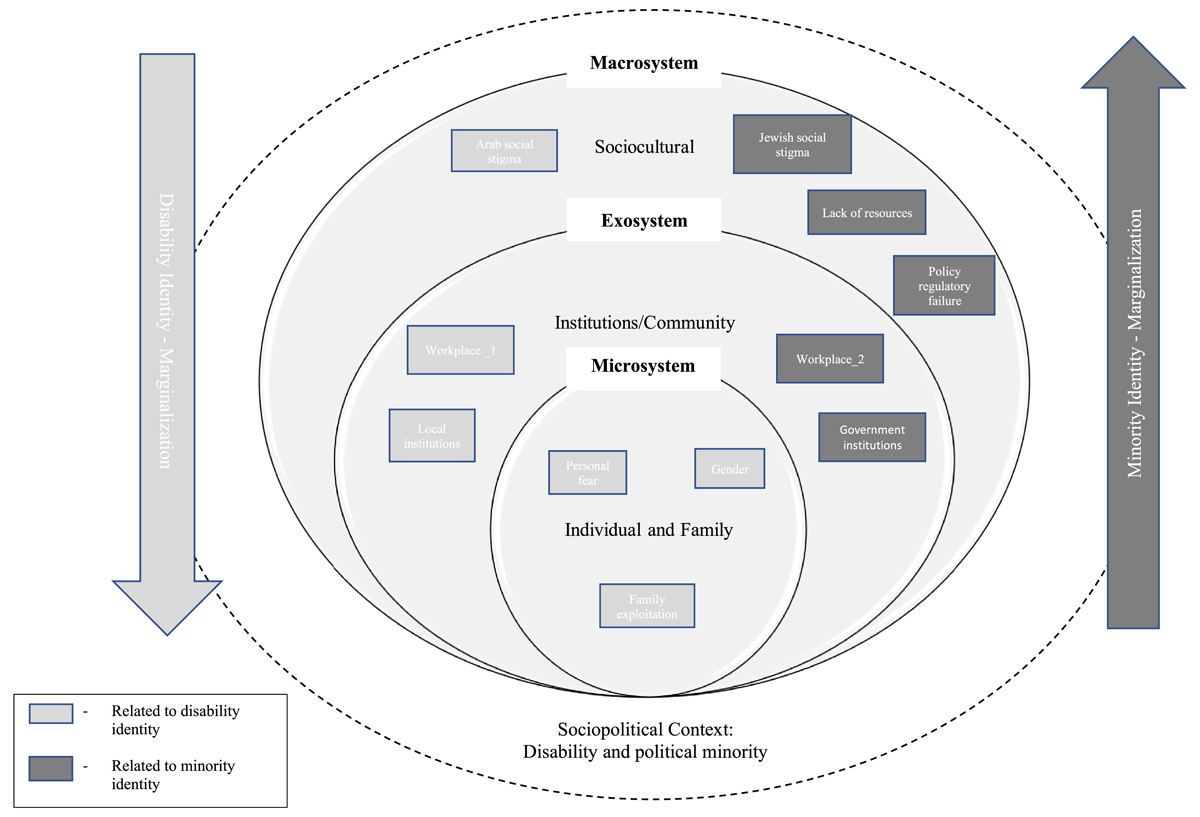
Figure 1
The Intersectional-Ecological Model.
Table 2
Summary of the themes and sub-themes.
| MAJOR THEMES | SUB-THEMES | EXAMPLES OF THE SUB-THEMES |
|---|---|---|
| Microsystem | Individual level | - Personal fear - Language - Gender |
| Family level | - Financial exploitation | |
| Exosystem | Governmental institutions | - National Insurance Institute - Checkpoints/airports - Healthcare - Colleges/Universities |
| Local institutions | - Schools | |
| Workplace | - Employers’ prejudices | |
| Macrosystem | Lack of Resources | - Lack of funds, services, and accommodation |
| Policy and Regulatory Failure | - Law enforcement and equity | |
| Jewish Social Stigma | - Stereotypes | |
| Arab Social Stigma | - Negative attitudes |
Theme 1: Layer 1—Microsystem: “They think my brain is paralyzed like my legs”
The microsystem is defined as the structures in which the individual lives. It includes the two sub-themes of individual and family. Barriers at the individual level identified by the participants included personal fear, language, and gender; financial exploitation comprised the main barrier at the family level.
Individual level
Personal fear: People with disabilities are rendered vulnerable by social prejudice and exclusion, and at times they respond by ‘accepting’ their harsh reality. Nora related how because of fear of social exclusion, she remained silent about the high salary her assistant exploited from her:
‘It took me three years to speak up about my material and financial exploitation and get rid of my assistant. I was afraid to be alone’ (38, single woman, MA, physical disability).
Language: Despite their qualifications, Arab higher education students with disabilities still face multiple barriers, including language, as instruction in all universities and most colleges is commonly in Hebrew. Dalal describes how, during her undergraduate studies, language limited her in many ways, despite receiving all the adjustments to which she was entitled:
They accommodate my visual impairment by giving me time extensions, but with all that, we find ourselves alone, as, at some point, you have to study by yourself for many hours. Of course, I can’t do this without assistance. First off, assistants are not always available, and many have limited hours and cannot read English. […] you have no time for social life. […] I attend all classes and spend 40 hours per week with an assistant […]. The most challenging thing is when you are in your first year, and your Hebrew is weak, and you must read English as well. Often, the reading assistant assigned to you is Jewish, and I don’t entirely understand all the Hebrew words […]. The visual impairment experience is shared among Arab and Jewish students, but the language is a particular challenge for Arab students (27, single woman, M.A., visual impairment).
Gender: More generally, disabled Arab women described their ‘triple marginalization’ of being members of a minority group, disabled, and female:
We are minorities nested within minorities, making challenges even more difficult for us. Meaning that being a woman with a disability living in a suburban town within conservative Arab society. All this affects the quality of services, social perspective, and jobs (Heba, 45, single woman, M.A., physical disability).
Family level
Financial exploitation: Although Arab families are generally perceived as supportive, stories have circulated within the community about families that have taken advantage of the welfare benefits their disabled children receive, sometimes due to poverty:
I meet families with a child with a disability who spend the […] benefits on the rest of the family. It’s the right of the disabled child to have all his needs covered. The car and the benefits are taken advantage of for family needs, not for the person with disabilities!? (Yasmin, 45, B.A., single woman, physical disability).
Theme 2: Layer 2—Exosystem: “If professionals treat you this way…”
This layer is characterized by the connections that the participants have with several systems in the wider outer circle of the model: Governmental institutions, local institutions, and the workplace.
Governmental institutions include the National Insurance Institute (NII), checkpoints/airports, healthcare, and universities/colleges. When the service providers in those systems were Jews, their marginalization was mainly due to being an Arab; when the service providers were Arabs, it was due mainly to their disability identity.
National Insurance Institute: The NII was perceived by the interviewees as the most bureaucratic and discriminatory government institution. They described constant frustration and resentment in their interactions with it, perceived as due mostly to their ethnicity:
For those using an electric wheelchair for about 15 years, you are eligible for a wheelchair accessible van. […] Like any Jewish person with severe disability, I was entitled to this van, and I needed to adapt this van to my disability. Other Jewish persons with less severe disabilities than mine received this expensive vehicle and the additional upgrades. As an Arab person with disabilities, I had to endure a long period of examinations by three medical committees. Had it not been for other Jewish acquaintances’ help, I would have never gotten this service […] (Waseem, 53, married man, BA, physical disability).
I have to fight for my rights because I don’t get them easily, but I’m a determined person and who doesn’t give them up. Throughout my meeting Arab-Jerusalem residents, I can tell you that they don’t get their full rights, The National Insurance Institute tends to overcomplicate the process by interrogating lots of unnecessary things. They would ask all sorts of questions; where do you live? Where are you staying at and since when? We need to see your electricity bills and Arnona (municipal tax)? Who do you live with? They would look for any irrelevant gaps just to frustrate the residents” (Yasmin, 45, B.A., single woman, physical disability).
In the exosystem, disability identity, although secondary in importance, is also relevant to Arab service users, with stereotypes of government service providers towards people with disabilities—including Jews—described as preventing rights fulfilment:
I should be unemployed to obtain the special services benefit (attendance allowance). For 30 years, I have been living alone and employing an assistant out-of-pocket. As a polio disabled person, getting older worsened my health conditions. […] When an inspector visited me at home, she would comment, “you have a nice place!” Ok, should my house be a mess to obtain such benefits? […] I once went to the Ministry of Health to submit my papers to obtain this benefit; the employee pointed at my clothes with her fingers saying you wouldn’t get the benefit with these nice clothes. […] If professionals treat you this way, what can you expect from the rest? (Mona, 60, single woman, M.A., physical disability).
Checkpoints/airports: The participants experienced routine discriminations and humiliations that are part of the daily life of all Arabs in Israel due to their ethnic identity, despite their being entitled to certain relief such as services and support. Humiliating security checks at military checkpoints in the Jerusalem area and at airports are extremely common and comprise a constant source of resentment:
You’d think they’d maybe sometimes be lenient with you and your escort at the airport, but you experience the brutality of the security inspections like any other Palestinian. […] I wonder why they are doing such a ruthless search. […] Once, I traveled with an Israeli travel company. I went through the two inspections although my Jewish assistant told me that he wondered why they wanted to take me to the second search station while the first search showed that I was OK. What do you want from me? You’ve searched me. They have no problem searching you as much as they can even if you have people accompanying you or you are disabled, but they regard you as suspicious because you are Palestinian (Dalal, 27, single woman, M.A., visual impairment).
Healthcare: It should be noted that discrimination against people with disabilities as regards to healthcare institutions is often literally structural in both Arab and Jewish societies (Badran et al. 2023; Gershuni 2018). The Health Maintenance Organization (HMO) is a governmental institution, and some branches are located in Arab towns, generally staffed by Arab professionals. Unfortunately, participants reported experiencing some forms of discrimination from state service providers who are Arabs.
Accommodations at the HMO aren’t available for the disabled, even though it’s visited by so many of them. I remember one time I had to use the bathroom there, so I went to the bathroom that had “disabled toilet” signs on its door, but it was locked, I went to an employee and told her to open the toilet room […]. She opened it after a long negotiation, only for me to find out that the bathroom was turned into a storage room, and I wasn’t able to enter it with my wheelchair since it was too narrow and small (Yasmin, 45, B.A., single woman, physical disability).
Discrimination in health services is sometimes caused by Jewish service providers’ fear of entering Arab localities, which could be attributed to the long-term impact of the decades-old political conflict (Harmen et al., 2017). For example, Omar described the difficult night he experienced without his respirator because the technician working for his HMO did not dare enter his Arab town.
Once, my respiratory equipment needed repair, and I couldn’t breathe […] I called the wheelchair accessible van driver around midnight, and he said he couldn’t go to the Arab area. […] I told him, “But you are an employee paid to provide services” […]? He said, “I know, but I won’t come.” Consequently, I […] stayed up all night sitting up straight in order not to choke due to oxygen shortage. The next day, I had to be hospitalized […]. (Omar, 48, single man, high school education, physical disability).
On the other hand, when the service provider was an Arab, the participants faced marginalization due to their disability.
Colleges/Universities: Ali experienced discriminatory treatment at an Arab college of education. Most often, this was due to ignorance among academics about the intellectual potential of people with disabilities, echoing Hoda’s statement about her paralysis ‘traveling’ to her brain:
I encountered racism in a major Arab teacher training college. After declaring that I had mental illness, they rejected me under the pretext that the Ministry of Education did not employ teachers with mental illnesses, even though I had high psychometric test scores and excellent high school final grades. My assistant from the Ministry of Health helped me determine that their claim was unfounded. And after challenging them with the help of the Association for the Rights of Persons with Disabilities, they admitted me. Today I’m a teacher, and I’m preparing to complete my master’s. (Ali, 21, single man, B.A., mental disability).
Local institutions: Discrimination against disabled people is also experienced at earlier stages of formal education due to lack of awareness and basic knowledge about disability among teachers:
In elementary school, when my visual impairment began to worsen, and I started losing my sight. The teachers thought that I was lazy, that I was not trying hard enough. I needed to close my eyes as they got tired; my teachers called me out, accusing me of sleeping during class. So, I started distancing myself from peers, my academic performance worsened, and I became isolated at school (Heba, 45, single woman, M.A., visual impairment).
Workplace: Finally, workplace environments were unwelcoming of Arabs with disabilities, and employers discriminated against them. Participants encountered and dealt with employers’ prejudices when looking for jobs, especially when employers expressed concerns about their capabilities. In fact, the participants reported that, due to the combination of their respective disability and a lack of workplace accommodation, they needed more time to complete the tasks given to them:
I once started looking for a job through National Insurance […] and the work placement coordinator introduced me to workplaces and shared my skills and outstanding qualifications. […] unfortunately, they were clearly saying that my disability was severe, and that I had to stay with an assistant. I could not work as a social worker because the job’s burden could be challenging to bear. These things hurt me a lot. Even though my disability was difficult, every morning I woke up at six o’clock to start the day with a strong will (Nora, 38, single woman, M.A., physical disability).
From the participants’ point of view, employment opportunities are scarce. Although many of them have academic degrees, they often find themselves working in the field of disability rather than in their higher education field:
Most persons with a disability work in the disability field as if it their monopoly! […] We should not only have special programs […] to employ people with disabilities. If I am with a disability, I should have the option [to work] in the field of disability as well as in other public workplaces (Laila, 41, single woman, M.A., visual impairment).
Nora indicated that she encountered double discrimination (due to her being both disabled and an Arab) while she was looking for a job. ‘Even I recall that my application was rejected when applying for work after graduating from university because I am an Arab woman with a disability and a hijab and needs workplace support’ (Nora, 38, single woman, M.A., physical disability).
Theme 3: Layer 3—Macrosystem: “You’re not doing me a favor”
The ecological theory’s sociopolitical level focuses on law enforcement and cultural stigma. Four subthemes emerged in this layer: lack of resources, policy and regulatory failure, Jewish social stigma, and Arab social stigma.
Lack of Resources
Limited access to information about rights and a shortage of support assistance were a source of concern among the participants and their families. According to Omar, ‘Information in Arabic is not always available and disseminated to government institutions.’
This, of course, is one example for the general problem of the lack of government resources for service provision for members of Arab population in Israel.
In Arab locales, there is […] discrimination regarding where funds are spent. There’s basically no funding for the disabled Arab—they don’t get much funding in the first place. On the other hand, the disabled [Jewish] Israelis have many accommodations and services, there are many clubs and facilities built for disabled people, while for disabled Arabs there’s no funding to build places for their activities and entertainment. If I felt like going to a park or a club, I wouldn’t find any near me, and it would take me an hour to get to the nearest park (Omar, 48, single man, high school education, physical disability).
The amount and quality of services varies, even though I consider my country to be prosperous—service-wise. But sometimes, I have to go from one town to another in order to get certain services such as hospitals, universities, colleges, and even elementary schools. (Heba, 45, single woman, M.A., visual impairment).
For Laila, this issue has been around since childhood:
When I was in seventh grade […] Every day we would take the school bus at six and arrive at eight due to traffic jams. The hard thing was that all of the students on the bus had hearing disabilities, and I am blind, but I can hear. Imagine the situation, we were unable to communicate with each other. Unfortunately, it was the only school that taught how to read braille, and I wanted to learn it. (Laila, 41, single woman, M.A., visual impairment).
Notably, the interviews were conducted after COVID-19 hit, and quarantine was forced in Israel. The participants reported that COVID-19 further increased their already significant difficulties. Specifically, in addition to Arab society being generally neglected and left without proper resources, emergency plans did not exist for the population. This added to the participants’ distress levels and left them unanswered on when they needed support.
Our life was hard before COVID-19. The social club that I manage was the only “lifesaver” for the participants, Arab people with disabilities were pleased to come here. Now, with COVID the club is closed, the people stay in their houses, and I am the manager have no way to communicate with them. It happened unexpectedly, we are not prepared for any emergency situation here, how will we be prepared with the existing resources, there is nothing at all (Yasmin, 45, single woman, B.A., physical disability).
Policy and Regulatory Failure
The unequal enforcement of disability laws and procedures received strong attention among the participants:
During the last three years, two accessible buses […] have been made available for each Arab neighborhood, but this is a problem. If you compare that to a Jewish area, all buses are accessible to wheelchairs. Two persons with disabilities can use Egged buses in the same time, and you don’t have to wait to the second bus as in the Arab neighborhoods. […] Suppose you mandate accessibility for all buses operating in the Arab areas, I don’t have to wait two hours for a second bus. As a person […] in a wheelchair who lives in an Arab neighborhood I will miss the doctor’s appointment […]. When I’m in a Jewish area, arriving to a hospitable is accessible, and I can transition from one place to another without asking the bus driver whether this bus is accessible or not (Yasmin, 45, single woman, B.A., physical disability).
Omar described how he had to struggle when a bank installed a heavy front door, and felt compelled to threaten to go to the media before accessibility was achieved:
In Jewish areas the infrastructure is much more comfortable. Often, wheelchair users are not taken into consideration. These sidewalks usually are not universally standardized from both sides—this not good planning. In the bank, there is a heavy door that is very difficult to open by yourself. I have never been able to open it without someone who comes from the street and opens it. Well, suppose I open this door to use the ATM, how can I go out? I have to wait for someone to come and open it for me […]. I wrote a letter to the bank and informed them that I would use social media, but they were afraid and replaced it with an automatic door. (Omar, 48, single man, high school education, physical disability).
Sami directly compared the infrastructure in his locality to those available in major cities with a Jewish majority, a discrepancy described by all the participants:
If you live in Haifa or Jerusalem, disabled accommodations there are much more wide-ranging and inclusive, especially the infrastructure and transportation. Also, I can easily walk with my cane on the sidewalks because they’re so wide and cars aren’t parked on them. Buses are also available every 30–60 minutes. But here, someone has to drop me off to work every morning (Sami, 35, married man, M.A., visual impairment).
Jewish Social Stigma
Arabs with disabilities are perceived by Jewish society as having lower abilities, a stereotype that inhibits their social inclusion. Heba provided an example:
After finishing the 12th grade, I did a preparatory year in a college to qualify people with visual impairments to work on a computer independently. In this Jewish-administered college, the only one in the region, there were several challenges. I went to study the computer course […] yet they offered me, through the sheltered employee program, to work in a bag factory. Here, I was astonished because I had a specific goal in mind […] I will not work in the factory because people who work there stay there, and they never recommend you to the university. […] and those who work there are mainly Arabs who remain there. I insisted that I did not want to work in the factory […]. After a few months, they called me about an opening in a computer course, which I quickly finished because I have high capabilities. Then they gave me a recommendation, and I was admitted to the university. My journey to enter the university was difficult, and if I did not insist, I could have been working in the factory to this very day. (Heba, 45, single woman, M.A., physical disability).
Sometimes stereotypes and discriminatory actions were rationalized in terms of Jewish fears of Arabs due to the ongoing conflict. Although this fear sometimes stems from the existing security situation in the country, the discriminatory attitude of government service providers often had more to do with the attitude of the service providers themselves:
The banal cruelty I experienced when I started taking driving lessons with a Jewish instructor… Then, National Insurance provided this new service […] for persons with disabilities. The Jewish driving instructor refused to pick me up from my house and drop me off on the street even though he would pick up all the disabled Jewish persons from their homes and then drop them off there. I know that because I was with him when we picked them up. While I confronted him many times […] He refused to pick me up. Initially, I thought he was scared, but in the end, I realized that he was a mere racist because I was an Arab. Every weekend he came to a nearby gas station in my Arab area to fill his car with gas [for less money], meaning that he was not afraid (Nora, 38, single woman, M.A., physical disability).
Arab Social Stigma
Societal marginalization is defined as the attitudes people with disabilities confront, including from members of their own society. As noted previously, Arabs with disabilities in Israel are defined as a minority within a minority. Strikingly, the participants perceived discriminatinatory treatment received at the hands of fellow Arabs more difficult to endure than that received from Jews, as in the following anecdote reported by Mona:
I remember one time I went to […] renew my passport, and I was unable to stand in line because of my crutches, so I asked a woman working there whether they had a special line for the disabled. She answered by asking me if I had a disability certificate. I told her she could tell my disability just by looking at me, but she answered me back in Hebrew that this is how it worked there […]. I moved aside to look for the certificate, then I showed it to her, and only then did she point me to the line. When my turn came, I told the receptionist that the other employee was not very considerate. What made me even sadder was that she was an Arab. (Mona, 60, single woman, MA, physical disability).
Negative cultural beliefs and attitudes toward people with disabilities are rooted deeply in Israel’s social consciousness, including within Arab society, and persist among service professionals themselves. According to Yusuf (37, single man, high school education, physical disability), ‘hospital doctors and nurses did not ask me what is going on with you? Rather, they asked the person accompanying me.’ For Yusuf, this was not a new experience; as well, he shared a childhood experience reminiscent of the one shared by Malak.
Discussion
The aim of this study was to chart a comprehensive overview of the intersectional identities of Arabs with disabilities living in Israel—the impacts and interactions of their several domains as viewed within the various layers of Bronfenbrenner’s (1979; 2005) ecological theory. Our findings indicate that Arabs with disabilities face a bitter reality of multiple and intersecting marginalization at all three levels of the model. Each of the respective identities has a different influence within the specific level or subsystem. Taken together, our findings move us closer to understanding what it means for a person with a disability to have an ethnic and political identity that intersects with their disability status. We note that the negative effects of the political minority or ethnonational identity on the lives of Arabs with disabilities in Israel increases when moving towards the macrosystems, while those of the disability identity loom larger towards the micro circle.
Our intersectional-ecological model (Figure 1) shows that an individual’s coping depends on their environment. This is consistent with many studies (Botticello et al. 2019; Jackson 2018). At the microsystem level, disability identity was more strongly present and had a larger effect on the person being exposed to discrimination. Inner fear, language, familial factors, and gender served as the main obstacles. Fear prevented participants from engaging in activities, asking for help, and complaining about difficulties or exploitation. These findings are supported by other studies (Anderson and Whitfield 2011) that show, due to personal factors such as fear, the confidence of people with disabilities in their abilities is undermined and some feel defenseless; consequently, they hesitate and avoid leaving their homes or trying new activities (Anderson and Whitfield 2011).
Even though families are supposed to be an anchor for Arabs with disabilities, families at times contribute to injustice for people with disabilities, especially when they exploit financial benefits. It is worth noting that socio-economic conditions such as poverty, food insecurity, trauma, and education levels are substantial factors in how families conduct themselves. Al-Qdah and Al-Zubaidi (2014), in a study of Palestinians was conducted in Jordan, found that the poor families sent their disabled sons to institutions due to lack of financial resources. In Israel, most Arab families live at the periphery, characterized by poor housing conditions and difficulties in accessing public transportation and other public services (Al-Krenawi and Graham 2011). Another study conducted in West Jerusalem, Abbas (2021), noted that in the shadow of such acute poverty, it is not surprising that disability benefits become an easy target for exploitation on the part of exhausted families.
The influence that gender has in a patriarchal society cannot be ignored. At the microsystem layer, Arab women with disabilities living in Israel suffer from multiple layers of marginalization: a marginalized gender (female) within a minority group (disabled persons) that is in turn subsumed within another minority group (Arab society within Israel). Disability has a profound impact on disabled women’s ability to perform their expected gender roles due to the stereotypical conception that they are ‘incomplete’ (Badran et al. 2022). This set of intertwined circumstances places them in a highly vulnerable position.
The impact of double discrimination was noticed in the exosystem more than in the microsystem. In the exosystem, Arabs with disabilities in Israel cope with a double marginalization due to their two identity categories. Government institutions were perceived as an oppressive discriminatory system. These institutions are controlled and operated by the Jewish majority. An unstable political reality and constant security incidents in the region, together with bureaucratic processes, language difficulties, lack of access to translated and adapted information, and fear of dealing with governmental institutions, together create a situation in which services are either not adequately provided or are underutilized. This complex reality, in which each side feeds the already pervasive discrimination against Arabs with disabilities, perpetuates an anguishing situation in which Arabs in Israel with noticeable disabilities do not receive the rights to which they are legally entitled. It was very revealing when participants reported that Arabs with disabilities were discriminated against on the basis of their ethnicity by Jewish service providers and on the basis of their disability by Arab service providers. Moreover, they perceived that the discrimination experienced at the hands of Arab service providers was more severe and chilling.
In the macrosystem, discrimination was related to societal inequity, inequality, or injustice. Opportunities for Arabs with disabilities are less frequent than for their Jewish counterparts (Pal 2011). Given the intersection of the disability and minority identity categories, the macrosystem was entangled, and the discriminatory effect was multiplied (Levine and Breshears 2019). At this layer of the model, discrimination and marginalization based on ethnic affiliation were experienced more often than that based on disability. Barriers such as the lack of verbal and physical accessibility, lower availability of quality services in all areas—as well as cultural stereotypes in both Jewish and Arab society—have existed for many years and were extensively addressed by the participants. With regard to Israel’s responsibility as a state party to the Convention and a promulgator of national-level disability rights laws and policies, our findings are in harmony with studies indicating a lack of workplace integration of people with disabilities (Shier, Graham, and Jones 2009). The same is true of healthcare institutions, which often do not comply with regulations mandating accessibility and equal provision of services. The humiliation experienced by Arabs with disabilities at checkpoints and airports indicates that having a disability does not mitigate the pervasive perceived ‘security threat’ that is deeply rooted in Israeli society (Shalhoub-Kevorkian 2014).
As suggested, the difficulties of integrating people with disabilities into society also derive in part from Arab society itself, and its practice of socially excluding this population. Arab social attitudes toward people with disabilities range from pity (which makes it difficult to promote independence and autonomy) to an ingrained cultural attitude of neglect, and even exploitation that can harm group members (Abbas 2013). The combination of institutional discrimination in Israel and Arab community-based social exclusion creates a reality in which most Arabs with disabilities are pushed to the margins. They face discrimination and exclusion because of the complex interaction between their functional limitations and the social environment.
Limitations and Implications for Practice and Research
It is difficult to generalize our findings to broader populations because the study focused on a particular sub-set of a minority population that has its own unique demographic, psychological, sociological, and cultural characteristics. Generalization is also limited due to the characteristics of Arab society in Israel, which is both an ethnic minority and engaged in a seemingly intractable political conflict. Additionally, the authors’ interpretations of the data were, like all researchers, affected by personal characteristics and experience. Hence, we recognize that different conclusions could be derived by others from the same data.
The problems faced by Arabs with disabilities in Israel are severe and many due to long-lived practices of discrimination and neglect, whether they are related to education, employment, or accessibility. Therefore, solutions cannot be immediate, and continuous work is required on all levels. Increasing the participation of Arabs with disabilities in society will be achieved through activities against both ethnonational and disability prejudice, and the promotion of policies that advocate the removal of social barriers. However, such institutional state-driven change is not enough; efforts should be made to also raise the issue within Arab society. To be effective, government and civil society must both work to promote the rights of people with disabilities, and at every level.
The current study provides avenues for future research. While our study focused on the subjective experience of the participants themselves, a future study might focus on describing the experiences of people with disabilities in Arab society from the perspective of their families. In light of the paucity of employment opportunities for people with disabilities among Arab employers, it would be appropriate to conduct research among those employers as well. Because the participants described difficult experiences and challenges arising from the prejudices of Jews towards Arabs with disabilities, it would be informative to study and distinguish between the effect of disability and that of nationality.
Another issue is the training and coaching of professionals to develop solutions and provide culturally sensitive psychosocial services. Professionals are the natural candidates to be agents of change on behalf of the state and have the maximum potential to act to promote the necessary integration. They also have the tools to act with cultural sensitivity and take into account the characteristics of the society and community. The use of cultural language and the mobilization of the effective structures of influence that already exist in Arab society will enable the building of trust and cooperation.
Finally, it is appropriate to develop tailored platforms to promote the self-advocacy of Arabs with disabilities in Israel. Recently, we are witnessing a remarkably positive change in Arab society as people with disabilities strive to improve their own situations (Abass 2013). However, the path of people with disabilities who want to organize and foment change is not simple. The difficulty manifests itself in both lack of knowledge, experience, guidance, advice, and adequate budgetary and other supports. Wherever successful organizations have been observed, people with disabilities have received assistance in building the infrastructure for action from a government agency, so advocacy efforts must be focused there. Despite some negative attitudes in Arab society towards people with disabilities, the last decade has seen signs of change on the part of both formal and voluntary organizations (Badran et al. 2023; Majadley 2020). Some local authorities have joined forces in an effort to help those with disabilities in various fields, make services and infrastructures accessible, and work for the integration of people with disabilities. Turning to formal institutional factors with the aim of establishing local organizations is a trend that has been developing in recent decades but is not yet well-rooted in Arab society. In this context, it should be borne in mind that a significant part of Arab society prefers to turn to family support rather than to government agencies.
Conclusion
Almost a decade after Israel’s ratification of the Convention, the existing built environment encompassing infrastructure, public buildings, commercial buildings, and private dwellings still fails to meet the accessibility needs of Arabs with disabilities. Many forms of institutional oppression result in the denial to this group of opportunities for self-development and result in continuing exclusion from mainstream society. Likewise, Arabs with disabilities are neglected and disadvantaged within their own communities due to social misconceptions. These factors, combined with social stigma, prevent them from leading full lives and continue their position as one of Israel’s most excluded groups.
Acknowledgements
We thank the Masira Fund for facilitating the recruitment process of our study, and the participants for agreeing to participate in the study.
Competing Interests
The authors have no competing interests to declare.
Author Contributions
All authors contributed to the preparation of the manuscript and have access to the data on which its conclusions are based.