
Introduction
There is an ongoing discussion in the disability movement concerning who has the right to speak for disabled people or whose statements can constitute a representative claim (e.g., Griffiths 2019; Hughes 2009; Thomas 2007). Clearly, the interpretations of members’ needs, how their needs can be met, and who is to have the legitimate right to communicate their needs are questions subject to constant debate. A fundamental issue is whether it is possible for someone without lived experience of disability to represent an organisation for disabled persons, or if persons without impairments are unable to grasp the lived experiences of being disabled, and should therefore not be eligible (Charlton 1998; Hugemark & Roman 2007, 2012). The conclusion has shifted over the years, a fact well illustrated by the Swedish case.
Historically, Swedish disability organisations, like elsewhere, were formed around charity, emphasising an almost patronising perspective (Sépulchre & Lindberg 2020). During the first decades, representatives in these early organisations were, with some exceptions, persons without impairments, organised in order to help them; the unfortunate, sick and disabled. In general, disabled people were rarely involved in these organisations, and if so, more or less without actual influence, instead upholding a symbolic function as show-room representatives of the others (see e.g., Höijer 1951; Nilsson 1963). One such organisation was DHR—The National Association of the Handicapped, formed in 1923 as an amalgamation of the separate organisations for patients/pupils on the 1920s work schools for disabled persons (‘vanföreanstalter’) (Berg 2007). Recently, DHR changed the meaning of its name to Disability Human Rights, as did the national umbrella of disability rights organisations, which is now called The Swedish Disability Rights Federation. These changes can be seen in light of a linguistic as well as an ideological move among disability rights organisations wanting to align their advocacy with the United Nations Convention on the Rights of Persons with Disabilities, and a general move towards a human rights focus in Swedish civil society (Bahner 2022; Sépulchre & Lindberg 2020).
The recent human rights focus in disability advocacy takes its starting point in an earlier policy development of changing the way that disabled people were seen in Swedish society, namely ‘from patients to citizens’ (Lindqvist 2021). This development can be seen in relation to the academic perspective frequently referred to as the move from the medical model, which perceives disability as deviation and the disabled person as dependent (Oliver 1990). A strong critique against this model led to an emergence of new disability organisations in the 1970s, and academically to a recognition of the social and relational aspects of disability; frequently known as the social model (Danforth 2018; Finkelstein 2004). This new perspective defined the disabling environment and oppression as the key disabling factors, hence locating disability outside the individual (Campbell & Oliver 1996; Charlton 1998; Oliver 1990).
In Sweden, similar thoughts were expressed by the disabled activist and writer Vilhelm Ekensteen (1968) in the late 1960s, i.e., a few years before the UPIAS (1975) fundamental principles. The gradual turn to a social perspective had the effect that the new organisations that formed during the 1970s in many cases were operated and represented by disabled people (e.g., Charlton 1998; Goodley 2011; Persson Bergvall & Sjöberg 2012). These emerging organisations emphasised political goals, putting pressure on politicians and political parties to address accessibility aspects (Charlton 1998; Symenidou 2009). In Sweden, Denmark, and the UK, disability rights organisations, independently of each other, were developing these perspectives (Sépulchre & Lindberg 2020). One difference was, however, that parts of the Swedish and Danish movements accepted non-disabled persons as representatives and leaders to a larger extent than did the UK ditto (Rydström 2019).
In Sweden, Ekensteen had also led the formation of a group, Anti-Handicap, in 1969. One of the first activities was a demonstration in support of a society for all. Banners were—for its time—radical, e.g., ‘stairs and narrow doors make me disabled’ (Arbetet 1969; auth. transl.). Furthermore, Anti-Handicap criticized DHR for being too close to the established political system, thus not radical enough in their political demands. For example, the chairmen of the DHR national board were politicians and members of the Swedish Parliament from the reigning Social Democratic party. This was widely criticized, and during the 1970s DHR gradually changed and became a user-led organisation with disabled persons on leading posts. During this process, Ekensteen and others had re-joined DHR, even though the matter of disability as a prerequisite for elected officials was still under debate (Berg 2007).
The matter of representation and representativity, i.e., who can or cannot claim to represent other persons, and the basis of such representation, has thus been discussed within the general disability movement for several decades. The main focus has been normative and theoretical aspects of being disabled as a prerequisite for eligibility (see e.g., Charlton 1998; Ekensteen 1968). If such prerequisite mirrors the actual opinions among members of disability rights organisations, and how it can be understood, are mainly unknown. Hence, with DHR as a case, the aim of this study is to analyse arguments concerning representational claims within a Swedish disability rights organisation. Studying representation in this context can enable a wider discussion and possible transferability concerning eligibility and legitimacy in disability organisations and movements elsewhere.
Theoretical Framework
One of the more significant conceptual interpretations of representation was established by Hanna F. Pitkin (1967). She defined representation as ‘acting in the interest of the represented, in a way responsive to them. The representative must act independently; his [sic] action must involve discretion and judgment; he [sic] must be the one who acts’ (Pitkin 1967: 210). Pitkin (1972) meant that the represented have demands and interests which representatives must act in response to, i.e., the represented precede representation; in Pitkin’s (1967) words, the represented are ‘logically prior’ to representation. Contemporary thinkers (e.g., Mansbridge 2003; Rehfeld 2009; Saward 2006; Squires 2008) have, however, challenged Pitkin’s conception in this respect, increasingly focusing representation as a performative process in which the represented and their interests are constructed. One example is Saward (2006), who portrays representation as a creative process in which a variety of actors strive for the power to speak for the represented and their interests. Contrary to viewing the represented as ‘logically prior’ to the representative process (i.e., Pitkin’s 1972 notion), the represented are, in fact, constituted within the process (e.g., Squires 2008). Thus, representation can be a two-way street: Not only do the represented choose and construct their representatives, but the representatives also choose and construct their constituents, for example by demonstrating to them that they have certain characteristics or interests that are shared or embodied or symbolized by the putative representative (Saward 2010). This process serves as the basis of the representative claim, which must be understood as not a simple statement or formulation of ideas, but a performative action filled with contingency, contestability, and instability (Jayal 2016).
We are specifically interested in what makes a claim perceived as legitimate, i.e., accepted (Lord & Pollak 2013). Legitimacy, in this case, is given by members of the organisation studied, and if not, claims made by the representatives will be seen as illegitimate. This is not only semantic; it has been argued that without this acceptance a ‘representative claim cannot have an impact on politics and society and is therefore meaningless for democracy’ (de Wilde 2013: 284; see also Montanaro 2017; Rehfeld 2006). Thus, if claims from the disability rights movement are to be seen as legitimate in a wider societal sense, they must be accepted as legitimate by its members. This, in turn, is directly linked to who makes the claim, or more specifically—with which mandate. According to Benhabib (1996), legitimacy of elected representatives within a democratic system presupposes free speech and an open discussion concerning matters of mutual concern regarding the claims made. However, this deliberative notion presupposes that members after discussion and in consensus decide which claims to make. In reality, claims are made by elected representatives and legitimacy is therefore based on beliefs among members of a constituency concerning the justification of power exercised by the elected representatives (Peter 2017). A dividing line here is between Pitkin’s notion if elected representatives who receives legitimacy because they share the same interest of the constituency and a descriptive representation—where the representatives instead receive legitimacy because they share the same background or characteristics as the constituency.
Pitkin (1967: 89) rejected descriptive representation by suggesting that it was insufficiently attentive to the element of agency that representation ought to entail. Advocates of a more descriptive representation argued that the concentration on ‘substantive acting-for’ risks perpetuating injustices (e.g., Phillips 1995; Young 1990). Instead, the best prospect for marginalised groups lies in a ‘relationship between ideas and presence’ (Phillips 1995: 25). The idea that marginalised groups (e.g., women, people of colour, disabled persons) should represent themselves came from the realisation of the obstacles these groups face at the same time as their ability to represent themselves, has usually been disavowed (Phillips 2012). The traditional interest-representation was criticised to do little to counter paternalism, and, as Phillips (1995: 43–44) drily remarks, ‘there is something distinctly odd about a democracy that accepts a responsibility for redressing disadvantage but never sees the disadvantaged as the appropriate people to carry this through’. This re-evaluation of ‘presence’ has been consequential, not least for disabled persons, symbolised by the notion of ‘nothing about us without us’ (e.g., Charlton 1998).
In this study, we are not so much interested in who are elected as representatives, but more so in why certain individuals are considered eligible in the first place. Does the claim maker (the representative) have to emphasise similar interests as the person being claimed upon, or is it more a matter of sharing particular traits (in this case, an impairment)? In other words, do members of the disability movement believe that representatives’ legitimacy comes from their opinions or from their lived experience? Furthermore, how is legitimacy of these beliefs created; is it ideologically driven or is it about pragmatism? But, before going into a more detailed discussion of these issues, and in relation to our empirical data, we will present our methodology.
Method
In Sweden, a number of disability organisations exist today, each focusing on a specific, or groups of, diagnoses/impairments. One of the major disability rights organisations in Sweden is Disability Human Rights (DHR), mainly organising persons with mobility-related impairments, with circa 12,000 members. During recent years, a discussion has emerged within DHR concerning elected representatives and the hitherto reigning principle that personal experience of disability is a prerequisite concerning eligibility. In order to explore this issue further, contacts were established with representatives at the national level of DHR, who agreed to let us invite their members to participate in this study. Members of DHR may or may not be disabled themselves, and, furthermore, be more or less active or passive, be elected officials or not, be engaged in their spare time or be employed within DHR—and all this on any of the local, regional, or national levels of DHR.
Data was then gathered by means of a qualitative questionnaire, giving every member in DHR—disabled or not—the possibility to answer three open-ended questions concerning the arguments they themselves had identified as important: (1) What are the arguments supporting disability being required for eligibility within DHR? (2) What are the arguments against disability being required for eligibility within DHR? (3) What is your personal opinion in these matters? There were no questions concerning whether respondents themselves were disabled or not; the questionnaire addressed the entire population of members. During 2018–2019, and across three subsequent issues of DHR’s members magazine (three months apart), a written invitation to participate was distributed together with the three questions, a description of the study, information that participation was voluntary, and that answers were confidential.1
In all, 171 answers were received. It is not known how many of the answers emanated from disabled persons. Hence, possible effects of being or not being disabled are not known. A qualitative content analysis was utilised for the analysis (Burnard 1996; Graneheim & Lundman 2004). More specifically, the aim was to link themes in the text (i.e., the answers), building on each single argument in the answers as the meaningful unit when forming a category system to understand the matter in question (Berg 2001). Thus, each individual answer may contain one or more meaningful units, and individual answers can therefore be represented within one or more of the themes, depending on the number of meaningful units identified. To elaborate, analysis of the data was step-based, and the primary step was to read the answers, aiming at an overall understanding. The next step was to identify the meaning units in the answers (i.e., the single arguments), whereupon the text was manually coded and condensed. After that, codes with a common content were grouped and named in accordance with their respective meanings. The subsequent step was to order the codes into categories (e.g., Graneheim & Lundman 2004). In an attempt to understand the phenomenon studied on its own terms (see, e.g., Kilbourn 2006) the system of categories was related in its entirety to codes and text. The coding and interpretations of the text were discussed, i.e., a form of researcher triangulation (Curtin & Fossey 2007) before the last step of confirming the categorisation by comparing and contrasting categories to codes, and codes to text.
The result of analysis was the system of categories, or dimensions of arguments, discussed below, based on the core of valuation of legitimate representation. Main dimensions and sub-dimensions consist of the themes and sub-themes identified during the analysis. A sub-dimension can encompass different perspectives of arguments. Hence, dimensions are a form of ideal types, and do not imply that individual answers are possible to place within one specific dimension; an answer may consist of one or more arguments of differing character: The meaningful unit is the argument, not the individual answer per se. It would, therefore, be less meaningful to display statistics of individual answers, not least in a qualitative study without intentions of generalisation.
Results and Analysis
Based on the material, the core theme was identified as valuation of legitimate representation. The core contains two main dimensions, namely the ideological dimension (focusing on the ideological struggle) and the pragmatic dimension (focusing on the organisation and its activities). The main dimensions each consist of two sub-dimensions. In the ideologic dimension, the two sub-dimensions are: (1) Lived experience claims, arguing that lived experience is an absolute prerequisite in order to represent the organisation; and (2) human rights claims, arguing that it is irrelevant how competence is acquired as long as it exists. In the pragmatic dimension of representation, the two sub-dimensions are: (1) Relational claims, emphasising the work done together with family, relatives, and other non-disabled members; and (2) organisational claims, concerning the organisation’s need for support and service from non-disabled persons, mainly on a local level, in order to ensure the organisation’s survival. This structure is illustrated in Figure 1: Thematic structure. For example, lived experience claims and human rights claims are both claims of an ideologic nature, hence belonging together in an ideologic dimension, but they are at the same time separate on a sub-dimensional level due to different types of claims. In the following, quotes illustrating such claims are examples of meaning units identified in several of the survey responses.
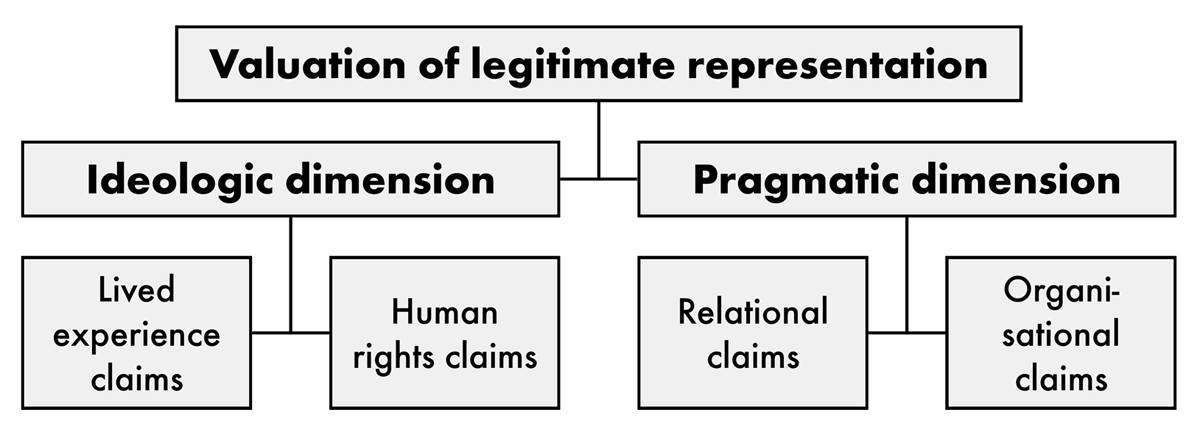
Figure 1
Thematic structure.
The ideologic dimension
The ideologic dimension has one focus, and that is the political/ideological goal of a society for everyone, regardless of a person’s embodiment. In order to achieve this goal, lived experience claims-related arguments emphasised the lived experience of a disability as an absolute requisite for persons in leading positions within the organisation. Human rights-claims emphasised the importance of rights-related knowledge and insights among persons in leading positions. As such, both the lived experience claims and the human rights claims emphasise an ideologic dimension of the organisation, focusing societal change.
Lived experience claims
A union for persons with mobility impairments must of course primarily be represented by persons who themselves have mobility impairments, [it] gives credibility. (Survey response)
This first category of claims under the ideologic dimension gives legitimacy to representation through lived experience, which is illustrated by the survey response above. Other responses argued that persons with a lived experience are the only ones who know ‘what it feels like’, and ‘know how it is’. This implied that the lived experience gives confidence and credibility, both within the organisation and towards the surrounding society. This argument was emphasised in terms of nothing about us without us, both verbatim and in other words: ‘We are a rights-based freedom movement and we, with mobility impairments, have not yet conquered our rights, [we are] not yet fully accounted for in society, still objects of charity and pity’.
The lived experience was also described as persons with mobility impairments ‘hav[ing] been forced to realise how society functions, or not, concerning accessibility, participation, assistive devices, etc’. This was seen to have increased the personal knowledge, since ‘a person without disability can never really understand what it is like to live with [a disability]’. This was further emphasised by another respondent: ‘Only persons with impairments have experienced the feeling of not being like everyone else’ and ‘emotionally it is impossible to understand to 100 percent another person’s situation’. It was thereby underlined that a person who speaks from their own personal experience of being excluded from parts of society can describe this better than anyone else. Lived experience is thus equated with competence. As a consequence of lived experience being put forward as important, it was implied that only such persons should be eligible for election: ‘Those who use wheelchairs and those who are injured, no one else’. Persons without impairments may, under specific circumstances, be active, but only as helpers: ‘They can support in other ways’, but nothing related to decisions or boards.
There was also a certain amount of criticism aimed at other organisations within the broader disability rights movement, for instance when other organisations ‘elect kicked politicians or others without impairments’ as chairmen, since such individuals do not have the required knowledge. The academic discussion concerning the understanding of disability has clearly had an impact in the movement. As one member states: ‘To NOT demand a personal experience of disability is to return to the warped reality of the medical model’. The ‘right to own our own organisation’ and ‘self-representation’, as a way for ‘us with impairments to take control over our lives’, was also emphasised. This, in turn, included the goal to ‘allow persons to grow, to believe in themselves if you live with a disability, to be elected, that others have confidence in you’, i.e., a form of empowerment.
Human rights claims
A person with knowledge and insights should be eligible for election—competence is in the head, not the legs. (Survey response)
The second category of claims under the ideologic dimension gives legitimacy to representation through disability competence—independent of lived experience—as explained in the above quote. Arguments within this sub-dimension implied that valuation of a candidate’s competence in relation to the requirements of a position should be made based on the actual competence of the individual, regardless of how this competence had been acquired: ‘I see no difference in qualities between a person with a disability or a person without [disability]’. As a result, the relation between individual competence and position requirements was made central, not how a person’s body may or may not function. Other respondents wrote that lived experience of disability is ‘unimportant, as long as you are motivated’, and that ‘everyone with a genuine engagement [should be] eligible for elected positions within DHR’. In other words, it was argued that the ideologic struggle for disability rights could be fought by anyone who shares the ideology: ‘to increase the understanding of mobility impairments in society, DHR must be open to everyone who is willing to work for a society open to everyone’. Another survey response highlighted that ‘every fight for rights needs more than the ones primarily concerned to fight for our rights’.
Another argument was that it was difficult, sometimes impossible, to define disability: ‘It is not that easy to see or determine if a member is disabled or not’. Moreover, definitions could lead to a candidate otherwise well qualified, but lacking a certain lived experience, being excluded in favour of a candidate with lower qualifications, but with a body that functions (or does not function) in a specific way: ‘Interest and not the functional variation should be a central qualification’, because a person who is ‘really enthusiastic in matters relating to disability rights should be welcome, with or without a disability’. This was stressed in several other responses: ‘Interest and engagement, and a deep understanding of the life-situation of persons with impairments can be gained in several ways’, and from another respondent that ‘they can bring important arguments and viewpoints’.
The line between legitimacy based on lived experience and human rights were not clear cut, though. Some made a difference between representatives and elected officials, where some respondents implied that there ‘may be situations when a person who is an elected official without disability can represent the organisation’, and that it had to be decided from situation to situation. One central argument was that the number of possible candidates would increase if candidates were ‘selected from a larger population’. This could result in ‘persons willing to engage themselves on a voluntary basis without earlier connections to disability issues [apart from knowledge-based] and can be assets as elected officials’. Furthermore, ‘every disabled person does not have the same problems’, as one respondent stated, emphasising general knowledge. This was underlined by another respondent who wrote that it was important ‘to have knowledge—not only concerning one’s personal issues’. Another respondent concluded that the ‘competence of the person, her or his personality’ and access to different networks, ‘contributes to the spectrum of knowledge within’. Other suggestions given were that ‘common sense, empathy, cooperativeness, knowledge of the way that our society works, are important qualities for candidates’. Competence beyond lived experience of disability was thus regarded as strategically important.
Another factor discussed was that persons without impairments could transfer their gained knowledge from the organisation to other arenas, where such knowledge was missing. Having a position in the disability organisation thus becomes not only a possibility for a person to contribute to the organisation itself, but also that the organisation can contribute to the individual, who in turn contributes to the dissemination of disability knowledge in wider society. The responsibility of the organisation to educate both members and non-members was also emphasised as a way to increase the membership and to ‘educate everyone interested and everyone who wants to engage in the organisation’. This can be understood within a human rights framework of mainstreaming disability whereby the overall aim of the organisation is a society for everyone, and no one is excluded. With this goal in mind, it would be wrong if the organisation was not open for everyone sharing its ideals; i.e., no person should be rejected due to not being disabled. This would be some kind of discrimination of persons without impairments from the organisation, in the same manner as society at large discriminates disabled people: ‘We should not discriminate our own members’ and ‘remove the “apartheid-rule” now!’. This rather sharp argument recurs in several responses, for example: ‘DHR are supposed to work for equal human dignity and equal values, human rights, and that disabled people should have the same possibilities as everyone else, and therefore, DHR cannot discriminate concerning eligibility [to positions]’.
Other arguments are more explicitly based on anti-discrimination: ‘If we wish to be integrated, we must integrate among ourselves’. Arguments were also based on the overall aim of the organisation, and in order to reach this aim, different roads could be possible, also when it came to attitudes: ‘We have to stop presenting ourselves as victims [in order to be taken seriously]’. Added to this were arguments concerning ‘difference is the best’ and that ‘we believe in diversity’, and ‘since we are an organisation that does not work towards a specific diagnosis, we cannot exclude anyone’. Finally, one answer stressed similarities between human rights and disability rights:
With the name, Disability—Human—Rights, the organisation turns to everyone who finds these three basic demands important, and therefore are, or become, members. DHR is, hence, not an organisation for disabled people, but an organisation that works for everyone finding the given demands important. Based on this, every member has to be eligible for elected positions, not only persons with impairments.
The pragmatic dimension
The second dimension, i.e., the pragmatic dimension, relates to the continued function of the organisation, and in the light of organisational function, individual/bodily function becomes irrelevant. Relational claims relate to the mutual dependence of persons with, or without, impairments, for instance during activities within the organisation, where relatives and family were needed in relation to practical matters. Thus, disabled persons, relatives, and family members were all on the same side, hence eligible within the organisation. Organisational claims concern factors related to organisational survival, and to find someone, anyone at all who may accept a position, regardless of that someone being disabled or not. As a result, and from a local perspective, it was not possible to prioritise between persons with or without impairments. In sum, both the relational claims and the organisational claims emphasise a pragmatic dimension of the organisation, focusing what is actually possible to do.
Relational claims
As a parent I have gained a lot of competence that persons newly disabled do not have. (Survey response)
This first category of claims under the pragmatic dimension revolved around notions of interdependence in disabled people’s lives. This type of representational claims, as exemplified with the quotation above, relates to the ways in which relatives and family members play a major, sometimes decisive role in organisational activities. They were frequently highlighted as persons that help to solve practical matters (what these matters consisted of, or within which context they are found, were not always commented in detail). Other survey responses emphasised that ‘a disability is a concern of the family, not only the person’; an argument supporting the importance of relatives. Other arguments were based on motivation, e.g., that ‘oftentimes family members and relatives are more motivated and really want to take the fight’. These arguments were also related to reciprocity, i.e., that all members need each other, regardless of disability or not, e.g., ‘everyone is needed’, ‘all forces are important’, etc. One example is found in arguments concerning the division of the local board between a majority of persons with impairments and a minority of persons without ‘if the person has a disabled relative’, or if ‘a disabled relative is required’ for someone without a disability.
Some of the survey responses came from persons who were themselves family members, partners, or relatives: ‘living together with a disabled person and working together, you understand, and can be a good, elected official’. Hence, competence was seen as possible to gain through another persons’ existence/competence, resulting in an almost marginal (or liminal) insider/outsider dynamic existence. As opposed to the human rights perspective, this competence is not to be understood as something else or valuable in itself, but rather as a good substitute. This relational competence, in one answer named ‘living-with-competence’, may be unique in the intersection of both belonging and not belonging to the category of disabled people. Possible experiences among members of this category may or may not include daily experiences of standing beside and observing all kinds of discriminating societal structures.
Organisational claims
We always need them [non-disabled members] to make coffee and fix sandwiches, arrange with the entertainment and provide general assistance. (Survey response)
The second category of claims under the pragmatic dimension consists of arguments relating to organisational aspects. One of these aspects concern activities within the organisation, mostly from a local perspective. Survey respondents argued that for practical reasons it is neither possible nor desirable to prioritise between groups with or without impairments (highlighted in the introductory quote above). Persons without impairments were by some respondents seen as central in solving such matters that disabled people are hindered from solving themselves, e.g., ‘someone needs to be active and work with practical matters and to execute activities’ and ‘[it is] difficult to handle practical work with a more severe “handicap” (as both arms and legs are needed sometimes)’. Hence, it became a way of letting practical work constitute arguments for accepting persons without impairments as active members. Similar arguments concerned the local premises, where certain chapters, according to one answer, have premises that are not accessible to everyone, which per se, constituted an argument: ‘If everyone in the board were disabled, we would not be able to have any meetings’.
Some arguments were based on a certain ‘sick-role competence’, following a traditional medical model where disabled persons were seen as sick and defective, and therefore in need of help. This is rather a sharp contrast to a more rights-based interpretation of the social model, emphasised already in the name Disability Human Rights. For instance, it was emphasised that we (i.e., disabled people) are ‘sick’, ‘ill’, and ‘in bad health’, and therefore need help from them (i.e., persons without impairments). One example is the following quote:
It is not good if only disabled [people are active members]. They [persons without impairments] can represent those who are too ill to speak for themselves. As we handicapped have difficulties getting jobs and so, we do not always know how things work. Everything is going so fast now; everything is more demanding. They [persons without impairments] have more energy to do things.
Another example was that persons without impairments should lead the organisation as ‘it is better that a healthy person helps the sick’, further confirming disabled people as sick. Other examples included: ‘It must not be seen as disparaging that [disabled people] are unable to organise activities, but I still think it does feel safer with such members [without impairments]’.
Nevertheless, even though persons without impairments were welcome, a number of persons with lived experience were necessary in order to function as role-models for both new and younger members. There were, however, certain nuances concerning if a local or a higher level within the organisation was discussed: ‘Leading officials, chairmen, etc., within DHR, on all levels, should have a disability themselves, and on a national level everyone […] should be disabled themselves, and on a regional or a local level […] a majority’. Hence, here were possibilities to some differentiation depending on organisational levels where a position higher up in the organisational hierarchy was seen as requiring a higher degree of personal competence and experience.
Another line of reasoning was that there may be a lack of disabled people with sufficient knowledge in certain areas, and the question was then if the organisation should not be represented at all, or be represented by someone without lived experience: ‘persons without impairments can perhaps speak for us in situations where we, disabled people, are excluded’. The focus here is not on competence or what is desirable—but on what is possible.
A frequent argument concerns the continued activities of local chapters. The main question is not who can represent them, but to find someone at all to represent them. This is only achievable if someone or some persons, regardless of personal experience or not, can take place in the local board. The alternative is to close down the chapter: ‘in smaller chapters, in smaller towns, we would not survive without persons who are not disabled’. Hence, survival of the chapter becomes, in itself, an argument for a widened view on competence. One answer underscored a historical perspective: ‘In our local section, most of the work was done by non-disabled persons, and when they died off, the section closed down, and now we do not have a section’. In other words, it was seen as more important to find someone at all to secure the survival of the local chapter.
Discussion
By collecting data from a Swedish disability rights organisation, this study has illustrated how representational claims can be legitimised in different ways. Two main dimensions were identified, the ideologic and the pragmatic. The ideologic dimension focuses the struggle for a society for everyone and sustains ideologically based arguments connected to either the lived experience of disability or a human rights framework. However, there is a paradox built into the claim of one’s own experience as the legitimising base of representation. The main political struggle for the disability movement is to change society in order to no longer render person’s different bodily functions a reason for oppression and disablement (Oliver 1990). In the long run, this political advocacy work aims to make the matter of disability irrelevant—but in the fight for this goal, the personal experience of disability becomes the only thing that is made essential for representation. As such, our case study has demonstrated dilemmas and challenges for advocacy groups regardless of identity and claims (e.g., Young 1990).
During the analysis, it was noted that answers mainly concerned the local level of DHR, and to a lesser degree national or regional levels. One example is arguments concerning how local chapters can recruit new (and younger) members, which in turn enables a continued work for a society for all. If answers had focused, for instance, the national level, arguments may, or may not, have had a different focus. It seems that the arguments, focusing on the national level to a greater extent expects lived experience as a requirement compared to the local level.
For disability advocates, when emphasising the personal experience as the basis of representational legitimacy, arguments are mainly related to Charlton’s (1998) ‘Nothing about us without us’, but herein also lies a question of who is us (e.g., Bahner 2022)? If us are persons with disability and no one else, the same type of discrimination is applied as in society as a whole where disabled people are discriminated against by means of an inaccessible environment. More specifically, the argument behind representation within an organisation claiming equal rights in society for disabled people is to exclude persons without impairments, thus a mirror-image of the impairment-related arguments that are emphatically criticised when occurring in society at large. In order to render impairments irrelevant in society, impairments are a main criterion of eligibility in the organisation.
Furthermore, when demanding that a representative first and foremost is required to have a body with certain characteristics, the basic point of Pitkin’s (1967) notion of representation, i.e., to act in the interest of the represented, may risk becoming less important. This paradox of, a struggle to render impairment a non-factor in society at large renders impairment the only factor of importance electing representatives to lead such a struggle. In sum, the matter of acting in the interest of the represented is, thus, less important than the impairment of the person expected to act in such interest. The risk is apparent: The general struggle may be less effective when electing officials based on their impairments rather than their ability to act in the interest of the represented. This may risk the achievement of the overall goals of the organisation. Needless to say, this does not exclude that someone with a particular impairment may also have the best capacity among a selection of candidates to act in the interest of the represented—but since impairment is the first criterion, and the capacity to act in the interest of the represented becomes less important, there is an inherent risk. The extent of this risk, however, is not known, and the paradox may be more or less of an actual dilemma within today’s disability rights organisations. Further research may be needed to address this paradox by, for example, focusing on representativity on different levels of an organisation (e.g., local, regional, national).
The second main dimension, the pragmatic, focuses arguments related to the functioning of the organisation, regardless of a persons’ disability or not. These findings correspond to Barton (2004) who identified two arenas in the disability movement: (1) The internal arena, offering peer-to-peer support and social activities (corresponding to the pragmatic dimension); and (2) the external arena, with political campaigns over anti-discrimination, human rights, and a barrier free society (corresponding to the ideologic dimension). Similar descriptions in terms of internal/external have been emphasised by, e.g., Freise & Hallman (2014), Bezzina (2019), and Henriksen, Strømsnes & Svedberg (2019). Here, the longevity of the organisation is considered as more crucial than how, or rather who, provides the content in these arenas. The dividing line between an ideological and a pragmatic position is not a matter of either or—in several responses these ways of reasoning occurred simultaneously. These positions can sometimes complement each other and are sometimes seen as prerequisites for each other. More specifically, a pragmatic dimension (i.e., we do what is practically possible) can be a prerequisite for an ideological dimension (i.e., we have a certain ideologic goal).
Especially in answers based on an ideological reasoning, opinions were strong. Apparently, the matter of who should be allowed to represent the organisation engages members not only intellectually but also existentially. Whether the arguments were based on lived experience or human rights, there are claims that recur: If the organisation is to be credible, representatives must have knowledge and competence. The difference lies in how this knowledge has been acquired and who can be considered competent. As a result, the boundaries of the disability movement are both fluid and contested. Likewise, it is difficult to draw boundaries in advance stating who is disabled and who is not, or who has experience and who does not. This is not just a theoretical issue (something the social model emphasises) but is a very concrete and tangible problem in the disability movement (Thomas 2007). Nor is there a consensus among the members about who has a disability, and, above all, who has a ‘real’ and ‘relevant’ disability. We can see that there are varying opinions among members on whether an ‘illness narrative’ has a place in DHR compared to a more social model-oriented disability rights advocacy (e.g., Hughes 2009).
In practice, the disability movement consists not only of individuals with lived experience of disability. This study has demonstrated arguments stating that even individuals without impairments can be affected by a non-inclusive society. Not least, it is described how parents, partners and children are affected by having a family member with impairments. It would be a simplification describing them as purely outsiders or as mere ‘helpers’ (e.g., Crow & Merchant 2019). The matter of family members is debated in the movement, but it can be argued that their experiences are as unique as those with their own lived experience of disability. Here, we want to emphasise that the assigning of persons into one or the other category is purely theoretical. It is likely that there are respondents who simultaneously are relatives and have personal experience of disability.
Furthermore, we would like to problematise the very notion of presence and self-representation. While we recognise self-representation to be a powerful part of the disability rights movement, disability research has taught us that there is a risk of creating a ‘single story’—that is, accounts of disability told from a very narrow perspective, in practice often white, westernised, middle-class, physically disabled men (Erevelles & Minear 2010; Meekosha 2010). Consequently, it is not immediately obvious who the ‘us’ in ‘nothing about us without us’ refers to. When including the functions of non-disabled allies, the matter becomes even more complex within the disability rights movement (e.g., Drake 1997), i.e., if allies may, or may not, become a part of ‘us’. In this study, ‘us’ can, for example, concern relatives, such as a spouse or a parent of a disabled child. This may or may not be an indication of the existence of several ‘us’, depending on situation.
Evidently, Pitkin had some kind of understanding of dilemmas like these, as she noted that the concept of representation ‘is a continuing tension between ideal and achievement’ (Pitkin 1967: 210). For voluntary organisations such as disability organisations, this dilemma can be translated in terms of finding a balance between effectiveness and responsiveness (e.g., Jonsson 2006), where effectiveness concerns the possibility to act/react rapidly—as an example, to contribute to a current debate—as well as the democratic responsiveness to involve, for instance, elected representatives in the local board in a discussion on whether to act/react, and if so, how. Decisions are then made under the assumption that they can be defended with sufficient arguments before members of the organisation, i.e., in line with Pitkin’s (1967) substantive representation on the matter of congruence between the actions of the representative and the interests of the represented.
Conclusion
The representational paradox outlined above may be more or less of an actual dilemma within today’s disability rights organisations. Nevertheless, the social and medical models of disability collide when representatives are chosen based on having a body with specific characteristics. Concretely, when an individual is elected based on a medical model type of criteria (body characteristics) in order to act in accordance with a more social model of disability. Hence, the medical and social models of disability are still relevant, not only for disability research, but apparently also within the disability rights movement itself.
Looking at the past can be one way to try to understand why there is a medical model perspective when electing representatives. Not too many decades ago, professionals and people without impairments dominated the disability movement (which at the time did not include the word ‘rights’ before ‘movement’), taking a more paternalistic approach to ‘helping the unfortunate’ (as we wrote in the introduction). In order to avoid returning to such a focus, today’s disability rights movement gathered arguments from the medical model itself and utilised these arguments in order to demarcate a group as non-eligible (persons without impairments). Using the medical model as a judo move against historical precedents, a social model perspective was secured.
As a potential problem, further research may need to address this paradox by, for example, focusing on representativity on different levels of an organisation. This is especially crucial in relation to the decreasing numbers of members, both in total and in relation to a willingness to be active as a representative. The decreasing numbers of members also relates to our concluding remark about the objective ‘nothing about us without us’. The fundamental battle for the modern disability movement may not even be about defining ‘us’, but rather about maintaining its members, as they are crucial for the local chapters. There needs to be an active local level where representatives can be recruited if the movement is not to be reduced to an academic debate, or again, run by professionals. After all, if the movement is to make claims and fill the ‘about’ with content, legitimate representatives are required. Daring to discuss undoubtedly sensitive questions about who is disabled and who has the right to make claims on their behalf is crucial if the disability movement is to evolve, expand and have an impact.
Notes
[1] Valid Swedish legislation was followed when conducting this study (SFS 2003:460; Swedish Research Council 2017). In order to ensure confidentiality, quotes have been reformulated, focusing the meaning but altering identifiable details (such as names of persons and places).
Acknowledgements
The authors would like to thank DHR, Disability Human Rights, and their members for partaking in this study. We would also like to thank our colleagues in the Swedish Network for Critical Disability Studies, KritFunk, for helpful comments on an earlier draft. Finally, we thank the reviewers for their thoughtful comments and efforts towards improving our manuscript.
Funding Information
Gathering of raw data was made possible by a small grant by DHR. The subsequent analysis and writing process was supported by FORTE – Swedish Research Council for Health, Working Life and Welfare within the framework of our research project Representation in the Digital Era: Democratic Consequences of Changing Engagement in the Swedish Disability Movement (grant no. STY-2021/0005).
Competing Interests
The authors have no competing interests to declare.
Author Contributions
The first author was responsible for the practical details when compiling the raw data. Thereafter, authors provided equal input when developing the analysis, as well as drafting, reviewing, and editing the final manuscript.