
Introduction
Wood fuel played a crucial role in human history after the beginning of the controlled use of fire which can be considered as ‘the main conquest of energy’ (Malanima, 2014: 7). Forests that provided firewood and charcoal, two basic forms of wood fuel, were indispensable sources of thermal energy in preindustrial societies. Nevertheless, excessive use of wood fuel, along with practices like logging, grazing, and clear-cutting, has been a major driver of global deforestation and forest degradation. The metallurgical industry, in particular, has significantly impacted forests worldwide due to its high thermal energy demand (Williams, 2006). In the Ottoman Empire (1299–1922), wood fuel was a pivotal element in the energy landscape, as well. Most industries and households in the empire consumed firewood and charcoal within the limits of natural resource endowments in local environments. This article investigates the industrial use of wood fuel and its implications for forests in the late Ottoman Anatolia with a specific focus on copper smelting.
In the 19th century, the Ottoman Empire was a part of the global periphery which integrated to the world economy via trade, finance, and investments (Kasaba, 1988; Owen, 1993; Pamuk, 2010). Within the capitalist world system (Wallerstein, 1974), the Ottoman agrarian economy supplied raw materials to the core in exchange for industrial products. After 1870, minerals became a significant component of the export trade, in parallel with a growing interest from foreign capital in the Ottoman mineral resources. However, a few public mines kept producing metals primarily to meet the demands of the state. The Ergani copper mine was among the Ottoman government’s largest and most profitable mineral assets during the last century of the empire. With its rich reserves, this mine garnered the government’s particular attention and witnessed a series of modernization attempts. At the end of the century, it became an export-oriented state mine, with semi-processed copper finding a market in England (Tok, 2019; Aras, 2022). The main objective of this import policy was to alleviate the fiscal crisis that had plagued the Ottoman treasury since the 1850s.
Wood fuel was the primary energy source for smelting Ergani copper ores. Due to the scarcity of fuel in the area surrounding the mine, however, it was very costly to complete the ore purification process entirely on-site. Instead, the final stages of the smelting operations took place in Tokat, an Anatolian city renowned for its copper industry despite having no copper reserves in the nearby vicinity. The rich forest cover around Tokat was decisive in the development of smelting industry in the region. The resource supplies and transportation opportunities were markedly different in this city. The advent of copper exportation at the end of the 19th century shifted the dynamics entirely, placing the burden squarely on Ergani and exerting greater pressure on its natural resources. The energy aspect of the copper smelting stands as an illustrative instance of preindustrial natural resource management involving an intricate balance between resource provisioning, rural workforce, and sustainability. In the lack of functioning markets, the state had to take initiative to procure fuel for the smelting operations. The governmental agents mobilized local peasants who not only harvested trees but also transported firewood and charcoal to the smelting sites. The use of animals, notably mules, alongside human labor, formed the backbone of this system, illustrating the labor-intensive nature of preindustrial natural resource management. Technological limitations, particularly in the domains of fuel production and transportation, exerted a profound influence on the scale and intensity of resource management activities. Peasants, while shouldering these demanding responsibilities, found themselves navigating a delicate balance between the exacting demands of the authorities and the ecological constraints of the environment. When supervision was absent or insufficient, this double pressure could easily turn to sacrifice of sustainability for the sake of copper production.
By investigating the sources, provision, and consumption of wood fuel in this context, my goal is to contribute to the environmental history of the broader Middle East and specifically of the Ottoman Empire. This emerging literature has revealed diverse aspects of the history of human-nature interaction by bringing factors like animals, plants, climate, and geographical landforms into the fore (Dolbee, 2023; Gratien, 2017; Husain, 2021, Inal, 2019; Mikhail, 2011; Pehlivan, 2020; White, 2011). The analysis of Ottoman forests from an environmental standpoint has also experienced a growing trend (Akgül-Kovankaya, 2019; Dursun, 2007; McNeill, 1992; Mikhail, 2017). Yet the relationship between the Ottoman smelting industry and forests still stands as an underexplored subject. The refining process of Ergani copper offers a unique opportunity to examine the linkage between smelting and forests in two separate locations with distinct geographic and ecological features. The Ottoman archives are an invaluable reservoir of historical information regarding this inquiry. By delving into the official records from various administrative bodies I collected and reviewed a substantial number of archival materials to demonstrate how the Ottoman copper refining processes interfaced with their natural surroundings. The primary sources used in this article have not been previously studied in connection with the specific theme under discussion. Thus, the research goes beyond the existing body of literature and provides an original understanding of the metallurgy-environment relationship in the Ottoman context.
Various facets of the interplay between metallurgy and forests in past societies have been scrutinized by historians and archeologists (Baron et al., 2005; Crew and Mighall, 2013; Lupo et al., 2015; Muntz, 1960; Perlin, 2005; Thirgood, 1981, Wertime, 1983). Although enriching our scholarly comprehension of the theme, most of the studies provide limited insights into the larger contextual factors influencing this nexus. Smelting-environment relationship has been shaped not only by the volume of charcoal demanded by metallurgical industries but also by the socio-economic and ecological interactions with forests (Iles, 2016). Indeed, there are few studies that discuss the subject matter, encompassing economic, social, political, and administrative aspects (Kim, 2018; Sivramkrishna, 2009; Studnicki-Gizbert and Schecter, 2010). This article employs a similar approach in analyzing the specificities of copper smelting and nature relationship within my research area, shown in Figure 1. It aims to explore how the Ottoman government employed forests for industrial energy production, fuel procurement for industrial plants, and the effects of smelting processes on landscapes, considering factors like technology, human actions, market forces, and nature. Additionally, it incorporates the Ottoman state’s role into the analysis, given its ownership of the Ergani mine and increasing control over the empire’s forests throughout the 19th century.
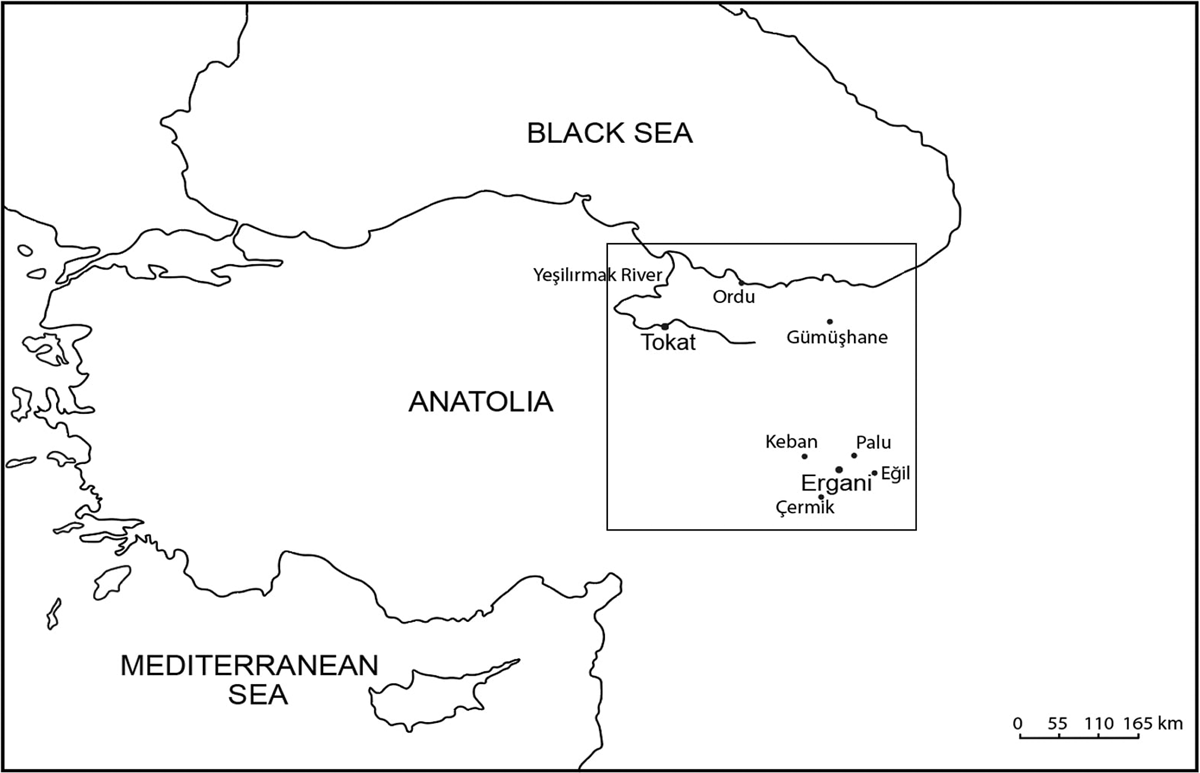
Figure 1
Research area: Ergani and Tokat in Ottoman Anatolia.
The state’s central role in operating Ergani mine and governing forests left a substantial repository of official records, which constitutes the bedrock of this study. The correspondence between the governmental units and reports from administrative and technical staff help researchers to shed light on less-known aspects of smelting in Ergani and Tokat, as well as the dynamics of fuel provision from the forests. However, the complexity of the research subject within a highly bureaucratic entity poses a formidable challenge, given the dispersion of pertinent documents across various collections of the Ottoman archives. The pursuit of related information requires a substantial and concerted effort. Moreover, the nature of these official documents inherently lean toward a state-centric presentation, often leaving other dimensions, such as the experiences of peasants and the nuances of everyday life in smelting sites and forests, invisible. In light of this challenge, the observations of Western consuls, engineers, and travelers provide an alternative perspective that not only enriches but also complements the insights derived from the archival materials. These sources are remarkably concise and offer details about the mine and fuel provision that are not present in the state records.
Smelting and forests in Ottoman Anatolia
Anatolia can be considered the cradle of metallurgy, with the earliest known copper artifacts dating back to approximately 8000 BCE unearthed here (Yalçın, 2016: 6). Smelting technology developed in the Old World at the expense of large forests around the Mediterranean, including those of Anatolia (Perlin, 2005; Thirgood, 1981: 56). The Ottomans maintained the smelting practices inherited from earlier civilizations lived in the Balkans and Anatolia, and the environmental impacts of this industry during Ottoman rule followed familiar patterns from previous periods. While they made attempts to modernize the mines and smelters by hiring European engineers and technical staff (Keskin, 2007: 82), the Ottoman mineral processing industry persisted in its reliance on firewood and charcoal, a practice that endured into the 20th century.
Several instances from different regions in Anatolia vividly demonstrate the Ottoman smelting industry’s dependence on wood fuel. The state-owned mines of Gümüşhacıköy, Küre, Bereketli, Bulgardağı, and Keban were important sources of metal ores in the 19th-century (Presidency Ottoman Archives [BOA] Ticaret Nafia, Ziraat, Orman, Meadin Nezaretlerine ait Evrak [T.OMİ] 1483/12, 1880). The metalliferous earth from all these mines was refined using wood fuel. By 1840, Gümüşhacıköy mine, which was one of the leading suppliers of the Imperial Mint, operated 34 wood fueled furnaces to refine silver (BOA Topkapı Sarayı Müzesi Arşivi Evrakı [TS.MA.e.] 1216/71, 1841). In the 1860s, silver-lead mines in Gümüşhane and copper mines in Küre consumed plenty of firewood and charcoal in addition to the props utilized in the pits (Bricogne, 1877: 371–375). Moreover, there were private metal processing facilities around mines. British consul Gifford Palgrave, who travelled several Anatolian provinces in 1869, reported that the region surrounding the silver-lead mines in Şebinkarahisar had more than 30 furnaces fueled by charcoal (Reports from Her Majesty’s consuls, 1870: 530). In Western Anatolia, the Balya-Karaaydın Mining Company, a joint-stock venture of French origin, burned shrub in its kilns to process argentiferous lead, despite using the latest technology in its mining operations (BOA T.OMİ 1694/13, 1902). Overall, both public and private enterprises depended on wood fuel for the processing of the ores they extracted.
The availability of fuel posed a significant constraint on the Ottoman mining industry. A prominent engineer employed by the government in the 1830s to prepare a report on the conditions of the empire’s mines pointed out this matter as follows:
‘One real problem for the Turkish mining industry is that Nature, so generous in its distribution of minerals, was not similarly generous in distributing fuel. At most spots there is either a complete lack of wood or overcut woods, the replacement of which no one considers. The barrenness is extreme. Both conditions demand quick relief and improvement.’ (Issawi, 1980: 285)
Thus, part of the problem was misfortune on the side of nature. Numerous mines in the country were either poorly operated or remained idle due to natural constraints in fuel supply. Nevertheless, it was the human factor that exacerbated the fuel shortages at certain mining sites in Anatolia. The lack of proper resource management and lavish wood fuel consumption for smelting could easily turn into environmental degradation. For example, while the forests in the immediate vicinity of the Bulgardağı silver and lead mines on the Taurus Mountains provided a great deal of wood in the 1840s (Issawi, 1980: 285), things changed in a few decades. A traveler who visited the same mine in 1876 depicted a transformed landscape, observing the absence of pine and cypress trees in the adjacent forests due to their extensive use in smelting operations. Consequently, firewood required for refining ores had to be transported from a distant location, requiring a nine-hour journey (Davis, 1879: 223) spanning no less than 50 kilometers (Çetin, 2013).
With its extensive exploitation and use, copper loomed large in the empire’s mining industry. Throughout the Ottoman history, more than 60 copper mines were operated in Anatolia. The ores were processed into copper or bronze in smelters numbered around 40. The majority of the copper mines and smelters were situated in central and eastern Black Sea region (Belli and Kayaoğlu, 1993: 58–59). Together with their mineral wealth, the rich forest cover played a pivotal role in the development copper industry in these districts. Ergani, renowned for its abundant reserves, stood as the primary copper source in the country during the 19th century. While the first stages of the smelting process took place in the immediate vicinity of Ergani mines, a semi-arid region with limited vegetation, the second phase of the production was conducted in Tokat which had a gentler climate and plentiful forests. It was these environmental differences that informed the decades-long division of labor between these places which started just after the reopening of the Ergani mine in the 1770s (Tızlak, 1995). As James Brandt, a British consul in eastern Anatolia in the 1830s noted, Ergani copper, after being roasted and smelted was conveyed to Tokat ‘for want of fuel’ (Issawi, 1980: 282). This production chain required a continuous fuel supply from available forests in both regions. Before discussing this, it is worth providing some details about the technical aspects of copper smelting.
Smelting Ergani copper
The Ergani mine, which had been previously exploited by several civilizations, began to be operated by the Ottoman administration in the early 18th century (Tızlak, 1997). With a few temporary suspensions, the mine remained active until World War I, producing approximately 0.2% of the world’s copper output around 1910 (‘Copper Mines in Turkey’, 1916: 79). Along with other mines, Ergani supplied copper for military production and coinage (BOA İrade Şura-yı Devlet [İ.ŞD] 30/1425, 1875; BOA Yıldız Sadaret Resmi Maruzat Evrakı [Y.A. RES] 103/92, 1899). Although the state had priority, surplus copper was also sold to merchants and civilian coppersmiths (BOA İrade Meclis-i Mahsus [İ.MMS] 67/3160, 1880). The mining in Ergani went hand in hand with the smelting business in Tokat. This city had already gained a reputation for copper work long before production began at the Ergani mine. In the second half of the 17th century, a foundry was built in Tokat to refine unwrought copper ingots coming from Gümüşhane and Küre (Genç, 1987: 163). The expansion in copper mining in Ergani in the mid-18th century and the appointment of Tokat as an alternate location for copper extraction further advanced the smelting industry in the city. Tokat remained a major hub for the copper industry until the 1910s.
Figure 2 shows a map of Ergani mine which was made during two Levantine businessmen’s efforts to secure a concession for modern copper smelting at the mining site. Although the map’s creator was not specified, its authenticity was confirmed by Ernst Weiss, the chief engineer of the mine. The map indicates that the 19th-century Ergani was a small town located in a rugged terrain. As the corners of the red line on the map suggest, the town and the mining area were surrounded by five major hills and a spring to its south. The town was predominantly inhabited by miners and their families, who resided in two different quarters. In addition to the townsmen’s houses, the map displays the smelting facilities, administrative buildings, pits, and roads in the mining site. As depicted in the marked area on the left side of the map, the majority of the blast roasters, known as filikas, were located near the galleries designated in the shaded area. A few others were situated along the creek. The waterfront also featured a couple of larger smelting kilns and a mill. The distance between filikas, which were utilized in smelting successively, ranged between 500 m and 2 km. The road network depicted on the map was designed to meet the requirements of mining and smelting activities. However, these roads were not well-suited for carts; they were primarily intended for use by beasts of burden. With continuous water supply of the creek, the transportation infrastructure and the smelting facilities, Ergani served as an ideal location for the copper industry, albeit facing challenges related to fuel sources. As indicated on the map, with a few exceptions, there was no vegetation in and around the mining area.
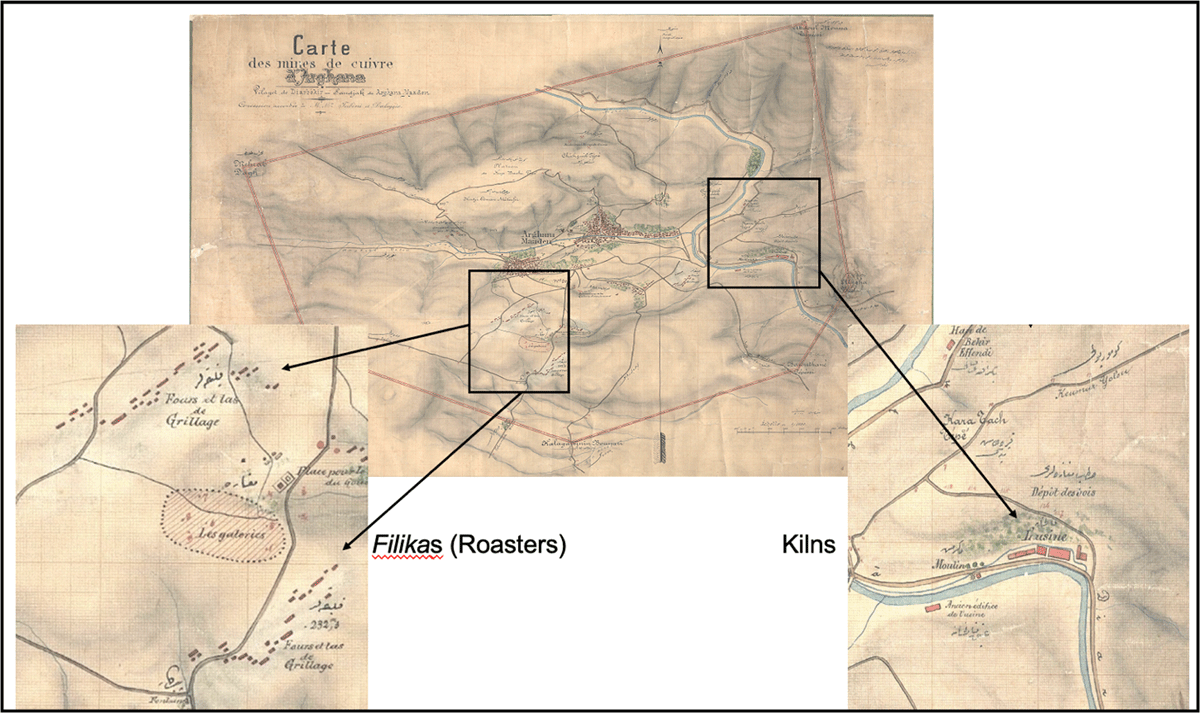
Figure 2
A map of Ergani mine from 1887 including filikas and kilns (BOA Haritalar [HRT.h] 534, 1887).
Pyrotechnology in the 19th-century Anatolia, including Ergani, was definitely backward. The ores mined in Ergani were converted to wrought copper through several successive steps. The first stage of copper ore processing took place in the filikas which were small open furnaces made of stones. Their number in the mining region rarely fell below 200 (BOA T.OMİ 1493/1, 1884). The ore, broken into nut-sized pieces, was piled into conical heaps in the filikas and roasted with wood for three days. This process was repeated several times, producing a material containing 25–30% copper (Karajian, 1920: 167). The products were then conveyed to greater kilns, which were barely larger than a spacious blacksmith shop, for further processing. By the end of the 1870s, the number of kilns had increased to eight with the construction of two new ones in addition to the six that were already in operation (BOA Dahiliye Nezareti İdare Evrakı [DH.İD] 105-2/47, 1912).
Following the initial processes in Ergani, ingots containing 60–65% copper (BOA İrade Dahiliye [İ.DH] 1255/98527, 1891) were transported to Tokat by large camel caravans for further refining. (Beşirli, 2004a: 18) Smelting in Tokat involved two steps: rough processing in furnaces and final purification in smaller ovens. According to official records, the nine furnaces at the foundry completed 80 processes in a one-year period beginning in March 1887. Concurrently, there were also 105 operations conducted in the ovens (BOA T.OMİ 1501/90, 1888). In its last years, the smelter had only four furnaces and two small ovens, indicating a decline in production. (BOA DH.İD 105-2/47, 1914) The fineness of the final product reached 97% at its best (BOA Hariciye Nezareti Londra Sefareti [HR.SFR.3] 358/14, 1889).
Every single step of copper refining required either firewood or charcoal, and sometimes both. In the late 18th century, the charcoal burned in Ergani furnaces was made of oak because of its higher fuel quality. Nevertheless, after the depletion of nearby oak coppices, miners began to rely on other species for fuel (Tızlak, 1997: 146). In the 1860s, the filikas and kilns used charcoal from different forests for their respective processes. The filikas primarily used charcoal from nearby towns’ small woodlands, while the kilns sourced their charcoal from more distant districts. In the mid-1860s, villagers supplied poor-quality charcoal, which an engineer’s report described as resembling roasted brushwood and branches rather than proper charcoal (BOA, İrade Meclis-i Vala [İ.MVL] 566/25434, 1866). In Tokat, local peasants delivered firewood from nearby state forests in the form of logs. At the smelter site, they were stored in a vast depot with the capacity for thousands of logs (BOA T.OMİ 1472/58, 1876). Despite evidence of oak wood in the fuel depot (BOA, Maliye Evrak-ı Emiriye Müdüriyeti [ML.EEM] 995/26, 1913), most of the logs burned in the furnaces were pine tree trunks and branches of various sizes. The logs, categorized by dimensions, were not shorter than 80 cm and had perimeters ranging from 30 cm to 80 cm, with weights varying from 3 kg to 18 kg (BOA DH.İD 105-2/47, 1914). Six types of logs were recorded, with the largest chunks being predominantly used for generating heat in the smelter. These large logs were burned in the furnaces for the initial stage of smelting, involving the rough processing of black copper from Ergani (BOA T.OMİ 1479/91, 1878). Due to its superiority in terms of energy density and lower sulfur and phosphorus content (Smil, 1994: 116) charcoal was burned in the final stage in which copper was purified at elevated temperatures in smaller ovens. However, there is no information available on the physical characteristics of the charcoal used in Tokat, beyond the fact that it was made from pine (Issawi, 1980: 259–60).
How much wood-fuel was burned to refine the ores? Although it is difficult to trace the consumption in every step, which could vary depending on factors such as technology, weather, and fuel and ore quality; some estimations are available. A comprehensive report of a mining engineer on the Ergani mines reveals the fuel consumption of the kilns used in the first stage. At the end of the 1870s, it was documented that the cost of the firewood burned in a kiln over a 12-hour period was 700 piasters. Given that the cost of each batman (7.7 kg) of firewood was one piaster, the total fuel consumption of a kiln in a single session of 12 hours was 700 batmans or about 5.5 tons. On this account, if all eight kilns operated twice per day, the daily consumption would have been around 90 tons. Based on the assumption that the furnaces could operate for nine months out of the year, with 23 days of operation per month, the maximum annual wood consumption for the furnaces would have been 18,600 tons (BOA T.OMİ 1480/96, 1878). However, it is unlikely that this level was actually reached due to limits on both mining and fuel availability. In Tokat, though the amount of firewood is unknown, the annual charcoal consumption of the foundry in the 1830s was around 5000 tons (Genç, 1987: 166). In the 1870s, the smelter had an annual capacity of smelting 1280 tons of black copper. In order to refine the copper ingots, the daily sum of charcoal used in the smelting process was about 10 tons (BOA İ.ŞD 30/1425, 1875). However, most of the time, the smelter did not operate at full capacity. In fact, it was barely active for half of the year around 1870 (Van Lennep, 1870: 215) meaning that the actual fuel consumption was much lower than its potential.
The smelter administration prepared periodical reports detailing the refining operations in Tokat. These reports involved various information, including the quantities of firewood and charcoal consumed at the plant. Compiling data from these dossiers provides insights into the smelter’s operational patterns over an extended period. As shown in Table 1, the production in the kilns and ovens was not consistently steady. In certain years, the consumption of wood fuel reached thousands of tons, whereas in other years, minimal fuel was utilized. There were also long periods of time during which the smelter was not in operation at all (Cuinet, 1892: 652). The fluctuation in production was primarily due to variations in the delivery of black copper from Ergani. Around 1877, for example, the inundation in the mine caused significant damage to the shafts, resulting in a near-cessation of ore extraction and a great decline in ingot arrivals in the following years (BOA T.OMİ 1479/77, 1878). Capital and management issues within the smelter were also contributing factors.
Table 1
Wood fuel consumption in Tokat smelter.
| YEARS | FIREWOOD (TONS) | CHARCOAL (TONS) |
|---|---|---|
| 1875–76 | 3650 | 820 |
| 1876–77 | 4330 | 1715 |
| 1877–78 | 125 | 190 |
| 1878–79 | 0 | 3 |
| 1879–80 | 685 | 5 |
| 1880–81 | 1895 | 0 |
| 1883–84 | 2010 | 510 |
| 1884–85 | 2105 | 625 |
| 1885–86 | 2325 | 730 |
| 1887–88 | 310 | 105 |
| 1895–96 | 480 | 3 |
| 1902–03 | 335 | 180 |
| 1903–04 | 200 | 2 |
| 1905–06 | 190 | 45 |
| 1906–07 | 105 | 100 |
| 1907–08 | 360 | 3 |
| 1908–09 | 375 | 60 |
| 1909–10 | 690 | 70 |
| 1910–11 | 360 | 65 |
| 1911–12 | 380 | 75 |
[i] Sources: BOA T.OMİ 1483/67,1880; BOA T.OMİ 1485/1, 1881; BOA T.OMİ 1493/22, 1884; BOA T.OMİ 1498/10, 1887; BOA T.OMİ 1501/90, 1888; BOA Ticaret Nafia, Ziraat, Orman, Maadin Nezaretlerine ait Defterler [T.d..] 1200, 1892-1912; BOA T.d.. 1205, 1896-1912.
Correspondence between Ottoman charcoal burners and the government reveals that 200 units of charcoal were produced from 1000 units of wood (BOA İ.MMS 12/523, 1858). Assuming that all the fuel originated from pine trees and that Ottoman charcoal production had an efficiency of approximately 20%, we can estimate the number of trees and forest area necessary to meet the energy demand of the smelter. Based on Williams’s (2006: 79) account which takes the average wood weight of a pine tree 800 kg and the number of pine trees per hectare 240 pieces, the average number of trees felled annually in the specified period is calculated at 2965, covering an area of no less than 12 hectares. The highest number of trees cut in a single year was 16,130, which were obtained from at least 67 hectares of forestland. Though the forest in the eastern valley was assigned for the foundry, its products were not solely used for smelting. Considering factors such as the firewood sales to private individuals, fuel donations for charitable purposes, losses during the river transportation and the uses of workers during cuttings (BOA T.OMİ 1498/10, 1887), it could be safely concluded that the forest area utilized by the smelter was far larger than the figures mentioned above.
There were substantial differences in fuel consumption between the post-1887 period and former years. The year 1887 marked a turning point for the smelting industry in Tokat, as it was the time that Ergani established a direct link with the global copper industry. Though there were sales to foreign merchants before, marketing the products of the Ergani mine to European countries was taken more seriously in the second half of the 19th century. In 1866, the Ottoman government tried to sell copper ores to England but the project was abortive (BOA HR.SFR.3 358/14, 1868). Success came afterwards when the government began to export black copper from Ergani to Europe in the 1880s. With the improvements in the smelting activities around the mine under an ‘energetic and honest’ director, the fineness of the ingots was increased from 60–65% to 85% in 1884 (Reports from Her Majesty’s consuls, 1885: 1942). From 1887 on, the government decided to export the majority of the mineral output of Ergani to England for final refinement via the Mediterranean route instead of sending it to Tokat smelter (BOA İ.DH 1255/98527, 1891). This decision led to a decrease in production in Tokat, and therefore a reduction in wood fuel consumption. On the contrary, it increased the burden on the filikas and smelters in Ergani, putting more pressure on the forests that supplied fuel to the mining district. Thus, smelting in Ergani became one of the ‘ecologically destructive activities’ which ‘focused concentrated demand of ever-larger economic units upon small landscapes’ in the context of international market integration (McNeill, 1992: 222).
Forests and fuel provision
According to a contemporary account, Ergani mine in the 19th century was a rich copper deposit for which ‘there would be no limit to the production could fuel be obtained’ (Issawi, 1980: 282). Nevertheless, finding fuel for smelting in Ergani had always been a challenge for the state due to the paucity of forests in this part of the country. The climatic conditions in eastern Anatolia allowed for the growth of forest vegetation only in a narrow band, which resulted in extreme pressure on the available sources (Hütteroth, 2006: 27). The Ergani mine was among the largest consumers of the woodlands in the region. While wood fuel for smelting was initially procured from the close coppices located at one-hour distance from the mines, the forests had already begun to withdraw in the last decades of the 18th century (Yüksel, 1997: 40). The destruction of forests due to metallurgical activities in Ergani continued in the following decades. The presence of another mining site nearby, namely Keban, exacerbated the fuel problem for copper industry in Ergani. After the depletion of adjacent forests, officers began searching for new sources of fuel. According to a report dated 1841, the only forest available for the mine was 65 km away which required about a 12-hour journey. It was estimated that this forest would be able to support the mine for 20–25 years (Issawi, 1980: 283). A decade later, the forest in Karacadağ, located 12 to 15 hours south of Ergani was suggested as an alternate source. According to officers, if regulated properly, this forest could fuel the industry for several centuries (BOA Sadaret Mektubi Kalemi Meclis-i Vala Evrakı [A.MKT.MVL] 48/21, 1851). In the 1860s, major forests that fueled the copper works were those located in Palu, Eğil, and Çermik. Like others, these sources suffered from depletion which increased the distance between the mine and forests from 8 to 12 hours (BOA İ.MVL 566/25434, 1866). Though estimations about the retreat varied, it was evident that the mine had swallowed up all nearby forests as long as smelting maintained.
Situated in a humid and warmer climatic zone, Tokat had favorable environmental conditions for vegetation. The forests of the region were rich enough to provide a consistent supply of fuel for the smelter. ‘There is no limit’ wrote Van Lennep (1870: 217) about wood fuel in 1870 ‘to the supply of this indispensable article’ in the mountains of Tokat. In the east of the city, along the Yeşilırmak river, there was a large forest that was designated for supplying firewood to the smelter. The forest covered an area of approximately 25 km in width and 70 km in length (BOA DH.İD 105-2/47, 1914). Moreover, the rich woodlands in the vicinity of the city provided charcoal for the copperwork. The forests of the province, thus, faced less pressure from industrial demand, given that the burden was shared by various localities.
The costliest aspect of copper production was fuel procurement. From 1902 to 1907, for example, 67% of the total cost of producing black copper from ores at Ergani was spent on wood fuel (Zengin, 2018: 940). In Ergani region, wood fuel transport was totally dependent on beasts of burden which used paths and ridgeways (BOA DH.İD 105-2/47, 1913). Along with the distance between the woodlands and the mine, the arduous topography made conveyance very challenging. For decades, the government sought opportunities to reduce the fuel costs chiefly by investing in transportation infrastructure. For this purpose, an engineer who visited the mine in the 1840s suggested to construct a railroad between the smelting site and a neighboring forest. He noted that this would be a permanent solution if the cleared areas were replanted (Issawi, 1980: 283). The project, however, was impractical due to the high costs of railroad construction in this mountainous area. More feasible plans came out at the end of the 1860s. There were attempts in this decade to build roads between Ergani and forests, but they were fruitless (BOA Sadaret Mektubi Mühimme Kalemi Evrakı [A.MKT.MHM] 423/83, 1868). In the 1870s, similar efforts were made to construct roads which would increase the carrying capacity of peasants by enabling the use of carts. The plan involved the construction of a large depot at the meander of the creek that flowed near the smelting site and building of a 45 km road with two transfer points for firewood. The road was expected to reduce fuel costs by half (BOA T.OMİ 1480/96, 1878). Despite these endeavors, transportation in the region did not see significant improvement due to the central government’s lack of funds, which was mired in a severe financial crisis. On the eve of World War I, the mine was barely able to cover its expenses due to the high price and scarcity of wood in the region (BOA DH.İD 105-2/47, 1913).
In Tokat, within the geographic limits, both land and water transportation were employed to carry firewood and charcoal. Charcoal from nearby forests was delivered to the smelter by pack animals. Nevertheless, since the distance between the firewood supplying forest and the smelting site was more than 45 km (BOA DH.İD 105-2/47, 1914), land transportation for wood was very costly. Water has traditionally been the cheapest means of transportation. Fernand Braudel wrote in The Structures of Everyday Life (1992: 365) that due to the bulky form of wood ‘it was ruinous to transport it more than 30 kilometers – unless, that is, it could float on its own by a waterway or sea.’ In Tokat, the officers took advantage of Yeşilırmak River which passed through forestlands in the upper sides and by the city center in the west. Therefore, transportation costs in this region were considerably economical.
In the Ottoman economy, which suffered from low productivity and transportation challenges, provisionism was an essential principle of economic policy. The central idea of this principle, as defined by Genç (2000), was that the goods and services, especially for domestic use, should be abundant, of good quality, and cheap. Yet the government did not implement comprehensive and permanent interventions, and often let the markets operate on their own. Thus, ‘selective interventionism’ was the best definition for the government involvement to the Ottoman economy (Pamuk, 1998: 365). Ottoman provisionism was neither a command economy nor statism. When it came to the supply of goods for public plants, however, Ottoman administrators did not trust the free market (White, 2011: 22). As the previous paragraphs illustrate, energy in the Ottoman Empire, much like in all preindustrial economies, was characterized by scarcity, costliness, and low efficiency, necessitating the implementation of natural resource management strategies to address these challenges. In accordance with the principle of provisionism, thus, the government employed strict regulations on fuel procurement for state enterprises such as arsenals, iron foundries, and smelters.
The organizations that provided combustibles to the Ergani and Tokat smelters were definitive examples of regulated fuel trade. In the earlier period, the sources of wood fuel for both centers were the forests classified as cibal-i mubaha (commons). Most of these woodlands became state property due to changes in forest regime in the 1860s (Dursun, 2007). While infrequently, they could also be registered in the name of local people and became private property (BOA İ.DH 717/50081, 1876). Although the smelting operations were held by private agents in Ergani, it was the government that undertook the fuel provision for the furnaces and kilns (BOA T.OMİ 1479/28, 1878). In the absence of an advanced commercial system to properly supply fuel, the enormous energy requirements of the copperworks was met by peasants assigned for fuel provision by the government. Indeed, when Ergani and Keban mines were united under a single administration in 1775, the borders of the new unit were determined in accordance with the requirements of the mines, including fuel. In the 1790s, there were nine towns responsible for supplying necessary materials to the Ergani mine (Yüksel, 1997: 18).
The foundry in Tokat was fueled using a similar method. The provision of logs and charcoal to the smelter necessitated a large organization that involved officers, peasants and numerous workers for a variety of tasks. In 1880, there were 17 villages charged with the firewood provision. These villages were located near the forest that was designated for the use of the smelter (BOA T.OMİ 1483/66, 1880). Due to the conducive weather conditions in the mountainous areas during the period from March to August, it was considered the ideal season for supplying firewood. In the early spring, peasants were mobilized to cut down trees and prepare logs in the forests. These activities were closely supervised by officers, including watchmen for security and clerks who were responsible for keeping track of the number of logs. Cut to the appropriate dimensions, the logs were then thrown into the river and floated downstream to Tokat with the help of accompanying workers. At the edge of the city, the logs were taken to canals that had been dug along the riverbank to remove the bark, which decreased fuel quality. Finally, the logs were transported to a depot where they were stacked after being cut into specific sizes (BOA Hazine-i Hassa Defterleri [HH.d] 23374, 1864).
In the early decades of the smelting industry in Tokat, the peasants of a single village in the northeast of the city were responsible for procuring charcoal from the local forests. These peasants received immunities from taxes and were protected by the central government from interference by local notables (Beşirli, 2004b: 249–250). They were also exempted from military duties owing to their critical service for the state in another form. During the mid-19th century, the people of four villages around Tokat received such an exemption (BOA Meclis-i Vala Evrakı [MVL] 326/31, 1850). In the 1860s, probably after the problems between the smelter administration and local villagers, charcoal was supplied to the foundry by peasants from Ordu and Gümüşhane, even though these cities were located a significant distance from Tokat (BOA İ.DH 548/38171, 1866). It was impossible to cut wood and make charcoal in the mountains during the cold and snowy winter season. However, the fuel supply for the foundry in Tokat was resilient to adverse weather conditions. According to records, the last deliveries of fuel arrived at the smelter in December. Despite this, work at the foundry was completely suspended in January and February, the coldest months in Anatolia. The next season for the trade of charcoal began in March. Archival documents indicate that the intensive work at the beginning of spring to procure charcoal helped to make up for the two-month break in the fuel supply. For example, to compensate for the temporary halt in production, a total of 14,300 panniers of charcoal were transported to Tokat for use in the smelting processes in spring 1876 (BOA T.OMİ 1468/41, 1876; BOA T.OMİ 1469/27, 1876). The transportation of fuel in the region relied on mules owned by peasants in charge (BOA İ.DH. 548/38171, 1866).
The peasants who provided fuel for copper smelting were often underpaid, which led to widespread discontent with forced labor (Issawi, 1980: 283). Such kind of drudgery had environmental impacts in both regions. On the one hand, the peasants chose to cut down the closest trees to the smelting sites in order to fulfill their responsibilities, without bothering sustainability. This is evident in the rapid deforestation seen in the area around Ergani. On the other hand, it could be argued that the lack of profit motive in the forced labor system prevented the peasants from engaging in greedy cuttings which would accelerate forest degradation as was the case in the regions open to free market. Besides, state interference to the fuel provision did not bring proper resource management in either region. However, the absence of forest management had severe consequences in Ergani, due to the region’s environmental vulnerability. While there were individual efforts to use the limited fuel sources efficiently, forest depletion remained a chronic problem in this region. In contrast, the rich forests of Tokat were able to support the copper industry properly, although there were drawbacks regarding management in that region as well.
Forest preservation and management
The need to protect the forests that supplied fuel was recognized as early as the 1830s. The exhaustion of forests in the Ergani region, as stated in a technical report, was caused by both ‘improvident use of fuel’ and ‘want of attention’ (Issawi, 1980: 282). However, there were no effective measures in place to protect forests in these decades. With the intensification of financial crisis in the latter half of the 19th century, woodlands became valuable sources of revenue, leading to the legal designation of almost all forests within the empire as state property, including those utilized by smelting facilities in Ergani and Tokat. In the 1860s, the Ottoman government implemented institutional changes that were guided by scientific and rational forestry practices, with a key focus on conservation. While many forests in the empire were placed under the control of the forest administration, the implementation of bureaucratic power in eastern Anatolia was rather slow. Even in the more central regions, forest management was shaped by ‘the oscillations between protectionist-interventionist and liberalist-free tradist economic policies’ (Dursun, 2007). The government saw a compelling need to conserve the forests around Ergani in the final decades of the 19th century due to the widespread clear-cutting problem in the region. In 1900 five guards were appointed to Ergani for supervising the fuel supplying forests (BOA İrade Orman ve Maadin [İ.OM] 6/63, 1900). Despite these belated protectionist efforts, it is evident that the forests in the Ergani region were not adequately preserved during the period under examination. At the end of the century, the liberalist-free tradist policies impacted on these forests indirectly as copper found market in England.
The degradation of forests around Tokat was generally attributed to factors other than the consumption of the smelter. In essence, the primary factors responsible for forest destruction include logging, land clearance by local farmers, and wildfires, rather than the metallurgical industry. Similar to many other provinces, the forest bureaucracy’s inability to effectively enforce preservation and regulation policies in Tokat exacerbated this issue. By 1890, the region in the southeast of the city was described as a treeless territory which lost its vegetation because of the ongoing peasant invasions and lack of registration (BOA Dahiliye Nezareti Mektubi Kalemi [DH.MKT] 1727/126, 1890). Meanwhile, Cuinet (1892: 717) observed the reduction of forests in Tokat caused by abuses and depredation by diverse groups of people. At the end of the century, there was a direct intrusion into the area designated for the smelter. In 1894, the office of forest inspection reported that a new settlement emerged in the smelter’s forest and the peasants began clear-cutting the area for agricultural purposes (BOA DH.MKT 274/38, 1894). This shows that the factors that destroyed vegetation in other areas were also threatening the smelter’s forest. Similar to Ergani region, forest conservation became a more urgent matter in the province of Sivas at the turn of the 20th century. By 1900, the estimated forests cover in the province was 927,000 hectares, but there were only 12 guards, which was evidently insufficient. Of these, only three rangers (one mounted and two patrol officers) were responsible for guarding the forests of Tokat. In 1903, after the request of the Ministry of Forests, Mines and Agriculture, another mounted forest guard was employed for the specific mission of protecting the smelter’s forest and keeping the forest rich enough to supply the firewood needs of the foundry (BOA DH.MKT 505/46, 1902; BOA İ.OM 8/33, 1903).
What measures, if any, were taken for the sustainable use of forests? The historical evidence shows that only a few ineffective steps had been taken towards this goal. In the 1830s, an engineer and one of the administrators of the mine repeatedly suggested the government to replant trees near Ergani (Issawi, 1980: 283). However, the government did not act on this proposal. In the 1850s, a rare example of sustainable forestry practices was the rotation of cutting in a coppice near Ergani. This forest was divided into three sections, and each year only one section was exploited while the others were left to regrow. The preservation of tree roots was also a concern in order to maintain natural vegetation (BOA A.MKT.MVL 48/21, 1851). It is clear that this rotation would not be functional, as it would be impossible for the trees to regrow sufficiently within a two-year period for use as firewood. Indeed, a high-ranking officer who visited Eastern Anatolia in 1878 reported that the forests around Ergani and Keban had been destroyed due to mismanagement by the mines’ administration (BOA Yıldız Perakende Evrakı Yaveran ve Maiyyet-i Seniyye Erkan-ı Harbiye Dairesi [Y.PRK.MYD] 1/58, 1878). In short, the government could not establish a sustainable system of forestry in Ergani at all. There is no evidence for afforestation and rotation in Tokat as well. However, it could be safely stated that, depending on the climate, forest regrowth occurred swiftly in this district.
Utilization of coal could have changed the fate of forests around Ergani and eased the pressure on the woodlands in Tokat. Yet the Ottoman Empire did not benefit as much from technological advances in metallurgy as industrialized countries did. In the 19th century, although coal was used in certain Ottoman industries including ironworks, miners continued to rely on wood fuel for smelting, especially in land-locked regions. This dependence on charcoal and firewood for energy continued until the demise of the empire (Tok, 2017). The copper works both in Ergani and Tokat were restructured in different decades of the 19th century. In the 1840s, the government decided to build new European-style furnaces in Tokat (BOA İ.DH 10/479, 1840). Similarly, mining and smelting techniques in Ergani were improved with the employment of Austrian engineer and workers (BOA İ.DH 77/3844, 1843). Despite all the modernization efforts, however, charcoal smelting continued in both Ergani and Tokat.
In the following decades, there were proposals to adopt smelting techniques based on coal. In the mid-1870s, for example, local officers suggested using the coal mine discovered near the Euphrates River in the Palu district as a fuel source for copper smelting in Ergani. To reduce the transportation costs, they suggested the government employ European technicians who would erect coal burning kilns close to the river. However, upon examination by experts, it was found that the coal was low-quality lignite and would not be suitable for copper smelting (BOA T.OMİ 1479/77, 1878). In a similar fashion, Cuinet (1892: 716) noted that the refinery in Tokat could potentially benefit from a coal mine discovered in a nearby location. Despite initial plans to utilize coal in Ottoman furnaces, the technology of the time was not advanced enough to support the high temperatures required for efficient burning. Additionally, the Ottoman government was unable to construct new, suitable furnaces. Even if the technology had existed, transporting coal would be costly unless the mines were close to smelting sites. Given the fact that Ergani was situated in a mountainous area, supplying coal to its furnaces would be almost impossible without railway transportation (‘Copper Mines in Turkey’, 1916: 79). A similar comment could be made for Tokat despite its more favorable geographic conditions.
Conclusion
Together with clear-cuts for agriculture and timber business, fuel consumption was a leading reason for the devastation of forests in the Ottoman Empire. Smelting with its high energy demand was among the most damaging industrial branches for wooded areas. Mineral refineries around the country caused forest degradation and in more severe cases, total loss of forests close to mines. This article shows that copper smelting-environment relationship took diverse paths in Ergani and Tokat due to dissimilar environmental and geographic conditions, as well as the contrasting effects of market integration. For decades, the woodlands around Ergani suffered much from the incessant pressure of the copper works and regressed in time. The natural constraints in the region gave way to the assignment of Tokat as the complementary refinery for copper processing. This decision was driven by Tokat’s advantageous climate for forest regeneration and its access to river transportation, which expanded the fuel supply area and facilitated sustainable resource management in the city.
Because a steady energy supply was crucial for maintaining production, the government regulated the provision of wood fuel needed for the copperworks. Fuel was considered a strategic resource, and the fuel economy around public plants was guided by provisionism, which was one of the pillars of the Ottoman economic mindset. To ensure the processing of extracted ores in Ergani and unwrought ingots in Tokat, the government went to great pains to secure the flow of fuel to smelting sites from the surrounding forests. In the absence of functioning markets, wood fuel was prepared and delivered to smelters by peasants living around the woodlands. The government granted certain privileges to the peasants, such as exemption from conscription and some taxes. Yet the prices offered for their fuel deliveries were often a source of dissatisfaction. The peasants could bargain with the state when the circumstances became unbearable but most of the time they had to comply with the government’s decisions. The compulsory form of labor had certain environmental reflections. The villagers chose the easiest way to fulfill their obligations without bothering the environmental impact. On the contrary, one could argue that the lack of profit orientation curbed their desire for cutting more trees.
Transportation conditions in Ergani and Tokat were dissimilar. The availability of water transport in Tokat was decisive in reducing fuel costs. In addition, as more resources around the Yeşilırmak river were accessible, the energy burden was distributed among different localities. In contrast, the land transportation in Ergani pushed up energy costs, when the distance between the forests and smelters extended over long journeys, sometimes spanning hours in the double digits. As more forests were exhausted, the regressions brought about additional transportation expenses. Increasing distance between the mine and coppices resulted in more working hours for peasants and their animals as well.
The Ottoman administration could not take effective measures towards forest preservation and management in the studied regions. Although the second half of the nineteenth century witnessed the gradual development of scientific forestry in the empire, the woodlands around Ergani and Tokat were subject to conservation efforts much later and, indeed, inadequately. The attempts at replanting and rotational cutting in Ergani proved unsuccessful in preventing deforestation around the mine. Such measures were not deemed necessary in Tokat. Despite proposals to use coal in smelting operations in both Ergani and Tokat, it was never implemented due to technical, financial, and resource-based limitations. Thus, the Ottomans could not save at least some fragments of forests by substituting wood fuel with coal in the field of copper smelting.
In the late 19th century, the opening of European markets triggered a surge in copper demand from the Ergani mine. To meet this demand, the mine began exporting semi-processed ingots directly to England. In a strategic move driven by lower transportation costs, the Ottoman government favored a Mediterranean port for these exports, leading to a diminishing role for Tokat, located on the Black Sea route, in the copper industry. This shift not only resulted in increased exploitation of forests in the Ergani region, driven by the need for wood in mining and smelting processes, but also alleviated the operational pressures on the Tokat smelter, reducing cuttings in that area. In essence, during a fiscal crisis, the Ottoman government chose to prioritize revenue generation, even at the cost of sacrificing the forests around Ergani.
Overall, smelting-forest relationship in Ergani and Tokat was shaped by multiple factors including geography, state, technology, and market forces within intertwined environmental, economic, and political processes. The interplay of these factors and processes generated two particular outcomes regarding rural landscapes in these regions. Ergani faced serious environmental challenges because of natural constraints, mismanagement and lately, political decisions taken under challenging economic conditions. Conversely, geographic conditions in Tokat generated a balanced relationship between smelting and forests. Since this article focused on the processing of the ores of a single mine, the inquiry remained limited to two regions. Further research on other mining areas and smelting of different mineral resources may provide a more comprehensive understanding of industry-environment relationship in the Ottoman Empire and allow for comparisons across multiple regions.
Archive Material
Turkish Presidency State Archives of the Republic of Turkey – Department of Ottoman Archives (BOA)
Dahiliye Nezareti İdare Evrakı:
DH.İD 105-2/47, 1912-14.
Dahiliye Nezareti Mektubi Kalemi:
DH.MKT 1727/126, 1890.
DH.MKT 274/38, 1894.
DH.MKT 505/46, 1902.
Hazine-i Hassa Defterleri:
HH.d. 23374, 1864.
Hariciye Nezareti Londra Sefareti:
HR.SFR.3.. 358/14, 1868-1889.
İrade Dahiliye:
İ.DH 10/479, 1840.
İ.DH 77/3844, 1843.
İ.DH 548/38171, 1866.
İ.DH 717/50081, 1876.
İ.DH 1255/98527, 1891.
İrade Meclis-i Mahsus:
İ.MMS 12/523, 1858.
İ.MMS 67/3160, 1880.
İrade Meclis-i Vala:
İ.MVL 566/25434, 1866.
İrade Orman ve Maadin:
İ.OM 6/63, 1900.
İ.OM 8/33, 1903.
İrade Şura-yı Devlet:
İ.ŞD 30/1425, 1875.
Maliye Evrak-ı Emiriye Müdüriyeti:
ML.EEM 995/26, 1913.
Meclis-i Vala Evrakı:
MVL 326/31, 1850.
Sadaret Mektubi Mühimme Kalemi Evrakı:
A.MKT.MHM 423/83, 1868.
Sadaret Mektubi Kalemi Meclis-i Vala Evrakı:
A.MKT.MVL 48/21, 1851.
Ticaret Nafia, Ziraat, Orman, Meadin Nezaretlerine ait Evrak:
T.OMİ 1468/41, 1876.
T.OMİ 1469/27, 1876.
T.OMİ 1472/58, 1876.
T.OMİ 1479/28, 1878.
T.OMİ 1479/77, 1878.
T.OMİ 1479/91, 1878
T.OMİ 1480/96, 1878.
T.OMİ 1483/12, 1880.
T.OMİ 1483/66, 1880.
T.OMİ 1483/67, 1880.
T.OMİ 1485/1, 1881.
T.OMİ 1493/1, 1884.
T.OMİ 1493/22, 1884.
T.OMİ 1498/10, 1887.
T.OMİ 1501/90, 1888.
T.OMİ 1694/13, 1902.
Ticaret Nafia, Ziraat, Orman, Maadin Nezaretlerine ait Defterler:
T.d.. 1200, 1892-1912.
T.d.. 1205, 1896-1912.
Topkapı Sarayı Müzesi Arşivi Evrakı:
TS.MA.e. 1216/71, 1841.
Yıldız Sadaret Resmi Maruzat Evrakı:
Y.A. RES 103/92, 1899.
Yıldız Perakende Evrakı Yaveran ve Maiyyet-i Seniyye Erkan-ı Harbiye Dairesi:
Y.PRK.MYD 1/58, 1878.
Acknowledgements
I wish to express my sincere appreciation to Ecem Doygun, Hasan Ali Çakmak, and Sırrı Emrah Üçer for their insightful reviews of the earlier versions of this article. Furthermore, I extend my gratitude to Lowe Börjeson, members of the editorial board and the anonymous reviewers, whose invaluable suggestions have helped me enhance the scholarly integrity and depth of this manuscript.
Competing Interests
The author has no competing interests to declare.