
Today’s labour markets have fully integrated a certain degree of professionalisation of management through higher education. Management jobs are often occupied by management graduates and correspondingly, these are likely to occupy a managerial job after graduation (Wilton, 2008). However, the increasing offer of management higher education programmes has caused considerable debate on the skills needed to perform managerial tasks. Traditional teaching approaches are often criticised for being inadequate for the present context of increasing organisational instability (Benati et al., 2021; Pina e Cunha et al., 2004). Criticism also stems from the idea that graduate and postgraduate degrees fail to integrate the human dimension and its complexity into management processes, undervaluing soft-skills and overestimating management as a scientific discipline, rather than a practice (Miller & Xu, 2019; Mintzberg, 2004). Some disconnection between fieldwork and university still persists, and the identification of key management skills in a global, rapidly changing world is considered a challenge for the future of management education (Durand & Dameron, 2017).
Despite common trends in management education in globalised economies, some authors have been claiming that managers’ education and training processes display important national variations. Warner (1987), for instance, argued that different national models of management education and training are shaped by industry and institutional factors. From this perspective, the later the industrialisation, the more vocational and specialised would be the management education and training model in a given country (Warner, 1987). On the other hand, Storey and colleagues (1997) found little evidence of truly distinct national models, highlighting, instead, the role of sectoral and organisational specificities in shaping managerial trajectories. These perspectives suggest that the identification of key management skills, and the analysis of managers’ trajectories, should consider the complex combination of different institutional factors, taking into account the specific configurations of national education systems, and its relation to other spheres, particularly, the labour market.
In this article, we analyse the educational and work trajectories of middle managers working for the same multinational company (MNC) in Sweden and Portugal. The article discusses the co-existence of different educational paths leading to similar professional outcomes and the effects of the institutional context in the shaping of individual trajectories and company strategies of recruitment. We start our analysis by setting the context on management and national education systems, focusing the cases of Sweden and Portugal. In the second section, we review the main perspectives on educational choice, skills profiles and MNC’s strategy. In the third section, we present the methodology, followed by the company case. In the central part of the article, we analyse managers’ trajectories, presenting a typology with four main categories: linear specialist, linear generalist, reoriented and disrupted. At the end, we discuss the findings.
Management and national education systems: The cases of Sweden and Portugal
The institutional differences between Portugal and Sweden place them in distinct categories of welfare state (Esping-Andersen, 1990; Ferrera, 1996) and production regimes (Hall & Soskice, 2001). Sweden is generally representative of a Nordic model of societal organisation, which includes tendentially universalistic social protection, centralized industrial relations autonomous from the state, higher qualification levels, and lower levels of social inequalities. Portugal, in turn, is commonly representative of a South European model where social protection is subprotective, industrial relations are centralised but highly dependent on the state, the levels of education are low and social inequalities are marked.
In the two countries we sought to analyse, the rise of higher education programs in business and management has largely been driven by the general increase in higher education qualifications. Over time, we see more managers with not only a higher education degree, but also a degree in management (Engwall et al., 1996). However, this transformation has been developing in different ways and at different rates in the two countries. Among other factors, the combination of Sweden’s solid industrialisation and Portugal’s late democratisation meant that the academisation of management began earlier and on a larger scale in the former. Both countries have a long history of higher education in management, dating back to the formalisation of the first administration courses in the eighteenth century (Berglund et al., 2017; Neves & Conceição Gonçalves, 2017). However, whereas in Sweden the spread of business schools occurred in the years following World War Two (Berglund et al., 2017), in Portugal this proliferation took place some decades later, in the 1980’s, with the end of dictatorship and the stabilisation of national institutions (Neves & Conceição Gonçalves, 2017).
Until recently, the number of business and administration graduates as a proportion of graduates from all fields of study was similar in the two countries: In 2016, 14.7% of tertiary education graduates in Portugal, and 14.1% in Sweden, had completed a degree in these fields of study (Eurostat, 2020a). However, in recent years this proportion has been increasing in Portugal and slightly reduced in Sweden: in 2020, business and administration graduates represented 17% of all graduates in Portugal, and 13% in Sweden (Eurostat, 2020a). On the other hand, the proportion of managers with higher education in Sweden (58.1%) is higher than in Portugal (47,3 %) (Eurostat, 2020b). Multinational and big companies are known to absorb most of the business graduates in both countries (Berglund et al., 2017; Cabral-Cardoso, 2006).
Although it is consensual that today’s managers are likely to have higher education, the complexification and dissemination of management, namely at the intermediate level, continues to promote great heterogeneity in the educational profile of managers. In that sense, when addressing their educational trajectories, it is also important to consider the functioning of the education system as a whole.
Sweden and Portugal represent distinct educational models, with historical, organisational and curricula-related particularities. In Sweden, despite the successive reforms of the last decades (Bunar, 2010; Heshmati & Kumbhakar, 1997; Lundahl, 2019), the education system is still characterised by the strong egalitarian tradition initiated in the 1960’s, that brought together the vocational and academic components of education to minimise social inequalities and guarantee that all students benefit from a uniform set of learnings (Aro et al., 2002; Beach & Dovemark, 2011; Lundahl, 2002). Around 18 courses are offered to students in secondary school, including vocational programmes with a strong labour-market orientation and apprenticeships, and general programmes oriented towards pursuing a university degree (Skolverket, 2022). Secondary level courses usually include common disciplines such as Swedish language, foreign language, physical education and health, mathematics, history, sciences, art, citizenship, and religious education (Skolverket, 2022).
In the Portuguese case, the difference between general and vocational secondary courses is significantly higher and the set of common disciplines is dramatically reduced: Portuguese language, foreign language, physical education and philosophy (DGE, 2022). In fact, for many years, secondary education has been designed solely to prepare students for higher education (Silva, 2012), and although some progress has been made regarding the reduction of the skills gap between vocational and general education, the change in the general perception of secondary-level degrees has been slow.
Consequently, regardless of their educational options, Swedish students seem to benefit from a broad range of reference competences, which is only achievable in the general courses in Portugal. Curricular differences can also contribute to the distinct pattern of competences in the two countries. At the end of secondary education, Swedish students generally present higher levels of literacy, numeracy and general competences than Portuguese students (OECD, 2015).
As for higher education, both Sweden and Portugal have been following the global trends of increasing enrolment rates, and both have experienced a strong massification during the 1990’s and over time (Alves, 2014; Kim, 2004). In Portugal, the proportion of higher education graduates in the total population increased from 7% in 1998, to 25.4% in 2020 (Eurostat, 2020c). In Sweden, it has increased from 25.1% in 1998, to 38.3% in 2020 (Eurostat, 2020c).
Portugal falls under the binary system of higher education, characterized by the existence of two main structures of higher education (universities and technical higher education institutions) (Kyvik, 2004). Classifying Sweden is more problematic, with some authors arguing for a unified nature, with academic and vocation programmes following similar administrative frameworks (Kim, 2004), and others claiming the Swedish system as a concealed binary one (Bauer et al., 1999; Kyvik, 2004), where the unified structure remains, but differences exist, regarding, for instance, the concentration of research mainly in universities (Kim, 2004). Nevertheless, just as in secondary education, the separation between university and technical schools is clearly more evident in Portugal than in Sweden, but contrary to what happens at secondary level, the literacy levels between Portuguese and Swedish with higher education tend to be closer (Ávila, 2005).
Educational choice, skills profiles and MNC’s strategy
Whereas in traditional organisations becoming a manager was not a genuine choice, at least some of today’s managers are likely to have decided, at some point in their lives, to follow a managerial path. Others will have achieved it incidentally or by career progression.
The variety of meanings that the concept of career entails has been debated in the literature (e.g. Adamson et al., 1998; Bakke, 2020; Bergmo-Prvulovic, 2020; Collin, 2007). Regarding management careers, the literature has been mainly focused on the professionalization of particular categories of management, such as expatriate management (McNulty & Vance, 2017), project management (Lutas et al., 2020), or non-profit sector management (Norris-Tirrell et al., 2018). Career is generally approached as a pathway that begins already in a work context and develops over the professional life. Some research has also been developed on the notion of career preferences amongst managers (Maher, 2015). Little attention has been given to the role of the institutional framework in the definition of managerial occupations, particularly, in MNC.
The extensive multidisciplinary literature on educational choices has examined several routes that explain the reasons why an individual opts for a certain educational pathway, be it in terms of attainment level or field of study. The approaches on the expected returns to education have analysed the link between educational choices and material rewards after completion of studies, stating that educational preferences are influenced by the expected returns of the educational title (Altonji, 1993; Beffy et al., 2012). Alternatively, identity literature has focused on the notion of vocation to explain unexpected educational choices (Akerlof & Kranton, 2002). In this sense, individuals opt for educational paths leading to the fulfilment of their passion and callings. More recently, some literature has advanced risk aversion as a reason why some individuals are prudent when choosing their education, avoiding fields of study associated with higher unemployment or precariousness (Brodaty et al., 2014; Monaghan & Jang, 2017). In difficult employment contexts, individuals tend to invest in the skills that are more likely to provide them with a job, irrespective of their needs of professional fulfilment. This idea seems to relate directly to institutionalist approaches, according to which the relationship between formal education and labour-market integration varies with national institutional configurations. The particular features of the education systems in Portugal and Sweden have direct implications for the types of skills available in each labour market. According to these perspectives, the stable social protection and wage-bargaining systems of Sweden, put the country in a firm, industry and occupational-specific skills profile, where skills specialisation, namely through vocational education, is high and the risks of specialisation for accessing the labour market are lower (Estevez-Abe et al., 2001). Portugal would fall under a mixed-market economy, where the weaker social protection and wage-bargaining systems benefit the acquisition of general skills (Tavares, 2017).
Literature on transition systems has also stressed the role of the institutional setting in shaping education-to-work transitions and the value of skills in the labour market (Kerckhoff, 2000; Müller & Shavit, 1998; Müller & Gangl, 2003; Gangl, 2003). Coordinated economies are described as having a strong link between education and employment, and a rapid labour market integration, with entry based on skills (Arnold et al., 2018; Iannelli & Raffe, 2007). Liberal economies, on the other hand, are characterised by a weak relation between education and employment, with slower labour market integration and entry based on potential, rather than on skills (Arnold et al., 2018; Iannelli & Raffe, 2007). Differences are also found in the use of qualifications in different institutional settings. In unregulated economies, qualifications are used to screen candidates for jobs, while in regulated labour markets qualifications are used as a signal of the specific skills possessed by an individual (Arnold et al., 2018). In the same line of thought, companies in coordinated economies tend to adopt more flexible job designs than in liberal contexts, and management careers are more likely to be developed within firms than between firms (Noorderhaven et al., 2015).
Risk aversion theories and institutionalist approaches are particularly useful to frame national differences in educational choice and predominant skills profile, but they are also essential to understand how the predominant skills profile in a given country influences the recruitment strategy of MNC. Institutionalist approaches have been claiming the still strong national effects of local practices in MNC (Geppert & Williams, 2006), not only in terms of the MNC country-of-origin effect, but also on the impact of the host country regarding the implementation of practices, as it is the case with recruitment. When recruiting in host countries’ labour market, MNC may need to adjust to the available skills, which may explain national differences in the educational backgrounds of professionals performing similar functions.
Methodology
This study adopted a qualitative approach based on in-depth interviews and documental analysis. Qualitative approaches in management and international business studies are particularly appropriate to collect in-depth data that allow the understanding of organisational processes (Doz, 2011). Considering the importance of written documents in organisations and organisational research (Lee, 2012; Michaud, 2017), documental analysis was used in this study with the purpose of capturing the official views of the company regarding its recruitment, training and career progression policies. As for the interviews, the main objective was to analyse possible variations or similarities in the managerial skill formation processes of middle managers working for the same MNC, but in two different countries, considering the general functioning of the education systems and how it is related to the organisational recruitment strategy. Given the multidimensionality of the research topics to be covered, in-depth interviewing was considered to be the most suitable method (Basias & Pollalis, 2018).
The institutional dissimilarity between Sweden and Portugal has generated scientific interest in a variety of educational topics (e.g. Flores & Niklasson, 2014; Schneijderberg et al., 2021). Our research shares these same interests, and the two countries illustrated how the institutional differences may manifest in MNC.
Our case study is a MNC in the retail sector, with an extensive chain of stores operating in several countries. We focused our analysis at the store level. The organisational structure of the stores does not vary between countries, including core departments such as Administration, Human Resources (HR), Logistics, Customer Relations, Communication, Marketing and Sales.
The Portuguese establishment counts with 640 employees and the Swedish unit with 778. The proportion of managers in each country is similar: 10,3% in Portugal and 9% in Sweden. The distribution of the workforce by gender and age is also approximately the same: 57% women in Portugal and 66% in Sweden; 30 years old on average in Portugal and 32 in Sweden. Most employees in both countries had secondary level qualifications, although the proportion was higher in Sweden (70%) than in Portugal (47.9%). 27.8% of the workforce in Portugal had a higher education degree, compared to 25% in Sweden.
The first contacts with the company were established through the HR and public relations (PR) departments of each store in both countries. After a preparatory meeting with the HR and PR representatives, official documentation pertaining to the company was granted.
Data collection began with an analysis of the company’s recruitment strategy and procedures, the skills profile for managerial occupations and the training and career progression schemes. This was done at both the Swedish and the Portuguese establishments, with a view to determining whether the organisational policies were common to the different sites in the multinational group.
Simultaneously, the HR departments of each stores sent an email to potential interviewees, presenting the objectives of the study and calling for participation. Participation in the study was voluntary and interviews were conducted to those who expressed interest and were available to concede the interview. Afterwards, 16 interviews were held with heads of department and section managers in the two countries, equally distributed by gender and with an average age of 32 years old. Considering the respondents’ availability to participate in the study, nine managers were interviewed in Sweden (six men and three women, average age of 31 years old, ranging from 26 to 44), and seven in Portugal (two men and five women, average age of 33 years old, ranging from 28 to 39). On average, the interviewees had been working in the company for two to three years. As it will be discussed in the following sections, the Swedish interviewees presented some diversity in terms of their formal qualifications, degrees and fields of study, while all of their Portuguese colleagues had higher education qualifications.
At the beginning of each interview, participants received information on the purposes of the study, interview contents, recording process, treatment and data usage, pseudonomisation, and right to withdrawal at any stage of the study. Informed consent was obtained verbally and recorded.
The interview script was developed around an open broad question, to which specific questions and clarifications were added to assist the interviewee in developing his/her point of view. The interviews started with an open question about their present job, main functions and responsibilities. Subsequently, the interviewees were asked to talk about their personal and professional trajectories, including their educational paths, previous work experiences, and expectations when choosing a specific field of study. Other topics included the identification of key skills for managerial occupations and a self-evaluation of the skills match between their formal education and present job needs.
The interviews were conducted in the company’s premises, were recorded, and lasted an average of 60 minutes. The same interviewer conducted the interviews in both countries, in English and Portuguese.
After the full transcription and editing of the interviews, the data was coded using MAXQDA software. The coding process combined deductive and inductive approaches, including pre-established codes (e.g. educational expectations or skills used) and codes directly derived from the data (e.g. educational disruptions or unexpected returns to education). Codes and sub-codes were then grouped into general themes that informed the empirically grounded typology (Kluge, 2000) presented in the following sections.
MNC Policy
According to the analysis of the official documentation of the organisation, in this company, recruitment for managerial positions starts internally, following the understanding of management as a practice that requires experience, knowledge, and trust. When appropriate candidates are not found internally, social networks and head-hunting agencies are used.
The selection process concentrates on soft skills and seeks to identify candidates that share the company’s ethical values. Consequently, instead of an assessment of education credentials, the emphasis is put on relational skills and work ethics. This policy is defined by the corporation’s administration and applied in all subsidiaries of the multinational group.
As stated in the company’s documentation, a new recruit can be attributed management responsibilities from the start, but internal progression is the most common way to occupy a management position and promotions based on merit surpass those based on seniority. There are four career units in the organisation: undifferentiated worker, technician, specialist and manager. Career progression can be made vertically, within each group of families and between different family groups; horizontally, between departments and functions in the company; and in a circle, through a system of temporary mobility that allows workers to experience other functions in the company. The processes for career progression are well consolidated and the proceedings for performance evaluation are normalised, allowing for little variation between the establishments of the multinational group. When entering the company, new workers are given compulsory training concerning the organisational functioning, and internal procedures. Depending on the professional category, these workers are then given modules of specific training, designed to provide technical tools.
Each career unit comprises subgroups horizontally and vertically differentiated. Management functions within the company stores are categorised in high management, corresponding to those who command all of the activities related to the store; medium management, referring to department and section managers; and low management, consisting of sub-section and team managing. Managers are expected to contribute to the overall goals of the company, designing and implementing strategies, policies and practices in their areas of responsibility. They are usually expected to deliver a broad set of administrative tasks, which may include financial managing and budgeting, logistics, quality control, and managing people. Apart from specialised skills related to their direct field of work, they are asked to apply transversal skills, such as communicating effectively, or assuring a good work environment within teams. Consequently, managerial occupations have specific company-training, focused on developing interpersonal skills and leadership, but also on improving management techniques, such as evaluation and recruitment. A career progression plan is also available to those who wish to obtain additional managerial skills within the organisation in a short period, allowing them to climb the organisational ladder if a new position becomes available.
A typology of manager’s trajectories
The analysis of the educational and work trajectories of this company’s managers in Sweden and Portugal suggests distinct patterns of skills acquisition for similar professional profiles. While all the managers interviewed possess a higher education degree in the Portuguese subsidiary, in Sweden only half of the interviewees completed a university degree. In addition, the educational fields of the Swedes were more diverse. Some of our interviewees in Sweden had studies in theatre, music, and political science, contrasting with the Portuguese group, mostly composed by graduates from management, economics or marketing. The decision to engage in higher education, the choice of a certain field of study, and the decision to leave formal education were mediated by a set of conceived expectations regarding the future of their professional lives.
In our sample of interviewees, we were able to generate four models of managerial trajectories, categorised based on the correspondence between expectations prior to education and professional outcomes (Figure 1). The expectations that dictated educational choices were divided between the wish to occupy, or not, a managerial position following education. The professional outcomes, considering that all interviewees were managers, were divided according to the levels (higher or lower) of use of technical skills acquired in formal education. Each type of trajectory was then characterised by country, education level, area of study, type of management and basis of recruitment (Table 1).
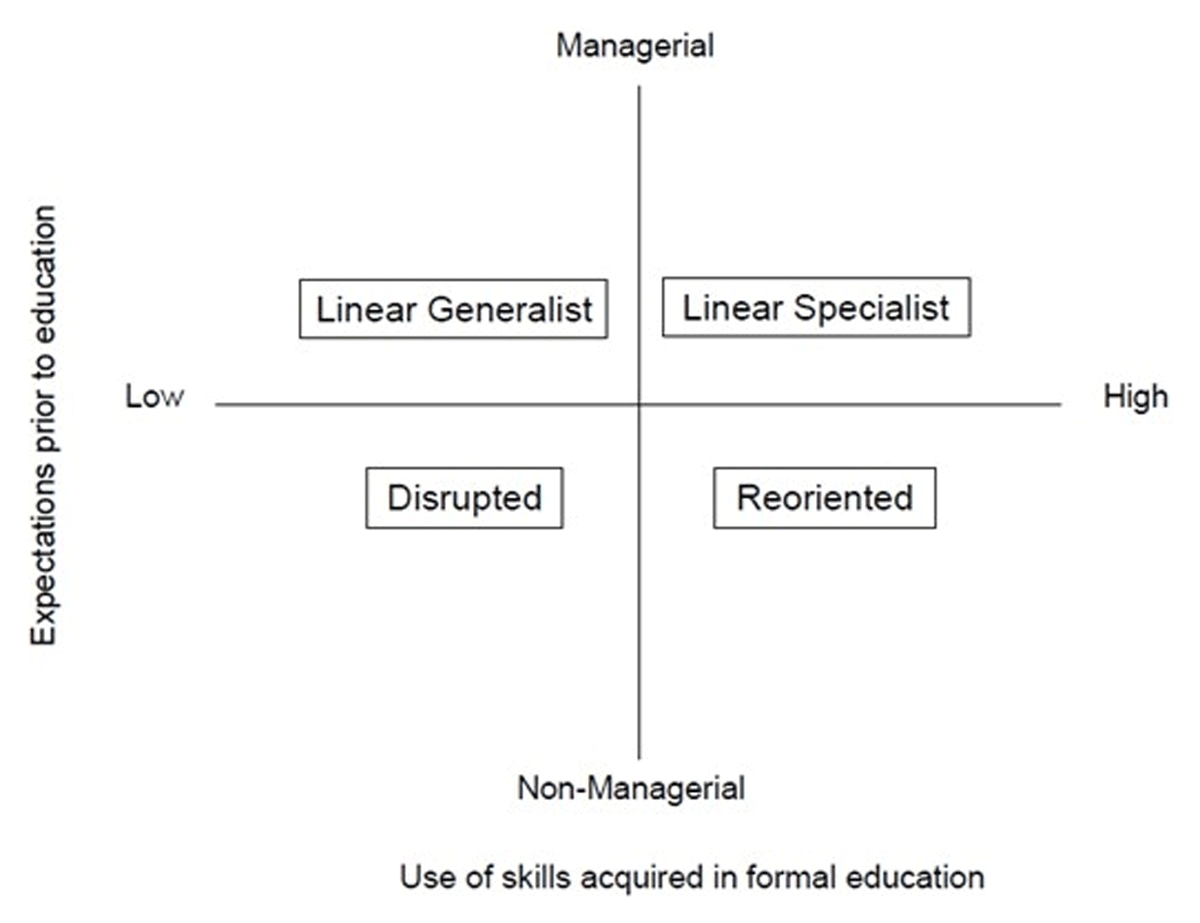
Figure 1
A typology of managerial trajectories.
Table 1
Main characteristics of linear, reoriented and disrupted trajectories.
| TYPE | EDUCATIONAL LEVEL | EDUCATIONAL FIELD | MANAGEMENT FUNCTIONS | PREDOMINANT COUNTRY | BASES FOR RECRUITMENT |
|---|---|---|---|---|---|
| Linear (specialist) N = 2 | Higher | HR | Specialist | PT/SW | Application |
| Linear (generalistic) N = 4 | Higher | Business Administration Economics | Generalist | PT/SW | Head hunting Application |
| Re-oriented N = 6 | Higher | Finance Hospitality Management Business Administration Marketing and Communication | Specialist | PT | Head hunting Application |
| Disrupted N = 4 | Higher Secondary | Political Science Law Music Theatre | Generalist | SW | Vertical progression |
Linear (specialist)
The first type of trajectories corresponds to the cases with a visible linearity between the expectation of becoming a manager and the outcome of actually having a managerial job, with high use of skills acquired in formal education. For these professionals, the initial expectation was to work in a technical function within management, in any sector of activity. In our case study, this corresponds to the trajectories of HR professionals in both countries. They had a clear preferred field of study and aimed to work as management specialists in any HR department. To achieve this goal, they followed higher education studies in the field and ended up being hired based on their academic title, which implies knowledge of employment law and regulations, employee relations, payroll, recruitment strategies, development of training models and performance assessments, among other specialised competences.
In these cases, the relation between the skills provided by the university and the ones looked for by the company and applied in the jobs are reported to be straightforward.
Linnea (SW), 27, decided to study HRM expecting to work in any sector of activity, as long as it involved developing the human capital of the business. “I’m good at personal relationships and I felt it was right to study something that would allow me to work with people in the context of an organisation (…) It didn’t matter what type of company.” Her trajectory evolved as she expected: after graduating from university in Sweden, she started to work in the present company, and after a promotion, she is now section manager within the HR unit. She is responsible for selection and recruitment and her job involves assessing the company’s needs, defining jobs descriptions, candidates’ profiles, selection criteria, and she also monitors the recruitment process and integration of new employees in the company. She uses communication skills, organisation, planning and decision-making.
Linear (generalist)
Also considered to have had a linear type of trajectory are those professionals whose initial expectation was to work in a management occupation independently of the sector of activity. We found this straightforward pathway to management in the interviewees that studied business administration and economics with the clear intention of working as management generalists in the private sector, in any type of industry. There is a direct correspondence between their goals of becoming a manager and their present jobs, but the mobilisation of technical skills gained in higher education is reported to be limited, generating the need to develop studies further at the masters’ level. They were selected to work in this company due to their previous work experience, know-how, social capital, and transversal skills.
Leonor (PT), 32, has worked in this company for three years. When she decided to study business administration, she had no preferable sector of activity to work in, but she wanted to work as a manager, applying her organisation and planning skills. After finishing her degree, she started to work for a big consultancy company and stayed for four years until being dismissed in a restructuring process. Finding another job was not difficult. She worked as department manager in an industrial company and as a project manager in another consultancy company before occupying her present position. She always had project and team management responsibilities. “I think there is a match between what you learn at university and what you do in real life, although university is very theoretical (…) I decided to do an MBA precisely because of that. I wanted something practical that would help me with my present functions.” Right now, she is department manager, responsible for the financial and administrative areas of the store. Her job involves the coordination of concrete areas, such as security, maintenance, IT, recovery, scheduling and environment. She manages a team of seven collaborators and, apart from using administrative and financial skills, she makes decisions regarding the general functioning of the store.
Re-oriented
Reoriented trajectories correspond to the most common model of transition between formal education and professional activity that we found in our sample. They refer to educational trajectories oriented towards a certain field of study and work, where the initial expectation was to work in a concrete sector of activity as specialist, without managerial roles.
These are examples of individuals who expected to find a clear association between their formal education and a company’s core business. However, due to a variety of factors, these professionals ended up working in a company where their technical knowledge is complementary to the core business of the organisation, in a sector of activity where most of them had never imagined working. We can therefore say that the specialised skills they acquired from formal education are directly applied in their daily functions, but they have experienced some type of sectorial or organisational discontinuity, which was motivated or resulted from a need to reorient objectives and professional goals. They all have higher education degrees and occupy specialised functions as department managers. They were recruited based in their previous work experience and know-how. Most of these trajectories were found in Portugal.
Heloísa (PT) 28, decided to study marketing to become an ‘ideas woman’ in the publicity industry, but she never made it. “I was going to be a creative, thinking about slogans every day, it was going to be fun (…) but then, at university, I realized things were a bit different, it was not going to be as I thought. Working under pressure to be creative is not that fun. Finding a job is not so simple and all my friends working in the area were going crazy.” After completing her university studies, she could not find ‘decent’ employment opportunities within her field of study in Portugal, so she started to work in the service sector, in sales and administrative jobs. She worked for a bank, with an attractive salary but poor working conditions, and she even worked in the public sector, with general good working conditions, but in a monotonous job. Eventually, she applied for a position in the company she is in today and was selected based in the specialised skills she had acquired at university and transversal skills she had gained in previous jobs. She works as section manager in the external relations department, where she has responsibilities in the public communication and marketing of the company. She negotiates and communicates with other companies and institutions such as the media, schools, universities or consumers’ associations.
Disrupted
The fourth type of trajectory regards initial expectations and choices related to the idea of vocation, talent, and ‘doing what you like’. These are cases where the current employment is not directly associated with the skills acquired in formal education and where there was a professional rupture, followed by a reconsideration of initial plans. These professionals never thought about becoming managers when they chose their educational paths. They followed the specialised studies that would lead them to pursuit their vocations. In some cases, this meant engaging in higher education, in others, enrolling in vocational courses. In most cases, the professional rupture came out of disappointment with the field and reaching a management position was merely a result of a process of vertical promotions within the organisation. They started in undifferentiated or base level jobs and are now generalist managers, making little use of the skills they acquired in formal education. This type of trajectory was mostly found in Sweden.
Alexander (SW), 27, always wanted to be an actor. He participated in his first performance when he was only 12 years old and started to study theatre on a vocational course when he was 16. While studying, he had several part-time jobs in cafes and restaurants. He graduated from vocational secondary education, specialising in theatre, and started to work as an actor. However, after some years in the field, he acknowledged he needed a more stable occupation and after careful consideration he quit his dream to find a ‘regular’ job. “I wanted to have a family and I felt I wouldn’t be able to be the sort of actor I wanted, in Sweden, and still raise a family (…) so I looked for a more stable profession.” He joined the present company as an undifferentiated worker at the warehouse. After passing through significant horizontal mobility and vertical ascension, he is now department manager in logistics, in charge of around 100 people. He is responsible for allocating and monitoring tasks among the staff, planning all the logistics and assuring the implementation of the company’s core activity.
Discussion
In this article, we analysed the educational and work trajectories of middle managers at the same multinational company in Sweden and Portugal in an attempt to discuss the effects of the institutional context in shaping individual trajectories and company strategies of recruitment. Following the analysis of the functioning of the education systems in both countries, and of the multinational case study, our findings reveal four different trajectories leading to equivalent professional outcomes, which allows us to discuss the co-existence of different educational paths in managerial occupations within this company.
Largely, the trajectories found in Sweden and in Portugal reflect the differences in the functioning of the two countries’ education systems and support institutionalist approaches and risk aversion theories to educational choice. Following Estevez-Abe and colleagues (2001), the institutional context of Sweden supports the educational profile of the country, strongly based on skills specialisation, namely through vocational education. The institutional context of Portugal benefits the acquisition of general skills as a more secure tool for entering the labour market.
In Sweden, we have found a variety of educational backgrounds, some of them including the acquisition of vocational and specialised skills not directly, or traditionally, associated a management career. This indicates that the skills used in managerial practice were acquired in a diversity of contexts. The educational choices of the Portuguese interviewees were more prudent regarding educational level and fields of study. Graduate courses such as music or theatre might be considered ‘risky’ in the Portuguese context of high unemployment and low social protection. Also, the employment returns to higher education tend to be more beneficial in Portugal, where unemployment is significantly higher for those without a tertiary degree. In this sense, the predominance of disrupted trajectories in the Swedish establishment could be a result of a higher proneness by Swedish students to assume risks in their educational choices, while the prevalence of linear and reoriented trajectories in Portugal may derive from cautious educational plans.
Regarding company strategy, although globalisation has brought significant standardisation of procedures, and MNC often adopt recruiting and training practices common to all their subsidiaries, companies recruit local workers based on the skills supply of the markets they operate in. Consequently, a certain degree of adjustment to local realities is necessary and subject to the predominant educational profile in the immediate environment.
In the cases we analysed, the countries’ skills profile influenced the outcomes of the organisational strategy in terms of recruitment and access to managerial careers. We argue that while employers in Sweden found the adequate skills in candidates with secondary-level education, in Portugal, the lack of intermediate skills made these more likely to be found in candidates with higher education. The provision of core general skills in the different educational modalities in Sweden also contributes to a better labour market integration of individuals with vocational education or incomplete university studies there than in Portugal. In general skills systems, such as the Portuguese, specialised and vocational education is not considered a valuable asset for labour market entry (Estevez-Abe et al., 2001). Consequently, labour market entry is, to a large degree, favoured to those with a “generalist” tertiary degree. In coordinated economies like Sweden, specialised and vocational titles are valued by employers, and labour market entry is also favoured to those with this type of qualifications. This idea, to which our findings dialogue well, is also closely associated with the management literature that points to more “flexible” job designs in coordinated economies than, for instance, in liberal ones (Noorderhaven et al., 2015).
Management practice seem to be particularly suited to illustrating the variability in today’s education and labour systems, even within the same MNC and in the context of a common European framework. Unlike the case of highly consolidated and professionalised occupations, the lack of a shared understanding of management as a professional activity makes it harder to clearly identify the skills needed for managerial tasks, allowing for a great variability of educational and work trajectories leading to managerial practice. Our case suggests that the skills needed to take on a management role are varied, including both specialised and transversal competences, which can be acquired in a diversity of ways. However, differences between the two countries regarding the predominant managers’ profile is also illustrative of institutional variations in the use of qualifications. Following Arnold et al. (2018), the results of our study indicate that in the Portuguese case, formal qualifications were used as a means of providing access to employment. In Sweden, qualifications were used to signal existing skills, opening the scope of suitable fields of study for management positions. Moreover, these differences seem to point out to a better account of “mindset” than qualifications in the recruitment of managers in Sweden, a trend increasingly identified in Swedish international businesses from the 1980’s (Noorderhaven et al., 2015). The effects of the institutional context over individual trajectories are thus evident not only in terms of predominant skills profile and expected returns from education, but also regarding employers’ behaviour and labour market functioning.
The educational and professional trajectories of middle managers remain largely under-researched. As such, we were able to contribute, with concrete input from a multinational company operating in distinct countries, to the current debates on the subject. However, the context-dependent nature of our work means that there are limitations on its scope and implications. It would be important for future research to provide evidence from other organisational and institutional realities, considering the influence of sector of activity and level of management to promote discussion and expand knowledge about the heterogeneity of the skills formation processes in contemporary labour markets.
Competing Interests
The author has no competing interests to declare.