
Many young people in rural areas face multiple challenges when leaving upper secondary education (Rosvall, 2020). For them, choosing a career is closely connected to their geographical place of residence and its restrictions and opportunities. Studies have shown that rural students often lack resources such as varied educational options and job opportunities in the local community when compared to their urban peers (e.g. Fjellman et al., 2019; Gray et al., 2006; Lundahl et al., 2020a; Rosvall & Rönnlund, 2019). Consequently, rural youths’ social, cultural, and economic resources have a greater impact on their transitions and career development (e.g. Rosvall et al., 2018; Stenseth & Bæck, 2021).
Corbett (2007) notes that young people living in rural areas are influenced by many information resources that they access through their school and local community when preparing to make a career decision. Similarly, Alexander (2016) emphasises that young people’s career development is bound to the geographical place and its sociocultural environment. However, in today’s interconnected society, with mostly everything and everyone available through the internet, it is possible that interactions made with people and organisations online also influence rural youth learning about education and work. As Corbett (2007) argues, the internet could alleviate potential negative influences arising from the conditions in rural communities, such as a lack of access.
The use of automation and digital services are becoming more common in rural welfare services in general. For example, physical meetings in an employment support office have, for many, been displaced to online video meetings and emails (Arbetsförmedlingen, 2021), increasing in line with remote teaching in schools (Öjefors Stark & From, 2020), as well as online consultations with healthcare professionals (Lindberg & Carlsson, 2018). Similar to most Nordic countries, digitalisation of information concerning education, work and career guidance, which in this text means support for career learning and decision-making provided by trained career guidance professionals, is increasingly prevalent in Sweden. Information on higher education particularly is now predominantly provided through websites and social media rather than brochures and catalogues (SOU, 2019).
These recent developments towards more digitalisation have been identified to represent the future of rural education (e.g. Öjefors Stark & From, 2020) with opportunities to reduce disparities between people in different places (Stenman & Pettersson, 2020). Similar to arguments for the perceived cost-effectiveness of online career guidance (Kettunen, 2021), digital technologies have been suggested in research and government reports as resource-efficient solutions to rural community problems, such as long distances, limited financial resources, and difficulties recruiting qualified professionals (Pettersson & Ström, 2020; SOU, 2019). Many rural communities find it challenging to offer welfare services, such as education, to a level offered in urban areas (Stenman & Pettersson, 2020). Thus, young people’s internet use could promote further inclusion for rural youth, making their access to career information and support more equal to urban conditions. However, it has also been suggested that reliance on these tools could amplify the urban-rural differences in welfare service provision, worsen the experience of service users, and reduce service satisfaction (Lindberg & Carlsson, 2018; Öjefors Stark & From, 2020).
Young people are commonly recognised as able to rapidly incorporate new technologies into their ways of living and communicating (e.g. Jochumsen, 2020; Prensky, 2001). However, little is known about their use of online career resources, which in this text refers to websites and social media offering information on education and work, and includes people and professionals available to interact with and gain support online. As these resources have become increasingly common, and in some cases as for public employment services intended to replace place-based information and support (Arbetsförmedlingen, 2021), there is an urgent need to better understand how these developments are used and perceived by those expected to benefit from them. Because no matter the quality or availability of a career resource, if the intended users have no interaction with it, or if those who uses it do not value it of importance, it will probably make less or no impact on their career learning. This study focuses on the experiences of the Swedish rural youth with online career resources, as well as their perception of its value in relation to career resources they access in their local community, such as people they interact with in family, school, work or place-bound activities (education fairs, internships or similar).
Youth career learning in online contexts is a relatively new research topic in Sweden, internationally there has been an increasing number of studies focusing on young people’s use of online career resources (e.g. Howieson & Semple, 2013; Galliot, 2017; Hummel et al., 2017; Levine & Aley., 2020). Among these, Howieson and Semple (2013) found that students’ social background and educational performance impacts their use of career websites, and that many students are unfamiliar with existing resources. Similar results were obtained in a study on Australian students (Galliott, 2017) finding that few participants knew of existing career websites and even fewer had used them. However, this may have changed during the pandemic because when societies adjusted to the need for physical and social distancing, upper secondary students had to continue their education at a distance (Nilsberth et al., 2021). This included preparation for and planning of their post-graduation careers. As a result, career guidance counsellors made a swift transition to deliver information and guidance mainly online in the spring of 2020. They used digital solutions, such as email and video seminars and meetings, as their main communication channel (Cedefop, 2020; Lärarnas Riksförbund, 2020). Using online career resources during this period was necessary for many students to access career information and gain support from peers and career guidance counsellors. It is therefore likely that more students now have experience using online career resources.
However, although the supply of online career resources has increased, online provision of career information and guidance is not new. The internet’s potential to expand its access and to offer new modes of deliver was recognised at an early stage (Watts, 1996). In late 1990s, the development of websites and widespread domestic internet access gave larger audiences exposure of career information and guidance (Watts, 2002). In addition to offering career guidance over long distances, the internet is recognised as offering various ways of improving the quality and availability of it (Kettunen et al., 2020). For example, the internet may enable access to more diverse resources, promote free access and immediate delivery of information, and facilitate the emergence of creative new solutions for customising information and experiences (e.g. Bimrose et al., 2014; Hooley et al., 2010; Hummel et al., 2017; Levine & Aley, 2020). Bright (2014) has argued that the internet could transform the nature of career guidance and how individuals and groups use it.
According Hooley (2012) online contexts provides potential spaces for expanding social and cultural influences on individuals’ career development because of the different ways people communicate and interact online. He points out that for its users, the internet can function as a career resource library of information, an opportunity marketplace, a space for the exchange of social capital, and a democratic media channel. Hooley thus argues that the online mode changes power structures relating to the use and delivery of career information and guidance. Kettunen and colleagues (2015) support this, suggesting that social media can be an initiating power for change and reform in career guidance. They describe social media as having the potential to be a participatory social space where individuals and groups in the wider society can share knowledge and learn from each other. This in turn could change the role of the career guidance counsellor from being an expert available in certain spaces, to a resource co-existing with the shared expertise of many others (Kettunen et al., 2015).
While the internet has been suggested as a possible medium to empower individuals in their career development (e.g. Bright, 2014; Hooley, 2012; Kettunen et al., 2015), concerns have also been expressed about potential risks of digitalising career information and support traditionally offered in a physical place (Sampson et al., 2018, 2019). Thus, a potential divide between offline and online modes occurs in literature analysing the relationship between technology and career guidance (Goss & Hooley, 2015). According to researchers there is a perception that online delivery of career information and guidance does not always require face-to-face interaction with professionals (e.g. Bimrose et al., 2014; Sampson, 1999; Sampson et al., 2019). Bimrose and colleagues (2014) warn against marginalising the role of career guidance counsellors in favour of career websites because, like Sampson and colleagues (2018), they identify a risk that lack of professional expertise could lead to the spread of disinformation, reducing the quality of shared information. Online delivery has limitations arising from both the technology itself and the different requirements of individuals and organisations, including confidentiality in online platforms and differences in access to and competency with technology among both users and career guidance counsellors (Sampson et al., 2019). Among others, Milosheva and colleagues (2021) have argued that the development of individuals’ competencies in handling information in their career decision-making process is becoming increasingly important. These are not the only reasons to question the increasing reliance on online resources; as noted by Glasheen and colleagues (2015), the place of service delivery matters for young people.
Little attention has been given to the educational experiences of rural students in Sweden (Beach & Öhrn, 2019), and even less to their career learning experiences. When online career information and support increases there is also a need to know more about how such technological developments are used and perceived by young people in rural areas. This paper investigates the role of online resources in rural students’ career learning process. The study was guided by the following research questions:
- What are rural students’ experiences of using online career resources in their final year of upper secondary school?
- What is their perceived importance of career resources in online and offline spaces, and how can rural students’ use of them contribute to their process of career learning?
The Swedish Case
Digitalisation of education has become an important issue in Sweden, as in many highly digitalised societies (Benedicto Krejsler & Moos, 2021). Swedish upper secondary schools generally offer students good access to digital resources and systems; typically, each student is given a PC to bring with them to school (Haglind, 2015). Upper secondary education is not compulsory in Sweden but is widely considered essential in society; about 95% of each cohort enters upper secondary school (Rosvall, 2020). Therefore, most Swedish young people are enrolled in upper secondary education and have access to digital devices and the internet.
Swedish upper secondary education offers 18 national programs: 6 Higher Education Preparatory (HEP) programs, and 12 Vocational Education Training (VET) programs. The former confer eligibility for higher education while the latter prepare students for a direct transition to working life. However, VET students can take extra courses to meet the requirements for admission to higher education. Within five years of completing upper secondary school, 79% of HEP students and 21% of VET students from a cohort enter post-secondary education, with higher education being the most common destination (SCB, 2021).
Career guidance in Sweden is mostly offered through educational institutions, and schools are legally required to give their students access to staff competent to meet their career guidance needs (Swedish Education Act, 2010). However, how and to what extent services are provided is not specifically regulated; each school decides how to organise and provide career guidance. Therefore, provision varies across the country (Lundahl et al., 2020b; Rosvall, 2020). In addition to their school, young people may receive career guidance support from higher education institutions or public employment services. Multiple actors, including official authorities, private organisations, companies, and individuals, provide career information and guidance services via internet. Uncertainty about where or whom to consult for information and support could thus cause confusion, as noted in previous governmental report (SOU, 2017). Swedish authorities, therefore, wish to develop a unified online careers platform that offers what they consider reliable and neutral online career information (SOU, 2019). Danish and Norwegian authorities have already created similar websites that could serve as models for Sweden. These sites blend career information and support via different interactive modes and content types, including text, videos, infographics, self-help tools, and individual or group online meetings with career guidance counsellors (e.g. Bakke et al., 2018; Jochumsen, 2020).
Young People’s Career Learning
The objective of this study is to investigate what role online career resources can have in students’ career learning and how it may relate to their physical place in a rural setting. In accordance with Hodkinson (2008), career learning in this article is perceived as an ongoing process that is part of people’s everyday lives. The learning process is therefore understood to be intertwined with their process of making career decisions and development in careers. Thus, analysis in this paper focuses mainly on the participants’ learning as preparing for making career choices and developing careers, navigating their alternatives, and considering their options.
Historically, the theoretical understanding of career choice and development has been dominated by psychological perspectives incorporating a rational view on career decision making. These perspectives assume that career choices are based on objective, neutral knowledge, and emphasise facts over feelings, separating individuals from their context (Brown, 2002). Staunton and Rogosic (2021) note that such rationalistic perspectives seem to dominate in many studies on technology and career information, which mainly focus on individual service delivery. However, they argue that this approach is problematic because it leads to a belief that “learning about the labour market involves building canonical, objective, knowledge about a subject which is neutral, unproblematic and safe for individuals” (Staunton & Rogosic, 2021, p. 711) Therefore, to establish an understanding of young people’s use of online career information and support, this paper embraces spatial perspectives that consider the influence of surrounding environments, in this text referred to as social spaces. The Careership theory (Hodkinson & Sparkes, 1997) provides useful guidance in this effort because it emphasises that career decisions and the information they are based on can never be context free (Hodkinson, 1995).
The Careership theory of Hodkinson and Sparkes (1997) is based on the conceptual framework of Pierre Bourdieu. It holds that career decisions are pragmatic and rational, developed through interactions with others, and follow unpredictable patterns. In their research on youth career decision making, Hodkinson and Sparkes (1997) found that young people create an individual outlook on desirable and accessible career options through interactions with significant others when navigating opportunities for education and work. Consequently, their career choices are made using incomplete information, are largely based on feelings and emotions, and follow a subjective logic of what is considered appropriate based on their situation and preferences regarding perceived education and work options. The authors then refer to an individual’s set of perceived career options as the horizon for action, which is central to understanding how young people make career decisions because it defines and restricts their perception of viable career alternatives (Hodkinson & Sparkes, 1997).
Hodkinson (2008) argues that individuals’ career learning experiences and the development of their horizons of action are both socially situated and dependent on their historical and geographical location. Building on this argument, Alexander (2021) looks more closely into the effect of spatial factors on rural graduates’ career trajectories, highlighting the importance of geographical place when individuals form decisions about education and work. These arguments imply that there is always a spatial dimension to young people’s career learning and development.
Alexander (2021) describes individuals’ career development in terms of their search for opportunities to become through mobility and their process of belonging, which she calls the pathway of becoming and belonging. In this perspective, a person’s career trajectory develops between their present and their future as they navigate towards space-bound opportunities. Each individual has a relational network and a set of career structures available in their geographical vicinity that offer them a distinct set of possibilities. As a result, individuals incorporate spatial, career, and relational elements when imagining their future, and their horizon for action and further career development is shaped by their experiences and networks in place (Alexander, 2021). The interaction between the online space and the geographical place can be understood by considering that the former co-exists with the individual’s physical location. In this text, the internet and the online space is therefore understood as an interactive social space where people from various geographical locations interact, while the geographical place refers to the individual’s physical location.
Method
This paper presents findings from a cross-sectional survey that was conducted between April and June 2021. The survey data were collected via a 23-question online questionnaire designed and administered using Survey & Report software. Ethical considerations were addressed in planning and conducting the study by following the Swedish Research Council’s Good research practice guidelines. For example, concerning the voluntariness and anonymity of the respondents when inviting students to participate and handling their responses.
Respondents
The survey’s respondents were year 12 (age 18–19) upper secondary school students (n = 267) from 21 rural schools in Sweden. Table 1 provides information on the respondents’ study programs and gender. Respondents were selected by clustered simple random sampling, initially with a similar share of rural and urban students for comparative purposes. Only rural respondents’ data is used in this study. Rural students were defined as young people conducting their studies in an upper secondary school located in municipalities with less than 15,000 inhabitants, a low level of commuting, and with or without tourism industries.
Table 1
Demographic Characteristics of Rural Respondents.
| CHARACTERISTICS | SUBGROUP | N | VALID RESPONSES (%) |
|---|---|---|---|
| Study program | Vocational Programme | 113 | 43.3 |
| Higher Education Preparatory Programme | 148 | 56.7 | |
| Missing | 6 | ||
| Sex | Female | 156 | 63.2 |
| Male | 91 | 36.8 | |
| Missing | 20 | ||
| Total number of participants | 267 |
Due to pandemic restrictions, the questionnaire was administered online, and all contacts were made by telephone and email with school officials (predominantly principals and career guidance counsellors), who distributed links to the questionnaire to their students. Of a population of around 8,600 rural students in their 12th year, about 1,600 could have received a link to the questionnaire. The chosen data collection strategy offered advantages from an ethical perspective but caused problems with the response rate and representativeness. It would have been preferable to share the survey on the spot in the schools in order to increase the response rate and ensure an even geographical spread of respondents across the country.
It is not possible to state that the rural sample was representative. But given the similarity between the distribution of the respondents’ study program and the distribution of program students over time in Swedish upper secondary schools (Skolverket, 2022), it is reasonable to think that similar results could be found among other young people in the population of rural students. However, the conclusions of this study serve as a contribution to the discussion about the role of online resources in youth career learning and its consequences from the perspectives of rural youth.
Analysis
Factor analyses of the included variables were performed to generate indexes that were then subjected to reliability analysis to evaluate internal coherence (indicated by Cronbach’s α value >0.7). Since all the studied variables are categorical and have nominal or ordinal scales, creating indexes made it possible to treat them as continuous variables on a larger scale. Inferential tests were used to explore relationships between variables. All items, except those relating to demographic characteristics and experiences of using online career resources, included ‘I do not know’ as a possible response; in the analysis, such responses were coded as missing values. The theoretical analysis was based on the Careership theory.
Measures
Demographic characteristics
Respondents were asked to state their sex (male, female or other) and which Upper Secondary Program they were studying. The study programs were merged into two categories: Vocational Program (VET) and Higher Education Preparatory Program (HEP).
Experience with online career resources
Respondents were asked to rank their level of experience with 11 different types of career websites and engagement with 16 online career learning activities provided by official authorities and private organisations during their 12th year in upper secondary education. Included career websites contained both general and specific information about education and work, depending on the organisation’s focus and type of website, and offered various interactive elements. The alternatives for career websites referred to a type-group of websites, such as employers, higher education institutions, trade unions and social media websites, while the seven other alternatives referred to specific sites with information on higher education, higher vocational education, adult education and/or work and education in general. To clarify which websites were meant, and avoid confusion between sites with similar names, hyperlinks were included in the questionnaire. The alternatives for activities included searching for information, watching videos, participating in social media groups, participating in digital events, reading others’ posts and comments, asking about or commenting on others’ experiences, posting in social media and conducting a careers test. These were divided into eight activities relating to gathering information on work and eight providing information on education options. Ratings were on a six-graded scale to what extent the respondents have experienced using a website or engaging in an activity during their 12th year, from not at all to a daily basis (1 = never used, 6 = daily use).
Perceived importance of career resources in offline and online spaces
Respondents were asked to rank the importance of different information sources in their career learning process, and their preferences concerning these. In addition to online career resources, students were asked about activities such as internships, part-time jobs, workplace visits, visits relating to work life in school, study visits at educational institutions, visits from education officials, lessons on education and work, and conversations with friends, siblings, parents, career guidance counsellors, teachers, and other school staff. Ratings were on a four-graded scale (1 = not important at all, 4 = very important). Four indexes were created relating to four different types of career information resource: online, education, family, and working life. Respondents were also asked about their preferences regarding career resources from various social spaces, including the options listed above, and preferences of channels for the provision of career guidance, including interactions individually and in groups through physical meetings, video, e-mail, social media, chat services, and telephone calls.
Results
Experience using online career resources
The respondents’ experiences of using online career resources providing information and support varied according to the type of information accessed, the distributor of the information, and the activities performed. Overall, a majority (>97%) had used web-based career resources during their last year in upper secondary education. Therefore, most respondents had experience of using online career resources. Table 2 shows an overview of the respondents’ online career resources experiences.
Table 2
Students’ use of online tools and websites when seeking to learn about education and work. Frequencies are quoted as percentages of the number of valid responses.
| N | |||||
|---|---|---|---|---|---|
| VALID | MISSING | NO USE | OCCASIONAL USE | REGULAR USE | |
| Activities | |||||
| Individual | 252 | 15 | 2.8 | 57.8 | 39.4 |
| Social | 246 | 21 | 10.2 | 81.0 | 8.8 |
| Automated | 255 | 12 | 27.1 | 51.7 | 21.2 |
| Websites | |||||
| Higher education info. | 254 | 13 | 19.7 | 45.7 | 34.6 |
| Labour market info. | 249 | 18 | 24.1 | 64.5 | 11.4 |
| Social media | 257 | 10 | 27.2 | 38.9 | 33.9 |
| Vocational education info. | 253 | 14 | 54.9 | 31.7 | 13.4 |
Individual activities such as searching for career information were the most commonly mentioned career-related activities. These included watching online videos and reading others’ posts or comments on social media; many participants stated they visited social media platforms to learn about career opportunities. Other commonly used resources were public authorities’ websites providing information about the labour market and higher education. However, the proportion of HE students who had used such sites (92%) was in a Chi2 test found significantly (p ≤ 0,01) higher than the proportion of VET students (45%). This result probably reflects differences in individuals’ interests.
More than individual learning activities, many respondents also had experience with social learning activities. These include interactions through social media, such as discussing, commenting and asking questions to other people about their experiences (as well as sharing their own) or participating in a digital event (e.g., an education fair). Automated career learning activities, such as conducting a careers test, were another usual activity reported. However, a larger share of respondents reported no experience with automated activities than with social and individual activities.
Although many respondents had experience with several online activities and websites for career learning purposes, few used them on a weekly or daily basis. The responses were widely dispersed and groups of regular users (a couple of times per month or more) and occasional users (a couple of times per year or fewer) are identified for all activities and websites. As can be seen from Table 2, the sizes of these groups differed depended on the activity or type of website in question.
Perceived relevance of resources in offline and online spaces
In the choice between various channels for receiving career guidance, many respondents (60%) preferred to receive career guidance individually in a physical room. At the same time, when deciding what resource to consult for information about education and work, the vast majority (79%) of respondents named the internet as their first choice; no other resource was named as first choice at a similar frequency. However, the other resources listed by respondents in their top five choices varied widely. These results suggest that no information resource is unimportant, but the relevance of different resources depends on individual preferences. Chart 1 illustrates the respondents’ ranking of the importance of the career information resources included in the questionnaire.
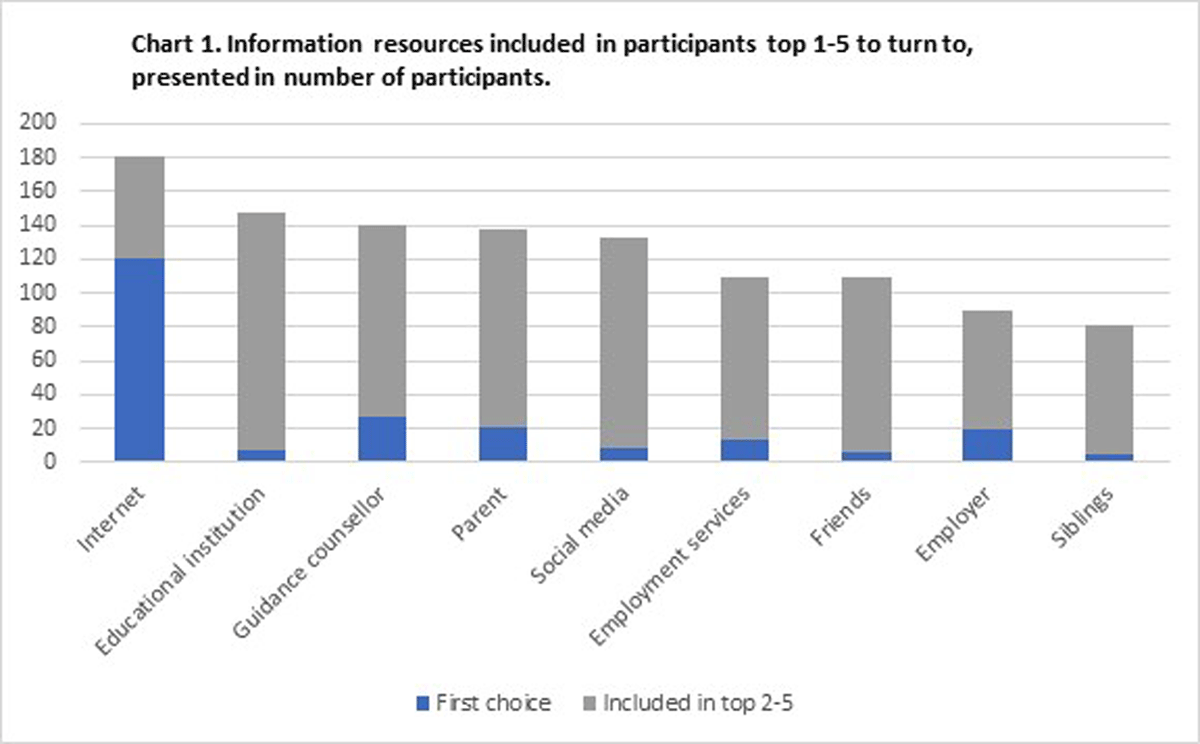
Similar trends were seen in the respondents’ ranking of different information resources when preparing for making career decisions: resources from diverse social spaces, including education (e.g., lessons on education and work, career guidance counsellors), the family (e.g., parents, siblings, friends), working life (e.g., workplace visits, internships), and the internet, were all considered important. Table 3 provides an overview of students’ perceptions of the value of career information resources from different social spaces.
Table 3
Students’ evaluations of the value of different sources of career information. Scores range from not at all important (0) to very important (1).
| N | MEAN | STD DEVIATION | ||
|---|---|---|---|---|
| VALID | MISSING | |||
| Social space | ||||
| Online | 240 | 27 | 0.65 | 0.31 |
| Family | 241 | 26 | 0.63 | 0.25 |
| Education | 208 | 59 | 0.56 | 0.26 |
| Work life | 206 | 61 | 0.55 | 0.30 |
As can be seen from Table 3, the mean score for all social spaces is above 0.5. This indicates that the respondents generally considered career resources related to these social spaces to be important in their career learning process. The table also shows that respondents place the highest value on online career resources and information resources within the family. However, it should be noted that these two resource types also had the greatest numbers of valid responses, which may have affected their mean scores. Consequently, the actual score differences between these resources and the others may differ from those shown in the table.
The number of valid responses pertaining to online career responses was high, despite many students reporting low engagement with resources of this type. Like family resources, for which a similar number of valid responses were given, most respondents interacted daily with online resources. Regardless of purpose, the internet, parents, and friends are more accessible to students in their daily life than events such as education fairs or workplace visits, which may occur only a few times per year. The differing availability of career resources may thus have impacted the response rates obtained and could also influence how students perceive their importance in career learning.
Table 3 also shows that there was substantial variance in the students’ responses. While the mean scores for each social space indicate their perceived importance across the entire sample, the high standard deviations show that many respondents stated that certain resources were of limited or no importance in their career learning. In this context, it is notable that the standard deviation was highest for the online and working life-related career resources. The explanation for this may be related to the above argument concerning participants’ frequency of exposure to and experiences with career resources in these social spaces.
Relations of career resources’ perceived relevance
To better understand the role of online career resources in students’ career learning, their appraisals of the importance of such resources were compared to the perceived importance of resources accessed through the family, education, and working life. Table 4 shows the correlations between the perceived importance scores for these four resource types.
Table 4
Pearson correlations for perceived importance of career resources from different social spaces. ***= p < 0.001.
| ONLINE | FAMILY | EDUCATION | WORK | |
|---|---|---|---|---|
| Online | 0.39*** | 0.47*** | 0.10 | |
| Family | 0.39*** | 0.55*** | 0.32*** | |
| Education | 0.48*** | 0.55*** | 0.58*** | |
| Work | 0.10 | 0.32*** | 0.58*** |
There are significant positive correlations of intermediate strength between the respondents’ importance scores for online career resources and those for information resources accessed through family and education. These results indicate that students who value online career resources also tend to value familial and educational resources. While the correlation is only moderately strong, it is sufficient to state that respondents’ perceptions of information resources from these three social spaces are related. Conversely, the scores for career resources relating to working life correlate only weakly and non-significantly (p = 0.17) with the perceived importance of online career resources.
Discussion
The internet – a common space for interactions
This study’s objective was to explore rural students’ experiences of using online resources for career information and support. It was found that most respondents had experience with online career resources, however with a variety of activities and platforms used. The results obtained in this work show the importance of adopting a broad perspective on factors that may influence learning when seeking to understand young people’s use of online resources when preparing for career choices. Factors that may contribute to the high share of users include the passage of time and the greater integration of technology in schools and society in general, especially since the data collection period coincided with the pandemic, which may have increased students’ propensity to use online resources. However, even during normal circumstances, certain types of information and support may only be available to students in rural areas via the internet (Rosvall et al., 2018). It can therefore be assumed that most rural youths will use the internet for career learning purposes at some point.
The analysis revealed differences in the frequencies with which respondents used different information resources; some students show negligible or low levels of engagement with online career resources while others use them heavily. In accordance with previous studies (Galliott, 2017; Howieson & Semple, 2013), there are reasons to assume that students’ social and cultural backgrounds affect their resource use frequency. Another possibility is that factors related to individuals’ skills and competencies may affect their ability to use online resources (Milosheva et al., 2021; Sampson et al., 2019). Thus, if digital solutions are supposed to promote equality and inclusion in rural communities, it will be important to learn more about the quality of digital solutions and the factors affecting the frequency with which adolescents use online career resources. Accordingly, further knowledge can evolve on how digital solutions and support for rural youth transitions may develop to empower individuals in their career development, and thus, be able to utilise the online space as a counteracting force to inequalities. Such investigations are outside the scope of this work, so further research on this topic is warranted.
Usage for access of information
As noted by Hodkinson (2008), career learning occurs in people’s everyday lives, and the results show that online interactions play a significant role in this process. Consequently, the internet is of importance in rural students’ career learning, but perhaps of a different kind. The respondent’s experiences of using various resources can be interpreted to mean that respondents consider them to serve different purposes when learning about careers, which as suggested by Hooley (2012) would mean that the internet fulfils a variety of functions for respondents in this study.
Mostly, the respondents seem to use the online space to individually access information to support their learning about education and work. A reasonable conclusion can thus be that rural youth mainly consider the internet as a careers library to meet their need for career information. This can explain the common use of certain websites, especially those with higher education information, to access information outside the local community. In this perspective, information resources online can complement or possibly compensate for what is not available in rural areas.
Using the online space for access of information seems to be most common, even where there is potential for joint learning, as in social media. In using social media, respondents mainly accessed others’ shared knowledge rather than to share their own. Thus, it seems rural youth tend to prefer one-way communication, acting as what Hooley (2012) calls consumers of information rather than producers.
However, many respondents also used the online space as a source of support for direct conversations with others, but less frequently. More than accessing career information, this study shows that the online space can function as a co-creative learning space where individuals exchange knowledge and support each other in their learning, as suggested by Kettunen et al. (2015). Knowing who interactions are made with, though, and in what roles they act, for example as consumers or producers, would increase understanding of the impact these interactions have on young people’s learning and development in careers. Possibly, the internet can be a venue for people from different places to influence each other’s career learning processes. But as Rosvall and Rönnlund (2019) noted, perhaps rural youth interact online mostly with people from their local community. Then, instead of expanding networks and possible influences from other places, the online space functions as another channel for ongoing interactions arising through the offline space.
Interconnection of offline and online interactions
The results of this study indicate that rural youth’s career learning process has both distinct online and offline components. An overall positive attitude towards online resources can be interpreted among respondents, while interactions in the offline space can also be depicted as generally important to them. The internet is preferred by many as the first-hand resource to go to and many perceive online resources as valuable in their career learning process. Simultaneously, in accordance with results from Glasheen et al. (2015), many respondents prefer to receive career guidance in offline spaces. Many also consider friends, parents, career guidance counsellors, and teachers of importance in their career learning process, although their perceived relevance varies individually. Thus, it seems both online and offline interactions are significant to rural youth’s career learning process.
According to Alexander (2021), young people’s career development is bound to their geographical place because of their social and cultural influences. And when learning about education and work, the rural place is expected to affect young people’s need or interest for using certain resources. Consequently, rural students’ experiences with online career resources may be influenced by interactions made within their local community, family or school. Interestingly, the respondents’ appraisals of the career resources available to them through family and education correlate positively with all social spaces in this study. These results corroborate the hypothesis of Hodkinson and Sparkes (1997) that information resources within the immediate social environment are particularly important for young people’s career development. This is important because it implies that online career resources are likely to be used together with other career resources.
Taken together, these results suggest associations between diverse interactions in the online and physical spaces that influence rural students’ career learning. The perceived relevance and purpose for using online career resources can be related to interactions made with people in the local community. Thus, attitudes towards and habits of using online career resources are likely to be influenced by young people’s offline interactions.
An empowering space for learning?
The results imply that the online space can empower rural youth in their career learning by providing easy access to a wide variety of career information. However, the exact contribution of the internet to students’ learning and the widening of their perspectives in career choices is likely to depend on several factors, including the provider of the information and to whom the information is exposed. The geographical place shapes the content and process of learning, and an individual’s relationship to the supplier of information will affect the development of their horizon for action. In rural settings, there is a risk that the internet could become another channel of urbanised influence, causing rural youth to consume information that is created and delivered based on urban contexts and conditions. Moreover, Hodkinson and Sparkes (1997) state that information is given meaning in the young persons’ local context and situation, and it is from there that the horizon for action develops. Consequently, the increasing access to information through the internet may increase students’ need for complementary actions in the local community, rather than making them more independent. The internet’s potential to change power structures is therefore likely to depend on the availability of career resources, such as information and support from career guidance counsellors and others, in young people’s local social spaces. Contrary to the proposed cost-efficiency of digital solutions, then, continued digitalisation of career resources could create a greater need for, and therefore generate greater costs for, place-bound support.
These results suggest that further digitalisation of career information and support could both reduce and increase differences between rural and urban young people’s opportunities to prepare to make well-founded career choices. On one hand, the large selection of information available online increases the scope for rural youths to be influenced by those outside their local community. On the other, these online interactions might not occur if what they offer existed in the local community. A lack of local resources might thus create a demand for online services that would not exist if similar resources existed in the students’ immediate area. As such, the high usage of online career resources by the respondents and the high value they assign to those resources does not necessarily mean that rural students prefer or need online resources while learning about education and work. The findings presented here must therefore be interpreted with caution, especially since there is a risk that instead of changing power structures, digitalising the delivery of career information and support could perpetuate or even strengthen the divisions between people and places. Efforts should therefore be made to ensure that appropriate career information and guidance is provided to rural students within their local communities, as well as via the internet.
Conclusions
This study set out to explore the use of online career resources in the career learning of rural youths. The findings suggest that the internet is one of many interactive social spaces that shape the perspective of such youths in their career learning process. Online career resources thus increase the range of social and cultural factors that can influence the career learning of rural youths.
It is suggested that the online space can potentially empower rural students in their career learning by complementing career resources in the local community or in some cases even compensate for lack of such. It can also be a space to continue ongoing interactions or possibly to develop new contacts and have influences from places beyond the rural community. However, local place-bound interactions continue to play an important role in rural youth’s career learning and their use of online career resources is likely to depend on interactions in the immediate surroundings. Therefore, the conditions in rural communities continue to affect the career development of young people.
Implications for career guidance counsellors and other professionals supporting rural youth transitions will need to consider online interactions as part of their career learning and help young people utilise the online space for such purposes. At the same time, it would be necessary for authorities and professionals operating outside rural communities to consider the value of place-bound interactions and provide the opportunity for young people in rural areas to be offered appropriate information and support at place. As for example, the development of a Swedish national career’s website should function as a complementary resource for young people’s career learning, together with place-bound information and support, but not as compensating for lack of resources in the local community.
There are still many unanswered questions about the interrelation of online and offline spaces and their roles in rural youth career learning. Further studies, possibly using qualitative approaches, will be needed to develop a fuller picture of this topic.
Competing Interests
The author has no competing interests to declare.