
Introduction
Career guidance scholars have used the concept of paradigm shifts to depict the change from modern to postmodern times (Loven, 2003), or in terms of entering into a life-design paradigm ‘for the 21st Century’ (Savickas et al., 2009). Paradigm comes from Greek (paradeigma), i.e. a general pattern (cf. Kuhn, 1962). The concept of a paradigm shift seems to presuppose that an overall career guidance pattern, a paradigm, in fact exists. If any such paradigm should be identifiable, it would be that a number of well-known career development theories are focused on the individual career. This individual focal point is closely linked with the idea of unlimited economic growth.
Examples of the individualised bias and its links to societal goals of economic growth are embedded in the so-called Big Five career theories (Leung, 2008), for example in Super’s life-span theory (Super, 1957, 1980); Holland’s (1997) person-environment fit theory; Gottfredson’s (2002) in her theory of circumscription and compromise; Gelatt (1989) in positive uncertainty; Mitchell, Levin and Krumboltz (1999); Krumboltz and Levin (2004) in planned happenstance; and Savickas and colleagues (2009) in individual life-design. These well-known theories from North America are based on the work-life experiences of the middle class and reflect a mainstream individualistic culture. They are an instance of a Western culture and pre-occupied with matters of economic growth, which will be discussed below. These examples of guidance theories will suffice here, as all share the same blind sport in linking prosperity, economic growth, and individual career choices: they are linked with societal trends where economic growth is viewed as pivotal. These guidance theories, in turn, reflect current politically based ideologies, which are deeply rooted in Protestant Work Ethics (Weber, 1958) in which Westernised individualistic work values, economic growth, prosperity, protestant work ethics, capitalism are interwoven.
Aligning with this, essential policy papers focus on the individual career, such as for example the European Union Resolution on Lifelong Guidance (European Commission, 2004, p. 7), which contains this view:
‘All European citizens should have access to guidance services at all life stages (…). The preventive role of guidance services in encouraging school completion and their contribution to the empowerment of individuals to manage their own learning and careers.’
Market-oriented thinking, supports this view, which implies that individual decisions, ego-centred as they may be, sum up to a collective good (i.e. economic growth), driven by the market’s ‘invisible hand’, as legendarily verbalized by Adam Smith (1776). Watts (2003, p. 12) claims that: ‘Career development services could represent Smith’s ‘invisible hand’ made flesh.’
With this backdrop, this contribution aims at questioning the above-mentioned mainstream ideas, concepts, and theories, based on understanding that guidance should build on visions of sustainability: on Green Guidance. For almost three decades, the author of these lines has promoted such views and analyses (see Plant, 1996, 1999, 2003, 2007a, 2007b; 2008, 2014a, 2014b, 2015). The present contribution is argumentative in nature. It analyses current challenges, argues for Green Guidance, draws on relevant research and policy documents, and adds an utopian dimension to the previous work on Green Guidance. One of the missions of this contribution is to question perhaps unconscious values, such as the link between (individual) career development and economic growth as a yardstick for societal achievements. In doing so, it puts career guidance in a pivotal societal position in terms of sustainability issues. (For a broad definition of sustainability, see UN, 2015).
Inconvenient Truths: Growth and Happiness
Well-established truths may well be profoundly outdated, or even in unhelpful in dealing with current societal issues. Adam Smith (1776), for instance, was seen as a modern, market-oriented thinker in his time, but he, and his economic neo-liberal followers, may not represent the end answer to the problems of (post)modern times. Perhaps the pursuit of one’s own interests does not promote the public interest, after all. The following paragraphs discuss some aspects of alternative views to the prevailing (neo)liberal positions, with special attention to sustainability issues.
In his film An Inconvenient Truth, Al Gore from USA, stated that:
‘Humanity is sitting on a ticking time bomb (which)… could send our entire planet into a tail-spin of epic destruction involving extreme weather, floods, droughts, epidemics, and killer heat waves beyond anything we have ever experienced’ (Gore, 2007).
It is noteworthy that in this pre-Corona list of disasters Al Gore included ‘epidemics’. Other influential policymakers have raised similar issues. French Nicolas Hulot (2006) introduced five concrete proposals on environmental issues and policies that included CO2 taxation, sustainable agriculture, and eco-education. Stern (2006) linked economic issues with climate change. The World Bank (Hallegatte, 2015) has repeatedly warned against the unevenly distributed impact of climate changes on poor people across the world (see also Hallegatte & Rozenberg, 2017). This point has far-reaching implications in terms of career guidance and career opportunities: the more vulnerable populations tend to have a greater risk of paying for the effects of climate changes. Green Guidance, as unfolded below, could be one tool to help socially disadvantaged people living under climatically vulnerable conditions. In this respect, Jeremy Rifkin (2010) argued that a ‘biosphere consciousness’ is emerging among young people (cf. Thunberg, 2019). Randers (2012), in a 40-year forecast, predicted an increasing focus on human well-being rather than on per capita income growth. Significantly, this is by no means a new position: it was famously promoted by Rachel Carson in ‘The Silent Spring’ (Carson, 1962).
However, the present role of career guidance is often depicted in terms of older paradigms in policy documents. For example, in the European Union Resolutions on Lifelong Guidance (European Commission, 2004; Council of the European Union, 2008), guidance is seen as a vehicle for economic growth in a global race for better competitiveness among the so-called ‘Competition States’ (Cerny, 1997; Pedersen, 2011). This perspective ignores the fact that much growth is ‘job-less’, and has no regard for environmental matters. Even the most recent overview of ‘evidence’ to inform European policy making in relation to career guidance (Hooley, 2014) has a blind spot in terms of green aspects and sustainability. This is all the more remarkable, as the European Union (EU), in its goals for 2020, re-defined these issues: growth in itself is no longer seen as the answer to future challenges, as smart, sustainable and inclusive growth are the future lead concepts (European Commission, 2011). Though these concepts still rely on traditional economic growth thinking, they represent steps towards greener, more sustainability-oriented concepts.
The EU Commission, however, is in fact changing its policies. In its 2019 report on education and training the commissions highlights ‘…work and jobs that minimise environmental harm and heighten the awareness of the importance of green careers’ (European Commission, 2019, p. 54). Aligned with this turn towards ‘green careers’, economic growth seen as GNP (Gross National Product) has been questioned, even by the Organisation for Economic Co-Operation and Development (OECD). They introduced the Better Life Initiative which aims to measure well-being and progress based on 11 dimensions: housing, income, jobs, community, education, environment, governance, health, life satisfaction, safety, work-life balance (OECD, 2011). Career guidance is not (yet) on this OECD list. The ILO (International Labour Organization) gets close to such issues in its Green Jobs Programme (ILO, 2015), linking sustainability and green economies to decent jobs.
Similarly, in the EU, the Stiglitz Report (Stiglitz, Sen, & Fitoussi, 2009) studied the concept of GNP in relation to social progress, and generated a number of recommendations to improve current GNP concepts. Further, the United Nations Development Programme (UNDP) has issued a number of Human Development Reports, one of which featured a Human Development Index, which pointed to positive synergies in the pursuit of greater equality and sustainability (UNDP, 2011). A few years later, the renowned and interlinked 17 Sustainable Development Goals were adopted by all United Nations Member States (UN, 2015). Climate change, in particular, has been highlighted both by the UN, and by the Swedish activist, Greta Thunberg, who has mobilized youth globally, in relation to pressing environmental issues (Thunberg, 2019). In short, sustainability has been added to traditional economic growth concepts as more than just a corrective measure: it represents a new direction, a new paradigm. Where would such developments link to career guidance, and to career development? The next section examines some examples of inspiration from non-Western cultures.
Non-Western Inspiration
At this point let us turn to some of inspirational arguments from non-western cultures, to counterbalance the concepts and values that underpin current career individualistic development theories. In India, for example, careers may be seen as having four steps, not all of them with an individual focus (Arulmani & Nag-Arulmani, 2004, p. 9):
Brahmacharya Ashrama (learning)
Grahastha Ashrama (family, personal career)
Vanaprastha Ashrama (serving society, not for personal gain)
Sanyasa Ashrama (serving humanity).
By contrast, inherent cultural factors in westernised models, e.g. Super’s Career Rainbow, depict the final phase in life as ‘Decline’ from the age of 60, following these stages: growth, exploration, establishment, maintenance (Super, 1980), quite disparately from ‘serving humanity’.
These concepts point towards mutual responsibility stewardship and sustainability. Likewise, Bhutan, for example, has launched the concept of the Gross National Happiness (GNH). It covers four areas of development: (1) sustainable and equitable socio-economic development, (2) conservation of the environment, (3) preservation and promotion of cultural heritage and (4) good governance (see e.g. Plant, 2007a). Further, the GNH framework approach groups a number of key domains, including and resilience, psychological wellbeing, health, education, good governance, and ecological diversity.
Similarly, the concept of “Sufficient Economy” in Thailand aims at the moderation in life, living together in peace and harmony with nature and the environment: “Yuyen Bhensuk” (i.e. ‘Happy and Healthy living’). This, in turn, has implications for career guidance policies which in this perspective will not seek to advance economic growth at the expense of sustainability (Plant, 2007a). Let us now turn to the implication for career guidance and career development.
Green Guidance: Social Justice
Guidance will have to take a stance in relation to the outlined challenges mentioned above. The predicament is that career guidance until now has served mainly as a link between the aim of economic growth on the one hand (at the expense of other, crucial sustainability focused goals), and, on the other hand, fostered the essentially individualistic values which have underpinned much westernized career development theory for generations, as pointed out above. But Green Guidance is a vital component in developing the concept of future careers, as noted by some scholars, notably Barham and Hall (1996); Di Fabio and Bucci (2016); Dimsits (2019); NCGE (2009); Packer (2019); Plant (1996, 1999, 2003, 2007a, 2007b, 2008, 2014a, 2014b, 2015); Guichard (2016); Pouyaud and Guichard (2017).
In a broader educational perspective, several scholars and organisations have dealt with environmental education (e.g. UNESCO, 2018), or from a sociological perspective in terms of developing Citizen Green (e.g. Mason, 2013). This points to the need for developing Green Career Education. One such example stems from Canada, where climate changes and career guidance, thematically, are brought together in career education programs which take their departure from the voices of children. This leads a researcher of these programs (Maggi, 2019, p. 3) to the conclude that:
‘Students would learn about the careers of their own interest, the role that such work would play in the bigger picture of planetary health, and they would be counselled to reflect on how their professional choices could make this planet healthier.’
In these terms, an important link between social justice and Green Guidance is established. This aligns with Irving and Malik (2005) in their argument that career choices, individual as they may be, have implications beyond the individual, as they are linked to wider societal issues of social justice. Similarly, Hooley, Sultana and Thomsen (2017) take the social justice discourse further in terms of criticising neo-liberalism: without increased sustainability these will be no social justice. Green Guidance, environmental issues, climate changes, and social justice are critically interlinked.
Departing from the concept of four aspects in terms of sustainable career development and career guidance, Packer (2019), based on Watts (1996b) and Dobson (2007), has developed this 4-field analysis model, to distinguish between Light Green and Dark Green approaches (Figure 1, below), thus differentiating between Radical, Progressive, Conservative, and Liberal approaches, and their respective practical consequences in terms of green guidance practices. This 4-field figure also highlights some of the tensions between the different views represented here.
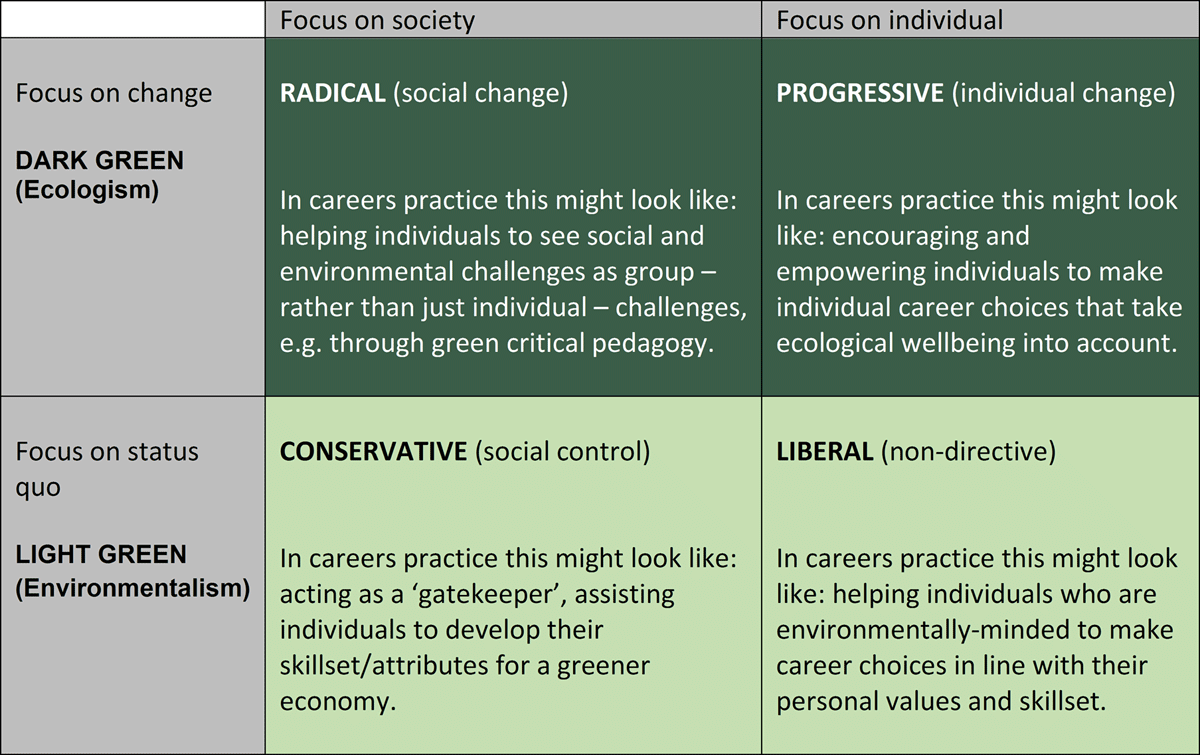
Figure 1
‘Light green’ versus ‘dark green’ approaches to environmental sustainability quadrant of socio-political ideologies, adopted from Packer (2019).
This Figure may serve as a vehicle to distinguish between ‘light green’ measures within the present society, versus a deeper, ‘dark green’ approach to rearrange societal structures. In these terms, Dobson (2007) makes a distinction between environmentalism and ecologism. Environmentalism ‘argues for a managerial approach to environmental problems, secure in the belief that they can be solved without fundamental changes in present values or patterns of production and consumption’ (ibid, p. 2). Environmental approaches, in this view, would be seen as socio-politically conservative or liberal, aligned to the bottom-half of Watts’ (1996) quadrant. Ecologism on the other hand, ‘holds that a sustainable and fulfilling existence presupposes radical changes in our relationship with the non-human natural world, and in our mode of social and political life’ (ibid, p. 3). Ecologism is politically radical in nature, aligned to the upper-half of Watt’s quadrant. ‘Sustainable development’, according to Dobson (2007) may fall into the category of a managerial, surface-level approach to environmental problems: in reality, it does not contest more radical ideas of less consumption and production as the way forward. Green accounting, which includes other factors than merely economic performance aspects (Schaltegger & Burritt, 2000), or Conscious Banking, may similarly be seen as environmentalistic: they simply reflect that it does no longer pay to focus only on short-term economic goals. In policy terms this distinction (light vs dark green) may assist in mapping and driving policy interventions, both on a broad societal basis, and more specifically in terms for career guidance policies and practices.
With this framework in mind (cf Figure 1, above), let us now turn to some practical implications of this analysis.
Green Guidance Ethics and Practice
The International Association for Educational and Vocational Guidance (IAEVG) in 1995, adopted global Ethical Standards, re-edited in 2017, recognising the tensions between economic growth and environmental issues. An ethically based U-turn (Scharmer, 2007), is needed, based on a number of principles for Green Guidance:
guidance should take into account and create awareness of the environmental impact of career choices and career development;
guidance should play an active role in establishing training and education opportunities with a positive contribution in terms of sustainability;
informational materials on career options should include environmental aspects;
guidance results should be measured, not only by an economic yardstick, but also by green accounting, i.e. by relating sustainability goals to guidance activities;
guidance theories and practices should address broader sustainability career development issues.
These principles (above) align with those of the ILO Green Jobs Program (ILO, 2015).
The inspirational list of green careers (below) might help to clarify the points made above:
green activist working with neighbourhood ecological gardening
green greenkeeper with a no-pesticide approach to maintenance of sports grounds
green lawyer working with environmental cases
green transport engineer work with non-pollutant means of traffic and transport
green farmer working with ecological practice in fields and stables
green painter using non-toxic and degradable paints
green builders using natural insulation materials
green wind-turbine designer
green fashion designer
green hairdresser
This incomplete list should be supplemented by inspirational registers of green careers such as provided by, for example, the USA-based Career Onestop Centres which present 200 green careers for a start (see https://www.careeronestop.org/GreenCareers/ExploreGreenCareers/explore-green-careers.aspx). In short, most careers could be seen as potentially green. A variety of new green career options are under way: ‘carbon trader’; ‘logistics engineer’; and ‘recycling coordinator’, to mention a few from the Career Onestop list.
Conclusions and Perspectives
Some economists and politicians are aware of the clash between endless economic growth, and environmental/sustainability concerns. Whereas economic growth used to be the solution, it now seems to create as many problems. Jobless growth, a deterioration of the natural resources, and the undermining of workers’ rights and wages: these are some of the present predicaments. Globalisation in terms of global trade with long-distance transport to/from low-wage areas adds to the problem, as does mindless tourism, and industrialised farming and fishing, just to mention a few. In this situation, guidance must become part of the solution, rather than the problem. Social justice and its relation to career guidance are interdependent, and, though obviously embedded in social structures, even more profoundly linked to sustainability issues.
New philosophies take some time to break through. Thomas More’s Utopia dates back more than 500 years (More, 1516). He was preoccupied with private ownership, and with social justice. Utopian visions, however, continue to emerge: a recent one, Utopia for realists by Bregman (2017), calls for a re-orientation in terms of work and wages, (re)introducing the concept of a basic citizens’ income. Such visionaries deal with career development, as did Frank Parsons (1909). His visions reached far beyond guidance and counselling itself. Based on ‘brotherly love’, his societal vision was ‘Mutualism’ (Parsons, 1894): using this concept, he advocated for a balanced, just, and peaceful society. He was a prophet and a practical utopian (Gummere, 1988). Other earlier utopians with a view to career development, such as Fourier (1848), and Owen (1813) were labelled, rather dismissingly, Utopian Socialists by their opponents. But new utopias are essential: green ones. Green Guidance is pro-active, questioning, probing, reflexive, and human-centred in the real sense: it moves career-decisions to a higher note of personal commitment, societal involvement, and meaningfulness. In relation to globalisation, and to social justice, it places guidance in a central global position: environmental issues and sustainability concerns know no boundaries (Monbiot, 2006). This is why it is so urgent that guidance workers and scholars make their contribution towards green changes, green career development, and a sustainable future. This is the new paradigm.
Author Information
Professor, Dr. Peter Plant has worked in the field of career education and counselling since 1974 in schools, higher education institutions, and in the employment service in Denmark. He has taken part in many European projects on guidance, including consultancy to the EU-Commission, and to the European Lifelong Guidance Policy Network (ELGPN), and globally in various expert capacities.
Competing Interests
The author has no competing interests to declare.