
Over the past two decades, the monitoring and evaluation of lifelong guidance systems has become an increasingly central theme in Europe. International policy frameworks, including the EU Council Resolutions on lifelong guidance (European Council, 2004, 2008), the European Lifelong Guidance Policy Network guidelines (ELGPN, 2015) and quality assurance and evidence base (QAE) framework (ELGPN, 2016), and the European Centre for Development and Vocational Training (Cedefop) (Cedefop 2022, 2023a, 2023b) work on standards for monitoring and evaluation of lifelong guidance systems and services, have consistently emphasised the importance of monitoring and evaluation of guidance systems and services. Monitoring and evaluation of lifelong guidance systems guidance is carried out for a number of purposes: to help providers evaluate and improve their performance and to measure the economic and social value of activities relative to their cost (e.g. Hiebert et al., 2014; OECD, 2021).
Despite this ongoing emphasis, the monitoring and evaluation of lifelong guidance systems remain underdeveloped in most countries, including those in the Nordic region (e.g. Barnes et al., 2020; Cedefop, 2026; Kadletz et. al., 2021). Although publicly funded guidance spans several sectors in all Nordic countries, systemic cross-sectoral monitoring arrangements lag behind (e.g. Haug et al., 2020; Thomsen, 2014). Systemic approaches are rare, partly because of inadequate resources for the complexity of the task or inconsistent use of the evidence that does exist (Barnes et al., 2020; Kettunen et al., 2025; Sampson, 2015). The evidence collected by many guidance providers often focuses on short-term outcomes or rates of progression towards employment, education and training. Little evidence has been collected and reported in relation to the cost-effectiveness of different service delivery modes.
A further challenge is that guidance systems operate across multiple administrative domains—education, employment, social, and youth services each contribute to the guidance landscape but often function under different governance structures with varying quality expectations (e.g. ELGPN, 2015; Hooley & Rice, 2019; Sultana, 2004). Lifelong guidance systems encompass schools, colleges, universities, training agencies, employment services, workplaces and community settings, involving the public and private sectors, and voluntary provisions (ELGPN, 2012). This implies that lifelong guidance needs to be defined and examined across three dimensions: as a policy, as an activity of individual organisations or networked services (sometimes in collaborative contracts between public administrations and the private and voluntary sectors) and as an individual process with clients or groups (Vuorinen & Kettunen, 2022).
Recent studies across EU member states have revealed that monitoring data are collected overwhelmingly at the individual client level, while the organisational and policy levels are far less frequently and systematically covered (e.g. Barnes et al., 2020; Cedefop, 2023a). The Organisation for Economic Co-operation and Development (OECD)’s review 2021 found that monitoring is seldom conducted in a systematic manner. It therefore emphasised that countries should share outcome data on a regular basis and strengthen coordination across the involved ministries. The literature suggests that comprehensive cross-sectoral monitoring remains challenging, has historically been limited by coordination gaps and the predominance of service- or sector-specific evaluation practices (e.g. Cedefop, 2022; Hooley & Rice, 2019; Sultana, 2004) and rarely considers longer term outcomes or economic benefits (e.g. Percy & Dodd, 2020). In the absence of agreed-upon and standardised approaches to monitoring inputs, processes, and outcomes of lifelong guidance systems, consistent assessment of resource use and results remains unattainable (Barnes et al., 2020).
Finland has a well-established tradition of developing lifelong guidance, including the establishment one of Europe’s first cross-ministerial lifelong guidance forums. While Finland’s strategic framework for lifelong guidance is well articulated, it lacks a systemic monitoring mechanism that would provide evidence-based feedback both within and across all levels of the guidance system. The National Audit Office of Finland (Valtiontalouden tarkastusvirasto, 2015) specifically recommends that ministries develop tools suitable for the continuous monitoring of guidance needs, resources, service availability and quality, and the current Lifelong Guidance Strategy (Finnish Government, 2020; Ministry of Economic Affairs and Employment, 2024) explicitly calls for systematic monitoring and evidence-based governance.
This article addresses the existing gap by describing the development of a systemic monitoring framework specifically designed to support the implementation of Finland’s cross-ministerial Lifelong Guidance Strategy 2020–2028 (Finnish Government, 2020; Ministry of Economic Affairs and Employment, 2024). The framework is grounded in a systemic understanding of guidance as a multi-level phenomenon, and it operationalises the strategy’s goals into three complementary surveys concerned with the objectives of lifelong guidance strategy and targeting distinct relevant actor groups. The article makes three main contributions to the field: First, it demonstrates how a systemic approach to monitoring and evaluation can be translated into practical, operational tools; second, it identifies several intended ways of using the framework and developing surveys; and third, it offers transferable design principles relevant to other countries seeking to develop similar monitoring mechanisms.
Finnish National Lifelong Guidance Strategy
Since 2010, coordination and collaboration on Finland’s lifelong guidance practice and policy development has been managed through a National Lifelong Guidance Coordination and Cooperation Group (Brown et al., 2026). This working group was designated and co-chaired by the Finnish Ministry of Education and Culture and the Finnish Ministry of Economic Affairs and Employment with representatives from related ministries, agencies, education and labour unions and students’ organisations. During its first working period (2010–2011), it launched a national strategy for lifelong guidance (Ministry of Education and Culture, 2011) covering both sectors for 2012–2016. Its mandate was then renewed to follow up on the implementation and to act as the steering group for national-level development programmes for guidance. In 2013, Finland’s regional Centres for Economic Development, Transport and the Environment (ELY Centres) were tasked with responsibility for coordinating the development of lifelong guidance provision in their respective regions, including the regional lifelong guidance working groups of service providers and key stakeholders. The regional working groups reported their activities to the National Lifelong Guidance Forum.
In 2020, both ministries renewed the mandate and reconstituted the body as the National Lifelong Guidance Forum, tasked with preparing an updated Lifelong Guidance Strategy (Finnish Government, 2020). This work was linked to the continuous learning reforms intended to address skills shortages and to improve upskilling opportunities for working-age people. The cross-sectoral National Lifelong Guidance Strategy 2020–2023 (Finnish Government, 2020) was endorsed by both ministries and aligned with government priorities in education, youth, employment and social policy. Strategic objectives and recommended actions were determined across six focal areas; ensuring that services are accessible and customer-oriented; of high quality; cross-sectoral and coordinated; evidence-based; digital; and equal and sustainable.
In 2023, the mandate of the current National Lifelong Guidance Forum and its Secretariat was renewed in 2023 to monitor the lifelong guidance strategy’s implementation and update the strategy as necessary. The six focal areas and long-term objectives were retained, while the sub-objectives were revised to reflect the current Government Programme (Finnish Government, 2023) and changes in the operating environment, notably the transfer of public employment services to municipalities from January 2025 (Laki työvoimapalveluiden järjestämisestä 380/2023). The revised sub-objectives, approved by the Forum in December 2023, emphasise the role of regions and organisations in identifying guidance service users and developing services accordingly, alongside ethical principles and systematic monitoring of implementation.
The current National Lifelong Guidance Strategy 2020–2028 (Ministry of Economic Affairs and Employment, 2024) identifies six focal areas with long-term objectives for the strategic development and delivery of guidance services. Across these priorities, 19 sub-goals specify further recommendations for action. Notably, the strategy positions monitoring not as an external auditing mechanism but as an integral component of the lifelong guidance strategy itself, thereby creating the policy mandate for the framework described in this article. (Finnish Government, 2020; Ministry of Economic Affairs and Employment, 2024).
Theoretical Grounding
The framework presented here is grounded in a systemic understanding of career guidance as a multi-level phenomenon and in the evaluation tradition that distinguishes inputs, processes, outputs and impacts as the building blocks of monitoring. This four-dimensional structure corresponds directly with actionable, participatory frameworks integrating assessments from planning through to evaluation (Roche, 1999). Understood in this way, monitoring forms part of an iterative quality-management cycle in which evaluative evidence is fed back into subsequent planning and delivery, consistent with the continuous-improvement logic of the Plan–Do–Check–Act (PDCA) cycle (Deming, 1986). The resulting chain distinguishes input and process indicators, output indicators, outcome indicators, and impact indicators as the building blocks of monitoring and evaluation systems. Within this tradition, indicators are understood as operationalisations of an explicit understanding of how guidance is expected to work, rather than as measures selected solely on the basis of data availability (Chen, 1990). Anchoring the framework in this tradition addresses a recognised weakness of guidance monitoring, namely that indicators are often selected for convenience rather than based on the intended effects (Barnes et al., 2020; Plant & Haug, 2018).
In the Finnish context, this systemic orientation is consistent with Nykänen et al.’s (2011) model of networked guidance service provision, which conceptualises guidance as coordinated activity across organisations, sectors and professional actors. From this perspective, monitoring cannot be limited to short-term client outcomes, but must also generate evidence on the organisational and policy-level conditions through which guidance is planned, coordinated and delivered.
Systemic Monitoring Framework for National Lifelong Guidance Strategy
The systemic conceptualisation of monitoring framework for National Lifelong Guidance Strategy builds on the ELGPN (2015) principles emphasising that effective lifelong guidance requires coherence across the policy, service provision, and service delivery levels. Each level creates enabling conditions for the level below while receiving feedback from it, thus establishing bidirectional information flows that support continuous improvement (see Figure 1). In the top-down direction, national policies set strategic priorities, allocate resources, and establish quality frameworks that shape how organisations design and deliver services. In the bottom-up direction, client experiences and service-level data provide feedback on whether strategic intentions are being realised in practice, signalling where policies or organisational services may need adjustment.
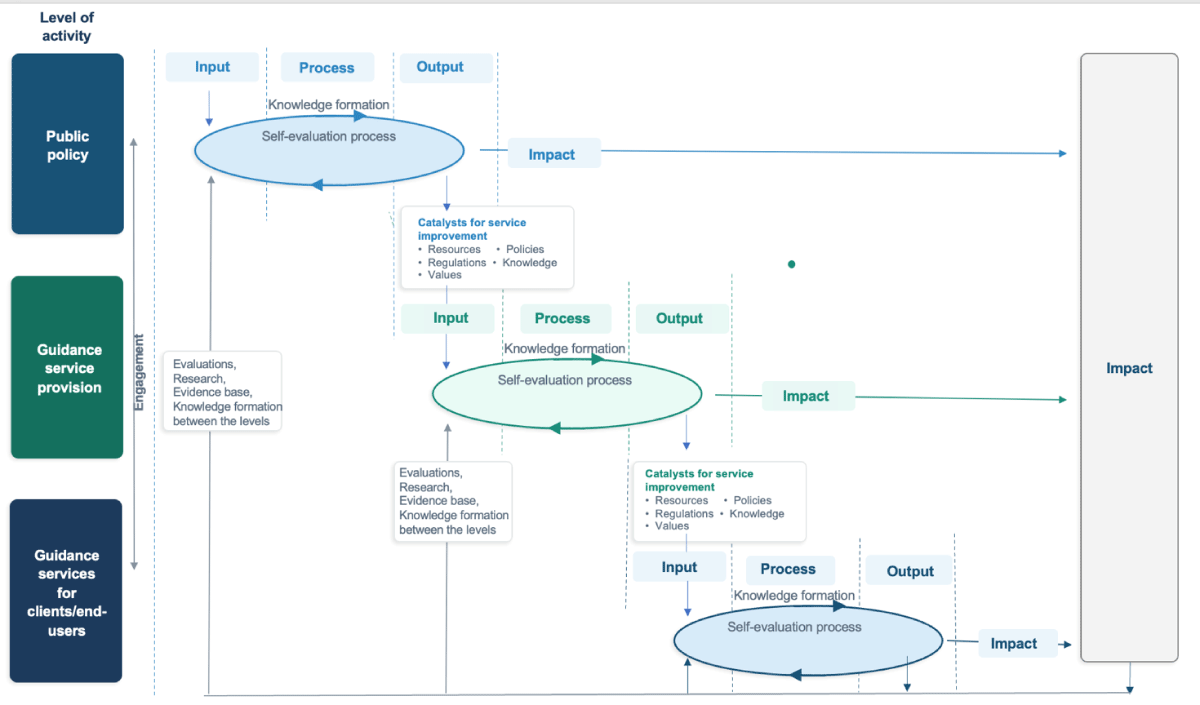
Figure 1
Systemic conceptualisation of the lifelong guidance and monitoring framework.
At each level, the assessment frame is structured across four dimensions: inputs (resources, strategies, and preconditions), processes (service design, collaboration, and implementation), outputs (service reach, accessibility and quality indicators) and impact (client outcomes, system effects and long-term change).
Development of the systemic monitoring framework for the Finnish Lifelong Guidance Strategy proceeded in two phases. In Phase I, the strategy’s six focal areas and 19 sub-goals were systematically analysed across the three systemic levels (policy, organisational, and service delivery) and the four evaluative dimensions (inputs, processes, outputs and impact). The basic model underlying the development of meta-criteria and indicators for each sub-objective is presented in detail in Kettunen et al. (2026). This analysis produced 285 metacriteria and indicators—descriptive statements specifying conditions, processes, and expected outcomes at each level for each strategic goal. However, a framework of this scope proved too extensive for direct operationalisation at current operating environment. Consequently, in Phase II, the metacriteria were distilled into three concise Likert-scale surveys (Kettunen et al., 2026) aligned with the objectives of Lifelong Guidance Strategy (Finnish Government, 2020; Ministry of Economic Affairs and Employment, 2024). The selection of items from the larger pool of metacriteria followed established indicator-selection logic favouring items that are specific, measurable, achievable, relevant and timely, as well as commonly applicable across guidance systems (Doran, 1981). Each survey was tailored to its respective respondent group while maintaining alignment with the shared framework. This condensation was guided by two principles: first, that each item should be understandable to its target respondents without requiring specialist knowledge of the strategy document; and second, that each question for every level of each survey should be comprehensive enough to cover the strategy’s six focal areas while remaining feasible in terms of administration.
The first survey targets policymakers, senior officials, and strategic leaders. Its 17 items assess whether national frameworks establish the necessary preconditions for effective guidance provision, addressing cross-sectoral coordination, resource allocation, digital service development, competence frameworks, ethical standards, and monitoring arrangements. The final item requests a global assessment of whether public policy adequately supports strategy implementation in accordance with the jointly defined outcomes of guidance services.
The second survey is directed at service providers, organisational managers, and development coordinators. Its 18 items examine how strategic intentions translate into operational practice: how services are organised, how staff competence is developed, how multi-professional collaboration functions, how digital tools are integrated into guidance delivery and how organisations participate in regional networking and monitoring activities.
The third survey captures the perspective of service users, students, jobseekers, and individuals accessing guidance across the lifespan. Its 19 items assess whether services are accessible, timely, and responsive to individual needs; whether digital services are usable and supported; whether guidance helps users acquire career management skills and whether services are perceived as ethical and equitable. This provides insights into whether strategic and organisational efforts result in meaningful outcomes for service users.
The three surveys are organised around a shared thematic framework. Each theme, derived from the strategy’s six focal areas, is represented at all three levels through wording adapted to the respective respondent group. Each item is rated on a 1–5 Likert scale, with an additional “not applicable / cannot assess” option. This design enables the same substantive issue to be examined from policy, organisational, and service user perspectives. For example, the digital theme is posed at the policy level as “Developing the digital service package is a shared goal across administrative sectors,” at the organisational level as “Our guidance staff have up-to-date digital competence,” and at the client level as “Digital guidance services are easy to find and use.” Similarly, the lifelong career management skills theme runs from whether national policy supports acquisition of such skills at all ages, through whether organisations make this a central part of their services, to whether clients report that their own skills and understanding of their options have grown. The complete item sets and the underlying 285 metacriteria and indicators are published in full in Kettunen et al. (2026).
Flexible Application
The framework is intended to support flexible application, provided that the instruments have first been trialled and validated. Because all items derive from the same strategy-based metacriteria, individual themes, specific sub-goals, or even single items can be extracted and used independently while retaining their connection to the overarching strategic framework. The surveys can be administered as a comprehensive assessment, simultaneously providing a full picture of strategy implementation across all three levels. A theme-based deepening allows stakeholders to investigate specific sub-goals, such as digital service development or ethical practice, across the three levels. Level-specific assessment enables a single survey to be deployed when only one perspective is needed. Cross-level comparison on the same theme reveals the alignment of or discrepancies between what is strategically intended by policymakers, organisationally implemented by service providers, and experientially received by clients. Additionally, the framework supports regional and organisational self-assessment. Regions can adapt the instruments to their local context, selecting items or themes that correspond to regional development priorities while maintaining comparability with national data. Similarly, individual organisations can use selected items to benchmark their practices against the national strategic framework, identify areas for development and track their own progress over time. This mode strengthens local ownership of monitoring by enabling organisations to generate data that are immediately applicable to their own development while simultaneously contributing to the national evidence base. Time-series monitoring and development assessment becomes possible when the same instruments are administered at regular intervals. Because the survey items are anchored to the national strategy’s sub-goals, repeated administration produces longitudinal data that can reveal trends, track improvements and identify persistent challenges across the guidance system. Time-series data enable policymakers and service providers to assess not only the current state of strategy implementation but also the direction and pace of change as well as to evaluate whether policy interventions or organisational reforms are having their intended effects.
Because all the items in framework are grounded in the national strategy’s metacriteria, they can also be incorporated into existing quality assurance mechanisms, organisational self-evaluation processes, accreditation procedures, or client feedback systems without losing their connection to the strategic monitoring framework. Individual items or thematic clusters can be embedded into broader surveys or evaluation tools used by educational institutions, employment services, or regional development agencies. This interoperability ensures that the monitoring framework does not function as an isolated instrument; rather, it can be woven into the fabric of existing governance and quality assurance practices across sectors.
Discussion
This article describes the development of a systemic monitoring framework for Lifelong Guidance Strategy in Finland. By linking national policy, service organisation, and client experience through a shared evaluative structure, it addresses a persistent gap, identified both in Finland (Valtiontalouden tarkastusvirasto, 2015) and at the European and international level (e.g. Barnes et al., 2020; Cedefop, 2022; Kadletz et al., 2021; Kettunen et al., 2025), between the systemic character of guidance systems and the fragmented nature of existing monitoring approaches. The three-level model enables monitoring not only of whether services meet quality expectations but also whether the Lifelong Guidance Strategy and related policy provides adequate conditions for effective service delivery.
The theoretical model’s bidirectional logic carries particular significance when translated into monitoring practice. Rather than merely serving top-down accountability, the framework channels information about how policies are experienced at the service and client levels upward. Where client-level results point to unmet needs or service gaps, this signals where organisational or policy adjustments are needed. Service providers responses reporting weaknesses in strategic frameworks or in enabling conditions, provides input for policy development. This approach resonates with calls for monitoring systems that serve not only accountability but also continuous quality improvement and policy learning (Cedefop, 2023a; ELGPN, 2015; OECD, 2004). Meaningful measurement and feedback mechanisms function as the cornerstones of successful systems change (OECD, 2017).
The framework takes the strategic goals of Finland’s Lifelong Guidance Strategy as its given reference point. It is designed to monitor whether those goals are being realised across levels, not to adjudicate whether the goals themselves are well-founded. This delimitation is intentional. The framework’s bidirectional logic enables evidence from implementation and user experience to be fed back into policy review, thereby identifying gaps between strategic intentions and practice, as well as tensions between intended and experienced provision. However, the renewal, reframing, or contestation of the strategic goals themselves remains a task for the strategy process.
For the Nordic context, the presented approach offers a concrete model for addressing a shared challenge. All Nordic countries offer publicly funded guidance services operating across multiple sectors, but comprehensive monitoring remains still limited (e.g. Haug et al., 2020; Thomsen, 2014). The design principles underlying the Finnish framework are broadly applicable: systemic conceptualisation, criteria anchored in national strategy, thematic alignment across policy, organisational and client levels and flexibility in how the monitoring tools can be used. The framework does not prescribe particular governance structures but provides a method for translating any country’s strategic priorities into a coherent monitoring architecture. Countries with national guidance strategies could apply the same metacriteria methodology, systematically mapping their own goals across activity levels and evaluation dimensions, to develop monitoring instruments that fit their institutional context and information needs.
Limitations should be noted. The framework has been developed for the Finnish context and has not yet been implemented at scale or undergone validation. Future research is needed to establish the reliability and discriminant validity, compare response patterns across respondent groups and sectors, and examine whether the results are sufficiently actionable. In addition, because the Likert-scale format captures perceived rather than objective conditions, supplementary qualitative or register-based data may be needed for a comprehensive picture of the guidance system.
Conclusion
Finland’s three-level monitoring framework (Kettunen et al., 2026) is developed to provide a systematic and structured way of assessing the current national Lifelong Guidance Strategy’s implementation across the policy, guidance provision and client levels. Grounded in the national strategy’s six focal areas and 19 sub-goals and aligned with the European discourse on monitoring standards, it addresses the documented need for instruments that extend monitoring beyond the client level to encompass the organisational and policy dimensions that shape service quality. The framework’s flexible structure is designed to support both comprehensive national assessment and more focused regional and local application. Although developed in the Finnish context, the framework’s core design principles are transferable and can support development of stronger evidence-informed guidance services in the Nordic countries and beyond.