
Introduction
Although transnational migration can be interpreted in various ways, such as a necessity, an opportunity or a challenge, it always gets described as impacting individuals and societies (Alfred, 2015). Multifaceted changes characterise the transitions from one context, where individuals are established, to another. Encountering a new environment involves engaging with the culture, values, norms, language, and structures in the host society, which challenges individuals’ identities, prior knowledge, and understanding. Thus, learning becomes an integral and unavoidable part of migrant daily life and migration can be viewed through the lens of learning (Kloubert & Hoggan, 2021; Morrice, 2013).
Moreover, the transition processes of adult migrants can largely depend on the structural opportunities in the host country (Söhn, 2016). These structural opportunities are created by the national integration measures (e.g., recognition of previous knowledge and qualifications, access to the labour market, educational opportunities, etc.) and significantly define the lives and career transitions of adult migrants. However, migration literature highlights that migrants often experience varied structural barriers, including the devaluation of prior qualifications and work experience, deskilling, long-term unemployment, and discrimination (Adversario, 2021; Kloubert & Hoggan, 2021; Liu & Guo, 2021; Söhn, 2016; Zikic & Klehe, 2021). Faced with structural barriers, migrants often resort to attending educational programmes in hopes of better career prospects. Once within the educational system, migrants gain access to career guidance (CG) support, which may mediate their transitions into the new social and professional environment of the host country (Bimrose & McNair, 2011; Fejes et al., 2022).
An important stakeholder in facilitating migrants’ learning in transitions is the adult education system in the host country. At the same time, transnational migration affects this system, too. The movement of people across national borders results in growing diversity in education and requires new approaches that meet adult migrant learners’ needs (Alfred, 2015; Kloubert & Hoggan, 2021; Sprung, 2013). Advancing globalisation drives changes in adult education, resulting in a need for more research exploring the role of professional practices in adult education. In the context of international migration, the main actor in adult education in Sweden is municipal adult education (MAE).
Career guidance as a part of adult migrants’ learning processes
CG is an established part of MAE and should, together with other actors, play a significant role in guiding and supporting migrants through their life and career transitions (Sundelin & Hertzberg, 2022). Research on CG for migrants in the Swedish context (Hertzberg, 2017, 2025; Linde et al., 2021; Munhall & Hertzberg, 2026) demonstrates insights on CG for adolescents and young adults with migrant experiences. For instance, CG for adolescent and young adult migrants is addressed in relation to recognition (Hertzberg, 2017) and social inclusion (Hertzberg, 2025). As per Linde et al. (2021), career counsellors (CCs) must deliver high-stakes counselling to asylum-seeking youth with tight matching demands to the labour market. Munhall and Hertzberg (2026) revealed a disjuncture between policy ideals and young migrants’ lived experiences and the risk of undermining the inclusive potential of CG. Swedish research on CG for migrants highlights a field of tensions between ideals and experienced practices, specifically concerning the target group of adolescent and young adult migrants. Nevertheless, it remains unclear whether and how CG is focused and considered in Swedish MAE research related to adult migrants’ learning throughout transitions.
In the context of our research, we start with the idea of CG being a part of a learning process. In the Nordic countries, arguments have been raised to move beyond merely educational and vocational choice and decision-making to include and emphasise aspects of learning in CG practice (Bakke & Hooley, 2022; Bergmo-Prvulovic, 2022; Hooley et al., 2018; Skovhus & Thomsen, 2020). Hooley et al. (2018) identified the learning process as a central part of CG:
Career guidance can take a wide range of forms and draws on diverse theoretical traditions. But at its heart it is a purposeful learning opportunity which supports individuals and groups to consider and reconsider work, leisure and learning in the light of new information and experiences and to take both individual and collective action as a result of this. (p. 20)
According to Kekki (2022), when meeting immigrants, CCs direct conversations towards decisions related to choices of vocation or education. Although migrants might benefit from career sessions that focus on decision-making, it would be advantageous for CCs to embrace the role of career educators, which includes facilitating, connecting, instructing, and training to support both groups and individuals in their learning and careers (Bakke & Hooley, 2022). Learning that centres on migrants’ transitions in public debates and policy often emphasises learning language skills and the need for migrants to educate themselves towards labour market needs along with employability discourses (Arbetsmarknadsdepartementet, 2024, p. 16). Despite the increased need for new holistic approaches to meeting the needs of adult learners (Bergmo-Prvulovic, 2022), specifically adult migrant learners (Kloubert & Hoggan, 2021), it is unclear whether these aspects have been considered in the context of MAE research over the past decade.
When viewed as a learning opportunity, CG can effectively address migrants’ multifaceted learning needs as they navigate complex life and career transitions. Additionally, adopting a holistic learning perspective could be beneficial for CG practices to address migration-specific issues in the context of adult education. One compelling argument for this approach might be that adult migrant learners frequently undergo ‘identity crises’ (Zikic & Richardson, 2016, p. 163) and ‘identity reconstruction’, where learning
not only involves epistemological processes of changing ways of thinking and changes how the world is perceived, but it can also involve a more profound ontological process where individuals have to adjust their sense of who they are and what they can be in the world. (Morrice, 2013, p. 267)
It is also essential to acknowledge that adult migrants’ learning can engage affective and cognitive aspects (Webb, 2017), defining individuals’ ability to utilise their mental capacities and confront new situations (Jarvis, 2010). Contemporary research indicates that psychological and emotional challenges are frequently an integral part of migrants’ career paths, suggesting that their emotional well-being needs to be supported (Lee et al., 2024). According to the Jarvis (2009) adult learning theory, ‘it is the whole person who learns’ (p. 25), including mind and body, and learning always takes place in a social situation. In the case of migrants, their biographies – what has already been learnt – are connected to a social environment that differs from the social environments in which new experiences occur. This leads to individual perceptions of a divergence between reality and one’s own biography, which results in specific learning needs. CG can facilitate migrants’ learning by creating learning opportunities that include self-reflection and meaning-making (Bergmo-Prvulovic, 2022).
The context of Swedish municipal adult education
Following our starting premise of transitions related to migration as a learning process, we address MAE as a part of the public education system populated by actors, such as adult migrants, CCs, and teachers. Considering the above and the fact that Sweden has experienced a substantial influx of migrants over the last 10 years, it is important to further explore the topics that MAE research has focused on over this period.
MAE is free of charge for residents in Sweden. It responds to the needs of individuals and society by offering a broad range of educational opportunities, including compulsory and upper secondary education, general and vocational courses, adapted education for adults with intellectual disabilities, and Swedish for immigrants (SFI). As a result of immigration and demographic changes, every fifth inhabitant of Sweden was foreign-born in 2024 (SCB, 2025). In 2023, 363 000 participants attended MAE, which is equivalent to 6% of the adult population aged 20–64 in Sweden. Furthermore, MAE attracts diverse participants in terms of age, gender, education, and migration background (Swedish National Agency for Education [SNAE], 2024). According to SNAE (n.d.), 67% of adult learners in Sweden were foreign-born in 2023, compared with 24% in the 2000/2001 academic year. Since two thirds of MAE participants are migrants, all practice and theory contain issues relevant to migration and the integration of migrants.
The past few decades have also seen rapid, neoliberal policy changes in the Swedish public sector and education system, including decentralisation, the introduction of new public management, and an intensified emphasis on individual agency and choice (Lundahl, 2016). Adult education has not been immune from these trends, with changes in organisations and processes as well as the roles of all the actors involved in education and their interrelationships being impacted (Fejes & Holmqvist, 2019; Lundahl, 2016; Lundahl et al., 2013). While all Nordic countries are affected by this trend, Dovemark et al. (2018) and Lundahl (2016) found that Sweden has embraced privatisation and marketisation to a larger extent, justifying the need for closer investigation of the Swedish context.
Given the background above, this study conducts a scoping review to explore what research themes have dominated the past decade and to what extent. Moreover, the study evaluates how migrants are addressed as well as how the role and function of CG emerge in such research. The following two research questions guide our study:
What themes have been addressed in Swedish municipal adult education research in 2014–2023 and how are migrants addressed in such research?
How, and to what extent, is the career guidance role and function for adult migrants addressed in Swedish municipal adult education research between 2014 and 2023?
This study is part of a larger project that aims to generate knowledge and understanding of highly educated migrants’ learning within Swedish MAE.
Methods
As a guideline for carrying out the review, we followed the Joanna Briggs Institute (JBI) methodology for scoping reviews (Peters et al., 2020) and used the PRISMA checklist for reporting (Tricco et al., 2018). First, we drafted a scoping review with assistance from a librarian. The protocol was designed by the research team, representing two research fields: CG counselling, and adult learning and education. The design was based on the preferred reporting items for systematic reviews and meta-analysis protocols (PRISMA-P checklist) (Shamseer et al., 2015). Study eligibility criteria were based on population, concept, and context (PCC) elements to identify research carried out within the context of MAE over the past decade. Regarding the population criteria, we primarily included studies focusing on adult learners aged 20 and older who had participated in MAE courses. Research of interest for the review addressed a group of professionals working in the MAE, such as teachers, principals, and CCs. Regarding the concept criteria, we included studies that emphasised formal education or learning. The exclusion criteria were introduced to filter out studies that addressed post-secondary education, labour market training, and continuing professional development programmes. Our review’s context was the Swedish MAE. Studies that addressed other contexts were included or excluded based on the assessment of their relevance to the study.
Research was selected based on study types, publication status, language in which the study was reported, and years considered. We were primarily interested in empirical studies using quantitative, qualitative, or mixed methods. Moreover, the selection was restricted to peer-reviewed articles published from January 2014 to 21 December 2023 in English or Swedish. The decision to restrict the selection of articles was made due to limited resources, the study’s context, and the intention to provide an overview of the contemporary research in the field.
Information sources, searching procedures, and article selection
Three electronic databases were used to identify articles addressing MAE in a Swedish context: Education Resources Information Center (ERIC) via ProQuest, Scopus, and Web of Science. ERIC is a subject-specific database that provides literature within the educational research field covering subjects of adult education and CG. Both Scopus and Web of Science are broad, multidisciplinary databases that address, inter alia, the social sciences (Booth et al., 2022). These three databases provided access to relevant scholarly literature within adult education with high-quality assessment.
The search strategy was developed in consultation with a university librarian with expertise in systematic review searching. The searching procedure was conducted using the block search strategy based on PCC mnemonic and Boolean operators (OR, AND), phrase search, truncation, and limit functions. Moreover, the searching process was conducted by using free text and thesaurus searching (based on controlled vocabulary for key terms: adults, adult education, inclusive of all narrower terms) as an option provided in the ERIC database. A complete electronic search strategy for the used databases, including the run dates, full search strings, and applied filters, is provided in Appendix 1.
The search results were imported to the reference management software EndNote and thereafter to an artificial intelligence (AI) tool, to organise the records and identify potential duplicates. The authors manually checked the flagged records and removed confirmed duplicates. Screening was also performed manually by the authors. Study selection was conducted in two screening phases. In the first phase, relevant articles were selected based on the reading of titles and abstracts. Applied inclusion and exclusion criteria were predefined during the initial literature review (see Appendix 2). This phase was predominantly conducted by the first author. Articles marked as ‘maybe’ were handled between team members. The research covering MAE as a formal adult education in the Swedish context was included in our research. Based on insight from the first phase, the second phase implied reading the full text and identifying relevant articles for final inclusion. The process of study selection for the scoping review is reported using the PRISMA flow diagram in Figure 1.
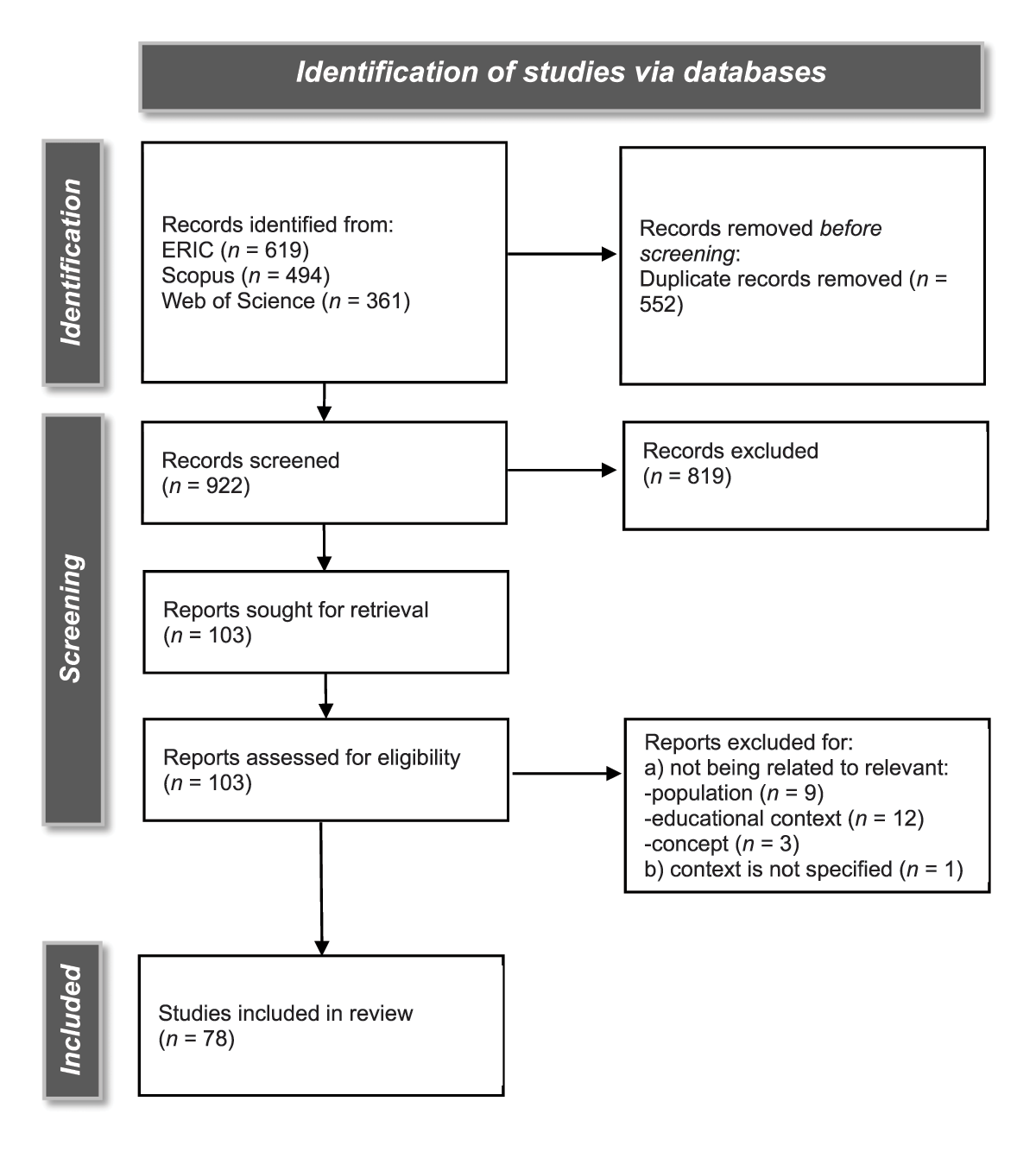
Figure 1
PRISMA flow diagram (adapted from Page et al., 2021).
Selection of sources of evidence
The searches conducted in the electronic database yielded a total of 1,474 results, from which 552 duplicate records were eliminated, resulting in 922 remaining records (Figure 1). Based on the title and abstract analysis, we eliminated 819 papers and evaluated the remaining 103 full-text articles for eligibility. Twenty-five reports were excluded for the following reasons: population (9), educational context (12), concept (3), and unspecified context (1). The data charting process implied ‘charting’ or ‘synthesising and interpreting qualitative data by sifting, charting, and sorting material according to key issues and themes’ (Arksey & O’Malley, 2005, p. 26). The data-charting form was developed by the research team and inconsistencies were addressed in the dialogue. Data was extracted from the Word document in the form of tables. The extracted data included general information about the study (i.e., author[s], year of publication, title) and information on guiding questions towards each article, addressing theme, context, research questions, stakeholders, professionals, student groups, research participants, audience, and CG. This data served as the foundation for the analysis. The final dataset of the 78 reviewed articles resulted in three major themes along with subthemes for each. This specific dataset was used for the scoping review and referenced in this article as an alphanumeric code (A01, A02…) due to the word count limitations of the main body of the article. A detailed list of the reviewed articles is available in Appendix 3.
Results
The scoping review provided a comprehensive picture of the most frequently addressed topics in Swedish MAE research between 2014 and 2023. We identified three broad themes – adults in transitions, classroom practices and teachers’ profession, and governance and organisation of MAE (Figure 2) – and seven subthemes, in which some more frequently and explicitly addressed migrants, while others ambiguously or implicitly addressed the topic. It must be noted that clear delineation is not always possible and that individual articles frequently cross the lines of identified themes and subthemes.
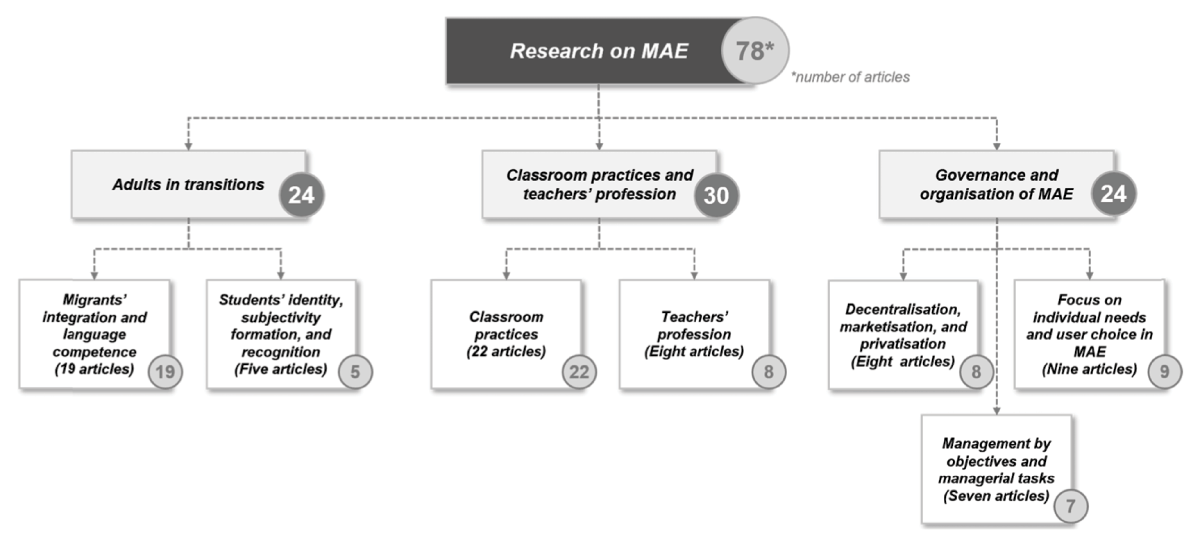
Figure 2
Main themes and subthemes identified in the scoping review.
Adults in transitions
Twenty-four articles (31%) addressed adults in life and career transitions. Nineteen of these articles addressed migrants, including immigrants and refugees; five explored students’ identity, subjectivity formation, and recognition. Migrants were therefore directly addressed in roughly four out of five studies in this theme, within topics of integration and language competence.
Migrants’ integration and language competence
Migration trends have brought new challenges to MAE practice and justified researchers’ increased interest in the field. Nineteen of the reviewed articles focused on migrant population. Of these, 11 emphasised migrants’ integration, while eight were concerned with migrants’ language competence.
Studies that addressed migrants’ integration centred on: opportunities and obstacles in Swedish rural areas for integration in general (A20; A66), especially work integration (A12; A19); the Swedish adult educational system’s influence on work integration (A50) and social inclusion of migrants (A11; A39); migrants’ occupational choices (A26) and job expectations (A61); migrants’ trajectories of social inclusion (A51); and school-to-work transitions (A41). Additionally, most studies focused on migrants and immigrants in general (A26; A39; A51; A61; A66). Other research addressed diverse migrant populations, including newly arrived migrants (A11; A12), highly skilled migrants (A19), refugee women (A20), poorer educated non-Nordic immigrants (A50), and young adults not in education, employment or training, with a significant portion of the participants (one third) being non-European (A41).
Within this theme of migrants as a specific target group, certain studies explored language competence (n = 8) related to Swedish as a second language. The topics of research interest were language learning and use in the workplace when combining language education and work placement (A74), what ‘a competent language user’ means from migrant language learners’ perspective (A68), their experiences of being adult language learners (A03), and their beliefs (A67) and attitudes towards language learning (A62). Furthermore, research explored friendship metaphors in second language writing (A02) as well as mobile technology for language learning (A14; A16). These studies examined these concerns in the context of basic language training: Swedish for immigrants (SFI).
Students’ identity, subjectivity formation, and recognition
The subtheme covering students’ identity, subjectivity formation, and recognition (n = 5) did not directly address migrant population. However, as two thirds of adult learners are migrants, these studies could not be excluded from this context, as they indicated that migrants are a part of the student population. The studies examined challenges related to MAE as an institutional space of importance for student subjectivity formation (A56) and recognition (A70). Additionally, the ways social structures and settings relate to adult education students’ occupational trajectories (A27) have been studied. Research also focuses on aspects of supporting recognition in adult education (A69) and how the combination of working and school life influences the identity formation of students enrolled in a vocational education and training (VET) programme (A37).
Classroom practices and teachers’ profession
The theme classroom practices and teachers’ profession covered 30 articles, represented 38% of the study’s scope, and consisted of two subthemes: classroom practices and teachers’ profession. Classroom practices were covered in 22 articles, of which 14 discussed classroom practices designed to promote migrants’ learning, mostly in the context of Swedish-as-a-second-language classrooms (n = 12) and in VET practices (n = 2). Eight articles emphasised teachers’ profession, with three papers concerning migrant adult learning groups.
Classroom practices
Classroom practices relate to different aspects of activities, interactions, and dynamics in classroom settings, which we grouped into six distinctive topics: teaching methods and designing educational materials; meeting the learning needs of a particular group of learners; strategies in supporting students’ engagement and classroom interaction; social practices and discourses’ impact on language learning classroom practices; integration of work and education; and aspects of teaching and learning in circumstances of breakdown during the pandemic. The largest group contained studies investigating teaching methods and designing educational materials to support migrants in acquiring basic knowledge of the Swedish language. For example, the researched topics were features of Suggestopedia teaching practices (A24); teachers’ pedagogical priorities in multicultural classrooms and contributions of Swedish native teachers and non-native Swedish teachers to learning environments (A36); various communicative resources in teaching grammar (A42); game-based educational materials in multicultural classrooms aiming to foster awareness of cultural differences (A53); and space for multilingualism and multiliteracy in linguistically heterogeneous classroom practices (A52; A76).
Additionally, one study addressed teachers’ design of online educational materials for teaching/learning Swedish as a second language (A15). This research on teaching methods encompassed two studies that, though they did not explicitly address migrants, concerned with comprehending information literacy in self-directed learning (A30) and the application of simulations in vocational education (A54), which are relevant to all students in MAE, including migrants.
Four articles represented the topic of meeting the learning needs of a particular group of learners (A01; A25; A35; A60). A25 examined classroom practices to meet educational needs of migrant learners with no or low educational experience from their home country. Furthermore, A01 studied the learning needs of adults studying mathematics in prison, noting that many students’ first language is not Swedish, thus indicating a migrant background. Moreover, A35 identified the learning needs of adult students with mathematical difficulties, but did not consider students’ backgrounds in the sense of migration. Finally, A60 explored success factors in an alternative study structure for unemployed young adults needing studies or vocational training, addressing learners with difficulties in the Swedish language, among others.
Strategies in supporting students’ engagement and classroom interaction was the next topic found in the research. Two studies focused on students’ engagement and interaction in second language classrooms by investigating the inclusion of multilingual assistance and using students’ first language as learning support (A71) and investigating students’ oral language production (A77). A further study explored students’ engagement in online learning (A13), not specifically addressing a group of migrant learners.
Furthermore, the social practices and discourses impact on language learning classroom practices (A18; A65) topic was covered in this scoping review. In addition, three studies centred on the integration of work and education (A21; A32; A75). Two studies explored the integration of work and education in VET practices in the context of supporting migrants/refugees. The first study provided insight into the integration of learning at work and educational institutions (A21). The second emphasised challenges that teachers face when teaching second language learners in VET (A32). A75 evaluated a partnership programme involving various educational and business stakeholders, aimed at enhancing site-based education.
Lastly, A31 addressed aspects of teaching and learning in circumstances of breakdown during the pandemic. This study did not specifically address the migrant population, leaving the topic implicitly relevant to our study.
Teachers’ profession
This subtheme was derived from eight articles (A05, A06; A10; A22, A23; A33; A38; A64), three of which explicitly related to migrant adult learning groups (A22, A23, A64). Contemporary research of adult education teachers can be categorised into: teachers’ professional identity, teacher experiences, and professional competences and continuing professional development.
Two studies addressed the formation of teachers’ professional identity in the context of Swedish as a second language, exclusively attended by migrant population (A22, A23). The first study focused on social changes and their impact on professional identity, while the second study investigated how this identity is constructed from the perspective of bilingual immigrant teachers.
Teacher experiences were addressed by A64, who highlighted the tensions of second language teachers’ pedagogical alignment with educational practices influenced by neoliberal values. Article 33 addressed teachers’ experiences from the perspective of tensions in teachers’ MAE work.
Finally, the third topic was built up by studies on professional competences and continuing professional development of VET teachers. A05, A06 and A38 emphasised teachers’ professional development concerning their initial occupations. A10 investigated teachers’ perceptions of professional competence and identified key competences. These studies did not explicitly focus on migrants; rather, their subjects might be viewed through the prism of their relevance to the migrant as a learner interacting with a competent teacher.
Governance and organisation of municipal adult education
Twenty-four papers or one third of the literature review’s scope centred on governance and organisation of MAE. The results showed that intensive policy changes and their influence on different aspects of MAE practices have been continuously studied over the last 10 years.
Three subthemes were identified under this theme. The first subtheme included research primarily addressing decentralisation, marketisation, and privatisation (A07, A08, A09; A29; A34; A49; A63; A78); the second one encompassed research about management by objectives and managerial tasks (A44, A45, A46; A48; A59; A72; A73); and the third subtheme combined the studies that focus on individual needs and user choice in MAE (A04; A17; A28; A40; A43; A47; A55; A57; A58). This division into three subthemes was based on the doctrinal components of new public management (Hood, 1991) and its features in Swedish adult education (Alexiadou & Lundahl, 2016).
Under this theme, five articles concerned migrants and their integration within MAE. This can be justified by the research focusing on governance and organisation. We identified two articles within the subtheme of decentralisation, marketisation, and privatisation. One study explored a historical perspective of the organisation of teaching Swedish as a second language (A63) and the other centred on the enactment of market orientation in VET practices and VET’s role in the integration of migrants into the Swedish labour market (A08).
The three remaining articles we extracted from the subtheme focus on individual needs and user choice in MAE explored the policy of individualisation and flexibility (A40) and the implementation of the policies into practice (A58). A55 delineated the historical development of SFI courses, reflecting changes in attitudes on integration and migration throughout time. Even if the purpose of the research or the research questions of the included articles under this theme did not explicitly focus on migrants, they often related to the research topic of migration and integration within the contexts of heterogeneous student population, the role of the MAE in social and labour market integration, the recognition of prior learning in the VET system, and the framework of Swedish as a second language.
Migrants in the context of municipal adult education research
The body of the reviewed MAE literature reveals articles that explicitly address migrants as a population of research interest and those that implicitly include them in the student population. Approximately half the articles included in this scoping review (53%) addressed migrants directly. Although not directly, the remaining articles in the context of Swedish MAE were connected to migrants. Of the 41 studies that addressed migrant issues directly (see inner circle in Figure 3, representing 41 articles, in three main identified themes), 23 studies conducted interviews with migrants as participants in the research, allowing them a voice as a target group.
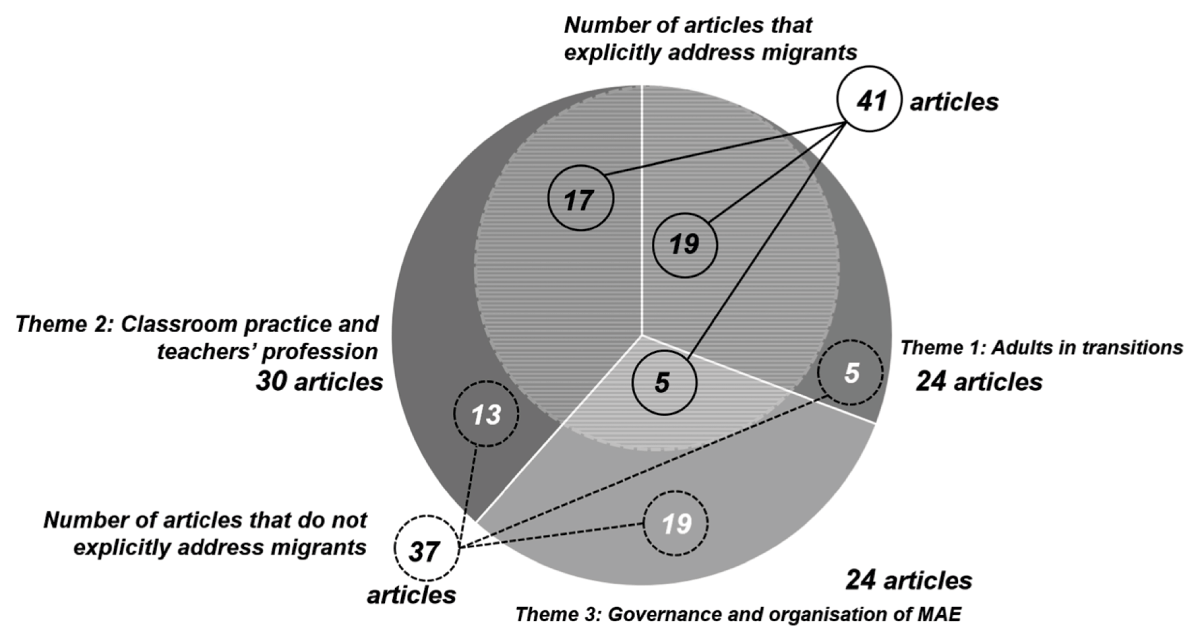
Figure 3
Distribution of studies focusing on migrants in the context of MAE research.
In the first theme, adults in transitions, 19 out of 24 articles centred on migrants (see Figure 3) in the context of migrant integration and acquiring language competences. Migrants were frequently included as research participants in these articles. In the second theme, classroom practices and teachers’ profession, 17 out of 30 articles directly addressed issues of the migrant population through the lenses of classroom dynamics and learning Swedish as a second language. Across these two themes, migrants were explicitly addressed in 36 of 54 articles. The last theme, governance and organisation of MAE, had minor coverage of the migrant population: five out of 24 articles.
It is worth noting that most of the articles addressed the migrant population in general or implicitly as a part of a larger student population, without distinguishing between different groups with specific circumstances and needs. Only a handful of articles dealt with these specific groups – for example, highly skilled migrants, refugee women, or poorer educated immigrants.
Career guidance for migrants in research on Swedish municipal adult education
Very few studies mentioned CG in research on Swedish MAE. Those that did, did so in a peripheral way and topics were fragmented on multiple angles, providing very little ground for meaningful comparison. The findings indicated that the CG profession and practice within the context of MAE are poorly represented (Figure 4) and insufficiently researched. Of the 78 articles, CG was featured in 10 articles; among these, CCs participated in six studies. The presence of CG could be described in three ‘levels’:
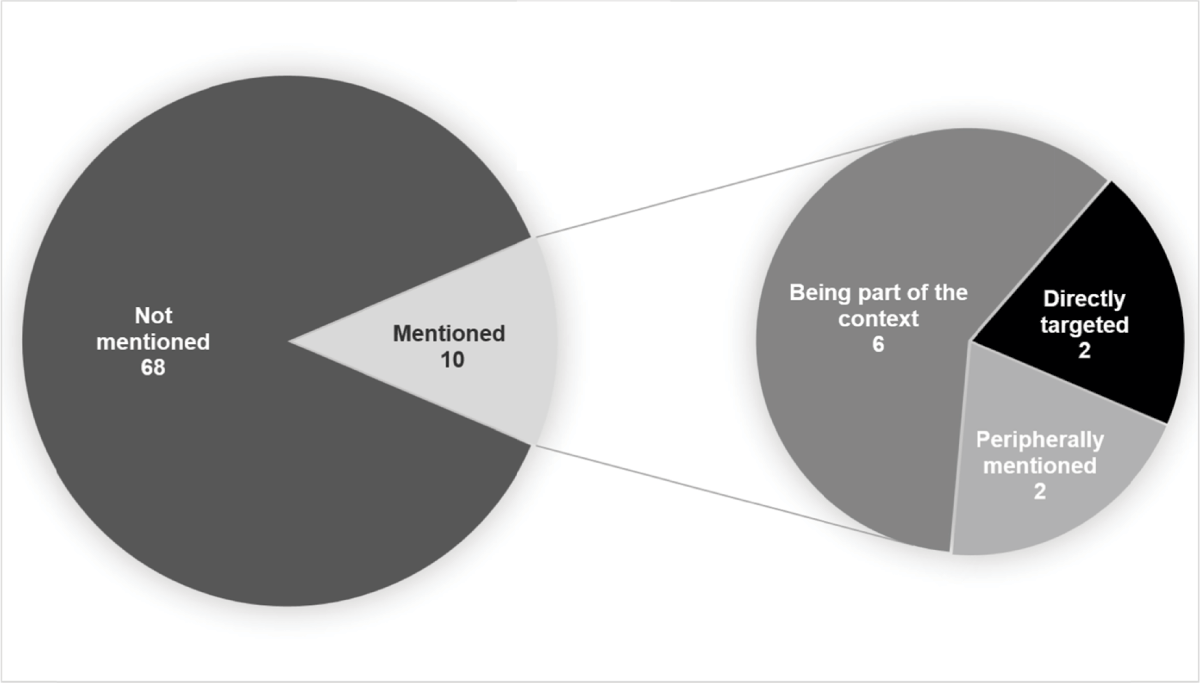
Figure 4
The presence of CG in research on Swedish MAE based on 78 articles reviewed.
Directly targeted CG in research: 2 articles (A09; A59);
CG being part of the context, and thus included as a part of staff or a support system for integration: 6 articles (A19, A20; A40; A41; A47; A66); and
CG peripherally mentioned: 2 articles (A34; A45).
CG was directly addressed in two studies – one study explored policy enactment in CG’s professional practices (A09) and the other focused on quality in CG services (A59). A09, while not explicitly focusing on migrants, highlighted that the role and task of CG in MAE is facing increasing complexity, driven by the heterogeneity of migrants as adult learners. Some studies emphasised CG for diverse migrant groups (A19, A20; A40; A41; A66). These studies were concerned with highly skilled migrants (A19), women refugees (A20), young adults (A40; A41) and immigrants (A66). While CG was particularly not the focus of the studies, it is present and seen as a part of a support system that facilitates the integration of migrants (A19, A20; A66), helping them navigate a complex regulatory environment and educational choices (A41) on their trajectories towards desired employment. According to A40, CCs play an active role in guiding and improving learning in the context of the basic studies of Swedish as a second language. Finally, A47 addresses CCs as actors in organisational issues that pertain to individual needs and user choices in MAE.
Discussion
This study identified three predominant research themes deriving from research on Swedish MAE over the past decade: adults in transitions, classroom practices and teachers’ profession, and governance and organisation of MAE. The results indicate that all themes integrate questions related to adult migrant learners. Migrants are addressed in the MAE area of research, particularly as language learners.
The learning that covers adult migrants’ life domains amid the multifaceted changes such transitions entail (Kloubert & Hoggan, 2021; Morrice, 2013) – namely, challenges related to entering a new environment, culture, values, norms, and structures and struggles with identity and prior knowledge systems – is less emphasised. The reviewed research primarily focuses on the learning that occurs in classroom practice and, as such, is facilitated and supported by teachers. Evidently, teachers’ profession is at the forefront of research in adult education as well as classroom practices as the most visible and logical parts of the process: teaching methods, designing educational materials, responding to diverse learners’ needs, or supporting students’ engagement and interaction. However, the study indicates a lack of research emphasising CG for adult migrants in the context of MAE. It is worth noting that the modest attention to CG in the reviewed research should not be interpreted as indicating that CG is similarly marginal in MAE practices. Future research on adult migrants’ learning would benefit from including career guidance (CG) as a learning supportive practice to enhance its visibility in MAE research.
Changes in the governance and organisation of MAE have attracted interest from researchers in the MAE field. The organisation of CG also faces increasing complexity driven by the transformation (marketisation) of the adult education system, the increased focus on the labour market needs, and the heterogeneity of migrants as adult learners (A09). Our findings indicate that migrants’ learning needs could fade into the background if there is too much focus on adult education based solely on labour market needs. The complex nature of adult migrants’ transition processes, of which learning is an integral part (Kloubert & Hoggan, 2021; Morrice, 2013), is at risk of being reduced to mere language learning and the choice of formal educational activities aimed at meeting labour market needs. According to A20, the labour market’s circumstances and demands tend to direct migrants towards jobs with shortages, resulting in reduced agency (which is part of what CCs strive to facilitate through learning) and career mobility for certain migrant groups. Furthermore, CG is caught in the tension between conflicting interests of different actors concerned with integration (Hertzberg, 2025; Kekki, 2022; Linde et al., 2021), which reduces career counsellors’ ability to facilitate the learning processes of adults in transitions.
However, since no study explicitly addresses CG’s role in facilitating adult migrants’ learning, there is a risk of missing the significant potential that CG support can bring to mediate migrants’ transitions towards social inclusion, as highlighted in CG research (Bimrose & McNair, 2011; Fejes et al., 2022; Sundelin & Hertzberg, 2022). Therefore, the answers to how and to what extent CGs role and function for adult migrants are addressed in Swedish MAE between 2014 and 2023 remain elusive and dependent on the interpretation of the six studies that partly address the topic of CG for migrants in the context of MAE (A09; A19, A20; A40; A41; A66). The result is remarkable, especially since both the research and practice fields of MAE and CG are highly concerned with adult migrants in career transitions. Evidently, MAE research may benefit from previous research on CG in the context of young migrants in Sweden. The studies highlight young migrants in relation to recognition, social inclusion, and tensions between CG supporting individual autonomy and policy demands towards matching the labour market (see Hertzberg, 2017, 2025; Linde et al., 2021; Munhall & Hertzberg, 2026).
Furthermore, the results indicate that the increasingly addressed importance of learning in the process of career transitions highlighted by many researchers in the CG field (Bakke & Hooley, 2022; Bergmo-Prvulovic, 2022; Hooley et al., 2018; Skovhus & Thomsen, 2020) seems to be missing in covered research. As adults and adult migrants may frequently undergo identity crises, identity reconstruction, and even experience identity loss in transitions (Bergmo-Prvulovic, 2022; Jarvis, 2009; Morrice, 2013; Zikic & Richardson, 2016), support for learning throughout such transitional processes seems to be an area for development (Bergmo-Prvulovic, 2022). There are valid reasons to claim that adult learning must be understood from an interdisciplinary perspective. Given the indicated gap between the research fields of MAE and CG regarding migrants’ learning, this study highlights how crucial it is to work across boundaries to address adult migrant learning. This indicates the importance of developing an overlapping research agenda between the two research fields: adult learning and CG, with a particular focus on MAE as the context and adult migrants as the group of interest.
Such an integrated research agenda may stimulate interprofessional knowledge development between all professions involved in the MAE in a common mission to support migrants’ transitions, building a common awareness of the complexity of migrants’ learning beyond mere language acquisition. Moreover, all professions involved in MAE (i.e., teachers and CCs) support migrants’ learning. However, it is not visible in the covered research that these professions benefit from each other. Migrants’ learning may benefit from a more organised and coordinated way across professions, with a focus on building a common understanding of their learning needs. Additionally, such an interdisciplinary approach to learning must be integrated into steering policy documents regulating the MAE context, including how the missions and tasks of the involved professions are articulated.
Migrants and their struggles are not new or unknown to the Swedish MAE or society. CG has a professional basis for developing support that may facilitate migrants’ learning processes, support them in navigating their disjuncture experiences, and address their identity struggles through self-reflection and meaning-making. However, in covered research, CG support for migrants’ learning, as suggested by Bakke and Hooley (2022), Bergmo-Prvulovic (2022), Hooley et al. (2018), and Skovhus and Thomsen (2020), appears at the margin within the context of MAE research.
Limitations
To make this study feasible, we applied several restrictions that are relevant to consider when interpreting its findings. The study focuses exclusively on research that addresses municipal adult education in Sweden, thereby limiting its scope to this specific context. Consequently, it may restrict the transferability of the study’s findings to other geographical and educational contexts. Furthermore, the search for relevant evidence relied on sources from three electronic databases, leaving the possibility that several relevant studies from other resources are missing. Regarding the search terms used, the titles of the career guidance professionals vary—which may have influenced the number of hits. Additionally, in terms of the search strategy, we applied limitations such as a ten-year period, only included peer-reviewed articles and articles published solely in English and Swedish. The screening process was predominantly carried out by the first author, which entails the risk of subjective decisions. However, to ensure the quality of the procedures there was continuous consultation within the research team.
Conclusion
This study indicates that CG and adult learning and education seem separated from each other’s knowledge areas in the context of Swedish MAE research. Moreover, the findings show that MAE research over the past decade mostly centres on migrants’ language skills learning and classroom practices related to Swedish as a second language. This focus on migrants’ language learning illustrates that language is an important aspect in migrants’ integration that is in line with policy measures (Government of Sweden, 2024). Based on the study’s results, we suggest a cross-boundary approach and a holistic view on adult migrants’ learning throughout their transitional processes. Finally, we argue that the separated research fields’ knowledge areas would benefit from being brought together for new approaches towards meeting migrant learners’ needs. An additional study that focuses on the research field of CG, on how adult migrants and the role of function of CG is expressed in relation to adult migrants’ transitions, would add complementary perspectives to this study.
Additional Files
The additional files for this article can be found as follows:
Appendix 1
The Block Search Strategy in Databases: ERIC, Scopus, and Web of Science. DOI: https://doi.org/10.16993/njtcg.115.s1
Appendix 2
Inclusion and Exclusion Criteria According to PCC (Population, Concept, Context). DOI: https://doi.org/10.16993/njtcg.115.s2
Appendix 3
The final dataset, i.e. articles analysed in this scoping review. DOI: https://doi.org/10.16993/njtcg.115.s3