
Introduction
Career guidance as an institutionalized pedagogical practice is loaded with aspirations and goals to support individuals in various transitions in education and the labor market. However, these social and political objectives are often formulated and set without definition of what this guidance is in practice and how it should be implemented (Hooley et al., 2018; Kekki, 2024). This has been witnessed in the largest Finnish educational reform in recent decades, namely, compulsory education’s extension to age 18 (Varjo, 2024). When compulsory education was extended to cover not only basic education but also part of upper secondary, schools were made responsible for providing additional guidance during the final years of lower secondary education to pupils whose path to further education was unclear or hampered by obstacles. This statutory guidance is referred to as ‘intensified personal guidance counseling’ (hereafter TEHO), which aims to support young people in their transition to upper secondary education and strengthen their attachment to the education and labor market (Niemi, 2022). The amendment is also intended to strengthen the systematic nature and continuity of guidance and cooperation in schools. However, it remains an open question how this guidance should be implemented in practice.
In this article, we explore the perspectives of guidance counselors (hereafter counselors) on TEHO and how they have managed its implementation. The data for this article originate from a project titled “Intensified personalized guidance counseling—work processes, encounters and pupils’ agency, (TEHEKOP)”, in which we use various qualitative methods and data sources (including interviews and observations) to study how TEHO has been put into practice. For the present analysis, we used interview data from counselors (N = 35) in lower secondary schools. We examined whom TEHO is targeted to and how it is implemented, according to the counselors. In addition, we considered how socio-political objectives are reflected in the ways in which counselors describe their work’s tools and objectives.
The focus on guidance as a work activity and a process is justified by the fact that despite its strong legal and political status, there is little research on school guidance activities and practices, in Finland or elsewhere (e.g., Romito, 2019; Souto 2020), especially that exploring guidance as an activity (e.g., Rosenblad et al., 2022; Vehviläinen & Souto 2021). More attention has been given to how young people’s educational choices and paths are constructed (e.g., Kalalahti et al., 2020; Tolonen & Aapola-Kari, 2022) and to the educational policy objectives and documents framing guidance counseling (e.g., Kettunen, 2024; Varjo et al., 2022). Our study approaches guidance with activity theory and object-oriented guidance activity as its theoretical lenses (Engeström, 2001; Leiman, 2015; Sannino & Engeström, 2018; Vehviläinen, 2021; Ylimaula & Toiviainen, 2022). This approach provides conceptual tools not only for object-oriented analysis of guidance but also for how guidance can be developed in schools. We begin by discussing the role of career guidance in balancing pupils’ interests with education policy, followed by an outline of our theoretical framework. We then present our data and methodological considerations. Finally, we summarize our key findings and interpretations.
Career guidance negotiating the tensions between individual and institutional goals
Career guidance in post-industrial societies is based on assumptions of, first, participation in paid labor and training as the central means of participation in society, and, second, the individual life being a self-realization project based on choice and individual responsibility (Giddens, 1991). Individuals can and must build themselves through their choices, actions, and paths in the work and educational market. Experts and professionals possess power in guiding individuals in navigating these life choices (Haug et al., 2020). The ‘imperative of choice’ is a major means of governance in our societies, while guidance is treated as a subjective right of citizens (Romito, 2019; Varjo et al., 2020).
In Finland, as well as the other Nordic countries, career guidance is embedded in basic, secondary, and higher education. Finnish guidance counseling was introduced to the school system in the 1970s by the welfare state, along with academic training for counselors (e.g. Haug et al., 2020; Merimaa, 2018; Toni & Vuorinen, 2020). In the following decades, guidance counseling became firmly established as part of the national school-based welfare project, supporting individual decision-making and providing information in classroom settings. Its methods were rooted in schoolwork, as well as in the professional role of the counselor as part of school staff, and in the aim of holistic guidance, which emphasizes the importance of supporting pupils’ psychosocial well-being alongside educational decision-making (Kettunen et al., 2020; Van Esbroeck, 2008). Guidance counseling in the 2000s has adopted a more work life–oriented and overarching frame, preparing individuals to navigate changing work. Thus, the context for TEHO activities is shaped by policy aims that blend the more traditional equity goals of the welfare state with neoliberal objectives of preparing pupils to cope with the economy. (Varjo et al., 2020).
Recent studies have shown that although guidance counseling as a pedagogical institutional practice pursues various objectives—including the holistic promotion of human growth—these objectives are often overshadowed by the neoliberal goal of coaching individuals to identify, develop, and align their skills with the demands of the education and labor market (Hooley et al., 2018; Romito, 2019; Varjo et al., 2020). This tendency has been criticized for placing too much responsibility on the individual while ignoring societal circumstances and inequalities—for example, unequal societal positions that shape individuals’ and groups’ possibilities, transitions, and life courses. Discussion has also called for a stronger social emphasis in guidance practices, one taking into account the meaningful others and communities surrounding individuals.
In the routine practices and processes of guidance work, these various political aims require practitioners to ‘balance’ not only multiple but often conflicting goals (Rosenblad et al., 2022; Watts & Sultana, 2004). The counselor’s task is to help pupils manage their studies and plan for the future and to ensure that every pupil successfully transitions to upper secondary education. On the one hand, the counselor represents the school institution and its educational policy demands, and on the other, the counselor is ‘on the pupils’ side.’ Counselors are meant to support pupils holistically, identifying issues that are relevant for them in order to strengthen their agency in transitions during their studies and future careers. Thus, we may say guidance counseling in schools entails pedagogy, control, and evaluation (Vehviläinen 2014). In this study, we were interested in how counselors negotiate and balance various aims while implementing the new TEHO form of guidance.
Theoretical standpoints
We view guidance as a family of practices. All types of guidance have a series of institutional encounters at their core and are aimed at enhancing a process in the pupil’s/client’s life that is meaningful to them. These processes typically involve learning, growth, or work- or life-planning elements. Since the practice of guidance is targeted at processes that are meaningful to the client (or pupil in our case), the practitioner should, according to the professional norm, form a collaborative and trusting working relationship with them. Furthermore, guidance practices are characterized by the professional norm of working in ways that strengthen the client’s or pupil’s agency, for instance, by expanding their potential to act and take a subject position in the issue being addressed. Achieving a trusting guidance relationship and formulating shared aims are accomplishments in themselves that cannot be taken for granted (Vehviläinen, 2021).
Our analysis is grounded in viewing guidance as an object-oriented guidance activity (Leiman, 2015) and, more specifically, the activity theoretical notions of human activity as an intentional, collective, object-oriented, historically changing, and meaningful effort. In cultural–historical activity theory (or CHAT), human work activities are understood as taking place in activity systems (such as a school), where various participants (‘subjects’) engage in joint efforts to work on a problem area or target, and to proceed toward a shared goal that renders their activities meaningful. The ‘object’ refers to participants’ various understandings of this problem area or target and to the core aim that gives meaning to their efforts (e.g. Engeström, 2001; Sannino & Engeström, 2018; Vehviläinen, 2021; Ylimaula & Toiviainen, 2022). Activity systems are typically depicted with a triangular representation (see Figure 1), where the subjects are shown working on the object and their actions are directed toward a goal, which is achieved with the help of, and mediated by, various tools. Tools should be understood not only as means to operate on an object but as mediators that partake in shaping how we see the object and make the object available to us. These tools can be material or nonmaterial—concepts and interactional practices are central tools in the working environments in question. For instance, tests, tasks, and exercises are tools that are typically used in career guidance, but theoretical concepts, for instance career theoretical concepts, can also be viewed as mediating tools. It is essential in learning a profession to become habituated in using such tools together with others, and it is a collective task in workplaces to agree on, modify, and develop these tools. As stated, the national TEHO implementation did not specify or regulate which tools schools should use; instead, this was left to their discretion.
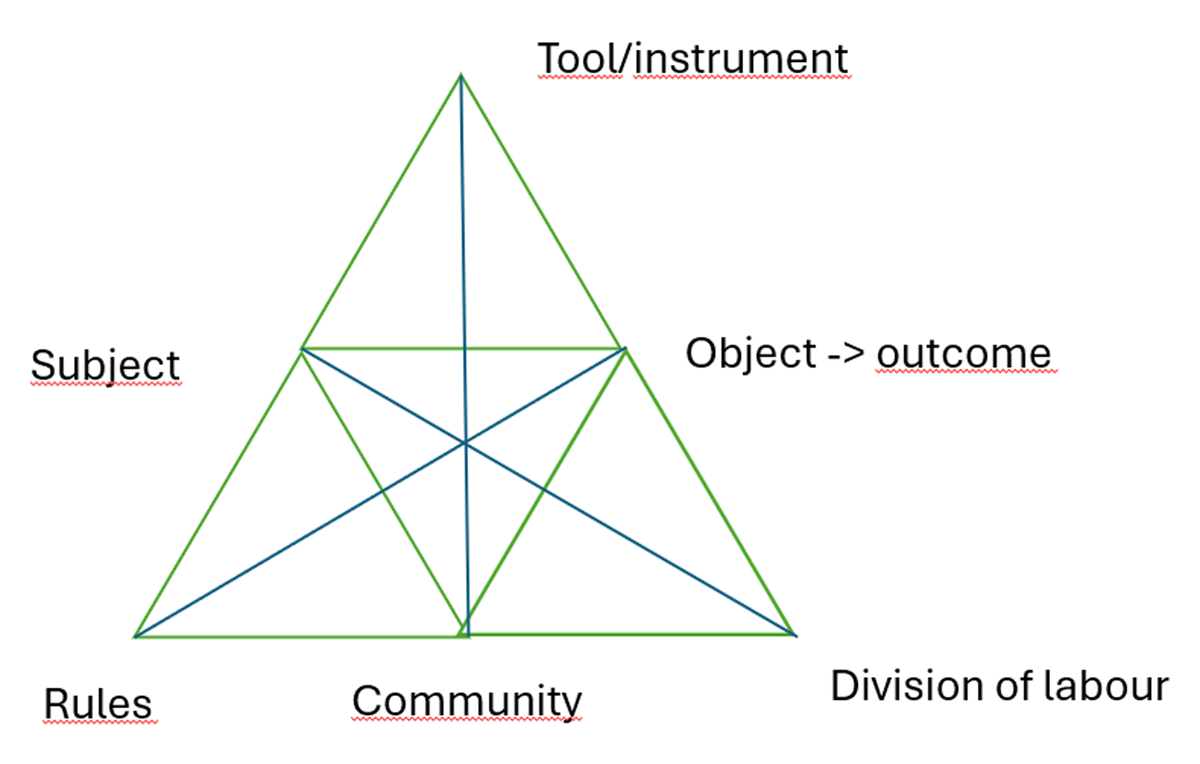
Figure 1
The activity system model (adapted from Engeström, 2001).
Our analysis focused on how counselors understand the object of their TEHO activity. Any human activity is influenced greatly by how its object is perceived. How we understand the object of the activity will inform how we work with or on it, what tools we need, who is entitled to participate in the work, and what is and is not possible. Furthermore, participants have a dynamic relationship with the object. For instance, we may perceive the object of guidance counseling as ensuring that each pupil makes the transition to upper secondary education, that is, they apply to a higher level school. How pupils carry out school-going and decision-making—what they do, whom they engage with, and their perceived possibilities and necessities—will greatly influence guidance activities and sometimes pose problems for practitioners (Engeström, 2001; Leiman, 2015). Importantly, in fields such as education and guidance, practitioners’ work is targeted at objects that not only respond to their activities but are also influenced by pupils’ meaning-making. As the objects of guidance work are processes taking place in the pupils’ lives and ‘owned’ by them, practitioners must collaborate with pupils and engage them in the process as its subjects. To put it concisely, practitioners should not perform guidance ‘on’ the pupils but with them.
Participants in an activity system may differ in how they understand the object of their work. For example, while counselors often stress that young people should make choices according to their preferences, it can be most relevant from a pupil’s perspective to follow the choices of their friends or guardians (Tolonen & Aapola-Kari, 2022). Sometimes, differences in understanding here cause disturbances in the work being achieved and in cooperation between practitioners. In CHAT, these disturbances are classified in detail and treated as potential triggers for collective learning and work development (Sannino & Engeström, 2018).
In our analysis, we are first and foremost interested in describing qualitative differences in the perceived object of TEHO. We also consider how the perceived object is connected to the tools chosen for use in guidance and to the cooperation arrangements between counselors, pupils’ parents/guardians, and other professionals at schools. The activity system model is typically extended to include the rules and norms, community, and division of labor (See Figure 1).
The ‘community’ in our study refers to pupils and their families/guardians, teachers, the principal, and other staff in and outside the school (e.g., youth workers). The key division of labor in our context was based on the differentiated tasks of teachers and counselors, where the latter were only partly involved in curriculum-based teaching and mainly involved in guidance tasks. This applied despite the expectation that the entire school should actively support the pupils’ school paths. The ‘rules’ that govern the TEHO process require that each pupil transition to upper secondary education by choosing and applying for this education, and those ‘in need’ receive TEHO to help them in the transition. What was left open in the reform is how schools should decide who is entitled to TEHO, what key issues should be worked on, how the process should be carried out, what tools should be used, and who should be involved. In that open context, the activity theory approach provides a useful way to analyze how practitioners put TEHO into practice.
This study is the first analysis of the perceived object of TEHO guidance in Finland. Thus, our analysis is exploratory and a first attempt at analyzing TEHO as a professional guidance activity. Ascertaining how counselors perceive the object of their work is the first step in understanding how lower secondary schools implement TEHO in the abovementioned conditions. In this article, we ask the following: What is the perceived object of TEHO from counselors’ perspectives, and how does this relate to the choice of tools and arrangements of cooperation—who are involved in TEHO guidance, and how? Answering these questions will improve our understanding of how TEHO guidance is embedded in work processes in the school community.
Guidance and counseling in Finnish lower secondary education
The translation by the Finnish National Agency for Education of the TEHO practice is ‘guidance counselling.’ We view this practice under the umbrella term of ‘career guidance,’ which in the Nordic countries refers to a service that is a mandatory part of comprehensive, secondary, and higher education. Among various guidance and counseling occupations, career guidance is the most professionalized one in the Finnish context, with master’s degree requirements, strong national steering from the Ministry of Education (Basic Education Act 628/1998) under the policies of lifelong guidance, and national recommendations for ethical practice and competence requirements (Toni & Vuorinen, 2020). In the Nordic context, guidance has been recently the chosen term, rather than ‘counselling,’ to highlight the connections to pedagogical institutions and pedagogical theoretical frameworks (Haug et al., 2020; Hooley et al., 2018).
In Finland, the aims of guidance in lower secondary education (grades 7–9) are defined in the National Core Curriculum (Finnish National Agency for Education, 2014). According to the curriculum, guidance and counseling promote the completion of schoolwork, the progress of studies, and education’s productivity and effectiveness—in other words, they connect the school and studies to society and working life (Toni & Vuorinen, 2020). The main task of guidance and counseling is to support pupils’ growth and development in a way that develops their ability to cope with changing life situations and transitions in their studies and future careers. Guidance and counseling should also promote equity, equality, and participation and prevent young people from being excluded from education and working life. These last two objectives are particularly relevant to TEHO guidance (Niemi, 2022).
In lower secondary education, pupils receive guidance and counseling personally or in small groups, in addition to lessons reserved for guidance and counseling. According to the curriculum, topics discussed in guidance and counseling include, study skills and school attendance, self-knowledge, opportunities for further studies, professions and professional fields, and working life. In addition, work experience placements are compulsory during career education in the last two school years (eighth and ninth grades; Kettunen et al., 2023). When these forms of guidance are not sufficient for a pupil’s successful transition, the new law provides that the pupil is entitled to additional guidance. However, as mentioned in the introduction, the TEHO guidelines (Niemi, 2022) do not prescribe how it should be implemented or what practical solutions or tools to use. Rather, it is up to individual schools and counselors to decide what additional guidance pupils will benefit from and to whom it should be offered. According to our project’s observation data, the most common forms of TEHO guidance are individual guidance discussions and the opportunity to undertake multiple work placements, which some schools implement as work-intensive basic education (called ‘TEPPO’) where pupils spend five to eight weeks of the academic year in work placements.
Although the counselor has the main responsibility for guidance and counseling in schools, the national core curriculum promotes a ‘whole school’ approach to career education. This means it is the shared responsibility of all staff members, and all practitioners at the school participate in the associated multiprofessional education and welfare work. In addition, guidance and counseling require cooperation with pupils’ guardians (Student Welfare Act 1287/2013). The same division of labor applies to TEHO, where the counselor has the main responsibility for its implementation but it is performed collaboratively whenever necessary. Counselors are also committed to adhering to the ethical guidelines of guidance work (SOPO, 2021). Although study guidance has a strong national policy foundation in Finland, it is influenced by regional differences in resources, such as the upper secondary education opportunities available to pupils, the pupil–counselor ratio in schools, and the value placed on guidance counseling by staff and school leaders (Kettunen, 2024).
Data and Methods
The data for this study were collected in the TEHEKOP -research project, which uses mixed data and methods to study TEHO’s implementation. This sub study used individual (11) and group interviews (7) with 35 counselors altogether, which were conducted across Finland in 2023–2024, either face-to-face or remotely, and were 90–120 minutes in duration (1575 minutes in total). Counselors were invited to participate either individually or with other counselors from their school or municipality. In other words, the participants were free to choose the interview format (individual or group) themselves; for us as researchers, the most important goal was to gather information on the various ways TEHO has been implemented. Interviewees were recruited mainly through previous contacts and counselors’ social media communities. The main themes of the interview questions were the following: how TEHO was implemented, its target groups, key TEHO issues, key partners, tools used, challenges, what has changed, new insights, the school’s role, and guidance management. The authors conducted nearly all of the interviews together; two interviews were carried out by guidance counseling students using the same interview framework. The transcribed interviews fill 644 pages (font Calibri 12, line spacing 1.15). Twenty-seven of those interviewed identified as women and eight as men. Most interviewees worked as counselors in lower secondary education, some concentrated on guidance under the work-intensive education model (TEPPO), and a few were counseling coordinators. Almost all had the qualification required to act as a counselor. The interviewees’ job descriptions were reflected to some extent in how they defined the targets and methods of guidance—for example, how central a role work experience placements have as a means of guidance. On the other hand, a shared feature among all interviewees was their interest in developing guidance counseling and their strong familiarity with the guidance practices of both their school and their municipality. The study was conducted in accordance with Finnish National Board on Research Integrity TENK guidelines. Interviewees were informed in advance about the main interview themes, and their participation was voluntary. The research project was approved by the University of Eastern Finland’s Research Ethics Committee.
The thematic analysis (Braun & Clarke, 2012) involved reading the interviews in three phases. First, and particularly guided by activity theory, the first author’s overall reading focused on identifying TEHO objects and tools interviewees described. When analyzing these, she observed that certain objects and tools were recurrent in guidance work with certain target groups/pupils, and counselors’ cooperation with other professionals and families/guardians was arranged differently in these different groups. In the second phase, the analysis was continued with all the authors, extending the analysis of guidance work with different target groups in relation to the school activity system (i.e., rules, political aims, and the division of labor) framing guidance counseling. We also explored what TEHO had brought to guidance work and what, if any, changes it had created. In this analysis phase, the different target pupil groups were structured into three thematic target groups: 1) pupils with limited further study options, 2) pupils performing well at school, and 3) pupils perceived as unmotivated. These were used as the basis for writing up the results. In the final phase, we analyzed our results in relation to the research literature on career guidance, focusing, on the one hand, on how TEHO balances different interests, and on the other, what should be given particular attention in the future to improve TEHO or the quality of guidance counseling, in general, in lower secondary education.
Pupils with limited further study options and TEHO as an additional time resource
The first group based on our thematic analyses comprised pupils 1) with special educational needs, 2) who have lived in Finland for a short time and were studying Finnish as a second language, or 3) with mental health challenges. Counselors stressed that pupils with these different challenges do not necessarily need TEHO, but their potential need for it will be checked. The need for guidance, as interpreted by counselors, arises in situations where a pupil’s aspirations do not coincide with the choices the educational system allows them, given their challenges. In such situations, the perceived object of TEHO from the counselor’s perspective is concretizing the limits of the school choice horizons for this pupil and helping them find their ‘own thing,’ then ensuring they complete a school application based on their limited options. We may say they perceived their main task as introducing a realistic horizon to the pupils and supporting them to come to terms with that. The following interview excerpt illustrates a situation in which a pupil has studied only limited content in two subjects resulting in a low likelihood of qualifying for standard vocational education and a training path in their chosen field. The counselor describes attempts to make the pupil and their guardians understand that the studies offered at special vocational education and training schools are suitable for a young person like them and that these special educational programs should at least be chosen as a reserve option on the application form, to fall back on if—and when—their primary wish is not fulfilled.
If a pupil has these learning difficulties. We have a case where a pupil could not accept the fact that, as they have limited content in the mother tongue and math, it’s not sure that they’ll get into a vocational school. They should now at least have the special education program as a fallback option. After all, it’s [with] such diplomacy that I could maintain the pupil’s good self-esteem and the fact that he or she is still good, even though now the special education program should perhaps be put in as an alternative. Yes, you must choose your words carefully. And then, if the guardian is also there and the guardian also agrees and doesn’t really understand, you have to try so hard to open up the situation. In these situations, we’ve often been together with the special education teacher, and we’ve always planned how to proceed. I’ve always tried to describe it to them that this would be good to do now.
Similar challenges are described by counselors in situations where pupils with a migrant background have educational aspirations that the counselor considers unrealistic due to insufficient language skills or school performance, or where mental health challenges limit pupils’ educational contribution and goals. The counselor quoted above described how such a situation requires, above all, sensitivity and patience as counseling tools: the counselor must not only discuss the pupil’s options informatively but also try to support the pupil’s self-esteem. In addition to requiring encouragement, diplomacy, and advice, counselors reported that they use the following guidance counseling tools in these situations to support pupils’ school-readiness: visits to educational institutions, work placements, monitoring pupils’ school attendance, and assistance in securing remedial teaching, among other measures.
In this category, we find that counselors rely extensively on cooperation with families/guardians and with other professionals in the school, such as special education teachers. School activity systems have routines and diagnostic tools for categorizing these pupils as needing support, and counselors join in applying these tools. Here, in particular, the processes of special education and student welfare services are significant, and according to the law, families/guardians must be consulted as part of them (Basic Education Act 628/1998; Student Welfare Act 1287/2013). As the transition to upper secondary education approaches, making an educational choice becomes part of, or runs parallel to, these processes. Reliance on collaboration with other school professionals continues to be necessary since sometimes both pupils and their families/guardians resist the ‘realistic choices’ recommended by school professionals, as the interview extract above shows. However, our data also contain examples of situations where counselors demanded that special education teachers revisit the need for limited content in certain subjects in order to widen pupils’ horizons for educational choices. Otherwise, guidance processes with these pupils seem quite routinized and well-established. The ‘extra’ that TEHO guidance as a new statutory activity brings to processes like these is the additional time for clarifying school choices, which counselors say is much needed.
TEHO and the possibility of providing guidance for pupils who perform well at school but are unsure about their choices
Another recurring target group for TEHO guidance comprises pupils who perform well at school but are indecisive about their upper secondary education choices. The need for extra guidance, according to counselors, arises in situations where pupils could choose any path thanks to their grades and do not know which way to go. According to counselors, these pupils position themselves as active guidance subjects: they seek guidance counseling on their own initiative and are highly engaged in the process. The perceived object of guidance is exploring different educational options and pathways, which will help these pupils make an educational choice at the end of their lower secondary education. To achieve it, counselors use various exercises and tasks that help pupils clarify their vocational interests and personal strengths. Visits to different educational institutions and work placements are also used as guidance tools. In addition, counselors use individual counseling sessions to discuss pupils’ pressure to succeed and their fears about, for example, studying at a general upper secondary school. In the interviews, counselors spoke a lot about the pressures placed on young people by society; when working with these pupils, counselors focus on calming and encouraging them. While counselors considered it important that TEHO allowed them to better address the guidance needs of pupils performing well at school, they reported sometimes being confused by the support needs and the phenomena they were working with, as the following quotation illustrates:
They’ve come at their own will, seven times. They’re in dire need of encouragement and information and support, and a colleague just commented on the role of the home! I’ve also wondered the same thing, that when young people who are so uncertain about their future, just top pupils like these, I ask them what their parents think, and they say that ‘you’ll do it, just as you want.’ In a way, I think it’s also a bit like throwing the ball to the young person, so that if you see that the young person is really uncertain, then I think it’s the home’s job to reinforce that ‘hey, you’re going to go to general upper secondary education or a vocational education.’ And then, in my opinion, what’s also exciting is that these successful pupils who feel that they’re not up to it in general upper secondary, or they’re afraid that they won’t succeed there. I think it’s so exciting that they feel that they could do it there. What’s this? I don’t know what’s here.
With regard to cooperation, in most cases, guidance provision remained between the pupil and the counselor, as in the example. Like the counselor quoted above, many of those we interviewed expressed the view that families/guardians could play a more supportive role in the pupil’s choice-making process, but few counselors had involved family members or guardians in the process (e.g., asking them to participate in guidance discussions or calling them at home), despite the fact that the law emphasizes (but does not require, as in the special education or student welfare processes) cooperation with guardians. In addition, counselors’ cooperation with other professionals in the school varied. Few reported working (concretely) with, for example, school social workers to address pupils’ fears—most often, counselors reported only ‘forwarding’ pupils to student welfare services. Many counselors expressed hope that subject teachers would support the pupils more in identifying career-related opportunities with respect to their strengths and capabilities, thus participating in the guidance process. However, in practice, this was rare. Thus, guiding successful pupils mainly remained the responsibility of the counselors, with no collaborative guidance routines apparent to meet these pupils’ needs.
Pupils perceived as unmotivated and diverse TEHO practices
The third TEHO target group comprises pupils perceived by counselors as unmotivated by schoolwork. According to the counselors, these pupils are not interested in thinking about upper secondary education choices, and some have difficulties in achieving the formal eligibility requirements, that is, obtaining a qualification in basic education. Guiding such pupils was a priority before TEHO, but the reform gave counselors more time and resources to work with them. While the perceived objects and tools of guidance were fairly similar to those for the previous TEHO target groups, guidance practices with these pupils varied extensively among our interviewees. Some counselors focused on stimulating pupils’ motivation to study and ensuring their eligibility, as in the following quote:
Well, it’s really difficult because I’ve given a lesson on motivation to almost all ninth-graders, for example, there was a researcher’s lecture on ‘Do you have motivation?’ It was extremely good and based on that, we’ve just talked about the fact that motivation doesn’t come by itself. It comes through work. And through routines, so we’ve talked about the fact that you just start doing something. There will be little successes. I don’t know, but I’ve said a lot at work that I don’t have a jar from which I could sprinkle motivation, that there’s no magic trick for it. After all, it’s going to come out on its own. We can talk about what motivation is, where it comes from and how to go about finding it, but in the end, it’s up to the individual to find it. It feels a bit like that, you might not have the tools for that anyway.
Here, the perceived object of guidance was increasing the pupil’s motivation for school. The counselor described giving pupils an expert lecture on motivation, seeking to make them understand the importance of upholding routines, and using even small successes as motivational elements. Although the counselor used informative and encouraging guidance tools to support the pupil and their attachment to schoolwork, they saw motivation as an object of guidance that they do not have the tools to address and that falls under the pupil’s control and responsibility.
From a collaborative perspective, the challenges in these cases are that teachers are often, according to the interviews, reluctant to allow these pupils to participate in individual guidance discussions and, for example, visits to educational institutions or work placements, which counselors offer to motivate pupils about their current and future studies. Teachers consider it more important that they attend, for example, a mathematics class than participate in guidance activities. Cooperation with families/guardians also varied and could be limited. It was often a pupil’s class teacher’s responsibility to contact the family or caregivers if a pupil was regularly absent from school, as well as their responsibility to determine whether a counselor was necessary in this cooperation. Counselors would have liked to receive more support from school principals to ensure that cooperation arrangements made to support these pupils account for not only their learning needs but also their guidance needs. A certain loneliness can thus be identified among counselors in seeking to ensure that these pupils are eligible for further studies and that they make an upper secondary education choice—especially if they are not subject to other pedagogical support processes.
Some counselors approached the guidance of pupils perceived as unmotivated from a different direction. As the following quotation shows, these counselors were focused on finding guidance tools that bring out the pupil’s voice and uncover the issues that matter to them. In other words, these guidance practices were aimed at achieving a trusting guidance relationship with pupils and strengthening their participation in determining the object of their joint guidance work.
If you think about the places where the pupil feels comfortable, the situation in which the discussion is taking place, who is leading the discussion … . And the fact that we go to a youth center to do some small group exercises, so it can be for those young people kind of free time–related place. We’ve also talked about what if we’d go to pupils’ homes to tell parents about guidance, if the parents feel it’s necessary … . We just had an interview in TEPPO guidance, where the father, there have been a couple of cases where parents with an immigrant background have made very strong statements about working life and societal issues and unequal structures and things like that.
Efforts to find guidance tools that bring out pupils’ voices include guiding pupils in small or peer groups or outside the formal school setting, for example, in corridors or the playground during breaks, or at a youth center, as in the quote. Counselors also work with these pupils individually, but they emphasize the importance of peers in reducing these pupils’ possible anxiety about participating in counseling, particularly for those they perceive as unmotivated about their current or future studies.
When we consider the cooperation in guidance among school staff, the guidance tools in play involve not only the pupils but also their friends. In addition, many counselors emphasized cooperation with school youth workers as important to better reach pupils and meet their guidance needs. As the quotation above shows, efforts have also been made to diversify cooperation with families/guardians. For example, the regular interaction stipulated under the work-intensive schooling TEPPO has allowed for guidance in which counselors’ relationship with pupils and their families/guardians has become better established and created opportunities to diversify the guidance topics addressed. To quote the example, guardian involvement in guidance has brought to the fore experiences of structural inequalities that, for example, families with immigrant pupils must consider during their children’s schooling. Additionally, with regard to cooperation with teachers and principals, similar challenges were described, as discussed in this section. The principal’s role was highlighted as particularly important for setting the school’s attitude to unconventional or alternative ways of engaging with pupils and their needs.
Summary: TEHO as an instrument to ensure educational transitions
We have explored counselors’ interpretations of the diverse target groups for TEHO and the objects, tools, and collaborative arrangements that the counselors work with for each group. What they all have in common is that they aim to ensure a transition to upper secondary education, in concrete terms, where the pupil makes an educational choice. Thus, our study reiterates previous findings (Kalalahti et al., 2020; Vehviläinen & Souto 2021) that the broader goals of holistically supporting human growth or pupils’ agency are secondary and guidance becomes outcome- (rather process-) focused, including in the TEHO context. Although TEHO has often made it possible (particularly in schools where there has been a concrete increase in guidance resources) to strengthen guidance’s processual nature—enabling counselors to meet more frequently with pupils, particularly in individual counseling meetings—guidance’s focus has remained on processing educational choices rather than on scrutinizing the socio-cultural and life-historical processes in which pupils make their educational choices. In our interviews, we found that counselors’ focus was largely on individual(ized) approaches and ‘school-centered’ topics, such as monitoring pupils’ schoolwork progress and grades, informing pupils about their options, encouraging and supporting them to consider these options, and providing activities and experiences that helped them identify their strengths and interests. With that said, there were also other interpretations of the main object, that is, to grasp the pupil’s life situation and provide guidance from that starting point. Given the emphasis, it seems new tools are needed (groupwork, crossing the school’s spatial boundaries, engaging the pupils’ social contexts) as are new types of collaboration among the staff. Such ways of working were used in a minority of cases, and they represent a direction for developmental activities, providing an interesting topic for further research.
When guidance counseling emphasizes the school institution’s needs and its educational policy demands, pupils and their guidance needs are approached largely from a perspective of ‘fit and attachment’ with the school path (Kalalahti et al., 2020). Here, the pupil is primarily seen and encountered from the perspective of their school performance and grades and making realistic choices in accordance with those (see also Sultana, 2014). This is most evident in the guidance of pupils with specific challenges, for whom there are set procedures for how to work within the school activity system. Guidance of these pupils seems to reflect Juho Honkasilta’s (2022) observations about how, in school culture, challenges signified as (more or less) formal diagnoses begin to dominate how pupils are encountered and guided and what is seen as possible for them. Instead of problematizing and scrutinizing these pupils’ situations and life spans (or discussing the unfairness of the joint application system from the perspective of pupils with special needs and challenges), counselors seem to rely on the school activity system to identify the pupils’ limitations and options, with guidance’s aim to diplomatically persuade them to make realistic choices (Kalalahti et al., 2020).
When these challenges and constraints are not present, counselors seem to assume more freedom in how they approach the pupil and choose tools for working with them and their situation. However, even then, counselors emphasize, or at least negotiate with, this ‘school-centeredness’ (Lonka et al., 2025). For instance, while some counselors upheld school-centered approaches in working with motivational challenges—even though they found them ineffective—others, by challenging this very ‘school-centeredness,’ had managed to address these challenges from a broader perspective—or at least they did not describe their work as impossible. The observations that these alternative (e.g., small and peer group) methods were rarely used with high-achieving pupils in school, even though the counselors recognized social and societal pressures behind pupils’ fears, illustrates how school-centeredness remains the default direction. Successful pupils usually do, after all, manage to make an educational choice, with guidance.
From the perspective of collaborative arrangements, our study reiterates previous findings that despite ‘the whole-school guidance’ approach, guidance counseling’s role in the school activity system is unstable and even secondary to other pedagogical support (Rosenblad et al., 2022). This was particularly evident in the observations that cooperation patterns were most systematic when they were linked to other pedagogical support (the case of pupils with special challenges). In contrast, for ‘non-diagnosed’ target groups, cooperation practices were unstable, unsystematic, and school- and counselor-specific. This was manifested not only in the variability of guidance practices but also in counselors’ expressed loneliness. Thus, we interpret that prevailing guidance practices and the structures framing them place great individual responsibility not only on pupils but also on counselors. Recent critical debates on career guidance have urged a stronger community-based orientation to client work, and we hope that this orientation will extend to research on and development of guidance practitioners’ work. Here, the theoretical lenses of activity theory and object-oriented guidance activity can provide insightful conceptual tools.
Discussion and Practical Implications
Research on pupils’ educational transitions (e.g. Kalalahti et al., 2020; Tolonen & Aapola-Kari 2022) has pointed out that in addition to individual factors, guidance for young people should consider the social and cultural contexts that inform choice-making processes. This was the case in study (Lonka et al. 2025), where pupils receiving TEHO expressed the wish that guidance counseling should address not only school-related issues but also other issues and contexts relevant to their choice-making processes, such as family and friendships, bullying, and discrimination. This more holistic approach would provide the tools to take into account societal factors that frame the construction of inequalities in schooling in order to better respond to guidance counseling’s equality objectives. While our analysis shows that TEHO appears as primarily a tool for ensuring young people’s educational transitions, there are alternative approaches. We hope that guidance approaches and collaborative arrangements that challenge school- and individual-centeredness will become more common in the future when working with more diverse guidance target groups and objects. One limitation of our study is that a different theoretical or methodological approach might have highlighted other key areas for development. It is also worth noting that the participants in our interviews were a selected group of study counselors who were particularly interested in developing their work—this is likely reflected in our data as well.
Finally, we want to emphasize that developing guidance work should not be left to guidance practitioners alone. When loading guidance with socio-political objectives, there should be a reflection on what guidance is in practice and what objects, tools, and cooperation arrangements are and could be used. Based on our data, we cannot say how guidance work should be performed in different situations—guidance should always aim to support each pupil’s individual process, as stated in the ethical guidelines for guidance counseling. However, varying guidance practices raise questions about who has the power to decide, and on what basis, how and with whom guidance is put into practice. Otherwise, there is a risk that clients and or pupils will end up in unequal positions with regard to the guidance they receive.
Data Accessibility Statement
Owing to the nature of this research, participants in this study did not agree to their data being shared publicly, so supporting data are not available.
Competing Interests
The authors have no competing interests to declare.