
Table 1
Interviewed maize campesinos (approximated ages and all names are changed).
| Campesino | Hectares | Product | Age |
|---|---|---|---|
| Agustina | 1 | maize | 50 |
| Leonel | 1 | maize | 50 |
| Benito | 1 | maize | 30 |
| Fidel | 1 | maize | 50 |
| Juan | 2 | maize | 25 |
| Federico | 2 | maize | 90 |
| Soledad | 3 | maize | 45 |
| Carlos | 3 | maize | 55 |
| Guillermo | 3 | maize | 45 |
| Enrique | 5 | maize | 45 |
| Marco | 6 | maize | 80 |
| Héctor | 8 | maize | 70 |
| Humberto | 50 (rent 46) | maize | 55 |
| Ricardo | 1.4 | strawberries | 45 |
| Rodolfo | 4 | greenhouse tomatoes | 55 |
| Cristobal | 1 | greenhouse tomatoes | 30 |
| Armando | 8 | onion | 55 |
| Alberto | 4 | onion | 40 |
Table 2
Use of agrochemicals and improved seeds, percentage of the cultivated area (Censo Agrícola, Ganadero y Forestal, INEGI, 2007).
| Mexico (national level) | Tonatico (local level) | |
|---|---|---|
| Chemical fertilizers | 26% | 61% |
| Improved seeds | 14% | 47% |
| Chemical herbicides | 17% | 53% |
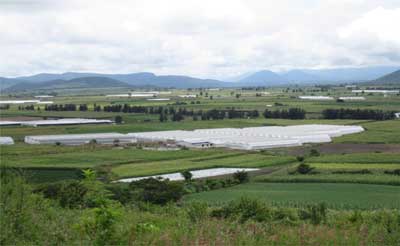
Figure 1
El Llano de Solidaridad, September 2010, Foto: Malin Jönsson.