
Introduction
The biocultural approach has established itself as a powerful narrative in academia, economics, and government (Caillon et al., 2017; Sterling et al., 2017). However, this concept still carries with it elements linked to the conventional paradigm of development, including unlimited economic growth in a finite world and the globalization of beings, knowledge, and power that has led humanity and biodiversity to multiple crises (Leff, 2004; Toledo & Barrera, 2008). Thus, from community-based organizations as producers of knowledge it is necessary to question inequalities in validation and power relations between rural communities and scientists. Faced with this, it is imperative to generate other research-creation processes (co-production of knowledge and actions) in rural territories, often affected by cognitive extractivism, impacting their epistemology and ontology (Grosfoguel, 2016). Therefore, the use of the lenses of the biocultural approach is advocated, i.e., an emerging paradigm that is sensitive to the interrelationships woven between humans and ecosystems, leaving behind anthropocentrism to move towards biocentrism (Hidalgo-Capitán et al., 2019).
Thus, redefining academic research on innovation processes from a post-development or post-growth perspective (Pansera & Fressoli, 2021) together with community and rural processes becomes a priority in a world immersed in social, environmental, and climatic crises (Poole, 2018). Precisely, understanding biocultural innovation processes at a communal level and from non-logo-centric languages and betting on the sound universe is a first step to finding other possible epistemologies. This, needs an emerging paradigm that transit from the sound ecology to the sound ecosophy (Barbanti, 2023a). In this context, a collective view of bioculturality can be seen in the work of Senabre et al (2022), around the collaborative use of technologies in the framework of environmental humanities.
There are community initiatives in technology, territorial management, and transportation, among others, that contribute to the collective well-being of people living in rural areas, sometimes called Communal Innovation (Reina-Rozo, 2019). We can highlight the Oaxacan Chiquihuite artifact for shrimp fishing created by the community El Carrizal, Santa Cruz Zenzontepect, southwestern Mexico (Quiroz Ruíz & Ortiz Santiago, 2019); the fisheries monitoring process in Nuqui that informs territorial planning in Chocó (Satizabal & Batterbury, 2018); the Piangüimetro as a joint innovation to monitor the size of Piangua (Anadara tuberculosa) (Invemar, 2010) and the voyage of Hokule’a, the 62-foot double-hulled canoe from Hawai’i to Tahiti (Animoto, 2019). These processes of new ways of doing things have the potential to make visible the cultural and productive processes related to the traditional knowledge of rural and especially coastal communities, as well as their seascapes, values, and norms.
Despite some experiences that have not been framed as Biocultural Innovation at a conceptual level in the literature (Reina-Rozo, 2022), it is vital to reflect on socio-technical change from rural communities (Indigenous, Peasant, Afro-diasporic) in Latin America. In particular, from the relationship between traditional ecological knowledge and biological-cultural diversity in their territories (Pretty et al., 2009). Being these intimately interwoven, leaving behind the Cartesian divisions that have fragmented knowledge between basic sciences and human sciences (Diaz et al., 2015; Nemogá, 2016). The central questions of this study are related to how to systematise the biocultural knowledge associated with Afro-Colombian communities beyond the logocentric way of writing? And what role can oralotecas play in these environments? Thus, the main aim was to co-create in an experimental and participatory way an Oraloteca of biocultural heritage for Nuqui and Guapi. This text presents six sections, the first of which raises the problem of the erosion of community biocultural systems of relations, sustained by biological and cultural diversity. The second section presents the theoretical framework focused on biocultural innovation. Then, section three shares the justification of the research at the territorial level in the Colombian Pacific Coast, in particular, Guapi (Department of Cauca) and Nuquí (Department of Chocó). The next section describes the methodological design and research-creation tools, followed by the results at the web platform level. Finally, section five presents conclusions and future actions.
Sound postcards as a tool for co-production of knowledge
The process of research-creation or better co-production for this exercise has been the sound research in intersection with the communication device understood as a postcard, through the polyphony of voices and noises of the Pacific coast environment linking Digital Technologies and Bioculturality (Markiewicz et al, 2023), exploring what is known as “Postal Sonora” (Salazar Botero, 2020), or sound postcard. The postcard emerges in the 19th century as a communication device (photograph, illustration, or engraving alluding to its place of origin) to be an artifact for the transmission of meanings. According to Restrepo (2010), “they ceased to be mere vehicles of transmission to also become objects of memory, easily acquired communication products that with their images captured memorable events for posterity” (p. 36).
The sound postcard, then, is a methodological tool derived from the field of socio-acoustics and widely used in ethnography. It was made visible by the geographer Claire Guiu (Guiu et al., 2014), in the context of the research group Ciudad Sonora. The above is the framework of research on the sound identity of coastal spaces of the city of Barcelona. In this way, at the tool level, sound is considered a phenomenon or object,
“as part of the cultural fabric, susceptible of being read in ethnographic and descriptive terms both in itself and in relation to others, as well as to the places in which it is produced or to the sources from which it comes” (Alonso et al., 2007, p. 3).
Following the research of Rodríguez-Sánchez and colleagues (2018), the sound postcard consists of a sound description based on perceiving and listening to how the participants’ environment is perceived at different and specific moments in their lives. For Salazar Botero they are:
“short sound pieces, in which fragments of soundscapes are used. Whose purposes are to make memory and to be shared. Capable of evoking a personal or collective memory, of a specific place or moment. But which are mediated by the aural perception of the one who creates them”. (2020, p. 27).
Thus, this research proposes to record socio-phonic phenomena from local communication collectives and then share them in the form of a printed postcard with a QR code that leads directly to the platform Seres Bioculturales. For example, according to Cambrón (2011, p. 59), this tool can be used in an exercise such as the following: “If you had the intention of sending a postcard to someone you knew who had never been to the neighborhood but, instead of choosing an image, you had to choose a sound, which sounds would you choose?
An example of this could be the socio-phonic environment of the cities during the Coronavirus disease COVID-19 pandemic (Cambrón, 2020). In other geographies, there are experiences such as the Audio Postcards Canada1 project, created by the Canadian Association for Sound Ecology (CASE) to exhibit, through a web page, the variety of soundscapes that exist in the Canadian territory. In addition, there are other sound experimentations carried out by the RadioLab collective, concerning Christmas2 or by the Recorrido Sonoro collective.3 Over the years, different categories have been established to classify the sounds that coexist in a sound space from different points of view; one of these classifications is based on the sources that produce the sounds known as Geophonies, Biophonies, and Anthropophonies (Krause, 2008).
In Colombia, in particular, this tool has been used at two levels, first, at the level of research related to urban soundscapes, especially in western Colombia, in the city of Cali (Cuellar Barrona & Llorca Franco, 2008, 2011) and Medellin with the project Invisible Valley in 2011 by the collective Ether.4 Meanwhile, at the regional level with the campaign Convite5 by the communications collective Nois Radio, a series of socio-acoustic products are generated around digital advocacy for environmental leaders. In the same way, research for peacebuilding has used sound postcards to investigate the change in the social fabric of communities affected by the armed conflict (Rodríguez-Sánchez & Cabedo-Mas, 2021). In this way, art and technology are woven through the generation of a polyphony of voices and sounds of the Pacific coast. The above is a basis for the revitalization of collective community knowledge, creating the pillars of digital oral libraries as repositories of orality around biocultural innovation. The digital Oralotecas, then, are spaces in the network to preserve and enhance the processes of creation and dissemination of knowledge through orality in rural communities, i.e., epistemic processes linking art and technology.
One example of these oral libraries is the Oraloteca del Caribe6 of the Universidad del Magdalena, which consists of a space that articulates various forms of research and creation based on orality (Ardila, 2009). Likewise, it shows and systematizes popular knowledge expressed through the voices of the Colombian Caribbean cultures in a world dominated by the empire of writing (Silva, 2014). On the other Colombian coast, the Pacific coast, under the leadership of the Technological University of Chocó, the Oraloteca of the UTCH7 was generated around the oral memory of the Pacific coast. In this way, higher education institutions on the two coasts of Colombia have generated research and documentation processes around the orality of ethnic communities in the different territories. This proposal proposes to complement these actions from a self-managed, non-institutional place, mixing art and technology.
Context of Colombian Pacific Coast
The biocultural approach emerges as a conceptual framework that can create a bridge between grassroots communities and other organizations around the society-nature relationship, particularly in rural areas. Therefore, traditional/ancestral knowledge is dynamic, complex, and integrative with the standardized knowledge of scientific research institutions. Thus, it is necessary to re-signify innovation beyond its hegemonic direction towards the generation of economic value as the only objective, where new ways of knowing and doing the communities can have other directions and other gestation processes.
Therefore, it is expected to generate collaborative research processes together with the communities through new digital tools allowing both the recognition of these innovation processes located in the territories from local dynamics, as well as the dissemination to other audiences where these practices and knowledge can integrate more complex processes. Additionally, it is key to inform with case studies to the biocultural perspective, in particular, complementing the concept of biocultural innovation with cases of rural communities in coastal ecosystems with mariculture activities. It has been found, in this process technologies as well as social processes gestated from diverse coastal communities in the American continent that are going to give new inputs to rethink innovation from a marine ontology (Animoto, 2019). Therefore, the two scenarios of analysis, Guapi and Nuquí are located on the Colombian Pacific Coast, in the departments of Cauca and Chocó respectively (See Image 1).
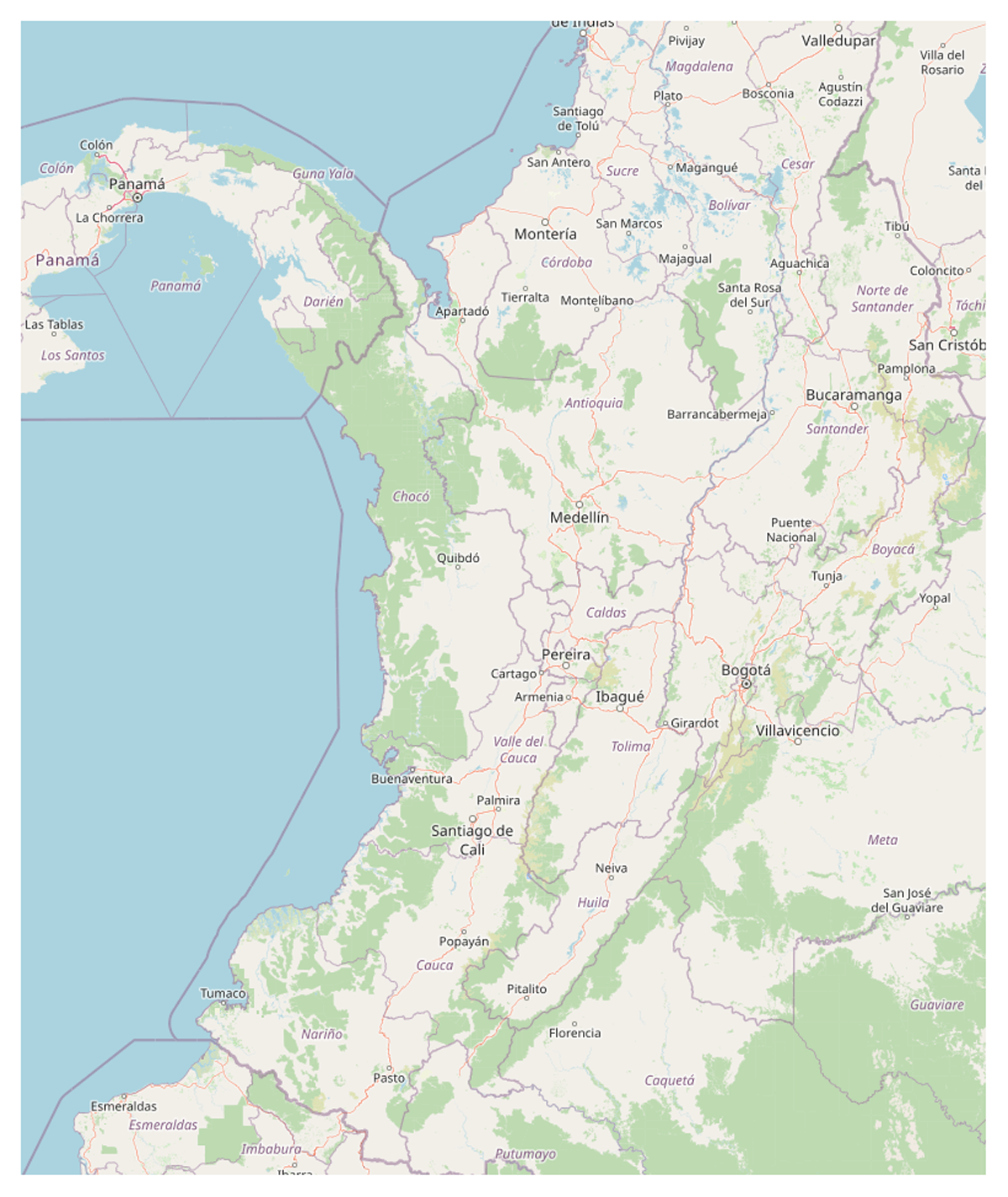
Image 1
Colombian Pacific Coast.
Source: OpenstreetMaps.org.
Guapi is located on the southern coast of the Colombian Pacific and is one of the three coastal municipalities in the Department of Cauca. According to the Characterization Plan of the Community Council of the Guajuí River. The continental part is crossed by the Guapi, Guajuí, and Napi rivers. The marine area includes the Gorgona National Natural Park, which is an island located 35 kilometers from the coast. At the ecosystem level, there are mainly tropical rainforests, which cover about 2,400 square kilometers, i.e. 90% of its surface. In addition, other marine and coastal ecosystems are found in its territory. One element of interest is the high biodiversity of this region, known as the bio-geographic chocó (IIAP, 2011). Another key ecosystem is the mangrove, which is very important in the region because they have a very strong relationship with the ethnic communities in the territory, especially around the activities known as “conchar” or mollusk extraction (Rodríguez-Peláez et al., 2009).
The municipality’s main economic activities are agriculture, artisanal fishing, and mining. Among the most common agricultural products are coconut, chontaduro, corn, rice, and especially two, Papachina (colocasia esculenta) and Chiyangua (eryngium foetidum). Fishing is a very important part of the municipality’s economy, as there is a great variety of species, both freshwater and saltwater. Finally, gold and platinum mining in the areas surrounding the rivers of this municipality continues to be a traditional practice among the communities at small scale; however, there are emerging interest by corporations to start exploitation of the sites, this could affect communities contaminating with mercury the rives and the sea.
Secondly, the municipality of Nuquí is located on the north coast of the Colombian Pacific and is one of the five municipalities in Chocó that have a coastline on the Pacific Ocean. This municipality is located on the north of the Pacific coast of the department of Chocó and has an area of 956 km2. Currently, the territory is under the intention of the National Government for the construction of a commercial port in the Gulf of Tribugá. As in other Pacific territories, the main form of community organization in Nuquí is the Community Council. In this context, the Consejo Comunitario Mayor Los Riscales (CCMLR) and the smaller territorial councils were formed in 2002.
According to the Ethno-Development Plan of the CCMLR entitled Visión de vida de las comunidades negras del golfo de Tribugá 2007–2020, its mission is to strengthen the autonomous organizational dynamics of the Black Communities of the Gulf of Tribugá to guarantee the Territorial, Environmental, Social, and Cultural Unity of the Gulf, its management and local governance (Asociación de Consejos Comunitarios General Los Riscales, 2007). Thus, the communities have organized themselves according to the mandate of Law 70 (Congreso de Colombia, 1993), generating autonomous forms of governance. These organizations have materialized their actions through productive activities, such as fishing and tourism. Artisanal fishing is a fundamental economic, social, and environmental activity for the population of Nuquí. It is considered a multi-species activity, meaning that many species are caught simultaneously with different fishing gear. According to PROCASUR (2015), artisanal fishing is carried out by more than 24 thousand fishermen, of which around 49% are located on the Pacific coast, where they generally carry out short fishing operations (one day) and up to 24 times a month. In this sense, FAO recognizes the importance of traditional knowledge in the biocultural sphere linked to biodiversity and its use (Fischer et al., 2015).
Sonorities of the biocultural beings of the Colombian Pacific
This case allowed us to explore sound postcards as devices for training, co-production, use of technology, and appropriation of knowledge from the territory of the Litoral. In this way, at a methodological level, a strategy on popular pedagogy (Cendales, Mejía & Muñoz, 2013), was developed from a virtual process that was developed in the second semester of 2020. After contacting several groups of young creatives, the training space – virtual – was led by I-Radia8 from Santander de Quilichao and focused on local communication collectives from Tumaco (Department of Nariño), Guapi (Department of Cauca), Buenaventura (Department of Valle del Cauca), and Nuquí (Department of Chocó) located in the Colombian Pacific Coast.
These collectives are community-based organisations made up of young Afro-Colombians between 18 and 30 years of age. In particular, they are people who have no academic training in the field of art, however, in an empirical way they have developed various activities related to culture. They are financed by self-management and some funds from international cooperation and the Ministry of Culture. These groups generate diverse activities related to communication, art and Afro-Colombian culture. Therefore, their importance lies in being generators of creative initiatives that allow the cultural survival of the coastal peoples of the Pacific. The above is based on the work of Fals Borda (1981) and their Participatory Action Research framework that allows the reflection and the transformation of power relationships in epistemic and cultural research based on the pillar of “desde la gente, para la gente” (from the people, for the people). In particular, in this process was the research on their knowledge related to biocultural heritage of their own territories.
The workshop had five sessions around the themes Introduction to sound awareness; Radio, radio broadcasters and the emergence of the podcast; Soundscapes, Sound postcards, and Presentation of products made in the training exercise. The workshop had an attendance of 21 participants from different territories of the Pacific Coast and as a final exercise, they made three sound products entitled “La Ruta De Rescate Ancestral”, “Mujeres Vigias De La Piangua”, and “La Ley 70, Una Provocación” (See image 2). These three exercises focused on experimentation and exploration as a prototype of a digital biocultural element of Oraloteca.
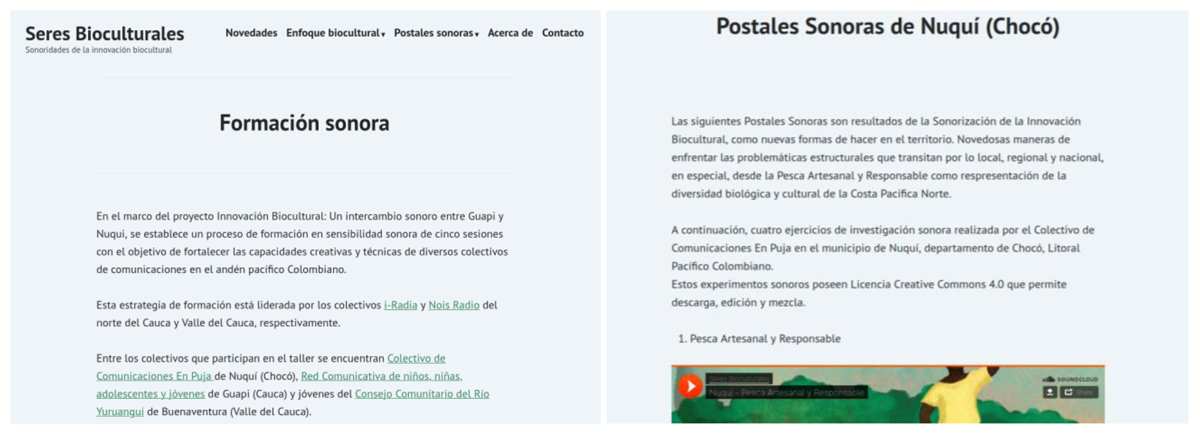
Image 2
Images of the web page’s project.
In this process, particular themes and interests of the communication collectives emerged, such as agroecology, cultural traditions, the role of women in fishing, and the political history of Afro-communities, particularly among Nuqui and Guapi participants. In this way, two field trips were made to accompany the pre-production, production, and post-production of the sound postcards in the territory hand in hand with the collectives. This means, that the youth from the collectives create the script, record and edit the material. The trips were carried out in the first semester of 2021 under strict care norms given the pandemic context. In this sense, logistical and operational planning meetings were held for the registration and interviews of various people, and the themes were freely chosen by the local collectives. The content developed during the work in the selected municipalities corresponds in the case of Guapi to knowledge related to agroecology, in particular the Musaceae (Musaceae) and Marimba music made from the wood of the chontaduro palm (Bactris gasipaes). Meanwhile, in the case of Nuqui, the central theme is associated with fishing, including the role of women and the payaos as a fishing technique. In this sense, recordings were made of soundscapes walking through the villages, as well as recordings for the introduction of the postcards and sounds for the change or ‘curtains’ between sections, in addition to recordings of people of special interest on the respective theme.
In relation to the indirect results, in addition to the production of the 9 sound postcards, 4 for Nuqui and 5 for Guapi jointly, skills were strengthened in interviewing, planning, as well as handling technical equipment and sound editing. This leads to nurture the previous experiences of the collectives and to be able to add new formats of communication and reflection to the sound. In such a way that, as an exploratory exercise, it has a prototype nature that allows for the generation of new spaces for creativity, in this case with a language around sound. At the collective level, the methodology was nurtured from the beginning through the participation of the collectives from the angle of participatory action research, which began with a pedagogical component at the conceptual level, and then continued with the pre-production of formats, duration and recording dates (See Image 3). Next, the collectives planned the times, to whom and what type of questions related to biocultural heritage to ask in the field, and then to carry out the post-production, adding traditional music from the Pacific.
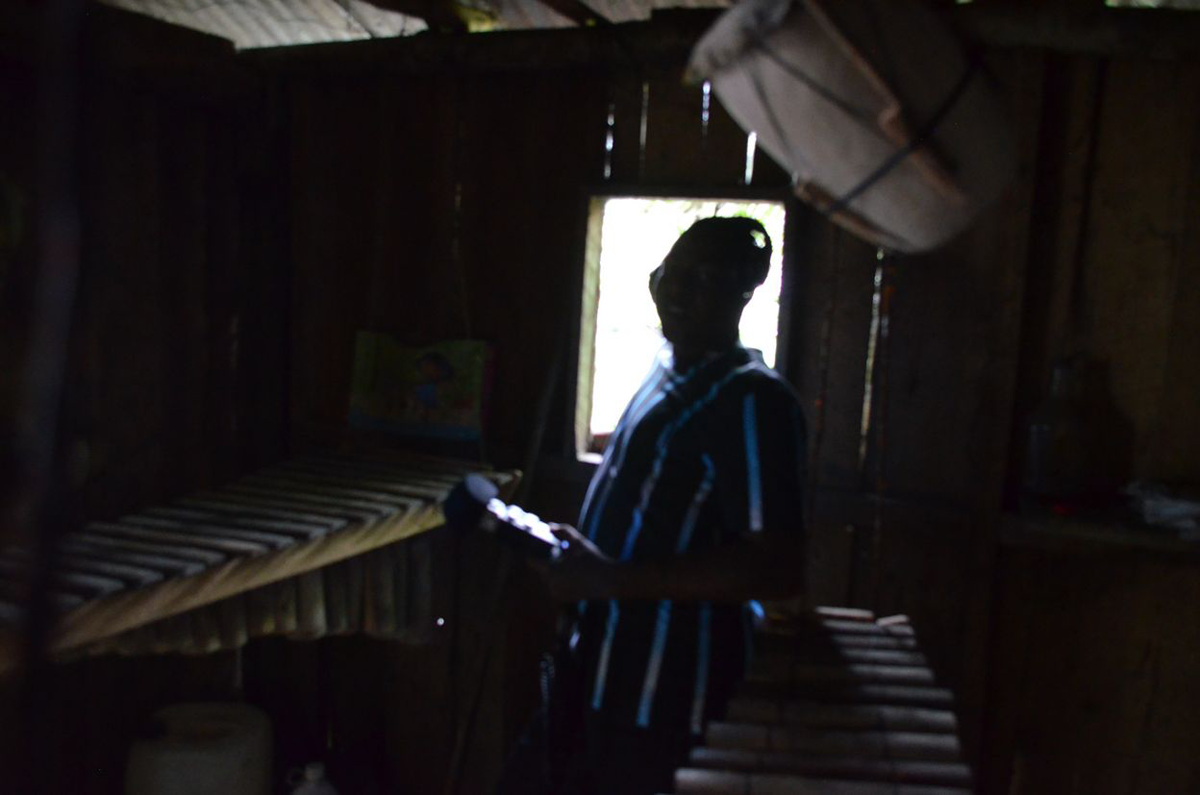
Image 3
Sound recording in the workshop with Genaro Torres, manufacturer of Marimbas.
Source: Author.
Once the fieldwork was done, the graphic phase of the exercise began. For this, the artist and designer Mapa Herrera, who has developed several creative processes in the territory, was contacted. In a couple of dialogues with local organizations, she created two illustrations for the postcards based on the local visual culture (Image 4).
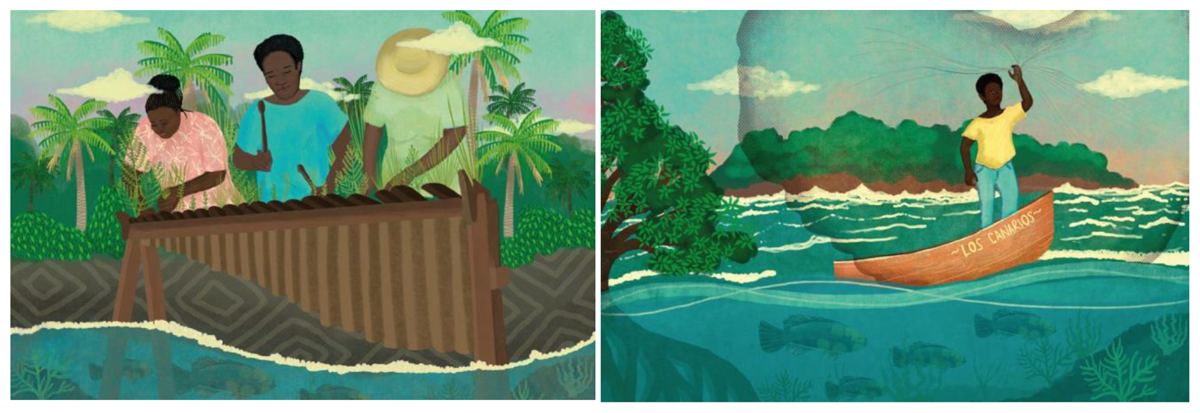
Image 4
Illustrations Sembrando Música and Canarios del Mar.
Source: Artist Mapa Herrera.
Finally, the back of the postcards is designed and a hundred of them are printed (Image 5). This is a dissemination artifact, reaching other populations and social sectors through the digital world using a QR that leads to a web platform where the process has been systematized.
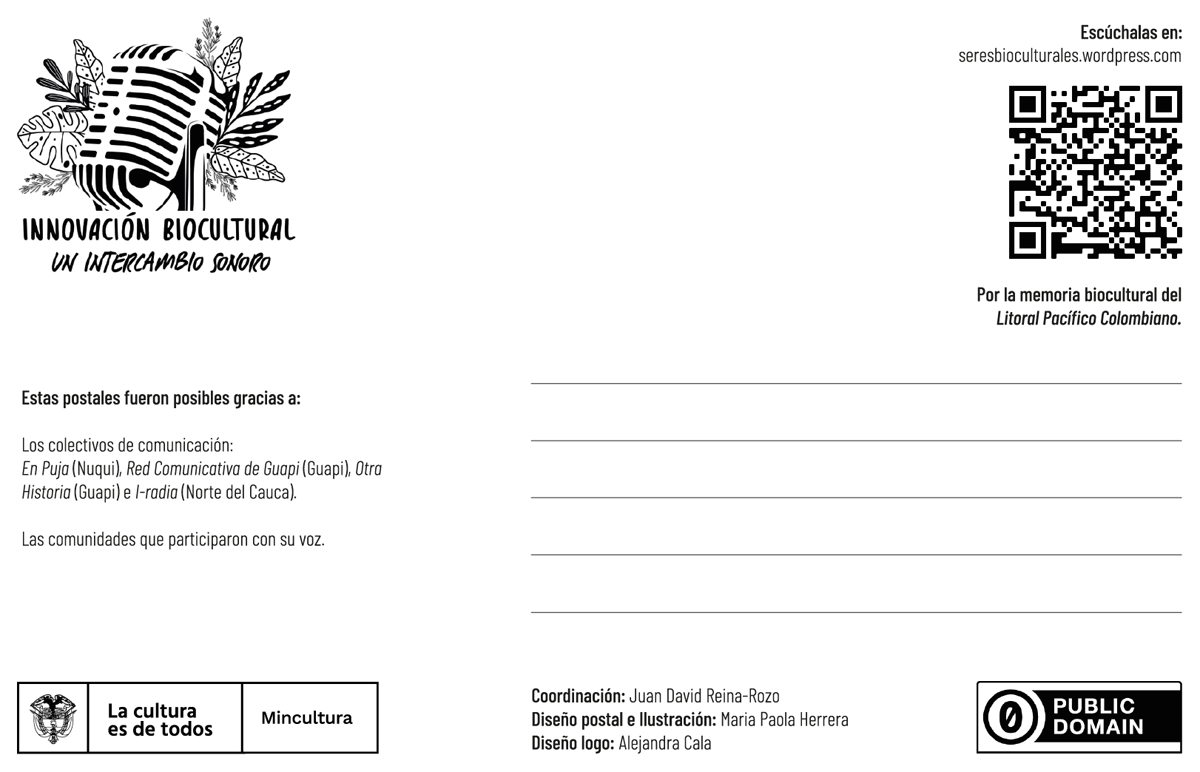
Image 5
Reverse side of the sound postcard.
Source: Mapa Herrera and Alejandra Cala.
In terms of sound production, nine exercises were generated by the two communications collectives. In Guapi, five recordings were made, entitled Artesanías; La Marimba; Mataratón y Musáceas; Música de la selva; and Reencarnación del Pacífico9 and was led by Roberto Cuero. In Nuquí, four registers were carried out, entitled Artes de Pesca, Payao, Mujeres pescadoras, Pesca Artesanal y responsable.10 All the previous exercise was systematized in a website developed by the project, where the theoretical, conceptual, pedagogical, and creative process is documented.11 This can be perceived as a digital biocultural approach towards the reflection on local knowledge, but forward to materializing the right to research paradigm, due that all human beings are researchers, since all communities make decisions that require them to make systematic forays beyond their current knowledge horizons. (Appadurai, 2006).
Discussion
The scope of this article is limited to the use of digital media by young people in western Colombia to safeguard the traditional ecological knowledge (TEK) of their Afro-Colombian communities. The above makes explicit the biocultural link with their territory, through the idea of generating sound postcards that nurture a biocultural Oraloteca of the Pacific coast. In this case, the axis was limited to two cases of co-production from the popular communication and social appropriation of science and technology, in Guapi and Nuqui, Afro-Colombian coastal towns.
Bioculturality as a transdisciplinary approach has emerged not only in the academic field but also in social movements. In this way, this look tries to be an epistemological and ontological bridge to safeguard the knowledge and memories of human collectivities concerning their environment. Thus, in the face of contemporary challenges, it is still necessary to delve deeper into the conceptual scope of bioculturality, especially in Latin America, with a threatened cultural and biological complexity. Thus, the use of emerging digital media in a community way is an alternative for the preservation of knowledge, but also capacity building for young people in the peripheries of the country.
In the field of environmental humanities as an emerging epistemological space under construction, the biocultural approach from a digital prism offers the opportunity for the generation of new ways of safeguarding the forms of relationship with the territory, through biological and cultural diversity. At a practical level, a reflection on the use of digital media to systematize and disseminate presents challenges at the pedagogical and logistical levels in territories with telecommunications deficiencies. However, it offers opportunities for communication from a local process of socio-phonies linked to the environment. Therefore, this text was an excuse to rethink sound postcards from an environmental perspective. According to Restrepo (2010, p. 45) states “postcards act as reminders, points of reference that bring memories to mind and are openings that preserve fragments of the lived experience so that they are not forgotten in the future”. I feel this is an initial proposal to define more clearly a relationship between technology, biodiversity, and culture.
Conclusions and future actions
The concept and practice of the “Oraloteca” are an opportunity for safeguarding, disseminating, and strengthening the biocultural heritage. Other ways of systematizing traditional ecological knowledge and its relationship with culture and biodiversity are vital. Thus, the co-production of sound postcards about agriculture and fishing of two villages of the Colombian coast is at an empirical level an exercise of biocultural innovation to nurture the exercise of an oral library of the Colombian Pacific. The above gives novel elements beyond the visual and hegemonic form to knowledge, paving the path to the ecosophies of sound that can challenge our way of listening to the world (Barbanti, 2023b).
In this case, exploring the potentialities of popular education and research-creation in the territory from a sound perspective through its geophonies, biophonies, and anthropophonies as exercises of exploration of digital media and epistemic justice are created. In this way, an intersection of environmental humanities is generated with a sound postcard that crosses the digital (the collection where the information is stored) and the analog (the printing of the postcard for exchange and gift in the territory of Guapi and Nuqui). At the level of the co-research tools used and energized in this research-creation process, the sound postcards have become an element not only to systematize the orality related to productive processes based on biological and cultural diversity but also forms of creation to revitalize local and popular knowledge of the Colombian Pacific coast.
In this article, the sound postcard was proposed as a prototype of the “digital bioculturality” exercise. This contributes to the environmental humanities, linked to digital humanities, in a fabric of relational relationships, in the use of digital media and formats such as sound, with the biocultural knowledge of Afro peoples in Colombia. Participatory research-creation exercises in the territory are vital to materialize the struggle for the right to research from communities with knowledge linked to biodiversity and who want their knowledge to survive in the future of the people.
The above strengthen processes that have been called Oralotecas in different geographies. That is spaces and dynamics around orality for its survival and documentation to enhance the biocultural memory of rural communities. In conclusion, it is necessary to continue to problematize the role of technologies and artistic creation for the dissemination of environment-based orality beyond the logocentric processes linked to the hegemonic communication of knowledge. The above linked with the reflection on the relation between media and Buen Vivir (Arcila Calderón, Barranquero, & González Tanco, 2018), and also as the continuation of work of Brazilian pedagogue Paulo Freire and the Colombian social scientist Orlando Fals Borda in an era of digital knowledge (Mota Neto, 2018).
Notes
[1] For more information see http://www.audiopostcards.soundecology.ca/.
[2] For more information see https://radiolab.cc/postales-sonoras-navidenas/.
[3] For more information see https://recorridosonoro.webnode.es/postales-sonoras/.
[4] For more information see https://invisiblevalley.bandcamp.com/album/noches.
[5] For more information see https://noisradio.co/convite.
[6] For more information see https://oraloteca.co/.
[7] For more information see https://corporaloteca.com/.
[8] For more information, see https://soundcloud.com/user-889219542.
[11] This can be accessed through the following link https://seresbioculturales.wordpress.com/.
Competing Interests
The author has no competing interests to declare.