
1. Introduction
Energy production from renewable sources has been recognized as one of the main cornerstones in achieving economic and social sustainability globally (Ribeiro et al. 2016). The energy and electricity sectors play an important role in the economic as well as the social development of a country through their intersecting environmental and social concerns, hopefully centred on using natural resources in a sustainable manner in the transition to renewable energy sources (Souza Júnior et al. 2019). However, the energy transition cannot only be centred on technological advancement, but must also consider economic, political, social and environmental challenges and concerns to grant a fully sustainable transition to cleaner energy sources (Berkhout et al. 2012).
With global climate change impacts, coupled with an increased concern over maintaining a trajectory within a safe operating space for the environment and humanity (Rockström et al. 2009), the transition towards a clean energy system is currently dominating policy arenas and narratives. Brazil is amongst the countries whose energy mix to a large part is composed by renewable sources – currently equivalent to 46% of the total energy mix (EPE 2020). With the countries’ many large rivers, including the Amazon Basin and the São Francisco River Basin (SFRB) in the semiarid North-Eastern regions of Brazil, hydropower has been a reliable source of energy nationally since the 1970s. The biomes over which both these rivers cross is however heavily impacted by climate change, accelerated by intensive land-use change and excessive deforestation due to agricultural expansion (Grecchi et al. 2014). The semiarid biomes in the North-East, the Caatinga and Cerrado, are particularly sensitive to climatic changes due to their vulnerable natural vegetation and characteristics. The regions are by default prone to droughts and inconsistent rainfalls due to them being located in a semiarid region, leading to water scarcity impacting hydropower production. Additionally, there is few national legislations for the protection of these biomes, accelerating the land use change and deforestation rates (Teixeira et al. 2021; Luiz and Steinke 2022). This have led to wind energy taking over the role as the main energy source over hydropower, making the North-East a key producer of energy from wind in the nation (Souza Júnior et al. 2019). It is further estimated that the wind power potential in the Brazilian Northeast will increase significantly in the coming decades. Currently, more than 85% of the nation’s wind power capacity is within the North-East semiarid region (Brannstrom et al. 2017; 2018), a region that historically has been seen as backwards and under-developed. The recent boom of and investments in renewable energy projects have directed new spotlights towards the formerly discriminated and neglected region. Whilst this brings possibilities for development, local concerns are noticeable, particularly regarding environmental damage in the fragile local ecosystems. Additionally, conflicts related to territoriality and land tenure rights are increasing in local communities where wind energy plants have been installed or are being planned (Santos et al. 2019). Socioeconomic inequality and uneven opportunities are national concerns in Brazil, where environmental damage in socio-environmental conflicts and injustices in the name of development and economic growth is occurring at an ever-higher speed. Such issues and conflicts are a dire pressure for local and traditional communities and their concerns and aspirations for a just and inclusive future.
1.1 Brazil’s Wind Energy Paradigm
Several studies predict that the implementation of wind power will grow significantly in Brazil, particularly in the North-East (de Jong et al. 2016, Frate et al. 2019, Gorayeb et al. 2018, Brannstrom et al. 2017; 2018). Brazil has historically had an energy matrix including many renewable sources (Ribeiro et al. 2016), and in 2018 the country’s energy matrix was composed of 65.2% hydropower, 27.9% thermal including natural gas, coal, biomass, and nuclear, 6.8% wind power, and 0.1% solar power (Frate et al. 2019, 186). In 2020, only two years later, wind power accounted for 10.1% of the total energy matrix, with 66 new wind power parks installed in the country of which 23, a third, were installed in the state of Bahia (ABEEólica 2020).
The various advantages of wind power are unquestionable. However, the concentration of wind power infrastructure can heavily impact the physiological environment, ecosystem and biodiversity (Turkovska et al. 2021). The current wind power expansion in Brazil is notably concentrated in the semiarid region in the North-East, holding more than 85% of the nation’s wind power capacity (Brannstrom et al. 2017). It is also the region with the least regulations for the protection of the local environment and ecosystems, making it vulnerable to environmental degradation from human activity, leading to increased desertification and biodiversity loss through the removal of natural and endemic vegetation, habitat fragmentation, soil erosion, ecosystem disturbance and threats to terrestrial and aquatic wildlife (Turkovska et al. 2021).
In relation to the social impacts of energy projects, previous literature has investigated the issue of displacement of local communities, including livelihood impacts, social disruptions of communities and unplanned urbanisation (Kircherr et al. 2016). Livelihood impacts that affects local and traditional communities include reduced quality of soil due to wind energy installations and waters for fishing being disturbed in coastal regions where wind energy have been installed since the early 2000’s (Souza Júnior et al. 2019). These impacts are even more damaging in regions where insecure land tenure, socio-economic inequalities, and political marginalisation are excessive, disproportionately effecting communities (Brannstrom et al. 2017; Traldi 2021).
In relation to opposition to renewable energy projects, many previous studies point out conflicts and opposition to the construction of dams for hydroelectric production, particularly in the Amazon (Da Silva Soito and Freitas 2011, Carvalho 2006, Bratman 2014, Mayer et al. 2021), whereas studies focusing on the North-Eastern region to a large degree have investigated wind energy projects by the coast. These projects are often constructed on dune fields and other coastal systems (Brannstrom et al. 2017; 2018, Brown 2011, de Andrade Meireles et al. 2013), and depict a reality where conflicts have arisen amongst traditional communities. Amongst the conflicts described are examples where local inhabitants are denied access to resources that sustain their livelihoods and cultural identifies, such as access to beaches for artisanal fishing (Brannstrom et al. 2017, Brown 2011).
1.2 Aim and case contextualization
The aim of this study is to explore the narratives regarding wind power as a promoter of sustainable development in the transition to renewable energy. We focus on wind energy expansion in the state of Bahia in North-Eastern Brazil, currently the state where wind power installations are expanding the most. Additionally, Bahia is a state that is characterised by its many traditional and landless communities, highly vulnerable to the land dispossession that the wind energy expansion entails (Traldi 2021). Many traditional communities in this state are still not represented by any existing landless or peasant movement or organization nor governmental policy frameworks, thus not granting them full property or territorial rights (Santos et al. 2019). Further knowledge is therefore needed about such traditional communities that are being impacted by development projects, an issue that has the potential of colonial reproduction due to forced displacements of communities that historically have not been granted the right to territoriality and land ownership rights (Yashar 2005).
In this setting, studying the frames of wind energy expansion is particularly interesting, since the transition to renewable energy is dominating political narratives globally. Arguably, how certain concepts and events are narrated and framed differs depending on who the messenger is and their agenda, a topic we aim to explore in this study. By conducting an analysis of official documents we aim to understand what narratives shape the concepts of clean energy and sustainable development through wind energy. Through exposing divergent narratives our study contributes to a broader understanding of the energy sustainability concept in relation to wind energy expansion. The questions that will guide our analysis are the following: how are wind power and the wind power expansion being framed in the documents analysed; and how are development, and particularly sustainable development, being framed in the different documents analysed? The documents included in the analysis are from governmental and non-governmental actors, such as governmental institutions, non-profit organisations and civil society organisations, aiming to identify contrasting narratives of the same occurrence. We apply framing theory to unfold the underlying framing mechanisms of the above concepts, arguing that the framings of these concepts differ depending on who is conducting the narrative, to whom it is addressed and why. We argue that corporations and governmental branches frame wind energy as a solution or pathway to sustainable development, whereas civil society and grassroot movements rather frame it as a potential stirrer of conflict and socio-environmental injustice. Furthermore, the marginalised and excluded narratives in the overall debate include local and civil society aspirations. These are essential to include in the aim of reaching a sustainable energy future.
2. Framing Theory
We apply framing theory to examine how wind energy expansion in the state of Bahia in North-Eastern Brazil are being portrayed by different actors. Framing theory is applied particularly in the social sciences, assisting in explaining how people and societies perceive and interpret topics, phenomena and events within their own social norms, values and assumptions (Bjärstig et al. 2022, Mino and Kudo 2020). This implies that framings can assist in explaining how broader concepts and events can be presented differently according to the underlying beliefs and values of the messenger, and in accordance with their potential agenda. They can be described as “discursive practices”, and the way one chooses to embed one’s narrative may assist in strengthening coalitions and gain supporters in accordance with one’s beliefs (Lichterman and Cefaï 2009, 403). It is a useful analytical tool for the understanding of the political discourse, including movements, opponents, and authorities (Polletta and Kai Ho 2009). Framing theory will herein be applied to understand how broader concepts are presented and created in different narratives. The main concepts being analysed are clean energy and sustainable development through wind energy. The questions that will guide the unfolding of these concepts and narratives are 1) on what ground they are being developed by the different actors, how they are described and 2) on what premises, that is who is the messenger of the narrative and who is it positioned towards, aiming to uncover divergences in different actors’ framing mechanisms. We argue that one concept may have various meanings, pin pointing the need to disentangle broad concepts and events from different perspectives thus providing the opportunity to gain a broader understanding of one specific event which does not occur in isolation – similar cases of conflicts and opposition to development projects already do and will continue to exist.
2.1 Framing Clean Energy
Clean energy is an important factor in mitigating climate change and achieving sustainable development (Djerf-Pierre et al. 2015; Avila 2018). How renewable energy is framed provides different meanings, at the local level as well as in the global context, depending on the messenger and the meanings behind the messages. The various implications of renewable energy assist in constructing different frames. Such implications include political and economic incitements, environmental concerns, technological progress and civil society aspects (Djerf-Pierre et al. 2015, Wolsink 2020). Different narratives are an important aspect as to comprehend the sustainability aspect of the clean energy transition, pinpointing that one concept or event may be framed differently depending on the messenger. Notions of political struggle, resistance, lack of institutional and political inclusion as well as hegemonic power imbalances may reveal the hidden message embedded in one actor’s specific narrative (Djerf-Pierre et al. 2015). Issues such as greenwashing in the energy debate are persistent and must therefore be further studied through dissecting the different frames of the clean energy transition. In accordance with Bjärstig et al. (2022), the introduction of wind energy in local communities brought territorial disputes and environmental concerns in Sweden, highlighting the potential greenwashing in promoting renewable energy sources as the most sustainable option without including social impacts of local communities. Other resistance narratives of clean energy through wind energy expansion is the perspective of Not-In-My-Back-Yard (NIMBY), a central narrative in the social understandings of wind power opposition (Magnani 2021; Avila 2018; Sovacool et al. 2022). However, this perspective has been critiqued for being too narrow and Western-oriented, (Sovacool et al. 2022; Magnani 2021), dismissing other local perspectives.
Instead, we focus on the frames developed and experienced by civil society actors and affected communities, perspectives that arguably are disproportionately addressed in energy policy, media coverage, academia and political as well as in the general discourses (Deranger et al. 2022; Obermeister 2018). The conflicts and power structures that are embedded in transitions that require societal change, such as the energy transition, are a complex phenomenon that has not yet been proportionately addressed in energy research and studies on the energy transition, particularly in the Global South (Frate et al. 2019; Avila 2018). We argue that these aspects must be included to ensure a just and sustainable energy transition, highlighting the contribution of this study.
2.2 Framing Sustainable Development
Sustainability science as a research discipline is a problem-based or solution-oriented science (Mino and Kudo 2020, 8). The concept of sustainability has evolved and changed over time as human knowledge has expanded in the field, highlighting the complexities of defining this concept. Sustainability can therefore be interpreted as an ongoing process rather than as having a fixed meaning. The relationship between humans and nature is essential for sustainable development and the emergence of sustainability science have advanced our understanding of the complex relations between social and natural systems (Mino and Kudo 2020, 4). Complex challenges of sustainability science include the effects of global climate change, environmental degradation, poverty and biodiversity loss to name a few, and must all be taken into consideration at various scales. Further on, the concept of sustainability and the whole sustainability and sustainable development discourse have been developed by Western academia and therefore bear a definition focusing to a large degree on the realities of the Global North, leaving the Global South perspectives of sustainability in the periphery (Fontana 2017). Arguably, questions such as what development entails and how sustainable development can be achieved through Global South perspectives have not yet been investigated in depth (Udemba and Tosun 2022). Many countries in the Global South struggle with economic and social challenges, including issues of poverty, social and institutional injustice, inequality, and marginalisation (Dalla Fontana et al. 2020, 173), highlighting the necessity to include such perspectives in the sustainability discourse. The concept of sustainable development encompasses the environmental, social and political domains, calling attention to the ethical and moral framings of development and that today’s development cannot occur whilst compromising the needs of future generations (Mino and Kudo 2020; Udemba and Tosun 2022). It is therefore critical to develop a thorough conceptual framework including key elements which are being evaluated when aiming to identify how the concept of sustainability and sustainable development are framed.
3. Empirical data
The empirical data that will be analysed in this study consists of official documents. Using documentary methods provides an analysis of different kinds of texts that contain information about the issue or phenomena being studied (Monageng Mogalakwe 2009). A total of 27 documents and texts have been included as empirical material. Of these, 11 derive from governmental actors and 16 from non-governmental actors. The governmental documents consist of official reports, public policies, news articles and state legislation relating to the study objectives. The non-governmental documentation consists of open letters, news articles, reports and proposals for public policy regulations. All empirical material has been derived from the official website of the selected actors and have been evaluated and analysed independent of their affiliation.
3.1 Data selection process
The first step of the data selection process consisted of identifying potentially relevant actors for the study objectives, and from there searching for relevant documentation to include in the data selection. The actors could be identified after conducting fieldwork in the study region and throughout the readings of the literature review for this study. The first delimitation process took place during this process, where actors that did not provide any relevant documentation that could assist in answering the research questions nor addressing the major themes for this study were excluded.
The second step of the data selection process entailed further investigating the remaining actors and identifying relevant material for the analysis. When searching for potential documents to include in the analysis, a search on each actor’s official website was done using the keywords ‘wind power’ and ‘Bahia’ in the first search. Documents and articles dating back to 2016, i.e. written in the past five years, were selected as relevant to this study. Any documents or articles that were written prior to the timespan were excluded, due to five years being considered as a relevant enough time frame since the energy transition is occurring at a high rate.1 Furthermore, we argue that the most updated and recent reports, documents, and articles are the most relevant to include in the analysis and cross comparisons were therefore not conducted amongst the recent and older version of similar reports. This step of the delimitation process included investigating whether or not the selected documents included any information that could assist in complying with this study’s objectives by focusing on narratives regarding the broader concepts of clean energy and sustainable development. Additional keywords that correlated with the study objectives were used, such as ‘sustainability,’ ‘development,’ ‘environmental impacts,’ ‘energy transition,’ ‘clean energy’ etc.
3.2 Methodological approach
The methodological tool of content analysis has been chosen as the approach to analysis of the material, aiming to identify and categorise the content of the chosen documents in categories and sub-categories in a systematic and replicable manner (Bryman, 2012, 289). We follow Bengtsson’s (2016) four analytical steps of content analysis. The first step refers to decontextualization, where the researcher goes through the process of reading through the material selected before breaking it down into ‘smaller units of meaning’ (Bengtsson 2016, 11). The second step of the process refers to recontextualization, where the smaller units of meaning are further examined, deciding whether to include all bits of text selected in the previous step. The third step of the process is the categorization. The coded material is then divided into broad groups based on the objectives of the study (Bengtsson 2016, 12). In this step, categories and subcategories that are consistent with the major themes are identified. During the coding process the documents selected were thoroughly and systematically reviewed, and relevant passages were retained for further analysis. This selection was based on the criteria that wind energy or sustainable development was explicitly mentioned, together with other similar concepts such as ‘clean energy,’ ‘green energy,’ ‘wind energy expansion,’ ‘the energy transition’ (see Figure 1). Further, the documents needed to be of sufficient length to allow a qualitative content analysis. The fourth and last step of the content analysis refers to the process of compilation, which is the main process of the analysis of the material where framing mechanism of the concepts are analysed in depth (Bengtsson 2016). A full description of the data selection processes and coding procedure is presented in Appendix I.
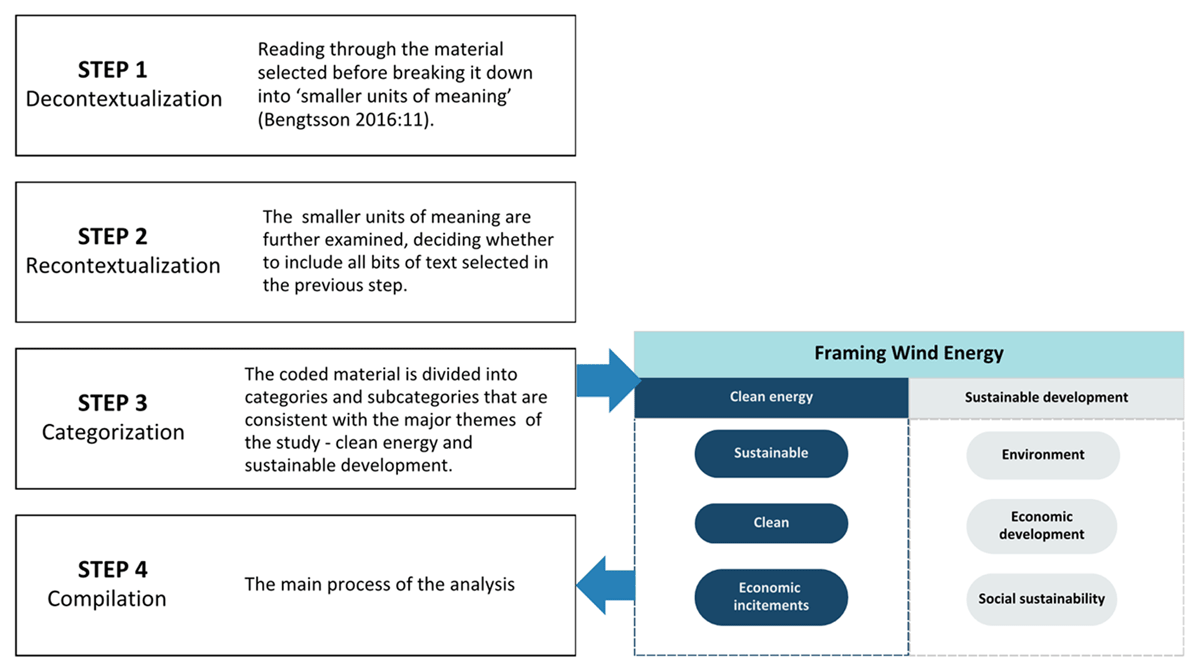
Figure 1
Illustration of the coding process following Bengtsson’s (2016) four steps of content analysis.
4. Results
The first research question of this study entails exposing the different narratives framing clean energy through wind power, with emphasis on the wind energy expansion in the state Bahia in North-Eastern Brazil. The findings will be presented in accordance with categories identified during the coding process, including notions of environment and climate change impacts, economic incitements as well as local resistance and opposition to the expansion.
4.1 Framing Clean Energy
A common thread in the documents analysed is presenting wind energy as an energy source with low environmental impacts that brings great benefits for the energy sector through reducing GHG-emissions. The wind itself is in both governmental and non-governmental documents framed as an abundant, never-ending natural resources that is available to all everywhere, highlighting incitements to further explore this energy source. Another commonly encountered frame in relation to the wind is one that presents it as ecologically correct for being consistent and frequently encountered in the interior of Bahia, referring to the wind as a free source that is easy to use.
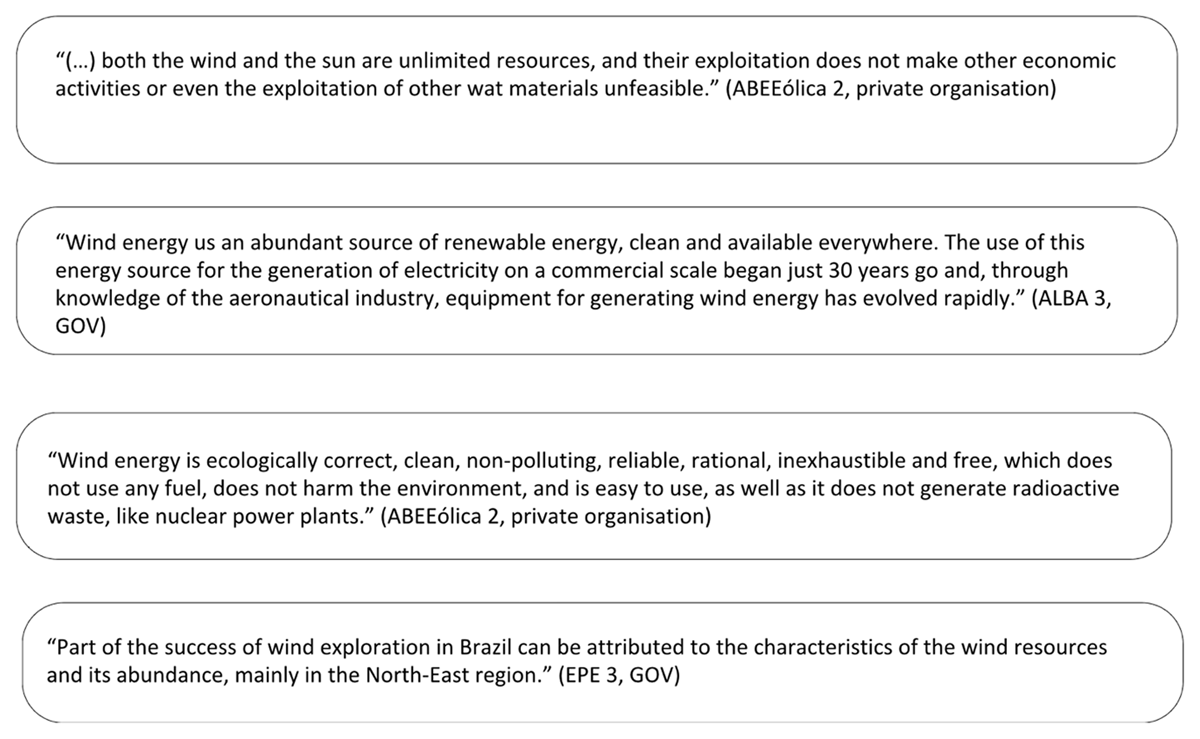
Opposing positions to this framing instead brings to the table a discussion on the actual cleanliness of wind energy, mentioning e.g., the production of materials for the construction of wind turbines as well as the construction of new roads for accessing the often-remote sites in which wind energy projects in the region are planned and constructed.

Throughout the coding process, one major category was identified as framing wind energy – the economic aspect. This aspect includes the issue of the free energy market. The energy market in Brazil can be divided into the regulated market, where energy is traded through state led auctions, and the free market, including market participants from the private sector that are able to freely negotiate energy prices and the amount of energy generated (Delapedra-Silva et al. 2021, 1). The free energy market has experienced great growth in the last decade due to the price of electricity tending to be higher in comparison with the regulated market, implying economic benefits for the investor. The following examples from the Federal Government and the institution ABEEólica clearly display how the free energy market is being presented as important for the development and expansion of the wind energy sector, emphasising the entrance of private actors:
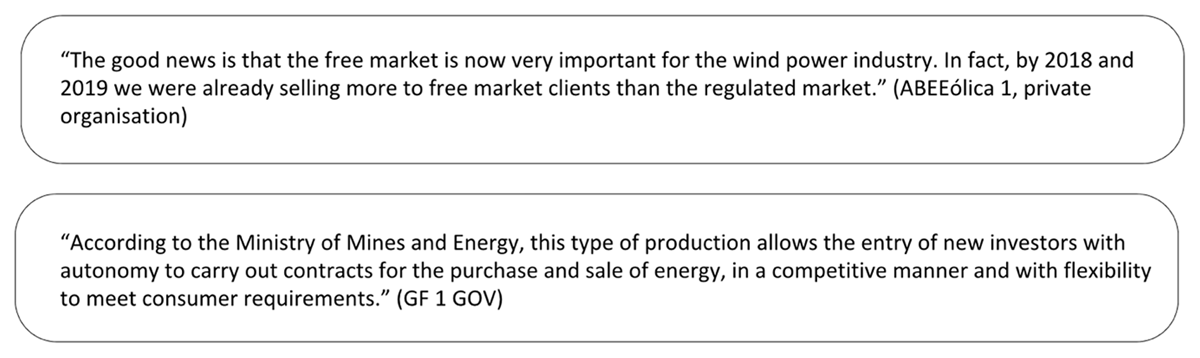
These two examples frame the free energy market and the entrance of private actors as regulating the market due to their being new and powerful investors, increasing competition due to their being more flexible in meeting the demand of consumers. The liberalisation of the wind energy sectors also brings barriers and environmental concerns, clearly displayed in this positioning of the free energy market from a governmental research institute:

This example problematizes the liberalisation of the energy sector, implying that the increased simplicity to enter the market brings environmental impacts since small-scale actors do not need to conduct studies of potential environmental impacts. Such problematizations were not encountered in any other material.
4.2 Framing Sustainable Development
The second research question surrounds the framings of sustainable development in relation to the wind energy expansion. We aimed to identify the extent to which the sustainability aspect is being weighed into the narratives of the expanding wind energy sector in Bahia.
The general framings of development in the analysed documents account for a vision where the wind energy expansion and transition to renewable energy sources are occurring at a high paste, generating benefits for the nation’s energy supply, industrial development as well as economic growth. The North-Eastern region is described as particularly promising due to favourable wind conditions, emphasising a need for technological advancement for the expanding sector. Economic and social development through investing responsibly in natural resources, such as wind and solar energy, is accounted for in the narratives analysed. The social development implied by wind power expansion are framed as a matter that will grant inclusion throughout the whole society. Human well-being is mentioned as an important matter in ensuring the sustainability of the process of expanding wind energy. However, framings on uneven development are reoccurring particularly in the material from civil society organisations, depicting a vision where privatised energy companies and the Brazilian government are the bread winners of the development path of expanding wind energy, whereas local communities are depicted as exploited.
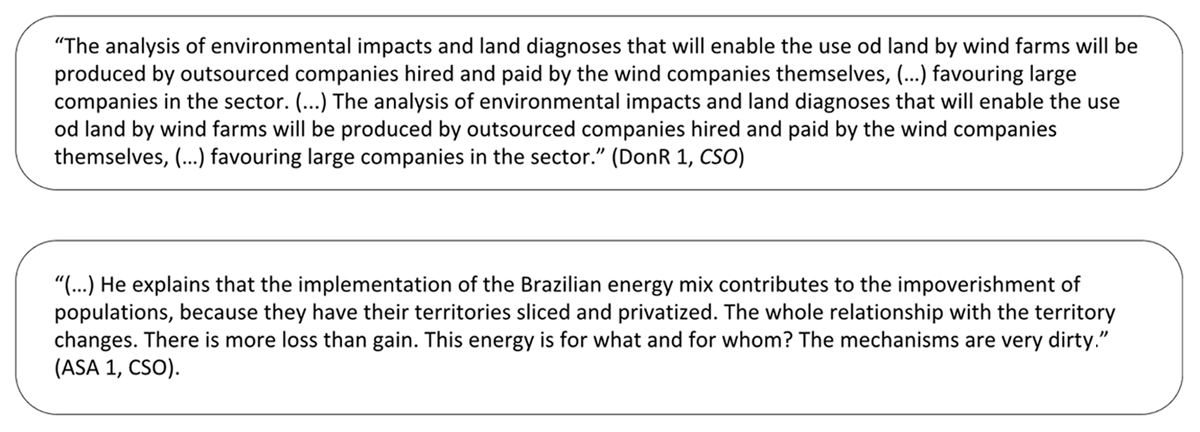
Income generation improving quality of life of local communities highlights the issues of achieving development for the few, reproducing notions of uneven development. Such framings emphasise the benefits for large corporations to install wind towers on rural communities’ properties without granting much in return for the communities occupying the land. The economic compensation the communities do receive is described as symbolic, implying that the model employed by the energy companies in relation to the communities rather increases inequality and even impoverishment of the local population.
In the framings of sustainable development, particular emphasis is on climate change as well as environmental aspects relating to the expansion of wind energy in Bahia. Human activities’ impact on the environment is one aspect identified regarding the sustainability of the energy transition, where issues of deforestation and dislocation of local populations are explicitly mentioned. Shifting the focus from a business-as-usual perspective, meaning that we continue the same path as we have in the past decades, continuously exploiting natural resources to achieve economic growth, is implied in such narratives. Instead, the focus should be directed towards local issues and concerns.

The uncertainties of the effects of global climate change on the energy supply are discussed in one of the reports by the governmental institution EPE. Climate change-related issues such as variation in temperatures and extreme events and their impact on the energy sector are mentioned as a are dire concern in aiming at predicting future energy demand and how to comply with those demands. Mitigation and adaptation efforts are identified as strategies that must be established to ensure energy security in different climate scenarios. Emphasis on local challenges and mitigation plans are identified and believed to be crucial in achieving a sustainable energy transition, including aspects of human vulnerability correlating to climate change.

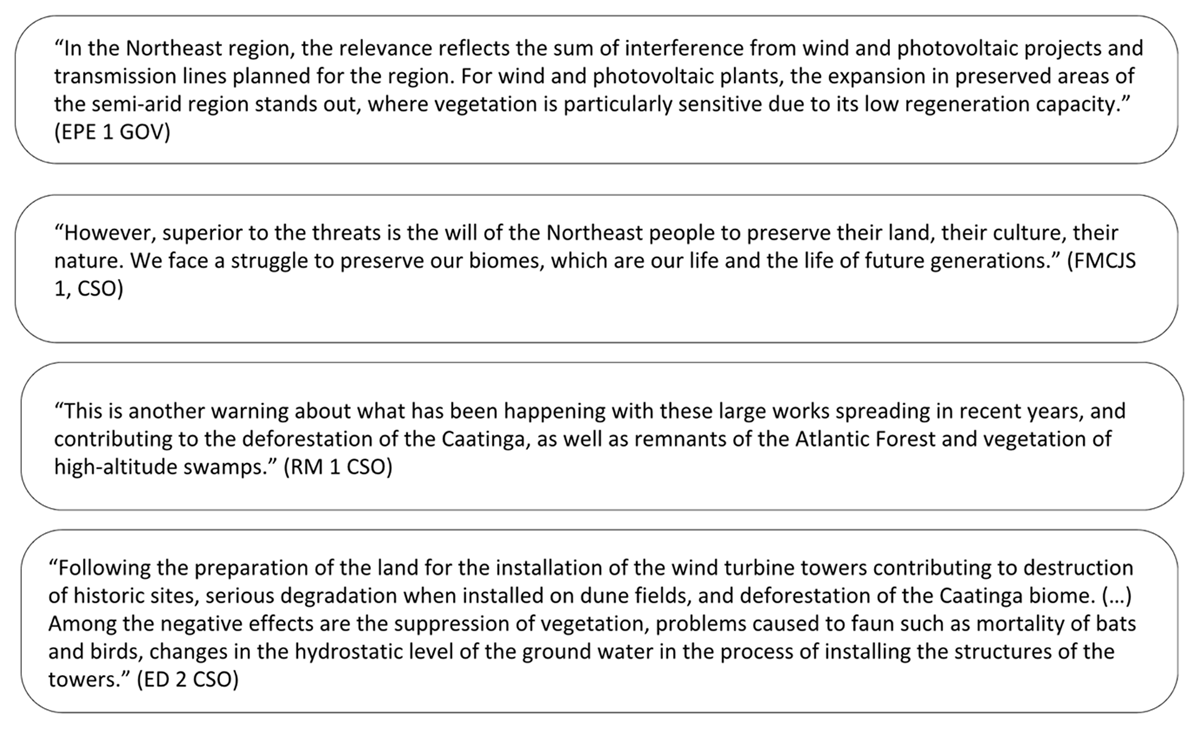
Issues of land occupation and impacts of land-use change affecting the native vegetation are present in the sustainable development frames. These issues are problematised to a higher extent in NGO documentation whilst also reoccurring in governmental documents. Deforestation and removal of vegetation to make space for wind towers and turbines is a direct effect of the energy transition, and even though wind energy is argued as needing little space in comparison with e.g. hydroelectric dams, the problem of deforestation in vulnerable ecosystems remains.
5. Discussion
The first research question of this study addresses how wind energy and the wind energy expansion are framed in the analysed material. Wind energy is commonly presented as a clean, sustainable source of energy and a great tool for mitigating climate change and reducing GHG emissions. In the analysed material, wind was often described as an abundant resource that is free and available to all, particularly in governmental and private organisation narratives. Invisible ecosystem services such as the wind are usually not proportionately valued unless they can be exploited and bring economic profit. The abundance narrative of wind energy is particularly interesting as this emphasises the corporate perspective and implications of wind energy expansion, framing it as a “free source” of energy that is available “everywhere”, without including aspects of the impacts on local communities or the environment, as well as implicitly meaning that wind energy is available to “everyone”. The wind is, in such narratives, depicted as a free service that nature provides us, an ecosystem service that can be turned into profit. Criticism regarding the commodification of natural services the environment provides us are based on the perception that nature has a value of its own, and that these values should not be made into profits on the demands of humans (Martin-Ortega et al. 2019), particularly so when the economic gain of the service provided is based on exploitation of humans, non-humans, and the local environment. However, when the expanding commodification of wind is based on profit for a few on the cost of exploiting the many, it can no longer be presented as the most sustainable approach. Also the economic aspect was identified as a common frame of wind energy and correlate with positive accounts for the free energy market that has allowed private actors and large corporations to enter the renewable energy sector in Brazil. The free market is also one of the main reasons for the fast expansion of wind energy in the state of Bahia.
The social implications of wind energy were often presented differently by different actors. Generation of jobs and increased quality of life for local communities were the most common framing encountered amongst governmental actors and non-profit institutions. However, civil society actors framed social issues differently, emphasising concerns of rapid and unplanned urbanisation due to the entrance of large energy projects, including rise of living costs. In accordance with Djerf-Pierre et al. (2015), the expansion of the energy transition correlates with social resistance of local communities living on land that are being expropriated by large wind energy companies. A growing concern regarding the greenwashing of large and often transnational corporations is apparent, where exploitation of the environment as well as of local communities occurs in the name of the clean energy transition. Social resistance is a clear framing of the wind energy expansion amongst civil society actors, describing it as a phenomenon that is occurring at an uncontrolled speed creating conflicts of land use and territoriality as well as reproducing colonial notions of exploitation and appropriation. Civil society organisations’ framing of the wind energy expansion as occurring at an uncontrolled speed correlates with the position that the wind energy development as it is occurring in Brazil is not entirely sustainable (Brannstrom et al. 2017).
The second research question aimed at identifying how sustainable development was framed in the material. The general development narratives identified in mainly governmental actors’ documents correlate with a vision where development is equal to economic growth – the process of development cannot occur without economic growth. Many of the framings of sustainable development encountered are largely based on economic growth and the increased energy demand that comes with it, correlating with a vision that bases the Brazilian development model on economic growth through exploitation of natural resources. In relation to natural resources, we encountered concerns related to deforestation mainly in civil society organisation’s documentation, an issue that characterise Brazil’s development strategies based on neo- extractivism (Milanez and Santos 2015). Deforestation is a pressing matter throughout Brazil, particularly in the Amazon, with deforestation rates accelerating at a record-breaking speed since the installation of former far-right-wing president Jair Bolsonaro (Pelicice et al. 2021). The native and endemic vegetation of the semiarid region is particularly sensitive and has historically been disvalued (Turkovska et al 2021, de Oliveira et al. 2012), highlighting a necessity to protect it. With large-scale wind energy installations expanding at an astonishing rate in the last decade, worries of increased deforestation are apparent.
Notions of uneven development were frequent in civil society actors’ positioning of development, pointing to a pressing issue – for whom is the wind energy being produced and at the cost of what? The increasing energy demand must be met through the expansion of renewable energy to mitigate global climate change. Such a process cannot be seen as sustainable if reproductions of social inequalities and marginalisation of traditional communities are the costs of the energy transition. Drawing equal signs between development and economic growth emerged already in the 1950s where development is described as a process that cannot occur without economic growth (Udemba and Tosun 2022). The economic growth of Brazil is highly based on a development model exploiting natural resources (Milanez and Santos 2015, Bratman 2014). In such a development framing, meeting the increasing energy demand due to economic growth may seem as prioritised in comparison to securing the well-being of the local communities and environmental protection (Carvalho 2006), reproducing notions of uneven development and social as well as environmental exploitation in the name of “green development”. Economic growth is a prerequisite in countries with great socio-economic inequalities. It implies that the nation is stabilising not only nationally but in the international arena as well and is the major reason for why and how Brazil in the early 2000s became one of the fastest-growing economies in the world (Weisbrot et al. 2014). Nonetheless, without including the socio-environmental aspects of economic growth, issues of uneven development become clear.
6. Conclusion
In this study, we aimed to examine the different narratives framing the broad concepts of clean energy and sustainable development through wind energy expansion. Wind energy and other renewable energy sources are essential to mitigate climate change and to achieve sustainability for future generations, highlighting that even the less positive framings of the wind energy expansion exposed in this study are not per se against it. Rather, granting the local population’s right to participate in decision-making processes and development projects is a requirement to ensure a fully sustainable transition to renewable energy sources. Without including local concerns and aspirations as well as potential environmental impacts of wind energy installations, the abundant wind cannot be argued as the most, or only, sustainable solution in the transition to cleaner energy sources. The analysis shows that the question is not whether different actors are opponents or supporters of the implementation of wind energy, but rather that various positionings must be addressed to ensure a just and sustainable transition. Although these perspectives have been examined in the case study of the state of Bahia in North-Eastern Brazil, they are believed to be applicable in other regions of the world facing similar conditions.
This study foregrounded the conflicting wind energy politics in the study region. The results expose that civil society and local perspectives must be included and recognized for the energy transition to occur in a sustainable manner, highlighting the various perspectives immersed in the frames of the energy transition. The social aspects embedded in development projects must be further exposed and acknowledged already in decision-making processes. By exposing these aspects and narratives, we contribute to problematizing what sustainability entails, considering that the specific case that has been examined in this study is not a single phenomenon occurring in isolation. Conflicts are likely to persist if local perspectives and aspirations, as well as just and equal participation in decision making spheres, are not granted in the future of the energy transition.
By using both governmental and non-governmental documents, varying narratives have been exposed, narratives that have been produced priorly to this study being initiated. We therefore argue that none of the documents may be misleading or produced for the benefit of this study.
Additional File
The additional file for this article can be found as follows:
Notes
Competing Interests
The authors have no competing interests to declare.