
1. Introduction
The role of China in the world is changing rapidly, as is its role in Latin America. During the first two decades of the 2000s, China emerged as a leading trading partner and became a major investor and lender in the region. In recent years, we have observed a shift toward the development of smaller loans and investment projects, often spearheaded by the private sector (Ray 2023). Simultaneously, we are witnessing significant qualitative changes in the relationship, attributable in part to developments within Latin America and strategic shifts from China, as well as the escalating global geopolitical competition with the United States and the European Union (EU). Currently, China is moving towards assuming a more defined global leadership role across various issues, including climate change mitigation.
Latin American countries have increasingly engaged in China’s global initiatives, moving beyond the Belt and Road Initiative towards the Global Security Initiative (GSI), the Global Development Initiative (GDI), and the Global Civilization Initiative (GCI). While China continues to emphasize the need to fortify existing multilateral institutions, including the Sustainable Development Goals (SDGs) and the United Nations Framework Convention on Climate Change (UNFCCC), it has also begun initiating a variety of regional and global forums to advocate for its global vision (Banik & Bull 2022; Vadell 2021; Vadell 2018). Two key dimensions in the emerging Chinese vision are the need to prioritize ‘development’ and to move the world towards carbon neutrality. China’s attempt to resolve the potential conflict between these two dimensions is expressed in the coining of the term ‘Ecological civilization However, that is by no means clear. As a consequence also how it will influence climate mitigation agendas around the world remains an open question (Brauteseth 2023).
This article asks how China’s engagement influences the multilateral climate agenda in Latin America. It argues that China is seeking both to establish new multilateral institutions and give existing ones new content and form. What is emerging is a ‘transmuted multilateralism,’ wherein existing multilateral institutions persist, but their role and content are altered as new initiatives evolve around them. Related to climate policy, it has moved multilateralism towards supporting a ‘thin’ understanding of sustainability focused on economic growth and a transition away from fossil fuels. However, how this has unfolded in Latin America has been deeply influenced by the division and fragmentation of the Latin American region, as well as the strategies by competing foreign actors, most importantly the USA and the EU.
The article is divided into four sections: The first discusses the concepts of geopolitics and multilateralism, how they interlink, and their potential contradictions. Here we will also define ‘transmuted multilateralism’. The second section delves into different visions for climate change mitigation and a green transition, distinguishing between ‘thin’ and ‘thick’ climate and green transition agendas and arguing that Latin American climate adaptation debate fluctuates between the two. The third section discusses China’s multilateral vision related to climate and development issues, positing that China has transitioned from laggard to potential leader, despite significant contradictions in this leadership role. The final section traces how China has sought to establish a multilateral agenda around its vision in Latin America, focusing on three cases: the Chinese entry into the Inter-American Development Bank (IDB), the Community of Latin American and Caribbean States (CELAC)-China Forum (CCF), and the triangular dynamics between EU and US green initiatives, and the linkage of Latin America to global Chinese initiatives.1
2. The Geopolitics of Climate Multilateralism
Geopolitics is centered around competition for land and resources, particularly among great powers. Øverland and Scholten argue that it involves competition between large powers for natural resources and strategic locations, as well as ongoing competition between them (Vakulchuk et al. 2020). While smaller states also engage in geopolitical competition and cooperation, such as in Latin American regionalism (Rivarola Puntigliano 2021), we here adhere to a view that geopolitics primarily pertains to competition among major states.
It has long been recognized that climate change has geopolitical implications. The effects of climate change, including melting poles, rising water levels, changing conditions for agricultural production, hurricanes, floods, wildfires, and droughts, have significant security and geopolitical implications on their own (Barnett 2007). Additionally, climate change mitigation policies also have substantial geopolitical ramifications. While competition over fossil resources has led to higher security risks and wars compared to competition over renewable resources (Øverland 2019), and geopolitical considerations often hinder efforts to reduce climate emissions, the severity of climate change and the binding obligations to mitigate emissions also alter geopolitical interests.
This creates a connection between two concepts that have traditionally been discussed separately in theoretical spheres: geopolitics and multilateralism. Multilateralism can be defined as the coordination of relations among three or more states based on generalized principles of conduct (Ruggie 1992). The main purpose of multilateralism is to influence a state’s self-serving behavior by specifying appropriate conduct for a class of actions, regardless of the particularistic interests of the parties involved or the strategic exigencies of specific situations (ibid: 11). Multilateral institutions are the formal organizational elements of international life characterized by permanent locations, distinct headquarters, ongoing staff, and secretariats (Caporaso 1992).
Multilateralism is rooted in a liberal institutionalist vision of international relations that considers not only a state’s power resources but also norms, rules, and institutions. This contrasts with geopolitics, which focuses on physical resources, geography, and state interests. However, geopolitics are never completely detached from multilateralism. It is widely accepted that hegemonic powers seek to embed their preferred norms and rules in institutions (Ikenberry and Kupchan 1990). Currently, we are in what realists would refer to as an “ordering moment,” where new hierarchical governing rules and arrangements are being proposed, and leading states are attempting to make weaker states accept their norms and rules (Malkin 2020). There is ongoing debate about whether and how China is seeking to alter the multilateral system (see Courmont 2012; Rajan 2017; Liu 2020), with little agreement on how multilateralism is being changed. One trend is towards ‘diminished multilateralism’, characterized by superficial consensus and organizational fragmentation that allows countries to choose between different institutions (Rüland 2012). This trend is evident at the global level, but also in regional contexts, including in Latin America (Jakóbowski 2018; Rodríguez and Rüland 2022).
Here, I focus on how this influences a specific issue area, namely, climate change mitigation. I argue that while the main institutions persist, some new ones are added. Yet more importantly, the way cooperation is conducted is changed: it rests on forming broad coalitions led by China around norms and ideas that emerge from the multilateral system, but are shaped to suit Chinese interests. There is no abrupt shift, but rather a gradual transformation of the institutions and norms they transmit. This is what I call ‘transmuted multilateralism’
3. Latin America Between a ‘thin’ and a ‘thick’ Green Transformation
Climate multilateralism began with the 1992 United Nations Framework Convention on Climate Change (UNFCC) from the Rio Summit, enforced in 1994. The Kyoto Protocol introduced periodic reporting, and the Paris Accord aimed to limit global warming to 1.5 degrees, legally binding through Nationally Determined Contributions (NDCs). Recognizing the limited capacity of developing countries for climate mitigation, they were exempted from greenhouse gas (GHG) reduction requirements (Skodvin 2023). Despite setting guiding principles, the UNFCC lacks specifics on how to cut emissions.
Visions for green transformation vary, with a basic distinction between ‘thin’ and ‘thick’ forms (Baker 2022). The ‘thin’ version, rooted in concepts like ‘ecological modernization’ and ‘green growth,’ sees sustainability as achievable alongside economic growth through technological and institutional advancements (Brundtland 1987; Meadows et al. 1972). Moreover, environmental protection may be a new source of growth (Adams 2019). This approach requires substantial investments for transitioning to low-emission sectors but doesn’t mandate reducing overall consumption or economic growth. While some versions narrow focus to climate emissions, overlooking biodiversity loss, others advocate combining growth with reduced resource use in less intensive sectors (Stoknes 2021).
The ‘thick’ version, aligned with perspectives like ‘degrowth’ and ‘environmental justice,’ contends that decoupling growth from ecological footprint is impossible (Martínez-Alier et al. 2010; D’Alisa et al. 2014). It argues that even ‘green sectors,’ like renewable energy, consume non-renewable resources, necessitating a profound transformation of the social and capitalist economic systems (Escobar 2015). This view rejects traditional ‘development’ tied to nature destruction and local livelihood harm (Demaria and Gómez-Baggethun 2023). Consequently, a ‘thick’ green transition advocates changes in global capitalism and its supporting institutions (Estenssoro and Dévez 2013), a perspective endorsed by the Ecosocial Pact, and governments like those of Gustavo Petro in Colombia and Gabriel Boric in Chile.
A ‘thin’ and a ‘thick’ vision of a green transition is summarized in Table 1.
Table 1
Summary of key ideas/policy recommendations of the ‘thin’ and the ‘thick’ sustainability agenda according to Baker 2022.
| ‘THIN’ SUSTAINABILITY AGENDA | ‘THICK’ SUSTAINABILITY AGENDA |
|---|---|
|
|
Latin American countries share some commonalities in their pending climate mitigation agenda, despite significant disparities in terms of level and causes of emissions. Despite the export of fossil fuels and depletion of the Amazon rainforest, historically, Latin America has been more a victim than a cause of climate change. Currently, emissions from Latin America and Caribbean (LAC) countries are slightly higher than the world average when compared to their share of global GDP, but slightly lower concerning their population.2 Also, Latin American countries have a higher coverage of renewable energy, making up 33 percent of LAC’s total energy supply, which is significantly above the global average of 13 percent (Cárdenas and Orozco 2023; OECD 2022).
Latin America also accounts for a significant share of the natural resources required for developing renewable infrastructure, including wind turbines, solar panels, electricity networks, and electric vehicles. Yet, Latin America remains divided in global climate policy (Edwards & Timmons 2016). All LAC countries are signatories of the Paris Agreement, but only Argentina, Brazil, Colombia, Costa Rica, and Panama have set unconditional targets. In contrast, most LAC countries have set conditional targets, meaning that their implementation relies on the delivery of international assistance. Bolivia and Venezuela stand out by, most often, attempting to block agreements that they consider too lenient on industrialized countries. Moreover, Latin America and the Caribbean participate in widely different coalitions to support climate change mitigation, as illustrated in Figure 1. This further complicates coordination.
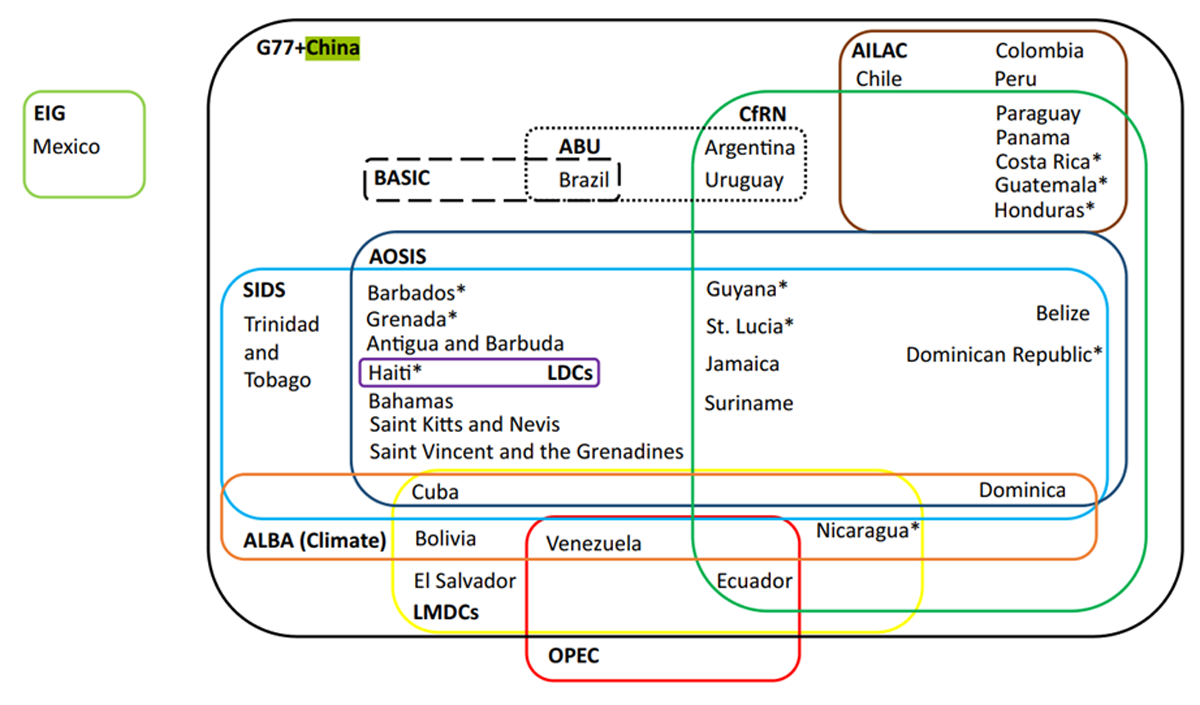
Figure 1
Latin American participation in climate policy coalitions.
Source: OECD et al. (2022), Latin American Economic Outlook 2022: Towards a Green and Just Transition, OECD Publishing, Paris, https://doi.org/10.1787/3d5554fc-en.
More importantly, there is no broad Latin American ‘green deal’ (Lebdioui 2022). There are several regional initiatives that have sought to create a common agenda, building on rich Latin American environmental thinking lying out a ‘thick’ agenda (Svampa et al. 2023). Among the most ambitious ones is the Regional Agreement on Access to Information, Public Participation and Justice in Environmental Matters in Latin America and the Caribbean (known as the Escazù agreement) signed in 2018 by 24 LAC countries. Rather than requiring specific environmental and climate policies, the Escazù agreement aims to promote socio-environmental transformation based on environmental democracy. Thus, it is more compatible with a ‘thick’ version of a green transformation (Bull 2022a). Also, several other initiatives, have aspects of laying the ground for a climate agenda in line with a ‘thick’ transformation climate agenda. This includes the Amazon-summit in August 2023, establishing the Amazon Act Cooperation Organization (ACTO) by 8 Amazonic states. The Belem Declaration resulting from the meeting, outlines a 113 point113-point agenda for cooperation.3 This refers to the multilateral agenda on climate change and sustainability (UNFCC, Agenda 2030 etc.), and makes a strong call to the international community to support the agenda. It has elements of a ‘thick’ transformation, involving both the protection of both the Amazon rainforest and its people. However, no consensus was reached on the goals of net zero deforestation, or the need to stop oil exploration.
In sum, there is no consensus on a Latin American climate agenda. Moreover, due to the need to attract foreign capital, and the region’s abundance of resources that are crucial for other nations’ green transitions, the agenda is vulnerable to be shaped by the interest of other powers..
4. China and Global Climate Multilateralism: From Laggard to Leader
China’s reengagement with the multilateral system, after a period of estrangement in the 1960s, started with inclusion into the United Nations in 1971. By 1989, China had joined 37 major intergovernmental organizations, including the World Bank and the International Monetary Fund (Hoo 2018). While China initially lagged in climate multilateralism, it now actively participates in global institutions. Additionally, China has launched various global and regional initiatives. These endeavors aim to establish rules and norms, serving China’s resource needs and shaping principles for a new global order (Schuman et al. 2023).
Within the UNFCC, China was from the start defined as a developing country and exempt from taking on NDCs. That changed in 2009 when China bypassed the USA as the world’s largest GHG emitter. At the ‘Copenhagen summit’ in 2009, China made its first international pledge: to cut CO2 emissions per unit of GDP by 40–45 percent from 2005 levels by 2020. While China had previously opposed proposals that imposed significant legally binding responsibilities on developing countries, it subsequently accepted the common responsibility system. China ratified the Paris Agreement in 2016, showing that it was committed to addressing change on par with developed countries. However, it still insists on being a ‘developing country’ and on differentiating responsibilities between developed and developing countries (Li 2022).
The Trump administration’s announcement of the US’ withdrawal from the Paris Accords in 2017 opened a new space for China as a leader in climate multilateralism. In 2020, President Xi Jinping (2013- pledged to reach peak carbon emission by 2030 and climate neutrality by 2060, emphasizing that this was China’s own initiative (Sandalov et al. 2022).
In addition to this, China has also taken a leading role in reaching agreements on other issues directly related to climate, such as biodiversity, by being a main promoter of the Kunming-Montreal Global Biodiversity Framework (GBF) that committed the world to protecting 30 percent of the terrestrial and marine environment by 2030 (Andersen 2023).
While portraying itself as a climate leader (Zhang, 2022), China launched a long series of initiatives that also sought to make it a multilateral leader in ‘development’. This has been done through initiating new development banks (the New Development Bank, and the Asian Infrastructure and Investment Bank (AIIB)), regional organizaitons (the Shanghai Development Cooperation, FOCAC, and the China-CELAC Forum), and global initiatives: the Belt and Road Initiative, launched in 2013, and later the Global Development Initiative (GDI) and the Global Security Initiative and the Global Civilization Initiative. All have been supported by the establishment of coalitions, regular meetings, and working groups. According to the official website of the Belt and Road Initiative, by July 2023, more than three-quarters of countries in the world and over 30 international organizations had signed agreements on Belt and Road cooperation with China, claimed to be able to generate US$1.6 trillion in annual global revenues by 2030 (PRC 2023). Three high-level BRI forums have been organized to strengthen the multilateral nature of it, building on the approximately 200 bilateral agreements signed.
Also, the GDI was followed up by the establishment of a coalition. By September 2022, over 60 nations had joined the Group of Friends of the GDI (Wu 2023). State Councilor and Foreign Minister Wang Ji described the GDI as a ‘a rallying call to galvanize greater attention on development and bring it back to the center of the international agenda.’ He further argued that ‘China is a consistent advocate for global development cooperation. We will stay committed to true multilateralism and an open and inclusive spirit of partnership, and actively share development expertise and experience.’ (PRC 2020).
However, fast development went hand in hand with increased emissions. While China transitioned to be a global climate leader, China’s emissions skyrocketed. In absolute terms, they reached over twice US emissions by 2020, although measured in per capita, each Chinese still emits half of what every US citizen does (see Figures 2 and 3).
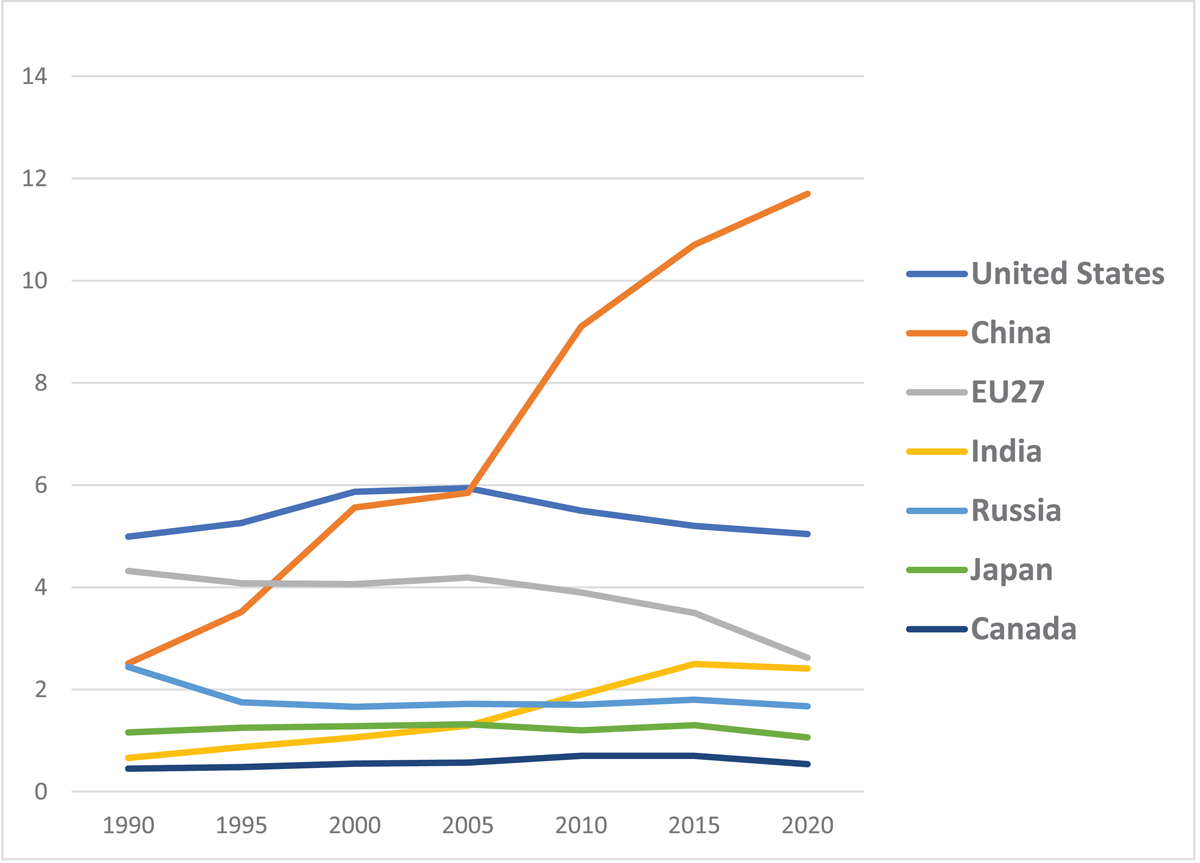
Figure 2
Trends in CO2 emissions per country/region, 1990–2020 (Unit GT CO2).
Source: Elaborated by Tora Skodvin with data from: “Trends in global CO2 emissions”. 2022 Report by PBL Netherlands Environmental Assessment Agency.
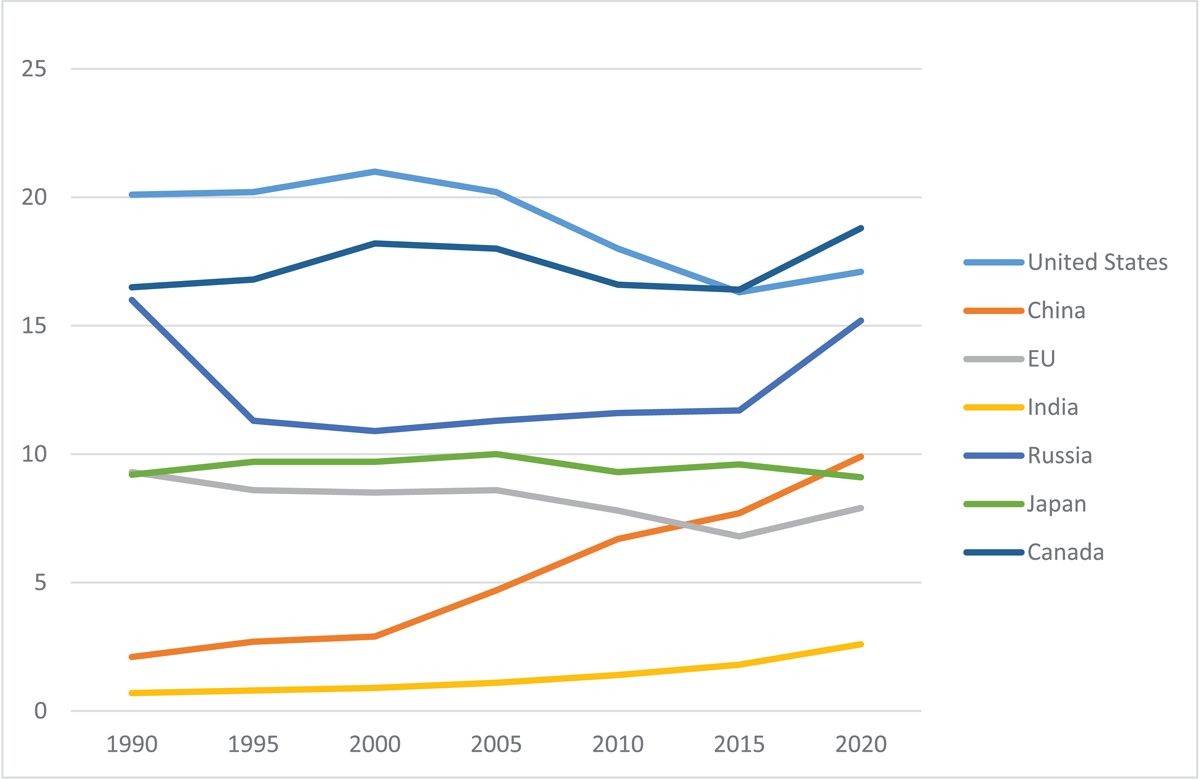
Figure 3
Trends in CO2 emissions per country/region, 1990–2020 (Unit: Tons CO2 emissions per person).
Source: Elaborated by Tora Skodvin with data from: “Trends in global CO2 emissions”. 2022 Report by PBL Netherlands Environmental Assessment Agency.
The evident contradiction between encouraging large-scale infrastructure, economic growth, and industrial development, and being a climate leader, has been attempted to be solved by Xi Jinping through the idea of ‘ecological civilization,’ developed through six environmental principles. While the term ‘EC’ is deliberately vague and only given specific content through its complex implementation by the Chinese Communist Party and state (Brauteseth 2023), the practical development strategy that has been encouraged has fallen clearly within a ‘thin’ understanding of sustainability. Indeed, Xi has underscored the economic importance of environmental action, as evidenced by his frequent mention of one of the six principles of ‘ecological civilization,’ namely that ‘clear waters and green mountains are as valuable as mountains of gold and silver’ (Rudd 2020).
This has also been the main line in the multilateral initiatives, cast in terms of expanding a specific vision of development to all corners of the world. In the white paper following the launch of the CDI it is stated that: ‘China is committed to propelling global development through its own development. It has thoroughly applied the new development philosophy, with a focus on promoting high-quality development to foster a new development paradigm’ (PRC 2023). This, in effect, links together the Chinese quest for modernization with its geopolitical ambitions. In the words of Rodríguez and Gurol: ‘this modernizing imperative translates into an authoritarian quest for ‘national rejuvenation,’ which is connected to the CCP’s declared ambition to heighten China’s position as a powerful actor in contemporary globalization’ (Rodríguez and Gurol 2023: 202).
China’s grand plans for global governance have been extended to climate issues through several initiatives. After the rapid expansion of the ‘Belt- and Road Initiative’ to all world regions, including Latin America, in 2019, China’s Ministry of Ecology and Environment and international partners launched the Belt and Road Initiative International Green Development Coalition (BRIGC or The Coalition). The goal of Greening the BRI was stated as reducing climate emissions, reducing pollution, and protecting biodiversity, while providing improved economic opportunities for the countries involved. The most widely discussed policy change was the promise to end new investments in coal plants outside of China. It also involves a Green Development Guidance for BRI Projects, which includes a ‘traffic light system’ to help avoid and mitigate environmental impacts throughout a project’s life (de Boer et al. 2022). This occurred in the context of a shift away from governmentally run mega-projects in the Global South towards risk-sharing with the private sector in the so-called ‘small is beautiful’ strategy (You 2023). The main motivation is China’s own economic needs and limitations, but it is framed in a discourse of climate responsibility and joint development efforts. It is embedded in multilateral initiatives but also transforms those, as evident in the regional agenda in Latin America.
4. Chinese Multilateralism in Latin America Between Climate and Development
While China has had a global focus, it has also pursued regional strategies. In Latin America, these are complementary to bilateral strategies, which have been more concrete and have received more attention. China’s current engagement with Latin America started with the rapidly increasing Chinese trade and loans to the region from the early 2000s and a tick up of investment in the mid-2010s (Myers and Wise 2016; Alden and Méndez 2023). China signed bilateral free trade agreements with Chile, Costa Rica, Peru, and Ecuador, and it is negotiating with Colombia and Uruguay. China also established strategic partnerships with Argentina, Brazil, Chile, Ecuador, Mexico, Peru, and Venezuela.
However, from the start, China has also pursued a multilateral agenda to become a favored development partner and a regional multilateral player. In the following, this will be illustrated through three cases. Throughout the focus is on how it has influenced the overall development of the climate agenda.
Chinese multilateralism and US opposition: The case of the IDB
The beginning of China’s multilateral efforts in Latin America was an attempt to enter the Inter-American Development Bank (IDB) (Bull 2022b).4 The IDB was established in 1959 out of a compromise between the US desire for hegemony in Latin America and Latin American elites’ ideas of a prosperous and autonomous region. As a result of the compromise, Latin American countries held the majority of the vote, and the president, while the headquarters were established in Washington, D.C. However, the devastating debt crisis of the 1980s and the neoliberal conversion of the 1990s made the US a more dominant force, while the IDB also looked for new extra-regional members to strengthen its capital base (Vivares 2013).
China applied to become a member of the IDB multiple times between 1993 and 2008 (Zhou 2016). Yet, it was rejected by the US on various grounds: that it was itself a borrower from multilateral banks, that there were no ‘free shares’ to be bought. Each time it was interpreted by the Chinese as a way to keep it out of the region (Jang 2005).
Finally, China was allowed into the bank in 2009. The context for the change of attitude was that the IDB needed fresh capital faced with the $1 billion loss due to the financial crisis. At the same time, Chinese lending to Latin America had been skyrocketing from basically nothing before 2005 to over $35 billion in 2010 – three times as much as IDB lending the same year (see Figure 4). Right after the entry of China, in 2010, the members agreed to the 9th general capital increase (GCI-9), the largest ever, providing $70 billion in additional capital.
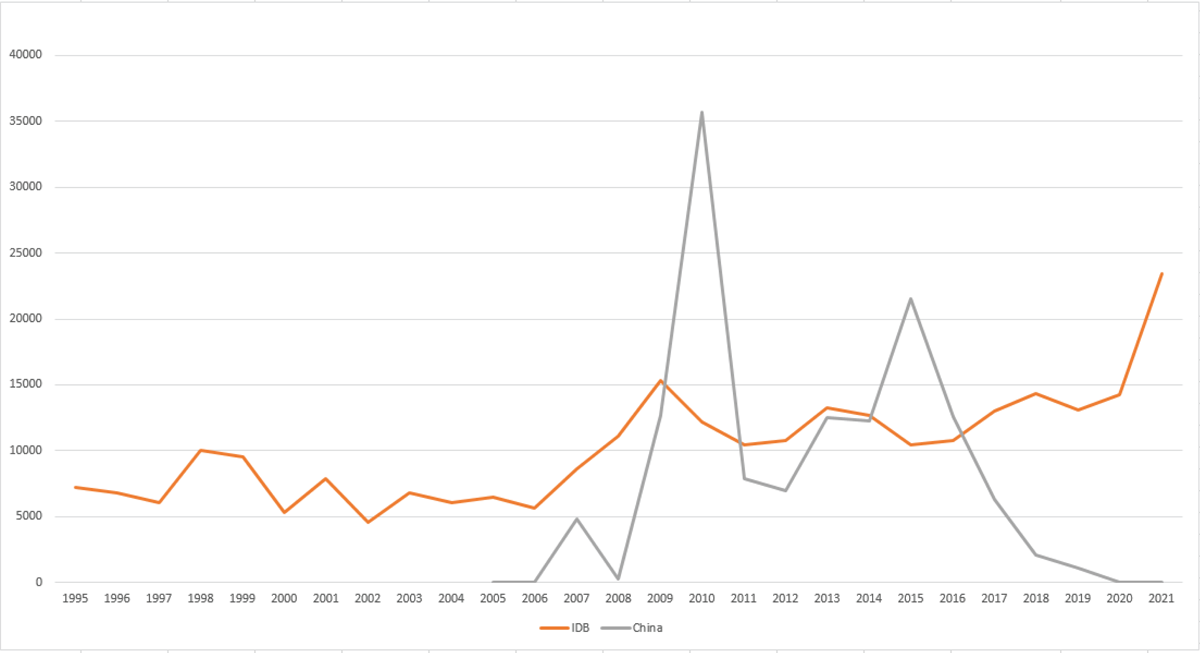
Figure 4
Total loans and grants to Latin America from China and the Inter-American Development Bank (IDB).
Sources: Authors elaboration based on the following sources: For IDB – various annual reports. For Chinese lending: Gallagher, Kevin P. and Margaret Myers (2021), “China-Latin America Finance Database,” Washington, DC: Inter-American Dialogue.
However, China received only 0.004 percent of the votes in exchange for a $350 million payment, leaving it with no formal influence.5 The Chinese solution to that was to focus on the private sector arm of the IDB and on renewable energy projects. In 2013, China established a Co-Financing Fund in the IDB for Latin America and the Caribbean of $2 billion dollars, of which $1.5 billion was channeled to private sector lending. In 2015, the two private sector windows of the IDB were merged into the new subsidiary, IDB Invest. When IDB Invest was established, the United States decided to reduce its participation, and so did Spain and Japan. The result was that there were more shares left for China, and it could translate its support into a voting share of 5.4%. Also, the $1.5 billion private sector share of the Chinese trust fund was transferred to IDB Invest. The trust fund was worth twice as much as the paid-in capital of IDB Invest at the time, giving China potential informal influence.
As a result, China became active in the governing of IDB Invest. Little suggests that it had major significance, though: Chinese co-financing has been channeled to countries that recognize Taiwan (Humphrey and Chen 2021: 15); there was no systematic favoring of Chinese companies;6 and China’s views did not differ significantly from those of other significant shareholders.7 But China did gain privileged access to information. According to interviews with IDB board members, the Chinese were mainly interested in gaining access to data and establishing contacts.8 The profile of the investments funded under the China Co-Finance Fund was that it mostly went to renewable energy, with a strong focus on Uruguay (see Figures 5 and 6).
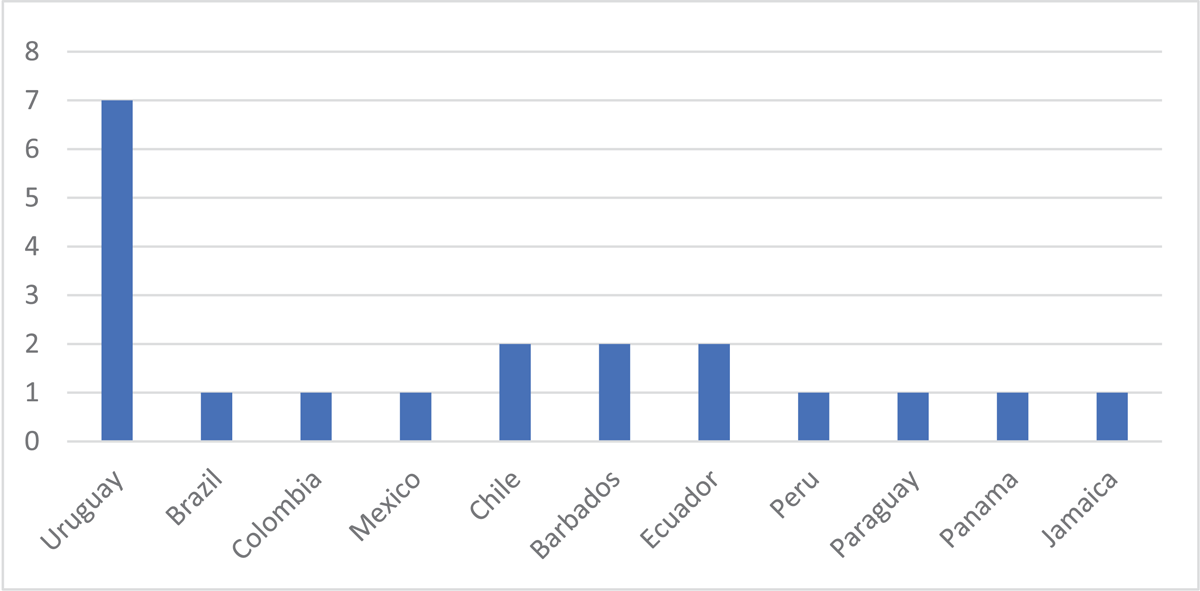
Figure 5
Geographical distribution of projects funded under China Co-Finance Fund for Latin America.
Source: Authors elaboration based on date from IDB Invest.
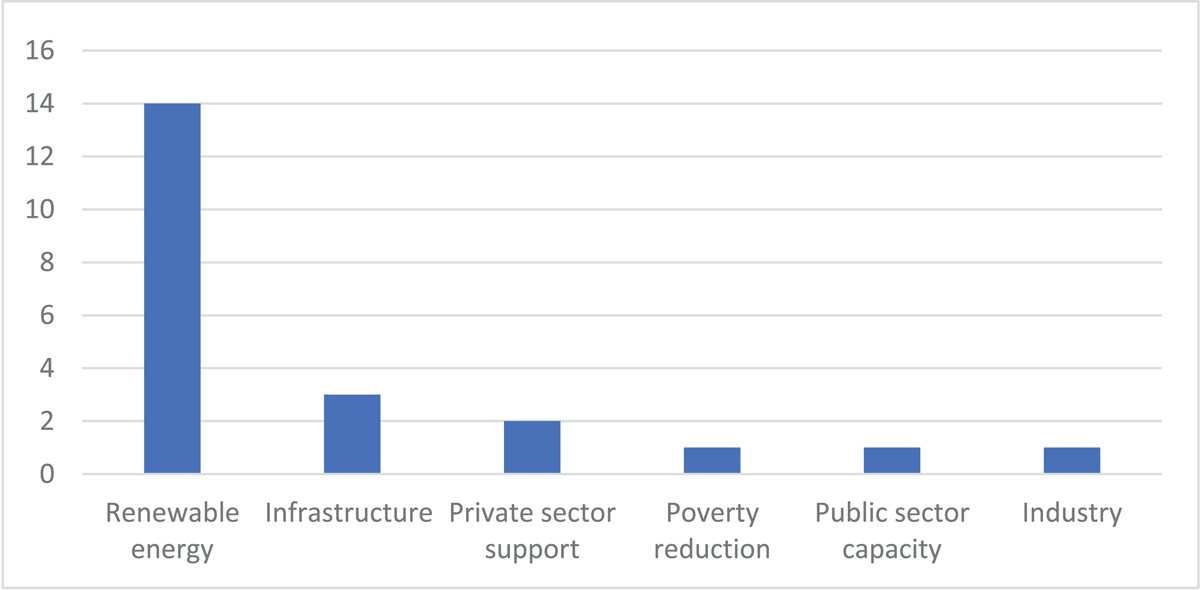
Figure 6
Sector distribution of projects funded under China Co-Finance Fund for Latin America.
Source: Authors elaboration based on date from IDB Invest.
However, U.S. attempts to keep China at bay continued, particularly during the Trump presidency. After the IDB president, Luis Alberto Moreno, sided with Venezuelan opposition leader Juan Guaidó against Chinese ally Nicolás Maduro, and the U.S. insisted on Guaidó’s parallel government representative being sent to the IDB Annual meeting organized in Chengdu in March 2019, the conflict became so deep that the meeting was canceled.
This was nevertheless just a mild wind compared to the storm that was to follow surrounding the election of the new IDB president in 2020 after Moreno ended his 15 years of presidency. Moreno had been a strong supporter of Chinese membership, in line with the wishes of most Latin American countries. Yet, after the Latin American countries failed to agree on a common candidate, the U.S. Department of the Treasury proposed Mauricio Claver-Carone as the new President of the IDB group, breaking the unwritten law of the U.S. supporting a Latin American candidate for the position.
Claver-Carone, born to Cuban exiles in Florida, had developed a career as a lobbyist for hardline Cuba policies in Washington and was a key strategist behind the ‘maximum pressure’ strategy towards Venezuela, including the imposition of tough sanctions (Waldron, 2020). He got elected, and his most high-profile endeavors were to work for a new capital replenishment and to introduce the idea of ‘nearshoring’ to the bank’s new strategy paper: Vision 2025. The idea of ‘nearshoring’ originates in Trump’s ‘Back to the Americas’ initiative and depicts a strategy to use the region’s own resources to ensure both Latin American investment and investment from the United States to Latin America. However, the purpose is clear: to make companies invest in Latin America instead of in China and avoid Chinese companies getting a foothold in Latin America. When Claver-Carone made ‘nearshoring’ a main thrust of his proposed Vision 2025, the Chinese were clearly unhappy.9
After a long struggle, Claver-Carone was able to get U.S. congressional support for capital replenishment. This was incorporated into the United States Innovation and Competition Act of 2021, adopted by the U.S. Senate on June 8th, 2021. The authorization of IDB capital replenishment is given under section 3250 of this Act, ‘Addressing China’s sovereign lending practices in Latin America and the Caribbean,’ that justifies the capital increase of the IDB pointing to ‘the Government of the People’s Republic of China’s predatory economic practices and sovereign lending practices in Latin America and the Caribbean negatively influence United States national interests in the Western Hemisphere’ (page 986, line 21–15).
China mostly continued its low profile despite what it considered a hostile president. However, Claver-Carone remained controversial, not least among his staff and Latin American board members. When Biden entered office in Washington, he also lost U.S. support. In May 2022, an investigation into an inappropriate relationship between Claver-Carone and his Chief of Staff, Jessica Bedoya, was revealed, and in September of the same year, he was dismissed by the board. The Chinese were left with their initial impression of an unruly and hostile U.S., reconfirmed, but also with information and useful contacts for further investments in renewable energy.
The China-CELAC-Forum and the Fractured Latin American Regionalism
The second path towards multilateralism in Latin America was the China-CELAC forum (CCF). The creation of CELAC in 2010 was encouraged and celebrated by Chinese officials (Zhang 2012). In various declarations, it was emphasized that CELAC was a decisive step away from US dominance and that it signaled the coming of an era of increased South-South Cooperation.10
To develop the relationship, a Dialogue of Foreign Ministers of China and the ‘Quartet’ of CELAC) was established, and at the 2nd Summit of CELAC in January 2014, member countries adopted the ‘Special Declaration on the Establishment of the China-CELAC Forum’ as laying out the principles and areas of cooperation. It was supported by a US$35 billion China-CELAC financing facility earmarked for development finance to the Latin American region. During the first Ministerial Forum held in Beijing in January 2015 an institutional setup similar to the already existing Forum for China Africa Cooperation (FOCAC) was established (Vadell 2018). While many different topics were discussed, the focus was almost exclusively on development, and experts judged it as a lost opportunity regarding climate change.11
In 2016, China issued its second Policy Paper on Latin America and the Caribbean. While the first had listed the key principles of Chinese outbound cooperation (the Five Principles of Peaceful Coexistence, win-win, intensification of exchanges, and respect for one China), areas for cooperation, including mitigation and adaptation to climate change (PRC, 2008), the second identified the CCF as the key instrument in future cooperation, as platform for both multilateral and bilateral agreements. This also expanded the statements of climate change and made the need to mitigate and adapt to climate change a background for cooperation in other key areas (PRC 2016). During the second Ministerial Forum of CCF in Santiago, Chile in 2018, Latin America was invited to become a part of the Belt and Road Initiative, following which 21 countries (excluding three of the four largest economies – Brazil, Mexico, and Colombia) signed MOUs to become associated with the BRI. These MOUs outline areas of strengthening connectivity and economic cooperation, with the aim of promoting development and prosperity, but with only very superficial mention of the environment.12 Rather, as the Policy Papers refer to the UNCCP when discussing climate, the MOUs refer to the Agenda 2030 when discussing environmental and social issues. In December 2021, the third ministerial meeting was held (PRC, 2021b). Here the China-CELAC Cooperation Plan for Joint Action in Key Areas (2022–2024), was adopted. In this, climate is barely mentioned, but energy cooperation is a main area, including on both renewable and fossil fuels. It also continued to make frequent reference to the UN as an overall framework for cooperation between China and Latin America (PRC 2021a).
However, the risk of basing multilateralism on CELAC was soon evident. First, CELAC lacked a secretariat, and although the Economic Co-mission for Latin America and the Caribbean (ECLAC) stepped int to perform some functions, it was not a platform that could provide continuity. One result, was that most of the actual investment commitments made in the auspices of CELAC have been of a bilateral character (Ellis 2019). Second, it soon became clear how vulnerable CELAC was to Latin American division and fragmentation (Nolte 2021). CELAC was not based on consensus, but rather on a majority view of the purpose of the organization. In the context of the economic crisis generated by the commodity price fall of 2014 and deep political and economic crises in Venezuela and Brazil, regional cooperation all but broke down. During the China-CELAC meeting in 2015, when the development agenda was defined, the Latin American countries had no explicit joint foreign economic policy strategy (Wise 2020). A careful reading of the Chinese official statements and declarations on CELAC makes it evident that the Chinese are seeking to establish a narrative about what Latin America is, as a means of creating a new form of consensus. This narrative rests heavily on the idea of ‘development’ and prosperity. The main thrust is that Latin America is a region of thriving development. That justifies China’s engagement through provision of capital and know how. More recently, China’s assistance with a renewable transition is also emphasized, but it is strongly within a ‘green growth’ paradigm. As for example Foreign Minister Wang Yi’s proposal ahead of the 3rd Ministerial Meeting of CELAC:
Countries in the region are welcome to continue to share the dividends of China’s construction of a new development pattern and deepen the high-quality joint construction of the Belt and Road to help accelerate post-epidemic recovery, Wang said.
China and CELAC countries should together create green development opportunities and strengthen cooperation in digital economy, e-commerce, electric vehicles, artificial intelligence, etc. China will work with LAC countries to promote green economic transformation, urge developed countries to implement climate financing commitments, and provide developing countries with greater support in terms of emission reduction technologies and capacity building.13
The strong focus on development, squarely based on growth and technological upgrading, is simultaneously reminiscent of Western calls in the 1950s for joint efforts to bring Western knowledge into the ‘backward areas.’ This perspective appears curiously out of touch with trends in development thinking, also in Latin America (Bull & Bøås 2012). Some statements from Chinese officials and media seem so disconnected from realities that they are better interpreted as attempts to construct a particular narrative. As argued in the Beijing Daily after the December 2021 Ministerial meeting of CELAC:
It can be predicted that CELAC will uphold its original intention, gradually expand consensus on the existing basis, continue to speak with the voice of the entire region, strengthen and expand cooperation with other parts of the world, and contribute to world progress and peace. Regarding relations with China, it will undoubtedly deepen understanding, enhance willingness to cooperate, expand the scope of cooperation, implement ‘strategic docking,’ and jointly contribute to the construction of the ‘China-Latin America Community of Shared Future,’ benefiting the people on both sides.
Recent documents seem to aim at writing Latin America into a global, Chinese-led multilateralism based on Chinese principles. This multilateralism is embedded in the existing system but transmuted to align with both Chinese forms of cooperation and interests. However, it has encountered both competition and challenges in that effort.
The EU and US offensive and the expansion of the geopolitical game
After Trump took power in the US in 2017 and regularly opposed multilateral international cooperation, and China promoted a form of cooperation without regard for democracy, the EU saw itself as the glue in a liberal world order based on multilateralism. Between 2017 and 2019, several important statements and strategies were issued on the EU’s relationship with Latin America from the EU Parliament, the EU Commission, and the EU Council of Ministers. All emphasized Latin America’s long traditions of multilateral cooperation and the shared values of democracy and human rights between Europe and Latin America.
A main instrument for strengthening this cooperation should be trade and association agreements and partnerships. Even before 2019, the EU had agreements with 27 of the 33 countries in Latin America. All had clear conditions for trade related to human rights, democracy, and environmental standards, followed up by detailed aid budgets. The EU countries represent around one third of all FDI to Latin America, but trade is not as impressive, at around 22 percent between 2008 and 2018.
The EU’s eagerness to cooperate with Latin America increased, particularly after the Russian invasion in Ukraine and the subsequent US and EU sanctions against its energy sector. In July 2023, the EU set off €45 billion of fresh funds to be channeled to Latin America through its Global Gateway mechanism. The main purpose was to support the Green Transition in Europe while also supporting Latin America’s development and ‘Green Transition’. To implement it, the European Investment Bank has entered partnerships for the rollout of Green Hydrogen in Chile and the strengthening of the Value Chain in Lithium in Argentina, among other projects.14 While frequent references were made to democracy, and support from civil society was called upon, the European Approach was clearly within the definition of a ‘thin’ form of sustainability (Dietz 2023).
The US agenda towards the region to face up to China’s presence had an even clearer ‘thin’ agenda. The aforementioned ‘nearshoring’ was written into law on August 16, 2022, with the Inflation Reduction Act. It envisions an estimated $369 billion in investments, including tax and other incentives to promote domestic production of electric vehicles, renewable energy technologies, and critical minerals. However, the Act will also subsidize investments in countries with which the United States has a free trade agreement, more than half of which are in Latin America (11 of 20). This is thought to benefit the Latin American mining sector, making it more attractive to invest in critical materials for the green energy transition, as well as projects such as ‘energy storage’, related to, for example, green hydrogen (Price 2022).
The Chinese reaction to the US and European challenges and attempts to compete with the BRI are multifold. One aspect of it has been to strengthen multilateral collaboration with the Global South, including Latin America. This has been done not only through the above-mentioned BRI and the Global Development Initiative but also through BRICS and G77 + China. The August 2023 BRICS summit in Johannesburg received attention principally for its inclusion of six new countries, including Argentina,15 while several others, among them Venezuela, had expressed its interests. However, the declaration of the summit was essentially a declaration for joint development, in the traditional sense, prioritizing economic growth, infrastructure, and industrialization.16 Interestingly, it was given the name ‘the new global pluriverse’, adopting a concept first used by the Zapatistas in Mexico to denote a world encompassing different life worlds (Escobar 2017).17
At the same time as China has sought to embed the relationship between China and Latin America in multilateral cooperation, concrete projects are rolled out to implement its new agenda, including the Greening of the BRI. In Latin America, oil and large-scale hydropower have made up the brunt of China’s energy investments, while coal represented a minor share (Gallagher and Myers 2021). In recent years, Chinese investments have refocused towards the entire renewable energy supply chain, including lithium production, energy grids, solar parks, and production of electric vehicles, in addition to zinc, nickel, and cobalt. Chinese companies will control large shares of the Bolivian, Chilean, and Argentinean lithium extraction, if recently announced deals are followed through (including the $1 billion deal for a Chinese consortium to develop Bolivia’s lithium reserves) and are also developing new hydropower plants (for example, the Patuca plant in Honduras) and solar parks (including the Cauchari expansion project in Jujuy, Argentina) (Albright et al. 2023). Recently, it has started to cooperate with Uruguay for the development of Green Hydrogen.18 All in all, a range of new projects in Latin America provides major opportunities for Chinese companies to develop their renewable projects.
The overall result of China’s strategies, adapted and adjusted as it has faced both regional fragmentation and global resistance, is a strengthening of the ‘thin’ transition agenda. The focus is squarely on reducing climate emissions, with the reduction of nature loss as a secondary agenda, but with a focus either explicitly or implicitly on continued growth and capitalist expansion. As such, it has strengthened what Bringel and Svampa call the ‘decarbonization consensus’ (Bringel and Svampa 2023).
5. Conclusion
There are currently major geopolitical changes that condition the search for multilateral solutions to the most pressing issues of our time, namely climate change and how to mitigate and adapt to it. These changes have also had a major impact on the context in which Latin America develops its climate mitigation approaches. One of the main changes has been the rise of China as a global leader in climate politics, but also as a main investor.
While China has often been vilified for its environmental conduct and is known to mainly pursue bilateral agreements, recently we see important changes in its agenda. China is seeking to become a leader in both climate mitigation and renewed development efforts, as a first among equals in the Global South. The agenda will strengthen development in a classic sense, meaning economic growth, industrialization, and technological upgrading. It seeks to do so by referring to existing multilateral organizations and agreements and by establishing multilateral coalitions around its own global initiatives.
Investigating how this unfolds in Latin America has led to three key findings. The first is that China is pursuing a multi-level strategy where bilateral agreements, and regional and global strategies are complementary. The resort to bilateralism has often been due to the weakness of existing multilateral institutions or resistance against China’s inclusion, as observed in the case of the IDB. Currently, geopolitical interests pursued by the United States and Europe contribute to shaping Chinese multilateral strategies. This can be seen particularly in the development-environment/climate nexus. EU and US strategies to compete with China in proving development finance have been integrated into strategies to ensure resources for their own ‘green energy transformation. Second, China’s climate mitigation multilateralism makes frequent reference to existing multilateral institutions, but it also seeks to give them new content by providing leadership of complementary coalitions and initiatives. As such, we see the emergence of a form of ‘transmuted multilateralism’ retaining part of the existing institutional structure but giving it new content and new forms of collaboration. Third, as a result of Chinese strategies and other actors’ responses, a ‘thin’ green transformation agenda is strengthened in the region. This may result in important new investments in renewable value chains, from lithium, zinc, and cobalt extraction to the production of green hydrogen and electric vehicles. This is supported by important actors in Latin America, including most governments. However, it will also weaken the actors pursuing a ‘thick’ green agenda, such as social movements and community organizations, and may deepen social conflicts.
Notes
[1] The article is based on extensive study of documents, secondary literature and 15 interviews with public officials in international institutions and individual Latin American countries, conducted between 2020 and 2023 in Washington, D.C., Mexico City and Santiago, Chile. Four of these have been conducted online.
[2] Latin America and the Caribbean represents approximately 8 percent of the total world population and 6 percent of the global gross domestic product (GDP). Its share of global GHG emissions is around 7 percent (Cárdenas and Orozco 2023).
[3] A link to the declaration is found here: http://otca.org/en/get-to-know-the-belem-declaration-signed-by-the-amazon-countries-at-the-summit/.
[4] Parts of this section draws on self reference 3 (Bull 2022b).
[5] As a comparison, the United States has 30.006 percent of the vote, the Latin American countries jointly control 50.055 and Brazil and Argentina control over 11 percent each.
[10] See for example: ChinaNews (2011). “Hu Jintao sends congratulations on the establishment of the Community of Latin American and Caribbean States”, https://www.chinanews.com.cn/gn/2011/12–04/3506135.shtml; ChinaNews (2011). “The Birth of the Community of Latin American and Caribbean States”, https://www.chinanews.com.cn/gn/2011/12–08/3519043.shtml.
[12] See for example the MOU between Ecuador and China. The others are very similar. https://www.cancilleria.gob.ec/china/wp-content/uploads/sites/78/2021/03/TRA_10814.pdf.
[13] China Daily (2021): Chinese FM puts forward proposals on China-CELAC cooperation https://www.chinadaily.com.cn/a/202112/05/WS61abf942a310cdd39bc79679.html.
[14] For overviews over the partnerships, see: https://international-partnerships.ec.europa.eu/system/files/2023–06/EU-Argentina-partnership_0.pdf.
[16] For the delarationdeclaration, see: https://brics2023.gov.za/wp-content/uploads/2023/08/Jhb-II-Declaration-24-August-2023-1.pdf.
[17] This was also emphasized in Chinese media, see: https://www.chinadailyhk.com/article/347745.
Funding Information
This research was funded by the Norwegian Research Council’s Chi-Nor program, grant no. 302001 Chinese Multilateralism and its Impact on Environmental and Democratic Governance in Africa and Latin America.
Competing Interests
The author has no competing interests to declare.