
Introduction
Beginning in 2012, a wave of occupy initiatives aiming to recuperate abandoned properties began to emerge in San Juan, the capital of Puerto Rico (Moscoso, 2018; Milián, 2020; Zayas del Rio, 2021; Milián, 2022). The various initiatives rose independently from one another in an apparently random way. Similarly, each of them followed a different path and fate. Although the squatters did not articulate a claim in unison nor constitute a formal organization, it is possible to trace common motivations, as well as key coincidences, connections, and collaborations. In all cases, the effort to revive a neglected space merged with a shared interest to satisfy personal, professional, and social needs. Despite their distinctive urban and middle-class character, these squats represent the most recent manifestation, and the first of the 21st century, of a squatting movement whose genealogy can be traced back almost a century.
This paper aims to bring the reader closer to an unconventional social movement (Bayat, 2013) sparked by the lack of essential spaces in the midst of countless abandoned properties. I will review the emergence, apogee, and containment of occupy initiatives in a context of precarization, dispossession, and devastation. I will also address the direct and indirect forces that led to the eviction of an occupy movement that succeeded, for better and for worse, in putting the spotlight on the problem of estorbos públicos (nuisance properties) in Puerto Rico. The fate of the movement exposes the perverse nature of the assetization of abandoned public schools. This agenda, as the experience in the Machuchal community in Santurce demonstrates, has served to displace the most disenfranchised and further limit their access to essential spaces, goods, supplies, and services.
Drawn by the idea of exploring the ‘afterlife’ of activism, what follows captures how I experienced/understood an occupy movement within which I played multiple roles, including organizer, mason, fundraiser, researcher, educator, and spokesperson. In doing so I wish to contribute to a growing body of research on occupation-based practices that preceded the global financial crisis (Vasudevan, 2015; Burgum and Vasudevan, 2023). In turn, the writing process has been of deep analysis, autoaprendizaje (self-learning) and conciliatory.1
An insider’s look
For over a decade professionals and scholars (i.e., lawyers, planners, journalists, sociologists, etc.) have turned to me to learn about the Puertorrican occupy movement and the (mis)management of abandoned properties in Puerto Rico. Being “voiced” by others—with its share of excitement but also discomfort and disappointment—has not only led me to a unique understanding of the complex issue of representation but it has also prompted me to write from the objective point of view (Haraway, 1988) of the woman who led the occupy initiative Casa Taft 169. The work and words of Richa Nagar (2014; personal conversation, 2022) also encouraged me to ‘theorize’ about my experience. As Manissa Maharawal rightly states, the way people come to their politics is often intensely personal, affective and tied to their life stories and to the spaces and places in which they reside [sic] (2017). Curated by feminist theory, her work shifts the focus of research on social movements from conventional politics to the affective afterlives of those who drive these movements.
I therefore find it relevant to situate the reader: I have been formally trained in anthropology, urban planning, urbanism, and, more recently, human geography. A significant dose of disaffection with the planning field prompted my determination to autoemplearme (employ myself) as a ‘professional squatter’, as I labeled myself for many years. In that role, I put on and took off the hats of squatter, urban planner, activist, and advocate from 2013 to 2018 before transitioning to work primarily as a consultant around 2020. This paper does not claim to be a feminist activist autoethnography (or perhaps just a first step), but rather to draw critical insights from what could rightly be qualified as seven years of tireless and uninterrupted fieldwork.
A snapshot of a legal racist anomaly
The US invasion of Puerto Rico in 1898 ended centuries of Spanish rule and imposed a new colonial order. In the following decades, the poorest islanders experienced a general amelioration in their living conditions as governors appointed from Washington took charge of developing infrastructure projects and welfare programs. With the dual purpose of Americanize Puertorricans (Torres, et al., 2017) and convincing Latin American nations of the bounties of liberal capitalism, the US developed a quality public education system. In 1952, prompted by the Declaration of Human Rights and the principle of self-determination, the US welcomed the creation of a legal racist anomaly (Jiménez, 2023) called Estado Libre Asociado (ELA) (Commonwealth of Puerto Rico). Interestingly, as writer Eduardo Lalo argues in his opinion columns, the ELA demonstrated a remarkable capacity to produce a conservative middle class. Such conservatism, I note, extends by default to the ranks of political parties and to every sphere of local politics.
Recently, a series of executive, legislative, and judicial decisions ratified the plenary powers of the US over Puerto Rico (Cox-Alomar, 2022). None of them broke the spell on the use of the word ‘colony’ when referring to Puerto Rico, as Obama’s Puerto Rico Oversight, Management, and Economic Stability Act (PROMESA) did in 2016. PROMESA essentially mandated the constitution of the Financial Oversight and Management Board (FOMB). Under the alibi of a huge public debt, this lavish, unelected body, locally known as La Junta, took control of the ELA and the public finances of the “commonwealth”.
In tandem, the ELA/FOMB has dictated numerous anti-social and highly unpopular structural reforms. Its rule has been particularly hostile towards public education—already plundered by corruption. By prescribing further dismantling of the school system and severe budget cuts to higher education, it continues to reverse the social, economic, and cultural role that the public education system once played (Torres, et al., 2017). Three years after the ELA/FOMB, data show more than half of the children residing in Puerto Rico subsist in poverty (Enchautegui, et al., 2019). Growing political, economic, and social vulnerability has increased vulnerability to extreme natural events and contributed to the emptying (Negrón, 2018) of an archipelago already plagued by abandoned properties.
By abandoned I am referring to properties that are neither inhabited nor maintained and therefore become a direct threat to public health and general well-being, especially in urban areas. For more than a decade, the US-Census has reported overall vacancy rates above 20% (Figure 1), but disaggregated percentages have doubled or even tripled in some municipalities (78 in total). These figures hide the true magnitude of the problem because they do not include uninhabitable housing (damaged or in ruins), non-residential units (commercial, institutional or office spaces), or vacant lots. In 2019, I estimated an overall vacancy rate of around 60% based on extensive documentation and compilation of local inventories.
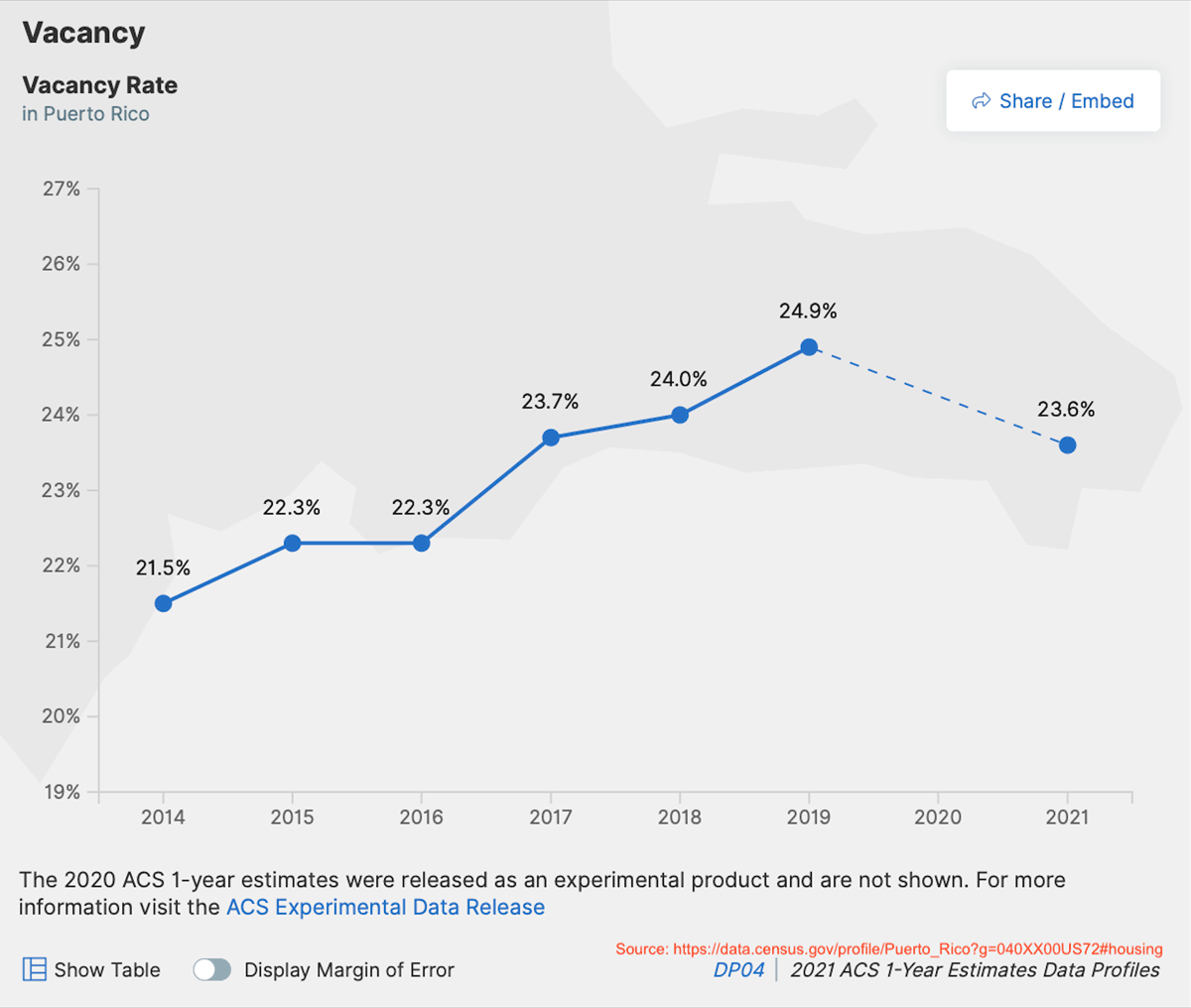
Figure 1
Vacancy rates for Puerto Rico. Source: https://data.census.gov.
A “boom” of occupy initiatives
Occupy initiatives to recuperate or reactivate abandoned properties began around 2012. The first squats in San Juan took place in the areas of Santurce and Río Piedras: PISO proyecto (Santurce, 2011); Save Velódromo (Río Piedras, 2012); and Cinema Paradiso en la Loíza (Santurce, 2012). These initiatives, like many that followed, were led by women. The squatters acted openly and sought visibility, which speaks to their conviction that they were contributing to rectifying a problem. The use of the term squatters is not arbitrary, as those who chose to occupy were neither owners, buyers, nor tenants. Since squatters were middle class (with the notable exception of one wealthy person), they were not seeking shelter. They were interested in taking advantage of existing infrastructure to meet personal and professional needs while fostering a different attitude towards a devalued urban space.
As a postrevolutionary movement (Bayat, 2013), squatters sought to peacefully and creatively challenge the sacredness of private property over public interest. Over time, many of them would claim their “right to the city” (Lefebvre, 2017; Harvey, 2012) to legitimate their efforts and counter the right of an absent and often delinquent owner. Though they aimed to create spaces for art, culture, education, recreation, gardening, etc., in many cases a single initiative displayed an interesting amalgam of interests and formats. The duration of the occupations was not a determining factor; however, most of the interventions rapidly achieved significant transformations, which prompted the desire to consolidate and extend over time.
Squatters may not have shared the same ideological motivation, but they were certainly not driven by an interest in obtaining an individual property title or profiting. Despite significantly different personal circumstances (income, background, etc.), self-sufficiency, communality, and popular education were key issues. Many also expressed support for Puertorrican independence—as misleading as it is to equate preferences for territorial status with social welfare, the independence movement has historically been stigmatized as leftist. As in other more or less contemporary movements (Sitrin, 2012; Gitlin, 2012), squatters explored non-hierarchical and participatory ways of organizing, and although they did not show interest in forming a supra-organization, there was crucial internal exchange, collaboration, and cooperation.
It can be said that the movement had direct external influence even if squatters and supporters did not explicitly express it. For example, among them where people who witnessed the occupied Zuccotti Park during Occupy Wall Street-NY, the occupied Tahrir Square (Egypt) during the popular uprising of 2011, and the occupied Plaza Catalunya (Barcelona) and Plaza del Sol (Madrid) during the Indignados in 2011. There were also squatters and supporters with close ties with the local left, and who had joined the massive civil disobedience and protest that managed to stop US-Navy practices on the island-municipality of Vieques. Although of a very different nature, there were also those whose involvement was motivated by their artistic practice or experience designing ephemeral interventions in abandoned spaces.
The table below compiles a non-exhaustive list of occupy initiatives divided into authorized and unauthorized (Figure 2). Authorized initiatives had some form of consent before or after occupation, while unauthorized “took” the property without consent or contravening any indication (oral or written) of ownership. Urbe Apié (2015) in Caguas, combined authorized and unauthorized squats. Typically, unauthorized squatters did not express interest in sitting down with owners, heirs, public officials, and/or supporters (legal advisors, donors, etc.) to obtain authorization and even acquire, until they realized the magnitude and economic costs of their ventures.
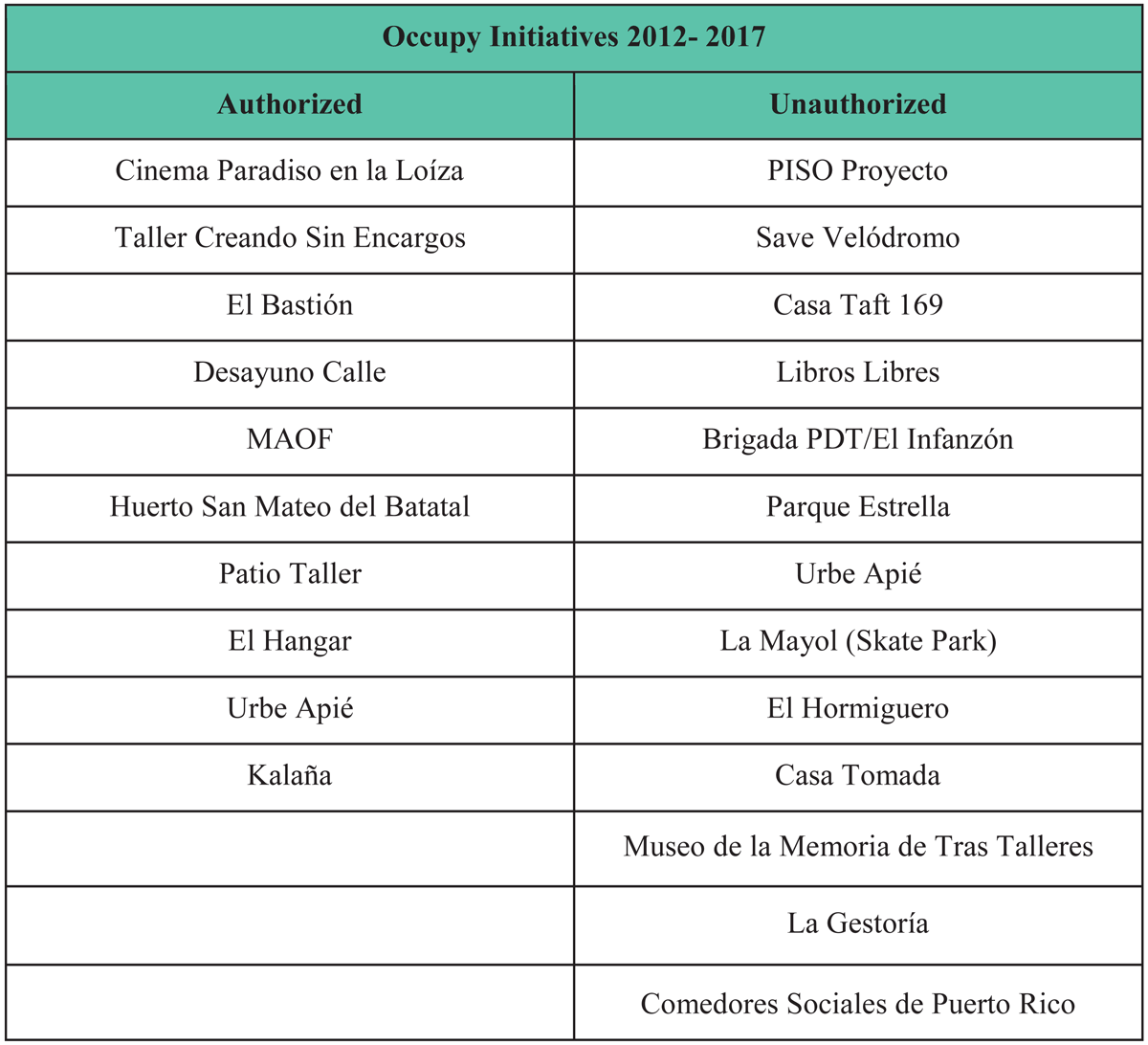
Figure 2
Occupy initiatives/Author compilation based on collaborations and site visits.
La movilización: the life of the occupy movement
Weaving the story of Casa Taft 169 with that of the occupy movement reveals the confluence of the personal with the political. It also shows how a web of individual circumstances, that is almost impossible to capture, can lead to collective action. Since I grew up just a short distance from Machuchal, I knew there was a beautiful property standing abandoned at 169 Taft Street long before I moved to 164 Taft Street in this part of Santurce in 2011. Today, Machuchal, historically populated by maroons just steps from a sandy shoreline (Aponte-Torres, 1985), is flanked by the most affluent urban area of San Juan, and the largest public housing project in Puerto Rico. The abandoned property had become a dumping ground where piles of construction debris started appearing just as I was carrying out renovation work on my new home. The fear of being blamed for this prompted me to act in a way that my mother seemed to predict, as she reproached me for buying a property in poor condition when the correct thing, according to her, was to occupy the empty house opposite.
The first time a group of neighbors gathered to clean up the dumping ground was in November 2012, but formal occupation did not take off until the summer of 2013. The decisive push was a heated incident between some neighbors and a group of teenagers who had apparently entered the nuisance property with the intention of breaking into nearby properties. Shortly after, a retired woman planted a small edible garden in front of the house, and that motivated the decision to clean and paint the facade of the building. In that context, a neighbor who had been my schoolmate and was studying architecture at the time, offered to help with the renovation of my home. Instead, I asked if he was willing to squat the abandoned property. He had just learned about squatting projects during a study trip to Berlin, so he did not hesitate. The next step was to paint a mural that covered only part of the façade to avoid hiding the problem. It ended up being multicolored due to the leftover paint that the neighbors donated during the painting process.
None of this emerged in a vacuum but in the context of the 2012 general and municipal elections. Sanjuaneros, in general, had to vote for a worn-out mayor or for a charismatic contender with a track record of supporting social causes. Machuchaleros, in particular, had to re-elect a conservative man who said he would redesign the bustling commercial corridor of calle Loíza (Loíza Street) or give a chance to a progressive woman who said she would support community initiatives. After she won the election, city officials began organizing meetings between residents, local business owners, and state and city police. These meetings were primarily focused on safety issues and eventually stopped, but they provided a space to connect and discuss other issues among neighbors. There were two other incentives: 1) two neighbors had managed to create an open-air Cinema Paradiso en la Loíza on a vacant lot where they had been showing films for free for over a year; and 2) the newly elected major had just sponsored the first Fiesta de la Calle Loíza, an urban street festival produced by a group of neighbors.
Casa Taft 169
As we claimed: A group of neighbors occupied a property that had been abandoned for nearly four decades to prevent the harm it was causing. The goal is to turn a nuisance building into a self-sustained and eco-friendly civic center; a place where the community can work together to improve their neighborhood and serve as a model for other communities seeking to recuperate and repurpose abandoned properties.
The claim appealed to two distinct but interconnected aspirations: to elaborate a participatory community plan based on the assessment, acquisition, and up-cycling of a nuisance property, and to gain the necessary knowledge and practical experience to pave the way for future squatters. Casa Taft 169 emphasized its proactive alignment with what appeared to be the new approach to municipal governance, seeking support to remedy the lack of a community space in Machuchal rather than demanding the municipality to excecute the project. True to the notion that it was not enough to provide a civic center to improve the lives of all Machuchaleros, the squatters also created the Asociación de Residentes Machuchal Revive (ARMaR), a resident’s association. Near the end of 2013, I received an invitation to meet with city officials, the first of many meetings I left without an unequivocal commitment of support. However, it was a very inspiring meeting because I met the women behind Save Velódromo and Cinema Paradiso en la Loíza and learned more about their work.
Access to the rear patio and the two buildings of Casa Taft 169 had been blocked up by the municipality in 2006 as part of a legal-administrative declaration of the property as estorbo público (nuisance property) (Figure 3). Thus, the first two years were dedicated to 1) reconditioning the exterior areas and a small rear building (cleaning, weeding, planting, painting, demolishing, etc.) and 2) complimentary community work in and outside Casa Taft 169 (fundraising, workshops, connecting with businesses along calle Loíza, pet vaccinations, etc.). Everything that was accomplished during those years was done because squatters (led by three adult women, two of them retired) held a meeting every Tuesday night and organized a day-long work brigade every Saturday, starting at 9 in the morning. These two regular events were outdoors and open to everyone interested in participating, whether it was two or three people or a large group of volunteers. The constant effort to engage other people and find essential support from neighbors, visitors, students, experts, scholars, etc. was very rewarding when reciprocity prevailed and deeply disappointing when opportunism prevailed.
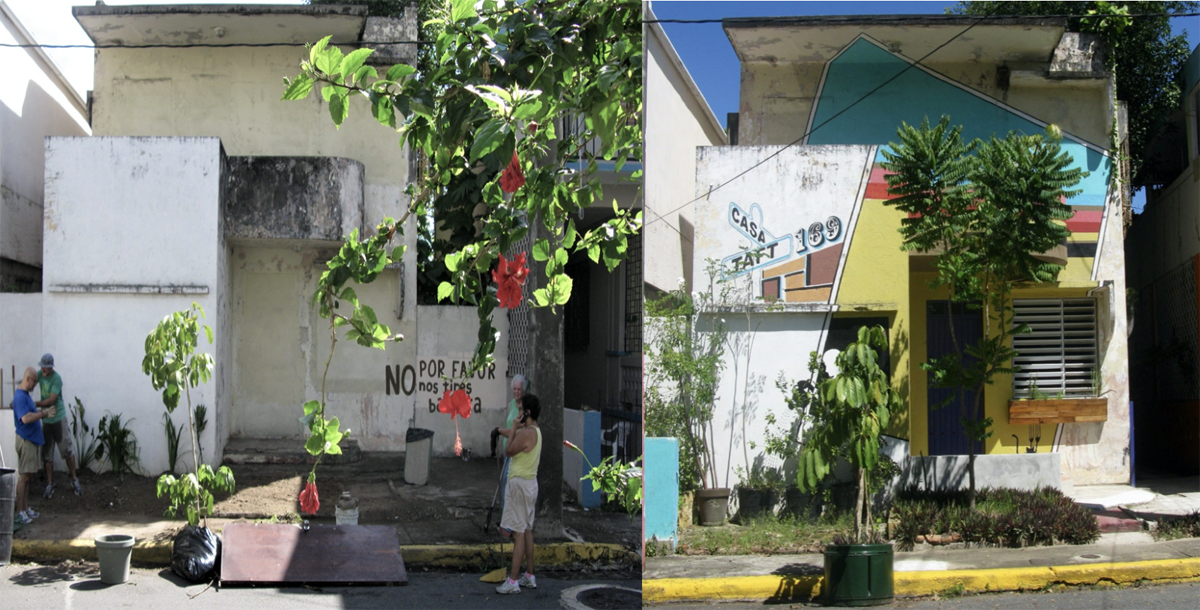
Figure 3
Casa Taft 169 in 2012 (left) and 2016 (right)/By Photographs by the author.
I also dedicated myself to understanding 1) the circumstances under which a property could remain abandoned indefinitely (and condemn a safe roof to ruin), 2) what could be (un)done to remedy such circumstances, and 3) what was required to rehabilitate the main building of Casa Taft 169. This led me to contact the family of the defunct owners of the property and learn about laws, property taxes (a property whose market value did not exceed $70,000 had accumulated a debt above $275,000), engineering, architecture, etc. Equally important, I dedicated myself to generating content for social media, giving talks, appearing on radio and television programs, etc. In a relatively short time, Casa Taft 169 became a reference for the communal right to land (Colón-Rodríguez and Rodríguez, 2020) and one of the go-to organizations for anything related to abandoned properties in Puerto Rico.
In early 2014, during a visit to the Pedro G. Goyco school, Casa Taft 169 discovered the appalling situation of the local public school: clientelism, lack of supplies, broken bathrooms and drinking fountains, violence, academic lag, etc. To provide immediate support to the school community, squatters moved dozens of volunteers to clean, plant, repair, paint, etc. Thinking long-term, the project collaborated with the Museum of Contemporary Art to offer an after-school arts program involving local artists (Figure 4). Despite its promising results, the arts program lasted one school year. In May 2015, the Department of Education (DE) unilaterally decided to close about one hundred public schools, including the Pedro G. Goyco school. The DE did offer alternatives or any kind of support to the families evicted from the public school, most of whom were poor, black and Dominican. Three months later, the government hit the community again, suspending the bus service between Machuchal and Barrio Obrero, a low-income community with a large black and Dominican population.
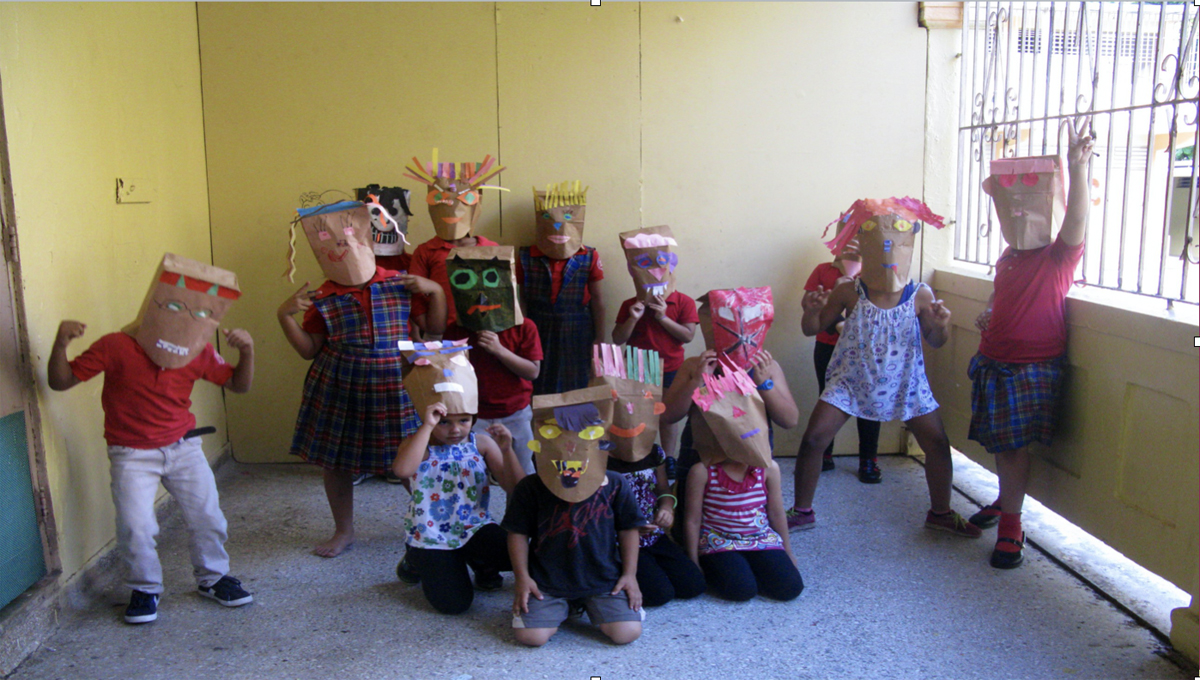
Figure 4
Children at Pedro G. Goyco school weeks before its closure (2015)/Photograph by the author.
Although Casa Taft 169 alone was a huge undertaking, reversing the closure of the Pedro G. Goyco School became a top priority. All of this coincided with the additional challenge of losing a vital extension of the project that provided electricity, water, storage space, etc., after I had to move out of 164 Taft Street. By then, the affective, community, professional, and political dimensions that Casa Taft 169 continued to acquire made it difficult to question its continuity. Even less so when expectations of receiving municipal support remained high. The experience in other countries continued to provide a source of motivation. Notably, the emergence of Podemos and municipalismo in Spain; which involved activists from the Indignados and the PHA (victims of abusive mortgages) movements that supported squat-based Centros Sociales Autogestionados (self-handled social centers). And the Empresas Recuperadas (recuperated factories) movement in Argentina. In fact, the research I carried out in that country led to the publication of local “toolkits” on how to recuperate abandoned properties in Puerto Rico.1
In early June 2015, a visit from a House Representative, and colleague of the mayor, prompted Casa Taft 169 to advocate for a change in public policy at the state level. Unlike the “tailored” alternatives that the project refused to accept, this alternative could be applied to those cases in a legal and tax situation like that of the property at 169 Taft Street. In 2016, Casa Taft 169 helped drafting a bill and launched the Todos Somos Herederos (We Are All Heirs) campaign to amend the Civil Code of Puerto Rico. The passing of Law 167-2016 gave municipalities legal power to inherit ab intestato real estate, formally declared estorbo público, as a previous step to transfer nuisance property to a non-profit organization without tax burdens. Legally, an estorbo público is an unattended, uninhabited and/or inadequate building and/or plot that threatens public and/or individual health and/or safety. In practice, it is often a building covered by vegetation, ruined, mined for metal products, a drug den, a mosquito breeding site, a dumping ground, etc.
In late 2016, the project Somos Machuchal, proposed in partnership with La Maraña, won ArtPlace’s National Creative Placemaking Fund. While Casa Taft 169 delegated the administration of the award, the project went from zero budget to $450,000 overnight. This event, like many others that influenced the trajectory of Casa Taft 169, had as its starting point an invitation to join a participatory process to ‘revitalize’ Santurce called Imagine Santurce.2 With the new law and the money needed to complete the rehabilitation of 169 Taft Street, enthusiasm grew as did the aspiration to help strengthen the occupy movement.
To give it even greater legitimacy, it became important to challenge the idea that the occupy movement had no precedent by referring to a third wave in the history of the squatting movement in Puerto Rico (Moscoso, 2018). This new wave had been preceded by a wave of “invaders” in the late 1960s and early 1970s. A movement represented by the call to ¡Desalambrar la tierra! (Unwire the land!) that was violently repressed (Cotto-Morales, 2006; Bonilla-Silva, 1993; Fontánez-Torres, 2020). Before them, tens of thousands of displaced peasants occupied the outskirts of Santurce in the first half of the 20th century (Llanes, 2001).
Private or public property?
Despite the enthusiasm, there was concern that the municipality would continue to drag its feet. Therefore, Casa Taft 169 hired a lawyer-activist and former municipal legislator with expertise in public nuisances and eminent domain laws, who had recently offered to help. Delegating the representation of the project seemed strategic to: 1) circumvent sexist and classist biases; 2) negotiate with the municipality in full command of legal jargon; and 3) extract a ‘pipeline’ to acquire/transfer nuisance properties to NGOs from the experience of Casa Taft 169. This person would also facilitate an ongoing exploration of alternative forms of land tenure and Community Land Banks (CLBs), which I added to my agenda after collaborating in the creation of the San Juan Community Land Bank in 2016.
In practice, the illusion of being a few steps away from overcoming the greatest challenges did not last. By September 2017, when Hurricanes Irma and María (just two weeks apart) devastated Puerto Rico,3 Casa Taft 169 was already trying to weather its own storm. A crisis fueled by how the new circumstances of the project impacted its internal functioning; its horizontality, its relationship with neighbors, collaborators, etc. The Casa Taft 169 that emerged from that crisis was a direct result of a greater crisis: mountains that seemed to have been scorched by fire, sandy coasts swallowed by the sea, and countless homes destroyed after being hit by man-made inequality and indifference. The new landscape before our eyes and the news that abandoned public school had been squatted by people in need of shelter suggested that occupy initiatives would multiply. By 2017, the plan to dismantle the public education system initiated in 2015 had reached 227 schools.4 In fact, in addition to combat poverty and illiteracy, many of these public schools were built to serve as shelters in case of emergency.
As I became more involved in the efforts to respond to the emergency, the need to create an organization dedicated to combating estorbos públicos throughout Puerto Rico became evident. Among the factors that reinforced that idea: 1) the growing desire to work with other communities and municipalities—the experience in San Juan continued to be rather disappointing; 2) the ambition to influence policies at the national level—there was a false belief that I could count on the support of the Secretary of Housing; and 3) the desire to organize a red nacional de espacios recuperados (a national network) to strengthen the occupy movement on the basis of mutual support.
The first step taken towards achieving these goals was to invite two close collaborators of Casa Taft 169, an architect and a lawyer, to co-create the Center for the Reconstruction of the Habitat (CRH). As expected, the CRH grew rapidly leveraging the name, trajectory, and resources of Casa Taft 169. Its incorporation in late 2017 coincided with that of Casa Taft 169, Inc., despite the fear this would completely alter the grassroots-ness of Casa Taft 169. In the end, the fear of losing the money granted to the project and starting over outweighed the reluctance to subordinate a community project to the interests of philanthropy and NGOs. On the basis of mutual support, the CRH would be based in Casa Taft 169 and would help develop the community project in Machuchal. This in turn would serve to demonstrate the feasibility of focusing community redevelopment plans on assessing estorbos públicos.
What I certainly did not predict was the emergence of a fundamentally different occupy movement that would target public school buildings (whether in impoverished urban, suburban, and rural communities) instead of private properties. Particularly, after the ELA/FOMB government opened the door to the possibility of usufructing, leasing, and even purchasing closed school buildings in line with its agenda of assetization of public property (Adisson and Halbert, 2022; Villanueva, Cobián and Rodríguez, 2018).5 The resounding call to combat public nuisances through community organizing, the outrageous abandonment of school buildings after the public schools were closed, and the fact that abandoned schools were now harming the communities they once served, led to a steadfast NGO-ization (Roy, 2003). Non-profit organizations (agricultural, cultural, educational, etc.) began to replace public schools across Puerto Rico, and Machuchal was no exception to this turn of events.
Demobilization and (counter)insurgency
At the end of 2016, it became known that the DE was going to transfer the Pedro G. Goyco school to the municipality of San Juan. The news raised hopes that opposition to the school closure would finally be heard—the multiple demonstrations, pickets, and petitions made by the community had been ignored. Relying on the personal and professional ties between a group of Machuchaleros and the municipality,6 Casa Taft 169 sought an alliance aimed at establishing a public Montessori school reinforced by the work of local artists, educators, activists, etc. The response revealed conflicting interests. By then, the proliferation of murals, restaurants, cafes, vintage shops, Airbnbs, etc., and the loss of local businesses sent an unequivocally dangerous signal (Dieppa, 2019). Fearing that the alternative plan to repurpose the public school as a co-working space would fuel the gentrification and touristification (Sequera and Nofre, 2018) of Machuchal, Casa Taft 169 declined to support any alternative that did not prioritize counteracting the harm caused to the most vulnerable Machuchaleros.
More than a year later, when Hurricane María contributed to reveal and amplify the vulnerable situation of most Machuchaleros, none of the alternatives contemplated by the municipality had prospered and the Pedro G. Goyco school had been abandoned for more than two years (Figure 5). This (briefly) rekindled the hope of reversing the loss of the public school, as well as the interest in rescatar (usufructing) the school building as a co-working space. This time, the latter became a critical objective for those Machuchaleros who had just lost their restaurant La Junta, which had become the epicenter of many of their cultural ventures (La Goyco, 2022).7
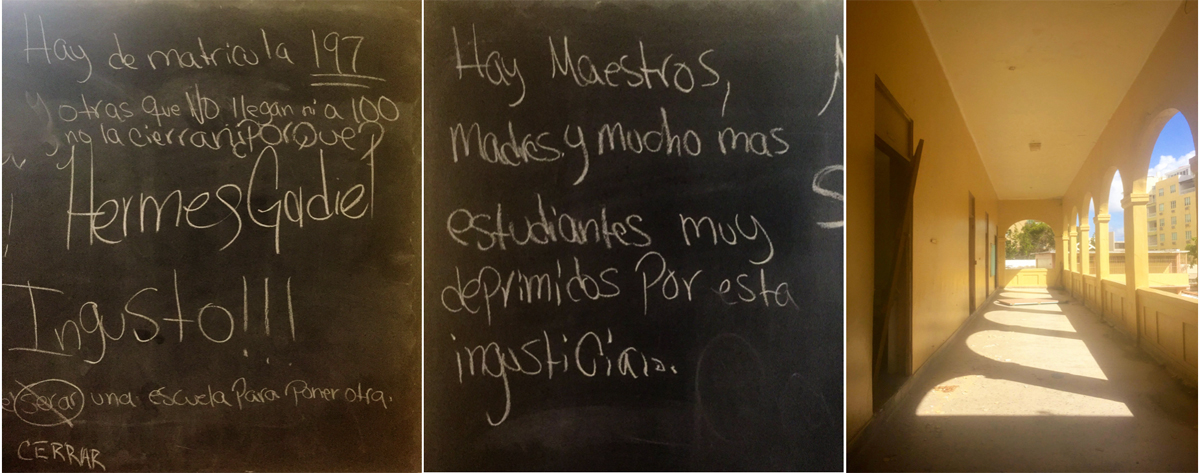
Figure 5
Messages found on blackboards in October 2017: “Why they close a school with 197 students while they keep schools with less than 100 open?”; Unfair!!!”; “They close a school to replace it with a different one“ (left) “There are teachers, moms and many more students very depressed by this injustice” (center)/Photographs by the author.
As Machuchal return to “normality”, the potlucks, the rails against the maelstrom of wage labor, the plans to squat to create a housing cooperative, and the hope that the municipality would keep its promise to facilitate a broad participatory process to decide the fate of the Pedro G. Goyco school all vanished. At the end of 2018, when calle Loíza became a Metropolitan Gastronomic and Cultural Center (Law 275), Taller Comunidad La Goyco (La Goyco Community Workshop) was already well underway. A year and a half later, a few months before leaving office, the mayor of San Juan organized an event to celebrate the free transfer of the public school building to the grassroots non-profit (Davis, et al., 2023) created for that purpose.
The experience of the occupy initiatives that attempted to recuperate private property for community purposes was different. In practice, the support offered by the municipality was more of a hands-off approach than a political commitment to find alternatives and/or circumvent existing bureaucratic, legal, regulatory, and procedural barriers. As such, gestures prevailed over the determination to deliver a document, a permit, an ordinance, etc. The constant oscillation between excitement, frustration, hope, and disappointment impacted initiatives economically, operationally, and organizationally. More crucially, the constant inconsistency drained the spirit of squatters and froze the momentum that the mayor herself had generated.8 By the end of 2020, after waiting in vain for support that never materialized, even the most vigorous squats like Casa Taft 169 and Brigada BDT/El Infanzón were exhausted.
After seven years and a large sum invested in legal services, Casa Taft 169 was still waiting for a title deed—even after having agreed to an expropriation9 instead of pursuing the Todos Somos Herederos alternative it had advocated for. Ultimately, the lack of formal ownership was a lesser evil compared to the impossibility of obtaining a simple authorization to demolish a crumbling roof or install electricity and water supplies. The collaboration agreement signed by the mayor, essential to obtain private funding, was of little use. The relative paralysis, professionalization, and the inevitable tensions between squatters led to debilitating internal conflicts. These tensions and conflicts may also have played a role in the disinterest in organizing an essential network of mutual support.
The erratic attitude of the municipality interplayed with another factor: the devastation in 2017 not only boosted the philanthropic sector but also proved to be a magnet for the real estate and financial sectors. This circumstance recalibrated in various ways both the non-profit and for-profit interest in combating estorbos públicos. By 2019 most unauthorized and even authorized squatters had been forced to vacate or had given up on prolonging their squats for fear of being evicted. Since relocating and starting over was not an option, most squatters ‘threw in the towel’ and unique spaces such as the indoor skatepark of La Mayol, the center for critical political and cultural action of El Hormiguero, or the feminist communal space of Casa Tomada simply disappeared. Those who had considered squatting just changed their minds and did not even try. Even doing what I called “the homework”, based on public information about ownership and delinquency, became increasingly difficult to accomplish.
In contrast, public and private support gave way to workshops, music concerts, film screenings (after Cinema Paradiso en la Loíza relocated), yoga classes, book readings, gardening, recycling, health fairs, and many more activities at the former Pedro G Goyco school. As expected, the pool of talent, entrepreneurial spirit, and resources from local artists, educators, and activists, etc. managed to transform an Escuela de la Comunidad (community school) that (mal)functioned under appalling material, institutional, and social conditions into a captivating space with a renovated library, studios, and a space dedicated to Afro-Puertorrican culture. However, the diminished presence of poor, black, and Dominican families who once walked down calle Loíza suggests that they are not the ones who have benefited from this transformation.
Assetization of abandoned public schools: Lucchetti and Segundo Ruiz Belvis
In October 2020, short after the CRH published a report on the condition of closed public schools (Rubiano, et al., 2020), a public entity acting as real estate broker, the Comité para la Evaluación y Disposición de Bienes Inmuebles (CEDBI), announced its intention to sell the Lucchetti school. This was the abandoned school I chose as a backdrop to present the findings of the report and expose the government’s wrongdoings.10 The call for sealed bids, ignored the historical and architectural value of the school building located in El Condado, one of the most affluent sectors of all of San Juan, adjacent to Machuchal. Such an omission opened the door to its demolition despite its architectural and historical value. For that reason, I teamed up with two architects and we embarked on a frantic race to deliver, on behalf of the Comité de Rescate Escuela Madame Lucchetti (rescue committee), an emergency nomination to the Official Registry of Historic Sites and Places of Puerto Rico (Berdecía, et al., 2021).
In addition to saving the Lucchetti school building, I also wanted to set a precedent that other communities could replicate in their attempts to protect their public schools. The Lucchetti was eventually registered which prevented its demolition, but did not save it from privatization. The government sold the public school building below its market value to Saint John’s school, one of the most exclusive and expensive private schools in Puerto Rico. This alternative prevailed over the one presented by the Museum of Contemporary Art to restore and usufruct the Lucchetti a short distance from the Rafael M. Labra school. The Rafael M. Labra public school became the home of the museum after the government closed and transferred the school building in 2002.
…..
Like the Pedro G. Goyco, the Lucchetti and the Rafael M. Labra, the Segundo Ruiz Belvis school building is one of the oldest monumental buildings in Santurce and Puerto Rico. These four public schools share another characteristic: their prime location. The DE first threatened to close the public school located in El Gandul, another poor and black community in Santurce facing neglect and gentrification, in 2017. The closure sparked strong opposition, so the DE waited until 2018 to evict the school community and abandon the public building. In 2021, Fundación Banco Popular, the philanthropic arm of the largest financial institution in the territory acquired the public building below its market value.
Noteworthy, the Segundo Ruiz Belvis school building is surrounded by several abandoned buildings. One of them, the historic and monumental Café Yaucono factory, has been abandoned for nearly two decades. Another one is a former branch of the Banco Popular itself. This two-story building with a large parking lot has been vacant and boarded up for several years. The sale of the Segundo Ruiz Belvis public school did not cause much social unrest (people posted condemnatory comments on social media) even though this transaction involved a financial institution directly responsible for spreading housing insecurity throughout Puerto Rico. In late 2022, the Fundación Banco Popular announced with great fanfare that the school building was going to be renovated (using New Market Tax Credits) and turned over to a non-profit dedicated to arts and technology.
Conclusion
Ruined by decades of neoliberal policies and flooded with abandoned properties, Puerto Rico experienced a wave of occupy initiatives between 2012 and 2017. In a supposedly fertile political context, many of these initiatives squatted private estorbos públicos in the capital city of San Juan. The emergence of the occupy movement narrowly preceded a plan implemented by the colonial ELA/FOMB government to further suffocate the territory with ultra-liberal measures, reformulated in terms of “austerity” (an alleged reduction in public spending), and containment of public debt. To top it all off, the devastating impact of two major hurricanes in 2017 served to expedite this agenda following the user manual of shock doctrine and disaster capitalism (Klein, 2007; 2018). These forces facilitated the quiet eviction of the occupy movement: directly, by a lack of decisive public support, and indirectly, by the “charitable” disposal of public schools.
Given the racist, sexist and classist nature (Zambrana, 2021) of the ELA/FOMB’s ‘austericidal’ and ‘debticidal’ measures (i.e., the costs of accessing food, education, housing, culture, health, electricity, etc. have skyrocketed), they have critically harmed racialized and marginalized women and communities.11 The community of Machuchal offers a unique case study of the precarization, displacement, dispossession, and violence that these measures have brought about. In particular, the closure of hundreds of public schools. As in other jurisdictions in the US, the unilateral subtraction of the Pedro G. Goyco school allowed for an urban “renewal” without the bulldozers (Berkshire, 2015). Moreover, the usufruct of the public school, like the co-location reform implemented in New York City, has served to cloak the racial inequities wrought by the disintegrative force of racialized organized abandonment (Benson, 2019), considering that it did not seek to prevent the displacement of poor, low-income, black, and migrant families.
In many ways, Machuchal is much worse off today than it was a decade ago, when a group of Machuchaleros squatted an ordinary property at 169 Taft Street as a first step to help “complete” the neighborhood by repurposing privately owned estorbos públicos and rescuing the local public school. As Casa Taft 169 feared and Ramos Zayas (2023) have documented, the transformation of Machuchal has satisfied the aspirations and expand the privileges of an urban middle and upper-middle class that did not even circulate on calle Loíza before its “revival” (Ramos-Zayas, 2023). The whitening of the community attests to the extent to which precarization and auto-emprendimiento (entrepreneurialism) lead people to a perverse crossroads where they must choose, if not compete, to access vital goods, supplies, spaces, and services. The rapid touristification of Machuchal (Figure 6) also demonstrates the successful bet that the state, the municipality, and local elites made on a radically different and cost-effective strategy to “revitalize” Santurce: disinvest + embrace community initiatives + promote the visitor economy.
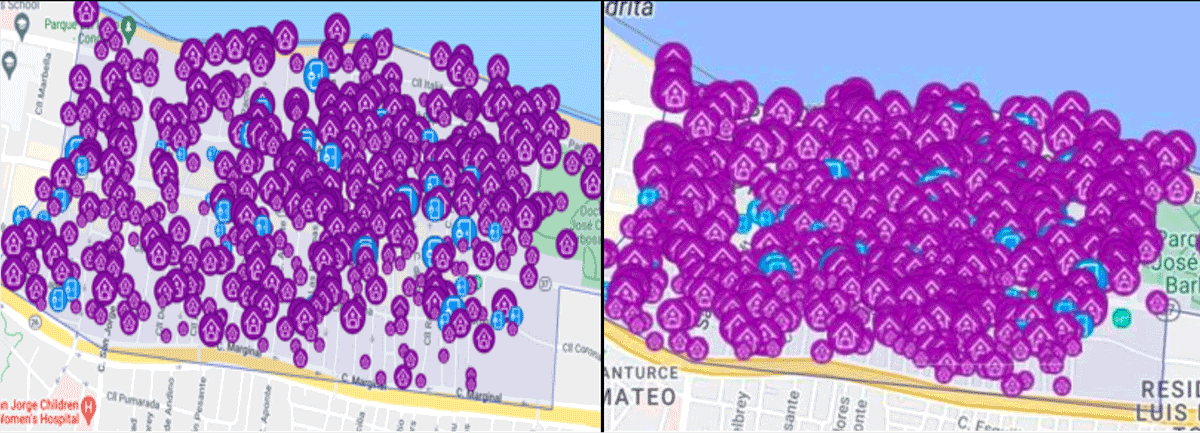
Figure 6
Vacation rentals in Machuchal in November 2022 (left) and August 2023 (right)/airdna.co (screenshots)/Photographs by the author.
For the most part, resistance studies focus on how “ordinary” people challenge various forms of explicit and veiled violence from the bottom up. Fewer studies focus on how elites organize to advance their interests, and very few look at the middle classes. An exception from the planning field is Eizenberg’s (2019) categorization of three forms of self-organization: 1) by the disenfranchised for basic rights, 2) by the ordinary for community interests; and 3) by the powerful for economic gain. From a political economy approach, Gago (2015) further complicates matters challenging uncritical victimization/romanticization of resistance in times of neoliberal immanence; considering the governmentality of racialized migrants who often engage in opportunistic, obscure, and exploitative saber-hacer (know-how). Brusi’s (2008) research on deluxe squatters in Puerto Rico is another formidable example from the field of anthropology.
Any critical approach must take into account that, in practice, class, gender, nationality, literacy,12 etc., intersect activism in ways that are not radically different from how they determine the lives of differentiated citizens (Holston, 2009) within a system skillfully crafted to perpetuate differentiated entitlements. In Puerto Rico, one must also take into account the degree to which community organizing, activism, and advocacy have been increasingly commodified and subordinated to the (in)ability to access grants, media, professional services, academia, and even the Puertorrican diaspora. This circumstance has ’popularized’ extraordinary forms of resistance, paraphrasing Scott (1989), that act from the middle and inwards (Moscoso, 2023) and interact in tricky ways with historical and deep-rooted clientelism. This is the case of those who denounce the gentrification or touristification of their neighborhood without fear of being priced out from their homes, businesses, and communities (as landowners, they may even benefit from an increase in the value of their real estate). This is also the case of those who rescue a public school to establish a non-profit organization while being able to afford a private school for their children. The question then arises: if insurgent practices are characterized as counter-hegemonic, transgressive and imaginative (Miraftab, 2019), to what extent are the responses that normalize and even exacerbate precarization, forced displacement, and dispossession acts of resistance or counterinsurgency?
When I first wrote about the third wave in the history of the occupy movement in Puerto Rico (Moscoso, 2018) I was convinced of the transformative potential of the movement and even avoided addressing the squatting of closed public schools.13 What could have been done differently to prevent the eviction of the occupy movement? How to turn defeat into a source of learning? Clearly there was a lot of individual and collective naivety, not in the possibility of outwitting the establishment but in underestimating its ability to distort the fight against estorbos públicos in its favor (CPI, 2023). Given that precarization and discontent continue to deepen, it is possible to expect new waves in the long history of the squatting movement in Puerto Rico. Regarding the assetization of public schools, is it possible to escape the perverse crossroads into which we have been thrown and reverse the damages? The possibility to find answers and offer alternatives lies in our ability to co-create safe spaces where difficult but vital conversations can begin to take place.
Notes
[1] The Center for Habitat Reconstruction published two guides dedicated to abandoned properties, and Vamos published one guide dedicated to abandoned public schools, originally inspired by the Cuadernos para la Autogestión, a series of manuals designed to support the conversion of abandoned factories into worker cooperatives published by the Aula Abierta Program of the Department of Philosophy and Letters of the University of Buenos Aires.
[2] It was sponsored by Foundation for Puerto Rico, a non-profit organization who had just established it headquarters in Santurce and brought an expert in placemaking from MIT.
[3] To learn more, watch The battle for paradise: Naomi Klein report from Puerto Rico. (https://www.youtube.com/watch?v=pTiZtYaB3Zo).
[4] That number rose to 255 in 2018. Between 2007 and 2018, the Department of Education closed 673 schools, representing 44% of all school buildings (Rubiano, et al., 2020).
[5] I stopped receiving calls from people interested in squatting private properties and started receiving them from people interested in “getting” a public school.
[6] Casa Taft 169 was aware that there were families who could not even provide a full meal for their children other than what was provided in the Pedro G. Goyco school.
[7] Among them were La Fiesta de la Calle Loíza, La Calle Loíza digital magazine, guided-walking tours in Machuchal, and content for Radio San Juan.
[8] The experience of Urbe Apié and Comedores Sociales de Puerto Rico (Soup Kitchens) was different, and both continue evolving in the municipality of Caguas south of San Juan.
[10] Even the CRH targeted an abandoned school for its headquarters after a forced reconfiguration of the organization. One can find videos and tutorials online prompting people to purchase abandoned schools as a lucrative real estate investment.
Competing Interests
The author has no competing interests to declare.