
Introduction
The Landless Workers’ Movement (Movimento dos Trabalhadores Rurais Sem Terra, hereinafter referred to as the ‘MST’) has been at the forefront of the struggle for agrarian reform in Brazil since the 1980s, attracting the attention of media, scholars, local elites, and political parties. The MST is a revolutionary Marxist mobilization of peasants, focusing on their constitutional right to occupy unproductive farmlands (Brazilian Const. art. 184 and 186). It leverages the legal framework to expropriate these farmlands in favor of the rural poor. However, recent transformations of the MST have not been sufficiently described in the current literature model. Class struggles continue to be a fundamental part of the MST’s agenda, though the movement also started to discuss ethnicity, gender, sexuality, and environmentalism. These discussions debuted at different moments inside the MST and are further explored in the analysis. Identities have become important principles for political mobilization against large-scale agribusiness and land concentration. On the MST’s digital platforms and official webpage, the ‘hammer and sickle’ symbols have largely been replaced by rainbow flags, Venus symbols, and references to the Black Lives Matter (BLM) movement.
This study explores the impact of the environmental movement and identity-based mobilization on the MST’s views regarding land justice. First, it situates the reader within the social movement and intersectionality studies; subsequently, it analyses six posts from the MST’s Instagram account, which represents a discursive arena supporting the organization’s activism. The MST is very active on Instagram, and six posts constitute a small part of such activity. Therefore, this study only provides a careful selection of some of the movement’s intersectional claims. Each post is therefore a preliminary link to a broader discussion to be further explored. The methods of analysis center on framing for social movements as presented by David Snow, alongside contributions from intersectionality and agrarian studies perspectives.
This study argues that the MST has benefited from and contributed to much-needed forms of reinterpreting land inequality in Brazil without fundamentally changing its political ideology. The conclusion addresses the emergence of an intersectional political subject within the MST, ultimately showing new ways of enacting and communicating agrarian mobilization via social media in Brazil and elsewhere.
Beyond ‘old’ and ‘new’ social movements
Allegedly, one of the hallmarks of social movement literature is the paradigm of ‘new’ social movements, also known as the ‘postmodern turn’ (Tarlau 2018). The works of Laclau and Mouffe (1985) and Castells (2009) draw from the critique that the working class—the ‘revolutionary agent’ against the hegemonic power in Marxist tradition—fails to represent the diversity of groups and interests found in contemporary societies. According to these authors, movements seeking to enact social change had to construct a new form of antagonism aligned with social diversity. Hence, the global proliferation of movements centered on the ideas of ethnicity, feminism, animal welfare, (dis)ability, sexual and gender diversity, environmentalism, and indigeneity, among others.
In the MST’s repertoire, the ‘working class’ translates into ‘peasants.’ The peasantry continues to feature predominantly in the MST’s vocabulary. However, despite the persistence of class alliances centered on the peasantry, the impact of the postmodern turn in the MST can be considered notorious. Hence, the establishment of the MST’s gender sector and lesbian, gay, bisexual, and transgender (LGBT) collective in 2000 and 2017, respectively (Mariano and Paz 2018). Moreover, the MST has incorporated environmentalism—or a version of it that is highly informed by agroecology—into its framework (Hernandez 2020).
The convergence of labor and identities within social movements is not new. Kelly (1998) investigated this topic in his ‘fusion theory,’ which was recently revisited by Heery (2018). Additionally, Marxist feminist theory has long criticized market economies for using both marginalized groups and the environment as resources for profit (Moeckli and Braun 2001; Giménez 2018). In this study, I draw on these ideas to present how the MST frames the boundaries between capitalist accumulation, human diversity, and the environment in the selected Instagram posts.
Advancing intersectionality
Intersectionality has been used in feminist literature to uncover how different social identities intersect with one another, resulting in distinct lived realities for different groups of people. This concept was coined in 1989 by Kimberlé Crenshaw to give visibility to African American women whose experiences could not be grasped by looking at ‘women’ or ‘African Americans’ alone. Without intersectionality, there is a false sense that people associated with one social identification are equally affected by different social forces (Guittar and Guittar 2015).
Despite its radical origins, some scholars have noted the loss of the emancipatory character of intersectionality in two relatable ways. First, intersectionality has been overly concerned with the individual (Hancock 2007), ultimately undermining a working alliance to address power differentials (Reed 2019). Second, the instrumentalization of intersectionality into the inert idea of ‘diversity’ emphasizes differences rather than change (Mohanty 2013; Salem 2018). As Bilge (2013) points out, the neoliberal logic created conditions to disarticulate the founding conceptions of intersectionality at the same pace that ‘diversity’ became a precept of good governance and efficient business. In ‘Freedom is a Constant Struggle,’ Angela Davis wrote that she finds the conceptualization of the intersectionality of struggles most interesting. She asks, ‘Initially intersectionality was about bodies and experiences. But now, how do we talk about bringing various social justice struggles together across national borders?’ (2016, 19). I draw from these critiques to shed light on the notion of ‘political intersectionality’ and reconnect intersectionality to agency.
According to Vardeman-Winter et al. (2013) and Price (2018), political intersectionality concerns the tactics employed by political actors, and how these may include or exclude groups of people. To maneuver political intersectionality in favor of an intersectional emancipatory change, actors committed to social justice must act both politically and collectively. In this regard, the expertise of social movements in coalition building is significant. Coalition building plays a central role in achieving political intersectionality because it can translate across different movements and cultures. For instance, to address both gender equality and environmental justice, the MST must bridge the positionalities of women and the environment in relation to land justice in Brazil. Bridging these divisions requires successful frame alignment (Snow et al. 1986), as evidenced by the MST and analyzed in the following pages.
Materials and Methods
Case selection and ethics
The data presented in this study includes a selection of posts from the MST’s Instagram feed. Instagram was chosen over Twitter and Facebook because it has the largest number of followers. As of July 2023, the MST had 921,00 Instagram followers compared to 353,000 and 417,000 on Twitter and Facebook, respectively. The posts were selected via purposive sampling, wherein the selection criteria were that each post should convey rich intersectional claims, broadening the interpretation of land justice in Brazil.
The sampling was limited to posts published between January 2021 and June 2022. According to analytics provided by the app InsTrack, this period included an estimated 3,118 posts. The author saved a total of 23 posts for further consideration, purposefully selecting six posts for in-depth qualitative analysis based on their representative claims. Six posts constitute a minimal fraction of the total dataset and are insufficient on their own to support statements about the MST as a whole. With that in mind, the analysis relies on existing literature to support, contest, or contextualize the post’s claims. In other cases, the analysis will urge further investigation. This is especially true when evidence from existing literature is scarce.
The scanning and selection of posts were performed manually because Instagram’s terms of use prohibit any kind of data scraping or content caching. Based on the related ethical implications, tools such as Instaloader and 4K stogram for metadata download were disregarded. Ethics were also a consideration on the basis that the sampled material is accessible to everyone on Instagram. This study neither relies on any source of primary data nor does it use data from private accounts as a data source. It does not disclose any personal information other than that which is already publicly disclosed by the MST.
Data presentation
Each post is analyzed based on the following: ‘Composition,’ which includes descriptive information about the post alongside a translation of texts in the image relevant to the analysis. ‘Contextual knowledge,’ which carries background information and/or literature related to the MST and Brazilian society necessary to make sense of the post; and ‘framing analysis’ where framing theory is applied.
Analytical framework
Framing analysis (Snow et al. 1986; Benford and Snow 2000; Snow 2013) has gained currency in social movement studies for understanding movements as signifying agents engaged in the construction and maintenance of meaning. This study focuses on two main types of framing activities: ‘core framing tasks’ and ‘frame alignment processes’ (see Table 1). Core framing tasks represent reality in terms of diagnosis, prognosis, and motivation. ‘Diagnosis’ addresses what is problematic in the rural context of Brazil and attributes responsibility for what is wrong, ‘prognosis’ articulates the MST’s proposed solutions, and ‘motivation’ includes a call to arms by employing vocabularies of justification that empower individuals to overcome the risks associated with collective action.
Table 1
Frames in connection with the MST’s intersectional representation.
| Core framing tasks | Diagnosis | ‘Blames’ someone or something for what is wrong. |
| Prognosis | Addresses the question of ‘what needs to be done.’ | |
| Motivation | Provides vocabularies, justification, and encouragement. | |
| Frame alignment processes | The intersection of two or more structurally disconnected but ideologically compatible struggles. It may include telling stories of real people, citing an event, or presenting numbers to broaden the MST’s primary framework and include viewpoints that are marginal to the movement’s primary objectives of land reform and land justice. | |
The second framing activity in this study, frame alignment processes, concerns the links between two or more compatible but structurally disconnected ideas in favor of the MST’s interests. In the original literature (Snow et al. 1986), frame alignment processes are categorized into bridging, amplification, extension, and transformation. This study opted not to exhaustively differentiate each frame alignment process in its analysis. Instead, frame alignment processes in the MST are analyzed without granular attention to naming because they all target ‘unmobilized sentiment pools’ (Snow et al. 1986).
‘Core framing tasks’ are useful when decoding the MST’s polarizing narratives of the peasantry vs. agribusiness (Bernstein 2014; Edelman et al. 2014), while ‘frame alignment processes’ are useful when scrutinizing how other-than-peasant identities are situated within this polarization.
Visual analysis
The literature on framing for social movements has been subjected to substantial reviews, yet framing has predominantly relied on the analysis of texts. This study sheds light on a small but significant area of research that combines framing literature and visual analysis. Examples of such academics include Safaian and Teune (2021) and McGarry et al. (2019). Visual analysis is essential in this study because social media represents a multimodal ‘repertoire of communication’ (Mattoni 2013), where messages are conveyed through texts and images. The visual is especially relevant for analyzing Instagram, which relies on several affordances (i.e. the possibility for action that emerges from Instagram’s design) for symbolic expression (Hutchby 2001). Moreover, visual and textual languages should not be treated as separate languages in social media. According to Safaian and Teune (2021), visual data is an important additional source for communication due to deep-rooted effects, which are different from those of texts. For instance, citing deforestation in the Amazon does not evoke the same emotional responses as showing an image of a forest on fire.
Framing Intersectional Activism
The six Instagram posts below are representative of different themes concerning MST’s intersectional activism. They illustrate how the MST frames intersectionality to address land justice in Brazil.
Post 1: Peasants vs. capital (Figure 1)

Figure 1
Life-affirming and against pesticides. Posted on December 1, 2021.
Composition: The post invites the audience to a ‘Cultural festival for life and against pesticides.’ The bottom-left corner of the image shows a group of people of different skin colors, genders, and ages carrying different crops. The banner in the field reads, ‘we do not use poison here.’ There is a fence on which a yellow triangle featuring a hazard symbol is placed. On the other side of the fence, an aircraft is observed spraying pesticides on a monoculture. Above this monoculture, the campaign logo can be observed. The logo includes a skull on a plate between a fork and knife, with the text ‘pesticide kills.’
Contextual knowledge: The post is part of the ‘Pesticide Kills’ (Agrotóxico Mata) campaign organized by educational institutions, NGOs, and social movements—including the MST. The fight against pesticides and genetically modified seeds is a fundamental part of the MST’s agenda (Hernandez 2020). Such a fight must be understood within the movement’s search for a popular agrarian reform to produce healthy food without pesticides ‘with an agroecological technological matrix’ (Bastos 2018, p. 222).
Framing analysis: The post represents the MST’s ‘conceptual architecture’ (Snow 2013) in its traditional form, that is, its diagnosis and prognosis are polarized between agribusiness and peasants. On one side, there is the diagnosis that pesticides kill and that large-scale agriculture facilitates the proliferation of pesticide use; on the other, there is the prognosis that peasant-driven agriculture is the solution to the hazards of capitalist agriculture. The specific harm caused by pesticides is not clearly stated, but the composition shows both a human skull on a plate and a lack of crop variety. The illustration symbolizes both the dangers to human lives through the ingestion of food containing contaminants and the loss of biodiversity as an outcome of capitalist agriculture.
Motivational framing often addresses the moral priority in each struggle. In this case, it is rooted in humans’ responsibility to preserve life and diversity. Here, peasant-driven agriculture is presented as a course of action that can bring life, not poison, to people’s plates. It also represents an agricultural model in which biodiversity flourishes. Gamson et al. (1992) refer to motivation framing as the ‘agency’ component in collective action frames—and as such, the post presents the audience with a call to arms to take part in the festival against pesticides together with the MST.
Post 2: Gender equality as agrarian reform (Figure 2)

Figure 2
Fighting against gender-based violence is agrarian reform. Posted on June 12, 2022.
Composition: The header states ‘Countering violence against women and fighting for gender equality is popular agrarian reform.’ Below, there is a photograph from the national march of landless women organized by the MST in March 2022. The women in the photograph are carrying banners with messages such as ‘Enough of femicide’ and ‘Agri(business) is death, pest, and profit.’ The main poster at the bottom states, ‘Land, labor, right to exist. Women are fighting, will not succumb.’ The hashtags used for this march were: #LandlessWomen, #AgainstTheVirusAndViolences, and #Valentine’sDay.
Contextual knowledge: The post was published on Valentine’s Day in Brazil (celebrated on June 12th) to raise awareness against gender-related violence. Women activists in the MST have been mobilizing since the first National Congress of the Landless was organized by the MST in 1985 (Amaral 2018). However, it was not until 2000 that the movement formalized its gender sector. The claims of representation on behalf of women farmers portray the earliest form of intersectional activism in the MST (Mariano and Paz 2018), which acknowledged that neither ‘peasant’ nor ‘landless’ were categories that could sufficiently address the specific demands of women in the movement. Nonetheless, the literature also informs of the persistence of crippling patriarchal structures within the movement, especially on the ground (Caldeira 2009; Vergara-Camus 2014).
Framing analysis: ‘Diagnosis’ is framed by the woman carrying the poster stating that ‘agri(business) is death, pest, and profit.’ In other words, the post held agribusiness responsible for violence against women. The prognosis is that fighting for agrarian reform is a way of countering violence against women. However, agrarian reform, as a concept, does not inherently address gender. The MST attempts to overcome such a gap by framing a ‘popular agrarian reform’, as stated in the heading of the post. Bastos (2018) explains that the project of a popular agrarian reform addresses the insufficiency of the peasantry to carry out an agrarian reform alone. Thus, ‘popular’ is a framing that seeks alignment with all working classes to fight for systemic change, including the standpoint of women.
The post dialogues with political intersectionality by ‘gendering’ the politics of land redistribution and bringing the rural perspective to the fight against gender-based violence. This framing is amplified by the women carrying posters demanding the end of femicide, access to land and work, and the ‘right of women to exist.’ These demands provide the frame with the ‘hot cognition’ (Snow 2013) component of femicide to overcome individuals’ indifference and garner enhanced support (Snow et al. 1986).
The hashtag ‘#AgainstTheVirusAndViolences’ situates the post within the context of the COVID-19 pandemic when cases of domestic violence increased. Additionally, the ‘#Valentine’sDay’ hashtag aligns with broader cultural celebrations, using the holiday to convey a message of agrarian reform and gender equality. Another hashtag, ‘#LandlessWomen’ (#MulheresSemTerra), is repeatedly used by the MST to represent this intersectional identity. As of July 2023, the hashtag ‘#LandlessWomen’ accounts for 2,501 appearances on Instagram alone.
The women’s struggle in the MST may represent a certain ‘locality’ in the movement. In other words, the intersectional activism of women peasants has advanced substantially inside the gender sector but not within the movement as a whole. This distinction is classified by Snow et al. (1986) between ‘domain-specific’ and ‘global’ frames. Women in the MST continue to face the task of extending the gender perspective inside the movement, eventually covering the gaps highlighted by Caldeira (2009) and Vergara-Camus (2014). This study encourages scholars to further update academic knowledge on the intersection of gender and land justice in the MST.
Post 3: Agroecology and diversity (Figure 3)
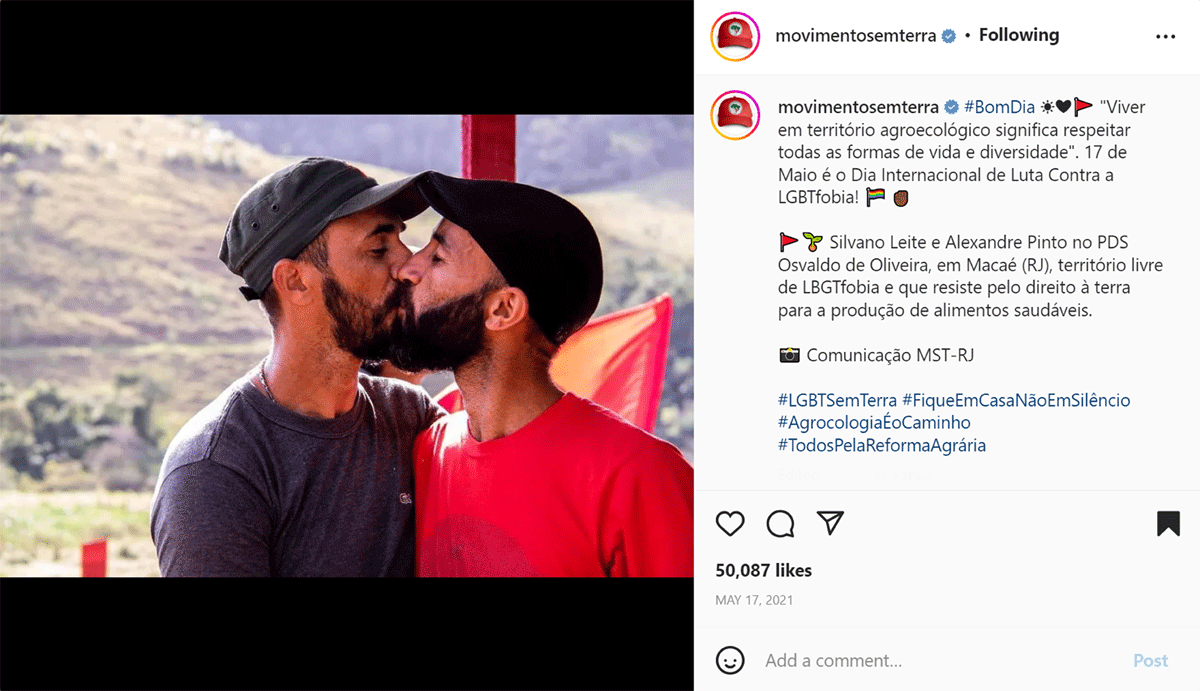
Figure 3
Agroecology and sexual diversity. Posted on May 17, 2021.
Composition: The post, with over 50,000 likes, has the following caption: ‘To live in an agroecological territory is to respect all forms of life and diversity,’ which is accompanied by a picture of two men kissing. The text states that May 17th is the International Day against LGBT-phobia, and claims the portrayed MTS community to be a ‘Territory free of LGBT-phobia that resists for the sake of land justice and the right to produce healthy food.’ Other aligned hashtags include #LandlessLGBT, #StayAtHomeNotInSilence, #AgroecologyIsTheWay, and #AllTogetherForAgrarianReform.
Contextual knowledge: Agroecology combines applied ecology and agricultural production. It debuted in the MST during the turn of the millennium and initially sparked resistance from settlements. Today, agroecology has transitioned from the sidelines to one of the MST’s main principles and practices (Hernandez 2020).
Regarding the inclusion of sexual and gender diversity in its agenda, the MST institutionalized its LGBT collective in 2017. While the formation of the LGBT collective is the outcome of internal activism, it is also a response to the politicization of sexuality that took place in Brazil during the 2010s. This is illustrated by the election of ‘homophobe and proud of it’ President Bolsonaro in 2018 (Mariano and Paz 2018).
Framing analysis: The most prominent framing in the post is its prognosis. According to the MST, agroecology can counter LGBT-phobia and transform settlements into communities where ‘all forms of life and diversity’ are respected. Post 3 can be viewed as a continuation of Post 1, which propounds that peasant-driven agriculture is a place where all forms of diversity flourish—this is in opposition to agribusiness, where diversity diminishes.
Thus, under the MST, agroecology has been framed in its full holistic potential. For the MST, agricultural practices, guided by ecological principles, must not be a matter of implementing organic regenerative polyculture alone; they must also encompass diversity and respect for people engaged in agriculture. When presented this way, agroecology serves the dual purpose of opposing large-scale agribusiness practices that are highly reliant on monocropping while promoting gender and sexual diversity in society.
This post illustrates the role of agroecology in the political ideology of rural proletarian movements, such as the MST. According to Meek (2014), agroecology acts as a resource for these movements because the overlap between society and the environment is a primary point of dispute between neoliberalism and anti-neoliberalism. Agroecology is a rich resource for frame alignment for envisioning harmonic relations between human and non-human nature that also provides support to other marginalized groups such as women, African Brazilians, and indigenous peoples.
The hashtag #LandlessLGBT (#LGBTSemTerra) is a construct by the MST to represent this intersectional identity. As of July 2023, 1433 Instagram posts used the hashtag. Sexual and gender minorities ‘were always there’ in rural areas; however, the lack of vocabulary has made them historically invisible. The crafting of the ‘landless LGBT’ identity is a positive endeavor (Snow 2013; Reed 2019) that broadens MST’s pool of adherents by garnering sympathy toward the MST from LGBT people who live in the city and are unresponsive to the political subjects of ‘peasant’ or ‘landless.’
The political currency of appealing to marginalized groups also factors into the MST’s promotion of LGBT rights. The MST resorts to the LGBT struggle to communicate the movement’s primary framework of popular agrarian reform. The post calls for ‘resistance’ by and on behalf of the portrayed community, which was facing eviction threats at the time of publication (Miranda 2021).
Similar to Post 2, the MST has formalized representation on behalf of its LGBT members (Mariano and Paz 2018). However, in contrast to women’s struggles, there is a scarcity of ethnographic studies assessing the quality of such representation. The analysis of this post provides a preliminary link into the intersection of the peasantry and queerness in the movement, and encourages scholars to use the post as a point of departure for future investigation.
Post 4: Land justice and the Quilombo movement (Figure 4)
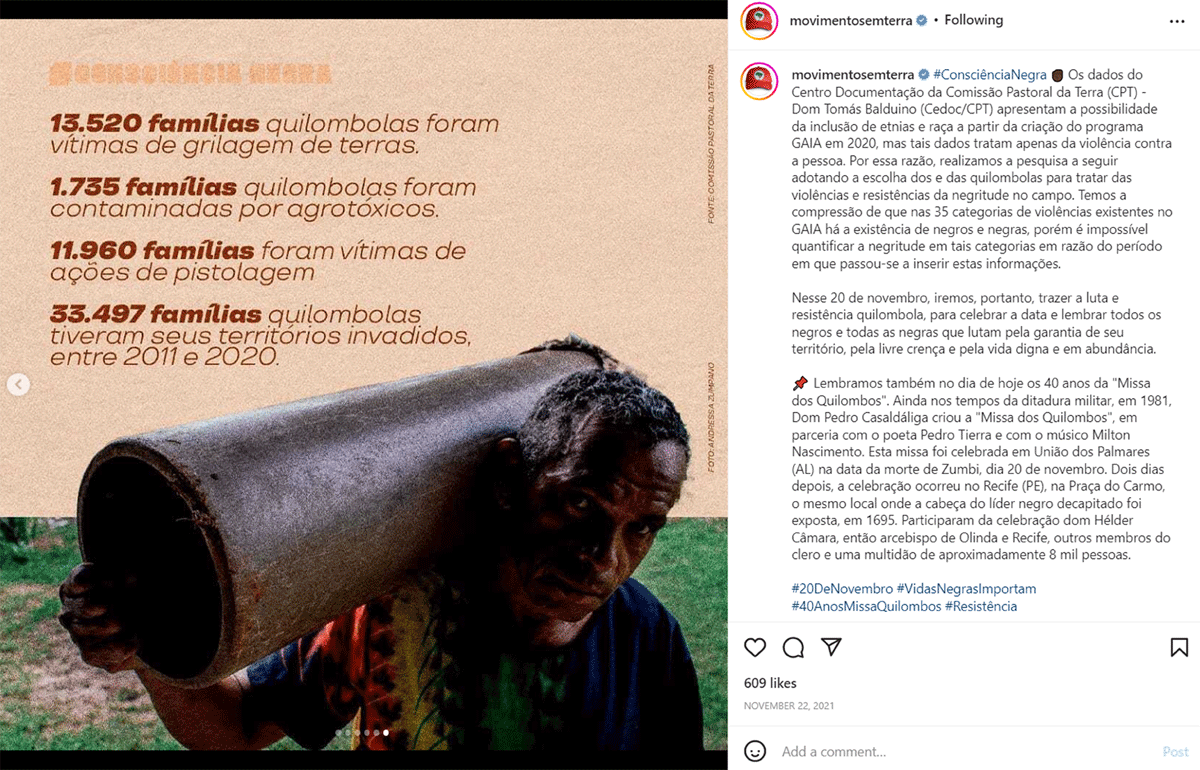
Figure 4
Black awareness. Posted on November 22, 2021.
Composition: The post raised awareness about the Quilombo communities in Brazil, which were resistance settlements established by enslaved people who ran away from plantation farms during colonial times. The post utilizes report data published by the Pastoral Land Commission (Comissão Pastoral da Terra, CPT) to address the violations that Quilombo lands suffered in Brazil in 2020. The first line in faded orange reads ‘Black consciousness.’ The subsequent text highlights that ‘13,520 Quilombo families were victims of land grabbing, 1,735 Quilombo families were contaminated with pesticides, 11,960 families were victims of gunmen activities, and 33.497 Quilombo families had their land invaded between 2011 and 2020.’
The last paragraph mentions a Catholic Mass honoring Zumbi dos Palmares, a Quilombo leader, murdered by decapitation on November 20, 1695. The post ends with four hashtags: #20thNovember, #BlackLivesMatter, #40YearsQuilombosMass, and #Resistance.
Contextual knowledge: Descendants of Quilombos who continued residing in their original communities are legally entitled to collective ownership of their land (Brazil Const. art. 68 ADCT). The Quilombo leader mentioned in the post, Zumbi dos Palmares, has become a symbol of the Black movement in Brazil. The day of his murder, November 20th, has become the national ‘Black Awareness Day.’
Framing analysis: The post’s immediate framing is the diagnosis that Quilombo land rights have been violated multiple times in the last year. The prognosis invites the Quilombo movement to continue resisting, as it did historically under colonization. References to ‘hero’ Zumbi dos Palmares and Black Awareness Day serve as vocabularies of motivation.
The frame alignment between the MST and the Quilombo movement takes place in the idea that both movements fight for land rights and are important actors in undoing historical injustices. This is highlighted by how the MST praises Black men and women in the Quilombo movement for fighting for their land and resisting armed violence from local elites. This reality is familiar to MST activists as well. Alignment takes shape in the effort to scale up this intersection by using the hashtag ‘#BlackLivesMatter’ to bridge it with the historical and localized Quilombo movement in Brazil, thus benefiting from a vocabulary within the African American resistance that is now used globally. The post was chosen based on its allusion to the intersectionality of struggles (Davis 2016) among the CPT, quilombo movement, and MST. The post is representative of social movements’ expertise in coalition building necessary to advance political intersectionality. This intersection sheds light on territory disposition and articulates how rural workers and Quilombo people use the national constitution to reclaim land and advance systemic change in the politics of agrarian reform in Brazil.
Moreover, while every ‘quilombola’ (i.e., individual from a Quilombo settlement) is an African Brazilian, not all African Brazilians are quilombolas. The MST claims representation on behalf of African Brazilians, but it has avoided using the frame ‘landless Black.’ This is in opposition to ‘landless LGBT’ and ‘landless woman,’ which are indeed used because the MST maintains its position of being a class-based organization that understands class as a racialized phenomenon in Brazil (Souza 2017). A popular agrarian reform, as defended by the MST, is thus a form of undoing the ‘agrarian racism’ of the past. This explains why there is no collective or sector dedicated to landless Black people. Instead, Black activists in the MST have established study groups called ‘Study Groups on Land, Race, and Class’ (Souza 2017; Oliveira and Negra 2022), which are dedicated to race and class.
Post 5: Land grabbing and the ‘common enemy’ of the struggle for land (Figure 5)
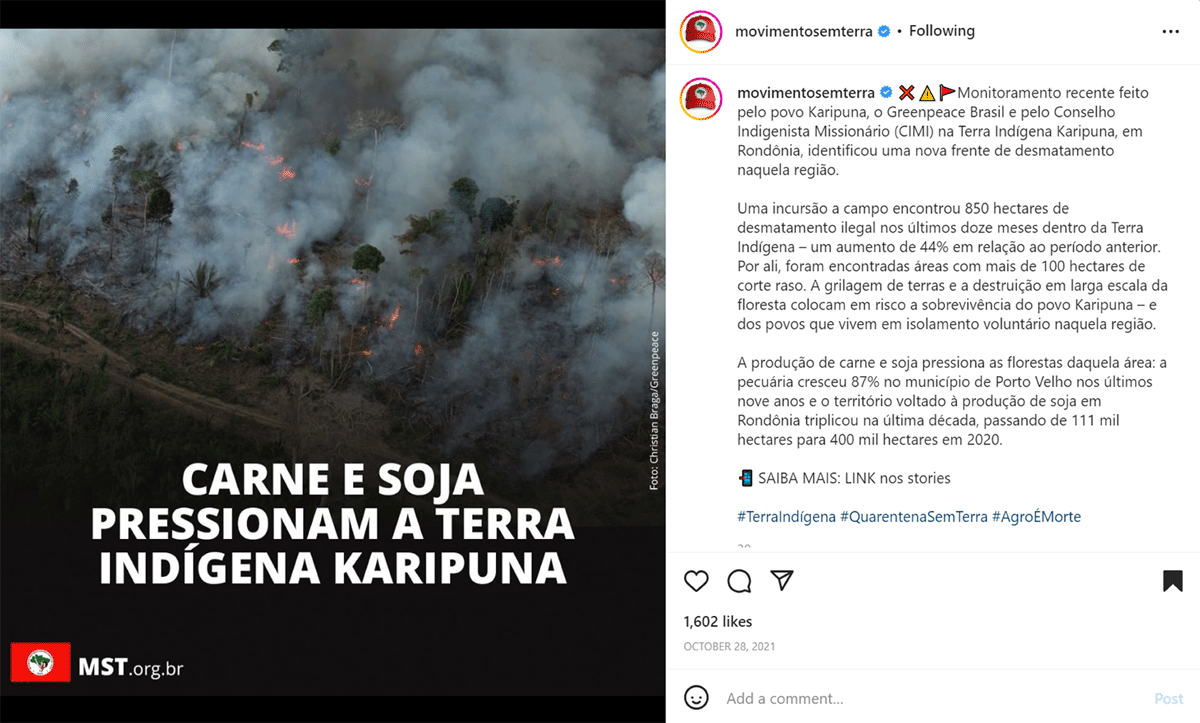
Figure 5
Agribusiness is a threat to the Karipuna people. Posted on October 28, 2021.
Composition: The post reads ‘Beef and soy put pressure on Karipuna indigenous land’ alongside a burning forest in the background. The text reports that mapping conducted by the Karipuna people, Greenpeace Brasil, and the Indigenous Missionary Council (CIMI) found 850 hectares of illegal deforestation within the Karipuna indigenous land. The post’s message is that land grabbing has put the survival of the Karipuna people at risk. The text ends by stating that there has been an 87 percent growth in cattle ranching in the last nine years in the municipality of Porto Velho, where the Karipuna indigenous land is located, and that soy plantations tripled in the last decade in the state of Rondonia. The post ends with three hashtags: #IndigenousLand, #LandlessQuarantine, and #AgroIsDeath.
Contextual knowledge: Beef and soy are the two main commodities of Brazilian agribusiness. Brazil is the world’s largest and second-largest producer of beef and soybeans, respectively (FAO 2020). ‘Indigenous land’ in the post refers to the indigenous land whose rights are stated in the 1988 Federal Constitution (Brazil Const. art. 231 and 232).
Framing analysis: The diagnosis is that agribusiness is expanding at the cost of indigenous land and the environment. The post aids the prognosis that peasant-driven farming must be favored over the agribusiness model. Reporting the expansion of cattle and soy plantations adds to the motivation to resist agribusiness by evoking the urgency of acting. This urgency is amplified by the image of the burning forest and the emotional response it attempts to evoke in the audience (Safaian and Teune 2021).
Indigenous and Quilombo lands are also premised on a different ontology as compared to the land claimed by the MST. As Biesecker and Hoffmeister (2010) point out, indigenous peoples’ claims for land sovereignty and cultural survival are not aligned with the outcry of peasants in capitalist-feudal societies that are fixated on productivity rather than reproductivity. The post succeeds in linking the indigenous and the landless struggles by reporting the violations perpetrated by agribusiness, alongside the effect-hashtag ‘#AgroIsDeath’.
The threats that landless peasants and indigenous groups share result in similar claims for sovereignty. However, they also hide the past instances of encroachment that both groups have faced. Indigenous peoples facing encroaching settlers were a common phenomenon during the military dictatorship (1964–1985); although Hendlin (2018) highlights ‘landless peasants as a symptom, not a cause, of indigenous dispossession’ (p. 120), with Brazil’s economic model to blame for pitting the rural marginalized against each other and favoring large-scale production, transnational corporations, and agribusiness (Jepson 2006; Hendlin 2018).
Today, the political cooperation between the MST and indigenous peoples has given the landless an important ally, especially at a time when the preservation of the Amazon has a powerful status within the international community. Frame alignment between the two marginalized groups reveals intersectionality at play when the expansion of agribusiness threatens both Indigenous lands and the systemic change in food production envisioned by the MST.
The MST does not claim a direct representation on behalf of the indigenous peoples, though the movement has fought ‘indigenous battles,’ such as the Belo Monte dam construction in Pará, which resulted in the displacement of over 60,000 indigenous peoples from flooded land (Hendlin 2018). The post represents political intersectionality between the MST and Indigenous peoples when the two allies form political opposition against agribusiness and reclaim territories despite ontological and historical differences between them.
Post 6: South-South cooperation (Figure 6)
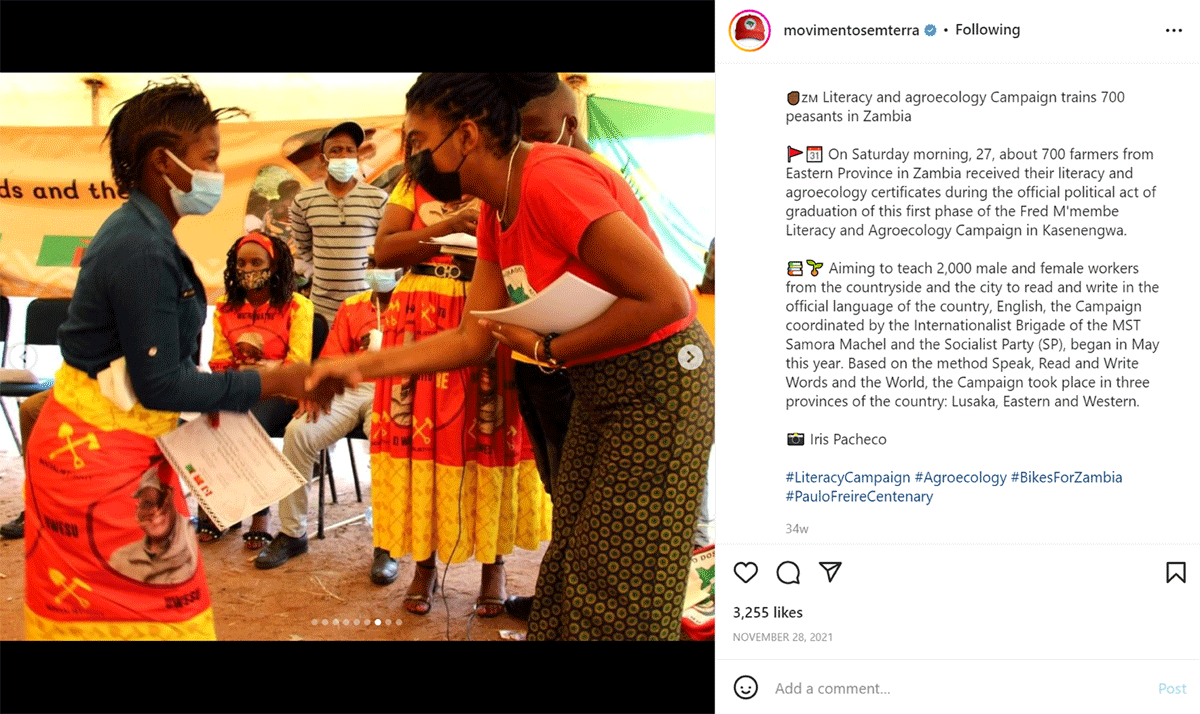
Figure 6
Literacy and agroecology campaign in Zambia. Posted on November 28, 2021.
Composition: The title of the post reads ‘Literacy and Agroecology Campaign forms 700 peasants in Zambia.’ The campaign was organized as part of the efforts of the Samora Machel Brigade of the MST to teach agroecology to peasants in Kasenengwa, Zambia. The image shows two women shaking hands at the course’s ‘conclusion ceremony.’
Contextual knowledge: The Samora Machel Brigade is one of the MST’s internationalist brigades. MST activists have formed these brigades, which travel abroad to engage in humanitarian and development work together with aligned organizations and political parties. Internationalist brigades are explained as part of a positive historical experience of socialism (Rubbo 2012), which strengthens international solidarity among the working class, which the MST wishes to actively foster. As of 2022, the MST has active brigades in Zambia, Venezuela, Haiti, and Palestine (MST 2022). It is important to mention that in addition to internationalist brigades, the MST also engages internationally through the transnational peasant movement Via Campesina (Bernstein 2014).
Framing analysis: The post confirms that the MST continues to use the peasant identity to mobilize people. It shows a rich symbology that enhances the similarities between the contexts of land justice in Zambia and Brazil. The audience is presented with two Black women shaking hands, the related references to illiteracy shared by the rural populations in the two countries, and the use of agroecology as the farming model shared by peasants of both countries.
Moreover, the post promotes alignment between the moral superiority of providing humanitarian work to fellow peasants and the leftist ideology of the movement. The MST has not changed its political ideology, and its international agrarian partnerships are pertinent examples. The campaign was named after the leader of the Socialist Party (SP) of Zambia, Fred M’membe. Such a relationship between the MST and leftist political parties is not new. In Brazil, it is better represented by close cooperation between the MST and the Workers Party (PT). Vergara-Camus (2014) describes the MST as being too pragmatic toward institutional politics, further stating that the movement prefers to use political parties to wage battles, ‘even if it means sacrificing the possibility of more far-reaching change’ (256).
The name of the Brazilian pedagogue Paulo Freire endorses the repertoire of motivation. Freire was renowned for his activism for the marginalized and was an important figure in the liberation theology movement in Brazil, also mentioned in Post 4. The post is written in both English and Portuguese, as its intended audience is not the Brazilian public alone.
Discussion
At first glance, the initial reflection gained from the analysis conducted in this study is that the MST has been subjected to the ‘postmodern turn’ (Tarlau 2018) following the critiques of Laclau and Mouffe (1985) and Castells (2009). These authors emphasized that class-based mobilization, such as the one centered on peasants, was unable to include nuances of social diversity. However, the MST has not completely abandoned the peasantry or the traditional class analysis. The movement has been disrupting the peasant as a monolithic category without disrupting the peasantry altogether. When casting individuals as ‘peasants’ or ‘landless,’ the MST is concerned with fostering a message of diversity among its members, as illustrated in Post 1 and in hashtags such as #LandlessLGBT and #LandlessWomen.
The core framing tasks of diagnosis, prognosis, and motivation remain largely informed by condemning the impositions of agribusiness—including dispossession, pesticides, deforestation, monocropping, and land concentration—and proposing solutions through visions of agroecology, community building, and social justice. Bernstein’s (2014) critique of peasant movements as overplaying binaries between peasants and capital can be considered valid thus far. However, these binaries have been invigorated by the characterization of women, sexual and gender minorities, quilombolas, indigenous peoples, and African Brazilians as rural actors aiding in the moral superiority of an intersectional landless against agribusiness.
There exist limitations concerning what can be inferred from this study regarding intersectionality in the MST. Even though this study has scrutinized posts in connection with contextual knowledge, and presented empirical evidence from other academic texts, the analysis results cannot provide a substantial qualitative assessment of how these claims of representation are being played out at the local level. However, it is possible to look at Instagram posts in relation to MST’s internal structure. Owing to the formalization of the gender sector in 2000 and the LGBT collective in 2017 (Mariano and Paz 2018), it is noticeable that women and the LGBT community are two groups in which frame alignment processes have advanced substantially inside the political structure of the MST. Consequently, intersectional identities such as ‘landless women’ (Post 2) and ‘landless LGBT’ (Post 3) have emerged in the organization and are materialized in the MST’s Instagram posts, as the frequency of the hashtags #LandlessWomen and #LandlessLGBT suggests.
Other groups, such as Quilombo (Post 4) and indigenous peoples (Post 5), have not been given formal spaces in the movement. Instead, their struggles and vocabularies of motivation are bridged into one contingent ‘Other’ to capitalist agriculture. There are still strong political intersectionalities at play when the MST mobilizes against territory dispossession despite the lack of direct representation of Quilombo and Indigeneity. Peasants, Quilombo, and Indigenous identities are premised on different ontological bases, yet, the MST is capable of utilizing the national constitution to advance its popular agrarian reform by building a coalition across different identities in a joint search for systemic change.
The current message conveyed by the MST through the analyzed data largely conforms with Marxist feminist theories, which propose that marginalized groups and nature have been underplayed or turned into a resource for profit (Moeckli and Braun 2001; Giménez 2018). The coalition alignment among peasants and identity-based movements suggests the fusion of traditional class-based mobilizations and identities as an organizing principle (Kelly 1998; Heery 2018). As the representation of diversity on social media does not automatically translate into intersectionality (Mohanty 2013; Salem 2018), this study encourages further ethnographic research and triangulation with existing literature on these specific intersections. The analyzed posts covered broad issues of land justice in Brazil and each post has the potential to become a case study on its own. The granularity of MTS’s claims of representation on behalf of an ‘intersectional peasantry’ is still being investigated.
The peasantry is a category that requires special attention because its definition is often elusive and the resources for framing it are plentiful. In her influential work on the landless in Brazil, Wolford (2010) describes that ‘peasant’ is not an objective identity with unchanging elements: ‘peasantness is a relationship, an identity that exists not in any organic, a priori sense, but rather in relation to people who are not peasants’ (p. 71). Peasantness can include categories such as small- and medium-scale farmers, waged rural workers, the landless, indigenous communities, and the rural poor engaging in different types of farming (Bernstein 2014). MST’s framings rely significantly on the understanding of peasantness as a relationship to evoke cohesiveness among its imagined community. This can be observed in its deft pairing of the landless and indigenous peoples (Post 5), despite historical and ontological tensions (Biesecker and Hoffmeister 2010; Hendlin 2018). Moreover, ‘peasant’ is an identity that can be easily scaled up and down (Wolford 2010) to represent both localized realities, such as the romantic love of two male farmers (Post 3), or a global network of activists (Post 6) brought together across national borders, as proposed by Davis (2016). Possible hypotheses to be generated from this study concern to what extent these frame alignments are overcoming the loss of emancipatory character that intersectionality has suffered (Hancock 2007, Mohanty 2013, Salem 2018, and Reed 2019).
Instagram is also a fertile ground from which the MST can approximate different fragmented struggles across space and time. This can be observed by how it has linked the largely urban-centric LGBT movement to the vision of rurality and agroecology (Post 3) and recalled the historical figure of the Quilombo hero Zumbi dos Palmares in the contemporary events of BLM (Post 4).
Lastly, the reliance on constitutional rights makes the MST an interesting arena to investigate political intersectionality. The right to occupy unproductive land has historically been understood as the right of the rural poor without considering the entrenched exclusions in such a policy. Consequently, gender disparities in the distribution of land, heteronormative visions of family farming, and the colorlessness of agrarian politics were all embedded in the historical foundation of the MST and the political arena it navigated. Today, the MST has allegedly taken steps toward a transformative reframing that enables it to maneuver the political apparatus available to advance its popular agrarian reform. Intersecting different struggles uncovers the complex patterns of exclusion in rural Brazil, and it also allows the MST to pull from a wider vocabulary of motivation anchored on ethnicity, gender, sexuality, and environmentalism.
Conclusion
This study uses David Snow’s framing analysis to examine the MST’s ability to narrate the landless on Instagram. Via the analysis of six Instagram posts published by the MST, this study has explored the organization’s adoption of gender and sexual diversity, gender equality, ethnicity, and agroecology into its political ideology—all of which have provided the movement with new entry points to address land justice in Brazil. These new interpretations of land inequality, in addition to granting strategic political currency to the MST, have led to the surfacing of important issues that were left largely unaddressed by the movement’s original conceptual architecture, which relied solely on peasants vs. capital in traditional class analysis. This study presents the argument that the MST has been formulating, as well as benefiting from much-needed forms of reinterpreting land inequality without fundamentally changing its core framing tasks of diagnosis, prognosis, and motivation, which remain aligned with the movement’s Marxist ideology.
The representative claims framed on Instagram are worth analyzing to capture a comprehensive picture of a ‘new’ imagined landless and how this has been communicated to broader audiences. The MST’s Instagram account is a multimodal site of communication in which these claims of representation are condensed and conveyed through images and text that attempt to evoke cognitive and emotional responses in the audience. I emphasize the need for further investigation regarding how these representative claims are being played out at the local level. Such studies would narrow the gap between what is framed online and the multitude of local experiences in a country as large and diverse as Brazil. Nevertheless, the MST’s Instagram posts carry an inherent knowledge about intersectional activism on behalf of land justice and marginalized groups that is separated from—but intertwined with—traditional forms of activism such as street protests and land squatting. Thus, I encourage interested readers to engage with the topic by searching on Instagram for hashtags such as #LGBTSemTerra, #MulheresSemTerra, and #AgroecologiaÉOCaminho. This new intersectional peasantry has invigorated the MST’s conceptual architecture, consequently revealing how to frame and enact successful agrarian mobilization in Brazil and elsewhere.
Funding Information
This research has been funded by the University of Bergen and the Meltzer Research Fund.
Competing Interests
The author has no competing interests to declare.
Author Information
De Melo has a master’s degree in Human Geography from the University of Oslo and is currently taking his PhD education in the same field at the University of Bergen, Norway. His ongoing PhD project involves different organising principles through which political representation of small-scale farmers is taking place in Brazil.