
Introduction
Climate change is caused by rising concentration of Greenhouse Gases (GHG) in the atmosphere and fossil fuels combustion is its greatest driver. About 42% of historical cumulative net CO2 emissions from 1850 to 2019 occurred between 1990 and 2019 (IPCC 2022: 10), and global GHG emissions from energy increased by 61.53% in these three decades (IEA 2021). Coal, oil and gas answered for 87% of total global energy supply in 1973 and 80.90% in 2019 – and energy supply increased by 138.58% in the period (IEA 2021). The same is true when only electricity is considered. Globally, fossil fuels answered for 75.20% of total global electricity supply in 1973 and 63.10% in 2019 (IEA 2021). In the global GHG emissions trajectory, the energy sector answered for 71.29% of total emissions in 1990 and 74.66% in 2020 (Figure 1).
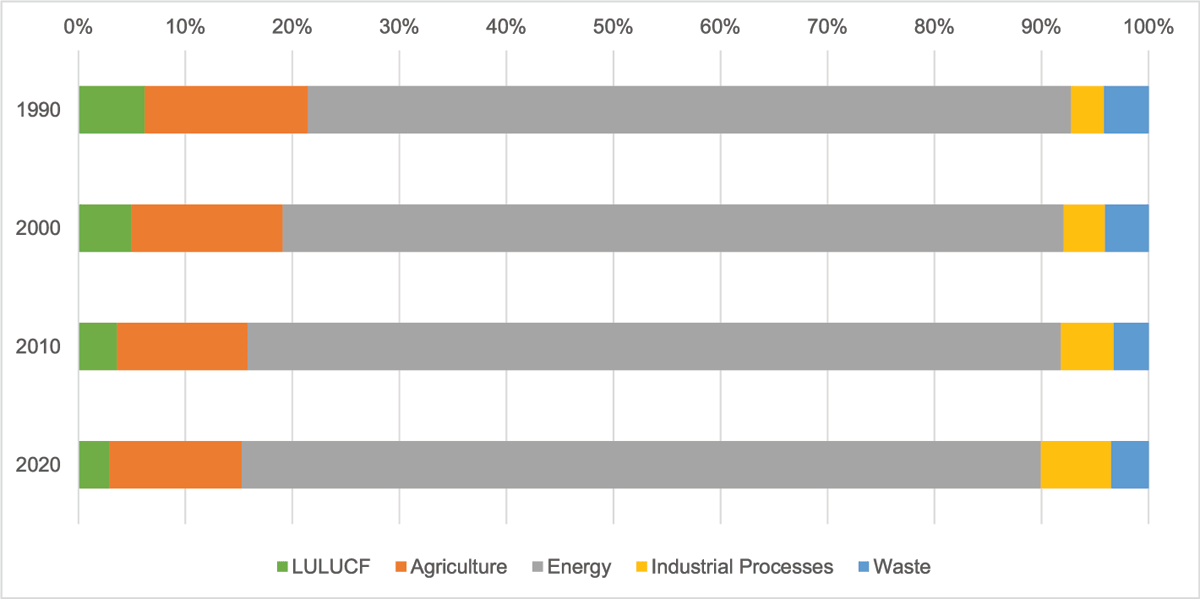
Figure 1
Global GHG emissions, 1990–2020, by sector (% of total).
Source: Own elaboration, based on data from Climate Watch (2023).
In Latin America, however, in addition to energy, two other sectors – land use, land use change and forestry (LULUCF) and agriculture – have a substantial share of total national GHG emissions. This is true for Argentina, Brazil and Peru (Figure 2).
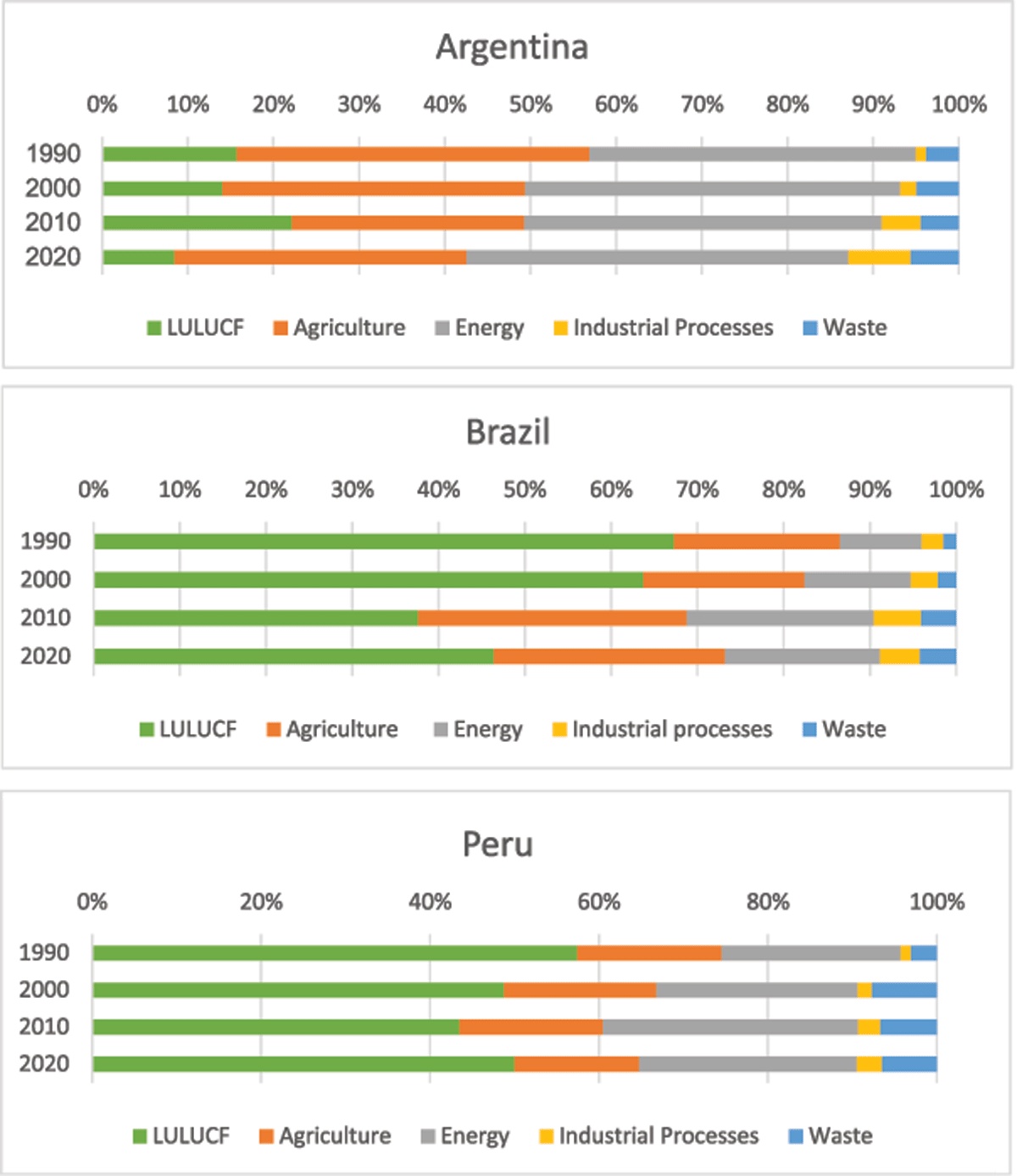
Figure 2
GHG emissions, 1990–2020, by sector (% of total).
Source: Own elaboration, based on data from Climate Watch (2023) and SEEG (2023).
In Argentina, agriculture answered for the greatest share of emissions in 1990 (41.17%), followed by energy (38.04%) and LULUCF (15.73%); in 2020, energy had the greatest share in total Argentinian GHG emissions (44.53%); agriculture had 34.10% and LULUCF, 8.44%. In Brazil, LULUCF answers for the greatest share of total GHG emissions since 1990: 67.31% in 1990, 46.43% in 2020. Agriculture had 19.22% of total Brazilian GHG emissions in 1990 and 26.80% in 2020, followed by energy, sector that had 9.47% of Brazilian GHG emissions in 1990 and 17.94% in 2020. The same role of LULUCF is true in Peru. LULUCF emissions also answer for the greatest share of total GHG emissions in the country, 57.42% in 1990 and 50% in 2020. Energy’s emissions come 2nd and agriculture’s, 3rd, and this profile has remained the same since 1990.
Tackling climate change requires action to reduce emissions in the sectors that have the greatest share in total GHG emissions. For most of the world, this means reducing emissions from energy – or energy transition. But in Argentina, Brazil and Peru, successful climate change mitigation depends on reducing emissions from LULUCF and agriculture as well. While this diversification might increase the chances of partial success – since action in different fronts can bring about change –, it also increases the complexity of reaching substantial mitigation, once action in different fronts require mobilization of different actors and change in different policy arenas.
This paper offers an exploratory analysis of if and how action to reduce LULUCF emissions, especially from deforestation, took place in three Latin American countries – Argentina, Brazil and Peru – between 1990 and 2020. It proceeds in 04 sections after this introduction. The following section offers a brief literature review on the theoretical framework informing our analysis of the political economy of climate action. After it, we present the composition and trajectory of GHG emissions in Argentina, Brazil and Peru, justifying why LULUCF emissions are relevant in all three cases. In the third section, we present a thick description of the drivers of LULUCF emissions, especially deforestation, in Argentina, Brazil and Peru, the main policy initiatives focusing on reducing deforestation in each of the countries and the broader political economy context in which they are embedded, which frame both deforestation and the initiatives to tackle it. We conclude by offering some insights on the limitations of our paper and how future research could contribute to a better understanding of the climate action in Latin American countries.
Climate action: a political economy approach
Climate action requires policy change, and policy is decided via politics. Politics does not happen in abstract; it is embedded in social, economic and political structures, or institutions (Hall 2016). Institutions are formed at a particular time and place; they are the rules of the political game, shaping the behavior of actors, their interests and their interactions (Hall 2016, 32). This is why the same political challenge can be addressed very differently and with very different outcomes depending on the place and time considered.
Institutions also determine how power is distributed amongst actors (Thelen and Steinmo 1992; Pierson 2016). Power relations are unequal; coalitions are formed by actors in the political arena to enhance their political power and push forward their interests (Pierson 2016). A historical institutionalist analysis uncovers the hidden dimensions of power, since the meaning of a particular conflict can only be seen by situating it within a larger process through which many alternative outcomes are removed from the agenda (Pierson 2016: 175).
Furthermore, while institutions are a product of the past, they determine the preferences of actors and the choices available to them in the present (North 1990). This feature is particularly relevant for collective action problems, such as climate change mitigation. Climate change operates in a time scale that is beyond human daily experience, so the appeal of passing the burden to future generations is always present; in addition, the poorest of every society are usually the ones that contribute the least to the problem, but also the ones that mostly suffer their effects (Steffen 2011). Successfully tackling climate change requires considering long-term impacts and consequences of choices that go beyond specific coalitions interests and preferences. Finding such a common ground when institutions allow winning coalitions to take it all is extremely difficult.
According to this framework, climate action is more likely when there are strong coalitions in favor of it and weak opposition to it, and less likely when the opposite is true. Thus, if action is needed in sectors that do not have coalitions with interests tied to the activities they encompass, action might take place. But when action is needed in sectors dominated by coalitions with vested interests in activities that contribute to emissions, it is more challenging to obtain change – especially if these coalitions are defending their vested interests against broader coalitions that are less politically powerful and more loosely organized.
In this paper, we argue that the latter happens when climate action to reduce GHG emissions from the LULUCF sector is considered in Argentina, Brazil and Peru. In all three countries, there are strong coalitions in favor of status quo, and, given their political and economic strength, they act to block change. We present evidence of it by rebuilding the trajectory of LULUCF emissions and key policy initiatives to reduce deforestation in the three countries between 1990 and 2020.
Trajectory and composition of LULUCF emissions in Argentina, Brazil and Peru
Figure 3 shows the trajectory of GHG emissions in Argentina, Brazil and Peru between 1990 and 2020.
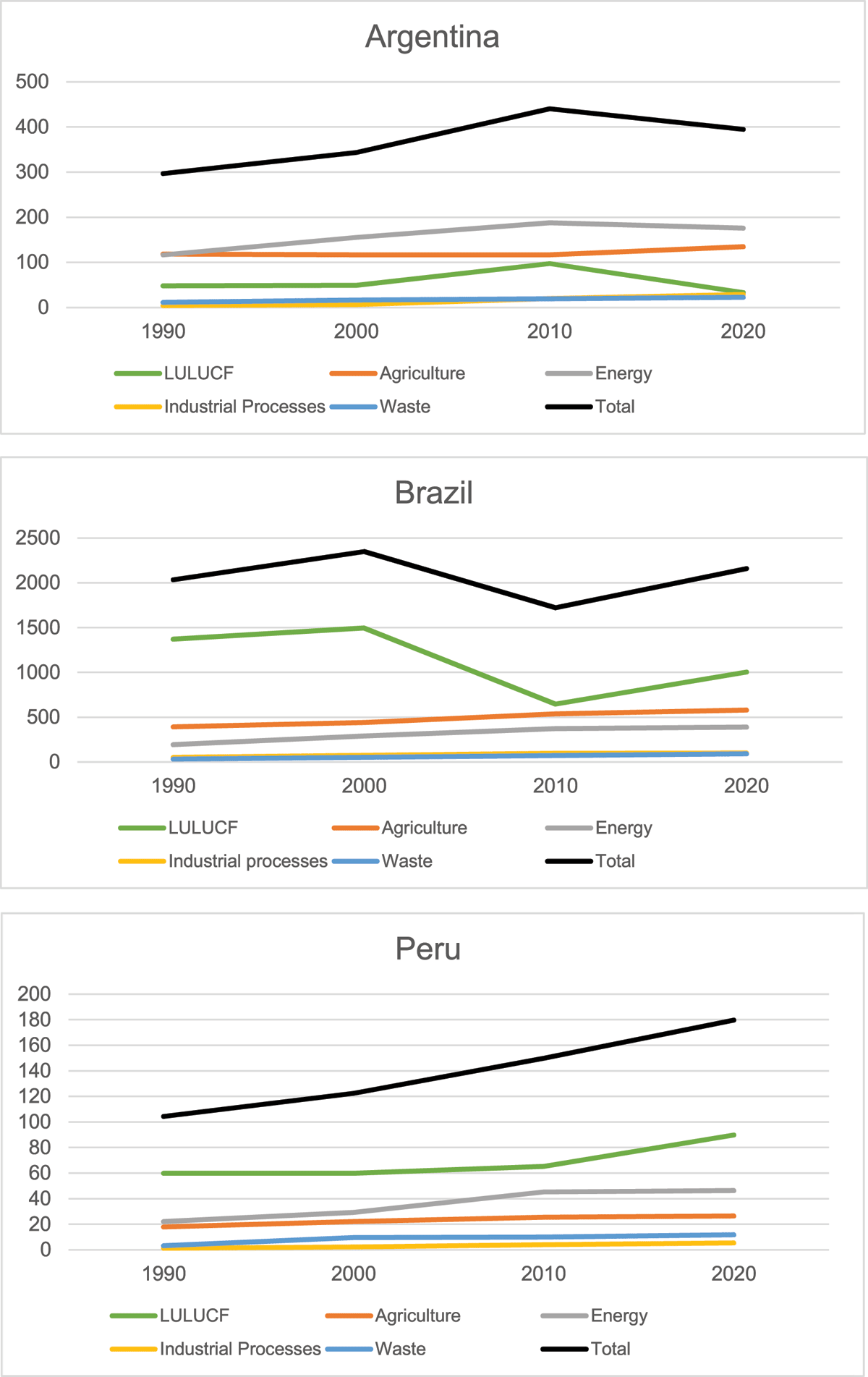
Figure 3
GHG emissions, 1990–2020, by sector (MtCO2e).
Source: Own elaboration, based on data from Climate Watch (2023) and SEEG (2023).
Argentina is a case of decrease in emissions since 1990. Argentinian emissions increased between 1990 and 2008 and then decreased. Two sectors answer for the decrease in total Argentinian emissions: energy, which emissions increased until 2014 and decreased by 14.60% between 2015 and 2020; and LULUCF, which emissions decreased by 65.87% between 2008 and 2020 (Figure 3).
In Brazil, the trajectory of emissions varies between 1990 and 2020. Brazilian emissions increased between 1990 and 2003, when they peaked – LULUCF answered for 70.16% of total emissions in 2003. Between 2004 and 2012, total Brazilian emissions decreased, pushed by the decrease in LULUCF emissions (Figure 3). Later, as LULUCF’s emissions increased again, so did Brazilian total emissions (Figure 3).
Peru is a different case. There, total emissions increased consistently between 1990 and 2020. Although emissions from all sectors increased in the period, LULUCF emissions increased more, in absolute and comparative numbers, compared to the other sectors (Figure 3).
While LULUCF and agriculture emissions are usually analyzed together in datasets, by organizing them in activities, we can separate the contribution from each sector. Emissions from drained organic soils, net forest conversion and fires are accounted under LULUCF; emissions from crop residues, rice cultivation, enteric fermentation, manure and synthetic fertilizers, under agriculture. Figure 4 presents the differences in activities promoting LULUCF and agriculture emissions in Argentina, Brazil and Peru.
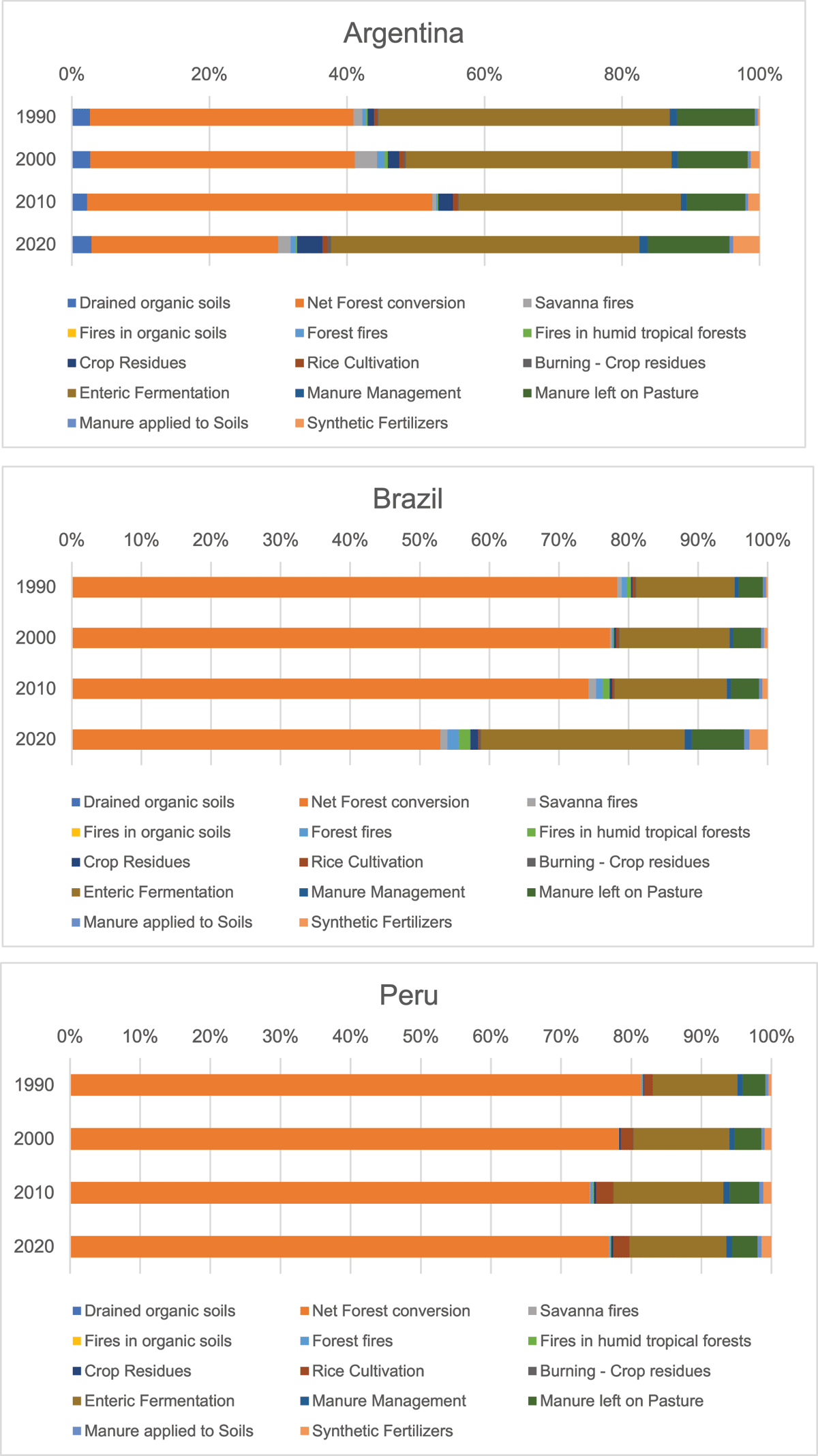
Figure 4
LULUCF and agriculture emissions, 1990–2020, by activity (%).
Source: Own elaboration, based on data from FAOSTAT (2023).
As illustrated by Figure 4, Argentina, enteric fermentation had the greatest share of LULUCF and agriculture emissions in 1990, 2000 and 2020, followed by net forest conversion; in 2010, the opposite was true. Emissions from manure left on pasture followed the first two activities in all years measured.
In Brazil and Peru, on the other hand, net forest conversion answered for the greatest share in LULUCF and agriculture emissions in all years measured, followed, by far, by enteric fermentation. In Brazil, the share of net forest conversion in LULUCF and agriculture emissions decreased between 2010 and 2020. Emissions from the activity also decreased in absolute numbers in the period, by around 60%, driving the 43% decrease in total LULUCF and agriculture emissions between 2010 and 2020. In Peru, emissions from net forest conversion play an even more substantial role in LULUCF and agriculture emissions compared to Brazil. While, in absolute numbers, they decreased slightly – by 6.23% – between 1990 and 2010, they increased by 19% between 2010 and 2020, surpassing their counting of 1990 and 2000.
Cattle grazing activities answer for emissions from enteric fermentation and manure. Having substantial emissions from enteric fermentation and manure is a consequence of the importance of cattle grazing activities in the country. This is the case of all three countries, but especially Argentina. Emissions from enteric fermentation are difficult to be mitigated, since they originate from the digestive process of bovines; manure emissions can be reduced with manure management techniques.
Meanwhile, net forest conversion, or deforestation, takes place when (i) the forest has value in itself – i.e. logging – and/or (ii) because there is interest in developing other activities in those previously forested areas. Net forest conversion had an important impact in LULUCF emissions in all three countries in the years measured. Understanding why requires an investigation of the political economy dynamics of the period.
The political economy of LULUCF emissions, 1990–2020
Case 01: Argentina
Ecoregions and drivers of land use change in Argentina, 1990–2020
There are different ecoregions in the Argentinian territory (Figure 5). The Bosque Andino Patagonico, a subantarctic forest, is located in the Andes region, from Neuquén to Tierra del Fuego. Also in the Andes region the desert Altos Andes is found. Argentina has large spaces covered by savannah: the Puna, from Mendoza until Jujuy; the Estepa Patagonica, in the provinces of Santa Cruz, Chubut, a large part of Rio Negro, Neuquén, and Mendoza; east of it, the Monte de Llanuras y Mesetas and the Monte de Sierras y Bolsones. There are also dry forests: the Yungas, located North of Monte de Sierras y Bolsones; the Chaco Seco and the Chaco Humedo – this one, more humid than the previous two –, both the North of the country. Near the border with Paraguay and Brazil, there are wetlands, the Esteros del Iberá; a subtropical vegetation mixing grassland and forest, the Campos y Malezales; and a humid forest, the Selva Paranaense. Finally, in and around the Buenos Aires province, there are the Espinal, a mixing grassland and forest, and the Pampa, a grassland area.
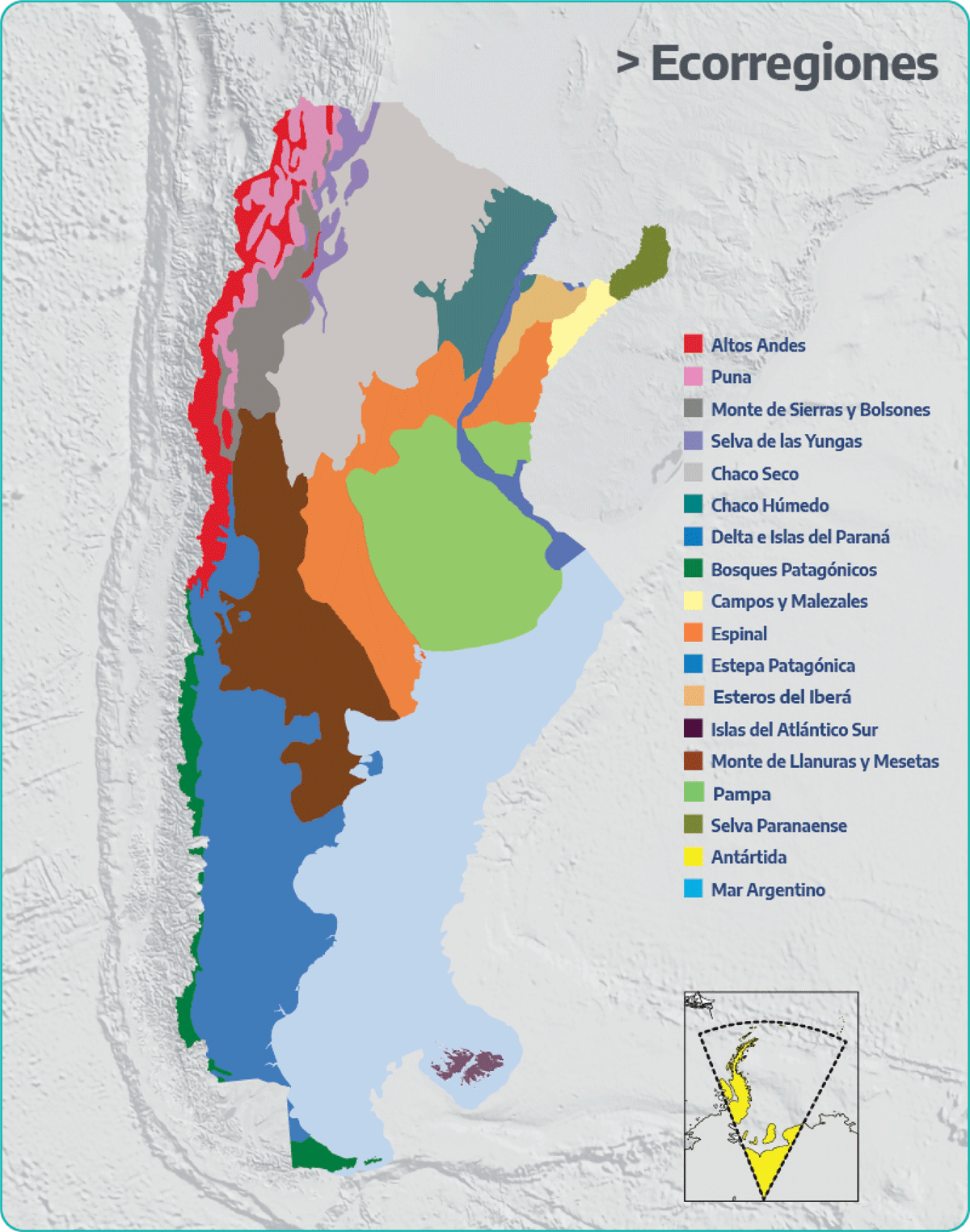
Figure 5
Argentina, ecoregions.
Source: Retrieved from Ministerio de Ambiente y Desarrollo Sostenible (n.d.) (non-modi!ied) CC BY 4.0.
Land use change has occurred in all Argentinian ecoregions, but differently. The Pampa has been deforested since colonial times, due to farming activities; it is almost extinct. The Espinal has also been severely devasted, only few original patches remaining. Since the 2000s, deforestation rates in Chaco Seco and Chaco Humedo, especially in the provinces of Salta, Santiago del Estero, Chaco, Formosa, Santa Fe and North of Cordoba, have been the highest in Argentina.
Since its colonial times, Argentina has been a strong agriculture and cattle producer. Traditionally, farming activities have dominated the landscape of the Pampa biome across the provinces of Buenos Aires, Entre Ríos, Santa Fe and Córdoba, and the Espinal biome, situated in the same provinces and in Corrientes, La Pampa and San Luis. Beef, dairy products, leather and wheat dominated for long, but soybeans were added after the crop was introduced for animal feed and became an international commodity.
In the beginning of the 1990s, soybean was already being produced in Santa Fe and Buenos Aires provinces (Turzi 2019), replacing other crops or grazing activities. But soon the production expanded to other provinces. Acted as incentives (i) the opportunity of selling the commodity in the international market, where demand for soybeans was rising, and (ii) liberal reforms, implemented by the administrations in the end of the 1980s and through the 1990s, especially parity between US dollars and Argentinian pesos and the reduction of export taxes for agriculture products.1 These policies encouraged investments in large-scale soybeans agriculture, especially plantations, which grew exponentially in the 2000s due to the global soybean boom.
Soybeans production expanded to the Chaco Seco and the Chaco Humedo ecoregions – across the provinces of Formosa, Chaco, Santiago del Estero, Salta, East of La Rioja, North of Cordoba and San Luis. Several factors contributed to it. First, farming was already a strong economic activity in the provinces (Fehlenberg et al. 2017). Second, these areas are relatively closer to other Argentinian traditional farming areas – proximity to current investment is an important variable for farmers considering expanding their activities (De Waroux et al. 2016). Third, the price of land in the region was lower compared to that of the Pampa (De Waroux et al. 2016; Lende 2018; Zak et al. 2008). Fourth, the region is well-connected to transportation networks, including the Paraná-Paraguay waterway, facilitating exportation (De Waroux et al. 2016; Lende 2018). Fifth, due to climatic changes, rainfall levels had risen by around 20–30% in the region during the first half of the 20th Century – later, the trend was reversed –, removing an environmental limitation for large-scale production (Grau, Aide and Gasparri 2005; Salazar et al. 2015; Lende 2018). Finally, two inter-related factors also contributed: the high peso-dollar exchange rate, increasing economic feasibility of investing in modern agriculture machinery, diminishing costs of production and raising profits; and the development of genetically-modified seeds, which are adapted to mechanized and non-tillage techniques (Grau, Aide and Gasparri 2005; Camba Sans et al. 2018; Arancibia, Motta and Clausing 2020; Fehlenberg et al. 2017; Salazar et al. 2015; Zak et al. 2008).
The area covered with soybean plantations in Argentina increased from less than a million hectares in 1970 to more than 13 million in 2003 – an area larger than Nicaragua (Grau, Aide and Gasparri 2005). Argentina lost 17% of tree cover between 1992 and 2015 (Arancibia, Motta and Clausing 2020). Approximately half of the national forest loss between 1998 and 2004 took place in only seven provinces: Chaco, Cordoba, Entre Rios, Formosa, Salta, Santiago del Estero and Tucumán – Chaco Seco and Chaco Humedo ecoregions (Arancibia, Motta and Clausing 2020). These are also the regions to where soybeans production expanded in the period.
Resistance to land use change and policy initiatives to counter deforestation
In the early 2000s, protests against the expansion of agrobusiness in the Chaco ecoregion intensified in Argentina. Small-scale farmers, also referred as criollos, have lived in Northern Argentina since the early 1930s, carrying out mostly self-supply agriculture and farming, and cotton production for profit. Their activities did impact the original biome, but limitedly, due technological, capital and labor limitations (Cotroneo et al. 2021). Around the 1960–70s, cotton production started to decrease due to drought, floods, plagues, and cotton price dropped. Consequently, families became more and more dependent on state subsidies (e.g. state machinery for tillage, seeds, and welfare plans for farmers with children) (Cotroneo et al. 2021). Due to the expansion of soybean plantations, conflicts over land tenure emerged between large-scale producers and criollos, as well as between the former and indigenous communities, which have been traditionally living in the Chaco area, sometimes in communal land (Aguiar et al., 2018). After GM-soybeans were authorized in Argentina in 1996, deforestation and conflicts between soybean plantations and traditional uses of land grew exponentially (Cotroneo et al. 2021; Aguiar et al. 2018; Alcañiz and Gutierrez 2020).
Around the mid-2000s, peasant organizations, indigenous communities, and transnational environmental non-governmental organizations (NGOs) mobilized against deforestation in the Chaco ecoregion and pushed for a law to restrict it. An alliance between peasant and indigenous associations and large environmental NGOs, such as Greenpeace, Fundación Vida Silvestre (Wild Life Foundation) and Fundación Ambiente y Recursos Naturales (Environment and Natural Resources Foundation) – who, together, had raised the national political profile of the struggle and were able to capture the political support of urban social groups aligned with conservationist causes (Aguiar et al., 2018) – formed the societal basis of a project of law presented at the Argentinian Chamber of Deputies in 2006. Miguel Bonasso, a left-wing politician and, at the time, president of the Commission of Natural Resources and Conservation of the Human Environment of the Chamber of Deputies, signed the project.
In the debates at the Parliament, Bonasso’s project of law received political support from the governmental basis, which had the majority both at the Chamber of Deputies and the Senate at the time. Yet the approval was not smooth; the law faced important opposition in specific topics. Article 5 of the law (establishing the territorial zoning in three categories and determining how much deforestation was accepted in each) received 112 votes in favor, 41 against and 10 abstentions. Article 12 (determining requirements to be followed by the provinces when authorizing deforestation) received 80 votes in favor and 60 against. These divergences are due to parliamentarians allegiances at provincial levels – while they would be in favor of the law given their membership to the governmental basis, they would suffer pressure from provincial constituencies, where soybean interests were strong and clashed with the law in debate – especially among parliamentarians from the Northern provinces, in the Chaco ecoregion (Ryan, 2014; Gutierrez, 2017).
The law was approved in 2007. It established that all Argentinian territory is subject to zoning procedure – Ordenamiento Territorial de Bosques Nativos (Territorial Planning of Native Forests, OTBN) – which is divided into three categories: red areas, in which deforestation would be forbidden; yellow areas, in which deforestation would be restricted; and green areas, in which deforestation would be allowed. The provinces should carry out the zoning procedure with open public participation in the process. Given the differences in the balance of power between productive and conservationist forces in the provinces, the degree of participation of different social actors and the resulting OTBNs were extremely heterogeneous, with areas of similar biodiversity or climatic importance being classified under different categories in different provinces (Alcañiz and Gutierrez 2020; Aguiar et al. 2018; Baldassini et al. 2020; Fernandez Milmanda and Garay 2019; Graziano Ceddia and Zepharovich 2017; Gutierrez 2017; Romero 2012; Salas Barboza et al. 2020).
As demonstrated by the data presented in this paper, LULUCF emissions decreased in Argentina between 2008 and 2020. Yet, there is an important debate in the literature on whether the decrease happened thanks to the law itself or if other factors also influenced it.
For some authors, the law did play a role. Nolte et al. (2017) analyzed the effectiveness of the implementation of the forest law by Argentinian provinces in the Chaco region and found that it played a role in reducing deforestation rates after the implementation. Other authors argue that decreased demand for new areas to become soybean plantations played a role. Lack of demand for new areas was due to a weaker international demand for soybeans starting in 2008, compared to previous years (Gasparri et al. 2013; Faingerch et al. 2021; Volante and Seghezzo 2018) as well as to new technology – including genetically modified seeds and mechanization –, increasing productivity per hectare and diminishing the need of deforesting new areas to increase production output (Gasparri et al. 2013; Faingerch et al. 2021). Finally, other aspects – such as spatial constraints, judiciary interventions, export regulations, exchange rates, and the level of taxation of agricultural products – could also have played a role in the reduction of deforestation rates in Argentina (Volante and Seghezzo, 2018; Camba Sans et al. 2018).
Case 02: Brazil
Biomes and drivers of land use change in Brazil, 1990–2020
Brazil is divided in six biomes (Figure 6). In the North, the Amazon, a tropical forest. In the central part of the country, the Cerrado, a type of savannah with sparce forested areas near fluvial courses. In the internal part of the Northeast, the Caatinga, a semiarid ecosystem with bushy vegetation. Along the Atlantic coast, the Mata Atlântica, another tropical forest. The Pantanal, the Brazilian wetlands, is located near the border with Bolivia and Paraguay. In the Southern region of Brazil, near the border with Uruguay, is located the Pampa, a natural grassland. The Mata Atlântica and the Pampa, where most of the Brazilian population lives, were mostly deforested during the first centuries of European colonization of Brazil.
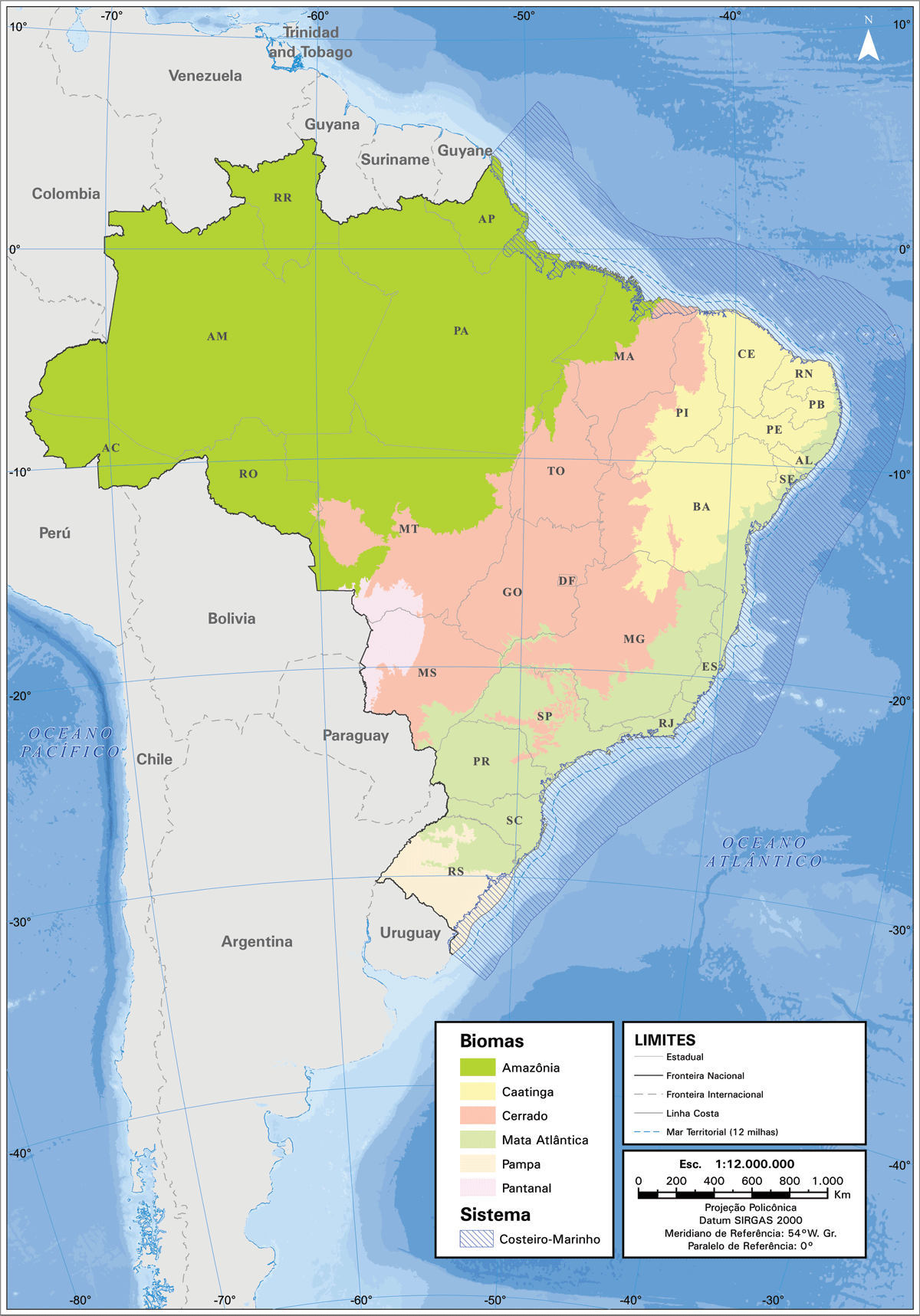
Figure 6
Brazilian biomes.
Source: Retrieved from Instituto Brasileiro de Geografia e Estatística (n.d.) (non-modi!ied) CC BY 4.0.
Between 1985 and 2020, areas covered by forests and non-forested natural vegetation (such as wetlands) in all Brazilian biomes decreased by 12.76% and 12.22%, respectively. Yet, the worst deforestation rate in relative terms occurred in the Cerrado biome, where forests and non-forested natural areas decreased by 20.07% and 18.63%, respectively, in the period. In the Pantanal biome – which deforestation dynamics is linked to Cerrado’s –, forested areas decreased by 18.07% in the period and wetlands decreased by 75.09%. The worst deforestation rate in absolute terms among the Brazilian biomes in the period took place in the Amazon biome, where forested areas decreased by 11.89% and non-forested natural areas, by 3.98% – 45 million hectares in total.2
While the dynamics of deforestation in the Brazilian Cerrado and Amazon share some similarities, they also have differences.
In the Cerrado, deforestation rates are largely driven by the soybean agro-industrial complex. Throughout the 1970s and the 1980s, the federal government started a strategy to modernize agriculture production and occupy the central area of Brazil; soybeans was seen as a great option given the role of the crop as an international commodity. The government established cooperation agreements with Japan and the United States to acquire technology and farming techniques; created a state-led research company, Embrapa, to study the Cerrado soil and prepare it for farming activities; and created substantial incentives to push large-scale agriculture in the region, including: settlements and land titles at low prices; extensive credit and insurance options; subsidies for the purchase of fertilizers and machinery; and minimum prices to soybean outputs.
In the 1990s, when the economic paradigm changed to reduce the role of the state and increase the private sector’s participation in economic activity, the soybean complex flourished, since previous policies had created the basis for it. Investments in technology grew exponentially, and productive units expanded in size in order to increase scale in production (Frederico 2013) – impacting deforestation rates in the biome. Currently, deforestation in the Cerrado biome is increasing in the states of Maranhão, Tocantins, Piauí, Bahia and in Northern Mato Grosso, near the limits to the Amazon biome.
In the Amazon, deforestation also started during the 1970–1980s as a threefold geopolitical strategy to systematically occupy the Amazon region. First, to restrict international influence in the region (Becker 2001). Second, to reduce the social tensions in rural areas in the southern Brazil – which were on the rise due to the new agro-industrial model that prioritized mechanization and large farms (Becker 2001; Almeida 2004). Third, similarly to the Cerrado, to establish modern economic activities in the region (Becker 2001; Almeida 2004).
In order to encourage the occupation of the area, the federal government (i) promoted rural settlements and (ii) granted property titles to people that occupied and developed economic activity in previously public forested areas (Garrett et al. 2021; Loureiro and Pinto 2005). Removing the forest, selling the timber, and putting cattle to graze qualified as economic activity, thus became a common practice. In fact, three economic activities usually take place in sequence and drive deforestation in the Brazilian Amazon. First, logging, selling the profitable timber. Then, cattle ranching. Cattle ranching requires little capital investment, little soil preparation and can be practiced in uneven terrain, so it is easy to practice it in areas where deforestation leaves many non-noble timber trunks behind (Rivero et al. 2009). Soybean and other agricultural crops, such as rice and corn, usually follow cattle grazing, as the areas are sold to agribusiness after land tenure regularization and road development; (Rivero et al. 2009; Trigueiro, Nabout and Tassarollo 2020; Garrett et al. 2021).
Resistance to land use change and policy initiatives to counter deforestation
In Brazil, in the Amazon biome, the state-led modernization was idealized and implemented without concern for the activities and traditional ways of living of local populations – indigenous groups, riverine communities, and traditional local populations living out of small agriculture and livestock production as well as extractive activities. New actors and alliances’ interests clashed with traditional groups’ and created substantial tension and conflicts. Yet, the picture is complex and nuanced since, in some cases, traditional groups have aligned with new ones. These conflicts catch the national and international attention since the 1980s, given the status of the Amazon forest among these audiences. In the Cerrado biome, on the other hand, there are also important conflicts regarding land use change, but they hardly receive attention from the public opinion. In addition, the economic and political power of industrial agriculture is much greater there, and this is reflected in lack of policy initiatives to counter deforestation in the biome.
Reduced LULUCF emissions in Brazil between 2004 and 2012 is linked to reduced deforestation in the Amazon forest; nothing changed in Cerrado. Reduced deforestation is directly linked to the implementation of the Plano de Ação para Prevenção e Controle do Desmatamente na Amazônia Legal – PPCDAm (Action Plan for the Prevention and Control of Deforestation in the Legal Amazon). It was the first Brazilian climate policy and entered into force in 2004. Implemented under the leadership of Marina Silva, ex-rubber-tapper and Minister of the Environment at the time, it is an umbrella policy-piece combining initiatives that started during the previous administration (Cardoso), such as the allocation of protected areas and titling of indigenous lands, and new efforts. Implementation of PPCDAM was possible due to political support from Lula, for whom tackling deforestation in the Amazon became a key policy objective; cooperation between federal and state governments; and support from domestic and international public opinion.
Among the initiatives of PPCDAm, a new system to monitor deforestation real-time was established in partnership with Instituto Nacional de Pesquisas Espaciais – INPE (National Institute of Spatial Research).3 The Programa Áreas Protegidas da Amazônia, ARPA (Program for Protected Areas of the Amazon), an initiative launched in 2002 as a tool to collect and manage grants to protect conservation areas in the Amazon Forest, started to be implemented.4 Law enforcement capacity was boosted. Firstly, by creating new environment agencies – the Serviço Florestal Brasileiro (Brazilian Forest Service)5 and the Instituto Chico Mendes de Conservação da Biodiversidade, ICMBio (Chico Mendes Institute for the Conservation of Biodiversity).6 Secondly, by hiring more personnel and purchasing equipment for law enforcement agencies, including the Instituto Brasileiro do Meio Ambiente e dos Recursos Naturais Renováveis, IBAMA (Brazilian Institute for the Environment and Renewable Natural Resources) and the Federal Police.
Other two factors were key to reduce deforestation. First, collaboration between the federal government and authorities of the Amazonian states in environmental law enforcement – Brazil is a federal Republic, and states also have jurisdiction over environmental matters (Viola and Franchini 2018; Pereira and Viola 2022). Second, funding. Besides an increased federal budget to environmental action, grants from international origins – for instance, Norwegian and German donations to the Amazon Fund, created in 20087 – and access to rural credit on the condition that land property titles were regularized and environment were protected, were key incentives.8
Within this scenario, in 2006 the Amazon Soybean Moratorium (ASM) was signed. It is a voluntary commitment from major soybean traders not to purchase soy grown on areas of the Amazon deforested after July 2006. At first, the commitment had a two-year period; later it was extended until 2016 and then, indefinitely. Two factors were key for the ASM to be signed. First, changes in regulatory framework and law enforcement regarding the Amazon deforestation in Brazil. Second, the appeal that the Amazon forest has always had before the international public opinion and pressure from retailers in soybean importing countries and Non-Governmental Organizations (NGOs). The Report “Eating up the Amazon”, published by Greenpeace in February 2006, created substantial momentum for the ASM. In addition to the international public opinion, mobilization from domestic actors pressuring for a Brazilian climate pledge, ahead of COP 15, in 2009, was also evidence – although indirect – of the support.9
Deforestation in the Brazilian Amazon decreased between 2005 and 2012: from around 28,000 km2 in 2004 to around 7,000 km2 in 2010 – and 4,500 km2 in 2012. Deforestation rates in the Amazon started to increase again after 2012. Among the factors contributing to it, according to the literature, were (i) a new Forest Law, reducing the limitation for deforestation in private-owned properties and cancelling all fines that were applied to outlawed deforestation that had occurred before 2008; (ii) reduced budget to the Ministry of the Environment and environmental law enforcement agencies, reducing their capacity to act on deforestation; (iii) changes in the composition of the Brazilian federal Parliament, with more representatives aligned with traditional agrobusiness – the rural caucus; (iv) rising unemployment, security concerns and corruption scandals, topics which have priority for constituencies in Latin America, diverting attention from other issues (Viola and Franchini 2018; Ryan 2017). Later, when Bolsonaro was elected to power, an anti-environmentalist agenda was pursued, with severe impact for deforestation.
Case 03: Peru
Biomes and drivers of land use change in Peru, 1990–2020
The Peruvian territory is composed of very diverse biomes (Figure 7). The Pacific desert along the coast; a dry equatorial forest, a type of savannah, in the Northern area; an alpine tundra system east of the equatorial forest; a mountain steppe East of the Pacific desert and south of the dry equatorial forest; a grassland ecosystem in the higher areas of the Andes; and the tropical forest, which dominates the landscape from the north to the south of Peru, in two versions: the high forest, a tropical forest in mountain areas; and the low forest, the largest ecosystem of Peru. The Amazon Forest, which encompasses both the high and low forests, occupies 60% of the Peruvian territory (Che Piu and Menton 2014).
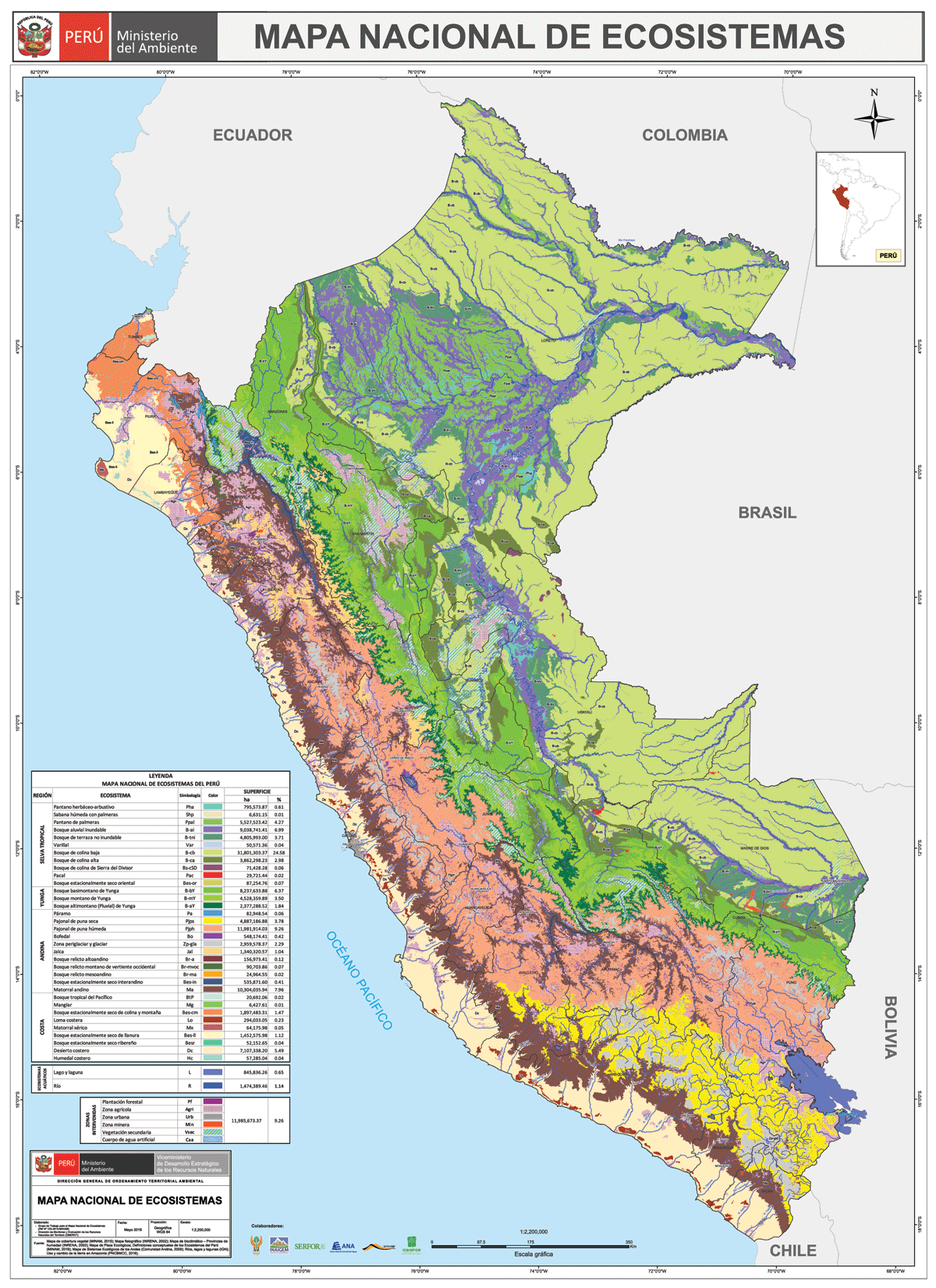
Figure 7
Peru, National Map of Ecosystems, 2019.
Source: Retrieved from Ministerio del Ambiente (2019) (non-modi!ied) CC BY 4.0.
Since the 2000s, deforestation rates in the Amazon have been the highest in Peru, when compared to other Peruvian ecosystems; large-scale plantations are the main drivers of deforestation in the Peruvian Amazon. Different crops are explored in large-scale plantations in Peru, among them rice and coffee, but oil palm and cocoa have dominate this landscape. Oil palm plantations in Peru grew by 167% between 2006 and 2013 (Dammert 2019). In 2000, Peru developed a national plan to promote oil palm production, still in force, in part to increase the production of biofuels in the country (Che Piu and Menton, 2014). Peruvian cacao production increased by 548% between the 2005/2006 and 2019/2020 harvests (Fountain and Huetz-Adams 2022).
Large-scale agriculture in Peru was boosted in the 1990s and 2000s by reforms sought to increase crop and livestock yields (via technology and techniques) and tree plantations (Alvarez and Naughton-Treves 2003). Via reforms, credit options and subsidies to small-farming were reduced; taxes were imposed; agrarian associations were dismantled; and a structural adjustment program with austerity measures was implemented (Alvarez and Naughton-Treves 2003). In addition, national administrations invested in infrastructure development – especially roads – and encouraged, via incentives, mechanization that benefited export-oriented large-scale agriculture enterprises (Sanchez-Cuervo et al. 2020; Chavez and Perz 2012).
There are two main business models to produce oil palm and cocoa in Peru. First, agro-industry: replacing primary tropical forest with private large-scale oil palm plantations (Finer and Novoa 2015). In this model, commercial agriculture focuses on acquiring land from smallholders to consolidate large-scale plantations (Dammert 2019). Second, company-community partnerships. Smallholders, either individually or collectively, rent their land to plantation companies in exchange for a share of the profits (Bennett, Ravikumar and Paltan 2018). This model was resisted by local communities, but support has increased: state services have been historically scarce in those areas, and companies provide – albeit precariously – to smallholders some, such as roads, market access, and even healthcare and education (Bennett, Ravikumar and Paltan 2018). In the same areas, incomplete titling and direct purchase, by companies from regional authorities, of land occupied by settlers has been displacing smallholder farmers, who then go deforest primary forest elsewhere (Shanee and Shanee 2016; Bennett, Ravikumar and Paltan 2018).
Resistance to land use change and policy initiatives to counter deforestation
In Peru, LULUCF emissions continuously increased between 1990 and 2020. There were policy initiatives to reduce deforestation in the period, but they were implemented half-heartedly. The coalition representing commodity exports and financial interests – Peru is dependent on these exports for its balance of payments – is strong, and still puts forward an utilitarian view of nature; the opposition, although fierce, is politically weaker. In the Peruvian Amazonian, conflicts around land tenure rights are massive. Groups fighting for a say in forest tenure in Peru have important indigenous roots and rural links, and, due to the memories of the violence perpetrated by guerrilla group Sendero Luminoso (Shining Path)10 – who also had rural roots – they are stigmatized by urban Peruvians. This is a major obstacle for better inclusion of environmental groups in politics and more democratic participation in forest governance (Pereira and Viola, 2022).
Peru has at least two relevant policy initiatives to reduce deforestation, both approved in 2011. The first is Law 19763, the Forest Law. Before the law was approved, decrees to reduce protection of natural areas and indigenous communal land tenure were enacted in a technocratic fashion, without consultation of societal groups or broad debates (Pereira and Viola, 2022). In 2009, following the negative impact of Baguazo,11 the most controversial decrees were revoked and a law on prior consultation of indigenous groups was approved by the Parliament. The Forest Law was elaborated in this context, with unprecedented consultation and participation of civil society groups – as a means to compensate for the previous incidents and ameliorate the government’s image in eyes of foreign actors (Pereira and Viola 2022) – and established a complex framework for forest governance. The second law is the Law on Prior Consultation, implementing International Labor Organization’s Convention no. 169 (ratified by Peru in 1995), which guarantees that indigenous people should give their prior consent to projects undertaken in the land they originally occupy.
In practice, however, neither law is implemented to enhance forest governance and tackle deforestation.
Regarding the Forest Law, the Ministry of Agrarian Development and Irrigation – who regulate the agro-industrial and mining activities, sectors that have always had strong political power in Peru – preserves the main say on forest issues, creating tensions with the Ministry of the Environment and environmental actors. Government’s concessions to extractive activities can overlap with indigenous rights to the land, and thus escalate the conflicts (Schiling-Vacaflor et al. 2018; McClintock 2021; Pereira and Viola 2022).
There are discrepancies when allocating land rights. For example, land titles are assigned to agriculture areas and pasturelands, but not to forest area: in this case, the area remain under public property and an usufruct contract is issued (Monterroso et al. 2017). Furthermore, while indigenous groups fight for the right of self-determination and for maintaining their lifestyle, by reclaiming, for example, communal titles of land, these are implemented only in few cases (Merino and Gustafsson 2021). In addition, rules on land tenure and the institutional framework to assign them are complex; thus the concession of land titles remains a slow and bureaucratic process in Peru (Merino and Gustafsson 2021).
Regarding procedures of prior consultation, there have been many undertaken since the law was approved, but the literature reports that are either pro-forma or do not allow communities to exercise influence over project design or veto projects (Hirsch 2017; Li 2015; Merino and Gustafsson, 2021). In addition, the procedures to exercise the right of prior consultation are sometimes unclear or communities might lack capacity to respond, limiting the exercise of their right (Schiling-Vacaflor et al. 2018).
Conclusions
In this paper, we demonstrated that climate change mitigation in Argentina, Brazil and Peru is not a synonym of energy transition since LULUCF plays an important role in GHG emissions in all three countries. We also demonstrated that the trajectory of those emissions was different in each of the countries between 1990 and 2020. Finally, by analyzing the political economy of land use change and forestry in each of the countries, as well as the policy initiatives on deforestation, we explained why it was so.
In Argentina, forests have been replaced by areas destinated to crops – first wheat and cotton, more recently, soybeans. In the 2000s, in the context of rising international demand for soybeans, Argentina became part of the soybean complex, and plantations expanded to the Northern areas of the country, where land was cheaper and connection to ports facilitated exports. However, peasants and indigenous populations already occupied the areas, and conflicts between traditional and new land owners intensified. A new forest law was approved as an environmental coalition was formed and became stronger. Yet, as the implementation of the law was left to provinces, the protection of forests varies according to the balance of power between environmental and productive interests in each of them. LULUCF emissions decreased in Argentina after 2008, but it is not clear if the law played a major or minor role, given that changes in demand of soybeans and new technology for production reduced the pressure for converting new areas into plantations around the same time.
In Brazil, the reduction of LULUCF emissions is directly related to reduced deforestation in the Amazon forest between 2004 and 2012. Brazilian forests are also subject to land use change pressure for commodities production, but the Cerrado biome has been disproportionally affected by it. Conflicts between new settlers and traditional populations in the Amazon have been fierce, and law to reduce them and tackle deforestation have been in place for long. Yet, it was in 2004, due to change in the federal government and the leadership of Marina Silva, an ex-rubber-tapper that was Minister of the Environment at the time, that a new umbrella-policy was designed to implement the existing legal framework. Under new law enforcement practices, institutional changes to change incentives to fight deforestation collaboration between federal and state governments and pressure from international and domestic public opinion, deforestation in the Amazon decreased substantially. They started to rise again when conditions changed, and especially in 2019, when a new administration, promoting anti-environmentalist practices, was elected to office in Brazil.
In Peru, pressure to convert forests for commodities plantations is also strong, cacao and oil palm being the greatest drivers in the Peruvian Amazon. There is also intense conflict between coalitions representing commodity exports and financial interests and traditional communities and indigenous populations on forest tenure. Although there has been legal developments to guarantee more participation in forest governance in Peru, especially to indigenous populations, implementation has faltered. In Peru, LULUCF emissions and deforestation continuously increased between 1990 and 2020. Large-scale commodity production is still at the basis of Peruvian economy and these interests are disproportionally favored in policy. The fact that groups fighting for better forest governance have rural links and are seen by many urban Peruvians as similar to the guerrilla Sendero Luminoso is also a burden in expanding their political appeal in Peru.
Our paper contributes to the literature on the politics of climate change mitigation by offering insights on how climate action dynamics are different in countries where sectors other than energy also have a key share of total emissions – case of most Latin American countries. It also offers insights on how a political economy analysis is useful to clarify which political coalitions exist and how their interests influence the political struggle on LULUCF issues. Future research on the transnational links of those coaltions, including their positions in global value chains, would deepen our understanding of those dynamics.
Notes
[1] Export tax is an important source of revenue for the Argentinian federal government – and the only tax revenue that is not shared with the provincial governments (OECD, 2018), except for a period between 2009 and 2018. Although it distorts commodities prices, it has been employed throughout the Argentinian history to raise federal revenue and transfer rents from economically strong yet politically weak sectors – which, at the federal level, include agriculture actors – to politically powerful yet economically uncompetitive urban sectors, such as the industry.
[2] All calculations in the paragraph based on data from MAPBIOMAS (2021).
[3] DETER system (<http://www.obt.inpe.br/OBT/assuntos/programas/amazonia/deter/deter>). PRODES system has been in force since 1988 and monitors annual rates of deforestation.
[4] SNUC was created by the federal law nr. 9985/2000, which regulated article 225 of the Federal Constitution of 1988.
[7] The federal decree 6231/2007 charged the Ministry of the Environment with the function of creating a list, to be annually updated, of those municipalities would be allowed to receive transfers from the federal government, on the condition that the given municipality kept control of deforestation verified by INPE’s data.
[9] Three open letters from Brazilian businesses were published in 2009: Coalizão Empresas para o Clima (Business Coalition for Climate, a coalition of 18 large Brazilian companies) asked the federal government for a formal pledge at the international climate regime to reduce Brazilian emissions (https://fbds.org.br/cop15/FBDS_CartaAbertaAoGoverno.pdf); Aliança para o Clima (Climate Alliance, 14 large agrobusiness) stated their concern for controlling deforestation in the Amazon and their support for a Brazilian climate pledge to reduce its projected curve of emissions (https://www.agrolink.com.br/downloads/Alianca_pelo_Clima-2009.pdf); and other 22 Brazilian companies, under the leadership of Instituto Ethos, requested Brazil to undertake a compulsory climate pledge to reduce emissions from a 2007 baseline (https://www.ethos.org.br/cedoc/carta-aberta-ao-brasil-sobre-mudancas-climaticas/). There is debate in the literature on whether these coalitions were truly committed to the climate agenda or making a public relations exercise in a period where international public opinion’s to climate change in general, and to deforestation in the Amazon in particular, was high. Still, it was the first time Brazilian businesses positioned themselves as such.
[10] Sendero Luminoso (Shining Path) was a guerrilla group with Maoist origins that emerged in the context of the debt crisis in 1980s and that engaged in violent action across Peru. Its roots were in impoverished rural communities in the Andes, where the movement “slowly acquired control of several municipal governments. It is estimated that between 1980 and 2000 more than 60,000 died in Peru as a result of political violence (McClintock, 2021).
Funding Information
The author receives the postdoctoral research grant FAPESP 2023/09230-0, connected to the thematic research project FAPESP 2019/16970-5, both from Fundação de Amparo à Pesquisa do Estado de São Paulo (FAPESP), Brazil.
Competing Interests
The author has no competing interests to declare.