
Table 1
Theoretical frameworks applicable to the Shining Path (SL) case.
| THEORETICAL FRAMEWORK | MAIN INSIGHTS |
|---|---|
| Fourth Generation Warfare | Lind and Thiele (2015) classified wars using dominions, the adversary’s nature, and the objectives of the war, as criteria. The fourth generation uses the political scenario, with combined weaponry looking forward to wearing the political and public will to fight of the enemy. |
| Asymmetrical Warfare | Asymmetrical warfare is fought between adversaries different in nature, strategies and tactics. This concept is used to describe the confrontations between States and terrorists or guerrilla groups. |
| People’s war | Tse-Tung and Griffith (1935) created and implemented this strategy based on driving the enemy to the rural areas to be confronted by small guerrilla groups that look to operate from “liberated zones.” Eventually, these groups increase in number and are trained to win a Revolution against the government. |
| Guerrillas war | Guerrillas are small groups conformed who execute tactics and operations based on surprise cleverness as they are smaller than their opponent. |
[i] Source: Authors.
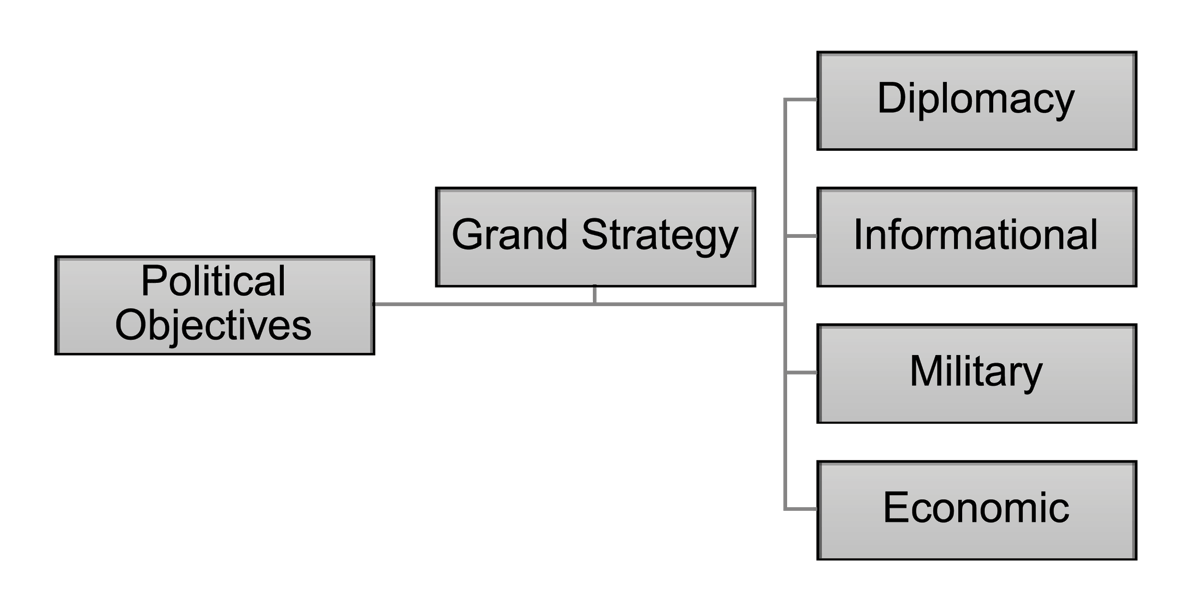
Figure 1
Hierarchical Relationship between Political Objectives, Grand Strategy, and Tools of Statecraft.
Source: Authors.