
Introduction
The fall of the Berlin Wall and the subsequent collapse of the Soviet Union, which ended the Cold War, further intensified the rise of interstate wars since the end of World War II. While state-on-state wars became somewhat an anomaly, the viciousness of intrastate or “civil” wars left the international community perplexed – especially considering the somewhat poor performance record of the United Nations, such as in Angola (1989–1999), Somalia (1992–1995), Rwanda (1993–1996), and Bosnia (1992–2002), described by Aksu (2003), Dallaire & Beardsley (2003), and Howard (2007).
This lack of effectiveness, amongst other factors, has led to an increased interest in the field of conflict resolution. In contemporary times, the study of conflict resolution concerns itself with negotiation or mediation sans military means—save for peacekeeping forces—to reach a compromise between belligerent parties with the sole aim of ending the war in question and establishing a stable and lasting peace. Within the discipline, there are multiple strands, focusing on different criteria, including the use of peacekeeping forces.
Various scholars, such as Michael Doyle and Nicholas Sambalis (2000), Page Fortna (2008), Sambanis (2008), Mason, Gurses, Brandt, and Quinn (2011), and Quinn, Mason, and Gurses (2007) argue in favour of using a (UN) peacekeeping force. Their quantitative analyses demonstrate its benefits for post-civil war stability, reducing the chance of the recurrence of violence. Luttwak (1999), however, argues that bringing wars to a halt, for instance, by enforcing ceasefires, provides the belligerents the opportunity to recover and rearm, resuming hostilities at a later point. In turn, Spears (2019) provides a general critical assessment of conflict resolution.
In this article, we use the so-called “Theory of Ripeness” developed by I. William Zartman (1989, 2007) as our point of departure. The basic idea of this theory rests upon the combined logic of rational choice and game theories. In general terms, it revolves around the point at which belligerent parties reach a mutually hurting stalemate—that is, the moment of “ripeness”—enabling them to proceed to a negotiated settlement. The ripeness theory posits that in the absence of such “ripeness,” the conflict becomes a mere zero-sum game for each belligerent.
However, what if the warring parties, devoid of “rational” decision-making capacity, are motivated by something other than reason? Indeed, cases exist in which the “ripeness” never materializes, such as in the Peloponnesian War, to name a leading example. Athens and Sparta never reached “ripeness” (Forde 2004). Instead, perpetual violence continued until Athens—following its defeat in the Sea-Battle of Aegospotami in 405–404 B.C.—finally surrendered (Kagan 2003; Thucydides et al., 2009; Tritle 2004).
Another such case is the Peruvian war against the Shining Path (Sendero Luminoso hereafter) guerrilla group. This war, too, never reached the moment of ripeness, given the underlying convictions and motivations of both actors involved. The government’s sole aim was to destroy the group at any cost, while Sendero Luminoso (SL) aimed to take over government control. This study of the Peruvian case presents an opportunity to examine how the government succeeded in “resolving” the war without any negotiated settlement or second-party intervention (i.e., there was no enforcement of ceasefire by international actors). As well, there are different theoretical frameworks that would be useful to analyse the SL case (see Table 1).
Table 1
Theoretical frameworks applicable to the Shining Path (SL) case.
| THEORETICAL FRAMEWORK | MAIN INSIGHTS |
|---|---|
| Fourth Generation Warfare | Lind and Thiele (2015) classified wars using dominions, the adversary’s nature, and the objectives of the war, as criteria. The fourth generation uses the political scenario, with combined weaponry looking forward to wearing the political and public will to fight of the enemy. |
| Asymmetrical Warfare | Asymmetrical warfare is fought between adversaries different in nature, strategies and tactics. This concept is used to describe the confrontations between States and terrorists or guerrilla groups. |
| People’s war | Tse-Tung and Griffith (1935) created and implemented this strategy based on driving the enemy to the rural areas to be confronted by small guerrilla groups that look to operate from “liberated zones.” Eventually, these groups increase in number and are trained to win a Revolution against the government. |
| Guerrillas war | Guerrillas are small groups conformed who execute tactics and operations based on surprise cleverness as they are smaller than their opponent. |
[i] Source: Authors.
These frameworks have in common the David and Goliath dynamic, in which a small adversary works to overturn the government. However, Clausewitz’s conception of war has proven itself as classical as it works as a foundation for the theories exposed above. Therefore, this paper examines how the interaction between the people, the government and the armed forces is key for a strategy to work.
More specifically, this article focuses on how the military force was used to end the war, contending that the use of military force can be effective under specific circumstances. The importance of this case should not be understated given that more often than not, governments have a poor record of winning wars against internal violent non-state actors.
Theoretical Framework
Thus, to examine the Peruvian war, particularly emphasizing the use of military force, a meaningful theoretical framework must be constructed through which such inquiry would be possible. Most importantly, this framework must enable us to examine how military force was used throughout the war, the context in which it was used, and the results it yielded. In other words, a more inclusive framework is required. Our framework was constructed based on several fragments of the theory of war examined in Carl von Clausewitz’s opus magnum On War written between 1816 and 1830, which came to be, perhaps, the most important work from the Military Romanticism tradition (Waldman 2013).1 In addition to Clausewitz’s theory of war, we used the simplified version of Colin S. Gray’s Theory of Strategy (2010, 2016, 2018). Clausewitz’s theory provides us with a seemingly prosaic but important insight: the connection between politics (Politik) and war (explained below). Gray’s seminal works on strategy build on that insight, contextualizing war by placing it into a comprehensive strategic framework.
Definitions of Strategy
The construction of the framework was based on one of the most quoted propositions from Book I of Clausewitz’s On War: “War is, therefore, an act of policy” (Clausewitz 1976, 28). In his discussion of the nature of war, Clausewitz intended to express that all war is waged for some political objective. Devoid of such an objective, war is nothing more than purposeless violence, pursued for its sake alone. Thus, war is subordinate to the political objective at stake; it is an instrument used to pursue that very objective—war’s raison d’être—or in Clausewitz’s own words: “The political object is the goal, war is the means of reaching it, and means can never be considered in isolation from their purpose” (Clausewitz 1976). This is true for each and every war, regardless of whether it is big or small, symmetric or asymmetric, regular or irregular (Clausewitz 1976).
This premise creates a vital link between a political objective and war, whereby the former gives the latter purpose. Thus, considering war seriatim would be a self-defeating exercise at best; in this article, war and, by extension, the use of force is considered in relation to the political objective(s) in question. Here, the political objectives are viewed as ends, and war as means to pursue those ends. However, what links war to its ends? In what ways is this triptych? The answer is strategy.
In its broadest sense, strategy most commonly refers to “the direction and use made of means by chosen ways in order to achieve desired ends,” as per Gray’s (2010) definition. In this definition, the formula is all-inclusive and can be applied to any domain, be it military or business, with the strategy variable being content-neutral. However, the content of strategy is contingent upon a number of constants and other variables, including but not limited to international and domestic contexts, geography, and a state’s aims and its various resources, to name a few. The previous must be factored in when content-specific strategies are formulated. It should be noted that strategy itself has no physical form and can be best perceived as “virtual behaviour” (Gray 2010, 2016). However, what can often be seen are the consequences of a good or bad strategic practice or lack thereof; this will be demonstrated later in the Peruvian case. Having established a general understanding of what strategy entails, a more distilled notion of strategy concerning war in general and the military, in particular, is presented.
Grand Strategy and Military Strategy
To understand how strategy fits within statecraft, we must explore different levels of stratagem, that is, grand strategy and military strategy. Grand strategy can be understood as “[t]he direction and use made of any or all among the total assets of a security community in support of its policy goals as decided by politics” (Gray 2010). In other words, the grand strategy uses the tools of statecraft such as diplomatic, informational, military, or economic (DIME) in specific ways to achieve the desired political end-state. Grand strategy, therefore, can be perceived as the highest level of strategy within the state system construct. It essentially governs the strategies that are nested under it, including the military strategy.
Given these definitions of strategy, it is plausible to define military strategy as the direction and use made of force (or threat) to achieve the desired political ends (Clausewitz 1976; Gray 2010). Thus, military strategy is formulated considering the overall grand strategic framework, directly linked to the central political end-state. At this stage, it is worth emphasizing a seemingly trivial yet important point: the relationship between policy/political end-estate, grand strategy, and military strategy (as well as other tools of statecraft) (see Figure 1). The relationship between the above is characterized by interdependence amongst its elements while being simultaneously hierarchical.
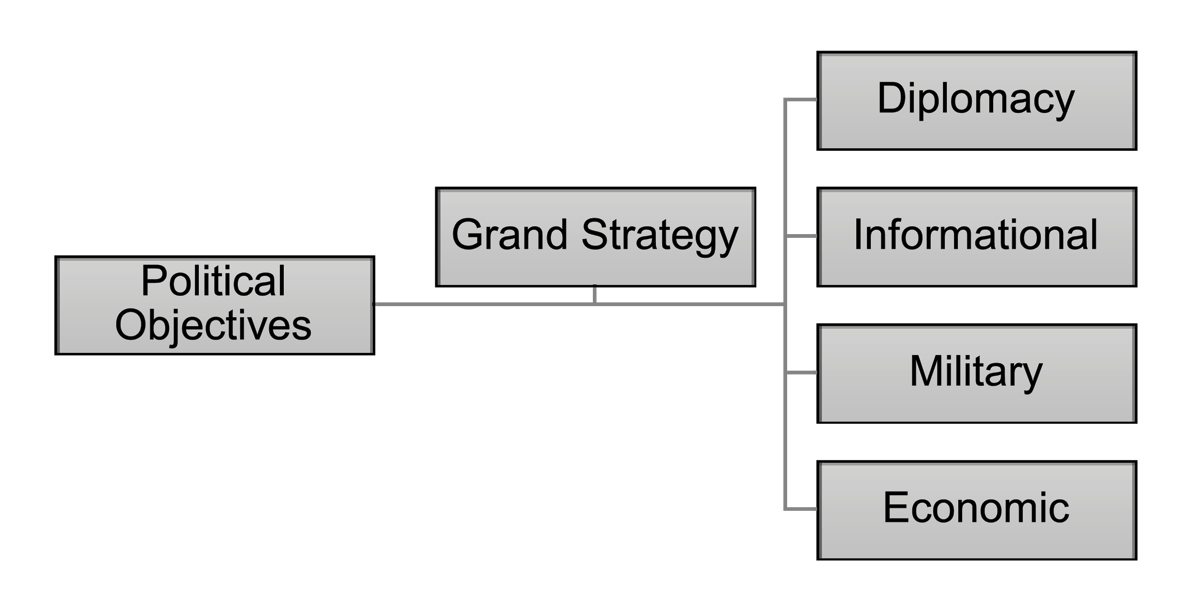
Figure 1
Hierarchical Relationship between Political Objectives, Grand Strategy, and Tools of Statecraft.
Source: Authors.
The above definitions can now be reconciled with Clausewitz’s most famous dictum, i.e., war is “…a continuation of political intercourse, [sic] carried on with other means” (Clausewitz 1976). War is an instrument directly linked to the political end-state through the layers of grand and military strategy. Paraphrased, war, while having its own dynamics, is always subordinate to policy which provides war with its raison d’être” (Clausewitz 1976).2 War, therefore, is not a replacement of policy but rather a more violent expression thereof (Smith 2005, 101). Aside from being an instrument of policy, what exactly does Clausewitz mean by “war”? Is there more to it than a duel on a larger scale or “a trial of moral and physical forces through the medium of the latter”? (Clausewitz 1976, 73).
To understand war, let us briefly look at its different natures. For Clausewitz, there are two natures, namely, the objective nature (nature hereafter) and the subjective nature (character hereafter). The former includes universal characteristics that are valid regardless of spatial and temporal settings. These are reason; chance and uncertainty; and passion and primordial violence, which Clausewitz describes as the wunderliche Dreifaltigkeit or the wondrous trinity. Each element is ascribed to a specific domain. For instance, reason rests within the policy-makers’ domain; chance and uncertainty are in the domain of the armed forces, while passion and primordial violence are ascribed to the population (Clausewitz 1976, 30–31).3 The character of war, in contrast, consists of specific characteristics unique to each instance of war, such as military forces, war doctrines, war technology, and similar (Clausewitz 1976, 26–28). These two concepts help understand the foundations that each war possesses regardless of whether it is an interstate or an intra-state war while allowing for enough flexibility to incorporate values of the variables that will always differ.
What about wars that are waged internally, between a non-state actor and a state actor within the latter’s jurisdiction? These, too, as noted above, are subject to Clausewitz’s theory of war. By definition, each belligerent has its own trinity, although, in the case of a non-state actor, the policy-maker and the forces’ commander are often represented by the same person. This condition is not different from what has been witnessed throughout the bulk of military history. Napoleon Bonaparte, for instance, was the sole decision-maker in political and military matters (Clausewitz 1976, 256).4
In such cases, given insurgent groups’ nature and insurgency’s high level of decentralisation, grand strategy has proven to be a key element as a baton to coordinate the means and efforts of its members. Furthermore, like any state, guerrillas require keen direction concerning diplomatic, information, military, and economic instruments and, most importantly, adaptation (Palma Morales 2012; Ünal & Uludağ 2019; Villalba-Garcia, Coronado-Camero and Sierra-Gutiérrez 2022). Otherwise, as will be shown, the counterpart acting in a harmonized and coordinated manner will have an advantage, facilitating its victory.
Regarding passion, the population’s support, as well as legitimacy, is essential to maintain or achieve power in intrastate conflicts. Each party will clearly have a comfort zone, generally the rural areas for the insurgency and the urban ones for the government. However, to obtain legitimacy, institutional presence is required besides the physical, as discussed by other authors such as Hurtado Noriega & Doria Valverde (2020). To advance to this point, the effort from reason is indispensable.
Having explained the key terms, Clausewitz’s Trinitarian framework is applied to analyse the belligerents in the case of the Peruvian war. This analysis is supplemented by the outlined theory of strategy to demonstrate how force was used throughout the war, addressing questions such as: Was the force aligned with the overall political goal? Was there a grand strategic framework underpinning the war effort? How did the use of force change throughout the war?
The war against Sendero Luminoso
With the theoretical framework for analysis of the case study in place, the following section will create a contextual setting, briefly recounting Peru’s political and economic conditions, which, amongst other factors, gave rise to the insurgency. While no single factor should be considered as a sole reason for the war that took place, a confluence of these factors offers a more cogent understanding of the war’s origins.
Subsequently, both belligerents will be situated into the Trinitarian framework, focusing on policy, particularly, strategic approaches and modus operandi. As stressed by some of the most prominent strategic thinkers, such as Sun Tzu and later Clausewitz, understanding one’s opponent is vital (Clausewitz, 1976).
Background
The political climate in the 1960s and 1970s that flourished in Latin America gave rise to numerous guerrilla movements, most notably in Cuba, Guatemala, and El Salvador, with Peru being no exception (Armstrong & Shenk 1982; Regalado Álvarez 2007; Warren 1998; Wickham-Crowley 2001; Wood 2003). In the early 1960s, Peru faced two simultaneous insurgencies inspired by the Cuban Revolution that the military forces had suppressed by 1965, setting the stage for a military coup in 1968 (Kruijt 2002, 55; Walter 2010, 68–72). The country’s political landscape, therefore, offered little stability. Peru finally returned to civilian government in 1980. However, distrust tainted the relationship between the civilian political leaders and the armed forces, given the history of military coups.
In economic terms, Peru experienced economic growth throughout the 1960s and 1970s (Palmer 1986). During the military rule of this period, the nationalization of the industry coupled with agrarian reforms eradicated poverty, thereby precluding the emergence of yet another insurgency. These reforms sought to redistribute land ownership, transferring large landholdings to peasant control. However, the hacienda system, which linked landowners with peasant communities and provided economic security to the latter, had been dismantled, thus severing the situation for peasant communities (Clayton 1999; Heilman 2010; Kruijt 2002; McClintock 1989).
These reforms only exacerbated the existing tensions between the urban elites of Spanish descent or mixed blood (mestizos) and the indigenous Quechua community, leading to overall societal dissatisfaction. In addition, they had an unforeseen political consequence, namely the legitimization and subsequent rise of the political left. All these aspects contributed to the increased support for the insurgents (Mason & Swartzfager 1989).
Moreover, Peru’s geographical landscape physically intensified the divide between the elites and the rural population, with a large portion of the territory consisting of the Amazon jungle and the Andean mountain range, making it difficult for the government to exert control in remote areas (Montoya Marallano 2008). One of these areas was the Department of Ayacucho, where the Sendero Luminoso movement originated in 1969, taking advantage of the favourable (for insurgents) geographic conditions coupled with extreme poverty and high illiteracy rates (Heilman 2010; Kruijt 2002; McClintock 1989).
Sendero Luminoso: Its Origins, “Reason, Chance, and Passion”
Here, we briefly discuss SL’s origins. Then, we project Clausewitz’s trinity onto the revolutionary movement to better understand the war in general and, specifically, the belligerent and their strategy.
SL was the brainchild of Abimael Guzmán, a philosophy professor at the University of San Cristóbal de Huamanga. It was created as an off-shoot of Peru’s Communist Party (Bandera Roja). Throughout the 1970s, Guzmán capitalized on his teaching position to indoctrinate, primarily, the Quechua community, underpinned by Marxist-Leninist-Maoist philosophy (Doria Velarde 2020; Fishel & Manwaring 2006; La Comisión de la Verdad y Reconciliación Perú 2003a, 2003b; Palmer 1986; Wickham-Crowley 2001). The last in this canon of “great thinkers” would be Guzmán himself. This effort created the necessary popular base to wage the armed struggle in 1980 as the means to the ultimate goal of SL, namely replacing the government with one of its own.
Reason
The movement consisted of Guzmán’s political party, Partido Comunista del Perú – Sendero Luminoso (PCP-SL), reinforced by a guerrilla army and various support mechanisms. Indeed, Guzmán believed that the structure of his organization would be the most important factor contributing to the achievement of SL’s goal (Manwaring 1995, 159). Thus, the “reason” of the trinity rested with Guzmán and, to a certain extent, with the Politburo and the Central Committee of the PCP-SL, otherwise known as the cúpula. Naturally enough, SL had a centralized, top-down hierarchical structure divided into various cells that formed a network of provincial and local committees. Meanwhile, all military planning was undertaken at the local level, allowing a certain flexibility, where the overarching strategic guidance and objectives were set by Guzmán (Bahamón Jara et al. 2021; Kruijt 2002; Marks & Palmer 2005). Guzmán was both the policy-maker and the commander-in-chief. Of course, this happened to be one of the so-called centres of gravity of his organization, as discussed below.
Chance and Uncertainty
Like most insurgent movements, SL had a military wing directly accountable to the cúpula. There were several subdivisions within the military wing consisting of regional/main, local, and base forces, depending on each force’s capabilities and armament. The main force was semi-regular, conducting attacks on police outposts and ambushes on army patrols. The local force was a “part-time” force consisting of farmers armed with pistols and carbines that reinforced the main force. The base force was the reserve force consisting of villagers infiltrated by SL (La Comisión de la Verdad y Reconciliación Perú 2003a; Manwaring 1995).5
This was SL’s domain of “chance and uncertainty,” that is, of its guerrilla army, which was perhaps more flexible than a state army, with less conventional tasks that included not only traditional manoeuvres but also stratagems prohibited by International Law. Terrorism, for once, was one of the methods that later on, combined with other groups’ actions, gave birth to the “Época del Terrorismo en Perú” (Terrorism Era in Peru). These tactics caused an “armed persuasion,” mostly in the areas neglected by the state. The SL fondly used these methods adopted in 1980, given the shortage of manpower resulting from the lack of appeal of its communist propaganda (Kruijt 2002), along with the capturing of weapons and other means, as well as staging terrorist attacks (see below).
Passion and Primordial Violence
The third component of SL’s trinity was its popular support and recruitment base. Upon its conception in 1969, SL had only 12 members, hardly enough to start a revolution (Roncagliolo 2012). It took SL a decade to attract enough supporters and sympathizers to wage war. Throughout SL’s more latent phase, its main focus was the indigenous community. As noted, Guzmán taught his version of Marxist theory primarily to revolutionary students from the Quechua communities. Once well versed in Marxist theory, these students would help spread the message by occupying teaching positions in villages indoctrinating the rural population. Another way of ensuring popular support was achieved through provision of public services (schooling, medical services) and even such extreme means as intermarrying (Bermúdez Tapia 2020; Gorriti Ellenbogen 1999; Isbell 1994; La Comisión de la Verdad y Reconciliación Perú 2003b; Starn 1995).
This recruitment strategy was comparatively successful, at least until the beginning of the war. The SL membership increased from a dozen members in 1970 to 520 in 1980, reaching almost a six-fold by 1990 (Kent 1993; La Comisión de la Verdad y Reconciliación Perú 2003a; Tarazona-Sevillano 1994). However, despite its efforts to build a strong social base to initiate a people’s war (La Comision de la Verdad y Reconciliacion Peru 2003a, 22), SL did not receive the expected amount of support in its “native” Ayacucho Department. This inevitably led to the use of “armed persuasion,” enacted from 1980 to 1983 (when the Army took control of Ayacucho).
SL’s strategic approach
While Mao Tse-Tung’s People’s War and the idea of commencing the revolution in the countryside inspired SL (Degregori 1994; Galdo 2015; Kay 1999), its strategic approach, devised by Guzmán, deviated from Mao’s three-stage theory, consisting of strategic defensive, strategic equilibrium, and strategic offensive (Tse-Tung & Griffith 1935). In contrast, SL used the five-stage approach outlined below.
The first phase was to convert underdeveloped areas (i.e., those suffering from weak government control) into support bases. The second phase, which began in 1980, was an offensive, consisting of attacks upon the state’s “bourgeois” symbols. The third phase aimed to spread the violence, launching a full-blown guerrilla war in urban areas. The fourth phase involved seizing territory and expanding the bases of support. As a logical progression from the fourth phase, the final one sought to isolate the cities, especially the capital, which SL believed would lead to a state collapse (Gorriti Ellenbogen 1999; Poole & Renique 1991).
In sum, SL had a meticulously structured organization, with a clear connection between the elements of its “trinity,” underpinned by a clearly outlined strategy and lines of operations, which helped SL quickly transition through its phases until the early 1990s. In other words, the cúpula had a clear grasp on how to achieve the overarching end of the state and what resources, human and otherwise, would be required to achieve it. However, the linearity of its strategy was detrimental to SL and the shortcomings of a hierarchical structure, as explored below.
The State Apparatus
In the case of a state actor, the trinity and its elements are fairly obvious. In the Peruvian case, the government represented the reason, the armed forces the chance and uncertainty, and the population the passion. However, it should be noted that the population, as discussed earlier, was somewhat fragmented given the divide between city elites and the rural population over which the government had little control. In addition, due to the military coup of 1968 and subsequent military rule, the relationship between the civilian government of Fernando Belaúnde Terry (in power from 1980 to 1985) and the military remained strained. Upon returning power to a civilian leader, the military ensured to maintain a degree of autonomy by passing specific legislation that would allow it to operate independently in areas declared under emergency rule at latter stages of the war (Agüero 2001; Burt & López Ricci 2016; Shadle 2015). This discord between the elements of the trinity had far-reaching implications on strategy formation in general and, in particular, on the use of force.
Trinity in Distress I: 1980–1985
When the insurgency broke out in May 1980, Peru was under a civilian government led by Fernando Belaúnde Terry, which essentially dismissed the seriousness of SL’s threat. However, as SL progressed through its strategic phases, it was clear that Belaúnde would have to use the much distrusted armed forces (FFAA hereafter), as the police were ill-suited to counter the unfolding threat (La Comisión de la Verdad y Reconciliación Perú 2003b; Montesinos Torres 2009; Obando 1998; Tapia 1997).6 The situation on the ground was spiraling out of control, resulting in Belaúnde declaring emergency rule in Ayacucho and deploying the FFAA to the region to regain control (Degregori 1997; Kruijt 2002).
At this point, the FFAA started operating autonomously, with little oversight and devoid of grand strategic direction or any reinforcement from other instruments of statecraft (Mauceri 1991, 90–91). This situation created an even greater rift in the State’s trinity, hampering the effective creation of an adequate grand strategy to situate and direct the military instrument toward the overarching goal. By the end of Belaúnde’s tenure in 1985, the results of the FFAA’s operations proved to be ineffective and counterproductive, not because it lacked the firepower but because it lacked political direction and a clear end-state.
Among the chief reasons were the lack of a complete strategic framework, doctrinal guidance, intelligence and, above all, the inability to win over the population in SL-infiltrated areas (Bermúdez Tapia 2020; La Comisión de la Verdad y Reconciliación Perú 2003b; Taylor 1998). Moreover, Belaúnde’s distrust of the FFAA deepened its inability to adapt to the strategic environment. The government misunderstood the main threat at the moment, confusing it with the ones from the past related to dictatorships and the weakening of democracy. In turn, the FFAA were constantly vigilant of the government’s actions and its lack of proficiency, which precluded joining the efforts from reason and chance in a climate of mutual skepticism.
Trinity in Distress II: 1985 – 1989
In 1985, a left-wing, social-democratic party, the Alianza Popular Revolucionaria Americana (or APRA) spearheaded by Alan García Pérez, won the elections. Subsequently, García became the new President who would occupy the position until 1990. The change in relations between the other trinity elements came with the change of the main component of the reason variable. Specifically, García sought to build a closer relationship with the FFAA and create more legitimacy in the eyes of the (rural) population. He addressed the existing social grievances linked to economic underdevelopment that SL was exploiting through several political and economic initiatives in the Andean highlands (e.g., interest-free loans for peasants) (McCormick 1990, 31). This was a significant departure from Belaúnde’s one-dimensional grand strategy and his hands-off approach concerning the FFAA. García understood that other tools of statecraft had to be used if SL was to be defeated, thus, creating what became known as the estrategia desarrollista (developmental strategy) (Mauceri 1991; Taylor 1998).
However, this “closer” relationship with the military did not necessarily imply cooperation. On the contrary, García sought to hold the military accountable for its human rights abuses (i.e. killings of innocent civilians) (Rodríguez Elizondo 1985; Salazar 2020), creating greater oversight of the FFAA with a possibility to integrate them into his grand strategic design. However, García’s design failed due to hyperinflation and the lack of funds for economic projects (Díaz Rosillo et al. 2020; Mauceri 1991; Yaworsky 2009), and because the FFAA could not be easily subdued. Indeed, the FFAA perceived themselves as an autonomous actor that should keep the politicians in check.
These failures at the grand strategic level were coupled with the lack of expected success at the military strategic level. The FFAA was trying to adjust its approaches to at least halt the spread of insurgency. Local military commanders (jefes político-militares) in charge of the emergency rule areas –that amounted to nearly 60 by 1990– were acting as de facto governors without any clear limits to their policy-making (Franco Fuquen et al. 2022; Mauceri 1991; Soifer & Vergara 2019).
In addition, the military began integrating the so-called “Village Guards” or rondas campesinas (volunteer peasant patrols) into their counterinsurgency efforts in rural areas (in the departments of Apurímac, Ayacucho, Huancavelica, and Junín).7 Using rondas represented a closer relationship between the domains of chance and uncertainty, and passion, which proved to be crucial as this would deprive SL of its vital supporters. The people’s war was turning against SL (Englund & Stohl 2016; La Comisión de la Verdad y Reconciliación Perú 2003a; Werlich 1984).
Notwithstanding the existence of some positive elements of the FFAA’s strategy, there was an overall lack of consistency resulting, above all, from a lack of a coherent political end state and a viable grand strategic framework (Mauceri 1991). While the domains of chance and passion found a common, though small, intersection, the domain of reason remained entirely disconnected, especially from the earlier.
Against this background, the FFAA made a crucial decision to restructure the strategic approach, which culminated in the so-called Plan Político-Militar (Political-Military Plan) devised in August 1989. This plan resulted from the FFAA’s growing dissatisfaction with García’s government. In addition, the ultimate purpose of this plan was to gain complete control of the war against SL on all levels (Obando 1998; Rospigliosi 2000; Taylor 1998). In other words, given the existing rift between reason and chance, the FFAA intended to merge the two domains by taking control of the reason, striving to establish a shadow military government not subject to civil control, which would address both military and non-military aspects deemed necessary to win the war (La Comisión de la Verdad y Reconciliación Perú 2003b).
Rebalancing the Trinity: Fujimori’s Approach, 1990–1993
While García’s government was strongly opposed to FFAA’s attempts to cross over into the political domain to implement the aforementioned plan, the situation experienced a radical shift in 1990 – the year Alberto Fujimori became the new president. Under close guidance from the chief of the National Intelligence Service (Servicio de Inteligencia Nacional), Vladimiro Montesinos, Fujimori ensured full implementation of the plan (La Comisión de la Verdad y Reconciliación Perú 2003b; Montesinos Torres 2009), going to great lengths to fight the opposition from the Congress. This inevitably led to Fujimori’s self-coup in 1992 which helped create an Emergency and National Reconstruction Government necessary to respond to the exigencies of war (La Comisión de la Verdad y Reconciliación Perú 2003a; Rospigliosi 2000). Hereby, the long missing balance between reason, chance and passion was restored.
The overarching approach to achieve this balance, as per plan, included not only military measures but also economic measures as to address the root causes of the war. The economic programme designed to reduce inflation, indeed, helped restore popular confidence in the government, especially amongst the indigenous population (Montesinos Torres 2009; Rospigliosi 2000). This helped to re-establish the missing connection between the domains of reason and passion.
Legislative reforms formed another pillar of Fujimori’s grand strategy and were designed to primarily encourage provision of vital intelligence through a Repentance Law of May 1992 which promised both protection and reintegration for captured insurgents (República del Perú 1992, 1993). Obtain intelligence proved to be useful in capturing Guzmán, who was well hidden among the population and therefore, his capture was only possible through an accurate operation.
The final and perhaps the most crucial pillar was the overhaul of the entire state security apparatus. The reforms undertaken were designed to facilitate cooperation between different agencies and increase the FFAA’s efficiency, integrating it into the overall grand strategic framework. This was achieved through creation of a National Defence Council to facilitate the synergy between all actors through a single political-military command. Similarly, the intelligence apparatus was restructured and reformed to the same end (Tapia 1997). Lastly, the police, too, was revamped and granted more powers through creation of the so-called National Antiterrorism Agency (Dirección Nacional Contra el Terrorismo or DINCOTE) which was responsible for the ultimate capture of Guzmán in 1992 (La Comisión de la Verdad y Reconciliación Perú 2003a).8 In other words, the domain of chance – and in this case this would include the police given that the war in question was an intrastate war – was reshaped not only to address the problem at stake but also to be better integrated into the trinity equation explored here.
Fujimori’s success and the end of the SL
All in all, once the trinity was in balance, the Peruvian government was able to put an end to the insurgent menace that had been plaguing the country for the past decade. Having created a grand strategic framework within which all elements of the trinity were set in balance was instrumental to defeating the insurgency. The efforts undertaken by Fujimori’s government served as a strategic surprise for the SL whose strategy was defined by its predetermined linearity, being, therefore, poorly suited to exogenous changes. The new strategy enacted was an important component of success, as Guzmán himself came to recognize.
The above demonstrates that negotiation in the point of mutual stalemate is not always possible. However, it is interesting that the government of Peru was closer to such point than Sendero Luminoso. As stated in a RAND report, the situation of Peru was almost impossible to recover, being the most severe threat the one posed by Sendero Luminoso (McCormick 1990). This report affirmed that a coup was a matter of time, nonetheless it was not directed by the FFAA as predicted.
Fujimori was democratically elected, though the implementation of a grand strategy was not possible until the 1992 self-coup, through which he was able to direct as the reason the chance and passion without any substantial obstacle. Yet, interesting enough, he was an engineer and not a military, displaying the RAND report as partially right when asseverating that “The military correctly considers itself to be the ultimate defender of the state rather than any particular form of government or administration, duly elected or not” (McCormick 1990). Even though Fujimori did not belong to the FFAA himself, he did enable the long-wasted capacities the FFAA had at the time.
Through statecraft, in the whole sense, Fujimori not only did use appropriately the force but also tackled the profound grievances that were fuelling the conflict and legitimating Shining Path. Economic and social policies were taken in place, while the population was authorised to fight against Shining Path as self-defence forces that responded at the same level the base force of Shining Path worked.
However, it should be stressed that creating a balance between of the trinity is only one side of the equation for a strategic interplay between two belligerent parties assumes action and subsequent reaction. This means that the achieved balance is not a constant and has to be readjusted according to the circumstances. As noted, SL, due to its organizational layout and perhaps due to the convictions held by its leadership, was unable to make the necessary adjustments. Thus, this lack of flexibility greatly contributed to SL’s demise.
Conclusion
This article commenced with a brief mention of the existing academic efforts in conflict resolution, focusing on the Theory of Ripeness, which assumes that in any given war, belligerents would reach a point at which it would be detrimental for both to continue fighting. This point came to be known as the moment of ripeness that serves as a catalyst for ending a conflict. It would compel the belligerents to enter into negotiations, which in an ideal case, would not only halt the violence but also reach a negotiated settlement. However, notwithstanding its theoretical value, there are cases that demonstrate that reality can look very different.
Thus, for analysing wars outside the explanatory scope of Zartmarn’s theory, this article used Clausewitz’s theory of war and his “wondrous” trinity: reason, chance and passion and Gray’s theory of strategy. These have been applied to an intrastate war in which, despite growing violence, the belligerents did not reach a moment of ripeness. The war ended through the use of military force. The main contention made in this article was that wars (or armed conflicts) can be successfully resolved using force, however, with several caveats. Firstly, the use of force must be aligned with the overall political objective and integrated within the broader strategic framework for it to be able to yield the desired results. Secondly, there needs to be a balance between the different elements of the trinity for the entire enterprise to work. In other words, the state, its military forces, and its people must be mutually linked.
As demonstrated, in the Peruvian case, military force was used from the very onset of the war. However, it was not until its last years that it started to generate the hoped-for results. It can be strongly argued that in the very beginning of the war, the use of force was not only ineffective but also counterproductive, playing right into the adversary’s hands. There was a disconnect between political leadership, the military, and society, especially, in those segments consisting of indigenous peoples affected by the adversary’s propaganda. It was not until Fujimori’s presidency that the situation changed in favour of the government and its armed forces. However, for that to happen an entire overhaul of the state’s system, including the defence structure, had to take place. In addition, a link had to be established with the people (going beyond metropolitan areas). Once all the elements were in balance and the armed forces were more effectively integrated within the grand strategic framework, underpinned by a clear political objective, it did not take long until the war was won (Peña Chivata et al. 2019). Of course, this is not to say that the other belligerent did not commit strategic errors, which helped the Peruvian government gain the upper hand. The above an absolute formula for success; however, the task here is not to devise but rather to demonstrate that, when used correctly, military force can be a decisive instrument in resolving conflicts (wars) even in absence of international conflict resolution attempts and the so-called moment of ripeness.
Notes
[2] Military Romanticism rejects viewing war through the lens of natural sciences, as Military Enlightenment did. Instead, it focuses on less predictable and quantifiable factors that do not adhere to rules, such as human psychology and chance. For a historical and contextual background on Clausewitz’s writing, see, for instance, Waldman (2013). For a more detailed account of Military Romanticism, see Lynn (2003).
[3] Certainly, this is not Clausewitz’s original idea. Niccolò Machiavelli (2001) expressed a similar idea in The Art of War, originally published in 1521. Clausewitz’s contemporaries, too, made similar conclusions, e.g., the Prussian General Friedrich von Lossau. For more information, see, Smith (2005, 100) and Waldman (2013).
[4] For works that disagree with Clausewitz’s trinity in the contemporary settings, see, for instance, Keegan (1983), Van Creveld (2002), and Kaldor (2012).
[5] Clausewitz considered that this was true in these cases. In others, where the statesman and the commander-in-chief were not the same, he suggested that the latter’s input should be considered in policy creation.
[6] This last force was armed with machetes and sticks, acting as guards and a reserve for the main and local forces.
[7] For more information on the military rule, see, for instance, Cleaves and Pease (1985, 233–270).
[8] For more information on rondas campesinas, see Delgado Vásquez and Rodríguez Barboza (1985).
Competing Interests
The authors have no competing interests to declare.