
Table 1
Variables of Presidential Powers by Dimension.
| Party leader | Head of state and government | Legislator |
|---|---|---|
| Leadership over their party | Appointment of executive at subnational level | Threshold to override presidential veto of a bill |
| Legislative majority of their party | Appointment of judges to constitutional court | Number of chambers that review a veto |
| Cohesion of the ruling party | Appointment of the attorney general | Threshold to override partial veto of a bill |
| Discipline of the ruling party | Appointment of the controller general | Partial promulgation of a bill |
| Leadership over their legislative coalition | Legislative authority to interpellate ministers | Presidential veto of budget bill |
| Legislative majority of their coalition | Legislative authority to censure ministers | Call for a period of extraordinary sessions |
| Number of parties in the legislative coalition | Restriction to censure by dissolution of legislative | Exclusive initiative on economic legislation |
| Cohesion of the legislative coalition | Threshold to initiate censure of ministers | Submission of bills under urgency |
| Discipline of the legislative coalition | Threshold to approve censure of ministers | Decree power in emergency situations |
| Leadership over unions and social movements | Number of chambers that review a censure | Restriction on the content of decrees |
| Number of institutions that review an impeachment | Result of decree process | |
| Threshold to initiate an impeachment process | Submission of laws to popular referendum | |
| Threshold to approve an impeachment | Call for a Constitutional Assembly | |
| Impeachment option for political reasons | Authority of legislative to increase spending | |
| Option for removal due to mental/physical incapacity | Type of budget bill proceedings | |
| Legislative ratification for emergency declaration | Relationship with the lower chamber’s presidency | |
| Limitation to suspension of rights under emergency | ||
| Temporal limitation of emergency period | ||
| State ownership of mass media | ||
| Country’s dependence on foreign loans | ||
| Subordination of the military to civilian power |
[i] Source: Authors’ elaboration.
Table 8
Indices of Presidential Powers by Dimension and Overall.
| Country | Party leader | Head of state and government | Legislator | Legislator* | Overall |
|---|---|---|---|---|---|
| Argentina | 0.350 | 0.429 | 0.615 | 1.281 | 0.465 |
| Bolivia | 0.767 | 0.401 | 0.333 | 0.146 | 0.500 |
| Brazil | 0.283 | 0.627 | 0.583 | 1.177 | 0.498 |
| Chile | 0.400 | 0.504 | 0.740 | 1.625 | 0.548 |
| Colombia | 0.467 | 0.254 | 0.573 | 1.031 | 0.431 |
| Costa Rica | 0.367 | 0.270 | 0.167 | 0.104 | 0.268 |
| El Salvador | 0.483 | 0.246 | 0.271 | 0.292 | 0.333 |
| Ecuador | 0.600 | 0.274 | 0.635 | 1.146 | 0.503 |
| Guatemala | 0.100 | 0.341 | 0.187 | 0.125 | 0.209 |
| Honduras | 0.433 | 0.437 | 0.187 | 0.125 | 0.352 |
| Mexico | 0.400 | 0.540 | 0.302 | 0.312 | 0.414 |
| Nicaragua | 0.850 | 0.456 | 0.281 | 0.219 | 0.529 |
| Panama | 0.333 | 0.397 | 0.542 | 0.948 | 0.424 |
| Paraguay | 0.300 | 0.357 | 0.385 | 0.479 | 0.347 |
| Peru | 0.400 | 0.313 | 0.531 | 0.812 | 0.415 |
| Uruguay | 0.600 | 0.357 | 0.531 | 0.906 | 0.496 |
| Venezuela | 0.583 | 0.254 | 0.406 | 0.406 | 0.414 |
[i] * With an interaction between veto and agenda-setting powers.
Source: Authors’ elaboration.
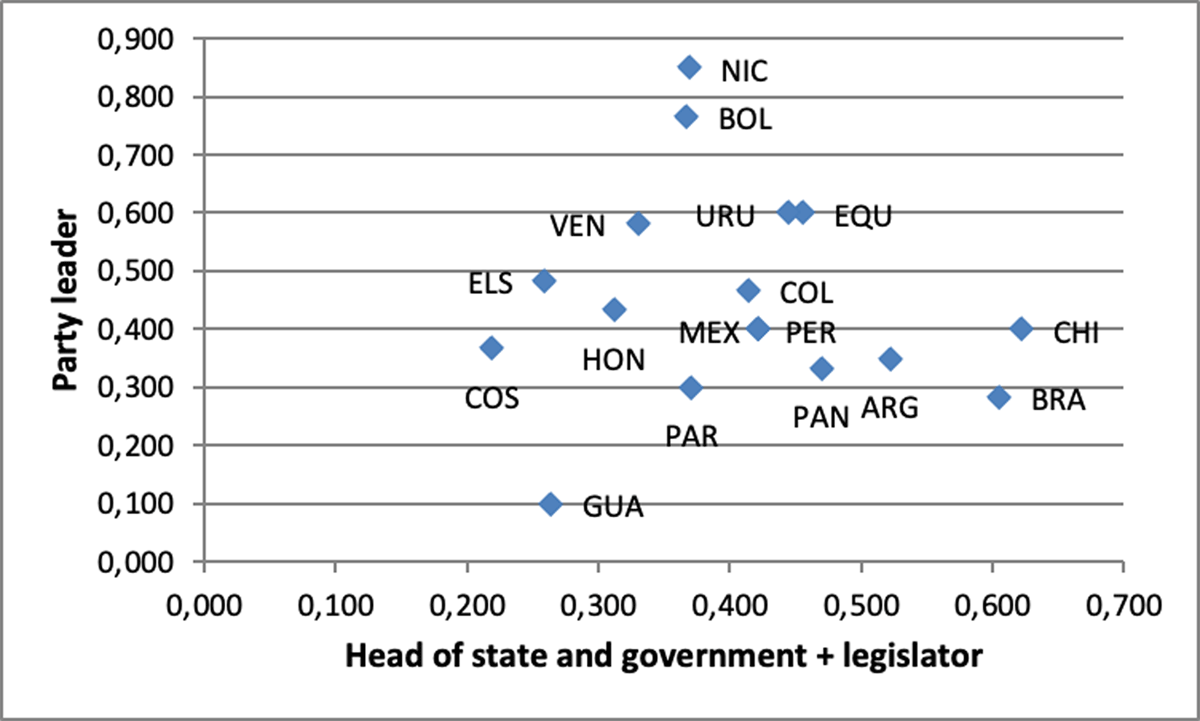
Graph 1
Distribution of Countries According to Presidential Powers.
Source: Authors’ elaboration.
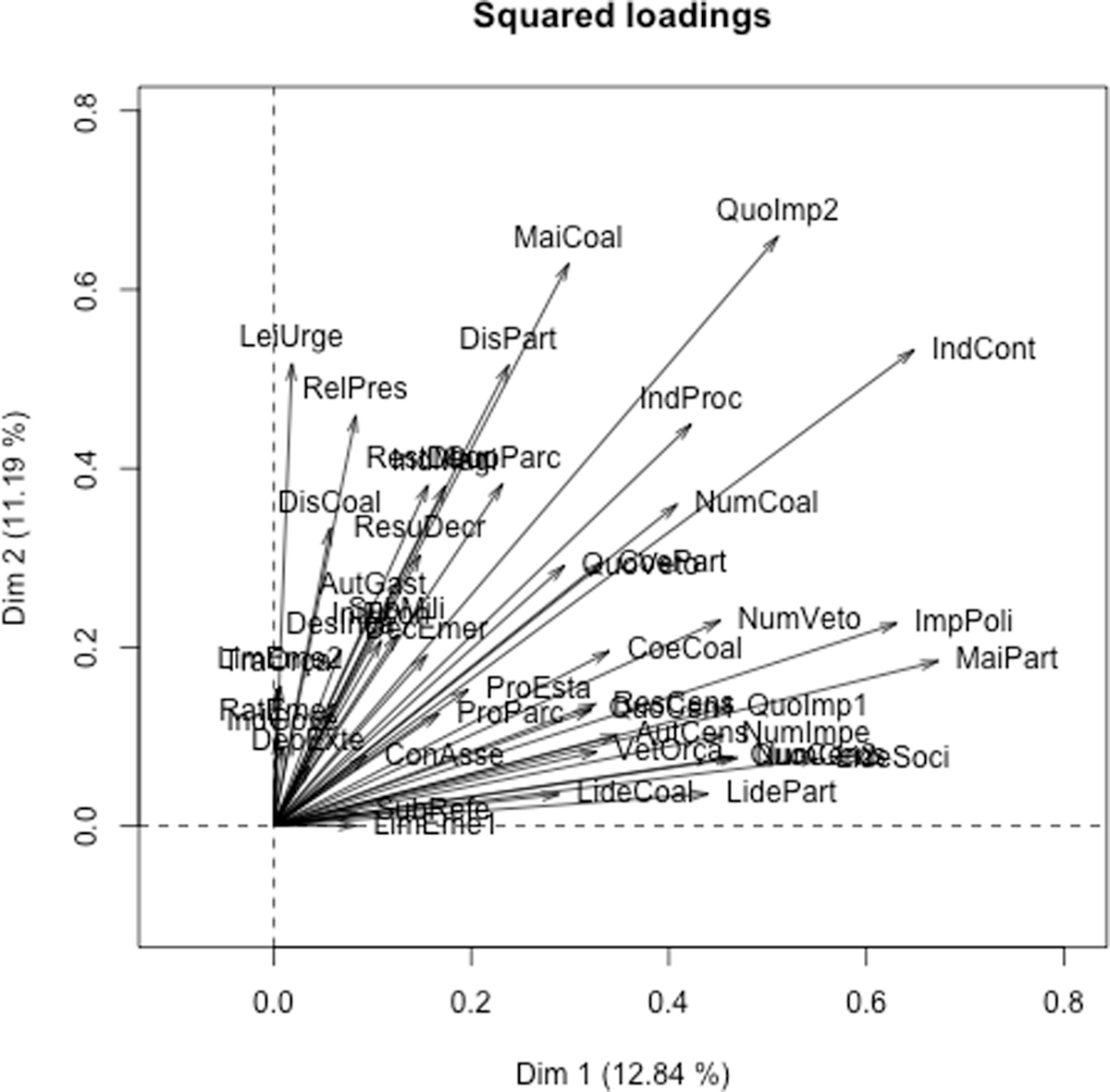
Graph 2
Squared loadings of the variables.
Source: Authors’ elaboration.
Table 9
Classification of Presidencies According to its Combinations of Powers.
| Classification | Powers in Common | Countries |
|---|---|---|
| Potentially dominant | Single-party with qualified or absolute majority and veto subject to override by a qualified or absolute majority | Nicaragua, Bolivia, Ecuador, and Uruguay |
| Majority coalition of three to five parties, decree subject to legislative authorization, and veto subject to override by an absolute majority | Colombia | |
| Proactive | Majority coalition of six or more parties, unilateral decree or subject to legislative authorization, veto subject to override by a qualified or absolute majority, and appointment of attorney-general subject to ratification by a qualified or absolute majority | Chile and Brazil |
| Unilateral decree or subject to legislative authorization and veto subject to override by a qualified or absolute majority | Argentina, Peru, and Panama | |
| Majority coalition of three to five parties or undisciplined single-party majority, veto subject to override by a qualified or absolute majority, and ministers are not subject to censure or dismissal for censure | Mexico and Paraguay | |
| Reactive | Disciplined minority and in condition of second force in number of seats | Venezuela and El Salvador |
| Potentially marginal | Minority party or coalition and veto subject to override by a qualified majority | Honduras, Costa Rica, and Guatemala |
[i] Source: Authors’ elaboration.
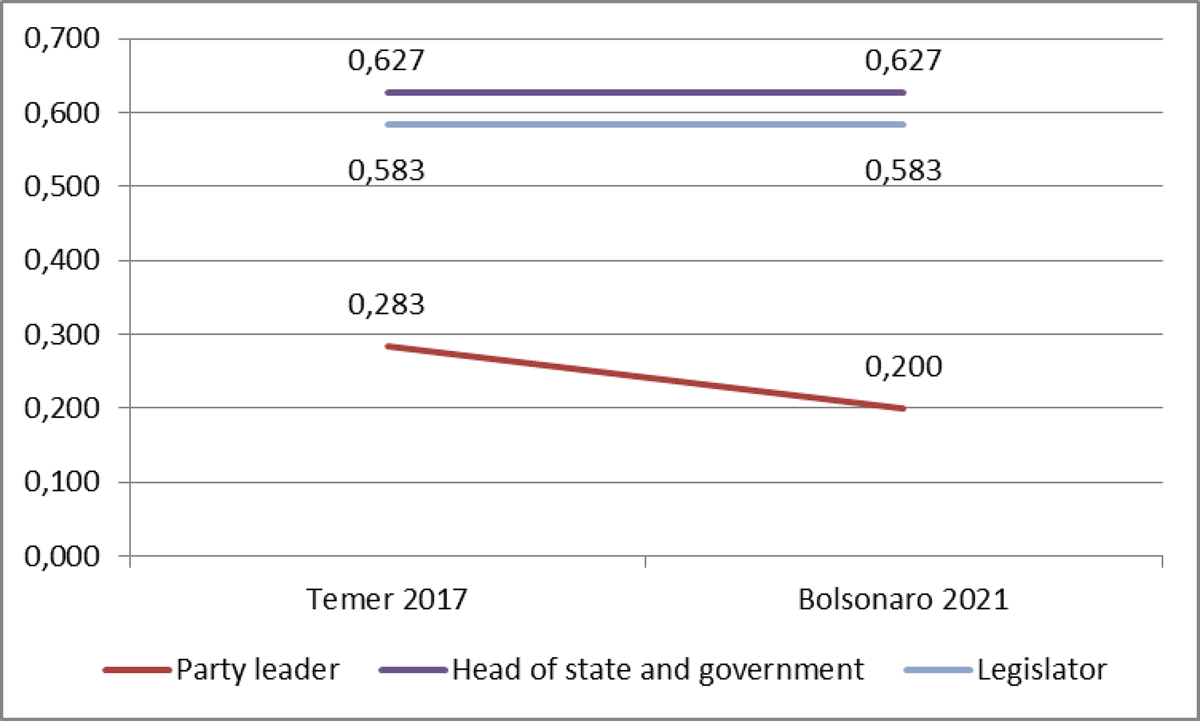
Graph 3
Presidential Powers in Brazil (2017–2021).
Source: Authors’ elaboration.
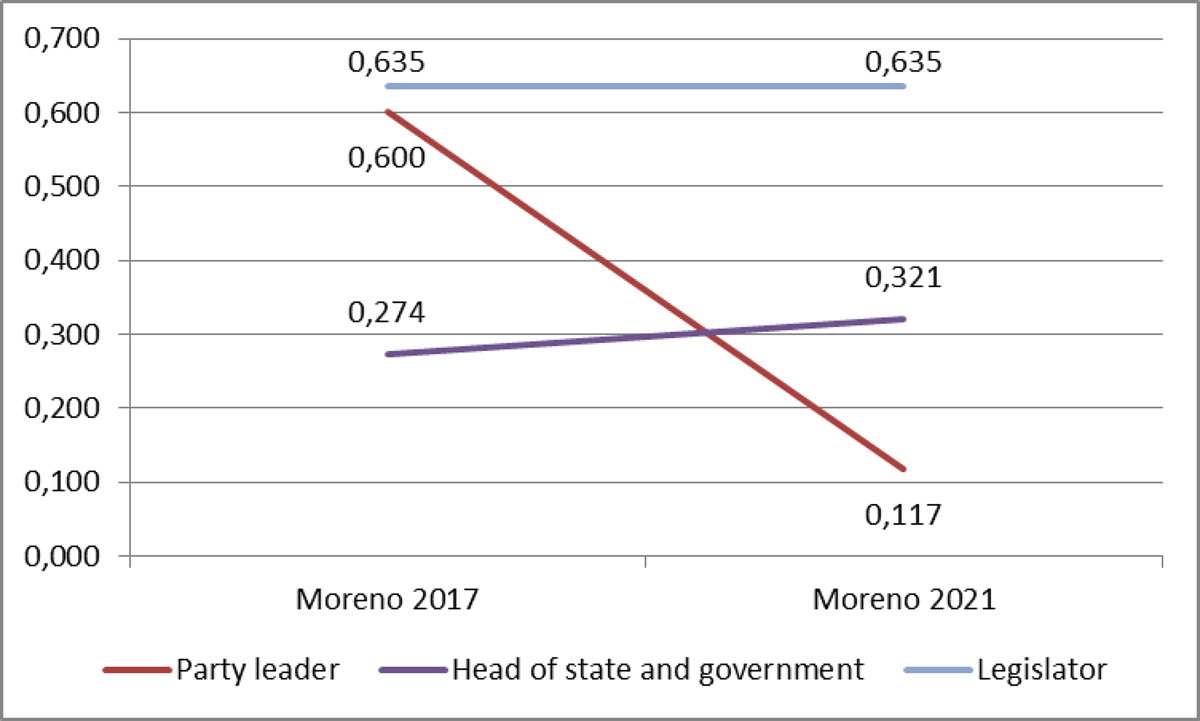
Graph 4
Presidential Powers in Ecuador (2017–2021).
Source: Authors’ elaboration.