
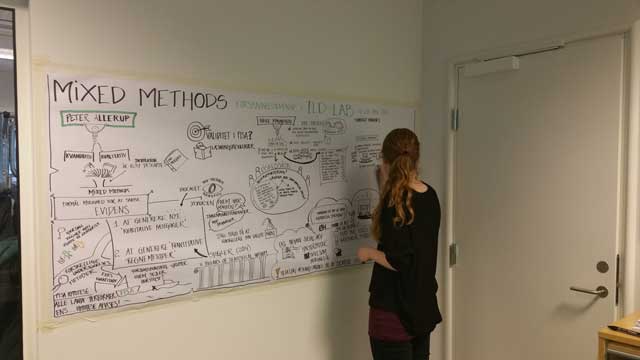
Figure 1
A graphic facilitation process seen from the position of the participants (source: photo by author R. Ørngreen, of author H. Hautopp in an ongoing facilitation process).
Table 1
Overview of the reviewed material.
| Genre | Examples from education | Examples from organization |
|---|---|---|
| Research paper that applies graphic facilitation/graphic facilitator | Prosser and Loxley (2007) Elementary school – focus on inclusion | Hautopp and Nørgaard (2017) Tyler et al. (2005) Van der Lugt (2000) Van der Lugt (2002) |
| Research paper/chapter mentioning graphic facilitation/graphic facilitator, but does not illustrate how it is used | Cockell and McArthur-Blair (2012). Higher education Eppler (2006) Higher education Nissley (2002) Higher education | Bason (2016) Crane (1993) McCarthy and Eastman, (2013) Nelson and McFadzean (1998) |
| Practice guides (books and how-to papers and reports) | Madsen and Frank (2014) Elementary schools Margulies and Maal (2002) All levels of education | Agerbeck (2012) Atlee and Zubizarreta (2010) Bunker and Alban (2006) Justice and Jamieson (2012) Kaner (2014) Kelly (2005) Margulies and Maal (2002) Nielsen et al. (2016) Schuman (2005) Shaw (2015) Sibbet (2008, 2010, 2011, 2012) |
| Papers addressing the history of graphic facilitation (non-research paper) | Sibbet (2001) Valenza and Adkin (2009) |
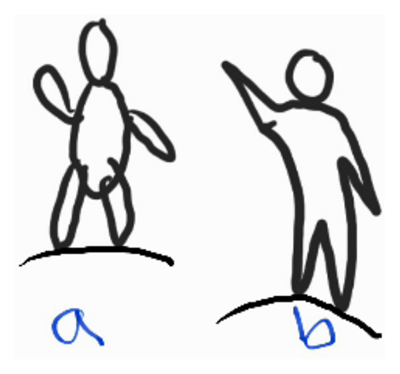
Figure 2
This figure illustrates two ways of drawing quick visualizations of a human. The first (a) is the classic abstraction of using symbols as a circle for the head, eclipse for arms, etc. However, even such an abstraction takes time to carry out in the very rudimental way shown, in particular, as it requires the drawer to lift the pen. The second (b) uses a different iconic solution, the “star man,” which illustrates a human in a star-like shape. This is drawn quickly and can be done in one pen stroke, with the added possibility of giving the human different postures, movements, etc., faster than in the other version.
(Source: figure drawn by author R. Ørngreen).