
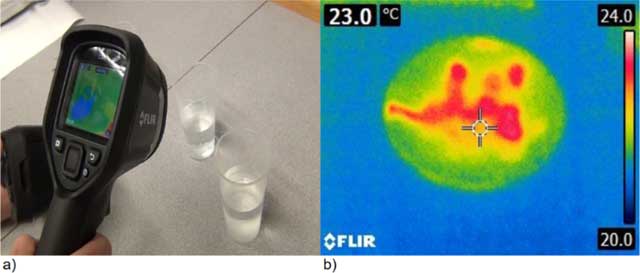
Figure 1
Photos of IR cameras. a) Students observing a phenomenon with an IR camera. b) Thermal image generated by an IR camera. The number in the upper left corner indicates the temperature and the scale to the right maps temperature to colors. A high temperature is displayed, due to a reaction between a salt and water vapor in the air.
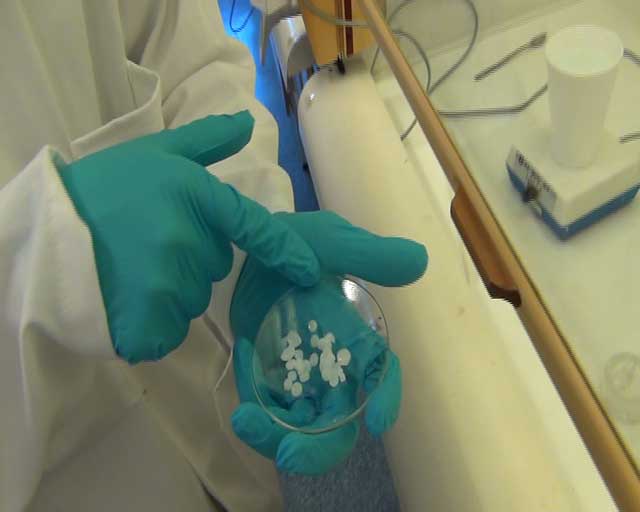
Figure 2
Container with salt. Student 2 pointing at what they want to draw everyone’s attention to.
| Line | Interlocutor | Verbal Action | Non-Verbal Action |
|---|---|---|---|
| 1 | Researcher | How is it going? | |
| 2 | Student 2 | Fine, we have weighed the salt now and ehm… though, I am a bit interested by it since after a while, … | Picks up container with salt from the bench. |
| I don’t know if it is visible it is kind of melting. | Points around the salt. | ||
| It’s sticky. | Rubs fingers. |
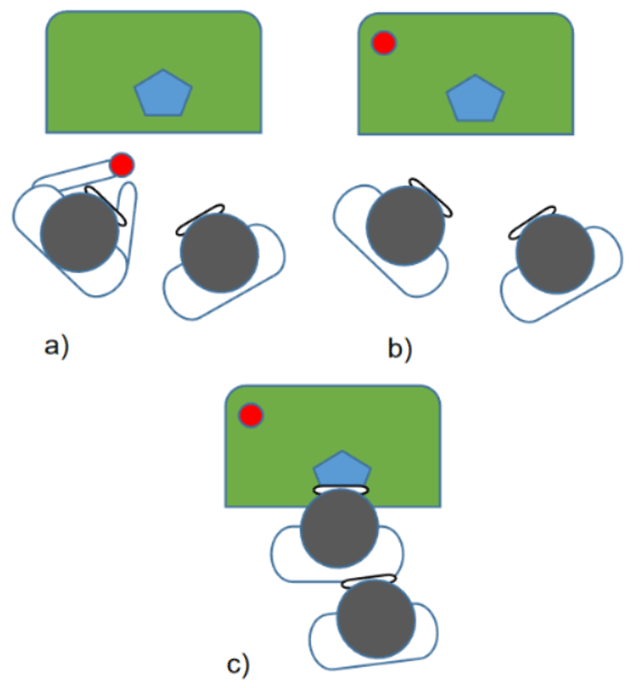
Figure 3
Positions of students and experiment. a) In Line 2, Student 2 displays the object they want to discuss, the salt in the container (red circle). b) When the discussion is initiated, in Line 4, the students put the container back on the bench. c) By shifting the position to the bench in Line 13, and moving their postures towards their instructed experiment (blue pentagon), in Line 14, the students signify that they are about to continue with their instructed lab.
| Line | Interlocutor | Verbal Action | Non-Verbal Action |
|---|---|---|---|
| 3 | Researcher | Mhm, and what do you think is the cause of that? | |
| 4 | Student 2 | I’m not really sure since it is…Ah! | Displays the container. |
| Okey! | Puts the container back on the bench. | ||
| If it hasn’t got to do with, what do you call it, the temperature, then maybe it has to do with the light exposure perhaps, but… | |||
| 5 | Student 1 | Don’t you think it is residual water dissolving? | |
| 6 | Student 2 | Yeah, maybe it is! | Looks at the container on the bench and exclaims surprisingly. |
| But… | Looks towards preparation bench and moves body towards the working bench. | ||
| …I thought it was supposed to be dry over there [the preparation bench] but yeah, perhaps… | |||
| 7 | Student 1 | Ah… | Moves towards the bench while looking at the container |
| 8 | Student 2 | …yeah if it isn’t… | Student 1 crosses his arms and looks at Student 2 |
| 9 | Student 1 | …it could…it could’ve attracted wat… | Student 2 looks at Student 1 |
| 10 | Student 2 | Exactly. | Student 1 points at Student 2 |
| 11 | Student 1 | …it may also have been that it attracted… | Looks at the container |
| …water… | Student 2 looks at Student 1 | ||
| …from the air. | |||
| 12 | Student 2 | Yeah, water vapor. | Looks at the container |
| Line | Interlocutor | Verbal Action | Non-Verbal Action |
|---|---|---|---|
| 13 | Student 1 | …that it’s been stored… | Moves towards the bench and looks at the container. |
| …well-ventilated…ehm but did we get a thermometer into that or what? | |||
| 14 | Student 2 | We’re here going to… | Looks at the equipment on the bench and picks up the thermometer. |
| 15 | Researcher | How do you think it will affect the experiment later on? | Student 1 looks at Researcher. |
| 16 | Student 2 | This? That it’s already been dissolved? Yes, if we s… | Looks at the container. |
| 17 | Student 1 | There will be a marginally larger amount of water. | Student 2 looks at Student 1 |
| 18 | Student 2 | Yes, some, maybe… | Continues with instructed lab work |
| …heat, has already been used up, when it’s dissolved already, so to speak. | |||
| 19 | Student 1 | Because…because it’s already a bit…ah…should already be a bit… | |
| 20 | Student 2 | But I highly doubt that it is noticeable, otherwise we just have to do this experiment again. It’s just fun. |
| Line | Interlocutor | Verbal Action | Non-Verbal Action |
|---|---|---|---|
| 1 | Researcher | So if you try to aim it at these two for example. | Moves two containers with salt towards the students. |
| Here you have some sodium hydroxide and it has been here for a while and you remember that you talked about how it was a bit wet. | Student 2 laughs in confirmation when seeing the salt through the IR camera (see Figure 4). | ||
| What do you now see when observing it with IR cameras? | |||
| 2 | Student 2 | It gets very red and… | |
| 3 | Student 1 | Yeah, I have a whi… it is even white. | |
| 4 | Student 2 | Yes, a bit. | |
| 5 | Student 1 | In other words, it is warm. | |
| 6 | Researcher | Yes, what do you think is the cause of that? | |
| 7 | Student 1 | That it has attracted heat…or what am I saying…water from the air and that the ehm exothermic dissolution reaction has started. | Student 2 looks up from the IR camera and back again. |
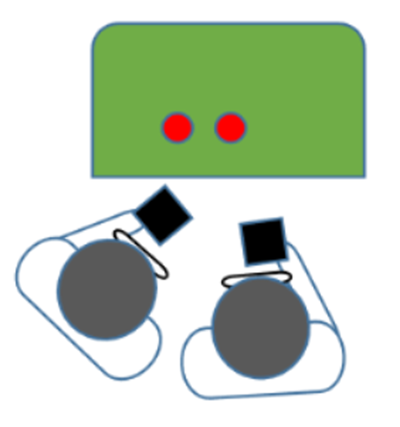
Figure 4
The students’ positions during most of the time in Sequence 2. Their gazes are fixed on the screens of the IR cameras. They sometimes vary the grasping of the camera (one or two hands).
| Line | Interlocutor | Verbal Action | Non-Verbal Action |
|---|---|---|---|
| 1 | Instructor 1 | But you can see that… | Instructor 1 aims his IR camera, close, at the salt and then moves his gaze from his camera to the salt and then the camera screen of Instructor 2 |
| …it has attracted a lot of water and… | Instructor 1 moves away his camera from the salt. | ||
| …see | Instructor 2 leans in closer to the salt with his IR camera, but with his posture directed toward Researcher. | ||
| …take…that it is very hygroscopic and… | Instructor 1 moves his camera back close to the salt again. | ||
| …you clearly see the exothermic reaction. | Instructor 2 moves the camera away and prepares to interact physically with the salt. | ||
| Do you have anything to add [name of Instructor 2]? | |||
| 2 | Instructor 2 | It is also visible where they have been placed, I am thinking of when you remove them from… | Touches one of the containers. |
| 3 | Researcher | Yeah, yeah. | |
| 4 | Instructor 1 | Yes. Yes, it is also clearly visible. | Instructor 2 moves one of the containers across the bench and Instructor 1 moves the other container. |
| They do not even have to be there for a long time and it is still visible. | Both instructors aim their IR cameras at the locations on the bench where the containers originally were, showing a trail indicating transfer of heat. |
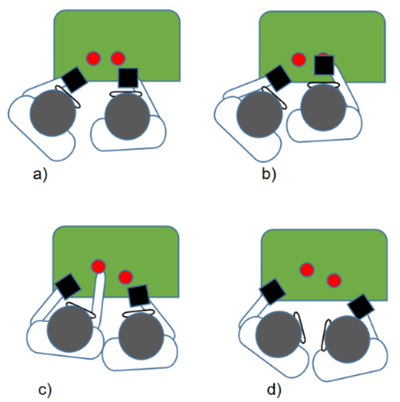
Figure 5
Positions of instructors, cameras and experiment. a) The instructors’ initial positions. The lab glasses mark their gaze. b) Before being fully instructed what to do, the instructors begin exploring the phenomenon, in Line 1, by varying position and angle of the cameras while describing what they observe. c) In Line 2 and 4, the instructors begin moving the containers to vary what they are able to observe. d) During the more intense discussions, as in Line 11 and 12, the instructors look at each other or the researcher before going back to the positions of a) or b), for example in Line 13.
| Line | Interlocutor | Verbal Action | Non-Verbal Action |
|---|---|---|---|
| 5 | Instructor 2 | You see that already when it dissolves water from the air, so it is enough to give indication. Does that tell us something about the reaction or the cameras? I don’t know. | |
| 6 | Instructor 1 | The reaction I think. | |
| 7 | Researcher | Yes, talk a bit about the reaction. What is happening? | |
| 8 | Instructor 2 | So my throat is hurting, it is your turn to talk. | Instructor 2 looks up at Instructor 1, who then looks back. |
| They turn their gazes back towards the salts. | |||
| 9 | Instructor 1 | Sodium hydroxide dissolves in water. | Looks up at the researcher. |
| 10 | Instructor 2 | Ehm, yeah, I would not call it that in this case. | |
| 11 | Instructor 1 | But it is rather… | Instructor 1 looks at Instructor 2 and does a pinching gesture with one hand. |
| …attracting water from the air but… | Instructor 2 looks at Instructor 1, who then looks back. | ||
| …you will still get a… | Gesture swirls with both hands. | ||
| …dissolution reaction. | |||
| Both instructors continue looking at each other. | |||
| 12 | Instructor 2 | Is it water dissolving in sodium hydroxide… | Instructor 2 looks at Researcher while Instructor 1 looks down for a moment. |
| …in… | The instructors look at each other again. | ||
| …when it is here? | Both instructors look down on the salt, still holding their IR cameras aimed at the salt. | ||
| But it is rather going into…there is more sodium hydroxide… | Both instructors look at each other again. | ||
| …than the water you got, so it is… | The gazes of the instructors switch back to the salt. | ||
| …rather than hydra…it goes into the crystal structure and hydrates. | |||
| 13 | Instructor 1 | Hang on… | Instructor 1 leans over close to the salt, still aiming his IR camera at the salt. Instructor 2 does the same. |
| …we do not have… | Instructor 1 looks at Instructor 2’s container with his IR camera. | ||
| …that much left of… | Shakes his container. | ||
| …the crystal structure on the surface, so there is no hydration in the crystal structure. | Looks at Instructor 2. | ||
| 14 | Instructor 2 | Nonono. | Instructor 2 shakes his head and both instructors laugh. |
| Not the structure. Sorry, … | Looks at Instructor 1. | ||
| …structural chemist, I do not work with that kind of trash, … | Instructor 1 looks up at Instructor 2 and then back down again. | ||
| I have batteries. | Instructor 2 looks back down on the salt. | ||
| 15 | Instructor 1 | Ehem, inorganic chemist, I work with structures. Yeahyeahyeah… |