
Table 1
Overview of the workshop series, including themes and participants.
| Workshop # | theme/purpose | No. of participants | Date |
|---|---|---|---|
| 1 | Introducing the pattern approach and collecting design patterns. | 4 | June 2014 |
| 2 | Introducing a developed pattern template and use of design techniques. Collecting design patterns through scenarios and storyboards. | 8 | October 2014 |
| 3 | Pattern language development (sketching its structure) | 6 | June 2015 |
| 4 | Pattern language development and pattern revision (finding the gaps in its structure) | 5 | September 2015 |
| 5 | Pattern discussion and refinement using a wiki. | 4 | October 2015 |
| 6 | Presenting the pattern approach to the whole school. | 41 (incl. 4 teachers from the previous workshops) | January 2016 |
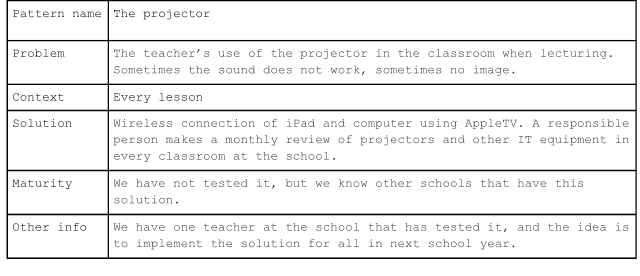
Figure 1
The design pattern “The projector” from the first workshop. The pattern describes a solution to the recurrent problem of using a projector in the classroom. The problem is present every lesson. The solution is to use a streaming device for presentations (translated from Swedish).
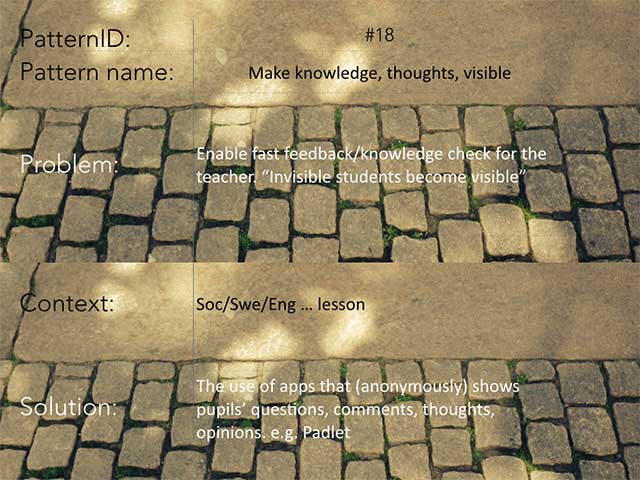
Figure 2
Design pattern 18 on making ideas and knowledge of pupils visible and inspectable during class (translated from Swedish).
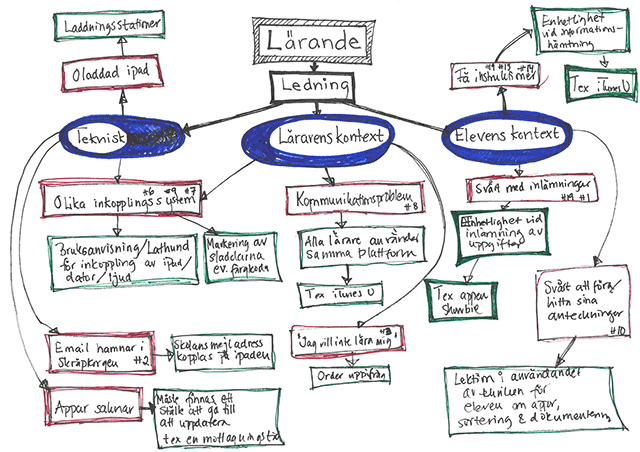
Figure 3
A sketch of a pattern language presented by the teachers (in Swedish). Patterns are represented as numbers (e.g. #6) as well as with pattern names, e.g. “Oladdad ipad” (Eng. Uncharged ipad).
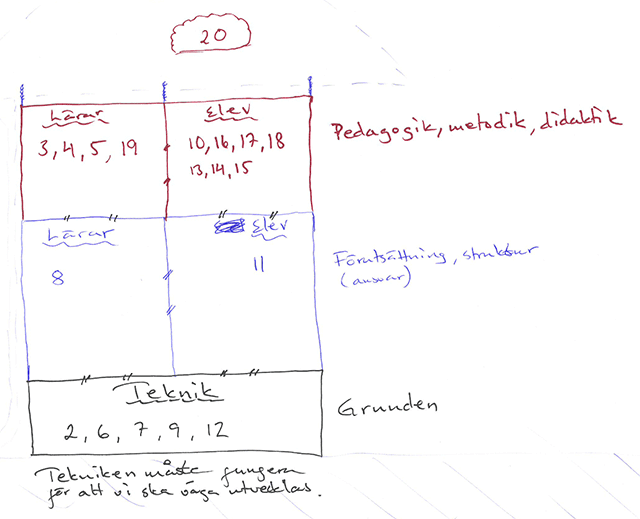
Figure 4
A sketch of a pattern language presented by the teachers (in Swedish). Patterns are represented as numbers (e.g. #6). 19 of 20 patterns are represented in this sketch of the pattern language.
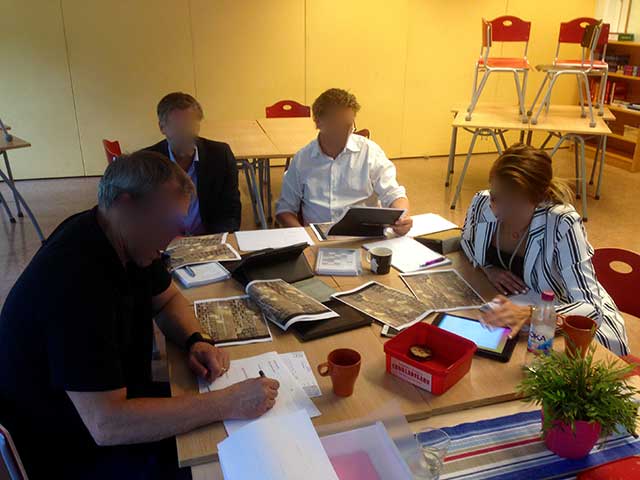
Figure 5
Teachers revising design patterns and writing new patterns to fill in gaps between patterns, during workshop 4.
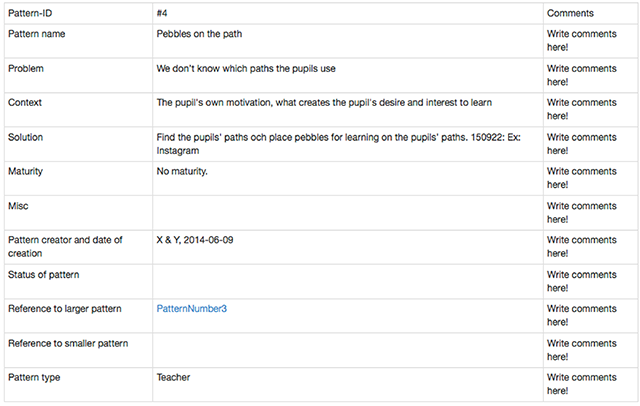
Figure 6
Example of design pattern 4 “Pebbles on the path” in the Wiki with connection to the larger pattern 3 “Share good examples to other teachers” (translated to English from Swedish by the authors).
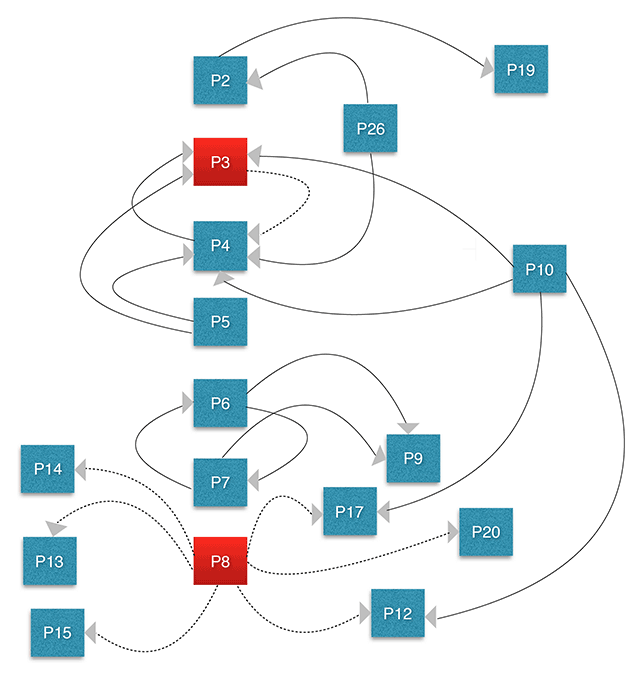
Figure 7
A visual representation of how patterns are connected in the pattern language. The visualization is made by the authors and is based on the 17 patterns that have connections to other patterns in the wiki (see Table 2). Pattern 3 (P3) and Pattern 8 (P8) are highlighted with red in order to show their central position in the pattern language.
Table 2
The table shows the links made from one pattern to smaller or larger patterns. Nine patterns include links to other patterns.
| Pattern name (number) | Links to smaller pattern | Links to larger patterns |
|---|---|---|
| One single e-mail address to be used (P2) | No | Share ideas and thoughts using virtual whiteboards (P19) |
| Share good examples to other teachers (P3) | Place pebbles for learning on the pupils’ paths (P4) | No |
| Place pebbles for learning on the pupils’ paths (P4) | No | Share good examples to other teachers (P3) |
| Games as teaching tools (P5) | No | Share good examples to other teachers (P3), Place pebbles for learning on the pupils’ paths (P4) |
| Design and equip classrooms the same way (P6) | No | One display solution in all classrooms (P7), Wireless connection of tablets for display (P9) |
| One display solution in all classrooms (P7) | No | Design and equip classrooms the same way (P6), Wireless connection of tablets for display (P9) |
| Use the same general digital learning environment (P8) | Increase lecture sustainability by video recordings (P12), Use the projector and apps for instruction and documentation (P13), Use templates when documenting science labs (P14), Use push messages to improve instructions (P15), Display of pupil’s work in the classroom (P17) Allow pupils to work outside the classroom using communicative apps (P20) | No |
| Increase the value of lessons by note taking (P10) | No | Share good examples to other teachers (P3), Place pebbles for learning on the pupils’ paths (P4), Increase lecture sustainability by video recordings (P12), Display of pupil’s work in the classroom (P17) |
| Communicate with pupils through social media (P26) | No | One single e-mail address to be used (P2), Place pebbles for learning on the pupils’ paths (P4) |