
Introduction
Many preschool teachers find it difficult to search for and find different applications that they want to use in their teaching, and they would like more focus on children’s participation when these applications are used, according to Otterborn, Schönborn and Hultén (2019). In this study, focus lies on applications used in preschools and their affordances, mapping out which kinds of genres can be identified, to facilitate preschool teachers’ informed choices and raise awareness concerning the importance of choosing digital content carefully. The definition of genre used in this study draws on van Leeuwen (2005b) and focus is on the function of the applications, and what they ‘do’ (p. 74), as well as Kress’ (2003) multimodal view of genre, going beyond the role of language and relate genres to ‘social, representational and communicative function’ (p. 106). The concept of affordance denotes the possibilities and limitations of different resources, in this case applications. Building on Gibson’s (1979) definition, affordances are seen as neither objective nor subjective, but can both be said to emerge in the use, and at the same time they are already there. The notion of children’s agency draws from social semiotic ideas of children’s possibility to act as producers of media, language and knowledge (Kress, 1997; Selander & Kress, 2010) and actively participate in the preschool environment, but also to use and hear their mother tongue or minority language in a social or educational setting, such as preschool, with inspiration from García (2009).
In preschool in Sweden, where this study is conducted, the use of digital resources is common (Statens medieråd, 2019). With the use of digital resources follows a need for critical perspectives on the content of these resources (Kvåle, 2020; Tønnessen, 2018). At the same time, a lack of possibilities for children to use their mother tongues and national minority languages in day-to-day educational contexts has been noted by for example Konstitutionsutskottet (2012). This is the case even though children have the right to use and develop their mother tongues and national minority languages in preschool, according to both the national preschool curriculum (Skolverket, 2018) and the law concerning national minorities and minority languages (SFS 2009:724).1 Preschool teachers’ own experiences of using digital tablets and applications in a Swedish setting show that digital resources are often used for discipline-specific or subject-related content and for social skills or generic skills such as documentation and fact searching (Otterborn, Schönborn & Hultén, 2019), but there are no examples of using digital resources or applications with the purpose of including children’s mother tongues.
However, teachers find they have limited resources, including a lack of time to look up and find different applications to use in the preschool environment (Otterborn, Schönborn & Hultén, 2019). The affordances of applications used in preschools are explored in this study, with particular focus on children’s agency and multilingual competencies, and app-genres that emerge from these affordances are proposed. These genres illustrate applications available to educators and also highlight the importance of taking care in choosing applications in a similar fashion as choosing children’s literature. Instead of using the applications to replace practices already present (Nilsen, 2018), new app-genres can contribute to the possibilities for preschool teachers to form new and different activities in the preschool environment.
Genres and Digital Resources
Genres are often used in relation to language and literacy (Martin, 2009), but there have also been proposals of genres in different digital media, such as video games (Apperley, 2006) and images (Kress & van Leeuwen, 2006). In this study, app-genres are suggested in relation to children’s multimodal ways of exerting agency when using them. This includes the possibility to hear and use their mother tongue or national minority language in preschool. Influenced by genres in children’s literature (cf. Percec, 2016) and a taxonomy of customisable literacy applications for children (Kucirkova, 2018), the affordances of applications used in preschool are examined. Kucirkova’s (2018) taxonomy involves children’s books and literacy applications that can be personalised by the children to various extents. In three different categories – audio (oral), textual (written) and visual (pictorial) –children can be fully involved, more dependent on producer involvement or fully dependent on producer involvement (Kucirkova, 2018). With a focus on children’s picture book applications, Tønnessen (2014) proposes four genres: visual audiobook, picture books with added effects, interactive picture book and digital first productions, where the content is not modelled on a picture book. Tønnessen (2018) also inquires what ‘quality’ could be when it comes to children’s picture book applications.
Digital resource design and children’s agency
The importance of the design of digital resources in relation to younger children’s possibility to express agency has been noted by e.g. Palmér (2015). Using observations, Palmér (2015) shows how a weaker framing in mathematics applications often led to children having more opportunity to act as agents than when the framing was stronger. Another aspect of the connection between the design of the digital resources and children’s ability to express agency is illustrated by Aarsand (2019). Using video observation, and focusing on guided participation, he illustrates how the affordances of the devices themselves also influence children’s agency. When a digital resource is portable, children can have a greater opportunity to act as agents than when stationary resources are used since these tend to be associated with more teacher-centred activities (Aarsand, 2019). The findings of Palmér (2015) and Aarsand (2019) inform the current study through the emphasis on the connection between the design – or affordances – of the digital resources and children’s possibility of exerting agency.
Nilsen (2018) illustrates how digital resources in preschool often are used in replacement practices, i.e. to do the same activities that could be done in the preschool environment anyway but using a digital framework. In these activities, the participants tend to focus on the limitations of the digital framework, but at the same time Nilsen (2018) shows how children’s possibility to exert agency depends not only on the application’s properties but also on the teachers, the participants’ interaction and the local guidelines.
With a focus on the properties and characteristics of abc-applications for children, Kvåle (2020) illustrates how the view on literacy that can be perceived in these applications often includes an aspect of correct/incorrect and more seldom an opportunity for children to produce their own text. Children can also be understood as exerting agency even if an application might somewhat restrict the possibilities available within the digital framework (Marsh, 2017). From a similar view on children’s participation, using a social semiotic approach, Kjällander and Moinian (2014) highlight how young children will act agentively by using the different affordances of digital tablets and applications to reproduce content. While children will exert agency within the digital interfaces (Kjällander & Moinian, 2014), the present study sheds light on how the design is related to different ways of acting agentively, including the use of different forms of communication beyond a majority language.
Translanguaging, multilingualism and digital technologies in early childhood
Digital resources can play a role in young children’s possibilities of taking part in translanguaging activities and communicating multilingually with e.g. grandparents in a home setting (Akhter, 2016). Social media can also be used by young children as a platform for translanguaging when chatting with relatives (Zhao & Flewitt, 2020). While the home environment and family surroundings (Kheirkhah & Cekaite, 2017; Paulsrud & Straszer, 2018) can be said to be important factors when it comes to young children’s possibilities to communicate multilingually, educational settings have not been studied as much in research on multilingualism, technology and young children.
Aims and research questions
In this study, the aim is to explore what genres can be found in applications used in preschool as a way to facilitate preschool teachers’ informed choices and raise awareness concerning the importance of choosing digital content carefully. The focus is on the genres’ relation to children’s agency and their possibility to use their mother tongue or national minority languages. Research questions posed are:
What are the affordances of applications used in preschool in relation to children’s agency and multilingual competencies?
Which kinds of genres emerge from the applications’ affordances?
A social semiotic approach in combination with translanguaging
To be able to analyse the many complex multimodal forms of communication that the applications consist of, a social semiotic approach (Kress, 1997; van Leeuwen, 2005a) was used in combination with the notion of translanguaging (García, 2009) and pedagogical translanguaging (Leonet, Cenoz & Gorter, 2017). Inspired by the notion of affordances (Gibson, 1979; Kress, 1997, 2012), the possibilities and restraints of the different applications are analysed. The many modes of communication – such as pictorial, musical, spoken language, movement and many more – are prevalent in the applications in different combinations (cf. Kress, 1997). While different modes can be seen as having different possibilities and limitations (Kress, 1997), children will use the resources at hand to create new representations of knowledge (Kress, 1997; Selander & Kress, 2010).
Affordance
In this study, affordance is used as a concept to describe the possibilities and limitations of different resources, in this case applications. Different modes also have different affordances (Kress, 2003). In Gibson’s (1979) definition, affordances are not simply objective or subjective: ‘But actually, an affordance is neither an objective property nor a subjective property; or it is both, if you like’ (Gibson, 1979, p. 129). Depending on the person, or in Gibson’s case, animal, a resource or a material can have different affordances. In a way, the affordances can be said to emerge in the use, but at the same time they are already there (cf. Gibson, 1979). This simultaneity is what makes the concept suitable for this study: depending on how and by whom a particular application is used in preschool, it gets different affordances, but at the same time certain properties are already there, making different things possible (c.f. Kress, 2003).
Mode
Modes of communication include many forms of communication, used in different combinations, such as spoken language, written language, pictorial and photographic modes as well as music, colours and so on (Kress, 1997). As a theoretical concept, modes are used in this study to be able to explore the many forms of communication that are present and used in applications commonly used in preschools.
Translanguaging
The idea of translanguaging includes both an acknowledgement of the importance of including children’s mother tongues in schools and preschools and the understanding of language differentiation as a social construct (Canagarajah, 2011; García, 2009). Pedagogical translanguaging (Leonet, Cenoz & Gorter, 2017) implies the deliberate inclusion of languages beyond the majority language to create translanguaging activities in educational settings. In a way, from a more social semiotic perspective this can be understood as didactic design (cf. Selander & Kress, 2010). Leonet, Cenoz and Gorter (2017) highlight the importance of teachers’ including children’s mother tongues actively in formal education, and in a similar way Selander & Kress (2010) emphasize teachers’ roles as designers of many different learning possibilities, even if they do not focus particularly on mother tongue languages. In a social semiotic approach, however, the dominance of verbal or written language in the Western world is questioned (Kress, 1997), and in this study the monolingual norm in educational settings is also challenged through ideas of translanguaging (García, 2009). Hence, the questioning of dominant forms of communication can be seen as similar between translanguaging ideas and a social semiotic approach.
Opportunities for agency
In this study, children’s agency is understood as the possibility to actively participate in the preschool environment, to be able to choose and create content as well as be able to communicate their interests. Agency is also seen as the possibility to act as producer of media, language and knowledge (Kress, 1997; Selander & Kress, 2010). Furthermore, children’s possibility to use, hear and communicate in their mother tongues or national minority languages is also seen as a form of agency in relation to the idea of translanguaging (cf. García, 2009). Since this study explores the applications and not children’s use of them, opportunities for agency lies within the limits of this study. These opportunities for agency can be seen as closely related to the exploration of applications’ affordances, as something that lies beyond the dichotomies of subjective/objective.
Genres from a social semiotic approach
Inspired by Kress and van Leeuwen’s (2006) detailed analytical ideas on the interpretation and reading of images, this study attempts to, in a similar fashion, go into the specific and multifaceted aspects of applications used in preschool. Using affordance (Kress & van Leeuwen, 2006) as an analytical concept to interpret images and other elements in the studied applications, in combination with ideas of children’s ways of being agentic (Kress, 1997), the analysis will contribute to some new notions of genres in the understanding of educational resources for preschool children in general, and of digital resources in particular.
The concept of genres has, from a social semiotic perspective, been explored and discussed by e.g. van Leeuwen (2005a, 2005b). The question of what characterises a genre can be a matter of, for example, the content or the function (van Leeuwen, 2005b) of the resource examined. In this study the focus is on the function of the applications used: ‘what they do’ (van Leeuwen, 2005b, p. 74). In the analysis, the concept of affordance is used as an analytical concept to be able to explore what the applications do in terms of being open for children’s own production of content, e.g. In relation to the multimodal aspects of the applications that are analysed in this study, inspiration has been taken from Kress’ (2003) ideas on genres’ social, communicative and representational functions. The social aspect of genre can of course be different in different settings and uses of the applications, but at the same time these social qualities can be linked to accessibility and teachers’ awareness.
If affordance is understood as possibilities and limitations, neither objective nor subjective, or perhaps both at the same time, as Gibson (1979) puts it, what the genres ‘do’ (van Leeuwen, 2005b) is in focus. This can be discussed in relation to Djonov and van Leeuwen (2018) who illustrate how software can be said to have an amount of power not only in relation to whether or not people have access to software in the first place, but also the software design itself. As Zhao and Zappavigna (2018) show, the concept of genre can be understood as a very complex issue, and when people define genres, they do it ‘in relation to the technological and sociocutural context’ (p. 1).
The genres proposed in this article are tentative, and only a suggestion for further exploration, in relation to a social semiotic approach; a “form of inquiry” (van Leeuwen, 2005a, p. 1). The use of the notion of genre in this study must also be understood as something that is placed in the setting of preschool didactics and the intentions of the ‘author’, if comparing it to literature genres, or the intended design of the developer, might not be the same as the possible use in a preschool setting.
Methodology and Analytical Process
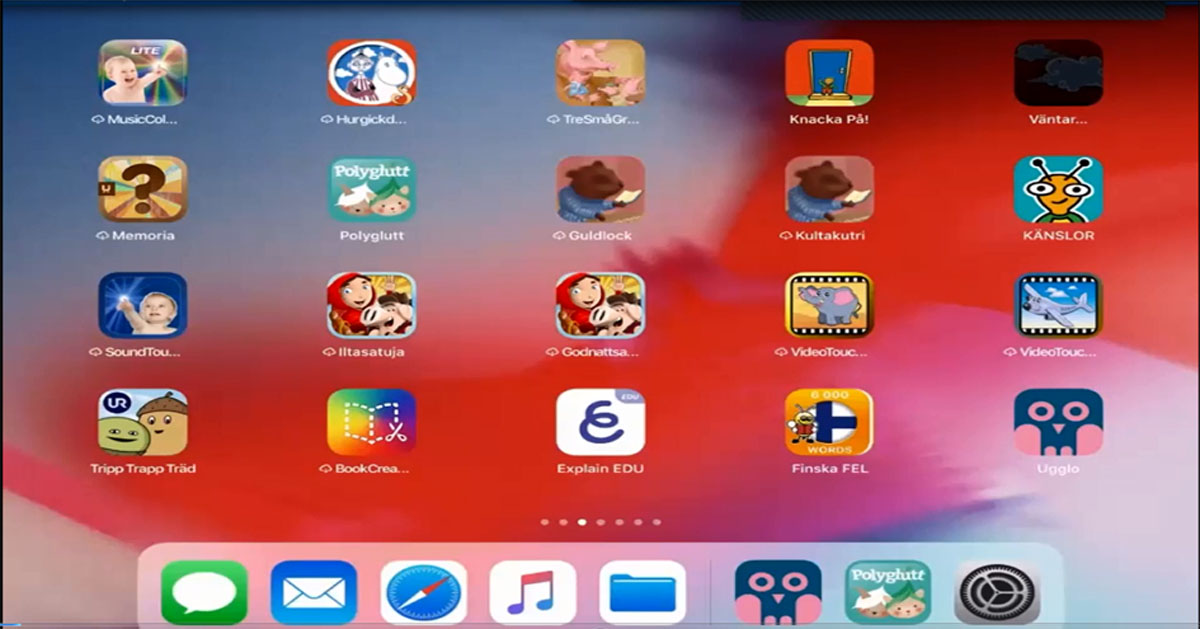
In this study, 20 applications were chosen for analysis to answer the research questions concerning each application’s affordances in relation to children’s agency and multilingual competencies and which genres emerged from these affordances. The selection of applications is based on three previous studies exploring the use of digital tablets in preschool (Petersen, 2015, 2018, 2020), where these applications were the most commonly used in the participating preschools. This became the criterion for selecting the applications explored in this study, since no comprehensive survey on the applications used in Swedish preschools has been conducted. A first outline of the idea of app-genres was presented in Petersen (2020), which this study builds on and develops by conducting a more extensive and thorough analysis with a particular focus on genres. To be able to explore the affordances of each application, a multimodal analysis was done of the following applications: 6000 words, Book Creator, Explain Everything, Jigsaw Puzzle, Knacka på!, Kultakutri, Memoria, Music Color, Muumi, Polyglutt, Puppet Pals, Sago Mini Doodlecast, Skype, Sound Touch, Stop Motion Maker, Train Conductor, Tripp Trapp Träd, Toddler’s Picture Book, Ugglo and Video Touch Animals.
The analytical process was divided into three steps. First an overall, broader categorisation was made, using an excel sheet noting different content, prevalent modes used, and which verbal languages were represented in the different applications. This resulted in a matrix of impressions of possible affordances which guided the development of the research questions. In step two, eleven representative examples were chosen for more detailed analysis: 6000 words, Explain Everything, Knacka på!, Music color, Polyglutt, Skype, Sound Touch, Stop motion Maker, Train conductor, Tripp Trapp Träd and Ugglo. These examples were chosen because they were typical of the overall material and made it possible to answer the research questions concerning the applications’ affordances in relation to children’s agency and multilingual competencies, as well as which genres emerge from these affordances. Screen recordings and screenshots were made of the chosen applications to be able to take into account the many multimodal aspects of the resources. I explored which modes and which combinations were primarily used in the application and whether the application was based on modes that could easily be used by preschool children. Inspired by Kucirkova’s (2018) taxonomy of personalisable book applications, it was explored whether the intended users need to be able to read (traditionally) and write in alphabetical modes, for example. The presence of any ready-made verbal language content in languages beyond the majority language was also explored. The opportunity for children to create their own content was examined, as were the modes and combinations thereof which they could use within the application. Whether the application was more open-ended or based on ready-made content was examined, as was any opportunity for children to create their own language content in their mother tongues or national minority languages. In step three, detailed transcriptions were made using comic-book style transcriptions inspired by Mondada (2007) and Ivarsson (2010), and the affordances of each application were documented in a more detailed excel document in what could be understood as a kind of semiotic work (Bezemer & Mavers, 2011). In this final step, analysis was informed by the two research questions and the concepts of affordance (Gibson, 1979; Kress, 1997), agency (Kress, 1997; Selander & Kress, 2010) and translanguaging (García, 2009) were used to examine the possibilities and constraints of the digital resources in relation to children’s opportunity to act as producers of media, language and knowledge, and their ability to communicate in their mother tongue or national minority language. A social semiotic approach makes it possible to explore the multitude of modes of communication used in different combinations within the digital resources and applications. In this study, it is crucial to pay attention to the various details of the applications beyond a spoken majority language. In what might be understood as an abductive process (for an overview, see Bertilsson, 2004), the material of this study – i.e., the applications – have led the way towards ‘finding’ genres, but at the same time theoretical understandings of multimodality, children’s agency and translanguaging have informed the analytical process. While focus in this current study is on the applications and the genres, the interest in children’s agency and possibility to use applications to include their mother tongues and national minority languages, however, stems from previous studies (Petersen, 2015, 2018, 2020) in which the focus was shaped by children’s actions. In a kind of back-and-forth movement, the analysis has oscillated between the emerging affordances and genres and the analytical questions.
Regarding ethical considerations, the Swedish research council guidelines (2017) have been followed. The analysis of the applications has not contained any personal information or pictures of children or teachers, and all of the application developers have given their consent to publishing screenshots of the applications.
Results
In an effort to highlight the importance of the resources at hand, the notion of app-genres is here used in relation to the possibility of expressing agency and the possibility to partake in translanguaging activities. With inspiration from Kucirkova (2018), a proposal of genres related to the overall possibility for children to produce their own content as well as to use ready-made content in their mother tongues or minority languages is put forward.
App-genres and children’s agency
As in literature, genres can be floating, or ‘mixed’ (c.f. Kress, 2003, p. 118), but ten main genres were identified in the applications explored in this study. These genres range from closed to more open-ended and from monolingual via multilingual towards open to any language and other modes (see Figure 1).
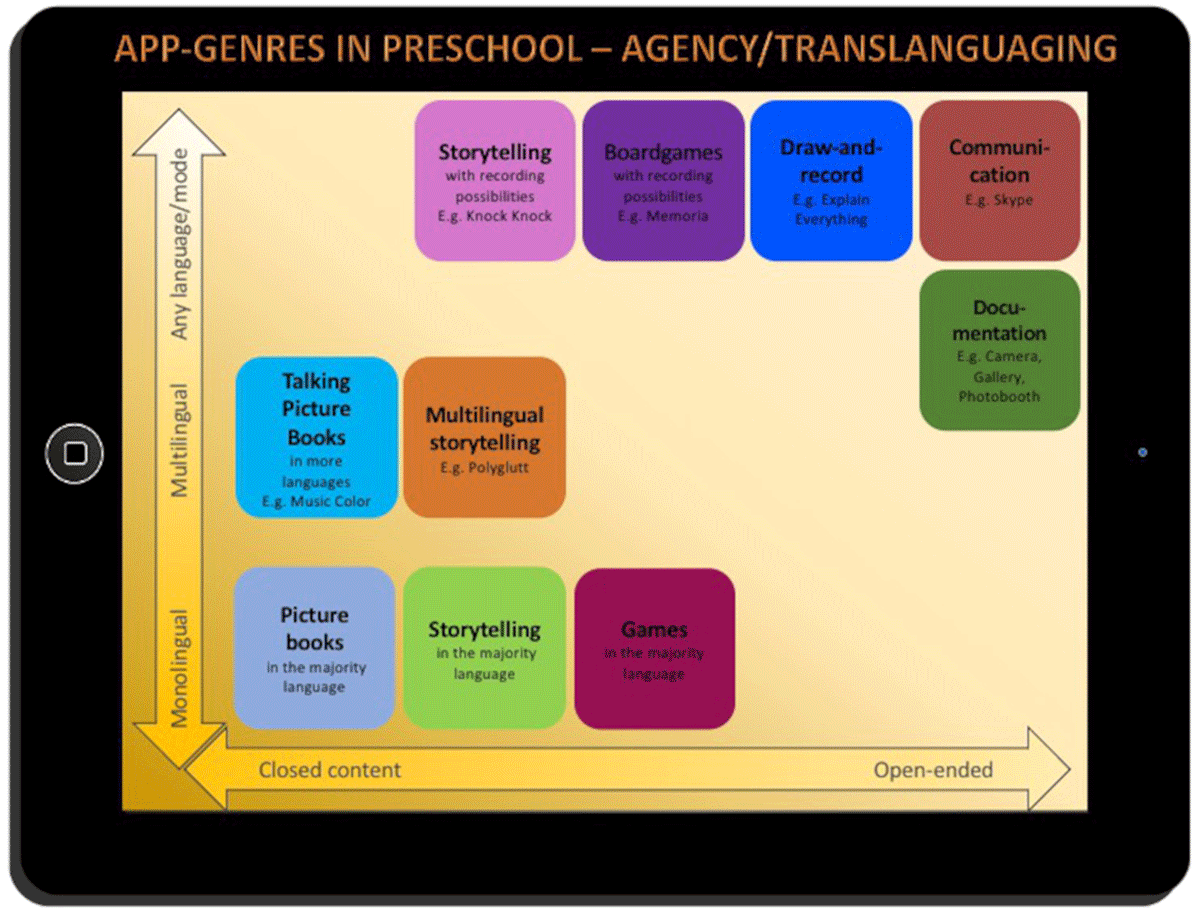
Figure 1
App-Genres.
(Adapted from Petersen, 2020, p. 160).
The affordances of the applications can be related to the openness of the contents, i.e., the children’s possibility to act as producers of media and language (cf. Kress 1997; Selander & Kress, 2010). They can also be related to the existing language content in the children’s mother tongue or minority language, which makes it possible to include all of the children’s languages in the day-to-day preschool environment, even if the teachers do not speak these languages.
In the following sections, the 10 genres are explained. While three genres, shown in the bottom left corner of Figure 1, build on the majority language and are not very open to children’s own design of content, the seven genres that do open up for children’s agency in different ways are more thoroughly illustrated.
Picture book apps in the majority language
In this genre, verbal majority language, mostly one-word utterances, is used in picture book applications. When a picture is pressed, the word in the majority language can be heard. There is often one picture per frame or page, but sometimes there are several pictured in the same view. The design is fixed and there is little or no opportunity for children to create their own content.
Storytelling apps in the majority language
Verbal and sometimes written majority language are used in combination with pictorial modes, in storytelling applications, reminiscent of children’s picture books. There are sometimes possibilities for children to interact within the digital framework, for example by pressing buttons. There is no content in any other languages beyond the majority language and there is relatively little opportunity for children’s own creation, however.
Game apps in the majority language
In this genre, different game like applications using the majority language can be found. While various games can be included in this genre, they are all limited to the majority language and there is little to no opportunity for children’s own production of content within the game.
Talking picture book apps in more languages
This genre includes book-like applications with pictures and spoken language, often one-word utterances, in different languages. Some of the applications contain several spoken languages, others only one. Pictorial or photographic modes are used as well as a variety of languages, which makes it possible for children to hear their mother tongue or minority language in the preschool environment, even if the teachers do not speak the language (see Figure 2).
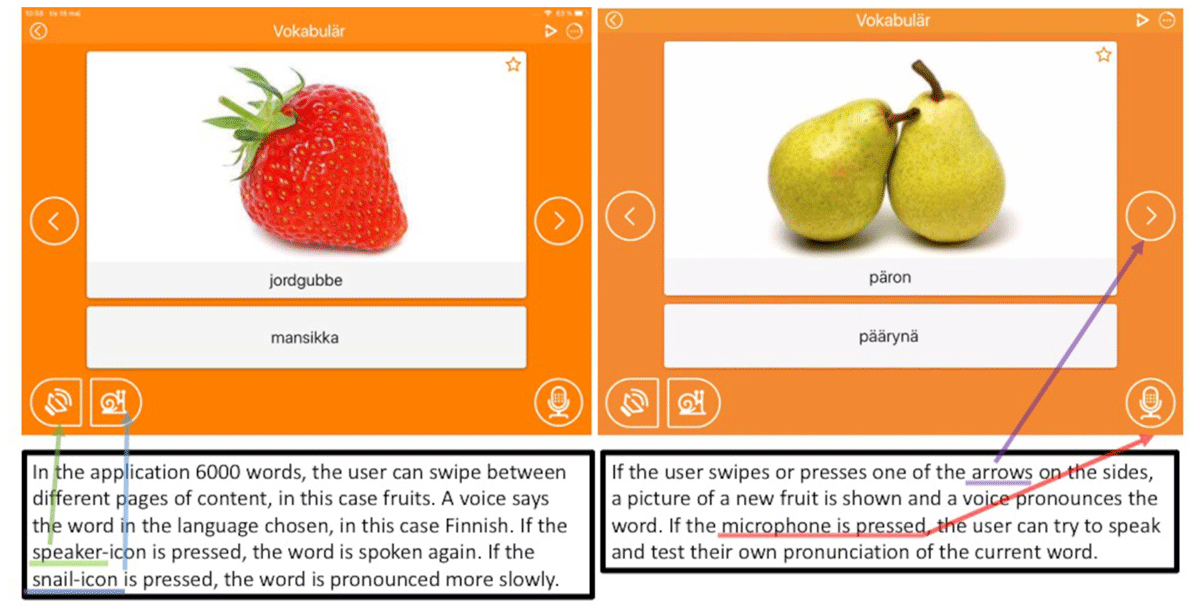
Figure 2
Talking picture book genre.
In this example, the application 6000 words, which is available in approximately 51 languages, has content in pictorial modes as well as verbal modes in many languages. A picture is shown and the user can listen to what it is called in the chosen verbal language. The Talking Picture Book applications in more languages is one of the app-genres that could be used by children and teachers to create multilingual practices in the preschool environment. Since the content is ready-made, there is little possibility for the children using these kinds of applications to create their own content. In that sense, there can be said to be little opportunity for agency in these applications, if agency is seen as constricted to children’s production of media, language and knowledge. Nevertheless, using this genre of applications makes it possible to create translanguaging activities (cf. García, 2009) in the preschool environment. When the notion of children’s agency is understood as the possibility to use their mother tongue or national minority language, like in this study, the inclusion of talking picture book applications in more languages can be seen as a way for multilingual children to express agency.
Multilingual storytelling apps
This genre consists of children’s books with recorded speech in many different languages. One example is Polyglutt, which uses pictorial and ready-made verbal modes (in approximately 61 languages including Swedish sign language, visual interpretation and TAKK2). There is a possibility to switch spoken language within the application/book. The content offers little possibility for children to create their own stories, however, since both the pictures and the narratives are fixed (see Figure 3 and Animation 1).
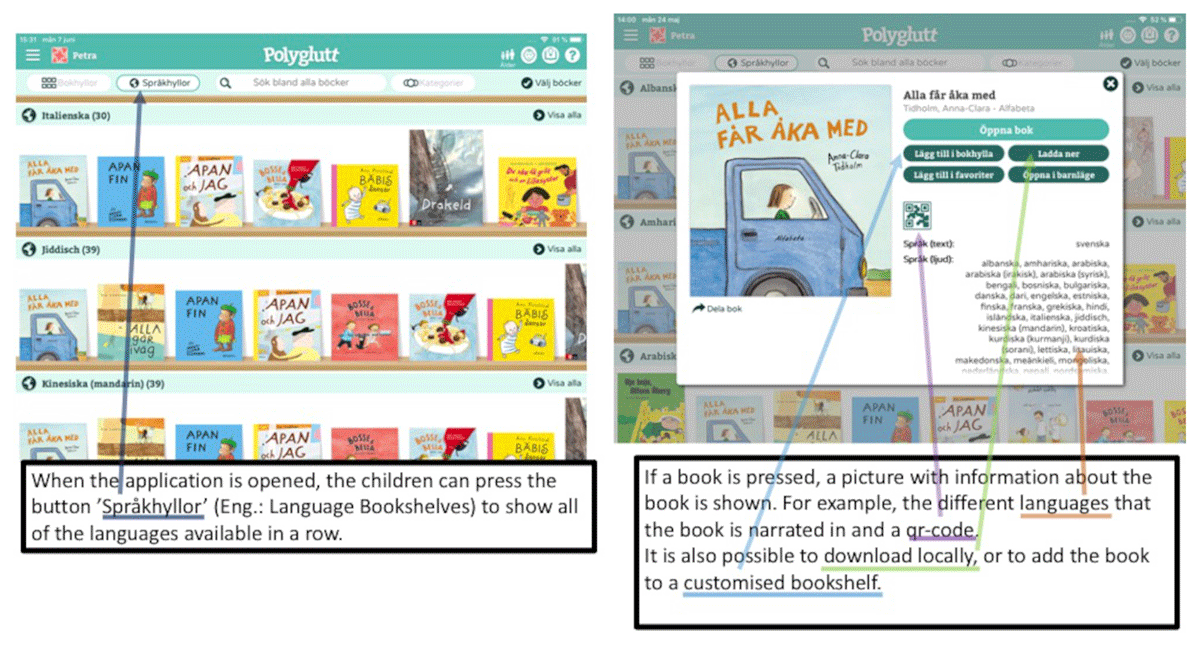
Figure 3
Multilingual storytelling genre, Polyglutt.
Animation 1
Multilingual storytelling genre, Polyglutt.
In Polyglutt, the books are presented in a pictorial mode and each picture can be pressed by using a finger to access to whole book. When starting out, the children, or the teacher, can choose a language and then see all the books available. As the book is opened, the narration in the chosen language starts. Since this genre is readily available and is built on modes that can be understood easily by young children, such as pictures and spoken language, this kind of application can be an easy way to include the children’s mother tongues and national minority languages in the day-to-day preschool activities.
In another multilingual storytelling application, Ugglo, the multilingual options are more difficult to find. Instead of having a ready-made option (a ‘shelf’ with books in many languages, ordered alphabetically), there is a search option and one can access an alphabetical list of languages presenting the books available in each language (see Figure 4).
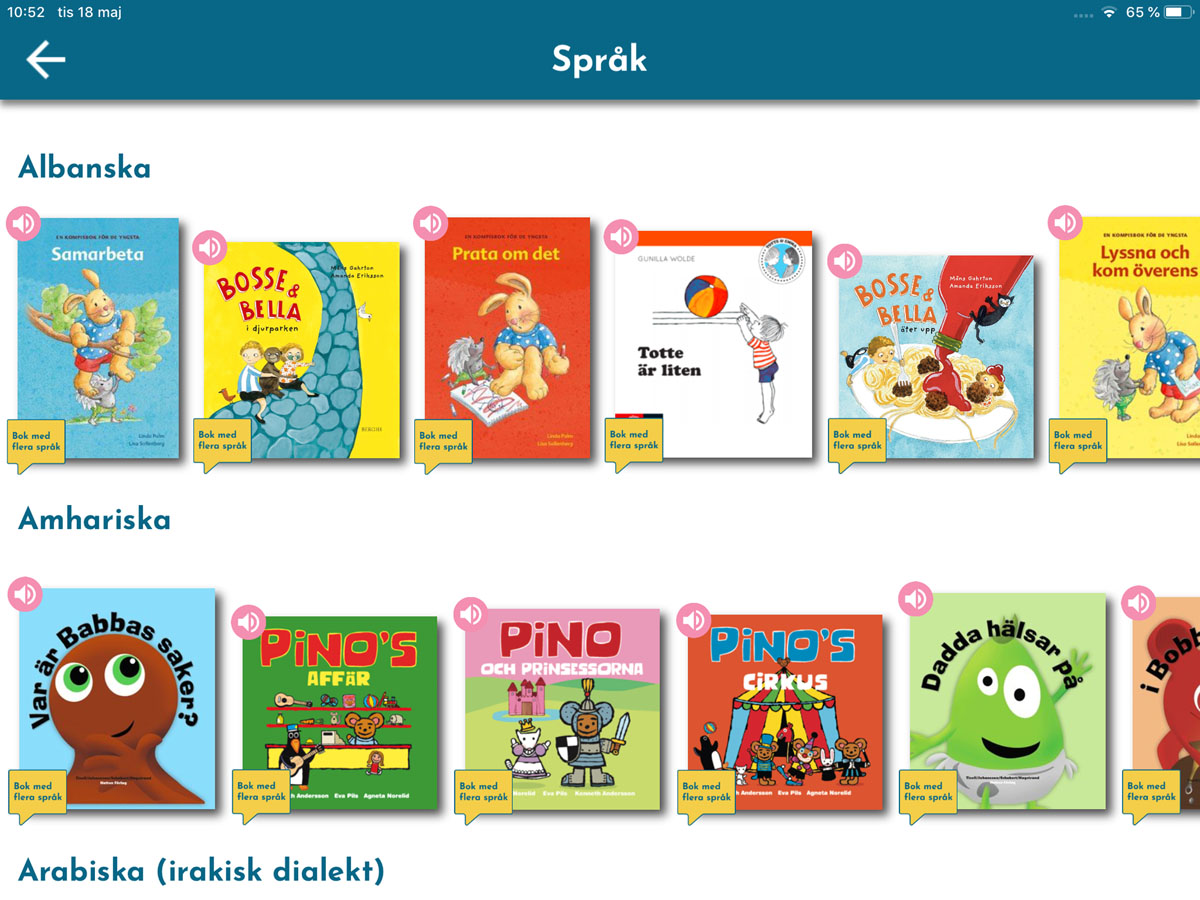
Figure 4
Multilingual storytelling genre, Ugglo.
The different designs in different applications make it easier or more difficult to access the multilingual content. When used in a preschool, it could be understood as important that either the children themselves or their teachers are able to easily find the particular language they are looking for. In comparison, the Polyglutt application might make finding content in the language spoken by each child more effortless than Ugglo, at least with the help of a teacher, since it is still presented as written text which the children may not be able to read.
Storytelling apps with recording possibilities
In Storytelling applications with recording possibilities, children can use their own mother tongue to record their voice into a ready-made storybook. One example of this kind of application is the Swedish children’s book Knacka på! (Eng.: Knock, knock) by Anna-Clara Tidholm. It is built on pictorial and verbal modes (in any language). In this kind of application, there is often a ready-made narration in the majority language, and sometimes in English as well, but a recording with the children’s own narration can be made using the built-in microphone of the digital tablet. With affordances that make it possible for children to record the story, the children can use their mother tongue or national minority language. They can also change the verbal content, if they choose to. The pictures, however, remain the same. This genre of applications could also be used to ask parents to help record a story in their children’s mother tongue or national minority language. In that way, the preschool can also show that the language competencies that children bring into the preschool are valued and sought after.
Boardgame apps with recording possibilities
Another genre of applications found in this study is boardgames, such as memory games, where children can create their own game (see Figure 5 and Animation 2).
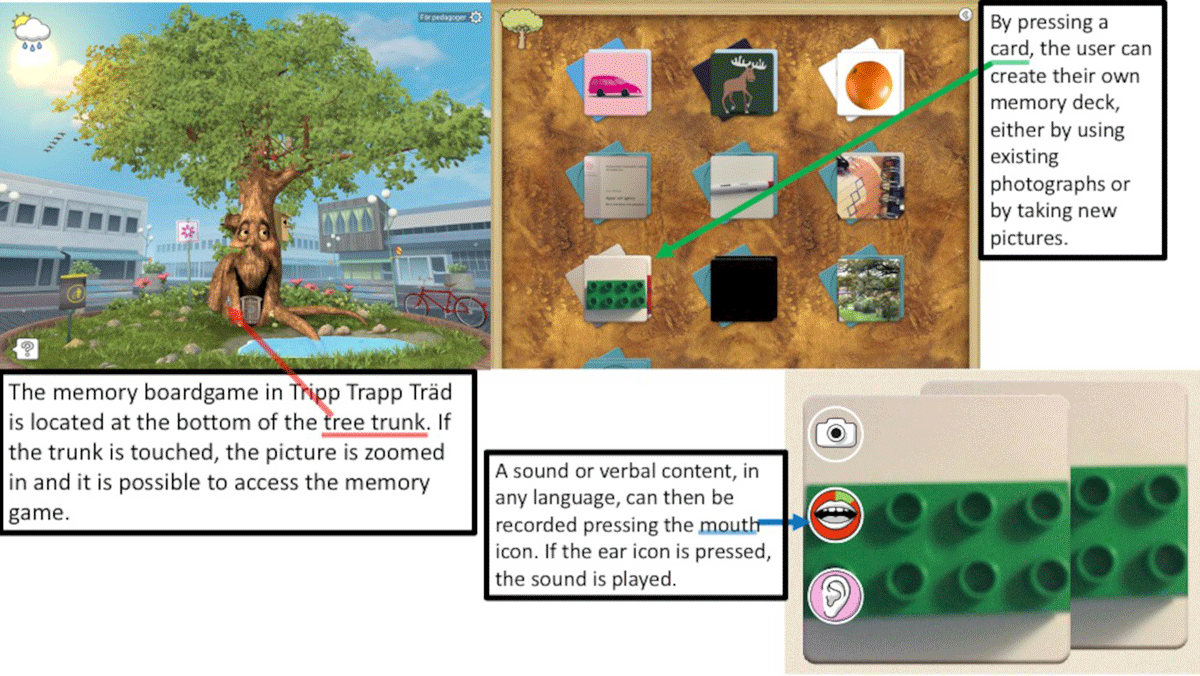
Figure 5
Memory game with recording possibilities, in Tripp Trapp Träd.
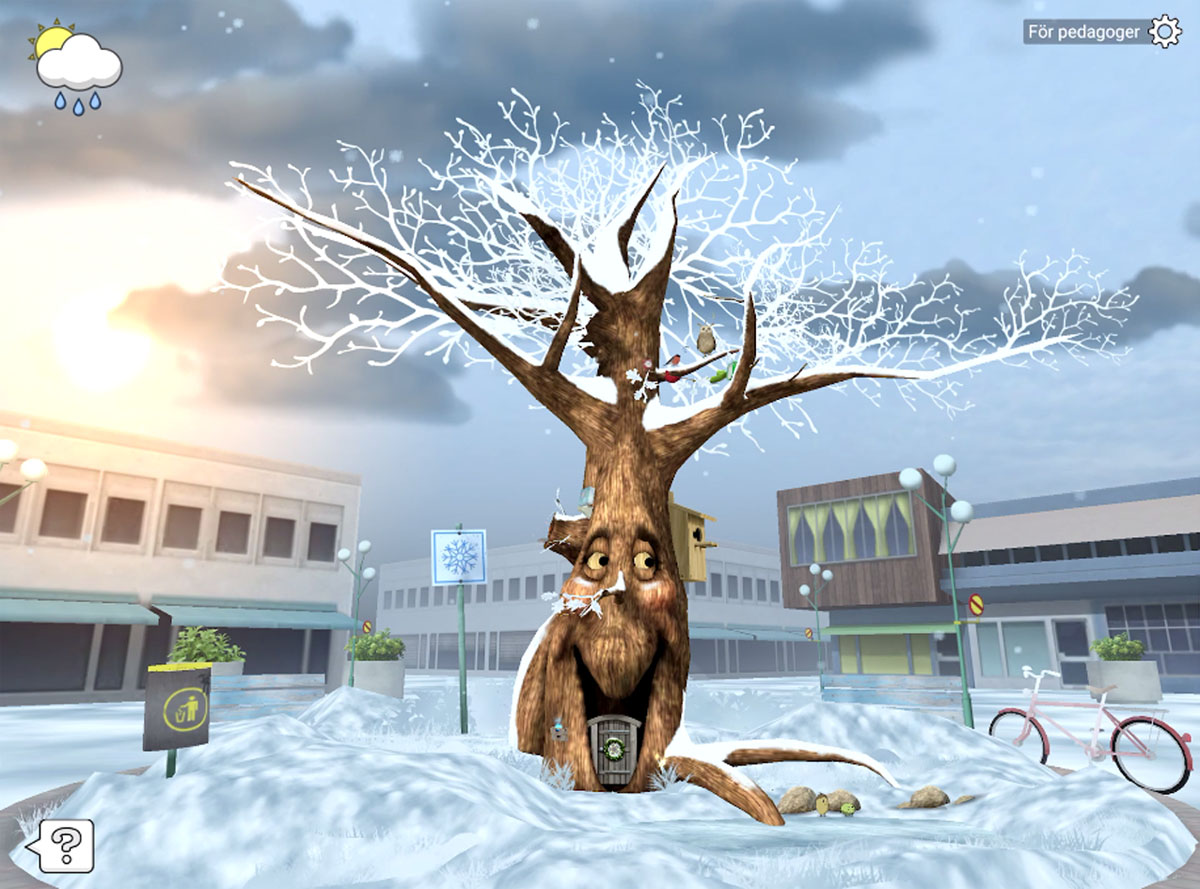
Animation 2
Memory game with recording possibilities, Tripp Trapp Träd.
This example of a boardgame is part of a larger application, Tripp Trapp Träd, with several other functions, but in this part of the application users can create their own deck of memory cards and play them. Pictorial, verbal and alphabetical content in any language can be created by the children. Pictures can be taken by children, using the digital tablet camera, within the memory-application. These pictures will then make up the cards used for playing the memory game. The children can also record spoken content in any language and write text on the cards. When the deck of cards is played, the audio content created by the children will replay when they get a pair. In this sense, there is an openness to this genre, and the children’s agency can be said to be expressed both by means of choosing and designing the content and by being able to choose any verbal language to record content. There is also a possibility to customise to an ongoing project or the children’s interests. Other applications within this genre include boardgames with recording possibilities in a single application, such as Memoria.
Documentation apps
Several built-in applications in digital tablets can be understood as documentation apps, such as the camera, the picture gallery and photo booth. There are also applications such as Stop Motion Maker where the children can create their own stop-motion films, based on their own photographs. In some of the applications, such as Stop Motion Maker, the children can also record a voice-over in any spoken language. This genre of applications uses photographical modes, plus the built-in camera and the portable affordances of the tablet, making it possible for children to choose and create their own content. There can be said to be much space for children’s own choice of content, and thereby a means for children to express agency by using modes beyond the spoken majority language. The children can use modes that are not necessarily dependent on verbal communication. This genre lies close to the following proposed genre of Draw-and-record apps and, depending on how it is used, can be linked to the genre of Communication apps as well.
Draw-and-record apps
This genre includes draw-and-record and listen applications such as Explain Everything and Doodlecast, as well as more book-oriented applications such as Book Creator. These applications are built on pictorial, photographical, touch and verbal modes (in any language). They are open-ended and content is created based on the children’s own storytelling.
In the Draw-and-record application genre, the children themselves can produce their own contents in any language. One example of this genre is the Explain Everything application illustrated in Figure 6; others are Doodlecast, a drawing application, and Puppet Pals, a theatre creating application. When the children are able to use their fingers to draw, make up a story themselves, and tell it in the language they want to, like in the example in Figure 6, the application can be seen as an important element in making it possible for children to use a multitude of modes. The possibility of recording content that the Draw-and-record applications offer also add to the possibility to act as producers of media and language in preschool environments (see Figure 6).
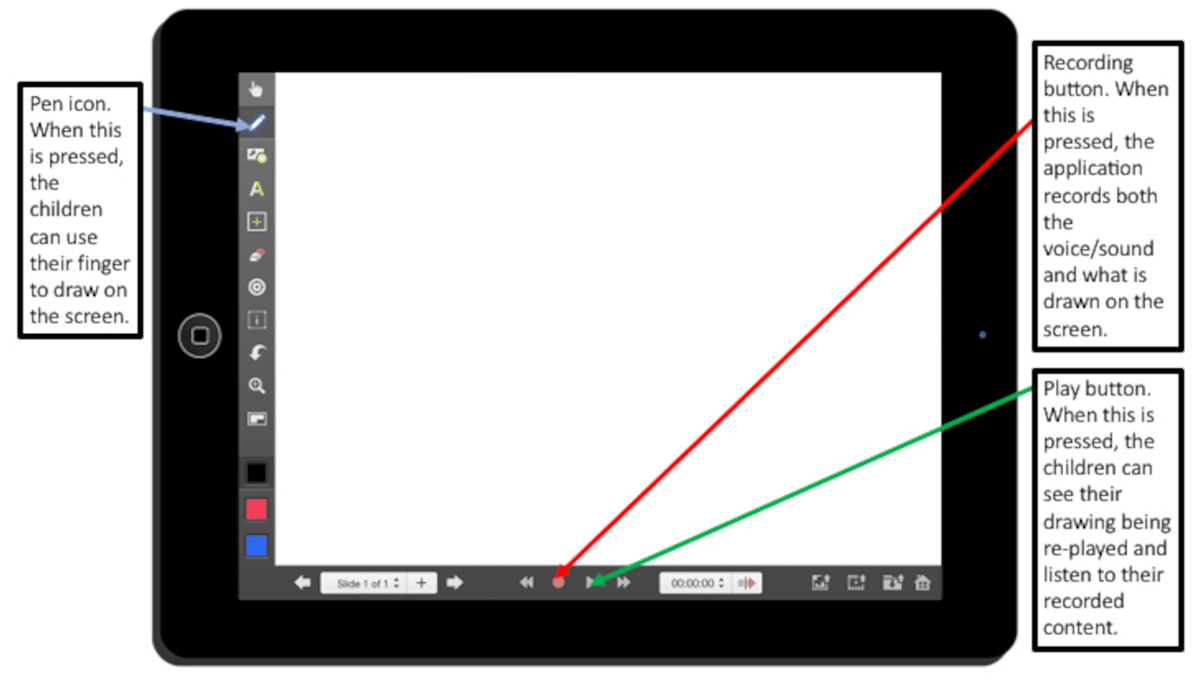
Figure 6
Draw-and-record genre, Explain Everything.
Verbal and pictorial communication can be recorded using the record button. After a recording is made, the play button can be pushed to replay sound and moving pictures. The design of the application can be understood as being open to be used in any language, including children’s mother tongues or national minority languages, in the preschool environment. The possibility to save the content and see and listen to it at a later occasion can also be seen as an affordance that could facilitate translanguaging activities (cf. García, 2009) in the day-to-day preschool environment.
Communication apps
The online affordances of Communication applications such as Skype could be used to enable communication between children with the same mother tongue or national minority language. These more open application genres can be understood as enabling children’s agency overall, including the possibility to create content using a language or other mode of their choice, the photographical and verbal modes (in any language), plus online affordances which can be said to facilitate communication between children at different preschools (in modes beyond the majority verbal language). The affordances of the application itself, however, are intertwined with the built-in affordances that make it possible to go online, for example. The portability is also intertwined with the application-specific affordances in an inseparable way, making it possible for children to walk with the tablet, showing their peers around the preschool. This would not be possible with a more stationary device and shows how there really is no real separation between the affordances of the digital tablet and the application, even if both are needed in this instance.
Discussion
The affordances of the applications that have been examined in this study span between closed content in the majority language with little possibility for children’s own production of media, knowledge and language, and open-ended affordances with multilingual content or open to any language as well as many more modes, such as photographical/pictorial. The 10 genres that emerge from these affordances consist of three monolingual app-genres (talking picture books, storytelling and games) and seven app-genres that allow for several languages: talking picture books in more languages, multilingual storytelling, storytelling with recording possibilities, boardgames with recording possibilities, communication apps, draw-and-record apps and documentation apps. The genres proposed in this study build on the affordances of the applications explored. They can be understood as opening up for multilingual children’s possibility to express agency in the form of getting to communicate in their mother tongue or their minority language, as well as in many more modes of communication.
Genres, agency and multimodal translanguaging
The significance of the design of the content in relation to the children’s ability to express agency is in line with Palmér’s (2015) findings in that a stricter framing within the applications decreased the children’s possibility to act as agents. Nonetheless, even application genres with a somewhat strict framing, but with language content in the children’s mother tongue or national minority language, could be seen as a way to include the children’s language competencies and a way of expressing agency. Even though the digital tablet’s affordances are seen as intertwined with the applications’ affordances, similar to what Arnott, Grogan and Duncan (2016) describe, the applications are part of the overall possibilities and restraints of children’s agency. A limitation of the current study is that it does not examine the actual use of the applications in preschool and, in relation to Nilsen’s results (2018), it could be said that there must be more factors that determine children’s possibility to express agency, for example how the teacher acts as well as the social interaction around the tablet (also see Walldén Hillström, 2020). That these aspects have importance is also noted in my own previous studies (Petersen, 2018, 2020). Compared to the ideas of Djonov and van Leeuwen (2018), who highlight that both access to a software and its design affect power relations in the use of its affordances, in this current study the range of applications and app-genres the children have access to in preschool can be said to be a factor that needs to be discussed. Furthermore, the complexity of identifying genres (Zhao & Zappavigna, 2018) needs to be assessed as well, and in this study the app-genres are proposed tentatively as a starting point for further discussion and analysis.
One notable similarity with Aarsand’s (2019) results concerning how the portability of digital resources connects to children’s agency can be found in particular in the genre of communication apps. This study’s illustration of the relevance of quality in the content of applications is also in line with Tønnessen (2018). In what could be understood as multimodal translanguaging practices, the use of the app-genres proposed in this study could highlight the possibilities of these digital resources.
Children as critical and active users and producers of digital resources, exploring the ‘digital competencies’, are sought after in the Swedish Curriculum for Preschool (Skolverket, 2018). The possibility of using the applications to overcome obstacles that are difficult to surmount without digital resources, such as the possibility to create digital pedagogical translanguaging activities, is discussed in this study. The opportunity to use applications with different language content to create multilingual activities in preschool, even if the teachers themselves cannot speak the children’s languages, is one example of this. In a way, the inclusion of children’s mother tongues and minority languages could constitute an aspect of social sustainability (cf. Kleemann, 2021) and moreover incorporate the recognition of children’s participation. An argument can be made in favour of moving beyond the use of substitute practices when using digital resources in preschool. While there probably will be more genres to discover, and more digital resources will definitely be developed, the idea of taking into account children’s different ways of exerting agency through different affordances should be valid even in the future. The app-genres can be a way to start a broader discussion of using digital resources in a meaningful and socially sustainable way.
Conclusions
The analysis of the applications in this study resulted in ten different genres, ranging from monolingual games in the majority language with little possibility for children’s agency to open-ended communication and draw-and-record applications that can be used in any verbal language and in many modes. In conclusion, applications allowing for multimodal communication beyond the majority verbal language can in a sense be seen as opening up for children’s opportunities for agency. Another conclusion is the importance of careful selection when choosing digital content in educational settings for younger children and that some of the app-genres proposed could be seen as facilitating digital pedagogical translanguaging.
Genres and taking care in choosing applications
In conclusion, by proposing genres this study has the potential to raise awareness among practitioners of the possibilities of using different applications’ affordances to open up for children’s expressions of agency as well as a possibility to communicate in their mother tongues or national minority languages. The importance of the choices that teachers make when offering different applications to children in educational settings can thus be highlighted. The inspiration from genres in children’s literature is in this study also a way of emphasising the significance of carefully examining and discussing the possibilities and constrains of different applications and digital resources. If similar attention was paid to the contents of the digital resources now used in most Swedish preschools and other forms of education as when choosing children’s books or other material, it could open up for a more conscious use of digital resources in education, especially in relation to children’s possibility to express agency. The use of the idea of app-genres might also make the available resources more accessible and easier to find for practitioners, as preschool teachers express the struggle in finding applications as a difficulty (Otterborn, Schönborn & Hultén, 2019).
Genres for digital pedagogical translanguaging
The use of the affordances of the applications examined in this study to deliberately include children’s mother tongues in preschool can be seen as a form of pedagogical translanguaging practice (cf. Leonet, Cenoz & Gorter, 2017). The specific affordances of these digital resources, however, might make it possible to create multilingual activities even if the teachers do not speak the languages. This practice could be understood as digital pedagogical translanguaging. The lack of inclusion of children’s mother tongues and minority languages noted by e.g. Konstitutionsutskottet (2012) might in some respects be possible to rectify, even if the use of multilingual applications can never replace teachers who speak the languages. A limitation of this study is that new or other affordances might emerge when children and teachers use the examined applications in preschool environments. Another question that needs to be further researched is whether there is a risk that the multilingual storytelling applications are used in only the majority language mode, instead of reading aloud to the children. The implications of such use of literary content applications would require new, in-depth multimodal studies in preschools.
Notes
[1] In Sweden, the national minority languages are Finnish, Sami, Meänkieli, Romani and Yiddish (SFS 2009:724, Law Concerning National Minorities and Minority Languages). Members of these minority groups have the right to preserve and develop their minority language and cultural identity (SFS 2009:724). The national minority language is not always the same as the speaker’s mother tongue, which is why I in this article differentiate between children’s mother tongues and national minority languages.
Competing Interests
The author has no competing interests to declare.