
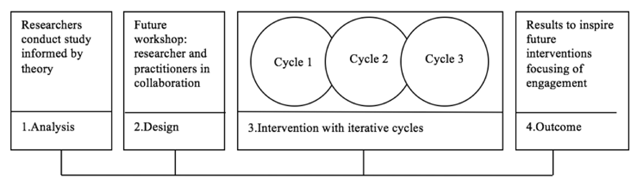
Figure 1
Four stages of DBR (adapted from Reeves, 2006).
Table 1
Outcome of the Critique Phase.
| Feedback | Limited duration of focus |
|---|---|
| No direct feedback provided | Technologies distract students |
| Students want to engage socially with peers | |
| Relevance | ‘Getting started’ in the activity is hard |
| Willingness to study only derives from a demand to obtain grades | Students are not committed to explore the content of the subject |
| Students have no long-term goals | Students struggle with concentration |
| Students do not find the task meaningful or understand how it relates to the curricula | Students display insufficient drive to engage and persist |
| Students do not think that the learning activity is fun | Students are afraid of failure, and this prevents them from trying |
| General engagement and self-regulation | |
| When it comes to engagement, there is a big difference between subjects and the extent to which students engage | The students need to be ‘reprogrammed’ to view technology not as entertainment, but as a tool for learning |
Table 2
Outcome of the Fantasy Phase.
| Visions of what a technology-enhanced learning (TEL) intervention may bring | |
|---|---|
| Digitally assembled submission | Every student can answer individually |
| Possibility of showing knowledge not asked for | Feedback quick and easy |
| Possibility to reflect | Familiar routines and structures to provide |
| Failure not costly | Skill matrix |
| Goals to meet | Diagrams of progress |
| Tools | |
| Virtual learning environment (VLE) | Goals to meet (progress bar) |
| Mini-test | Badges |
Table 3
Outcome of the Implementation Phase.
| Identified hindrance to student engagement | Suggested solution | Thought to be addressed by |
|---|---|---|
| Students struggle with concentration and easily become distracted by friends and mobile phones | Limit the time of the learning activity. Make the learning activity structured. The relevance of learning could be met if students could read peer postings |
|
| Students have no goal in their studies | Engagement of their peers is made visible. Having peers who engage can inspire others to engage | VLE – as above |
| Learning activity is not considered fun | See what peers contribute that can be fun/relevant/meaningful | VLE– as above |
| Relevance of knowledge: students do not agree that the knowledge is relevant, relates to curricula, goals or everyday life | Relevant terms are tested in a mini-test. Students are both contributors and readers of real-time postings in the VLE, which make the contributions relevant | Assessment application – as above VLE– as above |
| Students are primarily motivated by grades | Seeing how peers and high-achieving students think and plan their studies can inspire students who yet do not set long-term goals | VLE – as above |
Table 4
Course Content and Intervention.
| Content description | Learning technologies | ||
|---|---|---|---|
| Cycle 1 Lesson 1 | ‘Show prior knowledge in mini-test’ ‘Post your thesis statement in the VLE’ | Mini-test was launched to confirm students’ existing level of knowledge | VLE: multiple simultaneous dialogues prompting students’ participation, peer feedback and teacher monitoring |
| Cycle 2 Lessons 2 and 3 | ‘Post three arguments reflecting ethos, pathos and logos in the VLE’ | VLE: multiple simultaneous dialogues prompting students’ participation, peer feedback and teacher monitoring | |
| Cycle 3 Lesson 4 | ‘Find and select relevant sources; to back up your logos argument, post these in the VLE’ | VLE: multiple simultaneous dialogues prompting students’ participation, peer feedback and teacher monitoring |